Key takeaways
- Tesla's Canadian BEV market share has fallen from about 45% in 2022 to roughly 32% in early 2026, still the lead, but a shrinking one.
- Hyundai and Kia combined hold about 18–22% of Canadian BEV registrations in early 2026, on track to match Tesla's share by mid-to-late 2027.
- GM holds about 14% of the Canadian EV market, built almost entirely on the Equinox EV, which starts at $44,995, qualifies for the full $5,000 EVAP rebate, and beats the base Model Y on range (513 km vs 431 km).
- Over 30 battery-electric models from more than a dozen manufacturers are on sale in Canada in 2026, against a handful of realistic options in 2020.
- A Leger poll in late 2025 found 34% of Canadian EV intenders said Elon Musk's behaviour made them less likely to consider a Tesla, rising to 42% in Quebec.
Four years ago, Tesla held more than 40% of the Canadian EV market. Today that number is 32% and falling. Over the same period, more than 30 battery-electric models from over a dozen manufacturers have entered the market, Hyundai and Kia combined have taken roughly 20% of new EV registrations, and GM's Equinox EV single-handedly reshaped what affordable electrification looks like in Canada. The one-brand era is over.
What we're witnessing right now is the most competitive period in Canadian automotive history. Over 30 battery-electric models are available from more than a dozen manufacturers. The average transaction price has settled around $52,000, still higher than the average gas vehicle, but falling fast as affordable entries from GM, Kia, and soon BYD push the floor lower. Buyers have genuine choice for the first time, and the market share numbers reflect that shift.
Here's where every brand stands, why they're there, and what comes next.
THE CURRENT RANKINGS, WHO OWNS WHAT
Based on new battery-electric vehicle registrations through early 2026, here are the approximate brand market shares. These numbers come from Natural Resources Canada registration data, provincial reporting, and industry tracking from S&P Global Mobility.
- Tesla: ~32%, Still the leader, but down sharply from 45% in 2022
- Hyundai/Kia (combined): ~20%, The fastest-growing major group
- GM/Chevrolet: ~14%, Equinox EV changed everything
- Ford: ~9%, Stable but not growing
- Volkswagen: ~5%, Squeezed from every direction
- BMW/Mercedes/Audi (combined): ~6%, Premium segment holding steady
- Nissan, Rivian, Polestar, Volvo, others: ~10%, Fragmented but meaningful
- BYD: ~0%, Not yet selling, but already reshaping the market through anticipation
That's the snapshot. But snapshots don't tell the story. To understand where the Canadian EV market is heading, you need to go brand by brand. So let's do that.
TESLA, THE KING IS LOSING GROUND (32%)
Tesla still leads the Canadian EV market. That's the fact. But the trend line is unmistakable: Tesla held approximately 45% of Canadian BEV registrations in 2022, around 38% in 2023, roughly 35% in 2024, and has now settled around 32% in early 2026. The decline isn't a cliff, it's a steady erosion as competitors show up with real products.
The Models Driving Tesla's Share
The Model Y remains Canada's single best-selling EV by a significant margin. It accounts for roughly 55-60% of all Tesla sales in Canada, which means the Model Y alone represents about 17-19% of the entire Canadian EV market. That's an extraordinary number for a single model, and it's the main reason Tesla still leads despite everything working against them.
The Model 3 is Tesla's second pillar, making up approximately 30% of their Canadian volume. The Highland refresh improved interior quality and range, but the Model 3 Long Range starts at $54,990, well above the $55,000 EVAP cap once fees and taxes push the transaction price higher. For budget-conscious buyers, that's a problem.
The Model X and Model S together account for maybe 10% of Tesla's Canadian sales. These are luxury-tier vehicles competing with BMW, Mercedes, and Audi electrics, not the mass market where the real growth is happening.
The Cybertruck has been a cultural phenomenon but a modest sales contributor in Canada. Its polarizing design, premium pricing, and the lack of EVAP eligibility mean it's an enthusiast vehicle, not a volume play. Canadian registrations suggest it accounts for roughly 3-5% of Tesla's total volume.
Why Tesla Is Declining
Four factors are working against Tesla in Canada simultaneously.
Competition finally showed up. In 2020, if you wanted a mainstream EV in Canada, your realistic options were the Tesla Model 3, the Tesla Model Y, the Hyundai Kona Electric, and... that was about it for most buyers. In 2026, there are over 30 BEV models available. The Chevy Equinox EV, Kia EV6, Hyundai Ioniq 5, Ford Mustang Mach-E, VW ID.4, every one of these is a credible alternative to a Tesla. When buyers have options, monopoly share collapses. That's Econ 101.
EVAP eligibility. The federal Electric Vehicle Availability Program launched February 16, 2026, with a $5,000 rebate on EVs priced under $55,000 (base MSRP). The catch for Tesla: their pricing strategy puts most configurations above the effective cap. The base Model Y starts at $49,990, but by the time mandatory fees hit, many trims cross the threshold. The Model 3 Long Range at $54,990 is borderline. Competing vehicles like the Equinox EV ($44,995), Ioniq 5 ($48,999), and Kia EV6 ($49,495) all fall comfortably within EVAP range, giving them a $5,000 advantage at the point of sale. In Quebec, where you can stack the provincial Roulez vert rebate on top, the gap widens to $7,000. That's not a rounding error, that's a different monthly payment.
Brand perception. This is the factor that's hardest to quantify but impossible to ignore. Elon Musk's political activities and public statements have become a liability for Tesla in Canada. The GM dethroning in 2025 wasn't purely a product story, it was partly driven by Canadian buyers who no longer wanted to be associated with the brand. Polling from Leger Marketing in late 2025 showed that 34% of Canadian EV intenders said Musk's behaviour made them less likely to consider a Tesla. In Quebec, that number was 42%. You can debate whether that's fair to the product, but it's showing up in the registration data.
No affordable model. Tesla has no vehicle priced under $45,000 in Canada. Their cheapest offering, the Model 3 Rear-Wheel Drive, was discontinued in Canada. The cheapest available Tesla is the Model 3 Long Range at $54,990. Meanwhile, GM is selling the Equinox EV at $44,995, Kia has the EV3 starting around $38,000, and BYD is coming with the Dolphin at an expected ~$28,000. The fastest-growing segment of the Canadian EV market is the affordable segment, and Tesla has nothing in it.
Tesla's Supercharger Advantage
The one area where Tesla maintains unquestioned dominance is charging infrastructure. The Tesla Supercharger network in Canada is the largest, most reliable, and best-located fast-charging network in the country. With over 1,400 Supercharger stalls across Canada and growing, plus the adoption of NACS by virtually every other manufacturer, Tesla's charging lead is actually becoming a shared resource, which paradoxically benefits Tesla less over time as CCS-to-NACS adapters become standard and non-Tesla vehicles gain native NACS access.
Still, for buyers who prioritize road trip capability and charging certainty, Tesla remains the safest bet. That's a real advantage, and it's one reason their share decline has been gradual rather than catastrophic.

HYUNDAI/KIA, THE MOST SERIOUS CHALLENGER (18-22%)
The Hyundai Motor Group has become Tesla's most credible competitor in Canada. Depending on how you count shared models and whether you combine Hyundai and Kia (they share the E-GMP and eM platforms), their combined market share sits between 18% and 22% of Canadian BEV registrations in early 2026. On current trajectory, they will match or surpass Tesla's share by mid-to-late 2027.
The Model Lineup That Makes This Work
No other manufacturer offers the breadth that Hyundai Motor Group does in Canada.
Kia EV3 (~$38,000), The entry point. This is the vehicle that's pulling first-time EV buyers away from used gas cars. Starting under $40,000, qualifying for the full $5,000 EVAP rebate, and offering 370 km of range from a compact crossover, the EV3 is the affordable EV that Tesla doesn't have. It's been available since late 2025 and is already showing strong registration numbers, particularly in Quebec and Ontario.
Hyundai Kona Electric (~$42,999), The quiet workhorse of the lineup. The second-generation Kona Electric delivers 480 km of range in a familiar compact SUV package. It's been one of Canada's top-selling EVs for three years running, and it hits the EVAP sweet spot perfectly. Dealer availability is excellent across the country.
Hyundai Ioniq 5 (~$48,999), The brand-builder. The Ioniq 5 is the vehicle that put Hyundai on the EV map. Its retro-futuristic design, 800V architecture enabling 10-80% charging in 18 minutes, and strong range (up to 488 km) make it the direct competitor to the Model Y. In head-to-head comparisons, the Ioniq 5 often wins on charging speed, interior quality, and value, while the Model Y wins on software, Supercharger network access, and brand familiarity.
Kia EV6 (~$49,495), The performance option. Same E-GMP platform as the Ioniq 5, but with a sportier design and driving dynamics that appeal to buyers who want engagement on the road. The EV6 GT with its 576 hp dual-motor setup has earned a cult following among enthusiasts who want to prove EVs can be fun.
Hyundai Ioniq 6 (~$54,999), The sedan alternative. For buyers who want a sedan rather than a crossover, the Ioniq 6's aerodynamic design delivers class-leading efficiency. Its 0.21 drag coefficient translates to 581 km of real-world range in summer conditions, the longest range of any non-Tesla EV in Canada.
Kia EV9 (~$64,990), The family hauler. A genuine three-row electric SUV that competes with the Tesla Model X at a significantly lower price. The EV9 has found its audience among families who need seven seats but aren't willing to pay $120,000+ for a Model X.
Kia EV5 (~$47,000 expected), Arriving mid-2026, the EV5 slots between the EV3 and EV6 as a mid-size crossover. It's built on the newer eM platform and is expected to offer 500+ km of range. This is the model that could push the Hyundai/Kia group past Tesla.
Hyundai Ioniq 9 (~$72,000 expected), The full-size electric SUV that slots above the EV9. Three rows, premium positioning, and designed to compete with the BMW iX and Mercedes EQS SUV at a lower price point.
Why They're Winning
800V charging architecture. This is the single biggest technical advantage Hyundai/Kia has over most competitors, Tesla included. Their 800V systems allow 10-80% DC fast charging in approximately 18 minutes under ideal conditions. Tesla's Model Y and Model 3 use 400V architecture and typically take 25-30 minutes for the same charge. That 10-minute difference matters on road trips, and informed buyers know it.
EVAP eligibility across the lineup. Every Hyundai and Kia EV under $55,000 qualifies for the federal $5,000 EVAP rebate. That's five out of eight models in their lineup. Tesla has one model (base Model Y) that might qualify depending on trim. This isn't a small thing, it's $5,000 real dollars that come off the price at the dealership.
Dealer network depth. Hyundai has approximately 230 dealers across Canada. Kia has around 190. Combined, that's over 400 points of sale, every major city, every mid-size city, and many smaller communities. Tesla has roughly 30 retail locations across the country, plus a few service centres. For buyers outside Vancouver, Toronto, Montreal, and Calgary, buying a Tesla means either ordering online sight-unseen or driving hours to a showroom. Buying a Hyundai or Kia means visiting a local dealer, test-driving the car, and driving it home the same day. That accessibility advantage compounds over time.
Price-to-feature ratio. Hyundai and Kia consistently offer more standard features per dollar than any other EV manufacturer in Canada. Heated and ventilated seats, heads-up displays, advanced driver assistance, vehicle-to-load capability (plug your house into your car during a power outage), features that Tesla charges extra for or doesn't offer at all come standard on many Hyundai/Kia models.
Gear worth having
As an Amazon Associate, ThinkEV earns a small commission from qualifying purchases — at no extra cost to you.
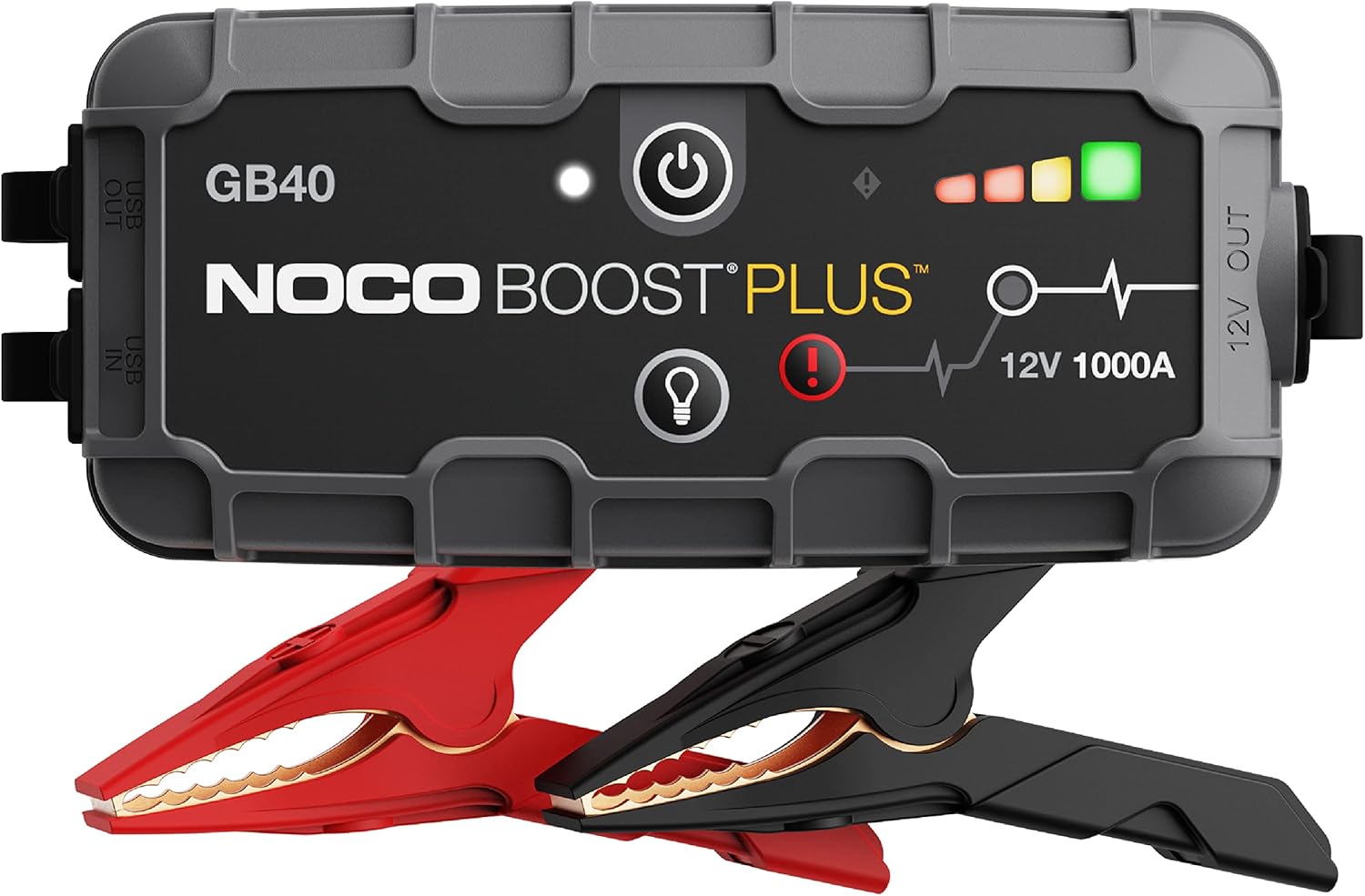
NOCO Boost Plus GB40 Jump Starter
A 1000A lithium jump starter that fits in your glovebox and works on any 12V battery. Your insurance against a dead 12V in a parking lot.
As an Amazon Associate, ThinkEV earns from qualifying purchases — at no extra cost to you.
GM/CHEVROLET, THE EQUINOX EV CHANGED EVERYTHING (14%)
GM's story in the Canadian EV market is really two stories: before the Equinox EV and after.
Before the Equinox EV launched in mid-2024, GM's EV presence in Canada was built on the Chevy Bolt (discontinued as a new model in 2023), the expensive Hummer EV, the niche Cadillac Lyriq, and the slow-selling Blazer EV. Combined, these gave GM maybe 5-7% of the Canadian EV market. Respectable for a legacy automaker, but not threatening anyone's position.
Then the Equinox EV arrived at $44,995, and everything changed.
The Equinox EV, Canada's Affordable EV Breakout
The Chevy Equinox EV has been the single most impactful new EV launch in the Canadian market since the original Model 3. Here's why it works:
Price. At $44,995 before rebates, the Equinox EV qualifies for the full $5,000 EVAP federal rebate. In Manitoba, stack that with the provincial $4,000 rebate and you're looking at a $35,995 electric SUV. In Quebec, the Roulez vert $2,000 rebate brings it to $37,995. These are numbers that compete directly with gas-powered compact SUVs, and that's the breakthrough. When an EV costs the same as the gas car people were going to buy anyway, adoption accelerates.
Range. The Equinox EV delivers up to 513 km of range on the base model. That's more than the base Model Y (431 km) and more than the Ioniq 5 (up to 488 km). For Canadian buyers worried about winter range loss, starting with 513 km means you still have 350-400 km of usable range in January. That's enough for the vast majority of daily driving and most road trips.
The GM dealer network. There are over 450 Chevrolet dealers across Canada, more than any other single brand. Many of these are in small towns, rural communities, and the prairies where Tesla has zero physical presence and Hyundai/Kia has limited coverage. A buyer in Brandon, Manitoba, or Prince George, BC, or Timmins, Ontario can walk into their local Chevy dealer, test-drive an Equinox EV, and have it serviced locally. That dealer footprint is GM's unfair advantage, and it explains why the Equinox EV is performing particularly well outside major urban centres.
Familiarity. The Equinox name has been one of Canada's best-selling vehicles for over a decade. The gas-powered Equinox regularly sits in the top 10 for Canadian sales. Putting an EV powertrain into a nameplate that Canadian families already know and trust removed a huge psychological barrier. This isn't some exotic tech company's product, it's the electric version of the car your neighbour drives.
GM's Broader Lineup
Beyond the Equinox EV, GM has been building out a full EV portfolio.
The Chevy Blazer EV (~$56,000) has had a rockier launch, early software issues tarnished its reputation, and it sits above the EVAP price cap for some trims. But the 2026 model year fixes have addressed most early complaints, and it's finding its market among buyers who want something larger than the Equinox but don't need three rows.
The Chevy Silverado EV (~$78,000 for the RST, ~$58,000 for the Work Truck) is GM's answer to the F-150 Lightning. In Alberta and Saskatchewan, where trucks are non-negotiable for many buyers, the Silverado EV Work Truck is a compelling proposition, especially for fleet buyers who can amortize the higher upfront cost against fuel savings. The Work Truck trim qualifies for EVAP in some configurations.
The Cadillac Lyriq (~$68,000) has carved out a strong position in the luxury EV segment. Its interior quality is genuinely best-in-class among electric SUVs, and Cadillac's brand cachet still carries weight with buyers who find Tesla too tech-bro and BMW too European.
The GMC Sierra EV and Hummer EV are halo products, low volume, high visibility. They demonstrate GM's capabilities but don't move the market share needle significantly.
GM's 2026 Trajectory
GM captured 21.2% of the Canadian EV market in 2025, briefly dethroning Tesla as Canada's number one EV brand. That number has settled back to approximately 14% in early 2026 as Tesla's sales partially recovered. But the Equinox EV continues to gain momentum, and if GM can maintain production volume, they're positioned to hold or grow from 14%.
The wildcard is GM's next affordable model, rumours of an electric Trax or Trailblazer priced under $35,000 would, if true, give GM a weapon in the affordability segment that only BYD could match.
FORD, STABLE BUT STAGNANT (9%)
Ford has been the most frustrating EV brand to watch in Canada. They have the right products on paper, a massive dealer network, and brand recognition that rivals GM. Yet their EV market share has been stuck around 9% for two years, neither growing nor shrinking in any meaningful way.
Ford's EV Models in Canada
The Mustang Mach-E (~$52,000-$72,000) is Ford's EV workhorse. It competes directly with the Tesla Model Y, and in many ways it's a superior vehicle, better interior quality, more conventional SUV proportions, and strong driving dynamics. But the Mach-E suffers from inconsistent availability in Canada, and its pricing puts several trims above the EVAP cap. The base model qualifies, but the trims buyers actually want (Premium, GT) often don't.
The F-150 Lightning (~$69,000-$125,000) was supposed to be Ford's EV trump card in Canada, the country's best-selling vehicle nameplate, now electric. And it has found a real audience in Alberta, Saskatchewan, and rural Ontario among truck buyers who want electric but refuse to compromise on capability. The Lightning can tow. It can power a job site. It has a massive frunk. But it's expensive, no trim qualifies for EVAP, and the range drops significantly when towing, which limits its appeal for the heavy-use truck buyers who would benefit most from fuel savings.
The E-Transit van has quietly become Ford's most interesting EV story in Canada. Fleet sales to Canada Post, delivery companies, and municipal governments are steady, and the E-Transit is the dominant electric commercial van in the country. It doesn't show up in consumer market share numbers, but it's a meaningful revenue stream.
Why Ford Isn't Growing
Ford's EV stagnation in Canada comes down to three issues.
Pricing above EVAP. Most Ford EV trims that buyers actually want fall above the $55,000 EVAP cap. When a Mach-E Premium costs $62,000 and a Hyundai Ioniq 5 with similar features costs $52,000 with a $5,000 rebate on top, the value calculation isn't close.
Dealer readiness. Ford has over 400 dealers in Canada, but not all of them are EV-certified. Buying an EV from a dealer that doesn't fully understand the product, can't explain home charging, doesn't know the rebate paperwork, can't troubleshoot software issues, creates a poor customer experience. Ford has been slower than GM and Hyundai in getting their dealer network EV-ready.
No entry-level EV. Ford's cheapest EV in Canada is the base Mustang Mach-E at approximately $52,000. That's not entry-level. The fastest-growing segment, EVs under $45,000, is where Ford has nothing. Until that changes, Ford's share will stay flat.
VOLKSWAGEN, SQUEEZED FROM EVERY DIRECTION (5%)
Volkswagen's EV ambitions in Canada have underperformed expectations. The German automaker positioned itself as the "people's electric car" company, but a 5% market share in 2026 is below where VW needs to be, and the competitive pressure is only getting worse.
VW's Models
The ID.4 (~$47,000-$56,000) is VW's volume EV in Canada. It's a solid vehicle, good range (up to 443 km), reasonable pricing on the base model, and VW build quality. But "solid" doesn't win market share when the Ioniq 5 is better on charging speed, the Equinox EV is cheaper, and the Model Y has better software. The ID.4 is nobody's first choice and a lot of people's third choice. That's a problem.
The ID.Buzz (~$59,000-$67,000) has generated enormous enthusiasm among a specific buyer demographic, families who remember the original VW Bus, design-conscious buyers who value form factor over specs. But it's a niche product. Canadian registrations suggest it accounts for maybe 15-20% of VW's EV volume. It's bringing people into VW showrooms, but the price and limited range (350 km) mean it's a lifestyle choice, not a rational purchase.
The ID.3 is not available in Canada, which is a significant gap. In Europe, the ID.3 is VW's affordable EV champion. Its absence in the Canadian market means VW has no entry-level offering to compete with the Kia EV3 or future BYD Dolphin.
VW's Competitive Problem
Volkswagen is being squeezed from three directions simultaneously.
From above: Hyundai/Kia offers better technology (800V charging vs. VW's 400V) and more models across a wider price range. From below: GM's Equinox EV is cheaper with more range. And from outside: BYD's upcoming entry will offer comparable vehicles at dramatically lower prices.
VW's path to relevance in the Canadian EV market requires either a dramatic price cut on the ID.4 to undercut the Equinox EV, or the introduction of affordable models (ID.2, ID.3) that can compete in the sub-$40,000 segment. Neither seems imminent.
BMW, MERCEDES, AND AUDI, THE PREMIUM HOLDOUTS (6% COMBINED)
The German luxury trio collectively holds about 6% of the Canadian BEV market. Their buyers are a different species from the mainstream market, these are people cross-shopping with Tesla's premium offerings, not with the Equinox EV.
BMW (~2.5%)
The BMW i4 sedan and iX SUV are BMW's main EV offerings in Canada. The i4 has found particular success among buyers who want the driving dynamics BMW is known for in an electric package. The iX, while polarizing in design, offers a genuinely premium interior that embarrasses Tesla's sparse cabin.
BMW is also pushing the iX1 and iX3 in Canada, targeting the compact luxury SUV segment. Their combined volume is modest but growing. BMW's advantage is brand loyalty, existing BMW owners upgrading to electric tend to stay within the brand. Their disadvantage is pricing: the cheapest BMW EV starts around $58,000, well above EVAP eligibility.
Mercedes-Benz (~2%)
Mercedes has taken a quality-over-quantity approach to EVs in Canada. The EQB compact SUV is their best-selling EV model here, followed by the EQE sedan and EQS flagship. The EQB's starting price around $60,000 puts it in direct competition with the Cadillac Lyriq and Tesla Model Y Long Range, and it's competitive on interior quality and brand prestige.
Mercedes' EV strategy in Canada has been hampered by limited model availability and high prices. They've signalled a shift toward more affordable electric models by 2027-2028, but for now, they're a premium niche player.
Audi (~1.5%)
The Audi Q4 e-tron is Audi's most accessible EV in Canada at approximately $54,000. It shares VW Group's MEB platform with the ID.4 but adds Audi interior quality and brand cachet. The Q8 e-tron and e-tron GT round out the lineup at higher price points.
Audi's challenge is the same as Mercedes and BMW: their EVs are too expensive to benefit from EVAP, and the buyers who can afford $60,000+ vehicles are increasingly considering Tesla or Hyundai's premium offerings instead.
The Luxury Segment Outlook
Premium German EV brands face a unique squeeze in Canada. Their traditional advantage, interior quality, build precision, brand prestige, is being eroded from above by Tesla's software and charging network and from below by vehicles like the Cadillac Lyriq and Ioniq 5, which deliver near-luxury experiences at mainstream prices. The 6% combined share is likely to shrink slightly as the overall market grows and the mainstream segment captures a larger proportion of new buyers.
Gear worth having
As an Amazon Associate, ThinkEV earns a small commission from qualifying purchases — at no extra cost to you.

Grizzl-E Classic Level 2 EV Charger (40A)
Canadian-made and rated for minus 40C winters. 40A / 9.6 kW, NEMA 14-50, indoor/outdoor, 24-ft cable. The charger built for Canadian weather.
As an Amazon Associate, ThinkEV earns from qualifying purchases — at no extra cost to you.
NISSAN, RIVIAN, POLESTAR, VOLVO, AND THE REST (10% COMBINED)
The remaining 10% of the Canadian EV market is split among a diverse group of brands, each with one or two EV models and a loyal but small customer base.
Nissan (~3%)
Nissan was an EV pioneer in Canada, the Leaf was one of the first mass-market EVs available here, and it built a loyal following. But the Leaf's dated design and CHAdeMO charging port made it increasingly uncompetitive, and Nissan discontinued it. The Nissan Ariya (~$53,000-$63,000) is Nissan's current EV offering, and it's a competent mid-size crossover. But it arrived late to a crowded segment, and its pricing puts it against the Ioniq 5 and Model Y, both of which are better-known products. Nissan's EV share has been declining, and the Ariya hasn't reversed the trend.
Volvo/Polestar (~2.5% combined)
The Volvo EX30 (~$47,000) is the most interesting vehicle in Volvo's lineup for the Canadian market. Compact, affordable (by Volvo standards), and packed with safety features, it's attracting buyers who want Scandinavian design and safety engineering in an EV package. The EX40 (formerly XC40 Recharge) and EX90 round out the lineup at higher price points.
Gear worth having
As an Amazon Associate, ThinkEV earns a small commission from qualifying purchases — at no extra cost to you.

PULIDIKI Car Cleaning Gel (Detailing Putty)
Press it into vents, buttons, and seams and it lifts out dust you did not know was there. Weirdly satisfying, genuinely useful.
As an Amazon Associate, ThinkEV earns from qualifying purchases — at no extra cost to you.
Polestar (Volvo's performance-oriented sibling brand) sells the Polestar 2 sedan and Polestar 3 SUV in Canada. The Polestar 2 has a devoted following among enthusiasts who appreciate its driving dynamics and understated design, but brand awareness remains low. Most Canadian car buyers have never heard of Polestar, and that's a fundamental challenge that great products alone can't solve.
Rivian (~1%)
Rivian occupies a unique position in the Canadian market with the R1T pickup and R1S SUV. These are premium adventure vehicles, think Tesla meets Patagonia, and they've found a dedicated audience among outdoor enthusiasts in BC and Alberta. But Rivian's pricing ($70,000+) and limited service network in Canada keep them in niche territory. They're the EV brand people aspirationally follow on Instagram but rarely buy.
Others (~3.5%)
A scattering of smaller brands round out the market: Toyota with the bZ4X (underwhelming reviews, poor value), Subaru with the Solterra (essentially a rebadged bZ4X), Mazda with the MX-30 (limited range, limited sales), Genesis with the GV60 and Electrified GV70 (excellent vehicles with negligible brand awareness), and Stellantis brands (Chrysler, Jeep) with limited EV offerings that haven't gained traction in Canada.
The common thread among these smaller players: they have one or two EV models, limited marketing budget for electric, and are playing catch-up to brands that committed to EVs earlier. Most will remain niche players unless they introduce breakthrough affordable models.
BYD, THE EARTHQUAKE THAT HASN'T HIT YET
BYD hasn't sold a single car in Canada as of March 2026. Their market share is literally zero. But they're already reshaping the market through anticipation alone, and when they arrive, likely mid-to-late 2026, they will be the most disruptive force Canadian car buyers have ever seen.
What BYD Is Bringing
Import permits opened March 1, 2026, under the revised tariff framework (reduced from 100% to 6.1% within a 49,000-vehicle annual quota). BYD is expected to launch with three models:
BYD Dolphin, expected ~$28,000. A compact hatchback with approximately 400 km of range. At that price point, this isn't competing with other EVs, it's competing with the Honda Civic and Toyota Corolla. No EV currently available in Canada comes close to this price. The Dolphin has been the best-selling EV globally (outside of Tesla) for good reason: it's a genuinely good car that costs less than most people expect an EV to cost.
BYD Atto 3, expected ~$34,500. A compact SUV that slots directly against the Kia EV3 and Hyundai Kona Electric, but at a lower price. Solid range, good interior, and BYD's Blade Battery technology (which uses lithium iron phosphate cells that are more resistant to thermal runaway than the nickel-based cells used by most competitors).
BYD Seal, expected ~$42,000-$48,000. A mid-size sedan designed to compete with the Tesla Model 3 and Hyundai Ioniq 6. The Seal has earned strong reviews globally for its driving dynamics and build quality.
The Competitive Impact
BYD's anticipated pricing is already affecting the market. Hyundai adjusted the Kona Electric's pricing downward in Q1 2026. Kia accelerated the EV3's Canadian launch timeline. GM has hinted at a sub-$35,000 electric Trax. The mere prospect of a $28,000 EV with 400 km of range is forcing every manufacturer to reconsider their pricing strategy.
However, BYD faces significant challenges in Canada. They have no dealer network yet, they're reportedly in negotiations with existing dealer groups in BC and Quebec. They have no brand recognition among mainstream Canadian car buyers. And Chinese-manufactured vehicles carry a trust deficit in Canada related to build quality, data privacy, and political sentiment around Chinese trade practices.
If BYD executes well, expect them to capture 5-8% of the Canadian EV market within 12 months of first deliveries, rising to 10-15% by 2028. If they stumble, poor dealer experience, quality issues, political backlash, they could stall at 2-3%. The range of outcomes is enormous, and that uncertainty is itself affecting how other brands plan.
HISTORICAL MARKET SHARE: HOW WE GOT HERE (2020-2026)
The shift in Canadian EV market share over the past six years tells a clear story of monopoly erosion and market maturation.
2020: Tesla held approximately 52% of the Canadian BEV market. The Model 3 was the dominant EV, the Model Y was just arriving, and competition was thin. The Hyundai Kona Electric and Nissan Leaf were the main alternatives, but neither had the range, charging network, or brand appeal to seriously challenge Tesla. Total BEV registrations: roughly 37,000.
2021: Tesla's share dipped slightly to about 48% as the Mustang Mach-E arrived and VW launched the ID.4. But the market was still Tesla's to lose, and these new entrants were supply-constrained. Total BEV registrations: approximately 52,000.
2022: Tesla peaked at around 45% share as the Model Y became Canada's best-selling EV. But Hyundai launched the Ioniq 5 to strong reviews, and Kia brought the EV6. The Korean invasion had begun. Total BEV registrations: roughly 78,000.
2023: Tesla's share dropped to approximately 38%. The Ioniq 5, EV6, and Kona Electric were hitting their stride. Ford's Mach-E gained traction. But the real story was the growing awareness that Tesla's dominance was temporary. Total BEV registrations: approximately 108,000.
2024: Tesla fell to roughly 35% as GM launched the Equinox EV to immediate success. Hyundai/Kia climbed to about 16% combined. The market had enough competitors that no single brand could dominate. Total BEV registrations: approximately 135,000.
2025: The earthquake year. GM briefly dethroned Tesla with 21.2% market share as Tesla's sales cratered 63.5%. The Equinox EV became a mainstream hit. Hyundai/Kia climbed past 18%. By year-end, Tesla had recovered somewhat, but the psychological damage was done, Tesla wasn't invincible. Total BEV registrations: approximately 165,000.
2026 (year-to-date): Tesla has stabilized around 32%, but the trend is clear. Hyundai/Kia is at 18-22% and climbing. GM is at 14% with the Equinox EV as its anchor. BYD hasn't arrived yet. The market is on pace for 180,000-190,000 registrations. The era of one-brand dominance is definitively over.
REGIONAL BRAND PREFERENCES, CANADA IS NOT ONE MARKET
One of the most important things to understand about Canadian EV market share is that national numbers obscure massive regional variation. Brand preferences vary dramatically by province, and a brand that's dominant in BC might be an afterthought in Saskatchewan.
British Columbia
BC is Canada's most mature EV market, with approximately 18-20% of new vehicle sales being electric. Tesla has historically been strongest here, Vancouver's tech-forward culture, high incomes, and mild winters created ideal conditions for early Tesla adoption. Tesla still leads in BC with approximately 35% of provincial EV sales, but Hyundai/Kia is growing fast at roughly 20%. The Volvo EX30 and Polestar 2 also perform disproportionately well in BC compared to national averages, reflecting the province's affinity for Scandinavian brands.
BC is also expected to be BYD's first beachhead in Canada, with Vancouver-area dealers reportedly in advanced negotiations. The province's strong EV culture and environmental consciousness make it receptive to new entrants.
Quebec
Quebec is the value market. The Roulez vert provincial rebate (up to $2,000, stackable with EVAP's $5,000) makes Quebec the most rebate-rich province for EV buyers. This heavily favours affordable, EVAP-eligible vehicles, which means Hyundai/Kia and GM outperform their national averages here. Hyundai/Kia leads in Quebec with approximately 25% of provincial EV registrations. Tesla's share in Quebec has dropped below 25%, hurt significantly by brand perception issues and the fact that most Tesla models don't qualify for maximum rebate stacking.
Quebec is also where BYD is expected to see its fastest growth, given the province's price sensitivity and the $7,000 in combined rebates that a $28,000 Dolphin would be eligible for, potentially bringing the effective price below $21,000.
Ontario
Ontario is the volume market, the largest province by population, with the most EV registrations in absolute terms. Brand distribution in Ontario roughly mirrors national averages, with Tesla at approximately 30%, Hyundai/Kia at 20%, GM at 15%, and Ford at 10%. The absence of a provincial EV rebate in Ontario means the $5,000 federal EVAP rebate carries extra weight, and brands whose vehicles qualify have a meaningful advantage over those that don't.
The Greater Toronto Area is the single largest EV market in Canada, and competition there is intense across every segment. Tesla's urban delivery centres, Hyundai/Kia's extensive dealer network, and GM's suburban dealerships all compete for the same buyer.
The Prairies (Alberta, Saskatchewan, Manitoba)
The prairies are truck country, and that shapes EV brand preferences significantly. Ford's Lightning and GM's Silverado EV perform disproportionately well in Alberta and Saskatchewan, truck-segment EVs account for a higher percentage of EV sales here than in any other region. Tesla's share in the prairies is lower than the national average (approximately 25%), partly because the Model Y doesn't appeal to buyers who need a pickup truck.
Manitoba's $4,000 provincial EV rebate (stackable with EVAP) makes it a surprisingly strong EV market for its population size. The Equinox EV at an effective price of $35,995 after combined rebates is an extraordinary value proposition, and GM's deep dealer network in Manitoba gives them a strong advantage.
EV adoption rates in the prairies remain lower than BC, Quebec, or Ontario, but they're growing faster from that lower base, driven primarily by affordable models and the practical needs of buyers who drive long distances.
Atlantic Canada
Atlantic Canada (New Brunswick, Nova Scotia, PEI, Newfoundland) is the smallest EV market regionally but growing rapidly. PEI's $4,000 provincial rebate makes it competitive with Manitoba for total rebate value. Nova Scotia and New Brunswick have more limited incentives. Hyundai/Kia performs well in Atlantic Canada due to strong dealer presence in smaller cities, while Tesla's limited physical presence (one delivery centre in Halifax) constrains their reach.
DEALER NETWORK DEPTH, THE INVISIBLE ADVANTAGE
Market share data tracks what buyers chose. Dealer network data tracks what was available to choose. In Canada, physical dealer presence remains a critical factor in EV adoption, particularly outside the five largest metropolitan areas.
Here's the approximate dealer count by brand for EV-selling locations in Canada:
- Chevrolet/GM: 450+ dealers, near-universal EV certification
- Ford: 400+ dealers, partial EV certification (estimated 60-70% EV-ready)
- Hyundai: ~230 dealers, high EV certification rate
- Kia: ~190 dealers, high EV certification rate
- Toyota: ~280 dealers, limited EV inventory (bZ4X only)
- Volkswagen: ~140 dealers
- Nissan: ~200 dealers, limited EV inventory (Ariya only)
- Tesla: ~30 retail locations + service centres (no traditional dealers)
- BMW: ~50 dealers
- Mercedes: ~55 dealers
- BYD: 0 dealers (negotiations ongoing for BC and Quebec)
The disparity is enormous. A buyer in Kamloops, Sudbury, or Fredericton has immediate access to a Chevy dealer but might need to drive 3-4 hours to see a Tesla in person. For mainstream buyers, not early adopters, not tech enthusiasts, but regular people buying a car, the ability to walk into a local dealer, ask questions, test-drive, and have a service relationship matters. This is why GM's Equinox EV has been so successful in smaller markets, and why Tesla's share is concentrated in major urban centres.
CUSTOMER SATISFACTION AND REPEAT PURCHASE RATES
Market share tells you who's buying. Satisfaction data tells you who's coming back.
According to J.D. Power's 2025 Canada Electric Vehicle Experience Study and consumer surveys from the Automobile Protection Association:
Highest satisfaction: Hyundai/Kia consistently ranks highest in owner satisfaction among EV brands in Canada. The combination of 800V fast charging, feature-rich standard equipment, and strong dealer service scores drives this. Repeat purchase intent (owners who say they'd buy the same brand again) is approximately 82% for Hyundai EV owners and 79% for Kia.
Tesla: Owner satisfaction is polarized. Tesla owners who love the software, Supercharger network, and driving experience rate it extremely highly, but service satisfaction scores are the lowest of any brand in Canada. Tesla's mobile service model and limited service centre network mean that repairs can take weeks. Overall repeat purchase intent is approximately 71%, lower than Hyundai/Kia but still strong, driven primarily by the Supercharger ecosystem and Autopilot.
GM: The Equinox EV has earned solid early satisfaction scores. Owners appreciate the range, value, and dealer service accessibility. However, as a newer product, long-term reliability data isn't yet available. Repeat purchase intent is approximately 74%.
Ford: Mixed satisfaction. Mach-E owners generally rate the driving experience highly but report frustration with Ford's SYNC infotainment system and inconsistent dealer EV knowledge. Lightning owners are more uniformly satisfied. Repeat purchase intent: approximately 68%.
VW: The ID.4 earns average satisfaction scores. It's not generating strong negative sentiment, but it's also not creating the enthusiastic advocacy that drives word-of-mouth referrals. Repeat purchase intent: approximately 65%.
These satisfaction numbers matter because the Canadian EV market is entering its second wave, the period when first-time EV buyers become repeat EV buyers. Brands with high satisfaction and repeat purchase intent will compound their share gains over time.
CHINESE BRANDS, THE PROJECTED IMPACT
BYD is the first Chinese EV brand expected to sell in Canada, but it won't be the last. Several other Chinese manufacturers are eyeing the Canadian market, and the revised tariff framework (6.1% on the first 49,000 vehicles) has cracked the door open.
Xpeng has expressed interest in the Canadian market, potentially launching with the G6 crossover (a Model Y competitor) and the P7 sedan. Timeline: earliest 2027.
NIO has been exploring Canadian expansion, with its battery-swap technology as a differentiator. However, building swap stations in Canada requires massive capital investment, making a near-term launch uncertain.
Geely (which owns Volvo and Polestar) could potentially bring its Zeekr brand to Canada, leveraging Volvo's existing dealer relationships. The Zeekr 001 and 007 have been strong sellers in China and Europe.
GAC Aion and Changan are longer-term possibilities, likely 2028 or beyond.
The collective impact of Chinese brands on the Canadian EV market could be significant. If BYD captures 8% by 2028, and two or three additional Chinese brands each capture 2-3%, Chinese manufacturers collectively could hold 15-20% of the Canadian EV market within five years. That share would come primarily from Tesla (losing budget-conscious buyers), VW (squeezed on price), and other brands without a strong affordable offering.
However, political risk remains. The 100% tariff was imposed in October 2024 for a reason, Canadian and American governments are wary of Chinese industrial policy. If trade tensions escalate, tariffs could snap back, closing the window that BYD is preparing to step through. Buyers considering a Chinese EV should factor this uncertainty into their purchase decision, parts availability and service support are less certain than for established brands.
WHAT 2027 MIGHT LOOK LIKE
Projecting market share a year out requires humility, nobody predicted GM's 2025 surge or Tesla's 63.5% sales crash. But based on current trajectories, product pipelines, and market dynamics, here's a reasonable scenario for the Canadian EV market at the end of 2027.
Tesla: 25-28%. Continued gradual decline as the market grows faster than Tesla. The long-rumoured affordable Tesla (often called "Model 2" or "Model Q") would change this trajectory if it launches in Canada at under $35,000, but there's no confirmed timeline. Without it, Tesla's share will keep sliding 3-4 percentage points per year as competitors multiply.
Hyundai/Kia: 22-26%. The EV5's arrival, continued Ioniq 5 and EV3 momentum, and potential Ioniq 9 halo effect push the group toward parity with Tesla. If you had to pick one brand group to bet on for 2027, it's Hyundai/Kia. Their product pipeline, pricing strategy, technology advantage (800V), and dealer network all point upward.
GM: 13-16%. The Equinox EV sustains its momentum, and if an affordable electric Trax materializes, GM could push past 15%. The Silverado EV and Blazer EV continue to chip in. GM's biggest risk is execution, production constraints and quality issues could cap growth.
BYD: 5-10%. Wide range because execution uncertainty is high. If the dealer network launches smoothly, the Dolphin delivers on its pricing promise, and political sentiment doesn't turn hostile, BYD could reach 8-10% within 12 months. If any of those factors falters, 3-5% is more realistic.
Ford: 7-9%. Slight decline unless Ford introduces an affordable EV model. The Mach-E and Lightning are aging, and Ford's EV pipeline for Canada is unclear. Ford has the brand strength and dealer network to compete, but they need a product in the sub-$45,000 range.
VW: 3-5%. Continued squeeze unless the ID.2 or ID.3 arrives in Canada. VW's current EV lineup doesn't offer a compelling reason to choose it over Hyundai/Kia (better tech, similar price) or GM (cheaper, more range).
Premium Germans: 5-6%. Slight decline as a percentage of total market, even if absolute sales grow. The luxury segment doesn't expand as fast as the mainstream segment.
Others: 8-10%. Rivian, Polestar, Volvo, Nissan, and newer entrants collectively maintain a meaningful but fragmented share.
Total 2027 BEV registrations: an estimated 220,000-250,000 units, representing approximately 15-17% of total new vehicle sales. The trajectory is clear, EVs are not a niche anymore. They're the fastest-growing segment of the Canadian auto market, and the brands that win market share now will define Canadian roads for decades.
Hyundai And Kia Are The Brands To Watch
The Canadian EV market in 2026 is the most competitive it has ever been. Tesla still leads, but their share is declining steadily. Hyundai/Kia is the brand group to watch, best technology, broadest lineup, strongest growth trajectory. GM proved with the Equinox EV that affordable EVs sell in massive numbers when priced right and distributed through existing dealer networks. Ford has the tools but hasn't found the formula. VW is stuck. The premium Germans are holding ground but won't grow. And BYD is about to add a completely new variable to the equation.
For buyers, this is the best possible outcome. Real competition drives better products, lower prices, and more choice. The average transaction price of $52,000 for a new EV in Canada is still high, but it's trending down, and the gap between EV and gas vehicle pricing narrows with every model year. By 2027, there will be at least five EVs available in Canada for under $35,000 before rebates. That's the tipping point.
The brands that win the Canadian EV market won't be the ones with the best technology or the coolest branding. They'll be the ones that put the right vehicle at the right price in a dealer that the buyer can actually visit. Market share follows availability, affordability, and trust. In 2026, Hyundai/Kia and GM understand that better than anyone else, and the numbers prove it.
Gear worth having
As an Amazon Associate, ThinkEV earns a small commission from qualifying purchases — at no extra cost to you.

WixGear Magnetic Air Vent Phone Mount (2-Pack)
A magnet strong enough that your phone never flinches over potholes or rail crossings. Two in the box, one for each car.
As an Amazon Associate, ThinkEV earns from qualifying purchases — at no extra cost to you.
Related Reading
- GM Dethroned Tesla as Canada's #1 EV Brand, How GM captured 21.2% of the Canadian EV market in 2025 with the Equinox EV leading the charge.
- Canada EV Sales February 2026: Market Report, Monthly breakdown of EV sales data, top-selling models, and provincial trends.
- EV vs Gas Sales Trajectory in Canada, How EV and gas vehicle sales are converging and what the crossover point looks like.
- EV Adoption Rate by City Across Canada, City-level data on where EVs are selling fastest and which urban centres lead adoption.
- Most Popular EV in Each Province, Provincial brand preferences and the regional dynamics shaping Canada's EV market.
- New EV Brands Coming to Canada, BYD, Xpeng, and other new entrants preparing to launch in the Canadian market.
Gear worth having
As an Amazon Associate, ThinkEV earns a small commission from qualifying purchases — at no extra cost to you.

Car Cup Holder Coasters (4-Pack)
Drop-in coasters that catch spills and crumbs so your cup holders stay clean. Rinse and reuse forever.
As an Amazon Associate, ThinkEV earns from qualifying purchases — at no extra cost to you.

Founder & Chief Editor
Vlad Pereira is the founder and chief editor of ThinkEV.ca, the Canadian electric-vehicle publication he writes and edits from Courtenay, British Columbia. He covers EV pricing, federal and provincial rebates, charging costs, and the Chinese manufacturers now entering Canada, from the buyer's side rather than the press-fleet side. ThinkEV is a venture of Vlad Pereira Online; his writing on health, income and the long game lives at vladpereira.com.
Frequently asked questions
Which brand sells the most EVs in Canada in 2026?
Is Tesla losing market share in Canada?
When is BYD coming to Canada?
Which EV brand has the most dealerships in Canada?
What is the cheapest EV available in Canada in 2026?
Which brand has the best EV customer satisfaction in Canada?
How many EV models are available in Canada?
Which province buys the most EVs in Canada?
Will Chinese EVs take over the Canadian market?
More EV & road-trip finds
Affordable upgrades worth a look — tap any to check the price on Amazon.
 ★ 4,424
Sun Visor Card and Document Organizer
View on Amazon ★ 308
★ 308Coiled Lightning Car Cable for iPhone (2-Pack)
View on Amazon ★ 119
★ 119Foldable Waterproof Trunk Organizer
View on Amazon ★ 392
★ 392Large Cup Holder Adapter (32-40oz)
View on Amazon ★ 4,050
Touchscreen Mist Screen Cleaner Kit
View on Amazon ★ 537
★ 537USB Star Projector Roof Light
View on Amazon ★ 1,083
Crystal Push-Start Button Ring (2-Pack)
View on Amazon ★ 979
★ 979Leather Headrest Purse Hook
View on AmazonRead, Plan, Then Stay Current
Explore our expert articles to understand incentives and ownership costs, use the map to pressure-test charging reality, then subscribe so new EV coverage comes straight to you.
Continue Reading
Canada EV Sales February 2026: The Growth Streak
Canada EV Sales January 2026: The Record Numbers

Electric School Buses Are Changing Canadian Streets

Norway's -27C Winter EV Test: Chinese Cars Beat Tesla
BYD 1.5MW Charging Canada: 400 km in Five Minutes