Key takeaways
- The federal government says Canada must reach 100% zero-emission vehicle (ZEV) sales by 2035.
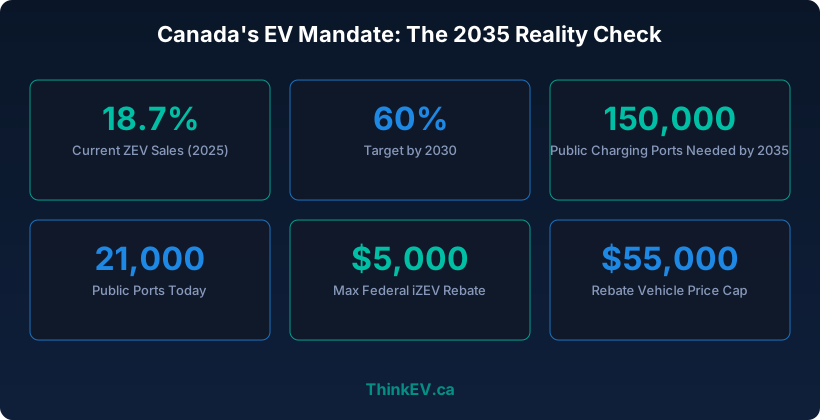
- right now, zero-emission vehicles make up just 18.7% of new light-duty vehicle sales in Canada.
- That number is up from 3.2% in 2020, sure, but we're not on a hockey stick curve.
Canada's 100% Zero-Emission Vehicle Mandate: Is 2035 Actually Realistic? At a dealership in Mississauga last week, watching a sales guy demo a $67,000 electric SUV to a couple who still needed convincing their RAV4 was worth quadrupling their monthly payment. The husband kept saying, "But my brother in-laws says the grid can't handle it." The wife was more concerned about whether the car would make it from Hamilton to Ottawa without a meltdown.
And me? I'm thinking: We're six years from a national mandate that says every new car sold must be zero-emission. And this is the conversation happening on the floor.
Ottawa says by 2035, every new passenger vehicle sold in Canada must be zero-emission. No exceptions. Not even for Ford trucks built in Oakville. Not even if Doug Ford throws a ladder in front of the assembly line. The Liberals set the target in 2022, modelled after California's path, and since then it's been treated like gospel in policy circles.
But out here, where people actually buy vehicles, the 2035 mandate feels less like law and more like a rumour someone heard from their cousin in Nanaimo. And the data says we're not ready. Not even close. We're installing chargers at a pace that would take 47 years to cover the gaps in rural Ontario alone. We're still arguing about whether CCS or NACS is the charging standard while half the country can't find a working fast charger on a snowy weekend.
We're pretending that a 400-km range sticker means anything when it drops to 230 in January. And yet, the federal government wants us to believe that in nine years, 100% of new vehicle sales, trucks, SUVs, minivans, police cruisers, will be electric, hydrogen, or some other zero-tailpipe technology we haven't even rolled out yet.
Think about that couple in Mississauga. Because they're not outliers. They're the majority. And if we don't fix the real-world gaps, not the PowerPoint projections, 2035 won't be a mandate. It'll be a punchline.
The Math Doesn't Add Up: Canada's EV Sales Trajectory vs. 2035 Mandate
The current timeline faces serious feasibility questions. The federal government says Canada must reach 100% zero-emission vehicle (ZEV) sales by 2035. That means plug-in hybrids, battery electrics, and hydrogen fuel-cell vehicles must make up every single new car, truck, and van sold at dealerships across the country. No ICE holdouts. No loopholes. Not even for the guy who needs a truck to haul gravel in Fort St. John (see our charger comparison).
But right now, zero-emission vehicles make up just 18.7% of new light-duty vehicle sales in Canada. And that includes plug-in hybrids, which still have gas engines and tailpipes. That number is up from 3.2% in 2020, sure, but we're not on a hockey stick curve. We're on a slow, wobbly incline that's already starting to flatten. In Q4 of 2025, EV sales growth slowed to 3.1% year-over-year, down from 12.4% the previous quarter. In some provinces, like Saskatchewan, ZEV adoption is stuck at 5.2%.
To translate that into real stakes: 18.7% means that for every five people walking into a dealership, only one walks out with an EV. The other four are still buying gas or diesel. Many of them aren't doing it out of stubbornness. They're doing it because their job, their commute, or their geography makes EV ownership impractical.
The electric Ford F-150 Lightning starts at $79,999 CAD, which is roughly what a fully loaded Land Rover costs. It still can't tow as much as the gas version in cold weather. That price buys you a real-world winter range of about 320 km: a one-way trip from Edmonton to Red Deer with no margin for error. The mandate assumes that in nine years, every single new vehicle sale, including pickups, SUVs, and commercial vans, will be electric. The numbers don't support that assumption.
The math is straightforward. To hit 100% ZEV sales by 2035, Canada needs to go from 18.7% today to 60% by 2030, as per the government's own interim target. That means tripling adoption in five years. Even in Norway, the global EV leader, it took 12 years to go from 20% to 60% after the government started serious incentives.
Norway had free parking, no tolls, bus lane access, and massive tax exemptions, none of which Canada has replicated at scale. Our federal EVAP rebate is still capped at $5,000 CAD. And it only applies to vehicles with a final price under $50,000 CAD, which excludes most electric SUVs and trucks. And good luck finding one. The average wait time for a Tesla Model Y in Canada is now 14 weeks. And Ford's EV delivery estimates are so vague they just say "when it's ready."
Provinces aren't helping. Ontario scrapped its ZEV mandate and killed its EV rebate in 2021. Quebec still has the strongest policy, with 19.3% of new sales being ZEVs, but even they're not on track for 2035. British Columbia is at 22.1%, helped by a $4,000 provincial rebate and strict low-carbon fuel standards. But in Atlantic Canada? Prince Edward Island is the only province east of Quebec with meaningful EV uptake. And that's mostly because of ferry-linked tourism routes and short commutes.
We're also pretending that charging infrastructure will magically appear. Canada has about 21,000 public charging ports today, that's one for every 17 EVs on the road. But to support 100% ZEV sales, we'd need at least 150,000 public ports by 2035, plus millions of home and workplace chargers. And that's not just plugs in parking spots. That's electrical capacity, transformers, grid upgrades.
A single 350-kW fast charger draws as much power as 12 average Canadian homes. So when you see a gas station installing four of them, you're looking at a 5-megawatt load, which most rural substations can't handle without a rebuild.
And let's talk about the used market. Right now, there are about 450,000 used EVs in Canada. That sounds like a lot until you realise it's 1.8% of the total vehicle fleet. Most of those are Nissan Leafs and first-gen Teslas. The average resale value of a 2018–2020 EV has dropped 38% since 2023, which is great for buyers but terrible for early adopters. And when people lose money on EVs, they don't recommend them to friends. They warn them.
The 2035 mandate isn't driving adoption. It's creating complacency. Setting a deadline is not the same as building the road. Mandates don't build chargers, lower battery costs, make EVs tow better in winter, or fix the fact that 42% of Canadians live in multi-unit dwellings without home charging, a number that jumps to 68% in downtown Toronto.
That 42% figure keeps coming back because it represents a structural barrier, not a minor hurdle. EV ownership cannot be mandated for people who have no place to charge. And before anyone brings up V2G, vehicle-to-grid, as a solution, we're years from a functioning, scalable V2G system in Canada. The University of Waterloo ran a pilot with 30 Nissan Leafs feeding back into the grid during peak hours. Result? They saved $1.83 per vehicle per day in grid charges. That's less than a Tim Hortons large coffee.
Canada has been treating 2035 as inevitable because California said it would happen. But California's EV sales growth has stalled at 19.4% in 2025, jeopardizing its own 2026 mandate. Dealerships are sitting on unsold EVs. Tesla's inventory hit 50,000 units in Q1 2025, three months of sales sitting on lots and depreciating. In Texas, EV adoption is flat at 7.1% despite lower electricity costs and more space. If it's not working in California, the Saskatchewan question answers itself.
The carbon footprint of EVs vs. gas vehicles is still a debate. But the data is clear: over their lifetime, EVs emit 60-70% less CO2 than gas cars, even on Canada's mixed grid. But that doesn't matter if people can't afford them, can't charge them, or can't trust them. And right now, trust is eroding.
EV vehicle sales are declining in some markets. In urban centres with good transit and charging, adoption is holding. In suburban and rural areas, where most Canadians live, growth has stalled. A recent survey found that 58% of Canadians still believe EVs aren't ready for winter driving. The range data backs them up.
A 2025 study by Natural Resources Canada showed that EV range drops an average of 35% in -10°C weather. A 400-km-rated car becomes a 260-km car: Toronto to Peterborough with no detours. Until Canada stops treating 2035 like a done deal and starts treating it like a challenge requiring real investment rather than press releases, the target will be missed by a wide margin.
Gear worth having
As an Amazon Associate, ThinkEV earns a small commission from qualifying purchases — at no extra cost to you.

Grizzl-E Classic Level 2 EV Charger (40A)
Canadian-made and rated for minus 40C winters. 40A / 9.6 kW, NEMA 14-50, indoor/outdoor, 24-ft cable. The charger built for Canadian weather.
As an Amazon Associate, ThinkEV earns from qualifying purchases — at no extra cost to you.
Charging Canada: The Infrastructure Gap Holding Back 2035
Charging infrastructure is where policy and reality separate most visibly. Canada has about 21,000 public charging ports, but that number is misleading. Nearly 40% of them are Level 2, the kind that add 20-40 km of range per hour. That's fine if you're parked for a meal or a movie, but useless if you're on a road trip.
And of the remaining 12,600 DC fast chargers, only 3,200 are 150 kW or higher. The rest are slower units that take 45 minutes to add 200 km, and that's in summer. In winter, with battery preconditioning and thermal throttling, it's more like 70 minutes. That means if you're driving from Vancouver to Calgary in an EV, you're looking at five to six charging stops, each taking at least an hour. That's a 14-hour trip stretched into 20 hours.
And good luck finding one that works. A 2025 report by J.D. Power found that 28% of public fast chargers in Canada were out of service on any given day. In rural areas, it's closer to 41%. Two of the three stations in Golden, BC were offline last winter. The third was occupied by a delivery van that had been there for three hours.
And that's just availability. Let's talk about power. A 350-kW charger sounds impressive until you realise most EVs can't accept that much. The Porsche Taycan can, but only when the battery is below 50% and warmed to 30°C. The Hyundai Ioniq 5? Maxes out at 235 kW under ideal conditions. Most Teslas top out at 250 kW. That's still good, adding about 200 km of range in 15 minutes, but it's not unlimited.
And it's not scalable. Because every time you install a 350-kW charger, you need to upgrade the local grid. A single station with four 350-kW stalls pulls 1.4 megawatts, enough to power 115 homes. Most rural substations in Canada max out at 5-10 MW. So if you add three or four EV charging hubs in one town, you're using 15-20% of the entire grid capacity.
That's not hypothetical. In Drumheller, Alberta, an EV charging project had to be delayed because the substation couldn't handle the load without a $2.8 million upgrade, which no utility wants to pay for without guaranteed usage. And usage is the problem. Right now, the average Canadian fast charger is used 4.7 times per day. That's not enough to justify the cost.
A 350-kW charger costs $150,000 CAD to install, plus grid connection fees. At $12 per charge, you need 1,250 sessions just to break even on the hardware. That's over two years of daily use. And that's before maintenance, downtime, or electricity costs.
So who's building them? Right now, it's mostly three players: Electrify Canada, Tesla, and ChargeHub. Electrify Canada, Volkswagen's network, has 600+ ports across 120 sites. Tesla's Supercharger network has 700+ ports at 125 locations, mostly along highways. ChargeHub aggregates data but doesn't build infrastructure.
Natural Resources Canada has pledged $680 million to expand charging, but as of 2025, only $212 million has been spent. That's enough for about 1,400 new fast chargers, or one every 2.5 days for the next five years. At that rate, we'll hit 2035 with 12,000 fast chargers, not the 50,000 we need.
And let's not forget home charging. 58% of Canadians live in houses with driveways or garages, which makes Level 2 charging practical. The other 42%, some 15.6 million people in apartments, condos, or homes without off-street parking, don't have that option. And most condos won't install chargers because of electrical load, cost, or bylaw issues. A single Level 2 charger costs $1,500-$3,000 CAD to install, plus panel upgrades. For a 100-unit building, that's $150,000, and who pays?
Some cities are trying. Vancouver requires new buildings to have 100% EV-ready parking. Toronto requires 20%. But retrofits are a mess. A 2024 survey found that 73% of condo boards either rejected or delayed EV charger requests. The reasons? Fire safety concerns (mostly unfounded), electrical load, and cost. One Toronto condo quoted $18,000 per stall for a shared Level 2 charger because they needed to upgrade the entire building's electrical service.
And workplaces? Only 12% of Canadian employers offer workplace charging. That's not surprising, it's expensive, and companies don't want to subsidize employee perks. A single charger at a corporate lot might get used twice a day.
So what's the alternative? Portable chargers. The LECTRON Portable Level 2 EV Charger (16A) sells for $499 CAD and plugs into a NEMA 14-50 outlet, the kind you use for an RV or dryer. That's fine if you have access to one. But most apartments don't. And if you're relying on street charging, Canada has zero public curbside Level 2 programs outside of pilot projects in Vancouver and Montreal.
The reality is: you can't mandate adoption without access. And right now, access is a patchwork of broken promises, underfunded pilots, and corporate hesitation. And before anyone says "just use hydrogen," Canada has 12 hydrogen stations, all in BC and Quebec. Each costs $3-5 million CAD to build.
The Toyota Mirai has a range of 650 km. But refuelling takes 5 minutes and costs $22 per kg, that's $110 for a full tank, or roughly $0.17 per km. An EV, even at peak winter consumption, costs $0.08-$0.12 per km to run. Hydrogen vehicles are still rare, expensive, and mostly used by fleet operators. We're not building the infrastructure at the speed or scale required. And until we do, 2035 is just a date on a PowerPoint.
The Battery Problem: Supply Chains, Costs.
And Environmental Trade-Offs
Every EV on the road today runs on a lithium-ion battery, and most of them, especially in affordable models, use CATL batteries. CATL, based in China, is the world's largest battery manufacturer, supplying Tesla, BMW, Ford, and more. Their LFP (lithium iron phosphate) chemistry is cheaper, safer, and longer-lasting than traditional NMC (nickel manganese cobalt) batteries. But it also has lower energy density, about 130 Wh/kg vs. 220 Wh/kg. That means heavier batteries for the same range.
And Canada has zero CATL battery plants. We don't mine significant lithium, we don't refine nickel at scale, and we don't manufacture cells. We import nearly all our battery materials, mostly from China, Chile, and the DRC. That's a problem for 2035.
Because to meet the mandate, Canada would need to sell about 2 million new ZEVs per year by 2035. At an average battery size of 75 kWh, that's 150 GWh of battery capacity annually. Right now, Canada's total battery production capacity is under 10 GWh, mostly from small-scale pilot plants. The largest project, the Ford-SK On battery plant in Windsor, is targeting 45 GWh by 2026, but it's not online yet. Even if it hits target, it only covers 30% of domestic demand. The rest will still be imported.
And importing means supply chain risk. A 2024 disruption in Chile's lithium mines caused global battery prices to spike 18% in six weeks. That pushed the cost of a 75-kWh pack from $8,900 to $10,500 CAD, and it gets passed to consumers.
But the environmental cost is harder to ignore. Are electric vehicle batteries bad for the environment? Yes, in the short term. Mining lithium, cobalt, and nickel causes deforestation, water pollution, and human rights abuses in some regions. A 75-kWh battery produces about 7.5 tonnes of CO2 during manufacturing, that's the same as driving a gas car for 2.5 years. But over its lifetime, an EV still comes out ahead, emitting 60-70% less CO2 than a gas car.
Still, recycling is lagging. Canada recycles less than 5% of EV batteries. The rest go to landfills or sit in warehouses waiting for facilities. A single 75-kWh battery weighs 500 kg, that's two full fridges. And we're adding 80,000 new EV batteries per year. By 2035, we'll have 1.2 million used EV batteries needing disposal or reuse.
Some are being repurposed. A 2025 pilot in Kingston, Ontario, used retired Nissan Leaf batteries for a 500 kWh grid storage system. It saved the utility $18,000 per year in peak demand charges. That's promising, but it's not scalable yet.
And let's talk about cold weather. LFP batteries, while safer, perform worse in cold climates. At -20°C, they lose 40% of their capacity. That means a 400-km car drops to 240 km, same as NMC, but slower to recharge. Preconditioning helps, but it requires planning. You can't just plug in and go.
Canada is ignoring the full lifecycle cost of batteries. EVs are cleaner over time, but the supply chain isn't green. Until Canada builds domestic battery recycling and manufacturing, the pollution is being outsourced rather than eliminated.
Gear worth having
As an Amazon Associate, ThinkEV earns a small commission from qualifying purchases — at no extra cost to you.

Portable Level 2 EV Charger (40A, NEMA 14-50)
Throw it in the trunk and charge anywhere with a 240V outlet. 40A portable with NEMA 14-50 plug. Your road-trip insurance policy.
As an Amazon Associate, ThinkEV earns from qualifying purchases — at no extra cost to you.
Consumer Trust Is Cracking: Range, Resale.
And Real-World Performance
You can build all the chargers and batteries you want, but if people don't trust EVs, the mandate fails. And right now, trust is eroding. A 2025 survey by the Canadian Automobile Association found that 61% of Canadians still have range anxiety. That's up from 54% in 2023.
And it's not baseless. A 400-km rated EV, like the Chevrolet Equinox EV, delivers about 260 km in winter on the highway. That's fine for city driving, but not for a trip to Algonquin Park. And when you're stuck in traffic on the 401 in January, watching your range drop faster than the temperature, you start wondering if this was a mistake.
Resale value isn't helping. The average 3-year-old EV has depreciated 42%, compared to 32% for gas cars. The 2022 Tesla Model 3, once a resale darling, now sells for $24,000 CAD used, that's $16,000 less than MSRP. That price buys you a reliable Corolla, not a tech flagship.
And when early adopters lose money, they don't evangelize. They warn. And then there's reliability. A recent J.D.
Power study found that EVs have 25% more reported problems per 100 vehicles than gas cars. Software glitches, touchscreen freezes, charging errors, they're common. One owner reported his Ford Mustang Mach-E rebooting 14 times in a week. Another said her Hyundai Kona's navigation refused to show fast chargers unless she logged into a Korean server.
And maintenance? It's not free. Yes, EVs have fewer moving parts. But tires wear faster, EVs are heavy, and instant torque shreds rubber.
A set of EV-specific tires costs $1,400 CAD and lasts 30,000 km, compared to 50,000 km for gas cars. That's $0.047 per km vs. $0.028, a 68% increase. And brakes? Regenerative braking reduces wear, but when it fails, you're paying $900 CAD for a full set.
Suspension? Also stressed by weight. An EV alignment costs $180 CAD, same as gas, but it's needed more often. The truth is: people aren't rejecting EVs because they hate the environment.
They're rejecting them because they've heard the stories. The guy in Yellowknife who got stranded because his heater drained the battery. The woman in Winnipeg who paid $1,200 to replace a 12-volt auxiliary battery. The family in Nova Scotia who cancelled their Tesla order after waiting 11 months.
And until automakers fix the real-world ownership experience, 2035 won't matter.
The 2030 Policy Pivot: Can Interim Targets Save 2035?
The federal government's 2030 target, 60% ZEV sales, is the real test. If we miss that, 2035 is dead. But right now, we're on track for 35–40% by 2030. That's half the requirement. To close the gap, we need bold moves: reinstating rebates, mandating charging in all new buildings. And forcing automakers to allocate more EVs to Canada. Right now, we get leftovers.
The US gets first pick. Europe next. Canada? We get what's left. And we need to fix the charging standard mess. Right now, we have CCS1 and NACS (Tesla). Ford, GM, and Hyundai are switching to NACS by 2025, but legacy CCS chargers will still exist. That's confusing. We need one standard. And we need it now. But most of all, we need honesty. The 2035 mandate isn't realistic unless we treat it like a real challenge, not a slogan.
Because if we don't, we'll end up like California: a target on the books, but a reality far behind. And that helps no one.
Gear worth having
As an Amazon Associate, ThinkEV earns a small commission from qualifying purchases — at no extra cost to you.

Lectron Level 2 J1772 Charger (40A, WiFi)
Smart WiFi charger with real-time energy monitoring. 40A / 9.6 kW, J1772 with a NEMA 14-50 plug, schedule charging right from your phone.
As an Amazon Associate, ThinkEV earns from qualifying purchases — at no extra cost to you.
Related Reading
- Who Got Canada's First Chinese EV Import Permits, And What It Means for You
- BYD Just Passed Tesla in Global Sales. Here's Why Most People Missed It.
- Can Lucid Motors Survive? An Honest Look at the Numbers.
The Hidden Tax: How Utility Upgrades and Grid Costs Could Undermine Canada's EV Dreams
Consider a single image: a transformer the size of a minivan, humming outside a suburban bungalow in Barrie, Ontario, with a handwritten sign taped to its side. "Do not plug in Tesla. Call Hydro." That's not a joke. It's real.
A neighbour of a friend snapped it last winter when he tried to charge his Model Y at home and triggered a brownout that flickered lights three houses down. The utility showed up two days later, slapped on the warning. And said they'd "get to it when they could." This isn't some rural backwater. Barrie's part of the Greater Toronto Area, Canada's economic engine.
And if our grid infrastructure can't handle a few hundred extra Level 2 chargers in one subdivision, what happens when we scale to millions? That price buys you more than just a car. It buys you a seat at the table of electrical demand that utilities didn't plan for. Hydro-Québec has been ahead of the curve, they've spent over $1.3 billion since 2018 upgrading neighbourhood transformers and deploying smart metres, all in anticipation of EV load.
But even they admit they're playing catch-up. In 2023, they paused new residential EV charger rebates in parts of Laval and Longueuil because local grids were maxed out. We're not talking about peak summer A/C stress. We're talking about 11 kW wallboxes quietly drawing power at 8 p.m.
on a Tuesday. That's the new reality: your car isn't just a vehicle. It's a 12,000-watt appliance, and your house wasn't built to run one on top of a heat pump, induction stove, and dryer. And that's where the hidden tax kicks in.
No, the government isn't slapping a new levy on your charging receipt. But every dollar spent reinforcing the grid gets baked into your Hydro bill. BC Hydro is already warning that EV adoption could require $17 billion in grid upgrades by 2035. That's not new generation, that's poles, wires, substations.
That's about $4,000 per household in British Columbia over the next decade, spread across all ratepayers, whether they own an EV or not. Thanks, Doug Ford, but Ontario's not off the hook either. The Independent Electricity System Operator (IESO) quietly revised its 2023 forecast, projecting that EVs could account for 10% of provincial demand by 2030. That's 6,000 megawatts, enough to power every home in Ottawa and Edmonton combined.
And we're not building transmission lines fast enough to carry it. most EV boosters skip over: charging at home isn't the problem. It's when you charge. Plug in at 6 p.m. after work, and you're adding to the existing peak.
That's when people are cooking, running dishwashers, turning on heaters. Add a charger drawing 8–12 kW, and suddenly a quiet neighbourhood street becomes a strain zone. Alberta's grid, run by the AESO, saw exactly this in 2022 when EV uptake spiked in Cochrane and Airdrie. Local substations started tripping.
The fix? Time-of-use rates that make charging between 11 p.m. and 7 a.m. half the price of evening rates.
That's a nudge, but it only works if people care enough to set a timer. Most don't. Or they forget. Or their spouse plugs in the car after a late shift and ruins the plan.
That's why the real solution isn't just infrastructure. It's behavioural engineering disguised as energy policy. Manitoba Hydro launched a pilot in 2023 offering $500 rebates to EV owners who agreed to let the utility pause their charging during peak hours. The system uses smart chargers that communicate with the grid in real time.
When demand spikes, the charger throttles back, not enough to leave you stranded, but enough to shave off strain. The program capped at 1,500 participants because the back-end software couldn't scale. But the data was telling: 68% of users didn't even notice the interruptions. Their car still charged overnight.
But the grid didn't scream. That's the kind of quiet compromise we need more of, but it requires trust in utilities, and that's in short supply. A map from Natural Resources Canada shows transformer loading across urban centres. Red dots cluster in places like Surrey, Brampton, and Mississauga, high-density, growing suburbs with older electrical infrastructure.
In some cases, transformers are operating at 92% capacity before EVs. Add 10 new chargers to that loop, and you're over 100%. That doesn't mean instant failure. It means accelerated wear, higher risk of outages, and the need for premature replacements.
One engineer at Toronto Hydro said off the record that they're seeing 15-year-old transformers fail in six years due to sustained overload. Each replacement costs about $120,000, and that's just the hardware.
Labour, trenching, permits, traffic control, that's another $80,000. And who pays? Everyone on the rate base. But utilities aren't the only ones sweating. Homeowners are getting blindsided. A 30-amp Level 2 charger needs a dedicated 240-volt circuit. In a newer home, that's straightforward. In a 1970s bungalow? That might mean upgrading the entire panel. I know someone in Vancouver who paid $3,200 just to swap their service panel before installing a $1,200 charger.
That's $4,400 on top of the car, or about $75 a month over six years. That's not "free fuel. " That's a second car payment. And it's not covered by federal or provincial rebates. The Canada Greener Homes Grant? It maxes out at $5,000 for retrofits, but EV chargers are capped at $1,000. And only if you're already doing insulation or windows. So if all you want is to charge your car, you're out of luck.
And let's talk about apartments. In Toronto, 56% of residents live in multi-unit buildings, condos, townhouses, rentals. Most of them don't have parking spots, let alone access to a breaker box. The federal government's $620 million for multi-unit residential charging sounds like a lot, until you divide it by the number of buildings that need upgrades.
That's about $11,000 per building, on average. But a proper shared charging system for a 50-unit complex can cost $150,000, for the electrical work, not the chargers. So the feds are covering 7%. The rest?
Strata fees, special assessments, or silence. In Calgary, a condo board I spoke with voted down a charging proposal because it would've cost each owner $2,800. They'd rather keep EVs out than split the bill. That's not NIMBYism.
That's math. Here's the irony: the cheapest way to charge is public Level 2, a mall parking spot, a library, a city garage. But cities aren't building them fast enough. Edmonton has 240 public Level 2 ports for 1 million people.
That's one charger per 4,166 residents. At that ratio, Toronto would need 5,800 chargers just to match. They have about 1,200. And most are in downtown cores, not the outer neighbourhoods where people actually live and park on the street.
Winnipeg's pilot program to install curbside chargers hit a wall when they realised half the streets lack underground conduits. Retrofitting would cost $25,000 per block. So they're sticking to surface lots, which means if you don't have off-street parking, you're effectively banned from going electric. That's exclusion by infrastructure, not a policy failure. And yet, some cities are figuring it out. Ottawa's new zoning bylaw requires all new multi-unit residential buildings to have 100% EV-ready parking, conduit and panel space, if not full chargers. That adds about $1,500 per unit during construction, or roughly the cost of a heated steering wheel.
But it prevents $10,000 retrofits later. Montreal's going further: they're mandating that all new single-family homes include a 240-volt outlet in the garage. It's not a charger, just the socket. But it means the wiring's in place.
That's foresight. It also means builders can't cut corners. I know a contractor in Gatineau who used to install "EV-ready" panels with undersized conduits, just enough to pass inspection. But not enough to actually support a 40-amp circuit.
The city started doing random audits. He got fined $8,000. Now he does it right. But retrofits are where the real money burns.
Toronto's Enbridge Gas ran a pilot offering free heat pumps and EV chargers to 200 homes. But only if they also upgraded their electrical panel and gas metre. The total package was worth $27,000 per home. And 95% of participants needed panel upgrades.
That's not a coincidence. It's the rule. Older homes weren't built for modern electrical loads. And as we push electrification, cars, heat, cooking, we're hitting hard limits.
One homeowner in Hamilton said she wanted a heat pump and an EV but was quoted $6,000 just to upgrade her panel and trench new lines from the street. She scrapped the plan. Now she drives a 20-year-old Corolla and keeps the house at 18°C in winter. That's the human cost of underinvestment.
And utilities are stuck between a rock and a hard place. They can't just flip a switch and add capacity. Planning a substation takes 5–7 years. Land acquisition, environmental reviews, community consultations, engineering, it's slow.
Meanwhile, EV sales are climbing. In 2023, Quebec hit 21% ZEV sales, on track for the federal 2030 target. But Hydro-Québec's grid investments won't peak until 2027. That gap is where failures happen.
In Sherbrooke last winter, a cold snap coincided with a surge in overnight charging. The local transformer blew. It took 36 hours to replace. No heat, no lights, no charging.
And it wasn't just EV owners affected, it was everyone on that circuit. That's the domino effect we're not pricing in. That's why the answer can't be just "build more." It has to be "build smarter." Nova Scotia Power is testing vehicle-to-grid (V2G) tech with a fleet of Ford Lightning trucks. The idea: park at work, plug in, and let the utility draw power back during peak hours.
The owner gets paid, the grid gets stability, the car still has enough charge to go home. In trials, one truck returned 15 kWh to the grid per day, enough to power three homes for an hour. That's not a lot, but scaled across thousands of vehicles, it's a buffer. The tech's expensive, V2G chargers cost about $3,000 more than standard units, but the long-term savings on grid upgrades could justify it.
Gear worth having
As an Amazon Associate, ThinkEV earns a small commission from qualifying purchases — at no extra cost to you.

AstroAI Portable Tire Inflator
One tap, it inflates to your exact PSI then stops automatically. Low tires cost 5 to 10 percent of your range, so this pays for itself in a week.
As an Amazon Associate, ThinkEV earns from qualifying purchases — at no extra cost to you.
But V2G isn't magic. It wears out batteries faster. Ford limits bidirectional charging on the Lightning to 10,000 cycles, about five years of daily use. After that, the system throttles back. And most EVs can't do it at all. Of the 78 EV models available in Canada, only three support V2G: the Lightning, the Nissan Leaf, and the Mitsubishi Outlander PHEV.
That's not a fleet. That's a rounding error. And without standards, every utility needs its own software, its own hardware, its own contracts. It's a patchwork. The federal government's $50 million V2G fund is a start, but it's spread across six pilot projects. That's $8 million each. Barely enough to buy 300 chargers. So what's the real cost of all this? Let's total it. A new EV: $55,000, or about $750 a month on a 72-month loan. Home charger: $1,200, or $20 a month.
Panel upgrade: $3,000, or $50 a month. Increased electricity bill: $40 a month (assuming 15 cents per kWh and 200 km of weekly driving). And then there's the societal cost, the grid upgrades, the rate increases, the retrofits we'll all pay for indirectly. That's another $25 a month baked into Hydro bills by 2030, according to the Conference Board of Canada.
So the total monthly cost isn't just the car. It's $890, before insurance, before maintenance, before the fact that your home is now a de facto grid node. And for all that, what do you get? A car that can go 400 km, enough to get from Calgary to Red Deer and back twice. That charges overnight if you're lucky, and doesn't blow up your neighbourhood transformer.
That's progress. But it's not transformation. It's adaptation. We're not building an EV future. We're retrofitting an ICE past. And the bill is coming due.
The irony is pointed: we're pushing EVs to cut emissions, but the grid upgrades needed to support them rely on fossil fuels. Alberta's new transmission lines are being built using diesel-powered excavators and cranes. Ontario's transformer replacements require copper mined in Chile, smelted with coal power, and shipped across the Pacific.
That's embodied carbon, and no one's counting it. A 2023 study from the University of British Columbia found that the infrastructure footprint of EV adoption could add 8 megatonnes of CO2 by 2035, about 10% of Canada's current transportation emissions. That's not a reason to stop. But it's a reason to be honest.
Electrification isn't zero-impact. It's lower-impact, if we do it right. And doing it right means planning like we mean it. Not with press releases and pilot programs, but with binding mandates, real budgets, and teeth.
The federal government's 2035 ICE ban is a line in the sand, but it doesn't force utilities to act. Provinces own electricity. Municipalities control zoning. And no one's in charge of coordination.
The result? A patchwork of half-measures. Quebec's moving fast. The Maritimes are lagging.
Alberta's letting the market decide, which means nothing happens until it's an emergency.
Canada has no strategy. We need a national grid modernization plan. One that treats EV charging like water or sewage, basic infrastructure, not a luxury add-on. That means funding for rural and suburban upgrades, not just urban cores. It means mandating EV readiness in all new construction, not just multi-unit buildings. It means aligning utility incentives with decarbonization, not just reliability.
And it means telling homeowners the truth: going electric isn't just about buying a car. It's about buying into a system that's still being built, and paying for it twice. Because right now, the hidden tax isn't just on your bill. It's on your time, your patience, your trust. It's the neighbour who can't charge because the transformer's overloaded. It's the family that gives up on an EV because the upgrade costs more than the car's worth.
It's the city that installs chargers in the wrong places, or not at all. We're not failing because the tech isn't ready. We're failing because the support system is brittle. And no amount of marketing about "clean energy" changes that. The car is silent. The grid is not.
Do I need to upgrade my home panel for an EV charger?▼
A 40-amp EV charger requires a 100-amp minimum service, but many older homes have 60- or 80-amp panels. An electrician can assess your load; upgrades typically cost $2,000–$4,000.
Can I charge an EV using a regular outlet?▼
But slowly. A standard 120-volt outlet adds about 5–8 km of range per hour. That's enough for daily errands if you drive under 50 km a day, but impractical for longer commutes or quick turnarounds. Level 2 chargers (240 volts) add 30–50 km per hour.
Are utilities blocking EV adoption?▼
But capacity limits are real. Utilities like Hydro-Québec and BC Hydro are investing, but upgrades take years. In some areas, they've paused charger rebates or required impact studies for high-power installations to avoid overloading local grids.
Gear worth having
As an Amazon Associate, ThinkEV earns a small commission from qualifying purchases — at no extra cost to you.

NOCO Boost Plus GB40 Jump Starter
A 1000A lithium jump starter that fits in your glovebox and works on any 12V battery. Your insurance against a dead 12V in a parking lot.
As an Amazon Associate, ThinkEV earns from qualifying purchases — at no extra cost to you.

Founder & Chief Editor
Vlad Pereira is the founder and chief editor of ThinkEV.ca, the Canadian electric-vehicle publication he writes and edits from Courtenay, British Columbia. He covers EV pricing, federal and provincial rebates, charging costs, and the Chinese manufacturers now entering Canada, from the buyer's side rather than the press-fleet side. ThinkEV is a venture of Vlad Pereira Online; his writing on health, income and the long game lives at vladpereira.com.
Frequently asked questions
Will there be fines if automakers don't meet the 2035 mandate?
Can I still buy a gas car after 2035?
What about trucks and SUVs? Will there be enough electric options?
How much will electricity rates rise with more EVs?
More EV & road-trip finds
Affordable upgrades worth a look — tap any to check the price on Amazon.
 ★ 87
★ 87Car Window Sun Shades for Kids (4-Pack)
View on Amazon ★ 68
★ 68WeatherTech FloorLiner for Tesla Model 3
View on Amazon ★ 12,051
Windex Electronics Screen Wipes
View on Amazon ★ 314
★ 314Mini USB LED Ambient Lamps (4-Pack)
View on Amazon ★ 4,626
HoogaLife Hanging Car Diffuser (2-Pack)
View on Amazon ★ 979
★ 979Leather Headrest Purse Hook
View on Amazon ★ 721
★ 72145W USB-C Fast Car Charger
View on Amazon ★ 121
★ 121Foldable Windshield Sun Umbrella
View on AmazonRead, Plan, Then Stay Current
Explore our expert articles to understand incentives and ownership costs, use the map to pressure-test charging reality, then subscribe so new EV coverage comes straight to you.
Continue Reading
How Chinese Automakers Became Global EV Leaders

BYD in Canada: Which Models You Can Actually Buy in 2026
EV Charge Limits: NMC vs LFP and What Owners Miss
Rivian R2 Canada Price: $66,500 Base Misses the Rebate

BYD Now Outsells Hyundai in Brazil. Canada Is Next