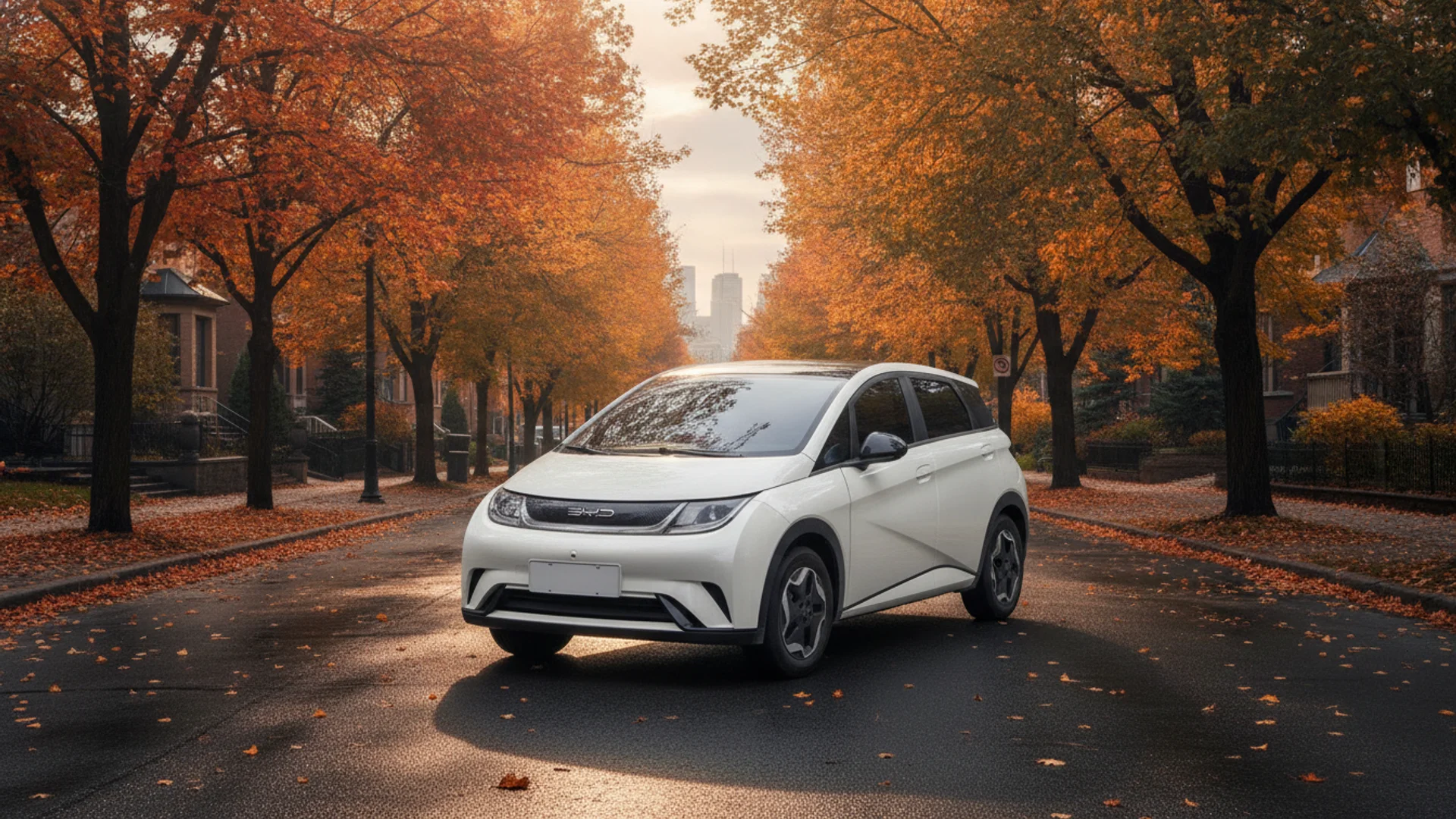
I'll put a band on the BYD Dolphin's Canadian landed price, C$28,000 to C$35,000 for the base trim, and I'll label that as an estimate rather than pretend it's a sticker. The car isn't in a Canadian showroom yet. What it has is a confirmed late-2026 launch, a dealer network being built out from Toronto to Vancouver, and a spec sheet that would make it the cheapest new EV any Canadian could walk in and buy. That's the story. The rest of this guide is the receipts.
The reason a band matters more than a single number: the Dolphin retails for the equivalent of CDN$28,000 in Australia, a market with pricing that's probably not too far off what we'll see on our shores, but "probably not too far off" is doing a lot of work in that sentence. Canadian tariff treatment, dealer margin structure, provincial sales tax stacking, and BYD's decision to price for market share versus margin all move the number. Anyone selling you a $27,999 sticker right now is guessing.
Key takeaways
- BYD targets a C$28,000–$35,000 landed price for the Dolphin, potentially undercutting the Chevy Equinox EV by up to $13,000.
- Federal EVAP rebates exclude all China-built vehicles, but Quebec and BC provincial rebates could drop the effective price to C$22,000–$28,000.
- The Dolphin's 60 kW DC fast charging is slower than rivals above $40,000, but largely irrelevant for daily Level 2 home charging.
- BYD includes a heat pump standard on the base trim, a feature competitors charge extra for, narrowing real-world Canadian winter range loss.
- Year-one dealer coverage targets 20-plus locations in Toronto, Vancouver, Montreal, and Calgary, leaving buyers in Saskatoon or Halifax with a service question to answer.
Quick Answer: What Canadian Buyers Need to Know Right Now
BYD has confirmed a Canadian launch by the end of 2026, and the Dolphin is one of the first models in the door. Expect a base-trim landed price in the C$28,000–$35,000 band, with the low end assuming BYD prices aggressively for share and the high end assuming they price closer to Australian parity plus Canadian sales overhead.
The dealer network is being built from scratch, the Dolphin sits alongside models like the Sealion 7 in the lineup BYD is bringing north, with plans for more than 20 dealerships targeting Toronto, Vancouver, Montreal, and Calgary in year one. That is a serious retail footprint for a first-year entrant. It is also less coverage than a national buyer might want, a Dolphin owner in Saskatoon or Halifax will need to think carefully about the service question before signing.
Federal rebate status is the piece that changes the arithmetic most. The current federal program is EVAP, not iZEV, which was the retired predecessor, and EVAP excludes China-built vehicles on country-of-origin grounds regardless of price. No BYD model qualifies for the federal $5,000 rebate. Any early Canadian coverage suggesting otherwise is working from stale information. Provincial rebates in Quebec and BC operate under their own rules and are more open to Chinese-built vehicles, which is where the effective-price math gets more interesting.
Gear worth having
As an Amazon Associate, ThinkEV earns a small commission from qualifying purchases — at no extra cost to you.

WeatherTech FloorLiner for Tesla Model 3
Deep-channel liners that trap every drop of slush and salt. The difference between a ruined interior and a showroom-fresh cabin after a Canadian winter.
As an Amazon Associate, ThinkEV earns from qualifying purchases — at no extra cost to you.
Specs That Actually Matter for Canadian Conditions
The Dolphin's headline specification is a WLTP range of roughly 420 kilometres. WLTP is a European test cycle. Canada is not Europe, in several relevant respects, starting with January. Expect real-world Canadian winter range in the 280–320 km band for a fully preconditioned car on a mixed commute, dropping further at highway speed in a cold snap. That is not a flaw of the Dolphin. That is what a 45-kWh-class LFP battery does in Canadian February.
The standard heat pump matters more here than the spec sheet suggests. Rival compact EVs in the sub-$40,000 category treat heat pumps as a trim upgrade or an option package; the Dolphin includes one on the base car. A heat pump doesn't rescue winter range on its own, but it narrows the gap between "range on the sticker" and "range you actually get in Regina" by a meaningful margin. On a car this cheap, that's the kind of decision that tells you the product team thought about buyers rather than about the marketing photo.
DC fast charging peaks at around 60 kW, delivering a 30-80% charge in roughly 29 minutes. Read that number carefully. Sixty kilowatts is slower than the 150-kW-plus peaks on EVs priced above $40,000, and it is slower than what most Canadian DC fast chargers can actually deliver. For an urban and suburban car, which is what the Dolphin is, the difference matters on road trips and almost nowhere else. For daily driving on a Level 2 home charger, the peak DC number is irrelevant.
The Dolphin is part of BYD's Ocean Series, sitting alongside the Seal and other compact-to-midsize models in the same design and engineering family. That matters for one specific reason: the Blade Battery. BYD's LFP chemistry carries an eight-year warranty and has shown notably low degradation rates in Norwegian and Australian owner data, markets where the Dolphin has been on sale long enough to generate real fleet-scale numbers. LFP does not have the peak energy density of NMC, which is why the range number sits at 420 km WLTP rather than 500. LFP is also more forgiving of daily 100% charging, cheaper to build, and more thermally stable. For a compact commuter, it is the right chemistry.
For a fuller technical treatment of why LFP and shape efficiency matter more than raw kWh in this segment, see the BYD Dolphin Canada price and full spec review.
How the Price Stacks Up Against What Canada Actually Sells
The average new EV transaction price in Canada currently sits around $55,000. The Dolphin, if the band holds, arrives at roughly half that.
Compare it to what a Canadian buyer can actually walk into a dealership and order today. The Chevy Equinox EV starts at roughly $41,000. The Dolphin undercuts it by $6,000 to $13,000 on the estimate. The Nissan Leaf, the previous default answer for "cheap EV hatchback in Canada," is discontinued. The Hyundai Kona Electric and the Volvo EX30 sit above $40,000. There is, at the moment, no direct sub-$35,000 EV hatchback rival on sale in Canada. The Dolphin enters an empty segment.
Gear worth having
As an Amazon Associate, ThinkEV earns a small commission from qualifying purchases — at no extra cost to you.
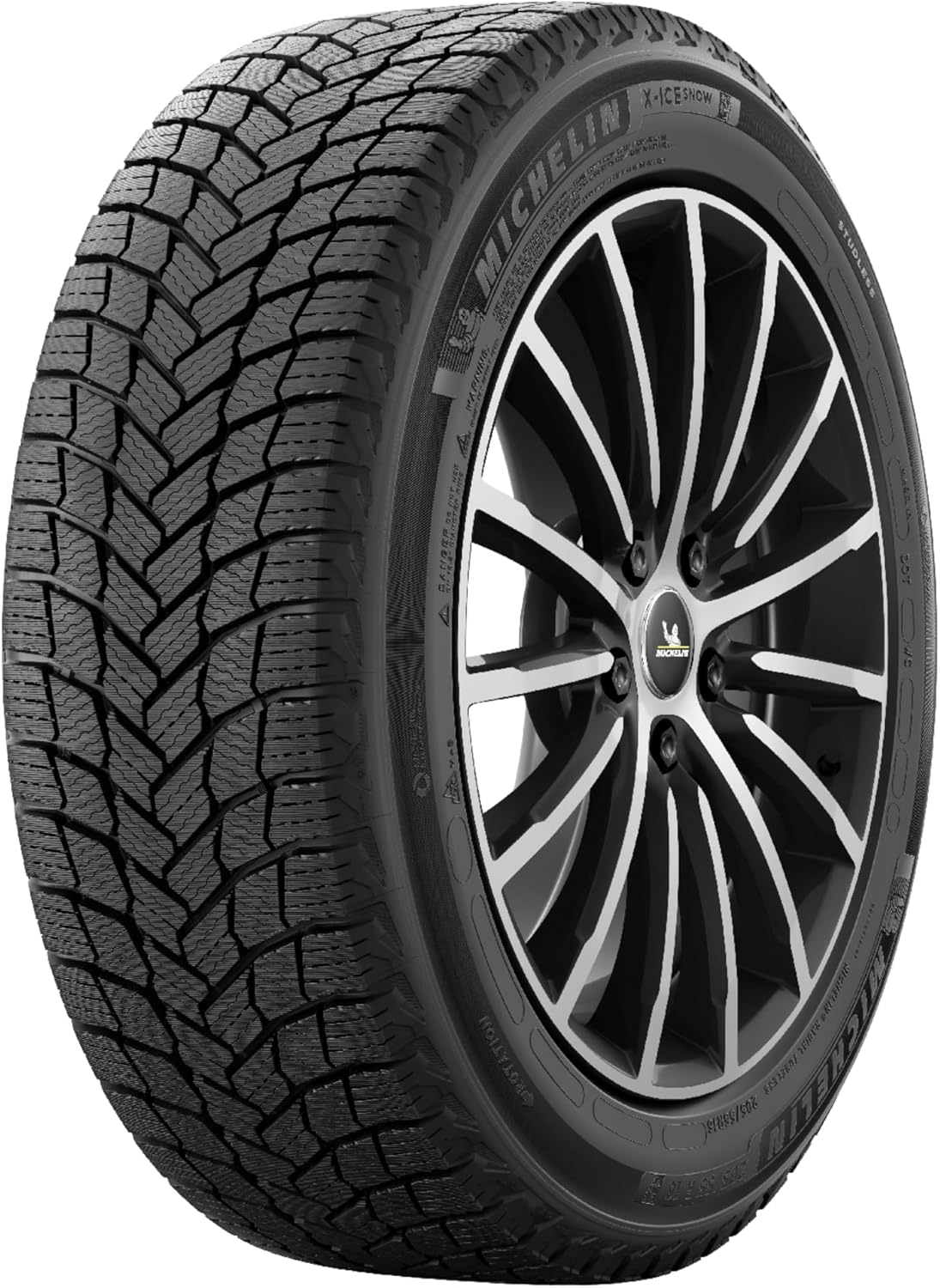
Michelin X-Ice Snow Tires (EV-rated)
EV-specific winter tires with low rolling resistance that recover up to 15 percent of cold-weather range. Mandatory in Quebec, smart everywhere else.
As an Amazon Associate, ThinkEV earns from qualifying purchases — at no extra cost to you.
Provincial rebates make the arithmetic more interesting. Quebec's Roulez Vert and BC's CleanBC programs operate on their own eligibility rules, they are provincial money with provincial politics attached. Where a China-built Dolphin qualifies, the effective price for a Quebec or BC buyer could land in the C$22,000–$28,000 band after rebate. That would be, by a comfortable margin, the cheapest new EV any Canadian has been able to buy since the Nissan Leaf's early years.
The stacked-up comparison, model by model, with dealer-timeline caveats and side-by-side spec tables, lives in the Dolphin versus Chevy Bolt 2027 comparison for anyone shopping this segment head-to-head.
Gear worth having
As an Amazon Associate, ThinkEV earns a small commission from qualifying purchases — at no extra cost to you.

Grizzl-E Classic Level 2 EV Charger (40A)
Canadian-made and rated for minus 40C winters. 40A / 9.6 kW, NEMA 14-50, indoor/outdoor, 24-ft cable. The charger built for Canadian weather.
As an Amazon Associate, ThinkEV earns from qualifying purchases — at no extra cost to you.
What the Canadian Rollout Actually Looks Like
BYD is not walking into Canada from a cold start. BYD Company Limited is a Chinese multinational manufacturing conglomerate headquartered in Shenzhen, Guangdong, China, and it has been the world's largest EV manufacturer by volume for several years running. The Canadian rollout is a retail expansion by a company that already sells more electric vehicles than anyone else on Earth, not a startup's first shipment.
The regulatory groundwork is partway laid. BYD has registered with Transport Canada, which is the paperwork that has to exist before a single car can be sold, but registration is a threshold, not a finish line. Model-by-model type approval, ADAS validation for Canadian conditions, safety recall pathways, parts distribution: each of those is a separate workstream, and each has to be sorted before the first Dolphin is delivered to a Canadian driveway. Late 2026 is plausible on that timeline. It is not guaranteed.
The dealer network is being built from scratch. That is a real cost and a real risk. Tesla spent its first Canadian decade with well-known service coverage gaps outside the major metros, and Tesla had the advantage of an obsessive owner community absorbing a lot of the friction. BYD will not have that cushion at launch. If you live within an hour of Toronto, Vancouver, Montreal, or Calgary, the dealer footprint at year one will probably serve you fine. If you don't, the advice is to wait a year and let the network fill in.
The structural unlock for all of this is the January 2026 tariff cut, from 100% to 6.1%, inside a 49,000-unit annual quota. Above the quota, the rate reverts to 100%. That quota is shared across all Chinese-built EVs entering Canada, not carved out for BYD, which means the Dolphin is competing with the Atto 3, the Seal, the Seagull, and eventually other Chinese entrants for the same tariff-favoured allocation. How BYD Canada divides that allocation across its four launch models will shape which Dolphins reach which buyers.
The quota math and the model-by-model allocation question get their own treatment in the guide to which BYD models Canadians can actually buy in 2026.
Gear worth having
As an Amazon Associate, ThinkEV earns a small commission from qualifying purchases — at no extra cost to you.

PULIDIKI Car Cleaning Gel (Detailing Putty)
Press it into vents, buttons, and seams and it lifts out dust you did not know was there. Weirdly satisfying, genuinely useful.
As an Amazon Associate, ThinkEV earns from qualifying purchases — at no extra cost to you.
Should You Wait for the Dolphin or Buy Something Now
Here is where the guide turns into an actual decision. If your budget is under $35,000 and your timeline can stretch past Q3 2026, the wait has a real case. Nothing else in the Canadian market is going to arrive in that window at that price with a heat pump, a warrantied LFP battery, and a company with genuine manufacturing scale behind the badge. The Dolphin is not the fastest, the roomiest, or the fanciest EV of 2026. It is likely to be the cheapest new one, and cheapest matters when the segment average is $55,000.
If you need a rebate-eligible EV in your driveway this quarter, the Dolphin is not your car, the EVAP exclusion for China-built vehicles is not a paperwork glitch that will be sorted before launch. The Chevy Equinox EV and the used Nissan Leaf market are the live options for a rebate-anchored purchase today. Neither is exciting. Both work.
The residual value question is the honest asterisk on any Dolphin recommendation, and I'd rather name it than bury it. We do not know what a three-year-old BYD Dolphin is worth in Canada, because there are no three-year-old BYD Dolphins in Canada. The Australian and UK secondary-market data is a directional read at best, different markets, different tariff structures, different buyer psychology. A conservative buyer should assume Dolphin residuals will lag established brands by a meaningful margin for the first two model years, and price the total cost of ownership accordingly. That risk is real. It is also priced-in at $30,000-ish; it would be a much bigger problem at $50,000.
The dealer-density question is the other one worth sitting with. Twenty dealerships across four cities in year one is a serious commitment for a launch, but it is a small footprint compared to Toyota or Ford. If you live near a launch metro, the service math works. If you're in Winnipeg, Halifax, or a smaller Alberta or Ontario city, wait for year two and see where the second wave of dealers actually opens.
I have not driven a BYD Dolphin. I do not need to have driven one to say what the spec sheet, the Australian owner data, the tariff calculation, and BYD's manufacturing record tell a consistent story about, this is a serious car from a serious company at a price no established Western brand is currently willing to match in Canada. If it lands as specified, in the window BYD has committed to, at anything close to the price band above, it will be the most consequential affordable-EV launch this market has seen since the original Leaf.
The number to check in the first quarter after launch is not the sticker. It's the trim mix, how many base cars actually reach dealer lots versus how many buyers are pushed toward the loaded trim to make the margin work. That's where the Australian playbook and the Canadian one will diverge or converge, and it's the earliest signal of whether "cheapest new EV in Canada" is a marketing line or a showroom reality.
Gear worth having
As an Amazon Associate, ThinkEV earns a small commission from qualifying purchases — at no extra cost to you.

WixGear Magnetic Air Vent Phone Mount (2-Pack)
A magnet strong enough that your phone never flinches over potholes or rail crossings. Two in the box, one for each car.
As an Amazon Associate, ThinkEV earns from qualifying purchases — at no extra cost to you.

Founder & Chief Editor
Vlad Pereira is the founder and chief editor of ThinkEV.ca, the Canadian electric-vehicle publication he writes and edits from Courtenay, British Columbia. He covers EV pricing, federal and provincial rebates, charging costs, and the Chinese manufacturers now entering Canada, from the buyer's side rather than the press-fleet side. ThinkEV is a venture of Vlad Pereira Online; his writing on health, income and the long game lives at vladpereira.com.
Frequently asked questions
Does the BYD Dolphin qualify for any Canadian government rebates?
How bad does Dolphin range actually get in a Canadian winter?
Is 60 kW DC fast charging going to be a problem?
Where will Canadians actually be able to service a Dolphin?
Can I charge the Dolphin to 100% every day without wrecking the battery?
More EV & road-trip finds
Affordable upgrades worth a look — tap any to check the price on Amazon.
 ★ 17,242
LISEN Mini USB-C Car Charger (54W)
View on Amazon ★ 61
★ 61Toddler Car Seat Snack and Cup Tray
View on Amazon ★ 392
★ 392Large Cup Holder Adapter (32-40oz)
View on Amazon ★ 2,941
Microfiber Cleaning Cloths (Multi-Pack)
View on Amazon ★ 314
★ 314Mini USB LED Ambient Lamps (4-Pack)
View on Amazon ★ 401
★ 401Crochet Daisy Rear-View Mirror Charm
View on Amazon ★ 4,424
Sun Visor Card and Document Organizer
View on Amazon ★ 848
★ 848Coiled USB-C to USB-C Car Cable (2-Pack)
View on AmazonRead, Plan, Then Stay Current
Explore our expert articles to understand incentives and ownership costs, use the map to pressure-test charging reality, then subscribe so new EV coverage comes straight to you.
Continue Reading
BYD Seal Canada: Demand Is Real, the Car Is Not Here
BYD Canada: The Quota Math Behind Ottawa's Bet
The 10 Most Affordable EVs You Can Buy in Canada in 2026
BYD Seagull With LiDAR at $13K: A Sub-$15K First
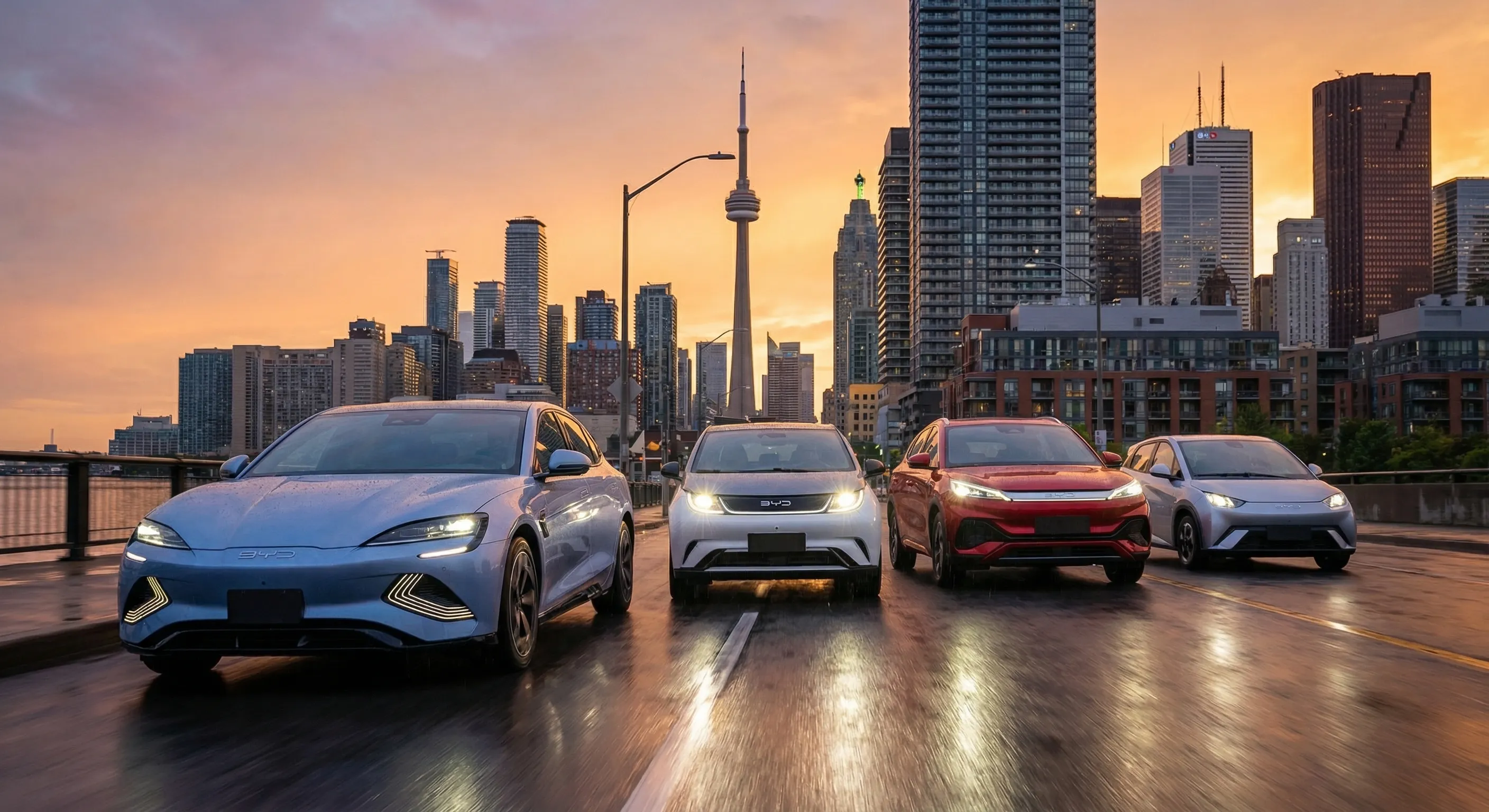
BYD Canada Lineup: The Four Models Coming First