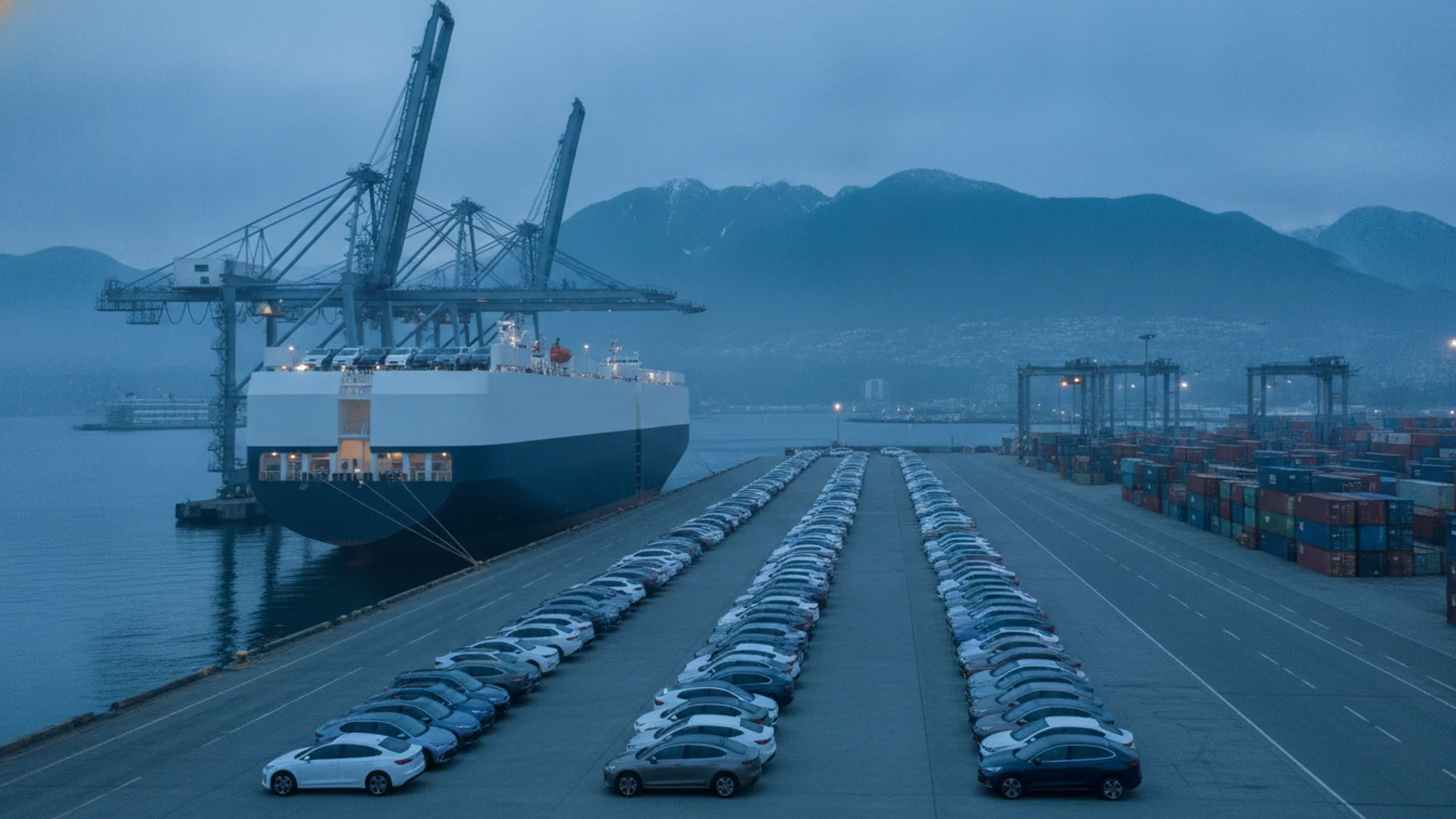
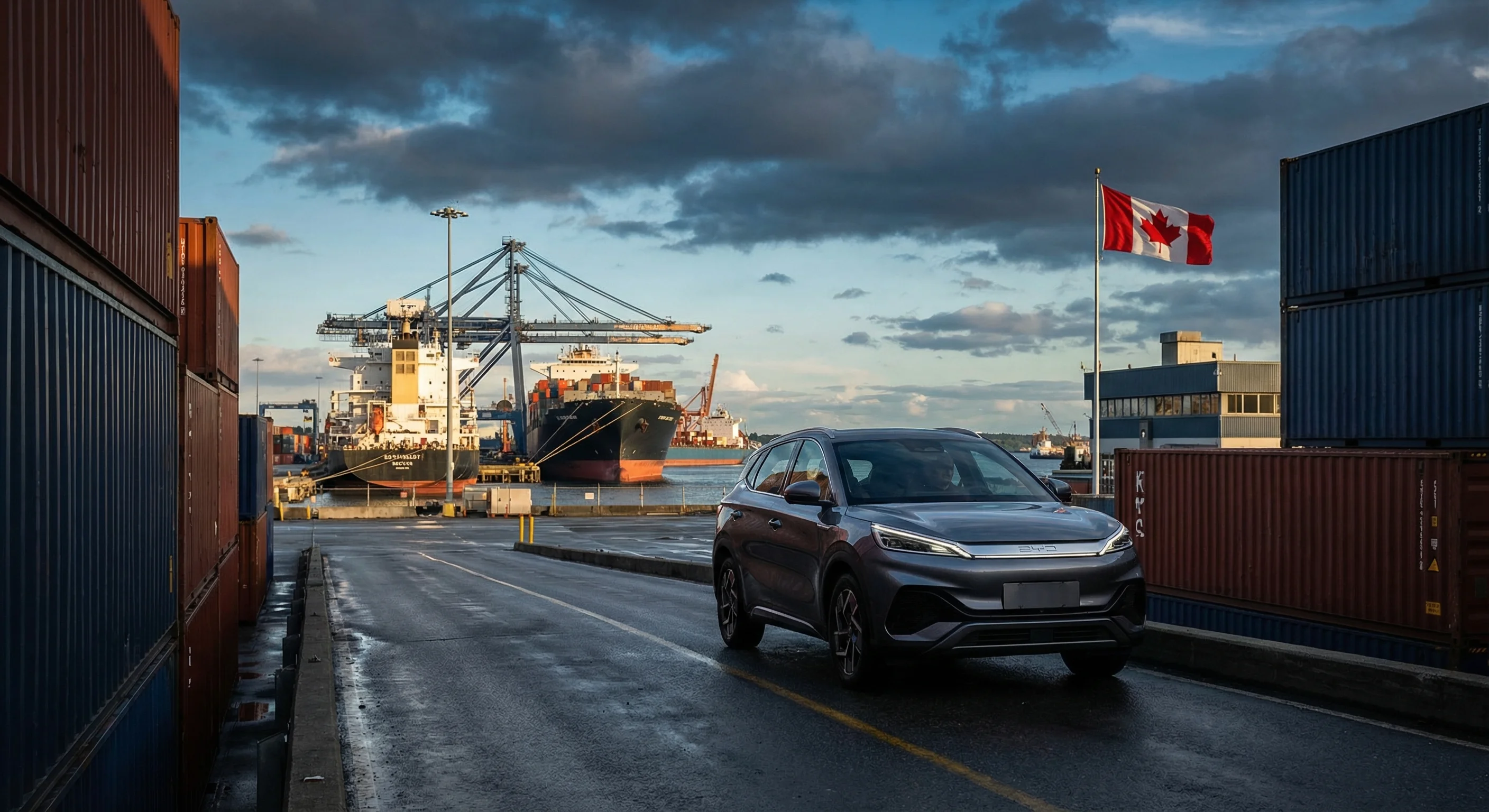
Canada finally has a number. As of September 11, 15,603 Chinese-built electric vehicles had cleared into the country this year, the federal quota tracker shows. That is roughly a third of the 49,000 the trade deal allows before the quota year closes on February 28, 2027. The cars are arriving. They are not the cars most buyers are waiting for.
Key Takeaways
- 15,603 Chinese-built EVs entered Canada between January and September 11, about a third of the 49,000-vehicle annual quota.
- Imports pay a 6.1% tariff, which replaced the 100% surtax when the deal took legal effect on March 1.
- Most of the volume is Shanghai-built Teslas and Geely-group cars such as the Lotus Eletre. No BYD passenger car is certified for sale here yet.
- The C$25,000 BYD price that still circulates was never real. Analysts put a first Chinese EV closer to C$35,000 to C$45,000.
- Chinese-built EVs are shut out of the federal EVAP rebate, which changes the math more than the tariff does.
Three companies hold access to the quota so far, and permits are handed out first come, first served. The volume is not coming from the brands that fill the headlines. It is Tesla, which builds the Model 3 it sells here in Shanghai, and Geely-group cars including the Lotus Eletre, the one Chinese-built EV already in Canadian showrooms at C$119,900. About half of the 15,603 arrived priced under C$35,000, so the affordable end is moving. It is just not moving under a Chinese brand's badge yet. Our live BYD Canada tracker follows each brand through the five gates it has to clear.
Why the cheap cars are taking so long
The tariff was never the bottleneck. Canada announced the arrangement with China on January 16, and it took legal effect on March 1 under Canada Gazette order SOR/2026-32, which repealed the 100% surtax and left eligible imports paying the 6.1% most-favoured-nation rate. Import permits opened the same day.
A federal trade-ministry spokesperson said some companies "haven't started to utilize the quota yet" because certification is still underway, and certification is the queue that matters. Approving a vehicle against the Canada Motor Vehicle Safety Standards means crash data, bilingual labelling and a stack of compliance paperwork for every model, and for a first-time entrant that routinely runs six to twelve months. Permits inside the quota are also weighted on after-sales service capacity, so a manufacturer has to build a dealer and service network before it earns the volume to fill it.
Where BYD actually stands
BYD has told Ottawa it intends to enter the Canadian passenger market, and the groundwork is visible. The company engaged Dealer Solutions Mergers and Acquisitions, a Markham, Ontario consultancy, to find retail sites, and DSMA chief executive Farid Ahmad has described a first-year target of roughly twenty stores, starting in the Greater Toronto Area and extending to Vancouver, Montreal and Calgary. Four BYD models sit in Transport Canada's Appendix G, the pre-authorization list that precedes full certification. Executive vice-president Stella Li has told Bloomberg and Reuters that Canadian sales will most likely begin in 2027 and that BYD is weighing a Canadian factory. This is the measured entry of the company that sells more EVs than anyone, done in the order the rules reward. The fuller picture sits in our guide to BYD's Canadian rollout.
Gear worth having
As an Amazon Associate, ThinkEV earns a small commission from qualifying purchases — at no extra cost to you.

Grizzl-E Classic Level 2 EV Charger (40A)
Canadian-made and rated for minus 40C winters. 40A / 9.6 kW, NEMA 14-50, indoor/outdoor, 24-ft cable. The charger built for Canadian weather.
As an Amazon Associate, ThinkEV earns from qualifying purchases — at no extra cost to you.
The price question is where the misinformation lives. The C$25,000 starting figure that still circulates traced back to an account impersonating Li, and Global News removed its story on May 28 for failing to meet its editorial standards. BYD has confirmed no Canadian price. Robert Karwel of J.D. Power Canada estimates a BYD Atto 2 would land in the high C$30,000s and an Atto 3 or Leapmotor C10 in the low-to-mid C$40,000s, with Chinese models undercutting the market by perhaps 10 to 15 percent. A realistic range for a first Chinese EV here is closer to C$35,000 to C$45,000 than to C$25,000. The ultra-cheap Seagull, around US$12,000 in China, is a volume play a market this size cannot yet support. For the model most readers ask about, we hold a price band for the Shark 6 rather than a single invented number.
There is one figure that will decide more sales than the sticker. A Chinese-built EV is excluded from the federal EVAP rebate of up to C$5,000, because Canada has no free-trade agreement with China, and that exclusion catches the Shanghai-built Tesla too. A C$38,000 Chinese SUV competes against a C$42,000 rival that qualifies, which narrows the gap buyers think they are getting. What your province pays on top matters more as a result, and our incentives page tracks what still applies where you live.
Gear worth having
As an Amazon Associate, ThinkEV earns a small commission from qualifying purchases — at no extra cost to you.
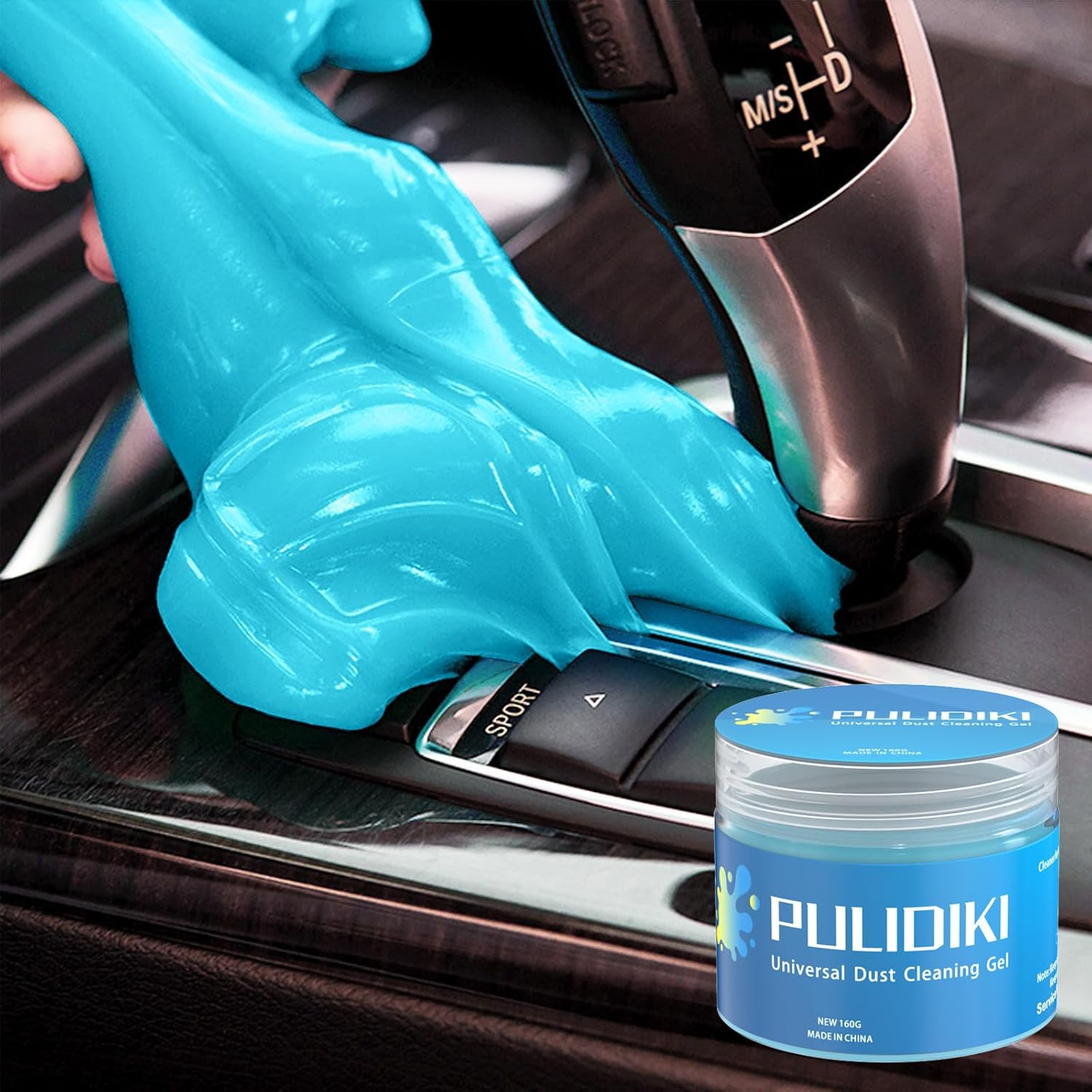
PULIDIKI Car Cleaning Gel (Detailing Putty)
Press it into vents, buttons, and seams and it lifts out dust you did not know was there. Weirdly satisfying, genuinely useful.
As an Amazon Associate, ThinkEV earns from qualifying purchases — at no extra cost to you.
The Quota Year Ends in February, Not This Fall
A third of the quota used by September reads like a slow start, but the year runs to the end of February, and the second six-month allocation only opened on September 1. The volume is real. It is simply flowing to Tesla and Geely while BYD, Chery and Geely's newer brands finish homologation. The thing to watch is the Transport Canada certification register, not another launch announcement, because a dealer cannot take a deposit on a car that is not road-legal, and no manufacturer prices a model before it knows which trims cleared. Anyone selling you a date and a price in the other order is guessing. For Canadian buyers the deal is already doing its quieter work: about half of this year's imports came in under C$35,000, and more competition at that end is how prices fall. The cars most people are waiting for are a 2027 story. If you are weighing it yourself, we laid out whether to wait for BYD in full.
Gear worth having
As an Amazon Associate, ThinkEV earns a small commission from qualifying purchases — at no extra cost to you.

WixGear Magnetic Air Vent Phone Mount (2-Pack)
A magnet strong enough that your phone never flinches over potholes or rail crossings. Two in the box, one for each car.
As an Amazon Associate, ThinkEV earns from qualifying purchases — at no extra cost to you.

Founder & Chief Editor
Vlad Pereira is the founder and chief editor of ThinkEV.ca, the Canadian electric-vehicle publication he writes and edits from Courtenay, British Columbia. He covers EV pricing, federal and provincial rebates, charging costs, and the Chinese manufacturers now entering Canada, from the buyer's side rather than the press-fleet side. ThinkEV is a venture of Vlad Pereira Online; his writing on health, income and the long game lives at vladpereira.com.
Frequently Asked Questions
How many Chinese EVs have entered Canada in 2026?
As of September 11, 15,603 Chinese-built EVs had cleared into Canada this year, about a third of the 49,000-vehicle annual quota that runs to February 28, 2027.
Why can't I buy a BYD in Canada yet?
No BYD passenger vehicle is certified for Canadian roads yet. Four models sit in Transport Canada's pre-authorization list, and certification against the Canada Motor Vehicle Safety Standards runs six to twelve months for a first-time entrant. Stella Li has said sales will most likely start in 2027.
Is the C$25,000 BYD price real?
No. That figure traced to an account impersonating a BYD executive, and Global News removed the story on May 28 for failing to meet its editorial standards. J.D. Power Canada estimates a first Chinese EV closer to C$35,000 to C$45,000.
Do Chinese EVs qualify for the federal rebate?
No. Chinese-built EVs are excluded from the federal EVAP rebate of up to C$5,000 because Canada has no free-trade agreement with China. The exclusion also applies to the Shanghai-built Tesla Model 3.
Which Chinese EV can I actually buy in Canada now?
The Lotus Eletre, built by Geely-owned Lotus, is the one Chinese-built EV in Canadian showrooms, starting at C$119,900. It was homologated before the tariff change and is sold through a small dealer network.
More EV & road-trip finds
Affordable upgrades worth a look — tap any to check the price on Amazon.
 ★ 537
★ 537USB Star Projector Roof Light
View on Amazon ★ 4,626
HoogaLife Hanging Car Diffuser (2-Pack)
View on Amazon ★ 21,304
Car Headrest Hooks (4-Pack)
View on Amazon ★ 1,944
VIOFO A229 Pro 4K Dash Cam
View on Amazon ★ 87
★ 87Car Window Sun Shades for Kids (4-Pack)
View on Amazon ★ 68
★ 68WeatherTech FloorLiner for Tesla Model 3
View on Amazon ★ 8,681
Chemical Guys Complete Car Wash Kit
View on Amazon ★ 314
★ 314Mini USB LED Ambient Lamps (4-Pack)
View on AmazonRead, Plan, Then Stay Current
Explore our expert articles to understand incentives and ownership costs, use the map to pressure-test charging reality, then subscribe so new EV coverage comes straight to you.
Continue Reading
BYD Canada: The Quota Math Behind Ottawa's Bet
Canada's EV Rebates Lifted March Sales Over 80%
BYD Coming to Canada 2026: Tariff Deal and Pricing
First-Time EV Buyer Mistakes Worth Avoiding in Canada
Are Canada's Repair Shops Ready for Chinese EVs?