Key takeaways
- Real-world data from Geotab, the Recurrent Auto study, and Norwegian fleet telemetry all converge on the same range: EVs lose 40-60% of their rated range at -40°C to -50°C.
- A vehicle rated for 500 km of range in ideal conditions, say 20°C, moderate speed, no climate control, might deliver 200 to 300 km in the depths of an Arctic winter.
- if you are driving at highway speed between communities, which in Nunavut might mean 80-100 km/h on a gravel road, every kilometre per hour costs you meaningful range.
- A preconditioned battery at -40°C might deliver 30-40% more range than one that was sitting unplugged overnight.
Nunavut is the hardest test for any vehicle on the planet. Not because of one factor, because of all of them at once. Temperatures that regularly plunge to -40°C and frequently hit -50°C. Only 13 of 30 communities connected by any kind of road. Diesel fuel that costs $2.50 to $3.50 per litre depending on which community you're unlucky enough to be buying it in. Electricity generated almost exclusively by diesel generators, running $0.30 to over $1.00 per kilowatt-hour. And distances between communities that would be brutal on a full tank of gas, let alone a battery pack sitting in conditions that cut its capacity nearly in half.
If an EV can make a genuine case for itself here, it can make one anywhere in Canada. And the uncomfortable truth that neither EV enthusiasts nor skeptics want to hear is this: the answer is more nuanced than either side admits.
This is not a post that will tell you to buy an EV in Rankin Inlet. It is also not a post that will tell you electric vehicles have no future above the 60th parallel. Both of those positions are lazy, and the people who hold them have generally never spent a February in Iqaluit. What I will do is lay out every dimension of this question honestly, the physics, the infrastructure, the economics, the politics, the Indigenous community considerations, and the international comparisons that actually matter, and let you arrive at the same conclusion I have: EVs will work in parts of Nunavut sooner than most people think, but the path there looks nothing like what southern Canadians imagine.
The Cold: -40°C to -50°C Is Not a Talking Point, It's a Material Constraint
Real-world data from Geotab, the Recurrent Auto study, and Norwegian fleet telemetry all converge on the same range: EVs lose 40-60% of their rated range at -40°C to -50°C. That is not a typo. A vehicle rated for 500 km of range in ideal conditions, say 20°C, moderate speed, no climate control, might deliver 200 to 300 km in the depths of an Arctic winter. The range hit depends on several interacting factors:
- Battery chemistry under extreme cold. Lithium-ion cells experience dramatically increased internal resistance below -20°C. The ions literally move more slowly through the electrolyte. At -40°C, the battery's ability to deliver power drops significantly, and usable capacity shrinks even if the pack is nominally "full. " This is not a design flaw, it is electrochemistry.
Every EV on the market is affected.
- Cabin heating load. In southern Canada, cabin heat might draw 2-3 kW from the battery. At -40°C, that number can reach 5-7 kW continuously, and that is a catastrophic drain on range when you are trying to keep occupants alive in conditions where exposed skin freezes in minutes. Heat pumps help, more on that shortly, but they do not eliminate the problem.
- Driving speed and conditions. Aerodynamic drag increases with cold, dense air.
Winter tires add rolling resistance. Unpaved Arctic roads add more. And if you are driving at highway speed between communities, which in Nunavut might mean 80-100 km/h on a gravel road, every kilometre per hour costs you meaningful range.
- Preconditioning status. Whether the battery was warmed before departure matters enormously. A preconditioned battery at -40°C might deliver 30-40% more range than one that was sitting unplugged overnight.
This is one of the strongest arguments for home charging access, you need to be plugged in overnight not just for energy, but for thermal management.
The net effect is stark. A Tesla Model 3 Long Range with a 500 km summer rating might deliver 250-300 km in Iqaluit at -30°C, and meaningfully less, possibly 200-220 km, during a -50°C cold snap in Cambridge Bay. That is enough for daily driving within a community. It is not enough to travel between most communities, even the road-connected ones, without charging infrastructure along the route. And that infrastructure does not exist.
I want to be very clear about something that EV advocates sometimes gloss over: at -50°C, we are pushing up against the operational limits of current lithium-ion technology. The battery management system may restrict charging rates, regenerative braking may be reduced or disabled, and the vehicle may consume significant energy just keeping the battery warm enough to function. These are real engineering constraints, not marketing inconveniences. They do not make EVs impossible in the Arctic, but they make them demanding in ways that a gas vehicle simply is not.
For a deeper look at how cold weather affects EV range in Canadian conditions, see our EV Winter Range Test Canada 2026, the data there corroborates everything above, and the testing methodology is transparent.
Not All EVs Are Created Equal: Heat Pumps, Thermal Management, and the Arctic Tier List
The 40-60% range loss figure is an average across the EV market. But the spread within that range matters enormously when you are making a purchase decision for Arctic use.
Vehicles with heat pump HVAC systems retain roughly 10-15% more range in cold weather compared to models that rely on resistive heating alone. A heat pump moves heat rather than generating it directly, which is inherently more efficient, but heat pumps lose effectiveness as temperatures drop, and most automotive heat pumps start struggling below -25°C to -30°C. Manufacturers like Hyundai, Kia, and Tesla have been improving their cold-weather heat pump performance iteratively, and the 2025-2026 models are meaningfully better than their 2022 counterparts. But even the best heat pump on the market does not solve the fundamental thermodynamic challenge of heating a cabin at -50°C.
Active battery thermal management is the other critical differentiator. This means the vehicle actively heats (and cools) the battery pack to keep it within its optimal operating temperature window. Vehicles without this, some older Nissan LEAFs, for example, suffer dramatically worse degradation and range loss in extreme cold. For Arctic use, active thermal management is non-negotiable.
Here is how the current EV market stacks up for extreme cold performance:
Top tier for Arctic use:
- Hyundai Ioniq 5 AWD, Heat pump, active thermal management, 800V architecture for faster charging, all-wheel drive. The 77.4 kWh battery provides enough buffer for meaningful winter range. Real-world cold-weather performance has been strong in Norwegian and northern Canadian testing.
- Kia EV6 AWD, Shares the Ioniq 5's E-GMP platform with the same thermal advantages.
Slightly sportier tuning but functionally equivalent for Arctic performance. The long-range AWD variant is the one to buy.
- Tesla Model 3 AWD, Heat pump (standard since 2021 refresh), Superconductor heat pump improvements in 2024+ models, active battery preconditioning via the app. Tesla's over-the-air updates have meaningfully improved cold-weather performance over time. The Highland refresh is the best cold-weather Tesla to date.
Viable but with caveats:
- Tesla Model Y AWD, Same thermal advantages as the Model 3, slightly more range consumption due to size and weight. Still a strong choice for Iqaluit daily driving.
- Ford Mustang Mach-E AWD, Has a heat pump and active thermal management, but its cold-weather range retention has been slightly behind the Korean vehicles in independent testing. Adequate for in-town use, less ideal for any inter-community driving.
- Chevrolet Equinox EV AWD, New to the market with competitive pricing and decent thermal systems. Cold-weather data is still emerging, but the Ultium platform's thermal management is competent.
Not recommended for Arctic use:
- Any EV without a heat pump
- Any EV without active battery thermal management
- Any EV with less than 60 kWh usable battery capacity (the winter range simply becomes too short)
- Rear-wheel-drive variants of any model (Arctic roads demand AWD)
The recommendation for Iqaluit specifically is clear: Hyundai Ioniq 5 AWD, Kia EV6 AWD, or Tesla Model 3 AWD. These three vehicles represent the best available cold-weather EV technology in Canada in 2026, and they are the only ones I would suggest for daily driving in a community that regularly sees -35°C to -45°C.

Infrastructure: The Problem That Is Worse Than the Cold
The cold is a physics problem. Physics problems have engineering solutions, and those solutions are improving every year. The infrastructure situation in Nunavut is a logistics and economics problem, and those are harder to solve because they require coordinated investment in places where the return on investment is genuinely uncertain.
Of Nunavut's 30 communities, only 13 are connected by road. The remaining 17, including communities like Grise Fiord (population 129), Resolute (population 183), and Arctic Bay (population 868), are accessible only by boat during the brief summer shipping season or by aircraft year-round. There is no road. There is no highway. There is no corridor along which you could string charging stations even if you had unlimited funding. For these 17 communities, the question of EV feasibility is fundamentally different from anything discussed in southern Canada. You cannot drive there. An EV would need to arrive by sealift or cargo aircraft, expensive in either case, and once there, it would operate exclusively within the community and its immediate surroundings.
Even among the 13 road-connected communities, the distances and conditions are daunting. The roads are unpaved, often impassable during breakup and freeze-up seasons, and the distances between communities can exceed what a cold-weather EV can cover on a single charge. There are no gas stations between communities, let alone chargers. If you run out of energy between Baker Lake and Chesterfield Inlet, you are in a genuinely life-threatening situation.
In Iqaluit, the territorial capital and by far the largest community with roughly 15,000 residents, there are three Level 2 public chargers. Three. For the entire city. These are not DC fast chargers; they are Level 2 units that deliver 7-19 kW, meaning a full charge takes 4-8 hours depending on the vehicle and charger rating. At -40°C, charging is slower still because the battery management system throttles charge rate to protect the cells.
Cambridge Bay has nothing. Arviat has nothing. Rankin Inlet has nothing. Pangnirtung has nothing. The second-largest community in Nunavut has no public EV charging infrastructure at all.
This is where the comparison to southern Canada breaks down completely. In Ontario or BC, if you buy an EV, you are inconvenienced if a public charger is occupied or broken. In Nunavut, if the single available charger is down, your car sits until someone fixes it, and the technician might need to fly in from Ottawa. The fragility of the charging network (such as it is) is a dimension of the problem that gets essentially zero attention in national EV policy discussions.
For a broader look at where Canada's charging infrastructure stands, and where it needs to go, see our EV Charging Infrastructure Canada 2026 analysis.
The Diesel Dependency: Understanding What EVs Would Actually Replace
To understand whether EVs make sense in Nunavut, you have to understand what they would be replacing, and the answer is a diesel dependency that is simultaneously Nunavut's lifeline and its heaviest burden.
Nunavut spends approximately $200 million annually on diesel fuel territory-wide. That figure covers not just vehicles, but the diesel generators that provide electricity to every community outside of Iqaluit (and even Iqaluit's power grid is primarily diesel-generated). Diesel is shipped in during the summer sealift season and stored in tank farms in each community. When the sealift is delayed, or when a community uses more than projected, the cost of emergency fuel delivery by aircraft can be staggering.
The pump price for diesel in Nunavut ranges from $2.50 per litre in Iqaluit (which benefits from relatively efficient supply chains) to $3.50 per litre or more in remote communities where every litre arrives by barge. For context, the Canadian average for diesel in early 2026 is approximately $1.65 per litre. Nunavut residents are paying 50-100% more for the same fuel.
This creates an economic paradox that is central to the EV question. On one hand, the fuel cost savings from switching to electric should be enormous, you are replacing the most expensive fuel in the country. On the other hand, the electricity you would charge with is also generated by that same expensive diesel. In communities where electricity costs $0.60 to $1.00+ per kWh (compared to $0.10-0.15/kWh in most of southern Canada), the cost advantage of electric driving is dramatically compressed.
Let me run the numbers plainly. A typical gas vehicle consuming 10 L/100 km and driving 15,000 km per year in Iqaluit uses about 1,500 litres of fuel at $2.50/L = $3,750 per year. An EV consuming 20 kWh/100 km (adjusted for cold weather) over the same distance uses 3,000 kWh. At Iqaluit's residential electricity rate of roughly $0.30/kWh, that is $900 per year. The savings are real: about $2,850 per year.
But in a remote community where electricity costs $0.80/kWh? The EV costs $2,400 per year to charge, and the fuel savings shrink to $1,350 per year. That is still a savings, but it takes much longer to offset the higher purchase price and shipping costs of the EV. And in the most remote communities where electricity exceeds $1.00/kWh, the math gets genuinely difficult.
The critical insight is this: the economic case for EVs in Nunavut is inextricable from the electricity question. Cheaper electricity makes EVs viable. Expensive diesel-generated electricity makes them marginal. And that is exactly why the renewable energy projects underway in the territory matter so much, they are not just environmental initiatives, they are the precondition for an EV transition that actually makes financial sense.
Electricity Costs: The Hidden Variable That Changes Everything
Southern Canadians rarely think about where their electricity comes from because they do not have to. In most provinces, the grid is powered by hydro, nuclear, or a mix that delivers electricity at $0.08-0.15 per kWh. Plugging in an EV overnight costs pennies per kilometre.
Nunavut has no grid. Every community generates its own power, and in almost every case, that power comes from diesel generators operated by the Qulliq Energy Corporation (QEC). The territory-wide blended residential rate is approximately $0.30 per kWh, but this figure is deceptive because it is heavily subsidized. The actual cost of generating electricity from diesel in remote Arctic communities can exceed $1.00 per kWh when fuel costs, maintenance, generator replacement, and fuel transportation are fully accounted for. The Government of Nunavut and the federal government subsidize the difference, which means ratepayers see $0.30-0.60/kWh, but the true cost to the public purse is much higher.
This has several implications for EV adoption:
- Charging costs are higher than anywhere else in Canada. Even at the subsidized residential rate, charging an EV in Nunavut costs 2-4 times what it costs in Ontario or Quebec. At unsubsidized rates, it can cost 6-10 times more.
- Adding EV charging load to diesel generators increases diesel consumption. This is a point that advocates sometimes ignore: if you charge your EV from a diesel generator, you have not eliminated fossil fuel use, you have moved it from the tailpipe to the smokestack.
The efficiency math is somewhat favourable (a diesel generator + electric motor is more efficient end-to-end than a diesel internal combustion engine), but the emissions reduction is modest, not significant.
- The grid has limited capacity. Diesel generators in small communities are sized for existing load. Adding even a handful of EVs to a community of 500 people could stress the local generation capacity, particularly if multiple vehicles charge simultaneously during evening peak hours.
Grid upgrades, which in Nunavut means bigger or additional diesel generators, are expensive and counterproductive if the goal is decarbonization.
- Renewable energy changes the equation entirely. If a community generates electricity from solar, wind, or a hybrid microgrid, the marginal cost of charging an EV drops dramatically, potentially to near zero for solar-generated electricity during the summer months. This is the scenario where EVs become genuinely compelling, and it is the scenario that Nunavut's energy planners are working toward.
Renewable Microgrids: The Key That Unlocks Arctic EV Adoption
Here is where it gets interesting, and where the lazy pessimism about Arctic EVs starts to break down.
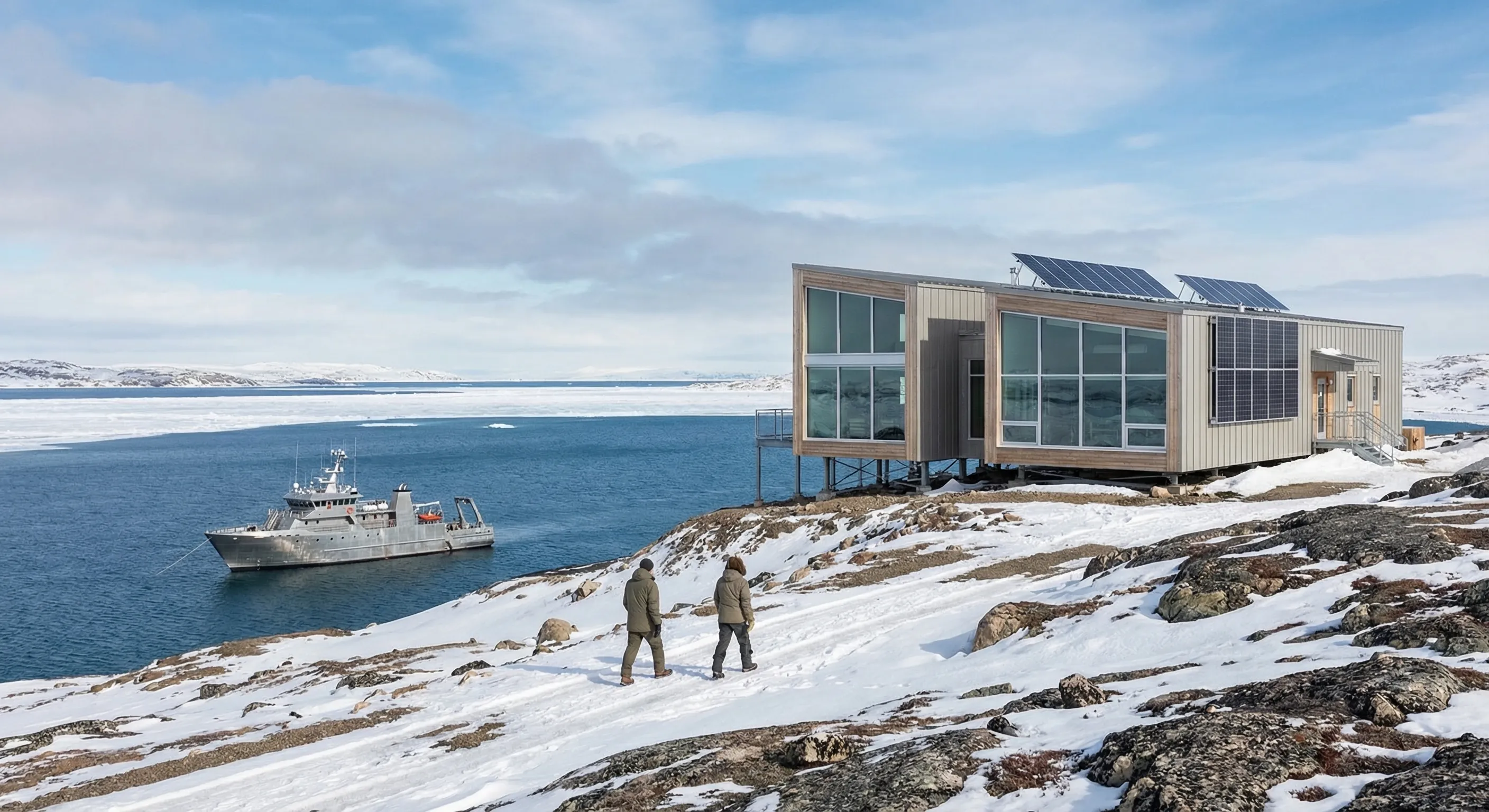
The Nunavut government, in partnership with Natural Resources Canada and several First Nations energy organizations, has committed to deploying renewable microgrids in 10 communities between 2025 and 2027. These projects combine solar photovoltaic arrays, wind turbines, battery energy storage systems, and smart grid controllers to reduce, and in some cases potentially eliminate, diesel generation during favourable conditions.
Solar in the Arctic sounds paradoxical, but the physics work. Above the Arctic Circle, summer provides 20+ hours of continuous daylight, and the high-latitude sun angle is offset by the sheer duration of exposure. Solar panels also operate more efficiently in cold temperatures, a panel at -20°C can produce 10-15% more power than the same panel at 25°C, because photovoltaic cells are more efficient when cool. Snow reflection (albedo) further increases irradiance. Several Arctic solar installations have demonstrated summer generation that exceeds projections made for southern installations of the same capacity.
The limitations are equally real. Solar generation is essentially zero during the polar winter, from November through January in the High Arctic, there is simply not enough sunlight. This is where wind generation and battery storage become critical. Arctic winds are strong and consistent, and small-scale wind turbines rated for extreme cold (down to -40°C) are commercially available and improving rapidly. The combination of summer solar, year-round wind, and lithium-ion or flow battery storage can meaningfully reduce diesel consumption.
Several pilot projects are already demonstrating results:
- Iqaluit solar-wind pilot: Testing solar panels and wind turbines specifically to power EV charging stations. Early results show that summer solar generation can fully offset charging load for a small fleet of vehicles.
- Kugluktuk renewable microgrid: A community-scale project combining 150 kW of solar with battery storage, designed to reduce diesel consumption by 20-30%.
- Sanikiluaq wind-diesel hybrid: One of the longer-running Arctic renewable projects, demonstrating that wind generation can reliably offset 15-25% of annual diesel consumption even in challenging conditions.
The connection between these projects and EV adoption is direct: every kilowatt-hour generated by renewables is a kilowatt-hour that does not come from a diesel generator. If a community's microgrid produces surplus renewable energy, particularly during the summer, that energy can charge EVs at near-zero marginal cost. The EV becomes not just a transportation tool but a distributed energy storage asset, absorbing renewable generation that might otherwise be curtailed.
This is the future that makes EVs genuinely viable in Arctic communities: not plugging into diesel generators to move fossil fuel combustion from the vehicle to the power plant, but plugging into renewable microgrids that break the diesel dependency entirely. That future is not here yet for most of Nunavut. But it is coming, and it is coming faster than the "EVs can never work in the Arctic" crowd acknowledges.
Off-Grid Charging Solutions: Solar, Wind, and Storage for Remote Communities
For the 17 communities with no road access and no prospect of grid connection to southern Canada, off-grid charging solutions are not a nice-to-have, they are the only path to EV adoption.
The technical building blocks exist:
- Solar PV arrays rated for Arctic conditions, with reinforced mounting for high winds and snow loading. Costs have dropped to approximately $1.50-2.50 per watt installed in remote locations (higher than southern Canada's $1.00-1.50/W due to logistics, but still economically viable over a 20-year panel life).
- Small wind turbines designed for extreme cold operation.
Units from manufacturers like Enercon, Vestas, and Northern Power Systems are rated to -40°C and have been deployed successfully in Scandinavian Arctic conditions.
- Battery energy storage using lithium-ion or vanadium redox flow batteries. Lithium-ion is cheaper per kWh but requires thermal management in extreme cold; flow batteries are more tolerant of temperature extremes but are heavier and more expensive per unit capacity.
Both technologies are viable, and the optimal choice depends on community-specific conditions.
- Smart charge controllers that can prioritize EV charging during periods of renewable surplus and throttle it during periods of high community demand or low generation.
A realistic off-grid EV charging system for a small Arctic community might look like this: a 50-100 kW solar array, two small wind turbines (10-30 kW each), a 100-200 kWh battery bank, and a charge controller managing 2-4 Level 2 EV chargers. The capital cost for such a system would be $500,000 to $1.5 million, significant, but comparable to the annual diesel fuel cost for a small community and substantially less than the lifetime cost of a diesel generator replacement.
The challenge is not the technology. The challenge is the logistics of building, installing, and maintaining these systems in communities that are accessible by sealift for only 6-8 weeks per year, where construction labour must often be flown in, and where a broken component might wait months for a replacement part. These are solvable problems, but they require sustained investment and community-level planning that goes far beyond what an individual EV buyer can do.
Gear worth having
As an Amazon Associate, ThinkEV earns a small commission from qualifying purchases — at no extra cost to you.
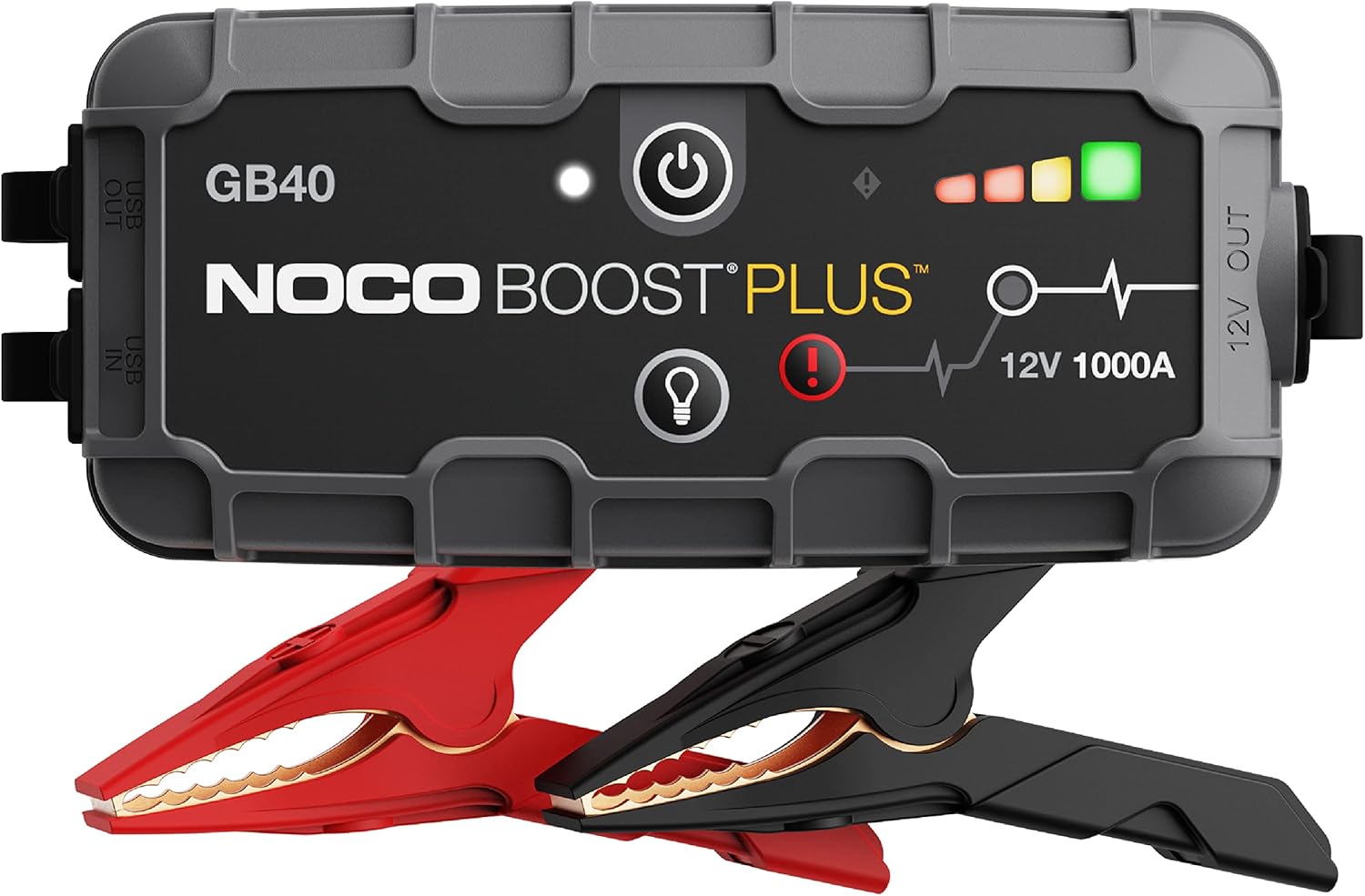
NOCO Boost Plus GB40 Jump Starter
A 1000A lithium jump starter that fits in your glovebox and works on any 12V battery. Your insurance against a dead 12V in a parking lot.
As an Amazon Associate, ThinkEV earns from qualifying purchases — at no extra cost to you.
Emergency Preparedness in Extreme Cold: An EV-Specific Survival Consideration
This section matters more than any spec sheet or cost comparison. In southern Canada, running out of fuel is an inconvenience. In Nunavut at -40°C, it can be fatal.
An EV that runs out of charge between communities in winter is a uniquely dangerous situation for two reasons. First, a gas vehicle with an empty tank can still be warmed with a candle, emergency heater, or by running the engine briefly if you have a jerry can of fuel. An EV with a dead battery has no way to generate heat, the heating system is electric, and if the battery is depleted, it is simply unavailable. Second, an EV at low state of charge in extreme cold may become unrecoverable without specialized equipment, the battery management system may prevent charging if the cells are too cold, creating a situation where the vehicle cannot accept energy even if a portable generator or charge source arrives.
Anyone driving an EV in Nunavut, even within Iqaluit, needs to take emergency preparedness seriously:
- Never leave home with less than 50% charge in winter. In southern Canada, 20% is the typical "get to a charger" threshold. In the Arctic, 50% is the minimum responsible buffer.
- Carry a portable emergency heating source that does not depend on the vehicle's electrical system. Catalytic propane heaters (with adequate ventilation) or chemical heat packs rated for extreme cold are essential.
- Keep a full winter survival kit in the vehicle at all times: insulated sleeping bags rated to -50°C, emergency food and water, a satellite communicator (InReach, SPOT, or similar), high-visibility markers, and extra layers.
- Inform someone of your travel plans before any inter-community trip.
Nunavut RCMP and community search-and-rescue teams should know your route and expected arrival time.
Gear worth having
As an Amazon Associate, ThinkEV earns a small commission from qualifying purchases — at no extra cost to you.

Grizzl-E Classic Level 2 EV Charger (40A)
Canadian-made and rated for minus 40C winters. 40A / 9.6 kW, NEMA 14-50, indoor/outdoor, 24-ft cable. The charger built for Canadian weather.
As an Amazon Associate, ThinkEV earns from qualifying purchases — at no extra cost to you.
- Carry a NOCO Boost GB40 or equivalent portable jump starter, while designed for gas vehicles, it can power small electronics and emergency lights. For EVs specifically, a portable 120V inverter generator (2-3 kW) can provide trickle charging sufficient to warm the battery enough to accept a charge or drive to the nearest community.
- Precondition aggressively. Always plug in overnight and precondition the battery and cabin before departure.
This is not optional in the Arctic, it is the single most important thing you can do to maximize range and safety.
The assessment: inter-community EV travel in Nunavut is not recommended in 2026 without charging infrastructure between communities. Within-community driving in Iqaluit, with home charging and responsible range management, is a different story. But anyone considering an EV for Arctic use must internalize that the margin of error is thinner than anywhere else in Canada, and the consequences of misjudging your range are extreme.
Gear worth having
As an Amazon Associate, ThinkEV earns a small commission from qualifying purchases — at no extra cost to you.

PULIDIKI Car Cleaning Gel (Detailing Putty)
Press it into vents, buttons, and seams and it lifts out dust you did not know was there. Weirdly satisfying, genuinely useful.
As an Amazon Associate, ThinkEV earns from qualifying purchases — at no extra cost to you.
Indigenous Community Considerations: Sovereignty, Self-Determination, and Energy Independence
Any serious discussion of EV adoption in Nunavut that ignores Indigenous perspectives is not just incomplete, it is irresponsible. Nunavut was created in 1999 as a territory with an Inuit-majority governance structure, and energy policy in the territory is inseparable from questions of Inuit self-determination, land stewardship, and economic development.
Several dimensions of the EV conversation look different through an Indigenous lens:
Energy sovereignty. The diesel dependency that defines Nunavut's energy system is itself a colonial inheritance. Communities did not choose diesel generators, they were imposed as the default solution by southern planners who prioritized expedience over sustainability. The transition to renewable microgrids represents, for many communities, a step toward energy self-sufficiency. If those microgrids also enable EV adoption, the transportation transition becomes part of a broader sovereignty story: communities generating their own power and fuelling their own vehicles from local resources, rather than depending on an annual sealift of diesel from southern refineries.
Land use and environmental impact. Nunavut's land is not empty, it is actively used for hunting, fishing, trapping, and cultural practices that are central to Inuit identity and food security. The environmental case for EVs (zero tailpipe emissions, reduced noise pollution) resonates differently in communities where the land is not an abstraction but a daily source of sustenance. Diesel spills from fuel storage, generator emissions in residential areas, and the noise of idling engines all have tangible impacts on community health and land quality that EVs would eliminate.
Economic development. If renewable energy and EV maintenance create local employment opportunities, training community members as solar technicians, wind turbine operators, and EV mechanics, the transition can contribute to economic self-determination. This is not a given; it requires intentional investment in training and local hiring. But the potential is real, and several northern Indigenous communities in the NWT and Yukon have already demonstrated successful models.
Traditional transportation. In many Nunavut communities, snowmobiles and ATVs are more important than cars. Any EV discussion should acknowledge that the vehicles most Nunavummiut rely on are not passenger cars, they are off-road vehicles used for hunting and travel on the land. Electric snowmobiles exist (Taiga Motors, for example), but they are early-stage, expensive, and largely untested in true Arctic conditions. The passenger EV question is relevant primarily to Iqaluit and a handful of the larger communities where road-based commuting exists.
Consultation and consent. Energy and transportation projects in Nunavut must involve meaningful consultation with Inuit organizations, particularly Nunavut Tunngavik Incorporated (NTI) and regional Inuit associations. Top-down policy mandates from Ottawa that do not account for community-level priorities and concerns are unlikely to succeed and may actively harm the transition by generating resistance.

Seasonal Logistics: Summer Roads, Sealift, and the Practical Reality of Getting an EV to Nunavut
Buying an EV in Nunavut is not like buying one in Toronto. You cannot drive to a dealership. There are no dealerships. The vehicle must be shipped, and the shipping options are limited, expensive, and seasonal.
Sealift is the primary method for getting vehicles to Nunavut. The summer sealift season runs approximately July through September, with exact timing varying by community. Shipping a vehicle by sealift from Montreal costs approximately $3,000-6,000 depending on the destination community, vehicle size, and whether it can be driven on and off the barge or must be loaded by crane. Orders must be placed months in advance, and if you miss the sealift window, you wait a year.
Air freight is theoretically possible for a vehicle but prohibitively expensive, $5-15 per kilogram, and a 2,000 kg EV would cost $10,000-30,000 to fly in. This is not a realistic option for most buyers.
Winter roads (seasonal ice roads) connect some communities temporarily during the coldest months. In the Kivalliq region, winter roads between communities like Baker Lake, Chesterfield Inlet, and Rankin Inlet operate from approximately January to April, depending on ice conditions. These roads are the only time some road-connected communities are actually accessible by ground vehicle. The irony is acute: the roads only exist when conditions are worst for EV range.
Summer road access is more reliable for the 13 road-connected communities, but Nunavut's roads are unpaved, often rough, and subject to closures during breakup (spring thaw) and freeze-up (fall). An EV operating on these roads will experience higher energy consumption due to rolling resistance on gravel and washboard surfaces, a factor that further reduces the already-compressed winter range.
The practical implications: if you are buying an EV for use in Iqaluit, plan to order it 6-12 months in advance and ship it by sealift. Budget $3,000-5,000 for shipping. And accept that if something goes seriously wrong with the vehicle, a battery failure, a motor issue, a damaged charging port, the repair timeline will be measured in weeks or months, not days, because parts and technicians may need to be flown in from southern Canada.
The Cost Equation: $38K Kona vs. $35K RAV4 and the Full Arctic Math
The purchase price comparison is just the surface. Let me lay out the full cost picture for someone considering an EV versus a gas vehicle for daily driving in Iqaluit.
Purchase price:
- Hyundai Kona Electric: ~$43,000 MSRP - $5,000 federal EVAP rebate = ~$38,000
- Toyota RAV4 (gas): ~$35,000
- Price difference at purchase: ~$3,000 in favour of the RAV4
Shipping:
- Both vehicles ship by sealift at comparable cost: ~$3,500-5,000
- No difference here
Annual fuel/energy cost (15,000 km/year in Iqaluit):
- RAV4 at 8.5 L/100 km, diesel at $2.50/L: ~$3,190/year
- Kona Electric at 18-22 kWh/100 km (cold-weather adjusted), electricity at $0.30/kWh: ~$810-990/year
- Annual savings for EV: ~$2,200-2,380/year
Maintenance:
- RAV4: oil changes, transmission service, brake replacement, exhaust system, estimated $1,200-1,800/year in Iqaluit (parts and labour costs are higher in the North)
- Kona Electric: tire rotation, brake inspection (regenerative braking extends pad life significantly), cabin air filter, coolant check, estimated $400-700/year
- Annual savings for EV: ~$800-1,100/year
Total annual operating savings for EV: ~$3,000-3,480/year
At that rate, the $3,000 purchase price premium is recovered in approximately one year. Over a 10-year ownership period, the EV saves roughly $27,000-31,800 in operating costs. Even accounting for one potential battery replacement at $10,000-15,000 (which may or may not be needed, see our EV Battery Degradation guide for longevity data), the EV is significantly cheaper to own over its lifetime.
The catch: these numbers assume Iqaluit's subsidized electricity rates and home charging access. In remote communities where electricity costs $0.60-1.00+/kWh, the annual energy savings shrink to $1,000-2,000, and the payback period stretches to 2-3 years. Still favourable, but less dramatically so, and more vulnerable to unexpected costs.
The cost equation also does not account for the psychological and practical value of fuel independence. In a community where a diesel shortage can mean $5.00/L fuel or worse, an EV owner with a home solar installation is partially insulated from supply disruptions. That resilience has value that does not show up on a spreadsheet.
Government Programs and the NWT Comparison
Nunavut currently offers no territorial EV rebate. The only financial incentive available to Nunavut EV buyers is the federal EVAP (Electric Vehicle Availability Program) rebate of up to $5,000 for eligible vehicles. Nunavut has no territorial top-up, no EV-specific electricity rate, and no public investment specifically earmarked for EV charging infrastructure (as distinct from the broader renewable energy investments discussed earlier).
Compare this to the Northwest Territories, which offers a $5,000 territorial rebate on top of the federal EVAP, making the total rebate stack $10,000 for NWT residents. The NWT has also invested in Level 2 and DC fast chargers along the Mackenzie Highway corridor, connecting Yellowknife to communities like Hay River and Fort Providence. The NWT's approach is not perfect, the territory still faces extreme cold, limited infrastructure, and small population centres, but it demonstrates that a northern territory can actively pursue EV adoption rather than waiting for the market to deliver it.
For a comprehensive breakdown of every provincial and territorial EV incentive in Canada, see our EV Rebates by Province Canada 2026 guide. The NWT's $5,000 rebate is covered there, along with the specific differences between the NWT and Nunavut programs that Northwest Territories EV Incentives 2026 explores in detail.
The policy gap between Nunavut and the NWT is not trivial. A $5,000 territorial rebate would eliminate the purchase price premium entirely for many EV models. Combined with the federal rebate, it would make an EV cheaper at point of sale than its gas equivalent, a psychological tipping point that matters enormously in a price-sensitive market. Nunavut's government has indicated interest in exploring EV incentives, but as of early 2026, no program has been announced.
Beyond rebates, the federal government's Zero Emission Vehicle Infrastructure Program (ZEVIP) provides funding for charging infrastructure in communities across Canada, including northern and remote areas. Several Nunavut communities have applied for ZEVIP funding, and approvals are expected throughout 2026. If those applications are successful, the territory could see its public charging count grow from single digits to something resembling a functional network, at least in the larger communities.
Alaska, Greenland, and Norway: What International Comparisons Actually Tell Us
The most common rebuttal to "EVs cannot work in cold climates" is Norway. And it is a powerful rebuttal. Norway has achieved over 90% EV market share for new vehicle sales, and large portions of the country experience winters that, while not as extreme as Nunavut's, are legitimately cold. Tromsø, 350 km north of the Arctic Circle, regularly sees -15°C to -25°C, and EV adoption there is strong. Norwegian drivers have demonstrated that with adequate charging infrastructure, EVs work in cold climates.
But the Norway comparison has important limitations when applied to Nunavut:
- Norway's coldest temperatures are mild by Nunavut standards. Tromsø's record low is -18.4°C. Iqaluit's record low is -46.1°C. The difference between -20°C and -45°C in terms of battery performance is not linear, it is a cliff. Norway's experience demonstrates that EVs work in "cold. " It does not demonstrate that they work in "lethally cold. "
- Norway has dense charging infrastructure. Even in northern Norway, public chargers are available every 50-100 km along major routes.
Nunavut has three chargers in one community.
- Norway has cheap, clean electricity. Norwegian electricity is 98% hydroelectric and costs approximately $0.10-0.15 CAD/kWh. Nunavut's electricity is diesel-generated and costs $0.30-1.00+/kWh.
- Norway has roads. This sounds obvious, but it is the single most important difference. Every community in Norway is connected by paved roads, and the national highway network enables long-distance EV travel with fast charger stops. Nunavut's road network is fragmentary, unpaved, and seasonal.
Alaska is a more relevant comparison. Interior Alaska sees temperatures comparable to Nunavut (-40°C to -50°C), and many communities face similar challenges with remote access, diesel dependency, and limited infrastructure. EV adoption in Alaska is concentrated in Anchorage and Fairbanks, where road networks and charging infrastructure exist. Rural Alaska, like rural Nunavut, has seen minimal EV adoption because the same infrastructure barriers apply. The Alaska experience validates the pattern: EVs work in Arctic communities with roads and chargers, and they do not work (yet) in communities without them.
Greenland is perhaps the closest parallel. With a population of 56,000 spread across communities connected primarily by air and sea, Greenland faces nearly identical challenges to Nunavut. EV adoption in Greenland is negligible as of 2026, for all the same reasons. The exception is Nuuk (population 19,000), where a small number of EVs operate for local commuting, a pattern that mirrors the Iqaluit case.
Nordic lessons that transfer:
- Cold weather EV performance improves with each vehicle generation. Scandinavian automakers and consumers have driven rapid improvement in heat pump efficiency, battery thermal management, and cold-weather software optimization.
- Incentive stacking works. Norway's combination of tax exemptions, free parking, free ferries, and toll exemptions made EVs cheaper to own than gas cars, and adoption followed.
- Charging infrastructure must lead adoption, not follow it. Norway invested heavily in fast chargers before the mass market demanded them, creating confidence among buyers that chargers would be available.
These lessons are directly applicable to Nunavut, but the implementation timeline is necessarily longer and the per-community investment is necessarily higher due to the extreme remoteness and harsh conditions.
Long-Term Infrastructure Roadmap: What Needs to Happen and By When
The transition from "EVs are not practical for most of Nunavut" to "EVs are a reasonable choice in most Nunavut communities" requires a specific sequence of investments and milestones. Here is what that roadmap looks like, based on current government commitments, technology trajectories, and realistic logistics:
2026-2027: Foundation phase
- 10 renewable microgrid projects deployed across Nunavut communities (committed by the Nunavut government)
- ZEVIP-funded Level 2 chargers installed in 3-5 additional communities
- Iqaluit achieves 10+ public charging points (Level 2 and potentially one DC fast charger)
- First EV fleet vehicles deployed by Government of Nunavut for in-community use
2028-2030: Expansion phase
- Renewable microgrids operational in 15-20 communities, reducing electricity costs to $0.15-0.25/kWh in those communities
- Level 2 chargers available in all 13 road-connected communities
- At least 2 DC fast chargers along the Iqaluit-Kimmirut corridor (the most-travelled inter-community route in the territory)
- NWT-style territorial EV rebate introduced (projected based on current policy discussions)
- EV battery technology improved to the point where 70+ kWh packs with solid-state or semi-solid-state cells deliver 30-40% better cold-weather range than 2026 technology
2031-2035: Maturation phase
- All road-connected communities have both Level 2 and Level 3 charging
- Renewable energy provides 50%+ of electricity in participating communities
- EVs are the default recommendation for in-community transportation in communities with renewable microgrids
- Electric snowmobiles and ATVs reach commercial maturity, extending the EV transition beyond passenger cars
This roadmap is optimistic but not unrealistic. It depends on sustained federal and territorial investment, continued battery technology improvement, and successful execution of the renewable microgrid projects. If any of those elements falters, the timeline pushes back. But the direction is clear, and the fundamental economics, replacing the most expensive fuel in Canada with locally generated renewable energy, increasingly favour the transition.
The Verdict: Honest, Community-Specific, and Uncomfortable for Both Sides
EVs are not practical for most of Nunavut in 2026. The charging infrastructure simply is not there, and the economics do not favour early adoption in remote communities powered by diesel generators. Anyone who tells you otherwise is selling something.
But that is a fundamentally different statement from "EVs can never work here." And anyone who tells you that is ignoring the trajectory of battery technology, renewable energy deployment, and the crippling economics of diesel dependency that make the status quo unsustainable regardless of what replaces it.
The honest, community-specific assessment:
Iqaluit (population ~15,000): EVs are viable today for daily in-town driving, provided you choose the right vehicle (Ioniq 5 AWD, EV6 AWD, or Model 3 AWD), have access to home charging, and accept the range limitations. The cost savings over a 10-year ownership period are substantial. This is not a stretch, it is a defensible financial decision right now.
Road-connected communities with upcoming microgrids (e.g., Rankin Inlet, Cambridge Bay, Baker Lake): EVs become viable within 2-3 years as renewable microgrids come online and reduce electricity costs. Early adoption is not unreasonable if you are committed to being an early adopter and can accept the current infrastructure limitations. A gas vehicle or hybrid is the safer choice today, but the window is closing.
Road-connected communities without microgrid plans: A gas vehicle is the pragmatic choice for now. Monitor infrastructure development and revisit in 2028-2029. The economics will shift as battery technology improves and charging infrastructure expands.
Fly-in communities (17 of 30): Not viable for the foreseeable future for passenger EVs. The absence of road access makes the entire framing different, these communities need electric snowmobiles, electric ATVs, and renewable-powered community vehicles before they need passenger EVs. The diesel dependency is real and harmful, but the solution is not passenger cars.
For the territory as a whole: The future is genuinely moving in the right direction. Renewable microgrids, falling battery costs, improving cold-weather EV performance, and the brutal economics of diesel dependency are all pushing toward an electric transition. The question is not whether EVs will work in Nunavut, it is when, and in which communities first. The answer to "when" is already "now" for Iqaluit and "soon" for a growing number of communities. For the rest, not yet, and probably not for a while. But the trajectory is unmistakable.
Gear worth having
As an Amazon Associate, ThinkEV earns a small commission from qualifying purchases — at no extra cost to you.

WixGear Magnetic Air Vent Phone Mount (2-Pack)
A magnet strong enough that your phone never flinches over potholes or rail crossings. Two in the box, one for each car.
As an Amazon Associate, ThinkEV earns from qualifying purchases — at no extra cost to you.
Related Reading
- EV Winter Range Test Canada 2026, Real-world cold weather range data for Canadian EV owners.
- Northwest Territories EV Incentives 2026, How the NWT's $5,000 territorial rebate compares to Nunavut's gap.
- EV Charging Infrastructure Canada 2026, The national charging network and where the gaps are.
- EV Battery Degradation: How Long Do EV Batteries Last?, Longevity data for cold-climate EV owners.
- EV Rebates by Province Canada 2026, Every provincial and territorial EV incentive explained.
- Canada EVAP Rebate Guide 2026, How to claim your $5,000 federal EV incentive.
Gear worth having
As an Amazon Associate, ThinkEV earns a small commission from qualifying purchases — at no extra cost to you.

Car Cup Holder Coasters (4-Pack)
Drop-in coasters that catch spills and crumbs so your cup holders stay clean. Rinse and reuse forever.
As an Amazon Associate, ThinkEV earns from qualifying purchases — at no extra cost to you.

Founder & Chief Editor
Vlad Pereira is the founder and chief editor of ThinkEV.ca, the Canadian electric-vehicle publication he writes and edits from Courtenay, British Columbia. He covers EV pricing, federal and provincial rebates, charging costs, and the Chinese manufacturers now entering Canada, from the buyer's side rather than the press-fleet side. ThinkEV is a venture of Vlad Pereira Online; his writing on health, income and the long game lives at vladpereira.com.
Frequently asked questions
Can EVs handle the extreme cold in Nunavut?
How much does it cost to charge an EV in Nunavut?
Are there any EV charging stations in Nunavut?
Is it cheaper to run an EV in Nunavut than a gas vehicle?
What's the future of EVs in Nunavut?
Does Nunavut offer any EV rebates?
How does Norway's EV success compare to Nunavut's challenges?
What emergency preparations are needed for driving an EV in extreme Arctic cold?
Which EV models are best for Iqaluit?
More EV & road-trip finds
Affordable upgrades worth a look — tap any to check the price on Amazon.
 ★ 537
★ 537USB Star Projector Roof Light
View on Amazon ★ 568
★ 568Personalized Photo and Text Keychain
View on Amazon ★ 1,340
Car Seat Gap Filler (Universal)
View on Amazon ★ 692
★ 692USB-A to USB-C CarPlay Adapter (3-Pack)
View on Amazon ★ 121
★ 121Foldable Windshield Sun Umbrella
View on Amazon ★ 268
★ 268Anti-Slip Leather Steering Wheel Cover
View on Amazon ★ 9,349
Auto Detailing Brush Set (10-Piece)
View on Amazon ★ 314
★ 314Mini USB LED Ambient Lamps (4-Pack)
View on AmazonRead, Plan, Then Stay Current
Explore our expert articles to understand incentives and ownership costs, use the map to pressure-test charging reality, then subscribe so new EV coverage comes straight to you.
Continue Reading
Import a Chinese EV Canada to US: Why It Fails
EV Market Under $50K in Canada: Why This Price Band Matters
Every Chinese EV Brand Coming to Canada in 2026
Switching From Gas to an EV in Canada: The Guide
Why Legacy Automakers Keep Losing to Chinese EV Brands