Key takeaways
- Industry data suggests that 23% of first-time EV renters go on to purchase an electric vehicle within six months.
- Canada's EV rental fleet has crossed 15,000 vehicles and is climbing fast.
- That number was under 7,000 at the end of 2023 and around 4,000 at the end of 2022.
Twenty-three percent of Canadians who rent an EV for the first time go on to buy one within six months. That conversion rate, tracked across rental agencies and corroborated by dealer surveys from the Canadian Automobile Dealers Association, explains why Canada's EV rental fleet has grown from 4,000 vehicles at the end of 2022 to more than 15,000 today. Renting before buying is not a workaround; it has become the most effective on-ramp to EV ownership in the country, and the options have never been better.
Here's what I find genuinely exciting about this: the rental market isn't just growing, it's becoming the front door to EV ownership for hundreds of thousands of Canadians who wouldn't otherwise take the leap. Industry data suggests that 23% of first-time EV renters go on to purchase an electric vehicle within six months. That's not a marketing stat plucked from a press release. That's real purchase behaviour tracked across rental agencies and corroborated by dealer surveys from the Canadian Automobile Dealers Association. The try-before-you-buy pipeline is real, and it's converting skeptics into buyers at a rate that no amount of advertising or government incentive programs could match on its own.
This post covers the full picture: who's renting what, where you can find them, what it costs, what renters learn from the experience, how to plan an EV road trip rental, and where this market is headed through the rest of 2026 and beyond. Whether you're EV-curious, actively shopping, or just trying to understand the picture, this is the most comprehensive look at the Canadian EV rental market you'll find.
The Fleet Numbers: 15,000 EVs and Climbing
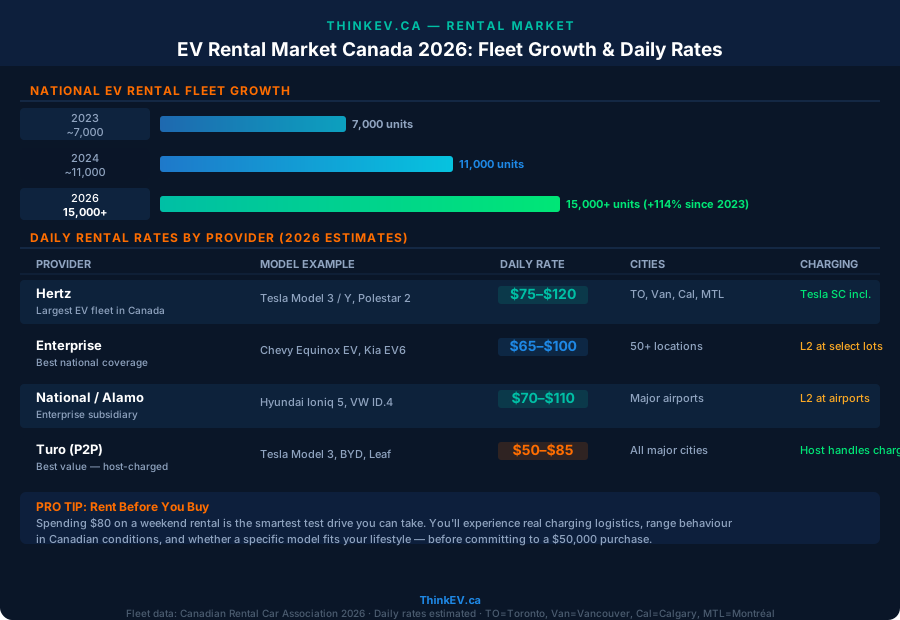
Let's start with the scale, because the numbers matter. As of early 2026, Canada's combined rental fleet includes more than 15,000 battery-electric vehicles spread across traditional rental agencies, national brands, and peer-to-peer platforms. That number was under 7,000 at the end of 2023 and around 4,000 at the end of 2022. The growth curve is steep, and it's being driven by a combination of manufacturer incentives to rental companies, federal fleet electrification targets, and plain old consumer demand.
To put 15,000 units in context: the total Canadian rental car fleet is estimated at roughly 250,000 to 280,000 vehicles across all agencies and platforms. EVs now represent about 5.5-6% of the rental fleet nationally. That might sound modest, but consider that three years ago it was under 2%. The trajectory matters more than the snapshot.
Here's the breakdown by major player:
-
Hertz operates the largest EV rental fleet in Canada with approximately 5,500 battery-electric vehicles across its locations. Hertz made a massive global bet on EVs starting in 2021, ordering 100,000 Tesla Model 3s for its worldwide fleet. The Canadian portion of that order, combined with subsequent purchases from other manufacturers, gives Hertz an outsized share of the rental EV market. Their fleet is heavily weighted toward Tesla, roughly 60% Model 3s, with the remaining 40% split between Chevrolet Bolt EV/EUVs, Hyundai Ioniq 5s, Kia EV6s, and a smaller number of Polestar 2s.
-
Enterprise Holdings (which includes Enterprise, National, and Alamo) has approximately 4,200 EVs in its combined Canadian fleet. Enterprise took a more conservative approach than Hertz, building their EV offerings gradually and focusing on mid-range models that appeal to mainstream renters rather than luxury seekers. Their fleet features a strong mix of Hyundai Kona Electrics, Ford Mustang Mach-Es, Chevrolet Bolt EUVs, and, as of Q1 2026, the Chevrolet Equinox EV. National, as the business-travel arm of Enterprise Holdings, tends to get the newer models first.
-
Turo is the peer-to-peer wildcard, with over 2,800 active EV listings across Canada as of March 2026. This number fluctuates because Turo relies on individual vehicle owners listing their cars, but the trend has been consistently upward. Turo's EV listing count has grown roughly 45% year-over-year since 2024.
-
Other agencies, including Budget, Avis, and various regional operators, account for the remaining 2,500 or so EVs in the rental market. Budget and Avis (both owned by Avis Budget Group) have been slower to electrify than Hertz or Enterprise, but they've accelerated purchases through 2025 and into 2026, particularly in Vancouver and Toronto markets.
The concentration is important to note: roughly 70% of all rental EVs in Canada are located in three metro areas, Greater Toronto, Metro Vancouver, and Greater Montreal. These are the markets where EV charging infrastructure is densest, where consumer demand is strongest, and where rental companies can turn EVs over quickly enough to justify the investment. Once you get outside these three hubs, EV rental availability drops off sharply, though not as sharply as it did two years ago.
Who's Renting What: The Fleet Breakdown
Hertz has made the biggest commitment to EV rentals in Canada. Their Toronto Pearson Airport fleet alone includes over 1,200 EVs, primarily Tesla Model 3s and some Chevrolet Bolts. In Vancouver, they've added Hyundai Ioniq 5s and Kia EV6s, which are popular with renters who want to try the 800V ultra-fast charging experience. Montreal's Hertz fleet has about 800 EVs, heavily weighted toward the Chevrolet Bolt EUV. Their Ottawa location carries around 300 EVs, and Calgary has roughly 250. Even Edmonton and Winnipeg now have 50-100 Hertz EVs available on any given day, though selection in those markets is limited primarily to Tesla Model 3s and Bolt EUVs.
Hertz has also introduced what they call the "EV Experience" package at select locations, Toronto Pearson, Vancouver International, and Montreal Trudeau airports. This includes a brief orientation for first-time EV renters: how to use the charging cable, how the onboard navigation finds chargers, how regenerative braking works, and what the dashboard range estimate actually means. I'll be honest, this is exactly the kind of thing the rental EV market needed. First-time renters getting handed keys to a Tesla with zero guidance was one of the biggest complaints in 2023 and 2024, and it led to a lot of bad experiences that had nothing to do with the car itself.
Enterprise has taken a different approach, focusing on mid-range models that feel familiar to mainstream renters. Their Ottawa and Calgary fleets feature the Hyundai Kona Electric and Ford Mustang Mach-E, with plans to add the Chevy Equinox EV across all Canadian locations by Q3 2026. Enterprise's strategy is interesting because they're specifically targeting the "curious but cautious" renter, someone who drives a RAV4 or CRV and wants to see if an electric crossover could replace it. The Mustang Mach-E and Kona Electric are perfect for this: they look and feel like normal crossovers, they have conventional-ish interiors with actual buttons (unlike a Tesla), and they don't require any real learning curve to operate.
National Car Rental, Enterprise's business-travel brand, has positioned itself as the premium EV rental option. Their Executive fleet at major airports includes the BMW iX, Mercedes-Benz EQE, and Tesla Model Y Performance, vehicles that business travellers with corporate accounts are willing to pay a premium for. National's "Emerald Club" members can choose an EV from the Executive aisle without a reservation, and the uptake has been surprisingly strong. National reports that approximately 18% of Emerald Club members who chose a vehicle from the Executive aisle selected an EV in Q4 2025, up from about 8% a year earlier.
Turo is the wildcard. The peer-to-peer platform now lists over 2,800 EVs across Canada, and the variety is staggering. In Vancouver alone, you can rent a Rivian R1T, a BMW i4, a Polestar 2, a Lucid Air, a Genesis GV60, or a VinFast VF 8, models that none of the traditional rental companies carry. In Toronto, there are Turo listings for the Porsche Taycan, Audi Q8 e-tron, and Mercedes-Benz EQS. Montreal's Turo market has a strong showing of the Hyundai Ioniq 6, Kia EV9, and Nissan Ariya. The prices are often lower than Hertz or Enterprise for comparable models, though the experience is less standardized.
Turo experiences range from excellent to mediocre, and the quality depends entirely on the individual host. The best Turo hosts provide a spotless car with a full charge, clear instructions on how to use the vehicle's features, and a portable charging cable in the trunk just in case. The worst hosts hand you a dirty car at 35% state of charge and don't respond to messages. But if you want to try a specific model before buying it, Turo is usually the only option, and for unusual or premium EVs, it's often the only option period.
Regional Availability: Where You Can Actually Rent an EV
The geography of EV rental availability in Canada tracks closely with EV ownership rates, which shouldn't be surprising, rental companies put cars where the demand is.
Greater Toronto Area is the largest EV rental market in the country. Between Pearson Airport, Billy Bishop Airport, downtown locations, and suburban branches, there are approximately 4,500 EVs available for rent on any given day across all agencies and platforms. The model selection is the broadest in Canada: everything from a $55/day Chevrolet Bolt to a $250/day Porsche Taycan on Turo. Hertz's Pearson Airport location alone has over 1,200 EVs, making it the single largest EV rental hub in the country. The GTA also has the densest public charging network in Canada, which makes renting an EV here the lowest-friction experience possible.
Metro Vancouver is the second-largest market with roughly 3,200 rental EVs. Vancouver's EV culture is more mature than Toronto's, BC has had the highest EV adoption rate in Canada for years, and the rental market reflects that. Hertz, Enterprise, and National all have strong EV fleets at YVR and downtown Vancouver locations. Turo's Vancouver EV listings are particularly interesting because BC's early adopter community means there are owners renting out Rivian R1Ts, Lucid Airs, and other vehicles you simply won't find in other Canadian cities.
Greater Montreal comes in third with approximately 2,400 rental EVs. Quebec's generous provincial EV incentives (up to $7,000 on new purchases, on top of the federal $5,000) have built a large EV ownership base, which feeds both the traditional rental market and Turo. Montreal is the strongest market in Canada for renting a Chevrolet Bolt EUV, there are hundreds available at any given time, and prices are among the lowest in the country at $55-$70/day.
Ottawa-Gatineau has approximately 600 rental EVs, benefiting from its position between Toronto and Montreal and its large federal government workforce (which tends to be EV-positive). Enterprise has been particularly aggressive here, and the cross-border dynamics of the National Capital Region mean you can rent in Ottawa and return in Gatineau or vice versa.
Calgary and Edmonton together account for roughly 800 rental EVs. Alberta has historically lagged in EV adoption, but the rental market has grown significantly through 2025-2026. The challenge in Alberta is less about demand and more about charging infrastructure outside the two major cities, renters who want to drive between Calgary and Edmonton (300 km) have a straightforward experience, but heading to Banff, Jasper, or anywhere in rural Alberta requires more planning.
The Prairies remain the weakest EV rental market in Canada. Winnipeg has approximately 150 rental EVs, Regina has fewer than 50, and Saskatoon has roughly 40. The extreme cold, long distances between cities, and thinner charging infrastructure make this the hardest region for EV rentals. It's improving, slowly, but if you're in the Prairies and want to rent an EV, your best bet is Hertz in Winnipeg or Enterprise in Regina.
Atlantic Canada is a mixed picture. Halifax has around 200 rental EVs and is the clear hub for the region. St. John's, Moncton, and Fredericton have smaller but growing selections, typically 30-60 EVs each. The Atlantic provinces have some of the highest electricity costs in Canada, which reduces the fuel-savings advantage of EVs and has slowed adoption, but for weekend rental purposes, the driving experience itself is what matters.
Pricing: What It Actually Costs
The economics of EV rentals are changing the picture, and the pricing picture in 2026 looks very different from where it was two years ago.
Mainstream EVs ($55-$120/day): This is where the bulk of the rental market sits. A Chevrolet Bolt or Bolt EUV from Hertz or Enterprise runs $55-$80/day in most markets, with Montreal and Quebec City tending toward the lower end and Vancouver and Toronto toward the higher end. A Tesla Model 3 from Hertz runs $85-$120/day, priced roughly comparable to a mid-size gas sedan like a Camry or Accord. The Hyundai Kona Electric sits at $70-$95/day. The Hyundai Ioniq 5 and Kia EV6, which offer faster charging and more interior space, typically run $90-$115/day.
Premium EVs ($120-$250/day): This tier includes the BMW i4, Polestar 2, Tesla Model Y Long Range, and Ford Mustang Mach-E Premium. Traditional agencies price these in the $120-$175/day range, while Turo prices vary wildly depending on the host. The luxury tier, Lucid Air, Porsche Taycan, BMW iX, Mercedes EQS, runs $180-$250/day and is almost exclusively available through Turo or National's Executive fleet.
Turo pricing deserves its own note. Peer-to-peer pricing on Turo tends to be 10-20% lower than traditional agencies for comparable vehicles, but there are hidden variables. Turo charges a trip fee (typically $10-$15/day) on top of the host's listed price. Many hosts also charge a delivery fee if you want the car brought to you rather than picking it up. And Turo's insurance options add $15-$40/day depending on coverage level. All in, a Turo rental can end up costing the same as Hertz or Enterprise, or significantly less, depending on the host and the specific listing.
Seasonal pricing is a real factor and one that most renters don't account for. Summer (June through September) is peak rental season across Canada, and EV rental prices follow the same pattern as gas car rentals, they spike. A Tesla Model 3 that rents for $90/day in November might cost $130/day in July. The Bolt that was $60/day in February could be $85/day in August. If you're renting an EV specifically to test it before buying, the cheapest time to do it is October through March, outside of holiday weekends. You'll also have an easier time getting the specific model you want, since inventory pressure is lower.
Winter pricing is cheaper, but it comes with a trade-off: you'll experience the EV's worst-case range performance. That's actually useful information if you're considering a purchase. If you can live with a Bolt's range in January in Toronto, which is realistically 300-320 km rather than the rated 400+ km, then summer range will feel luxurious. Renting in winter gives you the stress test. Renting in summer gives you the highlight reel. Ideally, you'd do both, a weekend in November and another in June, but realistically most people rent once and make their decision.
The daily rental cost might seem similar to gas cars, but the fuel savings during the rental are real and immediately noticeable. A weekend of driving costs about $8-$12 in electricity versus $40-$60 in gas. For a week-long rental, that difference adds up to $30-$50 in savings, which essentially subsidizes the cost of any charging time inconvenience. Over a longer rental (some agencies offer weekly and monthly rates), the math becomes even more compelling. Hertz's weekly EV rate in Toronto is typically 15-20% less than seven individual daily rates, and Enterprise offers similar discounts.
Gear worth having
As an Amazon Associate, ThinkEV earns a small commission from qualifying purchases — at no extra cost to you.

NOCO Boost Plus GB40 Jump Starter
A 1000A lithium jump starter that fits in your glovebox and works on any 12V battery. Your insurance against a dead 12V in a parking lot.
As an Amazon Associate, ThinkEV earns from qualifying purchases — at no extra cost to you.
What Renters Learn: The Try-Before-You-Buy Pipeline
The most common feedback from first-time EV renters is surprise at how normal it feels. The driving experience isn't alien, you get in, you press a button, you drive. The regenerative braking takes about 30 minutes to get used to, and after that, most people prefer it. The silence at stoplights is either peaceful or unsettling, depending on your personality. The instant torque when you press the accelerator is universally loved. Nobody comes back from an EV rental complaining about the driving experience.
What I find most interesting is the data on what happens after the rental. That 23% conversion rate I mentioned earlier, first-time EV renters who purchase an EV within six months, is one of the most remarkable statistics in the Canadian auto market. To put it in perspective: traditional test drives at dealerships convert at roughly 10-15% for any given model. TV and digital advertising campaigns for EVs have conversion rates in the low single digits. But a weekend spent actually living with an EV, charging it, driving it to work, taking it on a grocery run, sitting in traffic with it, converts nearly one in four renters into buyers. The experiential learning is that powerful.
The reasons renters cite for buying after a rental are consistent across surveys:
-
Charging was easier than expected (cited by 67% of post-rental buyers). Most people picture EV charging as a complicated, unreliable hassle. The reality, plug in, tap your credit card or app, wait 25-35 minutes at a DC fast charger or plug in at home overnight, is so much simpler than the mental model most people carry. Renters discover this in practice, not in theory.
-
Range was sufficient for their needs (cited by 61%). The average Canadian drives 40-50 km per day. Even the shortest-range rental EV (a Nissan Leaf with 240 km) covers that distance four or five times over. Most renters finish their weekend with 40-60% battery remaining, never having charged at all beyond the initial full charge. Range anxiety, it turns out, is largely a phenomenon of imagination rather than experience.
-
The driving experience was superior (cited by 54%). Instant torque, quiet cabin, smooth acceleration, one-pedal driving. These are things you don't fully appreciate until you've lived with them, and then you get back into a gas car and notice every vibration, every gear shift, every engine rumble.
-
Fuel savings were immediately tangible (cited by 48%). Spending $8 on electricity for a weekend versus $50 on gas makes the long-term math very concrete, very fast.

The complaints from renters are predictable and mostly valid. Charging infrastructure is still inconsistent. I've heard from renters who showed up at a broken Electrify Canada station in Barrie with 12% battery and had to scramble to find an alternative. The apps, ChargeHub, PlugShare, the car's built-in navigation, don't always agree on which stations are working. This is a real problem, and it's the number one reason renters hesitate about buying. The good news is that it's getting better. The number of public DC fast chargers in Canada grew by 35% in 2025, and Tesla's Supercharger network (now open to non-Tesla vehicles with an adapter) adds a reliable fallback that significantly expands the available charging map.
The other common learning moment is about home charging. Renters who live in houses quickly realize that Level 1 charging (a regular wall outlet) is painfully slow, maybe 40 km of range per night. Level 2 charging (240V, like a dryer outlet) is the minimum for practical EV ownership. Condo and apartment renters face a harder reality: without access to a dedicated charger, daily EV ownership is significantly less convenient. This is the single biggest barrier to EV adoption that renting helps people discover before they've signed a purchase agreement.
And that discovery process works both ways, which is exactly the point. If you rent an EV for a weekend and realize that your condo's parking garage has no charging infrastructure and your building's strata council has no plans to install any, you've saved yourself from making a $50,000 mistake. That's worth the $200 rental cost many times over. Conversely, if you rent an EV and discover that your house already has a 240V outlet in the garage from a previous owner's hot tub, and that plugging in overnight gives you a full charge every morning, you've just found your next car.
Charging Logistics for Renters: What You Need to Know
Charging is the part of the EV rental experience that requires the most preparation, and it's the part that rental agencies are still figuring out. Here's the practical reality for renters in 2026.
Starting charge level: Hertz aims to hand you a car with at least 80% charge. In practice, it's often lower, 60-70% is common, especially at busy airports during peak season. Enterprise has a similar policy. Turo hosts set their own standards, and you'll find everything from 100% charge to 40%. Always check the listing or ask the agent about the expected charge level when you pick up.
Finding chargers during your rental: Every modern rental EV has built-in navigation that can route you to chargers. Tesla's navigation is the best in the business, it plans your route around Supercharger stops, estimates wait times, and even preconditions the battery as you approach. Non-Tesla EVs vary. The Hyundai and Kia models with 800V architecture have decent built-in charging maps, but I'd still recommend downloading the ChargeHub or PlugShare app as a backup. These apps show real-time availability and user reviews for charging stations, and they'll save you from driving to a charger that's out of service.
Charging costs during the rental: Most rental agencies do not include charging in the rental price. You pay for electricity the same way you'd pay for gas in a traditional rental, it's your responsibility. The difference is that paying for EV charging is less intuitive than filling a gas tank. At DC fast chargers, you'll typically pay $0.35-$0.55/kWh, which works out to roughly $15-$25 for a charge from 20% to 80%. At Level 2 public chargers, rates vary wildly, from free (at some malls, hotels, and municipal lots) to $2-$4/hour. If you're staying at a hotel or Airbnb with a Level 2 charger, you may be able to charge overnight for free or at a minimal cost.
Return charge requirements: This is where rental companies diverge. Hertz typically asks you to return the car with at least 50% charge. If you return it below that threshold, they may charge a "refuelling" fee, typically $25-$50, to cover the cost of charging the vehicle before the next rental. Enterprise has similar policies but tends to be more flexible in practice. Turo hosts set their own rules, and return charge requirements vary from "bring it back with the same level you got it" to "just don't bring it back empty." Always read the fine print on this, surprise charges on return are one of the most common complaints about EV rentals.
Gear worth having
As an Amazon Associate, ThinkEV earns a small commission from qualifying purchases — at no extra cost to you.

Grizzl-E Classic Level 2 EV Charger (40A)
Canadian-made and rated for minus 40C winters. 40A / 9.6 kW, NEMA 14-50, indoor/outdoor, 24-ft cable. The charger built for Canadian weather.
As an Amazon Associate, ThinkEV earns from qualifying purchases — at no extra cost to you.
The charging time reality: For a weekend rental in the city, you may not need to charge at all. A Tesla Model 3 with 80% charge has roughly 400 km of usable range. If you're driving 80-100 km per day around town, you'll have plenty of juice for a three-day weekend without stopping at a charger. For longer trips or heavier driving, plan for one DC fast charging stop per day, 25-40 minutes from 20% to 80%, and schedule it around a meal or a coffee break. The worst thing you can do is treat charging like a gas stop that needs to be as fast as possible. Reframe it as a built-in break and the experience is dramatically better.
Road Trip Scenario Analysis: Renting an EV vs Gas
One of the best uses of an EV rental is a road trip. Not because it's necessarily easier than renting a gas car, it's not, at least not yet, but because it teaches you more about real-world EV ownership than any amount of city driving ever will. A road trip forces you to engage with charging infrastructure, range planning, and the actual rhythm of EV travel. Here are three common Canadian road trip scenarios and how they play out with a rented EV.
Scenario 1: Toronto to Montreal (540 km)
This is the gold standard for EV road trips in Canada. The Highway 401/20 corridor has excellent DC fast charging coverage, Electrify Canada, Tesla Superchargers (open to all EVs with adapter), Petro-Canada, and Ivy Charging Network stations are spaced roughly every 50-80 km along the route. In a Tesla Model 3 Long Range (which Hertz rents for about $110/day), you'd leave Toronto with a full charge, stop once near Kingston or Brockville for 25-30 minutes, and arrive in Montreal with plenty of range. In a Chevrolet Bolt (available for $65-$75/day), you'd need two charging stops because the Bolt's slower DC fast charging speed (50 kW max) means each stop takes 40-50 minutes to add meaningful range.
Total charging cost for the one-way trip: approximately $20-$30 in electricity. Comparable gas cost in a mid-size sedan: approximately $55-$70 at current fuel prices. The EV saves you $25-$40 in fuel each way, enough to cover a nice meal at one of your charging stops.
Time comparison: In a gas car, the drive takes roughly 5.5 hours with one quick gas stop. In a Tesla Model 3, it takes about 6 hours with one 25-minute charging stop. In a Bolt, it takes about 6.5-7 hours with two longer stops. The time penalty is real but manageable, especially if you're not in a rush.
Scenario 2: Vancouver to Kelowna (390 km via the Coquihalla)
This is a more challenging route because of the elevation changes (the Coquihalla summit reaches 1,244 metres), which significantly increase energy consumption on the way up. The good news is that regenerative braking recaptures a lot of that energy on the descent. The route has charging stations in Hope, Merritt, and several points along the Coquihalla, though coverage is less dense than the Toronto-Montreal corridor. In a Hyundai Ioniq 5 (available from Enterprise in Vancouver for about $100/day), you'd stop once in Merritt for a 20-minute fast charge, the 800V architecture means the Ioniq 5 charges extremely quickly, and arrive in Kelowna comfortably.
In winter, this route requires more careful planning. The elevation gain in cold weather means significantly higher energy consumption, and you might need two stops instead of one. The Coquihalla can also be subject to winter driving conditions that slow your overall pace, which paradoxically helps with range (slower speeds = less energy consumption). But plan conservatively and you'll be fine.
Scenario 3: Calgary to Banff (130 km)
This is almost trivially easy in any modern EV. A round trip is 260 km, well within the range of every EV available for rent in Calgary. You don't need to charge at all during the trip, just plug in when you get back. There's also a Level 2 charger at the Banff Centre and several DC fast chargers in Canmore if you want a top-up. This is the kind of trip where renting an EV is strictly superior to renting a gas car: lower fuel cost, better driving experience on the mountain highway, and zero range anxiety. If you're renting from Hertz or Enterprise at Calgary Airport, ask for the Ioniq 5 or EV6, the all-wheel-drive versions handle mountain roads beautifully.
The broader lesson from road trip rentals is this: corridor routes between major cities are excellent in an EV. The charging infrastructure exists, the math works, and the experience is pleasant if you plan one or two stops into your schedule. Off-corridor routes, heading to cottage country in northern Ontario, driving through rural Saskatchewan, or exploring Newfoundland's coast, are more challenging. They're doable in most cases, but they require more planning and more tolerance for inconvenience. If your primary concern about EV ownership is "can I still do my annual road trip," renting an EV and doing that exact trip is the definitive way to answer the question.
Gear worth having
As an Amazon Associate, ThinkEV earns a small commission from qualifying purchases — at no extra cost to you.

PULIDIKI Car Cleaning Gel (Detailing Putty)
Press it into vents, buttons, and seams and it lifts out dust you did not know was there. Weirdly satisfying, genuinely useful.
As an Amazon Associate, ThinkEV earns from qualifying purchases — at no extra cost to you.
Cost Comparison: EV Rental vs Traditional Rental
Let me run the numbers on a typical rental scenario, because the comparison is closer than you might think, and the EV comes out ahead in ways that aren't immediately obvious.
Weekend rental (3 days), Toronto:
- Gas sedan (Toyota Camry or equivalent): $75/day = $225 total rental. Estimated fuel for 300 km of driving: $45 (assuming 8L/100km at $1.65/litre). Total: $270.
- EV (Chevrolet Bolt EUV): $65/day = $195 total rental. Estimated electricity for 300 km: $8-$12 (charged overnight at a hotel with free Level 2, or one DC fast charge at ~$15). Total: $203-$210.
The EV is $60-$67 cheaper for a three-day weekend in this scenario. That's not a marginal difference, it's a 23-25% savings.
Week-long rental (7 days), Vancouver:
- Gas SUV (Toyota RAV4 or equivalent): $85/day = $595 total rental. Estimated fuel for 700 km: $90 (assuming 9L/100km at $1.70/litre). Total: $685.
- EV (Hyundai Ioniq 5): $100/day = $700 total rental. Estimated electricity for 700 km: $25-$35 (mix of hotel charging and one or two DC fast charges). Total: $725-$735.
In this scenario, the EV is about $40-$50 more expensive. The higher daily rate for the Ioniq 5 more than offsets the fuel savings. However, if you're renting a Tesla Model Y from Hertz at $95/day instead, the total drops to $665-$700, essentially break-even with the gas SUV. And if you have access to free Level 2 charging at your accommodation, the EV pulls ahead.
The point isn't that EV rentals are always cheaper, they're not. The point is that the cost premium, when there is one, is small enough that it shouldn't be the deciding factor. You're renting an EV to learn whether you want to own one, and the $40-$60 difference over a week is trivial compared to the value of the information you're getting. If the rental convinces you to buy an EV and you save $2,000-$3,000 per year on fuel and maintenance, that weekend rental paid for itself hundreds of times over.
Insurance and Damage Considerations
Insurance for EV rentals is a topic most renters don't think about until something goes wrong, and the specifics are worth understanding before you sign the rental agreement.
Traditional agency insurance: Hertz and Enterprise offer the same collision damage waiver (CDW) and supplementary liability insurance for EVs as they do for gas cars. The daily cost is the same, typically $20-$35/day for CDW and $15-$20/day for supplementary liability. There's no EV-specific surcharge at either agency. However, there are EV-specific damage scenarios that renters should be aware of.
The biggest one is charging cable damage. If you damage the charging port on the vehicle, which can happen if you yank the cable at an awkward angle or drive away with it still plugged in (it happens more often than you'd think), the repair cost can be significant. Charging port replacements on a Tesla Model 3 run $800-$1,500, and on a Hyundai Ioniq 5, they're $600-$1,000. CDW typically covers this, but check the fine print.
Undercarriage damage is another EV-specific risk. EV battery packs sit low to the ground, and a hard hit on a speed bump, pothole, or curb can, in rare cases, damage the battery enclosure. This is unlikely in normal driving, but it's worth mentioning because battery damage repairs are extremely expensive (we're talking $10,000-$25,000 depending on the vehicle and severity). Again, CDW should cover this, but know the limits of your coverage.
Turo insurance: Turo's protection plans work differently from traditional CDW. The platform offers three tiers, Minimum ($0 cost but $3,000 deductible), Standard ($15-$25/day with $1,500 deductible), and Premium ($30-$45/day with $0 deductible). For an EV rental, I'd strongly recommend the Premium plan or at least the Standard. The cost of any EV-specific damage can easily exceed the Minimum plan's deductible, and the $15-$30/day difference between Minimum and Premium is worth the peace of mind.
Your personal auto insurance: Before buying any rental insurance, check whether your existing auto insurance policy covers rental vehicles. Many Canadian auto policies include rental vehicle coverage, which could save you $20-$40/day on the rental company's insurance products. Your credit card may also offer rental car insurance as a cardholder benefit, but verify that it covers EVs specifically, as some older card benefits have exclusions for vehicles above certain values.
Specific Model Availability by Location
If you have a particular EV in mind that you'd like to test before buying, here's where to find it in the Canadian rental market:
- Tesla Model 3: Available everywhere. Hertz has them in every Canadian location. This is the easiest EV to rent in the country. Best availability at Toronto Pearson and Vancouver International.
- Tesla Model Y: Hertz and National in major airports. Less common than the Model 3 but growing. Toronto, Vancouver, Montreal, Calgary.
- Chevrolet Bolt EV/EUV: Hertz and Enterprise across most Canadian locations.
The cheapest rental EV available. Strongest availability in Quebec markets (Montreal, Quebec City).
- Hyundai Ioniq 5: Enterprise and National in Vancouver, Toronto, Montreal, Ottawa. Also available on Turo in most major cities. One of the best rental EVs for testing 800V fast charging.
- Hyundai Kona Electric: Enterprise in most Canadian cities including mid-size markets (Ottawa, Calgary, Edmonton, Halifax).
The most widely distributed non-Tesla rental EV.
- Kia EV6: Hertz in Vancouver and Toronto. National in Montreal. Turo in most major cities. The GT-Line trim is occasionally available through National.
- Ford Mustang Mach-E: Enterprise across most Canadian locations. One of the best options for someone currently driving a gas SUV. Available in Standard Range and Extended Range trims.
- Chevrolet Equinox EV: Enterprise is rolling this out across all Canadian locations through 2026.
Currently available in Toronto, Vancouver, and Montreal. By Q3 2026, expect nationwide availability. This is going to be the most important rental EV of 2026 because it's the model most likely to convert traditional SUV buyers.
- BMW i4 / iX: National Executive fleet at major airports. Turo in Toronto, Vancouver, Montreal.
- Polestar 2: Hertz in Vancouver and Toronto.
Turo elsewhere. A sleeper pick for anyone who wants a sporty, well-built EV that isn't a Tesla.
- Rivian R1T / R1S: Turo only. Vancouver and Toronto have the most listings. Expect to pay $175-$250/day.
- Lucid Air: Turo only. Extremely limited availability, maybe 15-20 listings nationally. Vancouver and Toronto. $200-$250/day.
- BYD Atto 3: Starting to appear on Turo in Vancouver and Toronto as early Canadian deliveries arrive. Still very limited (under 20 listings nationally) but expected to grow rapidly through 2026.
The BYD Factor: How Chinese EVs Will Change Rental Pricing
The biggest change coming to the Canadian EV rental market in 2026-2027 is the arrival of affordable EVs from Chinese manufacturers, and BYD is leading the charge.
Canada's tariff situation on Chinese EVs has evolved rapidly. The 100% tariff imposed in October 2024 was reduced to 6.1% in January 2026, with a 49,000-vehicle annual quota. This means BYD, along with other Chinese manufacturers, can now sell vehicles in Canada at prices that are competitive with, and in many cases lower than, equivalent Korean, American, and European EVs. Chinese-manufactured EVs are excluded from the federal EVAP purchase incentive, but even without the $5,000 rebate, a BYD Dolphin at roughly $28,000-$32,000 or a BYD Seal at $38,000-$45,000 represents extraordinary value.
For the rental market, the implications are significant. A BYD Dolphin or Atto 3 has acquisition costs low enough that a rental company could price it at $45-$55/day and still hit their utilization and profitability targets. That would undercut every gas rental on the market while offering a modern, well-equipped EV experience. A BYD Seagull, if and when it arrives in Canada, likely in late 2026 or early 2027, could push rental prices to $40-$50/day for a basic EV. At that price point, there's essentially no economic reason to rent a gas car.
Turo is where you'll see BYD rentals first. Early Canadian BYD owners who bought for personal use are already listing their vehicles, and as more deliveries land through 2026, the supply will grow. Traditional rental agencies are watching the market carefully, Hertz and Enterprise haven't announced BYD fleet purchases, but the economic incentive is compelling. A BYD Dolphin costs roughly $10,000-$15,000 less to acquire than a comparable Hyundai Kona Electric or Tesla Model 3. For a rental company operating on thin margins, that acquisition cost difference translates directly to either lower prices or higher margins, or both.
The other Chinese manufacturers to watch are NIO (which is exploring Canadian market entry), Xpeng, and Geely's various brands (including Zeekr and Volvo's EX30, which is manufactured in China). The Volvo EX30 is already arriving at Canadian dealers and is likely to enter the Enterprise/National fleet by late 2026, it's a compact, affordable EV from a brand that rental companies already have relationships with.
Where It's Headed: 25,000 EVs by End of 2026
The EV rental market in Canada is on track to hit 25,000 fleet vehicles by the end of 2026, according to industry projections. That's still a small fraction of the total rental market, but the growth rate is outpacing gas vehicles by a wide margin. The federal government's requirement for 100% zero-emission vehicle sales by 2035 is creating pressure on rental companies to electrify their fleets ahead of the curve.
Several factors will drive growth through the rest of 2026 and into 2027:
-
Cheaper models entering fleets. The Chevrolet Equinox EV, BYD Dolphin, and Volvo EX30 all offer lower acquisition costs than the Tesla Model 3s and Ioniq 5s that currently dominate rental fleets. As these models become available in fleet quantities, rental companies can expand their EV offerings without increasing per-vehicle costs.
-
Charging infrastructure expansion. The federal government's $680 million investment in EV charging infrastructure is funding thousands of new charging stations across the country. As the network gets denser, the operational friction of renting EVs in mid-size and smaller cities decreases, which allows rental companies to expand beyond the current Toronto-Vancouver-Montreal concentration.
-
Consumer demand growth. As more Canadians become aware that EV rentals exist, and as word-of-mouth from positive rental experiences spreads, demand will continue to pull supply. The 23% try-before-you-buy conversion rate creates a virtuous cycle: people rent, some buy, those buyers tell friends to rent, and the cycle continues.
-
Corporate fleet policies. Many Canadian corporations are implementing sustainability policies that include requirements for low-emission rental vehicles. Business travellers who previously wouldn't have chosen an EV are now required to, and many of them discover that they prefer the experience.
-
Rental company economics. EVs have lower maintenance costs than gas cars, no oil changes, fewer brake replacements, simpler powertrains. For rental companies that run vehicles for 30,000-50,000 km before disposing of them, the maintenance savings on EVs are meaningful. This economic incentive will continue to push fleet electrification even without regulatory pressure.
The biggest wild card is what happens to EV rental pricing as supply increases. Right now, EV rentals are priced roughly at parity with gas car rentals for comparable vehicle segments. As acquisition costs drop (thanks to BYD, the Equinox EV, and increasing competition), rental companies will face a choice: maintain current pricing and increase margins, or lower prices and increase volume. History suggests they'll do both, modestly lower prices to attract more renters while pocketing some of the acquisition cost savings as margin improvement.
My projection: by the end of 2027, renting a basic EV in a major Canadian city will cost $40-$60/day, less than renting a comparable gas car. At that point, the question won't be "should I rent an EV?" but "why would I rent anything else?"
For now, if you're EV-curious, rent one for a weekend. Drive it to work. Take it on a short road trip. Charge it at a public station. Use it for a Costco run. The experience will tell you more about whether an EV fits your life than any review, including this one, ever could.
Gear worth having
As an Amazon Associate, ThinkEV earns a small commission from qualifying purchases — at no extra cost to you.

WixGear Magnetic Air Vent Phone Mount (2-Pack)
A magnet strong enough that your phone never flinches over potholes or rail crossings. Two in the box, one for each car.
As an Amazon Associate, ThinkEV earns from qualifying purchases — at no extra cost to you.
Related Reading
- EV vs Gas: Total Cost of Ownership in Canada, The real numbers on fuel, maintenance, and long-term savings
- EV Charging Costs by Province Canada 2026, What charging actually costs across the country
- Most Affordable EVs in Canada 2026, The best value electric vehicles on the Canadian market right now
- EV Road Trip Charging Planning Guide Canada 2026, How to plan a cross-country EV road trip with confidence
- Switching from Gas to EV in Canada: 2026 Guide, Everything you need to know about making the switch
- EV Winter Range Test Canada 2026, How EVs actually perform in Canadian cold
Gear worth having
As an Amazon Associate, ThinkEV earns a small commission from qualifying purchases — at no extra cost to you.

Car Cup Holder Coasters (4-Pack)
Drop-in coasters that catch spills and crumbs so your cup holders stay clean. Rinse and reuse forever.
As an Amazon Associate, ThinkEV earns from qualifying purchases — at no extra cost to you.

Founder & Chief Editor
Vlad Pereira is the founder and chief editor of ThinkEV.ca, the Canadian electric-vehicle publication he writes and edits from Courtenay, British Columbia. He covers EV pricing, federal and provincial rebates, charging costs, and the Chinese manufacturers now entering Canada, from the buyer's side rather than the press-fleet side. ThinkEV is a venture of Vlad Pereira Online; his writing on health, income and the long game lives at vladpereira.com.
Frequently asked questions
How much does it cost to rent an EV in Canada?
Do I need to charge the EV before returning it?
Can I take an EV rental on a road trip?
Which EV should I rent to test before buying?
Is it cheaper to rent an EV or a gas car?
What happens if the EV runs out of charge during my rental?
Are EV rentals available in winter, and does cold weather affect the experience?
Do I need any special knowledge to rent and drive an EV?
Can I rent an EV if I live in a small city or rural area?
More EV & road-trip finds
Affordable upgrades worth a look — tap any to check the price on Amazon.
 ★ 1,944
VIOFO A229 Pro 4K Dash Cam
View on Amazon ★ 87
★ 87Car Window Sun Shades for Kids (4-Pack)
View on Amazon ★ 68
★ 68WeatherTech FloorLiner for Tesla Model 3
View on Amazon ★ 8,681
Chemical Guys Complete Car Wash Kit
View on Amazon ★ 164
★ 164Solar-Powered LED Ambient Light
View on Amazon ★ 900
★ 900Personalized Photo Car Air Freshener
View on Amazon ★ 865
★ 865Collapsible Trunk Organizer
View on Amazon ★ 1,866
70mai A810 4K Dual Dash Cam
View on AmazonRead, Plan, Then Stay Current
Explore our expert articles to understand incentives and ownership costs, use the map to pressure-test charging reality, then subscribe so new EV coverage comes straight to you.
Continue Reading

BYD Canada Lineup: The Four Models Coming First
Chery EVs Coming to Canada: Models and Prices

Who Got Canada's First Chinese EV Import Permits

Solid-State Batteries Are No Longer Coming Soon

Canadian Fleet Electrification 2026: The Real Data