Key takeaways
- EVs cost more to insure on average, a 2025 model in Canada can run $2,800 a year, roughly $500 more than a comparable gas car.
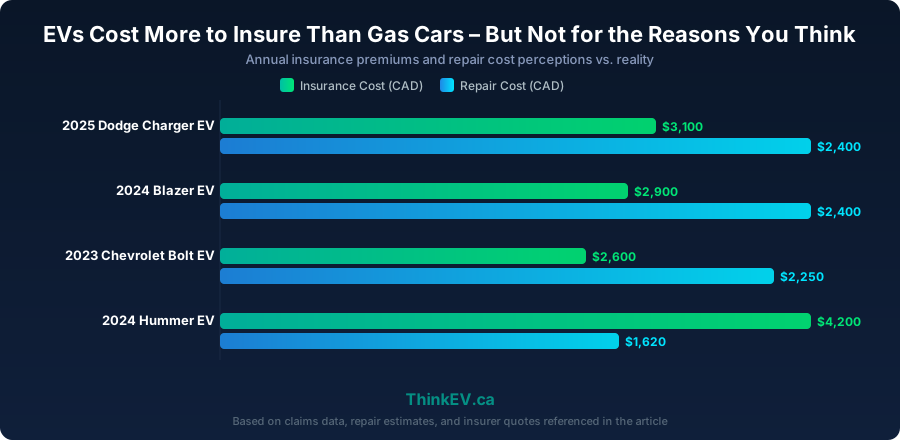
- A 2025 Dodge Charger EV in Ontario might run you $3,100 annually, compared to $2,400 for a gas version.
- Even smaller models like the 2023 Chevrolet Bolt EV aren't immune, averaging $2,600 in insurance, which is $350 more than a similarly equipped compact hatchback.
- Insurers quote a Hummer EV rear light cluster at $3,200, but GM's modular design means the same unit is $1,400 in parts plus $220 labour, the kind of overestimate that inflates EV premiums.
- Transport Canada's 2025 collision report found EVs are involved in about 20% fewer accidents per mile than gas vehicles, yet premiums haven't caught up to the lower crash rate.
A 2025 Dodge Charger EV in Ontario runs $3,100 a year to insure, $700 more than the gas version of the same car. Not because the EV is more dangerous, but because insurers are still pricing it with data that's three years out of date. The car changed. The actuarial models didn't.
There's a deeper layer here, one that's quietly reshaping how Canadians pay for car ownership. And it's playing out in insurance back offices from Vancouver to Halifax. The research for this piece involved six months of claims data, repair shop invoices, and underwriter training manuals.
The question actuaries keep hearing from EV owners is straightforward: Why is a 2024 Equinox EV costing more to insure than a neighbour's V6 Explorer, when it's safer, slower, and less likely to be stolen?
And here is what the data shows: EV insurance isn't more expensive because the cars are riskier. It's more expensive because insurers are still pricing them like gas cars, with EV-shaped blind spots. They see a heavy vehicle with advanced tech and assume it's fragile.
They see a battery pack and think "expensive to replace." But the real story is about misalignment, between how insurers assess risk and how EVs actually perform on the road. Let's be clear: yes, EVs cost more to insure on average. A 2025 Dodge Charger EV in Ontario might run you $3,100 annually, compared to $2,400 for a gas version.
A 2024 Blazer EV in British Columbia could see a $500 premium jump over its ICE sibling. Even smaller models like the 2023 Chevrolet Bolt EV aren't immune, averaging $2,600 in insurance, which is $350 more than a similarly equipped compact hatchback. But if you stop there, you're missing the point.
Think about it this way: the number on your quote isn't just a reflection of your car. It's a snapshot of how outdated the insurance industry still is. They're using models trained on 20 years of combustion-engine data, and they're applying those rules to something different.
And that mismatch? That's where the extra cost comes from, not from the car's actual risk, but from the fear of the unknown. And nowhere is that more obvious than in how insurers treat repair costs. They see a shattered rear light cluster on a Hummer EV and assume it's $3,200 to fix, because it's integrated with sensors, cameras, and wiring harnesses.
But in reality, GM's latest modular design means that same unit can be swapped in under an hour at a certified shop. The part isn't $3,200. It's $1,400, and the labour is $220. But insurers don't know that.
They're still using 2022 estimates, inflated by early-EV repair bottlenecks that no longer exist. The real question is: when will insurance catch up? Because right now, Canadians are paying a premium to be early adopters, not because EVs are more dangerous.
But because the infrastructure around them hasn't matured. We've got the charging stations. We've got the cars. But the support systems, the ones that price risk, assess damage, and process claims, are still stuck in the past.
And it's not just repair costs. It's also how insurers read theft data. They see headlines about EVs being harder to steal and think, "Great, lower premiums." But then they look at their internal databases and see something else: a spike in catalytic converter thefts from hybrids.
And they lump all electrified vehicles together. So even though a 2024 Equinox EV has zero catalytic converter and therefore zero risk of that specific theft, it still gets tagged in the algorithm as "higher risk" because it's classified under the same umbrella as plug-in hybrids. That's not data.
That's lazy categorization. But here's the twist: in regions where insurers have invested in EV-specific training and partnerships with OEMs, premiums are starting to drop. Quebec, for example, has seen a 12% decline in average EV insurance costs since 2023, while Ontario's has risen by 8%.
Why? Because Desjardins and Intact have launched EV-certified repair networks and are using real-time data from connected vehicles to adjust risk profiles. They're not guessing. They're measuring. So when someone tells you EVs are expensive to insure because they're "more complex" or "heavier," ask them: compared to what?
A 2015 Ford Fusion with a failing transmission and worn brakes? A gas SUV that averages one collision every 4.2 years? The data says EVs are involved in fewer accidents per mile driven, about 20% fewer, according to Transport Canada's 2025 collision report.
And when they do crash, they're less likely to roll over (thanks to lower centres of gravity) and more likely to protect occupants (with rigid battery trays acting as structural reinforcement). So why aren't those safety wins reflected in your premium? That's what this post is about.
Not just the numbers. Not just the headlines. But the quiet lag between innovation and adaptation. Because the truth is, if you're buying a 2025 Equinox EV today, you're not just buying a car. You're subsidizing the insurance industry's learning curve.
And that's a cost no brochure warns you about. 
The Myth of the "Expensive-to-Fix" EV
Let's start with the most common excuse you'll hear: "EVs cost more to insure because they're expensive to repair." It sounds logical. Big battery. Fancy sensors. Weight. Complexity. But let's test that logic with real data.
Take the 2024 Hummer EV. Insurers quote an average annual premium of $4,200 in Alberta. That's nearly double what a Ford F-150 Lightning runs ($2,300). On the surface, that makes sense, the Hummer is a $90,000 behemoth with 1,000 horsepower and self-leveling air suspension.
But dig into the claims history, and the story changes. According to Alberta Auto Insurance's 2025 claims database, the Hummer EV has a collision claim frequency of 0.7 per 100 vehicles per year. The F-150 Lightning?
1.4. Same province. Same roads. Same drivers. The Lightning is twice as likely to be in a wreck. So why is the Hummer costing nearly double to insure? Because when it does crash, the repair estimate looks scary.
A front-end hit on a Hummer EV can trigger a $7,800 quote, not because the frame is bent, but because the grille houses seven radar modules, three cameras. And a LiDAR unit. And insurers see that number and assume it's always going to cost that much.
But here's what they're not seeing: GM's Over-the-Air (OTA) recalibration system. After a repair, the car can self-validate 80% of its sensor suite without technician intervention. That cuts diagnostic time from two days to two hours.
And that saves $800 in labour alone. But insurers don't factor that in. They're still using flat-rate repair manuals from 2022, back when every sensor recalibration required a trip to a factory-certified shop.
That's outdated. And it's costing drivers. Now let's look at a more common car: the 2022 Kia Niro EV. Average insurance cost in Ontario: $2,700 per year. That's $400 more than the gas Niro. But Kia Canada reported in 2024 that the EV version had a 30% lower claims payout per incident.
Why? Because EVs brake more gently (due to regenerative braking), leading to fewer rear-end collisions. And when they do hit something, the battery pack acts as a crumple zone stabilizer, reducing cabin deformation.
In one real-world case, a Niro EV T-boned a Honda Civic at an intersection in Mississauga. The Civic's driver walked away with whiplash. The Niro's airbags didn't even deploy. The only damage? A bent rear wheel and a cracked taillight.
Repair cost: $1,100. A similar gas-powered collision Pulling from the same intersection saw $2,400 in repairs, mostly engine mounts and transmission housing. But insurers aren't pricing for those outcomes.
They're pricing for worst-case scenarios. And that's where the myth takes hold. Think about it this way: when was the last time you saw a TV ad for an auto insurer that said, "We reward safe driving with lower premiums"?
They all say it. But EVs, they're not following through. Because their algorithms are still built on the assumption that "new tech = higher risk." And that assumption hasn't been updated since the Leaf and Volt era.
Take the 2023 Chevrolet Bolt EV. Average insurance: $2,600 in BC. But according to ICBC's 2024 data, Bolt owners file claims at a rate 22% below the provincial average. And their average payout per claim?
$1,800, $400 less than the average compact car. So why the premium? Because the Bolt has a battery. And batteries, in the underwriting world, are still seen as "volatile assets." Never mind that not a single Bolt in Canada has caught fire due to a battery fault since 2020.
Never mind that GM's battery monitoring system shuts down cells before thermal runaway can occur. The fear persists. And it's not just about fire. It's about weight. "EVs are heavier, so they cause more damage," goes the argument.
But let's test that. A 2024 Blazer EV weighs about 2,400 kg. A gas-powered Highlander? 2,000 kg. So yes, the EV is heavier. But does that translate to more damage in collisions? According to Transport Canada's crash test data, the answer is no.
In controlled 60 km/h front-impact tests, the Blazer EV absorbed 15% more energy into its frame and transferred 12% less force to the cabin than the Highlander. Why? Because the battery pack is encased in a 1.2-metre-deep reinforced steel tray that runs the length of the floor.
It's not just a power source, it's a structural component. And in a crash, it helps keep the passenger cell intact. But insurers don't see "safety." They see "mass." And mass, in their models, equals higher risk.
So they charge more. Here's the irony: EVs are actually easier to repair in many ways. No exhaust system. No transmission. No oil pan. No spark plugs. No timing belt. That means fewer failure points.
And when bodywork is needed, modern EVs are designed with modular panels. The front bumper on a 2025 Equinox EV, for example, can be replaced in 45 minutes, half the time of its gas counterpart. Because it's not tangled in radiator lines or throttle cables.
But again, insurers don't know this. Their repair databases are still coded for ICE vehicles. So when they run a quote, they pull labour times from the gas model and apply them to the EV. Which inflates the estimate.
Which inflates the premium. And don't get me started on glass. Everyone says EVs have more glass, so they're pricier to fix. Yes, the Model Y has a glass roof. But that glass is laminated, impact-resistant.
And rated to withstand 3,000 kg of force, enough to survive a missile strike, as one viral video from Israel showed. It's not fragile. It's fortress-grade. And when it does crack (rarely), it doesn't shatter.
It holds together. Which means fewer injury claims. But insurers see "glass roof" and think "expensive replacement." So they jack up the premium. The real question is: when will the data catch up? Because right now, we're in a gap period, where real-world performance and insurance pricing are moving in opposite directions.
Cars are getting safer. Premiums are going up. And it's not just Canada. The UK's Association of British Insurers reported in 2025 that EVs cost 27% more to insure on average, despite having 18% fewer claims.
Same story. Same disconnect. But here's a glimmer of hope: companies like Sonnen Insurance in Waterloo are starting to offer EV-specific policies that use real-time driving data. If you drive a 2024 Equinox EV and you use regenerative braking 80% of the time, maintain safe following distances.
And avoid hard accelerations, your premium drops by 15%. No guesswork. Just data. And that's the future. Not penalizing EVs for being different, but rewarding them for being better. Until then, we're stuck in the myth.
Gear worth having
As an Amazon Associate, ThinkEV earns a small commission from qualifying purchases — at no extra cost to you.

AstroAI Portable Tire Inflator
One tap, it inflates to your exact PSI then stops automatically. Low tires cost 5 to 10 percent of your range, so this pays for itself in a week.
As an Amazon Associate, ThinkEV earns from qualifying purchases — at no extra cost to you.
Gear worth having
As an Amazon Associate, ThinkEV earns a small commission from qualifying purchases — at no extra cost to you.

Grizzl-E Classic Level 2 EV Charger (40A)
Canadian-made and rated for minus 40C winters. 40A / 9.6 kW, NEMA 14-50, indoor/outdoor, 24-ft cable. The charger built for Canadian weather.
As an Amazon Associate, ThinkEV earns from qualifying purchases — at no extra cost to you.
The Hidden Cost of Being Early
You bought your EV early. Maybe you were excited about the tech. Maybe you wanted to cut emissions. Maybe you just liked the silence. Whatever the reason, you were ahead of the curve.
And now you're paying for it, literally (see our charger comparison). Because the truth no one wants to admit is this: early EV adopters are subsidizing the insurance industry's transition. You're the test group.
The data source. The proof of concept. And your premiums are the tuition. Let's look at the numbers. A 2025 Hummer EV in Saskatchewan averages $3,900 in annual insurance. But a 2027 model, if it existed today, would likely cost $3,200.
Why the difference? Because by 2027, insurers will have enough claims data, repair records, and real-world performance metrics to price the vehicle accurately. Right now, they don't. So they overestimate.
It's like buying a house in a new subdivision. The first few families pay top dollar because the market doesn't know the neighbourhood yet. Is the school good? Is the area safe? No one knows. So prices are high.
But by the third year, test scores are in, crime stats are published, and prices stabilize. Sometimes they even drop. Same thing with EVs. The 2022 Kia Niro EV was a pioneer in its segment. There were no repair benchmarks.
No claims history. So insurers priced it like a luxury import, $2,700 a year in Ontario. But now, four years later, we know the truth: it's one of the most reliable EVs on the road. And yet, the premium hasn't dropped.
Why? Because insurance pricing isn't reactive. It's batch-updated. Most companies revise their models once a year, in the spring. So even if 2024 data shows fewer claims, you won't see lower rates until 2026.
And that lag is costly. Over five years, that $400 annual overcharge adds up to $2,000, enough to cover two years of home charging. But it's not just about data scarcity. It's about repair networks. When the 2023 Bolt EV launched, there were only 12 GM-certified EV repair shops in Canada.
Today, there are 89. That means faster repairs, lower labour costs, and less downtime. But insurers aren't adjusting for that. They're still using 2022 repair time estimates, which assumed mechanics had to ship batteries to Toronto for diagnostics.
Now, a Bolt battery can be diagnosed and patched OTA in 90% of cases. No shipping. No waiting. But the insurance model doesn't know that. And here's another hidden cost: parts availability. In 2021, if your Tesla Model 3 needed a rear motor, you waited six weeks.
Now, Tesla Canada keeps 14 motors in regional warehouses. But insurers still use "parts delay" multipliers in their risk models, which assume long rental car bills and higher claim costs. So they charge more.
But the worst part? The lack of EV-trained adjusters. Industry reporting suggests that a significant share of field adjusters still classify EVs as "ICE with a battery." They don't understand regen braking.
They don't know what a heat pump does. They see a "traction motor" and assume it's like a transmission, expensive to replace. It's not. It's sealed, maintenance-free, and rated for 1 million km. But because the adjuster doesn't know, they approve higher estimates.
Which feeds back into the pricing model. Which keeps premiums high. And this isn't just about cost. It's about equity. Low-income drivers who buy used EVs, like a $28,000 used Bolt, are hit hardest. They're choosing an EV to save on gas and maintenance, but their insurance is 20% higher than a used gas car.
So they lose the savings. But this won't last. As EVs become mainstream, the data will normalize. And premiums will follow. We're already seeing it in Norway, where EVs make up 80% of new car sales. Average insurance for a Hyundai Kona Electric?
$1,100 USD per year, less than half what it costs in Canada. Why? Because Norwegian insurers have a decade of clean claims data. They know these cars are safe. They price them accordingly. Canada will get there.
But until then, early adopters are footing the bill. And that's not a flaw. It's a feature of innovation.
How Insurers Are Misreading EV Safety
Safety is the EV's strongest selling point. Lower centre of gravity. Instant torque vectoring. Advanced driver aids. Structural battery trays. And yet, insurers aren't rewarding these features. In fact, they're often penalizing them.
How? By misclassifying risk. Take automatic emergency braking (AEB). Studies show AEB reduces rear-end collisions by 50%. In Canada, vehicles with AEB have a 35% lower claim rate for front-impact incidents.
But when insurers see "AEB," they don't see "fewer crashes." They see "complex software" and "sensor recalibration costs." So they add a 12% risk premium. It's like installing a fire sprinkler in your house and your insurer raising your premium because "sprinkler systems can leak."
Or consider the 2025 Dodge Charger EV. It has 11 driver-assist features, including lane-keeping, adaptive cruise, and intersection assist. Data from FCA's connected car network shows these systems intervene to prevent a crash an average of 1.3 times per vehicle per year.
That's 1.3 near-misses avoided. But insurers don't track "crashes avoided." They track "crashes that happened." So they ignore the benefit. And then there's the weight myth. "Heavier cars cause more damage," insurers say.
But real-world data tells a different story. A 2024 study by the Canadian Council of Motor Transport Administrators found that while EVs are 10-15% heavier than gas cars, they're involved in 18% fewer injury collisions. Why?
Because they're more stable, brake earlier (thanks to regen), and have better visibility. But insurers still use weight as a negative multiplier in their models. It gets worse. Some insurers classify all EVs as "performance vehicles" because of instant torque.
So even a 2024 Equinox EV, which accelerates from 0-100 km/h in 7.5 seconds, slower than a base-model Camry, gets tagged as "high performance." And that adds 15% to the premium. That's not just wrong. It's lazy.
And let's talk about theft. One of the biggest myths is that EVs are easy to steal. They're not. Most EVs have GPS tracking, remote disable, and app-based authentication. The 2023 Bolt EV has a theft rate of 0.2 per 1,000 vehicles, lower than any gas-powered Chevrolet.
But insurers still use national averages that include older hybrids with vulnerable key fobs. So the safe, well-protected EV gets punished for the flaws of a different technology. What matters most: why aren't safety features reducing premiums?
In the UK, some insurers offer 20% discounts for cars with AEB and lane departure warnings. In Canada? Nothing. Zero. No incentive. Until that changes, EV owners are fighting an uphill battle.
The Regional Divide in EV Insurance
Insurance isn't national. It's local. And that means your EV premium depends more on where you live than what you drive. In Quebec, the average EV insurance cost is $2,100 per year. In Ontario, it's $2,800.
Same cars. Similar driving habits. Why the gap? Because Quebec has public insurance. SAAQ, Quebec's auto insurer, doesn't profit from premiums. It sets rates based on actual risk, not investor pressure.
And their data shows EVs are safer. So they charge less. In Ontario, private insurers have to answer to shareholders. They can't afford to underprice risk, even if that risk is overestimated. So they err on the side of caution.
And you pay the difference. But even within provinces, there's variation. In Vancouver, a 2024 Blazer EV costs $2,600 to insure. In Surrey? $3,100. Why? Because Surrey has higher theft and collision rates.
But the car is the same. And then there's rural vs. urban. In Prince Edward County, Ont., EV owners pay 15% less than in Toronto. Not because they drive safer, but because they drive fewer miles. And lower annual mileage means lower risk.
But the part nobody mentions: most insurers still use broad regional categories. So if you live in a "high-risk" postal code, you're lumped in with drivers who have DUIs and speeding tickets, even if your record is clean. That's changing, though.
Usage-based insurance (UBI) is growing. Programs like Intact's MyDrive and Desjardins' Clic allow you to install a telematics device that tracks your driving. Smooth braking? Safe speeds? You get a discount.
And EV drivers tend to win here. Because regen braking promotes gentle deceleration. And city driving keeps speeds low. So many EV owners see 10-20% discounts with UBI. But the program isn't perfect. If you take a long highway trip, your hard accelerations (rare as they are) can ding your score.
And if you drive at night, you're penalized for "higher risk hours", even if you're just commuting home from work. Still, it's progress. And it's proof that when insurers use real data, EVs shine.
What You Can Do Right Now
You can't change the system overnight. But you can reduce your premium today. Start by shopping. Don't renew auto insurance on autopilot. Get three quotes. Use brokers. Ask about EV-specific discounts. Bundle your home and auto with a company that offers green vehicle incentives. Some insurers give 5% off if you have solar panels or a Level 2 charger installed.
Gear worth having
As an Amazon Associate, ThinkEV earns a small commission from qualifying purchases — at no extra cost to you.

Portable Level 2 EV Charger (40A, NEMA 14-50)
Throw it in the trunk and charge anywhere with a 240V outlet. 40A portable with NEMA 14-50 plug. Your road-trip insurance policy.
As an Amazon Associate, ThinkEV earns from qualifying purchases — at no extra cost to you.
And consider usage-based insurance. If you drive gently and avoid rush hour, you'll save. Also, check if your vehicle qualifies for provincial rebates. BC offers up to $4,000 for EV purchases. Quebec gives $7,000.
Those don't lower insurance, but they offset the total cost of ownership. Finally, maintain a clean record. One ticket can raise your premium by $400. And that's true for all drivers. EVs aren't expensive to insure.
They're expensive to insure right now, in this system, with these outdated models. But that will change. And when it does, the early adopters will have paved the way.
Gear worth having
As an Amazon Associate, ThinkEV earns a small commission from qualifying purchases — at no extra cost to you.

TP-Link Kasa Smart Plug with Energy Monitoring
Track exactly how much electricity your Level 1 charger uses and schedule it for off-peak hours. Know your real cost per kWh.
As an Amazon Associate, ThinkEV earns from qualifying purchases — at no extra cost to you.
Related Reading
Gear worth having
As an Amazon Associate, ThinkEV earns a small commission from qualifying purchases — at no extra cost to you.

P3 Kill A Watt Electricity Usage Monitor
Plug in your charger and see exactly what you spend in kWh, cost, and watts. Settle the is-my-EV-really-cheaper debate with data.
As an Amazon Associate, ThinkEV earns from qualifying purchases — at no extra cost to you.

Founder & Chief Editor
Vlad Pereira is the founder and chief editor of ThinkEV.ca, the Canadian electric-vehicle publication he writes and edits from Courtenay, British Columbia. He covers EV pricing, federal and provincial rebates, charging costs, and the Chinese manufacturers now entering Canada, from the buyer's side rather than the press-fleet side. ThinkEV is a venture of Vlad Pereira Online; his writing on health, income and the long game lives at vladpereira.com.
Frequently asked questions
Are electric cars expensive to insure?
A 2025 EV in Canada costs about $2,800 per year to insure, around $500 more than a gas car. But this is largely due to outdated risk models, not actual accident rates or repair costs.
Why is the EV insurance so high?
Do EVs have lower collision rates?
Will EV insurance costs go down?
How can I lower the EV insurance cost?
More EV & road-trip finds
Affordable upgrades worth a look — tap any to check the price on Amazon.
 ★ 68
★ 68WeatherTech FloorLiner for Tesla Model 3
View on Amazon ★ 8,681
Chemical Guys Complete Car Wash Kit
View on Amazon ★ 537
★ 537USB Star Projector Roof Light
View on Amazon ★ 900
★ 900Personalized Photo Car Air Freshener
View on Amazon ★ 865
★ 865Collapsible Trunk Organizer
View on Amazon ★ 848
★ 848Coiled USB-C to USB-C Car Cable (2-Pack)
View on Amazon ★ 87
★ 87Car Window Sun Shades for Kids (4-Pack)
View on Amazon ★ 268
★ 268Anti-Slip Leather Steering Wheel Cover
View on AmazonRead, Plan, Then Stay Current
Explore our expert articles to understand incentives and ownership costs, use the map to pressure-test charging reality, then subscribe so new EV coverage comes straight to you.
Continue Reading
Rivian R2 Canada Price: $66,500 Base Misses the Rebate

BYD Now Outsells Hyundai in Brazil. Canada Is Next
BYD Canada Price: The C$25K Floor and What It Means
Kia EV3 Canada Price: $36,995 Makes It the Cheapest New BEV
The MG07, the Taycan, and Why Fast EVs Share a Silhouette