Key takeaways
- For a generation of Canadian buyers who need a practical daily driver but can't justify $55,000, the EV3 is a serious option.
- At 4,300 mm long, it's slightly larger than a Honda HR-V but smaller than a Toyota RAV4.
- Park it next to a $55,000 Ioniq 5 and the EV3 doesn't look like the budget option.
- One thing worth noting: at 4,300 mm, the EV3 occupies a size class that's extremely popular in Canada but has been underserved in the EV space.
The Kia EV3 is a small car with an unreasonable amount of range. Depending on trim and battery, early Canadian pricing discussion has placed it roughly in the high-$30,000 to low-$40,000 range, with the federal EVAP potentially bringing the entry point into the mid-$30,000s if the qualifying trim lands where expected. On paper, that would make the EV3 one of the strongest value propositions in the Canadian EV market, but the exact trim and pricing matrix still needs to be treated as near-final rather than fully settled.
That number deserves to sink in, with one important caveat: it depends on final Canadian trim pricing and EVAP eligibility landing where current reporting suggests. If it does, the EV3 becomes one of the clearest examples yet that EVs are moving into mainstream crossover pricing rather than luxury-only territory.
Kia has taken the formula that made the EV6 successful, bold design, fast charging, practical interior, and scaled it down to a smaller, more affordable package. The result is a city-friendly EV that doesn't compromise on range or technology. For a generation of Canadian buyers who need a practical daily driver but can't justify $55,000, the EV3 is a serious option. It slots into the market exactly where the demand is: below $40,000, with enough range for Canadian winters, from a manufacturer with a national dealer network and a warranty that actually means something.
The timing matters too. The federal EVAP rebate is available now. Provincial rebates in Quebec, Manitoba, and PEI stack on top of it. Interest rates are starting to soften. And the alternatives in this price bracket, the BYD Dolphin, the Volvo EX30, the Hyundai Kona Electric, each have trade-offs that the EV3 avoids. BYD has no Canadian dealer network and is excluded from EVAP. The Volvo EX30 starts higher and has less range. The Kona Electric charges slower and doesn't have V2L. The EV3 isn't perfect, but it gets the most things right at the lowest price. That's a potent combination.
Think about the market positioning for a moment. The EV3 looks designed to land in one of the most important Canadian EV price bands: practical crossover money rather than luxury money. That is why this launch matters so much. But the cleanest way to describe it today is as a very promising near-final product story, not a fully settled retail story in every trim.
DESIGN AND SIZE
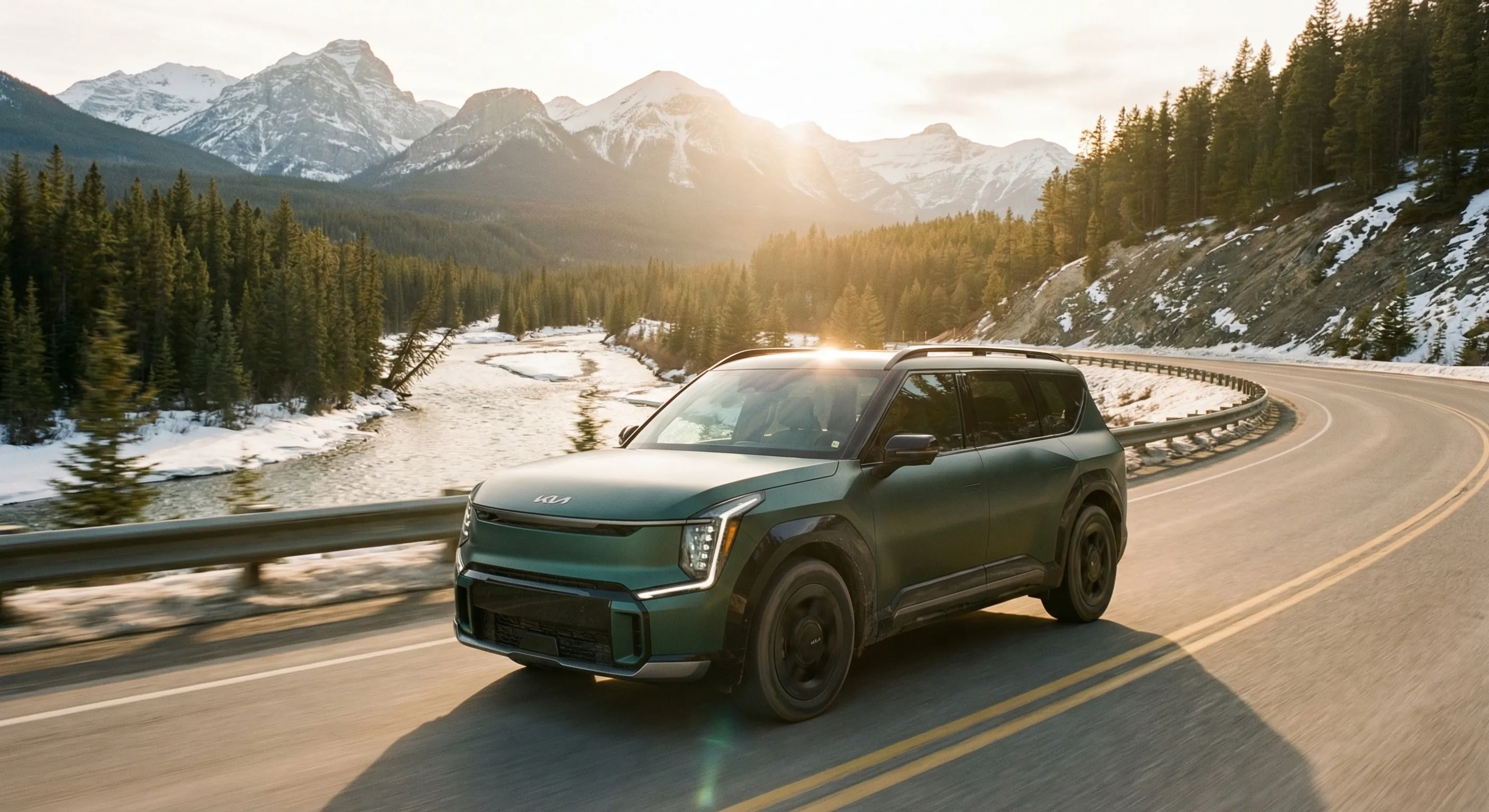
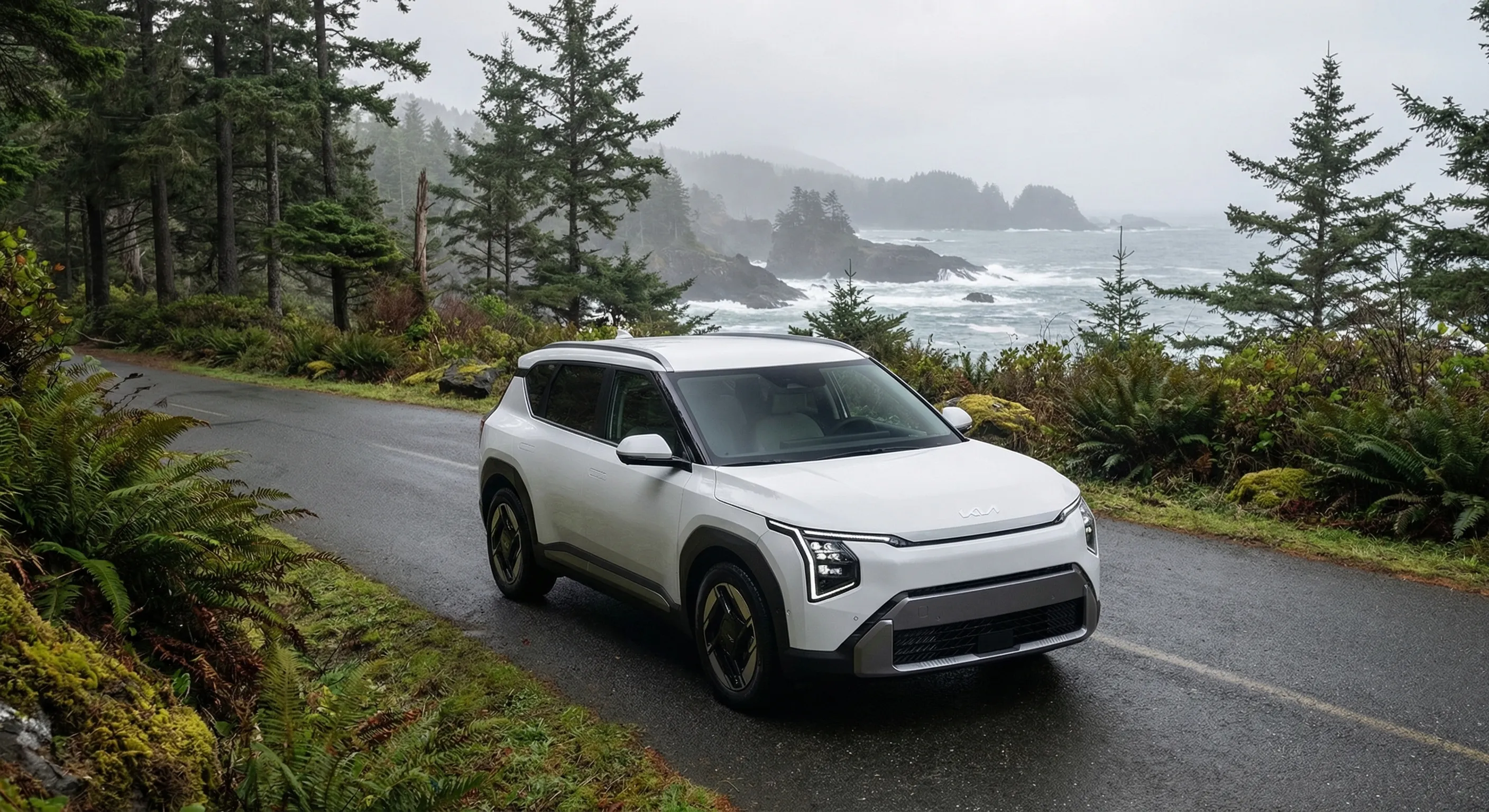
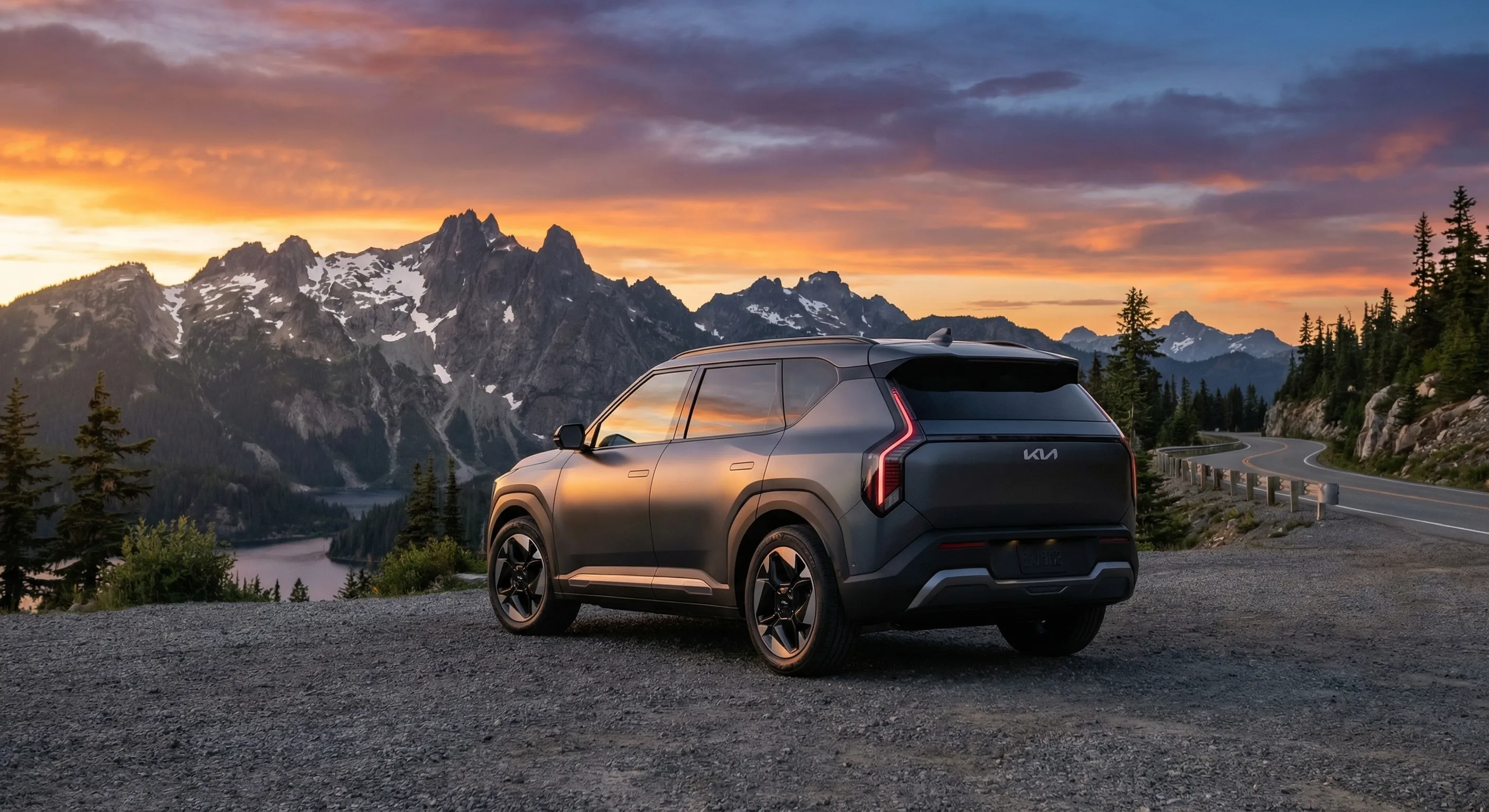
The EV3 is unmistakably Kia. It shares the angular, modern design language of the EV6 and EV9, with sharp LED headlights, a flat front end, and distinctive vertical taillights. It looks like a scaled-down EV6, which is to say it looks like a proper car and not a toy. The proportions are good for a subcompact, the short overhangs and tall roof give it a planted, purposeful stance.
At 4,300 mm long, it's slightly larger than a Honda HR-V but smaller than a Toyota RAV4. It fits in any urban parking spot and is easy to manoeuvre in tight downtown streets. The turning circle is tight enough for easy U-turns, and the visibility is good from the driver's seat. If you live in Toronto, Vancouver, Montreal, or any Canadian city where parking is a competitive sport, the EV3's compact footprint is a genuine daily advantage. You can parallel park this car in spots that a RAV4 owner would drive past.
The design makes a statement without trying too hard. The flat front end with the "Digital Tiger Face" light signature is distinctive from a block away. The C-pillar treatment is unique, a vertical element that gives the rear end a squared-off, SUV-like look despite the compact dimensions. The overall effect is a car that looks more expensive than it is. Park it next to a $55,000 Ioniq 5 and the EV3 doesn't look like the budget option. Kia's design team has been on a streak since the EV6, and the EV3 continues it.
One thing worth noting: at 4,300 mm, the EV3 occupies a size class that's extremely popular in Canada but has been underserved in the EV space. The HR-V, Tucson, CX-30, Corolla Cross, these are the cars that fill Canadian driveways. They're big enough for a family, small enough for the city, and priced where normal people actually shop. The EV3 is the first genuinely competitive EV in this exact size and price bracket. That's why it matters.
Inside, the flat floor (thanks to the skateboard battery layout) creates more usable space than you'd expect. The front seats are comfortable and well-bolstered, with enough room for two adults of any size. The rear seat is adequate for adults on shorter trips and fine for children. It's not a road trip car for four tall adults, but it handles a family of four for daily driving without complaint.
Cargo space is approximately 460 litres behind the rear seats, expanding to approximately 1,250 litres with them folded. That's competitive for the segment and enough for weekly groceries, luggage, or a couple of hockey bags. For context, the Honda HR-V offers about 537 litres with seats up, more than the EV3, but the EV3's flat floor and lower load height make loading heavy items easier.
You win some, you lose some, but the EV3's cargo space is more than adequate for the way most people actually use a car this size.
RANGE AND BATTERY
Two battery options are available. The Standard Range uses a 58.3 kWh battery with approximately 350 km of rated range. The Long Range uses an 81.4 kWh battery with approximately 460 km of rated range. In real-world Canadian summer driving, expect roughly 290-320 km from the Standard Range and 380-420 km from the Long Range.

Those are rated numbers from NRCan testing, and real-world results will vary with speed, temperature, terrain, and driving style. But even with a conservative 15-20% reduction from the rated number, the Long Range EV3 delivers 370-420 km in comfortable summer conditions. That is a staggering amount of range for a $42,995 car. For perspective, the Tesla Model Y RWD base (which costs $49,990 and now qualifies for EVAP at $44,990 effective) is rated at roughly the same range. The EV3 Long Range gives you Tesla-equivalent range at a lower effective price after rebates ($37,995). That's not a marketing spin, it's just the math.
The Standard Range at 350 km rated is still very usable. If you commute 40 km round trip, that's roughly six to seven days of driving on a single charge in summer, even accounting for climate control and highway speeds. The Long Range stretches that to nine or ten days. For the vast majority of Canadian commuters, either battery provides more than enough daily range to charge at home once or twice a week and never think about it again.
Winter range drops to approximately 220-260 km for the Standard Range and 290-340 km for the Long Range. For a daily commuter driving 40 km round trip, the Long Range model provides a full week of driving between charges even in deep winter. The Standard Range gives you four to five days. Both are practical for the way most Canadians actually drive.
Gear worth having
As an Amazon Associate, ThinkEV earns a small commission from qualifying purchases — at no extra cost to you.

Grizzl-E Classic Level 2 EV Charger (40A)
Canadian-made and rated for minus 40C winters. 40A / 9.6 kW, NEMA 14-50, indoor/outdoor, 24-ft cable. The charger built for Canadian weather.
As an Amazon Associate, ThinkEV earns from qualifying purchases — at no extra cost to you.
The Long Range model is the one to get. The extra $4,000 for 110 km of additional rated range is well worth it for the winter buffer alone. If you live anywhere that regularly sees -15C or colder, the Long Range eliminates the need to think about range on a daily basis. The math is simple: $4,000 for 110 km of extra range works out to about $36 per kilometre of additional rated range. Compared to the Tesla Model Y (where the jump from Standard to Long Range costs roughly $5,000 for 80 km), the EV3's Long Range upgrade is actually one of the best value battery upgrades in the market.
The battery itself uses Kia's latest cell chemistry, shared with the larger EV5 and EV6. It's proven technology, the same family of cells that has been in service across hundreds of thousands of Hyundai and Kia EVs worldwide since 2021, with no battery-related recalls or widespread degradation issues. Kia warrants the battery for 8 years or 160,000 km, whichever comes first, with a minimum 70% capacity guarantee. That's industry standard and provides meaningful peace of mind for buyers concerned about battery longevity.
CHARGING
The EV3 supports DC fast charging at up to 128 kW, which gets you from 10% to 80% in approximately 31 minutes. That's slower than the 800V Ioniq 5 or EV6 (which do it in 18 minutes) but faster than the BYD Dolphin (88 kW, not yet available in Canada) or the VW ID.4 (170 kW peak, but with a slower sustained charging curve). For a car at this price point, 128 kW is solid. It's fast enough that a bathroom break and a coffee at a highway rest stop covers your charging time. It's not fast enough to be invisible, but it's fast enough to be tolerable.
The charging curve is reasonably flat up to about 60% state of charge, which means you're getting close to the full 128 kW for most of the useful charging window. After 80%, the speed drops significantly, which is why 10-80% is the standard DC fast charging benchmark. For road trips, the strategy is the same as any EV: charge to 80%, drive until you hit 10-15%, charge again. The EV3's 31-minute 10-80% time means you're stopping for about half an hour every 250-300 km on a highway trip. That's not Tesla Supercharger speed, but it's practical for the occasional Toronto-to-Montreal or Vancouver-to-Kelowna run.
The EV3 is expected to support broad public fast-charging compatibility in Canada, but the exact adapter, port, and Tesla-access details should still be verified against Kia Canada before being treated as final.
Home charging on a Level 2 (240V, 48A) circuit takes approximately 9 hours for the Long Range from empty to full. Plug in after work, full by morning. For most EV owners, home charging is where 90% of your charging happens. A Level 2 home charger like the Grizzl-E costs about $500-$600 installed, and your monthly electricity cost for driving roughly 1,500 km per month will be about $40-$60 depending on your provincial rate. Compare that to $150-$200 in gasoline for a comparable gas crossover. The savings start from month one.
One practical note: the EV3's charge port is located on the right rear quarter panel, which means you'll want to back into your garage or driveway if your charger is on the wall behind you. It's a minor consideration, but worth thinking about when planning your home charger installation.
DRIVING
The EV3 is front-wheel drive only, with a single motor producing 204 hp. That's more than enough for a car this size. Acceleration is smooth and immediate, 0-100 km/h in about 7.5 seconds, which feels peppy in daily driving. Highway merges, passing manoeuvres, and city traffic are all handled with confidence. It's not a performance car, and it doesn't need to be.
For reference, 204 hp in a car this light (approximately 1,700 kg for the Long Range) gives you a power-to-weight ratio that's better than most gas crossovers in this class. The HR-V makes 158 hp and weighs 1,390 kg. The Tucson 2.0L makes 187 hp and weighs 1,580 kg. The EV3 has more power and the instant torque advantage of an electric motor, which means it feels genuinely quick in the real-world situations where you actually use acceleration: merging, passing, pulling out of side streets. The on-paper 0-100 time doesn't tell the whole story, the EV3 feels faster than 7.5 seconds because the torque is available from zero RPM with no turbo lag and no transmission hunting for the right gear.
The ride quality is good for a subcompact, better than you'd expect at this price. The suspension absorbs most road imperfections without transmitting harshness into the cabin, though very rough roads (Montreal potholes, prairie frost heaves) will remind you that this is a small car with a short wheelbase. The steering is light and direct, which makes parking and city driving effortless. At highway speeds, the steering firms up enough to feel stable and confident. There's no wandering, no constant correction, you can cruise the Trans-Canada with one hand on the wheel without feeling nervous.
Gear worth having
As an Amazon Associate, ThinkEV earns a small commission from qualifying purchases — at no extra cost to you.
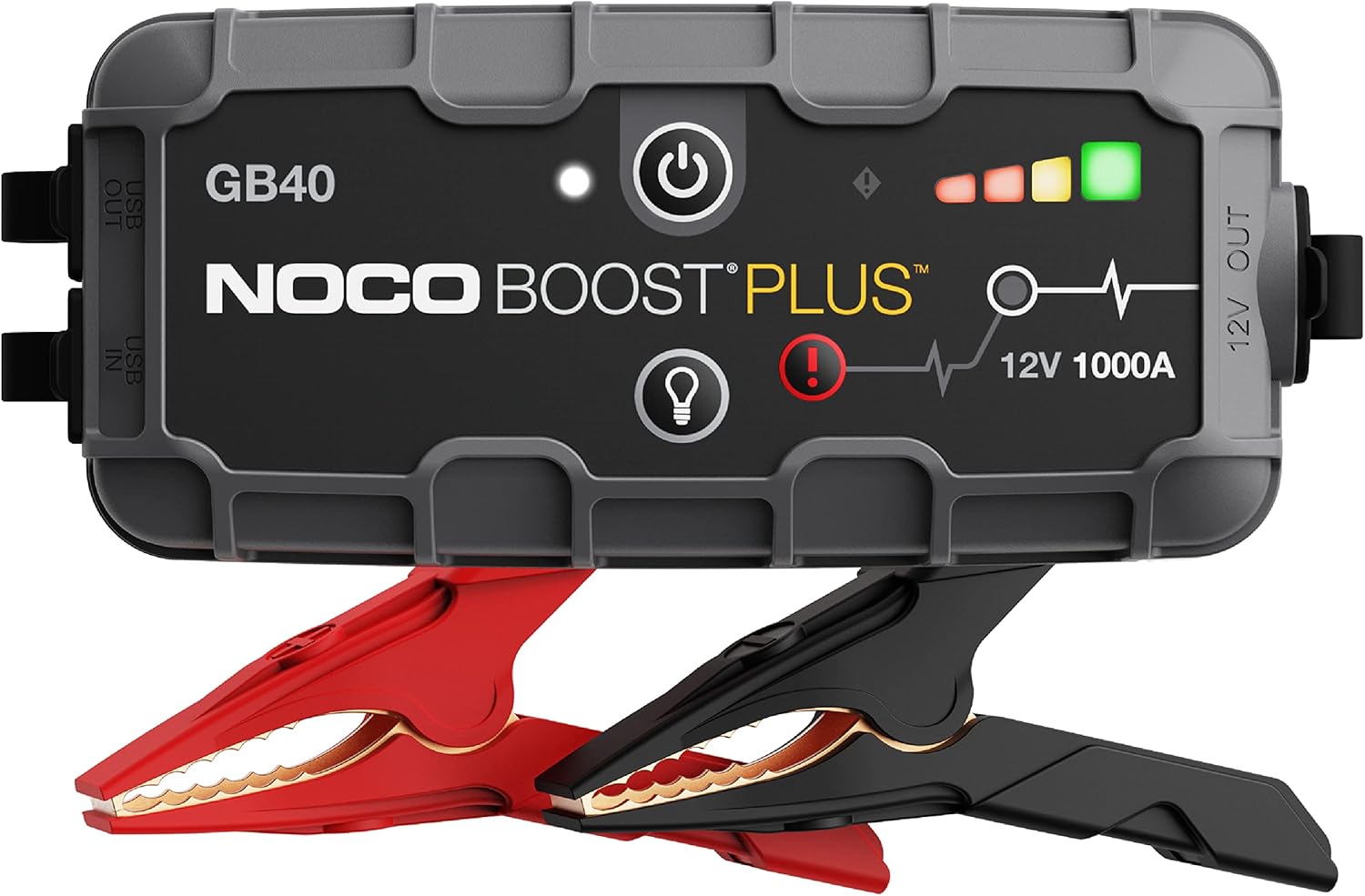
NOCO Boost Plus GB40 Jump Starter
A 1000A lithium jump starter that fits in your glovebox and works on any 12V battery. Your insurance against a dead 12V in a parking lot.
As an Amazon Associate, ThinkEV earns from qualifying purchases — at no extra cost to you.
Road noise is moderate at highway speeds, typical for a subcompact. The cabin is reasonably well-insulated, but you'll hear more tire and wind noise than in a larger EV like the Ioniq 5. For a car at this price, the NVH (noise, vibration, harshness) levels are acceptable. It's a commuter car, and it commutes well.
Regenerative braking is adjustable via paddle shifters behind the steering wheel, a Kia/Hyundai feature that's genuinely useful. You can set it from zero regen (coasting) through three levels to full one-pedal driving. In city traffic, max regen is the way to go, you can drive for blocks without touching the brake pedal, and the deceleration is smooth and predictable. On the highway, lower regen or coasting mode makes more sense for efficiency. The ability to toggle regen on the fly, without diving into menus, is a small thing that makes daily driving noticeably more pleasant.
The EV3 also includes Kia's standard suite of driver assistance features: adaptive cruise control, lane-keeping assist, blind spot monitoring, rear cross-traffic alert, and automatic emergency braking. Highway Driving Assist 2 (HDA2), which combines adaptive cruise with lane centring for semi-autonomous highway driving, is available on higher trims. These systems work well, they're not Tesla Autopilot, but they're competent enough to reduce fatigue on long highway stretches. The adaptive cruise control is smooth and handles stop-and-go traffic without jerky acceleration or late braking, which makes the daily commute on the DVP, Deerfoot, or Autoroute 15 noticeably less exhausting.
One driving characteristic worth mentioning: the EV3 is quiet. Not luxury-sedan quiet, at highway speeds you'll hear some tire roar and a whisper of wind noise, but meaningfully quieter than any gas car in this price range. There's no engine drone, no transmission whine, no vibration through the steering wheel at idle. After a week of driving the EV3, getting back into a gas crossover feels like someone left a lawnmower running under the hood. That silence is one of those EV advantages that's hard to appreciate on a spec sheet but impossible to ignore in daily life.
WINTER PERFORMANCE
This is the section that matters most for Canadian buyers, so let's be thorough.
The EV3 is front-wheel drive only. There is no AWD option. In the gas car world, this would be a dealbreaker for many Canadian buyers, but in the EV world, FWD tells a different story. The EV3's battery pack sits in the floor, creating a very low centre of gravity and putting substantial weight directly over the front axle. That weight distribution, combined with the instant, smooth torque delivery of an electric motor (no wheelspin from sudden throttle tip-in), means the EV3 with winter tires has better traction than most FWD gas cars and comparable traction to many AWD gas crossovers in typical winter conditions.
That's not marketing, it's physics. A heavy, low-slung FWD EV with good winter tires will outperform a lighter, higher-centre-of-gravity AWD gas crossover with all-season tires in most winter scenarios. The only situations where AWD provides a meaningful advantage are steep, icy hills and deep unplowed snow. If you live on a steep hill that doesn't get plowed promptly, or you regularly drive unplowed rural roads, AWD matters. For everyone else, city driving, plowed highways, typical suburban streets, the EV3 on winter tires is more than adequate.
Winter range is the bigger consideration. The Long Range model drops from 460 km rated to approximately 290-340 km in real-world winter conditions, depending on temperature, driving style, and how much you use the cabin heater. The Standard Range drops from 350 km to approximately 220-260 km. That's a 25-35% reduction, which is typical for EVs in Canadian cold. The culprits are battery chemistry (lithium-ion cells are less efficient in cold temperatures), cabin heating (which draws directly from the battery), and increased rolling resistance from winter tires and cold, dense air.
The EV3 includes a heat pump as standard equipment, which is critical for winter efficiency. A heat pump moves heat rather than generating it, which makes it roughly twice as efficient as a resistive heater at temperatures above -15C. Below -15C, the heat pump's efficiency drops and the system supplements with resistive heating, but even then, it uses less energy than a car with resistive heating alone. Kia's heat pump implementation in the EV6 and Ioniq 5 platform has been well-tested in Canadian winters, and the EV3 benefits from that engineering maturity.
Preconditioning is your best friend in winter. When the EV3 is plugged in, you can schedule departure times or remotely activate cabin and battery heating through the Kia Connect app. This does two things: it warms the cabin so you're not drawing heating energy from the battery while driving, and it warms the battery to its optimal operating temperature so you get full range and full regenerative braking from the moment you unplug. A 20-minute preconditioning session while plugged in can recover 20-30 km of range compared to a cold start. Over a winter season of daily commuting, that adds up to hundreds of kilometres of "free" range that comes from your home electricity rather than the driving battery.
The no-AWD trade-off is real, and it's worth naming. If you live in Whistler, Banff, or anywhere with steep grades and heavy snowfall, the EV3 is not the ideal choice. Look at the Kia EV5 or EV6, both of which offer AWD. But if you're in Toronto, Ottawa, Montreal, Vancouver, Calgary, Edmonton, Winnipeg, or any city where the roads get plowed and you're mostly driving on flat-to-moderate terrain, the EV3 with a set of quality winter tires (Michelin X-Ice Snow, Bridgestone Blizzak, or Continental VikingContact 7) will handle anything a typical Canadian winter throws at it. Budget approximately $800-$1,200 for a set of winter tires on steel rims, and remember, you'd need those on a gas car too.
INTERIOR AND TECH
The interior punches above its weight. Twin 12.3-inch screens span the dashboard, one for the instrument cluster and one for infotainment. The software is Kia's latest, with wireless Apple CarPlay and Android Auto, fast response times, and a clean interface. The controls for climate and audio include physical buttons below the screen, which is a welcome design choice that avoids the touchscreen-for-everything problem that plagues too many modern cars. When you're wearing gloves in January, being able to adjust the temperature without taking your eyes off the road or trying to jab a flat touchscreen is a meaningful safety and convenience advantage.
The infotainment system responds quickly and the menus are logically organized. Kia has iterated on this software across the EV6, EV9, and now EV3, and it shows. Navigation is integrated, with real-time traffic and EV-specific routing that accounts for charging stations and battery level. You can plan a road trip on the screen and the car will tell you where to stop, how long to charge, and what your estimated arrival time is. It's not quite as smooth as Tesla's navigation integration, but it's close, and it's dramatically better than what most non-Tesla EVs offered even two years ago.
Materials are a mix of soft-touch surfaces on the upper dash and harder plastics below, which is appropriate for the price. The front seats are heated (standard), the steering wheel is heated (standard), and the rear seats are heated on higher trims. These should be standard on every car sold in Canada, and Kia gets credit for including them. The seats themselves are comfortable for long drives, good bolstering, reasonable lumbar support, and a driving position that's slightly elevated for that crossover feel without being truck-like. The headroom is generous for a subcompact, and even taller drivers (up to about 190 cm) won't feel cramped.
The rear seat is the EV3's one real compromise. Legroom is adequate, two adults can sit behind two adults of average height without their knees hitting the seatbacks. But three adults across is tight, and the centre position is narrow. For a family with two car seats or two children, the rear seat works fine. For three adults on a long road trip, it's not the right car. This is a subcompact, and the rear seat is where that classification shows.
The ambient lighting deserves a mention. Kia has included a subtle, customizable ambient light strip across the dashboard and door panels that shifts colour based on driving mode or your personal preference. It's a premium touch that you wouldn't expect at this price point, and it contributes to the interior feeling more upscale than the sticker suggests. Small details like this are what separate the EV3 from a basic transportation appliance, Kia wants you to enjoy being inside this car, not just tolerate it.
Gear worth having
As an Amazon Associate, ThinkEV earns a small commission from qualifying purchases — at no extra cost to you.

Emporia Smart Level 2 EV Charger (48A)
Budget-friendly 48A charger with WiFi and per-session energy tracking. Best bang for buck if you want smart features under 500 dollars.
As an Amazon Associate, ThinkEV earns from qualifying purchases — at no extra cost to you.
Storage solutions are thoughtful throughout. There's a large centre console bin, door pockets that actually hold a water bottle without it falling out, a wireless charging pad for phones, and USB-C ports in both the front and rear. The glove box is reasonably sized. There's no frunk (front trunk), the motor and electronics take up the front space, which is a minor disadvantage compared to competitors like the Volvo EX30 that offer a small frunk for cable storage. The centre console, however, is deep and well-organized, with enough space for a purse, phone, wallet, and the random accumulation of items that collects in every daily driver. Kia clearly thought about how people actually use the interior of a car, not just how it looks in a showroom.
V2L AND PRACTICAL FEATURES
Vehicle-to-load (V2L) is one of those features that sounds like a gimmick until you use it, and then you wonder how you lived without it. The EV3 supports V2L at 3.6 kW, the same output as the larger Kia EV6 and EV9. That's enough power to run a full-sized refrigerator, a laptop, a portable heater, power tools, a TV, LED lighting, or essentially any household appliance that draws less than 15 amps.
Here's how it works: a V2L adapter plugs into the EV3's charge port (CCS connector), converting the car's DC battery power to standard 120V AC household power. Kia includes the adapter with the car, no extra purchase needed. Plug the adapter into the charge port, plug your device into the adapter, and you have a portable power station with an 81.4 kWh battery. For context, a Jackery Explorer 1000 (a popular portable power station) has 1 kWh of capacity and costs about $1,500. The EV3 Long Range has 81 times the capacity and you're already buying the car.
The practical applications are genuinely useful. For camping, you can run a portable electric heater, charge devices, power a mini fridge, and run LED lights for an entire weekend without meaningfully depleting the battery. A 100W draw (laptop, phone charger, LED lights) would take about 800 hours to drain the Long Range battery. Even a 1,500W space heater would run for about 50 hours, more than two full days, before the battery was empty. The EV3 turns into a rolling power station that eliminates the need for a generator on any camping trip.
For emergency power during winter storms and power outages, which are increasingly common across Canada, V2L can keep a refrigerator, a few lights, and phone chargers running for days. A typical household refrigerator draws about 150W average. At that rate, the EV3 Long Range could power your fridge for over 500 hours, more than three weeks. Add lights and phone charging and you're still looking at well over a week of basic emergency power from a fully charged battery. In provinces like Nova Scotia, New Brunswick, and Quebec, where ice storms and power outages are a regular winter occurrence, this is not a theoretical benefit, it's genuine household resilience.
There's also an interior V2L outlet on some trims, located under the rear seat, which lets you power devices inside the car without using the external charge port adapter. This is useful for tailgating, working from the car, or just keeping a laptop charged during a long day of errands.
V2L is available on the Hyundai Ioniq 5, Kia EV6, Kia EV9, and now the EV3. It's not available on any Tesla, any Chevrolet EV, the VW ID.4, or most other competitors at this price point. It's a genuine competitive advantage that becomes more valuable the more you think about how you'd actually use it.
OWNERSHIP AND VALUE
Let's talk money, because this is where the EV3's case becomes truly compelling.
The Standard Range starts at approximately $38,995 CAD. The Long Range starts at approximately $42,995 CAD. Both fall well under the $50,000 final transaction value cap for the federal EVAP rebate, which means both qualify for the full $5,000 federal rebate. That brings the effective prices to $33,995 and $37,995 respectively.
But federal EVAP isn't the only rebate available. Provincial incentives can stack on top, and the savings can be dramatic ? but the exact net prices depend on final Canadian trim pricing and eligibility by province. The cleanest way to think about the EV3 today is as a likely mid-$30,000 federal-rebate story, with some provinces potentially pulling it lower if the qualifying trims stay under the thresholds. For the full breakdown of every provincial rebate and how to stack them, see our full breakdown of EV rebates by province.
The five-year total cost of ownership (TCO) comparison against a gas crossover is where the EV3 really pulls away. Take a comparably priced gas crossover, say, a Hyundai Tucson Essential FWD at about $34,000. Over five years and 100,000 km:
- Fuel: The Tucson at 8.5L/100km and $1.55/L costs approximately $13,175 in gasoline. The EV3 at 16 kWh/100km and $0.12/kWh costs approximately $1,920 in electricity. Savings: $11,255.
- Maintenance: The Tucson needs oil changes ($600/year), brake pads ($400 at 60K km), transmission service ($300), air filters, spark plugs, and other ICE maintenance. Five-year estimate: $4,500-$5,500. The EV3 needs tire rotations, cabin air filters, and brake fluid. Five-year estimate: $1,200-$1,800. Savings: $3,000-$4,000.
- Total five-year savings: approximately $14,000-$15,000 in operating costs.
Even if the EV3 costs $4,000 more at purchase (Long Range vs. Tucson Essential), the five-year TCO favours the EV3 by roughly $10,000-$11,000. And that's before you consider that electricity prices are more stable and predictable than gasoline prices. For a deeper dive into this math, see our EV vs gas total cost of ownership analysis.
Kia's warranty is among the best in the industry and provides genuine ownership confidence:
- Basic vehicle warranty: 5 years / 100,000 km
- Powertrain warranty: 5 years / 100,000 km
- Battery warranty: 8 years / 160,000 km (minimum 70% capacity)
- Corrosion perforation: 5 years / unlimited km
- Roadside assistance: 5 years / unlimited km
The 8-year / 160,000 km battery warranty is particularly important. It means that if your battery degrades below 70% of its original capacity within 8 years or 160,000 km, Kia will repair or replace it. For the Long Range model, 70% of 460 km is still 322 km, more than enough for daily driving even after 8 years of use.
Kia has 195 dealerships across Canada, which means parts, service, and warranty work are accessible in virtually every Canadian city and many smaller communities. This is a meaningful advantage over brands like BYD (zero Canadian dealers), Polestar (limited showrooms), or even Tesla (service centres concentrated in major cities). If something goes wrong with your EV3 in Sudbury, there's a Kia dealer in Sudbury. That peace of mind has real value.
Insurance costs for the EV3 are comparable to gas crossovers in the same price range. Early quotes suggest approximately $1,400-$2,000 per year depending on province, driving history, and coverage level. The EV3's ADAS safety features (automatic emergency braking, blind spot monitoring, lane keeping) should help keep insurance premiums reasonable, as these features reduce the frequency and severity of claims. One tip: shop around between insurers, as EV insurance pricing varies significantly. Some insurers still apply a premium for EVs based on outdated assumptions about repair costs, while others have adjusted their models to reflect the lower collision frequency that ADAS-equipped vehicles demonstrate. Getting quotes from at least three insurers can save you $200-$400 per year.
Resale value is another ownership factor worth considering. Kia EVs have held their value well in the Canadian market, the EV6 in particular has shown strong residual values through its first two years. The EV3, with its combination of high range, low price, and strong brand recognition, is well-positioned for solid resale. The 8-year battery warranty transfers to subsequent owners, which supports used pricing. The EV market is maturing, and the days of dramatic EV depreciation are largely behind us for well-known brands with dealer support.
WHO SHOULD BUY THIS CAR
The EV3 isn't for everyone, and it's worth being specific about who it serves best.
First-time EV buyers. If you've never owned an electric vehicle and you're nervous about the transition, the EV3 is the easiest on-ramp. The Long Range model has enough range that you'll never experience range anxiety in daily driving. The Kia dealer network means you can get service at a familiar dealership rather than a Tesla service centre or a boutique brand showroom. The driving experience is normal, it drives like a regular car, just quieter and smoother. There's no learning curve beyond plugging it in at night.
Young buyers and first-time car buyers. At $33,995 after EVAP (or as low as $29,995 with provincial stacking), the EV3 is priced where young professionals and first-time buyers actually shop. The monthly payment on a 7-year loan at current rates is comparable to a Honda Civic or Toyota Corolla, and the fuel savings of $150-$200/month effectively reduce the net payment further. For a generation that cares about climate impact, the EV3 lets you act on those values without a financial penalty.
City commuters. If your daily drive is under 60 km round trip, which describes the majority of Canadian commuters, the EV3 is perfectly suited. The compact dimensions make city parking effortless. The range is more than enough for a full work week without charging. The operating costs are minimal. You charge at home overnight and drive all week. The car disappears into the background of your life, which is exactly what a commuter car should do.
Downsizers. If you're an empty nester driving a mid-size SUV that you no longer need, the EV3 offers a compelling downsize. You get a car that's easier to park, cheaper to fuel, cheaper to maintain, and still has enough cargo space for groceries, golf clubs, and occasional grandchild transportation. The heated seats, heated steering wheel, and good ride quality mean you're not sacrificing comfort.
People who can't charge at home, maybe. This is the one caveat. The EV3's 128 kW DC fast charging is solid but not blazing fast. If you rely entirely on public charging, your experience will be less convenient and more expensive than home charging. The EV3 is optimized for the home-charging lifestyle. If you have a garage, a driveway, or even a parking spot with a 240V outlet, the EV3 works brilliantly. If your only option is public fast charging, you should still consider it, the charging network in Canadian cities is good and improving, but be aware that the per-kWh cost at public chargers ($0.30-$0.50/kWh) is significantly higher than home electricity ($0.08-$0.15/kWh), and 31-minute charging sessions require planning.
Who should look elsewhere: families that need three-row seating (EV9), people who demand AWD for mountainous terrain (EV5, EV6), performance enthusiasts (Ioniq 5 N), and long-distance road trippers who want ultra-fast charging (EV6, Ioniq 5).
HOW IT COMPARES
The EV3 doesn't exist in a vacuum. Here's how it stacks up against the closest competitors in the Canadian market.
Kia EV3 vs BYD Dolphin. The Dolphin is expected to enter Canada at an estimated $28,000-$32,000 CAD, which would make it the cheapest EV on the market. On paper, it's compelling: 427 km range, 176 hp, competitive interior. But there are significant caveats. BYD has no Canadian dealer network, zero dealers, zero service centres, zero parts inventory.
Chinese-manufactured BYD vehicles are excluded from the $5,000 federal EVAP rebate due to the tariff policy. DC fast charging tops out at 88 kW, which is slow by 2026 standards. And the Dolphin is a hatchback, not a crossover, it's lower and less practical for cargo. The EV3, with Kia's dealer network, EVAP eligibility, faster charging, V2L, and crossover practicality, is the more complete package even at a higher sticker price.
After EVAP, the price gap narrows significantly. For a detailed comparison, see our BYD Dolphin review.
Kia EV3 vs Volvo EX30. The EX30 is the premium play in the small EV segment. It starts at approximately $46,000 CAD, offers 423 km of range, and comes with Volvo's renowned safety reputation and a beautifully minimalist interior. The EX30 feels more upscale than the EV3, better materials, a more refined ride, and Google Built-In infotainment. But it costs $7,000-$8,000 more before rebates, has less range (423 vs 460 km), doesn't offer V2L, and has a smaller dealer network in Canada than Kia. The EX30 is the car you buy if you value premium feel and are willing to pay for it. The EV3 is the car you buy if you want maximum range and value. For the head-to-head breakdown, see our Volvo EX30 vs Kia EV3 comparison.
Kia EV3 vs Hyundai Kona Electric. The Kona Electric is the EV3's corporate cousin, both use Hyundai Motor Group platforms and share engineering DNA. The Kona starts at approximately $44,999, offers 418 km of range from a 65.4 kWh battery, and has a slightly larger cargo area (466L vs 460L). But the Kona's DC fast charging maxes out at 100 kW (vs 128 kW for the EV3), it lacks V2L, and it costs roughly $6,000 more before rebates. The EV3 has more range, faster charging, V2L, and a lower price. The Kona's advantages are a slightly larger rear seat, a slightly larger cargo area, and the Hyundai badge if you prefer it. On objective metrics, the EV3 wins this comparison convincingly.
Market positioning. The EV3 occupies a unique position in the Canadian market: it's the most affordable long-range EV from a manufacturer with a national dealer network and EVAP eligibility. The only cars that approach its combination of price, range, and practicality are the Chevy Equinox EV (more range and space, but starts higher at $46,995) and the Nissan Ariya (more range, but significantly more expensive). For buyers in the $30,000-$40,000 bracket after rebates, the EV3 is effectively the only game in town, and it's a very good game. For a broader look at every affordable option, see our most affordable EVs in Canada guide.
It's worth stepping back and appreciating what the EV3 represents in the broader arc of the EV market. Three years ago, a 460 km EV cost $60,000 or more. The technology was there, but the pricing wasn't. The EV3 is the result of battery costs falling, manufacturing scale increasing, and Kia's platform sharing across the EV6, EV5, and EV3 driving down per-unit engineering costs. This is exactly how technology adoption works, the early expensive versions fund the development, and eventually the technology becomes accessible to everyone. The EV3 is the "everyone" car. It's the car that proves EVs aren't a luxury product anymore. They're just cars, better cars, in many ways, that happen to run on electricity.
VERDICT
The Kia EV3 is the right car for the right moment. It's affordable enough for first-time EV buyers, has enough range to handle Canadian winters without anxiety, charges fast enough for occasional road trips, and is practical enough for daily family use. It's not the most exciting car on the road, and it doesn't pretend to be. It's a well-executed, well-priced small EV that makes the transition from gas to electric easy.
If the base EV3 lands around $33,995 after EVAP, it would compete directly with new gas crossovers like the Hyundai Tucson and Toyota RAV4. When you factor in the fuel savings ($1,500-$2,000 per year at average Canadian driving distances), the EV3 is actually cheaper to own over any reasonable time horizon. That's the tipping point that turns EV adoption from early-adopter territory to mainstream, and the EV3 is right at that tipping point.
If provincial rebates stack the way current programs suggest, the EV3 could become one of the clearest examples yet of a mainstream-priced long-range EV from a major dealer-backed brand. It's not the fastest, the most luxurious, or the most technologically advanced EV you can buy. But it might be the smartest.
The EV market has been waiting for a car like this. If the final Canadian retail package matches the current picture, the EV3 could be a genuine tipping-point vehicle for mainstream buyers.
Gear worth having
As an Amazon Associate, ThinkEV earns a small commission from qualifying purchases — at no extra cost to you.

70mai A810 4K Dual Dash Cam
4K front and 2K rear with STARVIS 2 HDR night vision and 24/7 parking surveillance, recording while parked without draining the 12V. A budget alternative to Tesla Sentry.
As an Amazon Associate, ThinkEV earns from qualifying purchases — at no extra cost to you.
Related Reading
- Volvo EX30 vs Kia EV3 Canada 2026, Head-to-head with its closest premium competitor.
- Most Affordable EVs Canada 2026, Every budget EV ranked and compared.
- BYD Dolphin Canada Review 2026, The other affordable EV contender from China.
- EV Rebates by Province Canada 2026, How to stack federal and provincial rebates for maximum savings.
- EVAP Rebate Guide 2026, Everything you need to know about the federal $5,000 rebate.
- EV vs Gas Total Cost of Ownership 2026, The five-year math that makes the EV3's case even stronger.
Gear worth having
As an Amazon Associate, ThinkEV earns a small commission from qualifying purchases — at no extra cost to you.

PULIDIKI Car Cleaning Gel (Detailing Putty)
Press it into vents, buttons, and seams and it lifts out dust you did not know was there. Weirdly satisfying, genuinely useful.
As an Amazon Associate, ThinkEV earns from qualifying purchases — at no extra cost to you.

Founder & Chief Editor
Vlad Pereira is the founder and chief editor of ThinkEV.ca, the Canadian electric-vehicle publication he writes and edits from Courtenay, British Columbia. He covers EV pricing, federal and provincial rebates, charging costs, and the Chinese manufacturers now entering Canada, from the buyer's side rather than the press-fleet side. ThinkEV is a venture of Vlad Pereira Online; his writing on health, income and the long game lives at vladpereira.com.
Frequently asked questions
Does the EV3 qualify for the EVAP rebate?
How does the EV3 compare to the BYD Dolphin?
What is the real winter range of the Kia EV3?
Is the EV3 available in AWD?
What is V2L and how does it work on the EV3?
How much does it cost to charge the EV3 at home?
What warranty does the Kia EV3 come with?
Can the EV3 use Tesla Superchargers?
Is the EV3 a good first EV?
More EV & road-trip finds
Affordable upgrades worth a look — tap any to check the price on Amazon.
 ★ 546
★ 546Funny Headrest Face Covers (2-Pack)
View on Amazon ★ 12,396
K KNODEL Car Trash Can with Lid
View on Amazon
TP-Link Kasa Smart Plug with Energy Monitoring
View on Amazon ★ 119
★ 119Foldable Waterproof Trunk Organizer
View on Amazon ★ 392
★ 392Large Cup Holder Adapter (32-40oz)
View on Amazon ★ 47,507
HOMEXCEL Microfiber Cloths (12-Pack)
View on Amazon ★ 537
★ 537USB Star Projector Roof Light
View on Amazon ★ 4,055
6-Speed Manual Shift Knob Display
View on AmazonRead, Plan, Then Stay Current
Explore our expert articles to understand incentives and ownership costs, use the map to pressure-test charging reality, then subscribe so new EV coverage comes straight to you.
Continue Reading
Kia EV4 Canada: Cheapest Long-Range EV at $38,995

Ford F-150 Lightning Canada Review: The Real Math
Ford Mustang Mach-E Review 2026: Still Worth It?
Kia EV5 Canada Review 2026: The $48K Electric SUV
Kia EV6 Canada Review: The Most Overlooked EV