Key takeaways
- Write those two numbers down, then add a third: $5,000, the federal EVAP rebate the EV3 qualifies for and the EX30 does not.
- When you do that arithmetic, the EV3's real entry point is $33,995 and the EX30 stays at $46,950.
- That is a $12,955 gap, not the $7,955 the sticker prices suggest.
- the EX30 needs to clear a $13,000 bar to justify itself, and while it clears parts of that bar, it does not clear the whole thing.
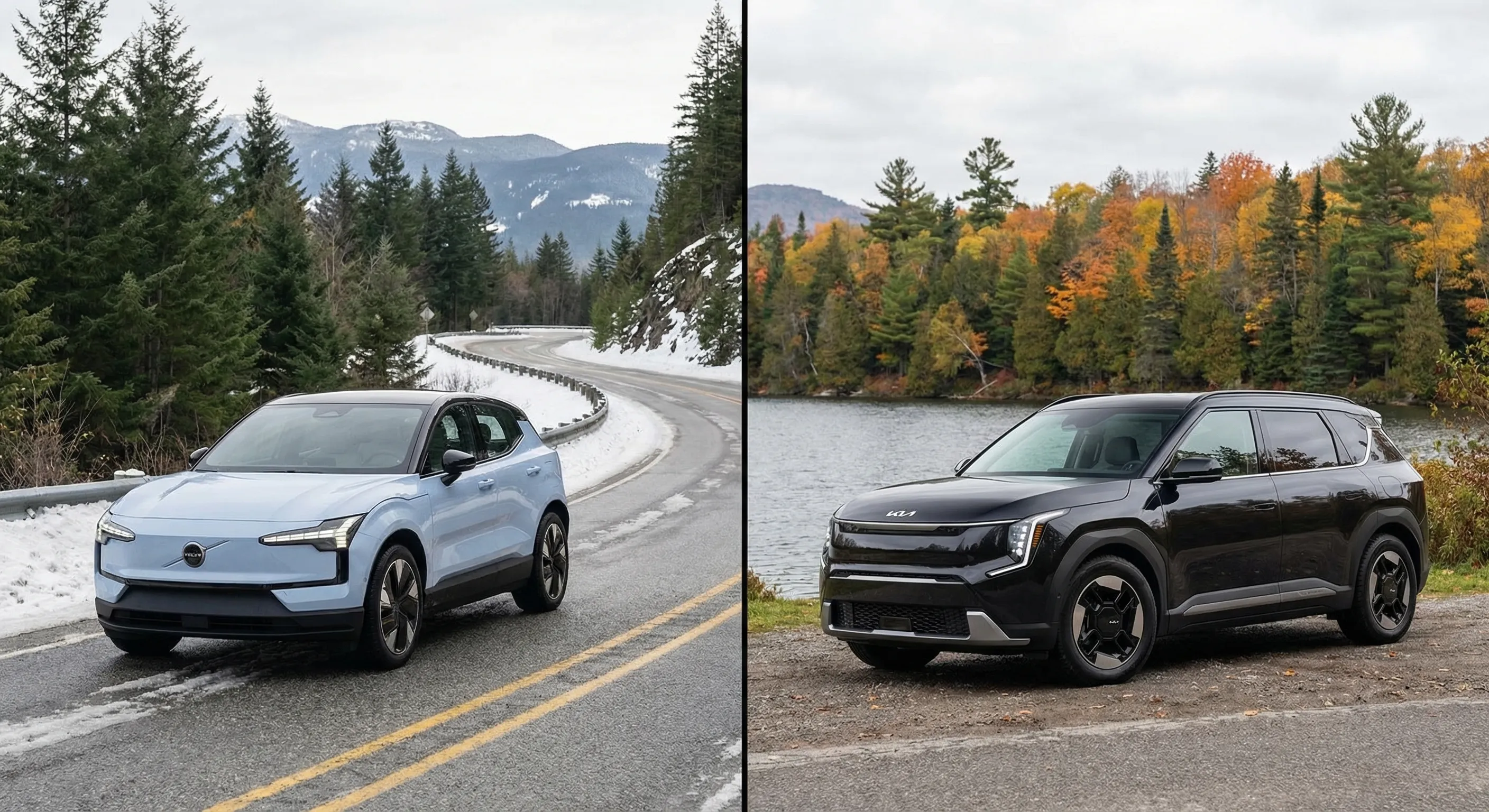
The Volvo EX30 starts at $46,950 CAD. The Kia EV3 starts at $38,995 CAD. Write those two numbers down, then add a third: $5,000, the federal EVAP rebate the EV3 qualifies for and the EX30 does not. The EX30 is assembled in China. Canada's Electric Vehicle Affordability Program excludes Chinese-manufactured vehicles, full stop, regardless of how many Scandinavian engineers approved the design or how Swedish the branding feels. When you do that arithmetic, the EV3's real entry point is $33,995 and the EX30 stays at $46,950. That is a $12,955 gap, not the $7,955 the sticker prices suggest.
Thirteen thousand dollars. In Canadian terms, that is a set of premium winter tires every two years for a decade. That is a professional Level 2 charger installation plus hardware with money left for groceries. That is a year's worth of electricity for your house. When a comparison has that kind of financial asymmetry baked in from the first paragraph, it shapes every section that follows.
Here is my position, stated plainly so you can read the rest of this with full context: the Kia EV3 Long Range wins this comparison for the overwhelming majority of Canadian buyers. Not because the EX30 is a weak car, it genuinely is not. It is a legitimately excellent compact EV with a driver's character that the EV3 cannot match. But the EX30 needs to clear a $13,000 bar to justify itself, and while it clears parts of that bar, it does not clear the whole thing. The value math runs too strongly in the EV3's direction.
If you are still reading because you want to understand exactly where the EX30 is worth it and where it is not, that is what the next 8,000 words are for.
THE REBATE SITUATION IS MORE COMPLICATED THAN YOU THINK
Let me explain why the EVAP exclusion matters beyond just the five-thousand-dollar sticker shock, because there is a second-order effect that most comparisons miss.
The EX30's disqualification from EVAP is not a policy oversight that might get corrected. It is a structural consequence of where the car is built, and that manufacturing location creates a second problem: tariff risk. Canada imposed 100% tariffs on Chinese-manufactured EVs in October 2024, then reduced them to 6.1% in January 2026 under the EVAP quota system. But that 6.1% applies to the first 49,000 qualifying vehicles in the quota, and the EX30 is explicitly excluded from the EVAP framework entirely, which means it does not benefit from that reduced tariff rate the same way EVAP-eligible vehicles do. The pricing stability picture for Chinese-manufactured vehicles in Canada is genuinely uncertain in a way that Korean-manufactured vehicles are not.
Kia builds the EV3 in Gwangju, South Korea. South Korea has a free trade agreement with Canada. The EV3's pricing is predictable. The EX30's pricing depends on tariff negotiations between Canada and China that nobody should be trying to forecast with confidence. This is not a theoretical risk, it is the kind of supply-chain uncertainty that should factor into a five-year ownership calculation, because if tariff rates move, the EX30's residual value and repair-parts costs both shift.
The EV3's rebate eligibility also has a ceiling effect worth understanding. The EVAP rebate applies when the final transaction value stays under $50,000. The EV3 Standard Range at $38,995 and Long Range at approximately $42,000-$44,995 both sit comfortably under that threshold, even with popular add-ons. So long as you are not loading the EV3 up with every dealer add-on known to humanity, you get the full $5,000 off. The EX30 at $46,950 for the base Single Motor Extended Range is above what would be needed to access EVAP even if it qualified, though Volvo has not historically discounted aggressively in Canada.
Provincial stacking makes the EV3's position even stronger. Quebec's Roulez Vert program offers up to $7,000 on eligible EVs. BC's CleanBC Go Electric program offers up to $4,000. When you stack provincial and federal rebates, an EV3 buyer in Quebec pays as little as $26,995 out of pocket. An EX30 buyer in the same province pays $46,950. That is a $19,955 gap on identical provincial roads. At that spread, you are no longer comparing two compact EVs, you are comparing two different financial decisions.
Ontario ended its provincial EV rebate program in 2018 and has not reinstated it as of early 2026, so Ontario buyers work with the federal EVAP alone. Even so, the $5,000 federal gap is significant. Nova Scotia offers a $3,000 rebate for eligible EVs under $55,000. Prince Edward Island offers $5,000 matching the federal amount. New Brunswick offers $5,000. Every province-by-province stack widens the EV3's position further, while the EX30 sits outside all of it, collecting no rebate from any level of government anywhere in Canada.
RANGE AND BATTERY: WHERE THE EV3 ERASES THE PREMIUM
The EX30 Single Motor Extended Range carries a 69 kWh battery and is rated at 440 km of range. That is Volvo's headline number, and it is a legitimate one, not aspirational padding. In real-world Canadian summer conditions, expect 360-395 km. That puts the EX30 in genuine long-range territory for a compact premium crossover, and it is one of the strongest range figures in its segment.
Then there is the EV3 Long Range, which carries an 81.4 kWh battery and is rated at 460 km, twenty kilometres more than the EX30's best variant. On a car that costs $13,000 less. That is not a close call on specs; that is the cheaper car beating the expensive one at the thing EVs are most commonly compared on.
Here is how I would think about the two EV3 configurations: the Standard Range at 58.3 kWh and 350 km rated is the budget entry point, and it is fine if your daily commute is under 80 km and you have reliable home charging. But the Standard Range model is not the right frame for this comparison. If you are cross-shopping an EX30, you are someone who cares about range, probably does some highway driving, and wants flexibility. The EV3 Long Range at 81.4 kWh is the correct configuration for that person, and it is the one that beats the EX30's range at a lower price.
Real-world numbers, summer conditions: the EV3 Long Range delivers approximately 380-420 km depending on highway speed and climate system load. The EX30 delivers approximately 360-395 km. Both are strong performers. The EV3 is stronger.
Now we add Canadian winter, because ignoring it would be irresponsible. Lithium-ion batteries lose 25-35% of rated capacity below -10C. That is physics, not a warranty issue, and it applies to both cars. The EX30 at 440 km rated drops to roughly 286-330 km in hard winter conditions, say, January in Edmonton or Saskatoon at -20C sustained. The EV3 Long Range at 460 km rated drops to roughly 300-345 km in the same conditions. The EV3 Standard Range at 350 km rated falls to approximately 220-260 km, which is why I said the Standard Range is not the right frame for this comparison.
The practical winter margin question: if your daily drive is 60 km, you want to never start the day below roughly 150 km of buffer to account for battery precondition drain, unexpected detours, and the fact that your climate system is working harder than it does in July. The EV3 Long Range gives you that margin comfortably, as does the EX30 Extended Range. If you are in Winnipeg where -30C is a January reality, both Long Range variants are the move, and both handle it adequately.
One efficiency note: the EX30 is marginally more efficient per kilometre, approximately 16-17 kWh per 100 km in temperate conditions versus the EV3 Long Range's 17-18 kWh per 100 km. The difference is attributable partly to the EX30's slightly smaller, lighter package. In practice, at Canadian electricity rates of roughly $0.17 per kWh, this efficiency gap translates to about $15-25 per year in charging costs at 15,000 km annually. It is not a meaningful real-world differentiator.
The battery story has one more chapter: warranty. The EV3 comes with a 10-year, 200,000 km battery and electric motor warranty. The EX30 comes with an 8-year, 160,000 km battery warranty. Kia will replace the battery if capacity drops below 70% within the warranty period. For a buyer holding the car for 8-10 years, which is a completely reasonable plan given how expensive both cars are, the extra two years and 40,000 km of coverage is substantive. The battery is the most expensive component in an EV. Kia's warranty on it is better than Volvo's. That matters.
CHARGING SPEED AND INFRASTRUCTURE: THE ROAD TRIP QUESTION
The EX30 wins on DC fast-charging speed. It supports up to 153 kW on the Extended Range variant, getting from 10% to 80% in approximately 26-28 minutes. The EV3 maxes out at 128 kW, reaching 10-80% in approximately 31 minutes. That is a genuine three-to-five-minute advantage at each highway stop. Over a Toronto-to-Ottawa drive requiring two charging stops, the EX30 saves you roughly 6-10 minutes of sitting at an Electrify Canada station, enough for one additional washroom visit, or most of a coffee.
Both cars use CCS connectors, which means they work at every major public fast-charging network in Canada: Electrify Canada, Petro-Canada, FLO, ChargePoint. Both manufacturers also provide NACS adapters for Tesla Supercharger access. In the real world, both cars have access to the same charging infrastructure. The EX30's advantage is purely in how fast it moves electrons through that infrastructure, not in which infrastructure it can access.
Here is the real question for Canadian buyers on charging speed: how often are you actually on a road trip that requires fast charging, versus driving your normal life and plugging in at home? The research answer is consistent across markets, roughly 80% of EV charging happens at home, overnight, on Level 2. On a 240V, 48-amp circuit (which is what a standard Level 2 EVSE provides), both the EX30 and the EV3 Long Range charge at similar rates, roughly 9-11 hours to a full charge from near-empty. Plug in after dinner, full by six AM. For that 80% of charging, the 25 kW speed difference between these cars is completely invisible.
Where the speed difference does matter: you live in an apartment without access to home charging and rely primarily on public charging. For that buyer, the EX30's faster charging meaningfully improves the ownership experience. A 28-minute stop versus a 31-minute stop, multiplied by five or six charging sessions a week, adds up to roughly 90 minutes per month. That is real. It is also a scenario specific enough that most buyers should honestly assess whether it applies to them before weighing the speed advantage heavily.
The EV3 has a capability the EX30 simply does not: Vehicle-to-Load at 3.6 kW. There is a standard AC outlet adapter you plug into the EV3's charging port, and suddenly the car's 81.4 kWh battery is a mobile power station. Run a laptop, a camping fridge, power tools on a job site, or a string of lights at a tailgate. During the 2024-2025 BC ice storm season, multiple EV owners used V2L to keep medical equipment running and charge neighbours' devices through extended outages. The EX30 offers no equivalent. Volvo simply has not added V2L to the EX30 at any trim level.
For buyers who camp, which, in Canada, is a lot of people, V2L is the kind of feature that sounds marginal until you are in a campground in Kootenay National Park with 81 kWh of electricity under the hood and the realisation that you are carrying a generator. At 3.6 kW continuous output, you can power a camping stove, charge electronics, and run a small heater for days on a single charge. The EX30 cannot do that. At all.
SAFETY: VOLVO IS STILL THE BENCHMARK, BUT NOT BY $13,000

Volvo's safety engineering is not a marketing claim, it is a 70-year institutional commitment that shows up in measurable ways. The EX30 earned a five-star Euro NCAP rating with scores of 89% for adult occupant protection, 89% for child occupant protection, 72% for vulnerable road user protection, and 84% for safety assist. These are strong numbers, particularly the adult and child occupant figures.
The body structure uses high-strength boron steel extensively, and the active safety suite includes automatic emergency braking with pedestrian, cyclist, and large animal detection (the large animal detection matters in British Columbia and Alberta in ways it does not in Stuttgart), blind spot information with steering assistance, cross-traffic alert with braking, lane keeping with road edge detection, and Pilot Assist, Volvo's semi-autonomous highway system that manages both steering and speed control simultaneously.
Pilot Assist is worth dwelling on. On the Trans-Canada between Revelstoke and Golden, or on a long Saskatchewan highway stretch in white-out conditions, the ability to have the car manage both throttle and steering within its operational envelope reduces driver fatigue in a way that basic adaptive cruise cannot. The EX30's Pilot Assist is not full self-driving, but it is genuinely useful on the kind of monotonous 300 km stretches that define Canadian inter-city driving.
The Kia EV3 is not unsafe. It includes Highway Driving Assist, blind spot collision warning with avoidance, rear cross-traffic collision avoidance, lane following assist, and forward collision avoidance with braking. Kia's recent EV6 and EV9 have both earned five-star Euro NCAP ratings, and the EV3 shares significant safety architecture with those vehicles. Full EV3 results were not published at time of writing, but the platform and system hardware suggest it will perform well.
The honest gap: Volvo's safety engineering has forty years more refinement than Kia's. The EX30 benefits from a corporate culture where safety is the first design constraint rather than a compliance requirement, and the sub-scores show it. The 89% adult occupant protection figure is genuinely excellent for a subcompact. If safety ratings are the primary decision factor in your purchase, the EX30 is the right choice. That is a legitimate, well-founded position.
What that safety advantage does not justify is a $13,000 premium, because the EV3 is not dangerous. The gap is between very good and exceptional, not between safe and unsafe. If the EX30 cost $3,000 more than the EV3, Volvo's safety credentials would swing the comparison clearly. At $13,000 more, they are one strong argument in a case that needs several more to reach a verdict.
INTERIOR AND TECHNOLOGY: PREMIUM VERSUS PRACTICAL
The EX30's interior is the strongest argument Volvo has for the premium price, and it is genuinely compelling. The cabin reflects a design philosophy that costs money to execute: recycled materials throughout (the My Forest variant uses reclaimed wood panelling from managed forests; the Indigo variant uses a microfibre blend made from recycled plastic bottles), a single large 12.3-inch portrait-oriented centre display that handles almost all controls, and an overall aesthetic that feels intentional and restrained in a way that most subcompact interiors do not.
The operating system is Google Automotive Services running natively, Google Maps, Google Assistant, and Android Auto are built in, not bolted on. Apple CarPlay is also available. The interface is fast and the maps integration is excellent. The trade-off is that Volvo has removed most physical controls in favour of the touchscreen, which creates friction for operations you want to do while driving, adjusting climate, changing audio volume, that now require looking at the screen. This is a genuine usability critique, not a personal preference quibble. Using a touchscreen to adjust fan speed at highway speed is objectively less safe than turning a physical knob. Volvo made this choice consciously, and buyers either accept it or they do not.
The optional Harman Kardon audio system in the EX30 is legitimately impressive for a car this size. Harman has designed the speaker placement and DSP tuning specifically for the EX30's interior geometry, and it shows, the soundstage is remarkably coherent, the bass is controlled without being boomy, and the system handles both classical recordings and bass-heavy modern music well. If audio quality in a car matters to you, the EX30's Harman Kardon setup is a meaningful differentiator. It is one of the best sound systems you can get in a compact vehicle at any price.
Front seats in the EX30 are well-shaped and supportive, with heating as standard across trims. Rear seat space is honest: the EX30 is 4,233 mm long with a 2,650 mm wheelbase, and rear passengers of average height will feel the compressed geometry on trips over an hour. Two adults in the front, two adults in the rear for a run across the Lions Gate Bridge is fine. Two adults in the front, two adults in the rear for a Vancouver-to-Kelowna run over the Coquihalla is a different conversation. The EX30 is a two-adult car that occasionally accommodates two more, not a genuine four-adult vehicle.
Cargo capacity is 318 litres behind the rear seats, meaningfully less than the EV3, expanding to 904 litres with the rear bench folded. There is no frunk. The sloped roofline that gives the EX30 its visual character costs boot space, which is a reasonable engineering trade-off that buyers should understand before purchase.
The EV3's interior takes a deliberately different approach. Twin 12.3-inch screens span the dash, a digital instrument cluster on the left and infotainment on the right, with physical climate controls positioned directly below the infotainment screen. That last detail deserves specific attention: adjusting fan speed, temperature, and seat heating without taking your eyes off the road is something the EV3 handles and the EX30 does not. In stop-and-go commute traffic in a Canadian January when you are constantly adjusting climate, having a physical knob for the heat is not a small thing.
Kia's software is competent and quick without being exceptional. Wireless Apple CarPlay and Android Auto work as expected, the menu logic is sensible, and the response times are fast. It does not have the smooth integration of Google Automotive Services, but it does have the pragmatism of a brand that understands most people just want to see their familiar phone interface on the car's screen.
Materials in the EV3 are appropriate for the price: soft-touch surfaces on the upper dashboard and door uppers, firmer plastics below. The assembly quality is solid. It feels like a well-made Kia rather than a premium Swedish interior, that is an accurate description, not a criticism.
The space comparison runs decisively to the EV3. At 4,300 mm length, 67 mm longer than the EX30, and with a flat floor from its skateboard battery architecture, the EV3 provides meaningfully better rear legroom. Cargo behind the rear seats is approximately 460 litres, expanding to roughly 1,250 litres with the seats folded. That is 40% more cargo capacity than the EX30 in both configurations. For a family doing a Costco run, shuttling hockey gear, or packing for a long weekend at the cabin, that difference is not abstract. You either fit the gear or you do not.
Here is how I would frame the interior choice: the EX30 is the car you buy when you care how your daily environment feels and sounds. The EV3 is the car you buy when you care what the daily environment can carry and accommodate. Both are coherent priorities. Most buyers, when they account for the $13,000 gap, will find the EV3's priorities more defensible.
DRIVING DYNAMICS: THE ONE AREA WHERE VOLVO EARNS ITS PRICE UNCONDITIONALLY
The EX30 Single Motor RWD produces 272 hp, and that power goes to the rear wheels, which is unusual for a compact EV where FWD is the default. That drivetrain layout, combined with the EX30's firm suspension tuning and precise steering, produces a car that genuinely rewards engagement. The 0-100 km/h time of approximately 5.3 seconds is properly quick, not quick for a compact, not quick for the price, just quick. The Twin Motor Performance at 422 hp and 3.6 seconds to 100 km/h is in sports car territory, but the Single Motor is the relevant configuration for this comparison and it is still faster than most cars that cost more.
What makes the EX30 special on a good road is not just the straight-line performance, it is the balance. The RWD layout distributes weight differently than a FWD compact, and combined with Volvo's suspension tuning, the EX30 feels like it wants to be driven rather than piloted. On a clear summer run through BC's Sea-to-Sky corridor or Alberta's Highwood Pass, the EX30 delivers genuine driving satisfaction. One-pedal driving is well-calibrated and natural. The steering weights up appropriately at speed without being artificially heavy.
The trade-off for that sporty tuning is ride quality on bad roads. The EX30's firmer suspension setup that makes it fun on smooth asphalt makes it more noticeable on Montreal's municipal testing grounds (they call them "streets"), northern Ontario frost-heaved secondary roads, or any BC side road that has not seen a grader since before the last Olympic games. This is not a comfort-tuned car, and Canadian roads are not consistently smooth. Buyers who commute primarily in urban environments with significant road imperfection should register this honestly.
The Kia EV3 produces 204 hp from its single front-mounted motor, in a FWD configuration, with a 0-100 km/h time of approximately 7.5 seconds. Those numbers are accurate, and they describe a car that is not trying to be a driver's machine. The EV3 is tuned for refinement and comfort, the suspension absorbs road imperfections rather than communicating them, the steering is light and easy in urban environments, and the overall experience is quiet and relaxed. For a driver spending 45 minutes in commute traffic twice a day, every day, for the next seven years, "quiet and relaxed" is not a consolation prize. It is the correct specification.
The absence of AWD on the EV3 is worth addressing directly, because it is one of the EX30's genuine structural advantages. The EX30 Twin Motor offers full electric AWD with instant torque distribution to both axles, meaningfully better traction on ice, snow, and gravel. If you live somewhere with serious winter traction demands, a steep driveway in a northern Alberta acreage, unplowed subdivision streets in a prairie city, mountain passes in BC, the EX30 Twin Motor with winter tires is a more confident choice than the EV3 FWD with winter tires.
Gear worth having
As an Amazon Associate, ThinkEV earns a small commission from qualifying purchases — at no extra cost to you.
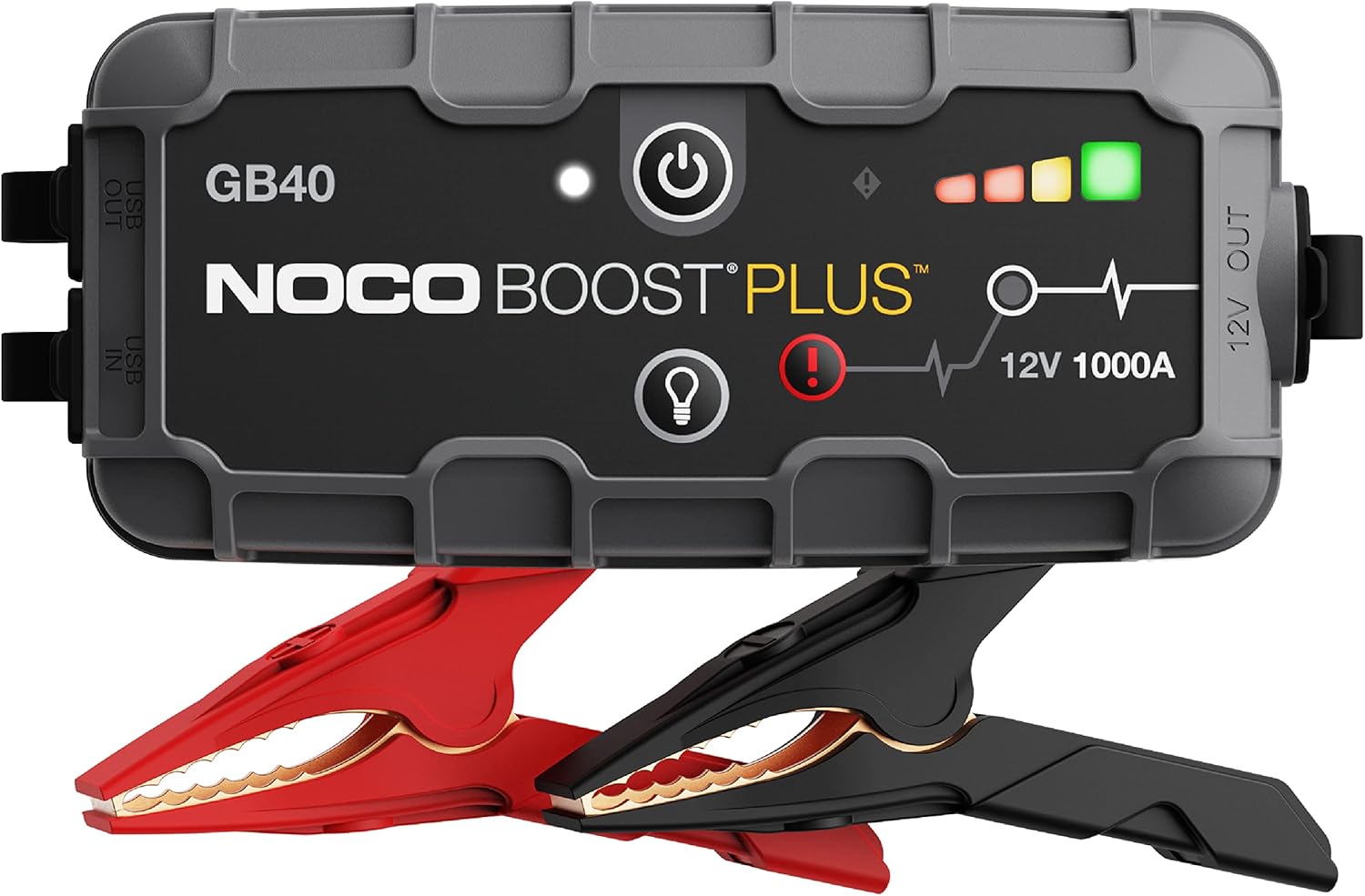
NOCO Boost Plus GB40 Jump Starter
A 1000A lithium jump starter that fits in your glovebox and works on any 12V battery. Your insurance against a dead 12V in a parking lot.
As an Amazon Associate, ThinkEV earns from qualifying purchases — at no extra cost to you.
The counterargument, which I think is usually underweighted: FWD EVs with proper winter tires are genuinely capable winter vehicles. The battery weight over the front axle gives FWD EVs more front traction than a comparable FWD gas car. Countless Canadians drive FWD EVs through hard winters without incident. The superiority of AWD in winter conditions is real but often overstated by people who have not actually tried a good set of winter tires on a FWD car. Unless you have specific traction demands, steep grades, rural unplowed roads, very hilly terrain, the EV3 FWD with Blizzaks or Nokian Hakkapeliitta is adequate for most Canadian winters.
The dynamics verdict: the EX30 is a better driver's car by a meaningful margin. If the act of driving matters to you, not just getting from A to B but the experience of the transit, the EX30 is worth considering seriously. It is the one category where the premium feels cleanest.
CANADIAN WINTER READINESS: BOTH PASS, BUT WITH DIFFERENT PROFILES
Both the EX30 and EV3 were designed for markets that take winter seriously, Volvo for Scandinavia, Kia for South Korea, and both arrive in Canada with appropriate thermal management.
The EX30 Single Motor Extended Range includes a heat pump as standard equipment. Heat pumps extract ambient thermal energy from outside air rather than converting all electricity directly into heat, making them roughly three times more efficient than resistive heating above -15C. Below -15C, heat pump efficiency drops and the system supplements with resistive heating automatically, Volvo's thermal management handles the transition without driver input. The EX30 also includes heated front seats, a heated steering wheel, and heated rear window as standard across all Canadian trims. This is the right spec for Canada, and Volvo has made none of these features optional.
The EV3 Long Range also includes a heat pump, heated front seats, and a heated steering wheel as standard. Where the EV3 adds something particularly useful for Canadian winters: Kia's preconditioning system integrates with the home charging connection. When you schedule a departure time, the car heats the cabin and brings the battery to optimal temperature while still plugged into house power, so you leave with a warm interior without having drawn from the range you need. This is not unique to the EV3, but Kia's implementation is among the better ones in the segment, and the scheduling integration with the Kia Connect app is straightforward to use.
Winter range figures, reiterated because they are the number that actually matters for Canadian ownership: the EX30 at 440 km rated delivers approximately 286-330 km in sustained cold below -10C. The EV3 Long Range at 460 km rated delivers approximately 300-345 km. For a typical Canadian commute of 40-80 km daily, both figures provide comfortable margin. For a 200 km inter-city winter drive, say, Saskatoon to Moose Jaw and back, both cars can handle it with one charging stop planned, though you should plan the stop rather than wing it.
The AWD dimension matters in specific winter contexts but less in others. Prairie winters are cold and often windy, but the roads are frequently plowed and flat. FWD EVs handle prairie winters well. Mountain winters in BC and Alberta feature steep grades, switchback climbs, and unpredictable surface conditions, that is where AWD earns its keep most clearly. If you are in Whistler, Banff, or Fernie, the EX30 Twin Motor with winter tires is the more confidence-inspiring choice between these two. If you are in Calgary, Winnipeg, or Halifax, the EV3 Long Range FWD with winter tires is entirely adequate.
One winter-specific feature the EV3 has over the EX30: the 3.6 kW V2L capability does not disappear in cold weather. If you are camping in Algonquin in November or ice fishing in Quebec and you need to run a heater for a few hours, the EV3's battery is available for that. The EX30 offers no equivalent power output capability at any temperature.
WARRANTY AND TOTAL COST OF OWNERSHIP: THE NUMBERS THAT SETTLE IT
The warranty comparison is straightforward. The EV3 offers 5 years / 100,000 km comprehensive and 10 years / 200,000 km on battery and electric motor. The EX30 offers 4 years / 80,000 km comprehensive and 8 years / 160,000 km on battery and drivetrain. The EV3 wins on every metric, duration, mileage, and the specific coverage of the battery. Kia's 70% capacity retention guarantee means that if your EV3's battery degrades to 69% of its original capacity within ten years or 200,000 km, Kia replaces it. For a buyer planning to own the car for eight or more years, the battery warranty gap is not trivial.
Service network coverage affects ownership cost in ways that rarely appear in spec comparisons. Kia has dealerships across Canada, in major cities, mid-size cities, and many smaller communities. If you live in Lethbridge, Moncton, or Prince George, there is a Kia dealer within reasonable distance. Volvo's Canadian network is more concentrated in major urban centres. In Vancouver, Toronto, Calgary, and Ottawa, Volvo service is accessible. In much of the rest of the country, the nearest Volvo dealership may be a significant drive. Service access affects not just convenience but also the practicality of warranty claims, recall work, and software updates.
Insurance costs run higher for the EX30 than the EV3, reflecting the higher replacement value and imported components. The gap is not catastrophic, an EX30 in most Canadian provinces runs approximately $1,800-$2,200 annually versus $1,400-$1,800 for the EV3, but over five years of ownership, that $400-$800 per year difference adds $2,000-$4,000 to the total ownership cost. On top of the $13,000 initial gap.
Let me put a five-year ownership number on this comparison, because the aggregate is more useful than any individual line item.
EX30 Single Motor Extended Range five-year cost profile:
- Purchase: $46,950
- Insurance (5 years at $2,000/year average): $10,000
- Charging (15,000 km/year at 16.5 kWh/100km at $0.17/kWh): $2,121
- Maintenance (minimal for an EV, primarily tires and brakes): $2,500
- Total spent: $61,571
- Residual value at year 5 (premium compact EV depreciation ~45-50%): $23,475-$25,822
- Net cost of five-year ownership: approximately $35,749-$38,096
EV3 Long Range five-year cost profile:
- Purchase after EVAP rebate: $33,995
- Insurance (5 years at $1,600/year average): $8,000
- Charging (15,000 km/year at 17.5 kWh/100km at $0.17/kWh): $2,251
- Maintenance: $2,500
- Total spent: $46,746
- Residual value at year 5 (mainstream compact EV depreciation ~42-47%): $18,418-$20,337
- Net cost of five-year ownership: approximately $26,409-$28,328
The five-year net ownership gap is approximately $9,000-$12,000 in the EV3's favour, accounting for the differences in residual value, insurance, and charging. If you add provincial rebates on top of the federal EVAP in Quebec or BC, that gap widens further. If you are in a province with no additional provincial incentive (Saskatchewan, Alberta, New Brunswick), the gap narrows slightly but remains in the EV3's favour.
The EX30 is a car you buy because you want it and can afford the premium. The EV3 is a car that actively rewards you financially for choosing it. Both are coherent positions. Most buyers should understand which position they are actually in.
THE DRIVERS WHO SHOULD SERIOUSLY CONSIDER THE EX30
I have been clear that the EV3 wins this comparison for most buyers. But "most buyers" is not all buyers, and being honest about where the EX30 makes sense is part of giving a complete answer.
The EX30 is the correct answer if you live in a city with full Volvo service access, drive mountain passes regularly and want AWD (the Twin Motor specifically), do significant highway driving where 153 kW charging speed compounds over multiple road trips per year, place genuine value on the driving experience as an end in itself, or care deeply about interior aesthetics and audio quality and will use both every day for years.
The EX30 is also the answer for apartment dwellers who rely heavily on public charging and find the 5-minute-per-stop advantage meaningful over the life of ownership. And it is the right answer for buyers who are replacing a premium European gas car and have no appetite for a vehicle that does not match that tier of interior quality.
What the EX30 is not: a rational financial choice versus the EV3 for buyers who are primarily optimising for value, practicality, or total cost of ownership. The math does not close that gap.
THE EV3 BUYERS WHO ARE MAKING THE RIGHT CHOICE
The Kia EV3 Long Range is the right vehicle for first-time EV buyers who want to minimise risk, lower entry cost, longer battery warranty, better dealer network, and $5,000 back at the point of purchase all reduce the financial exposure of switching from gas for the first time.
It is the right vehicle for families who need cargo space and genuine rear-seat capacity, the 40% cargo advantage and better wheelbase are not abstract, they are the difference between fitting the hockey bags or not.
It is the right vehicle for buyers who charge primarily at home and do the occasional long road trip, the 128 kW charging speed is entirely adequate, the range is excellent, and the V2L capability adds utility that the EX30 cannot match.
And it is the right vehicle for buyers in smaller Canadian cities and rural areas where Kia's dealer network covers the map and Volvo's does not. Ownership of any car is shaped partly by the service experience, and the EV3's network advantage is meaningful outside the major metropolitan areas.
The EV3 is also the right choice for buyers who are coming out of a gas vehicle lease and want to reduce overall expenditure on personal transportation. The combination of lower fuel costs (roughly $15,000-$18,000 saved versus a similar gas crossover over five years at Canadian gas prices), lower maintenance (no oil changes, fewer brake jobs from regenerative braking), and the lower purchase price creates a total cost argument that is genuinely hard to refute. If someone said they wanted to spend as little as possible on getting reliably from A to B for the next eight years while driving something modern and well-equipped, the EV3 Long Range is the answer before we have even finished the sentence.
THE VERDICT ON THIS COMPARISON
The Kia EV3 Long Range wins. Not narrowly, by a margin that reflects a fundamental value advantage rather than a close call on competing priorities.
At $33,995 after the EVAP rebate versus $46,950 for the EX30, the EV3 delivers more range, more cargo space, a longer battery warranty, better dealer access across Canada, V2L capability, and physical climate controls that the EX30's touchscreen-only approach does not match. The total five-year ownership gap runs $9,000-$12,000 in the EV3's favour after accounting for insurance, depreciation, and purchase price.
The EX30 counters with better driving dynamics, a more premium interior, faster DC charging, the option for AWD, Pilot Assist on the highway, and Volvo's five-star Euro NCAP safety package. Those are real, substantive advantages. They are worth something. They are not worth $13,000 to the median buyer.
The clearest version of this I can give you: buy the EX30 if you actively want what it specifically offers and have the budget to pay for it without financial strain. Buy the EV3 Long Range if you want the most capable, practical, well-warranted compact EV available in Canada right now at its price point. Take the $13,000 difference and install a Level 2 charger at home, put some toward winter tires, and keep the rest.
The EX30 is a better driver's car. The EV3 is the better decision.
CONNECTIVITY AND SOFTWARE: THE ECOSYSTEM YOU LIVE WITH DAILY
There is a dimension of modern EV ownership that spec sheets do not capture well, and it is arguably the one you interact with most, the software ecosystem running behind the infotainment screen, the app on your phone, and the over-the-air update schedule that determines whether your car gets better or worse over time.
The EX30 runs Google Automotive Services natively. That means Google Maps is not just a CarPlay projection, it is built into the car's operating system, with full offline maps, real-time traffic rerouting, and native integration with the charging network display that shows available stations along your route with live occupancy data from Electrify Canada and other CCS providers. When you ask Google Assistant a question through the EX30's microphone, it responds through the car's native software rather than bridging to a phone. For Google ecosystem users, Android phone, Google Calendar, Gmail, the EX30's integration feels smooth in a way that even CarPlay mirroring cannot fully replicate.
Volvo's over-the-air update cadence for the EX30 has been reasonably consistent since launch. The car has received software improvements to range estimation accuracy, Pilot Assist performance, and the Google Maps interface. Volvo's parent company Geely has the engineering capacity to deliver meaningful updates, and the EX30's architecture was designed for OTA updates from the ground up. This is not a guarantee of future improvement, but the track record since the EX30's launch is encouraging.
The EV3's software is Kia's own platform, competent, quick, and sensible without being exciting. The dual-screen arrangement (instrument cluster plus infotainment) means the EV3 presents more information simultaneously than the EX30's single-screen setup, which some drivers find useful and others find cluttered. Wireless Apple CarPlay and Android Auto work without complaints, and the EV3's Kia Connect app handles remote preconditioning, charge scheduling, charging status monitoring, and location finding reliably. For a buyer who just wants the phone integration to work every time without fussing, the EV3 delivers that.
Kia's OTA update history for the EV3 is shorter than Volvo's for the EX30 (the EV3 is newer), but Kia has committed to software support for the EV3 and the broader EV platform. The EV6 and EV9 have both received meaningful OTA updates since launch, which suggests Kia's support infrastructure works. The EV3 inherits that same architecture.
One practical software difference: the EX30's navigation system integrates charging network data more deeply, partly because of Google's partnerships with charging providers. When you enter a destination that requires charging stops, the EX30 plans those stops intelligently and pre-conditions the battery temperature for fast charging before arrival, the same way Tesla Supercharger navigation works. The EV3's navigation handles charging stop planning adequately but does not pre-condition for DC charging in the same smoothly automatic way. For buyers doing frequent long-distance trips, this is a real-world convenience difference. For buyers who mainly commute, it is invisible.
The connected services pricing is worth checking before purchase. Both Volvo and Kia offer some connected services on a subscription model after the initial trial period. Volvo's Care Key, connected safety services, and some of the Google-dependent features operate within Volvo's connected services subscription. Kia Connect has similar tiered service levels. Neither brand has been transparent enough about long-term subscription costs at purchase, and buyers should ask specifically what features require an ongoing subscription and what the annual cost is. Over a ten-year ownership period, subscription costs for connected services add up in ways that sticker prices do not reflect.
THE REAL COMPARISON: WHICH CAR FITS YOUR LIFE IN FIVE YEARS
Here is the framing I find most useful when people ask me about this comparison: stop thinking about what these cars are today and think about what your life looks like in five years with each car in it.
Five years with the Kia EV3 Long Range looks like this: you bought it for $33,995 after rebate, installed a Level 2 charger at home for roughly $1,200, and have spent the last five years plugging in every night and never thinking about it. The battery warranty has another five years left and the car has covered 80,000 km. Your total fuel cost over five years has been approximately $2,000-$2,500 in electricity, compared to the $15,000-$18,000 you would have spent on gas in a similar-sized crossover.
The Kia dealer in your city has handled two software recalls, a warranty tire rotation issue, and a minor sensor replacement without drama. The V2L adapter has come out at three camping trips and during one winter power outage. The car still has 450 km of rated range because the 10-year battery warranty means Kia replaced a cell module that degraded to 78% in year three.
You are driving a car that is worth approximately $19,000-$22,000 and have spent a total of roughly $43,000 to own it.
Five years with the Volvo EX30 Single Motor looks like this: you paid $46,950 at purchase, installed the same Level 2 charger, and have been driving a car that you genuinely enjoy, the steering is still satisfying, Pilot Assist has made every highway trip less fatiguing, and the Harman Kardon system still sounds better than anything else at the price. The car has covered 75,000 km and the battery is still performing well within warranty. You found a Volvo dealer when you needed to, though one recall required a 120 km round trip to the nearest service centre because your city does not have a Volvo dealership. The car is worth approximately $23,000-$26,000 after five years. Your total ownership cost is roughly $53,000-$56,000 when you add insurance, charging, and the initial price.
The $10,000-$13,000 difference in those two five-year pictures represents genuine money. It is not abstract. For most Canadian households, $10,000 is a meaningful financial cushion, it is a year of RRSP contributions, a down payment addition, or simply the removal of financial stress from an already expensive asset purchase.
The question is not which car is objectively better in a vacuum. Both are good. The question is whether the EX30's advantages, the driver experience, the interior quality, the faster charging, the safety pedigree, are worth $10,000-$13,000 more over the ownership period to you specifically. For most buyers, with honest reflection, the answer is no. For some buyers, with the right circumstances and priorities, the answer is yes. Both answers are valid. Make sure you are giving yourself the honest version.
Gear worth having
As an Amazon Associate, ThinkEV earns a small commission from qualifying purchases — at no extra cost to you.

Grizzl-E Classic Level 2 EV Charger (40A)
Canadian-made and rated for minus 40C winters. 40A / 9.6 kW, NEMA 14-50, indoor/outdoor, 24-ft cable. The charger built for Canadian weather.
As an Amazon Associate, ThinkEV earns from qualifying purchases — at no extra cost to you.
Gear worth having
As an Amazon Associate, ThinkEV earns a small commission from qualifying purchases — at no extra cost to you.

PULIDIKI Car Cleaning Gel (Detailing Putty)
Press it into vents, buttons, and seams and it lifts out dust you did not know was there. Weirdly satisfying, genuinely useful.
As an Amazon Associate, ThinkEV earns from qualifying purchases — at no extra cost to you.
FAQ
Related Reading
- Most Affordable EVs in Canada 2026, Budget-friendly EVs compared head to head.
- EV Pricing Guide Canada 2026-2027, The numbers that settle the cost debate.
- Every New EV Coming to Canada in 2026-2027, What is arriving on Canadian roads.
Gear worth having
As an Amazon Associate, ThinkEV earns a small commission from qualifying purchases — at no extra cost to you.

WixGear Magnetic Air Vent Phone Mount (2-Pack)
A magnet strong enough that your phone never flinches over potholes or rail crossings. Two in the box, one for each car.
As an Amazon Associate, ThinkEV earns from qualifying purchases — at no extra cost to you.
Gear worth having
As an Amazon Associate, ThinkEV earns a small commission from qualifying purchases — at no extra cost to you.

Car Cup Holder Coasters (4-Pack)
Drop-in coasters that catch spills and crumbs so your cup holders stay clean. Rinse and reuse forever.
As an Amazon Associate, ThinkEV earns from qualifying purchases — at no extra cost to you.

Founder & Chief Editor
Vlad Pereira is the founder and chief editor of ThinkEV.ca, the Canadian electric-vehicle publication he writes and edits from Courtenay, British Columbia. He covers EV pricing, federal and provincial rebates, charging costs, and the Chinese manufacturers now entering Canada, from the buyer's side rather than the press-fleet side. ThinkEV is a venture of Vlad Pereira Online; his writing on health, income and the long game lives at vladpereira.com.
Frequently asked questions
Do the Volvo EX30 and Kia EV3 qualify for the federal EVAP rebate?
Which has better range in Canadian winters, the EX30 or EV3?
Is the Volvo EX30 worth the premium over the Kia EV3?
Which is better for a first-time EV buyer, the EX30 or EV3?
Does the Kia EV3 have AWD?
Which car has faster DC fast charging, the EX30 or EV3?
What is Vehicle-to-Load and does it matter for Canadian drivers?
More EV & road-trip finds
Affordable upgrades worth a look — tap any to check the price on Amazon.
 ★ 314
★ 314Mini USB LED Ambient Lamps (4-Pack)
View on Amazon ★ 1,349
Cool Swinging Duck Dashboard Ornament
View on Amazon ★ 1,340
Car Seat Gap Filler (Universal)
View on Amazon ★ 692
★ 692USB-A to USB-C CarPlay Adapter (3-Pack)
View on Amazon ★ 121
★ 121Foldable Windshield Sun Umbrella
View on Amazon ★ 268
★ 268Anti-Slip Leather Steering Wheel Cover
View on Amazon ★ 9,349
Auto Detailing Brush Set (10-Piece)
View on Amazon ★ 55
★ 55LED Car Door Logo Projector Light
View on AmazonRead, Plan, Then Stay Current
Explore our expert articles to understand incentives and ownership costs, use the map to pressure-test charging reality, then subscribe so new EV coverage comes straight to you.
Continue Reading

Rivian R1T vs F-150 Lightning: Canada 2026 Test
EV vs Gas: 5-Year Cost of Ownership in Canada
BMW i4 vs Tesla Model 3: Is the $11K Premium Worth It?
BYD Atto 3 vs Hyundai Kona EV: The $35K Comparison
BYD Dolphin vs Chevy Bolt 2027: Cheapest EVs