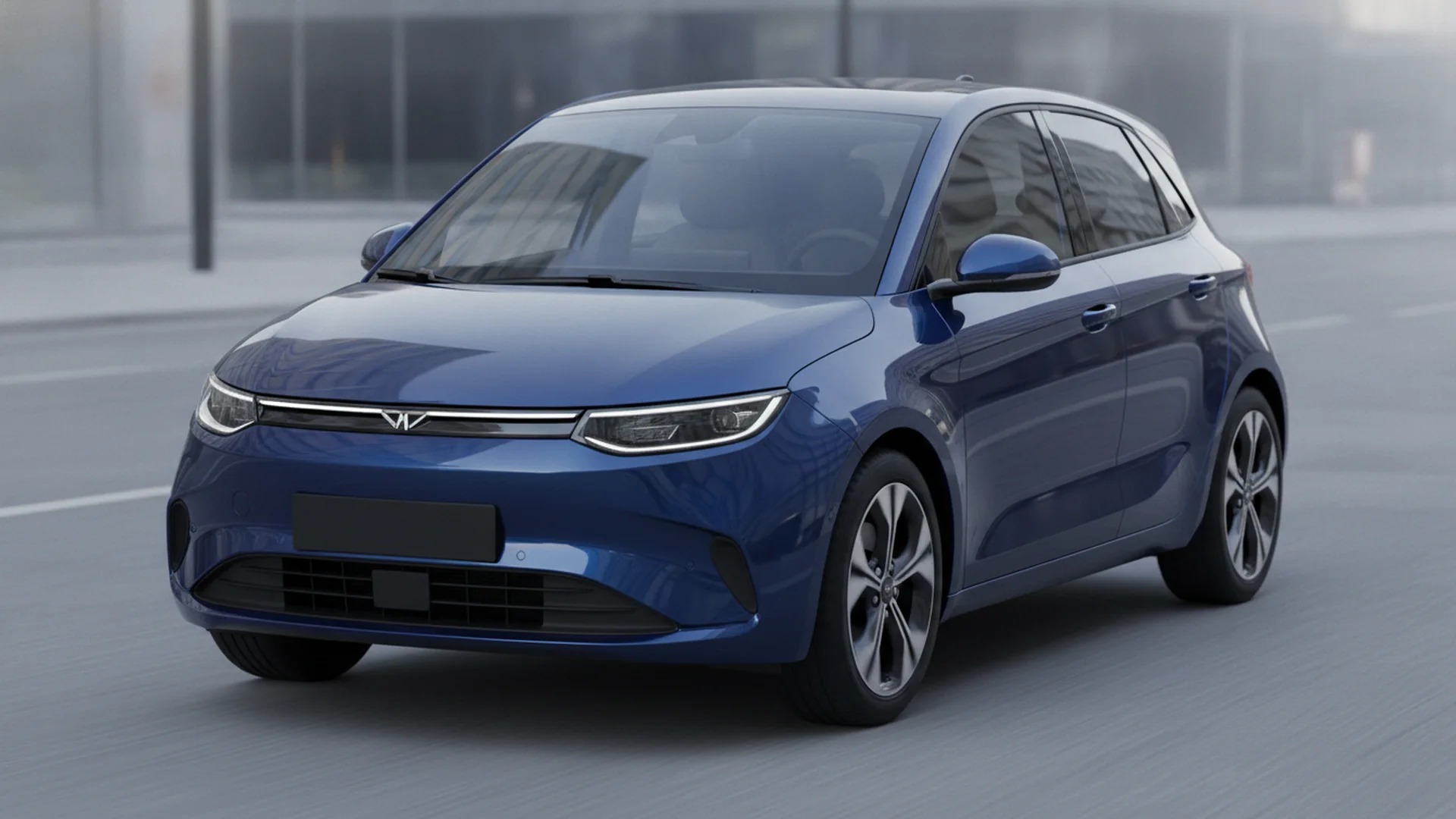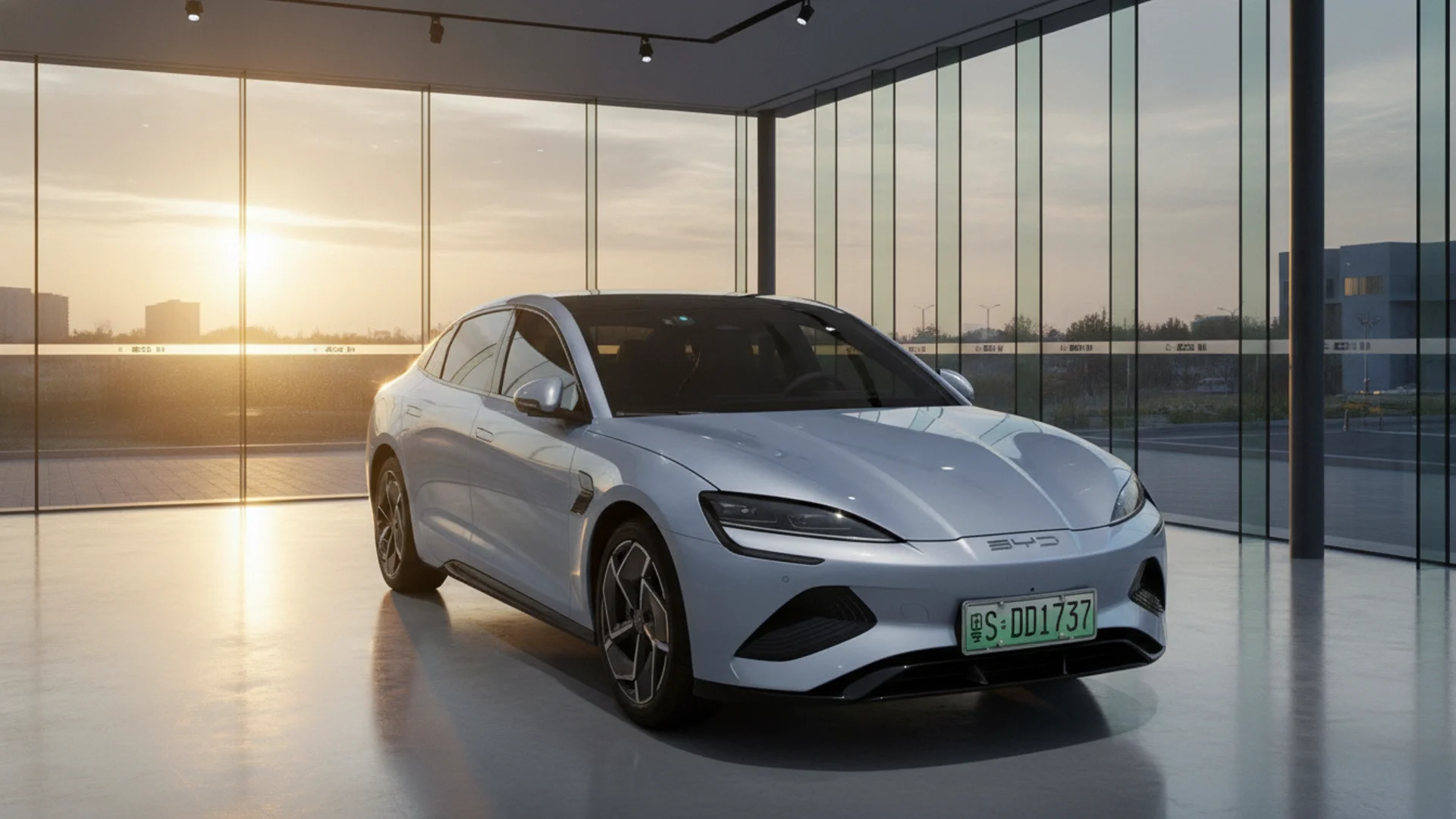
BYD's chairman just told investors his company will outsell Toyota within five years. His own sales chart told a different story.
Wang Chuanfu walked into a room of nervous shareholders, watched the share price slide in real time, and reached for the biggest target on the global automotive map. Not "we'll grow market share." Not "we'll lead the EV transition." Number one. Bigger than Toyota. Bigger than Volkswagen. The whole crown.
A great line, and on the math available today, a fantasy timeline attached to a real company doing real things. The BYD story keeps getting flattened into "Chinese juggernaut eats Detroit" or "overhyped EV maker peaks." Both framings miss what is actually happening.
Key takeaways
- BYD's chairman announced the Toyota-beating target during a shareholder meeting triggered by a falling share price.
- BYD's China sales dropped 29%, and full-year 2025 growth was the slowest in five years.
- Toyota sells twice as many vehicles annually as BYD, roughly 10-11 million versus 4.6 million.
- BYD's second-generation Blade Battery is the only concrete technical mechanism cited to support the growth thesis.
- BYD is spending £1.8 billion on five-minute flash chargers in Europe while Toyota dominates Southeast Asia for 50 years.
The announcement nobody should take at face value
Wang Chuanfu told the meeting on Tuesday that he expected BYD to become the world's largest automaker within five years, as he sought to reassure investors following a steep decline in the company's share price. Read that sentence twice. The Toyota-slayer promise wasn't the opener of a strategy day. It was the response to a sell-off.
CEOs don't reach for the biggest number on the board when things are going well, they reach for it when the stock is bleeding and the room needs sedating.
The follow-up is even more telling. BYD later confirmed that Wang said he wants the company to be the world's No. 1 automaker, but didn't respond to additional questions from Reuters about other details discussed at the meeting. The headline gets confirmed. The substance, how, when, with what, goes into the vault.
That is not the behaviour of a company executing a documented five-year plan. That is the behaviour of a company managing a narrative.
Wang has earned the right to set ambitious targets. BYD did pass Tesla in global EV sales, the story most Western outlets buried at the time. But "we beat Tesla in EVs" and "we'll beat Toyota in everything" are not the same claim. One was an industry inflection. The other is, on this evidence, a soundbite.
China sales just fell 29%. That's the actual headline.
BYD's home market is wobbling, a fact obscured by the Toyota theatre.
Not satisfied with simply building more cars than Ford, BYD wants to become the world's largest car manufacturer, outselling the Volkswagen Group and Toyota, the company's chairman, Wang Chuanfu, said that the brand wants to become the world's largest car manufacturer within just five years. The Carscoops headline that paired the ambition with the 29% China sales drop was the only honest framing in the news cycle.
Domestic pressure isn't a one-month blip either. Late 2025 already showed the cracks. BYD chairman Wang Chuanfu says the Chinese EV giant can become the world's largest automaker within five years, targeting Toyota's long-held crown despite slowing domestic sales and a sharp fall in its share price.
The full-year numbers tell the same story. BYD sold roughly 4.6 million vehicles in 2025, up from 4.3 million the year before, the slowest annual growth in five years. December alone was down 18.3% year-over-year. The Chinese price war BYD started is now eating BYD.
Toyota, meanwhile, sells in the 10–11 million range annually. To achieve that goal, the firm would need to overtake Toyota Motor, which sold more than twice as many vehicles as BYD in 2025. Twice. In a market where BYD's growth rate is decelerating.
Five years to close a 2.4x gap while your home market shrinks. That is the math.
Gear worth having
As an Amazon Associate, ThinkEV earns a small commission from qualifying purchases — at no extra cost to you.

Lectron Level 2 J1772 Charger (40A, WiFi)
Smart WiFi charger with real-time energy monitoring. 40A / 9.6 kW, J1772 with a NEMA 14-50 plug, schedule charging right from your phone.
As an Amazon Associate, ThinkEV earns from qualifying purchases — at no extra cost to you.
What BYD actually needs to pull this off
Strip out the rhetoric and look at the operational requirement. To pass Toyota by 2031, BYD needs to roughly double annual production. Not grow, double. While defending share in a domestic market where competitors like Geely, Xiaomi, and Leapmotor are now pricing aggressively against it.
The export number, for context: BYD aims to sell 1.5m vehicles overseas this year. That's the international ceiling for 2026. Toyota's annual lead over BYD is bigger than BYD's entire overseas business.
Geographically, the playbook is real but narrow. Beyond Europe, BYD's path to Toyota-scale volume runs through markets where trade barriers are lower and BYD's price positioning is structurally advantageous, Brazil, Thailand and Australia are the current volume pillars outside China and Europe; a manufacturing complex in Brazil functions as a regional hub for Latin America, and Thailand anchors BYD's Southeast Asia production and export strategy.
Brazil, Thailand, Australia. None of those are Toyota's weak spots. Toyota has been embedded in Southeast Asia for fifty years. The Hilux is a religion in Thailand. Australia's best-selling vehicle is, perennially, a Toyota.
BYD doesn't need to convert Toyota loyalists. It needs to find net-new buyers at a pace nobody has done since the postwar Japanese expansion. Possible. But "possible by 2031" and "we'll do it because the chairman said so" are not the same sentence.
Gear worth having
As an Amazon Associate, ThinkEV earns a small commission from qualifying purchases — at no extra cost to you.

Magnetic Windshield Snow Cover
Skip the scraping. Magnets hold it on, peel it off with the snow, and your defroster stops draining range on cold mornings.
As an Amazon Associate, ThinkEV earns from qualifying purchases — at no extra cost to you.
The second-gen Blade Battery is the one legitimate wildcard
The part of the announcement that actually deserves respect. Wang specifically named the second-generation Blade Battery as the technical lever underwriting the growth thesis.
That's not a soundbite. That's a real claim with a real mechanism.
The first-generation Blade is already the reason BYD's cost structure shocks Western OEMs. LFP chemistry, blade-format cells, integrated pack-as-structure, the package gave BYD a multi-hundred-dollar-per-kWh edge that the rest of the industry is still trying to copy. If gen two materially lifts energy density without giving up the cost profile, the global delta widens, not closes.
That has knock-on effects for everybody else's electrification math too. North American PHEV strategy, for instance, only pencils when battery costs stay where they are. The Toyota PHEV bet that just got vindicated by charging data assumes a cell-cost environment BYD itself is shaping.
A better Blade doesn't get BYD to 11 million vehicles. But it does buy global pricing room, the kind that turns "we want to be number one" from theatre into something a bank would actually underwrite.
Gear worth having
As an Amazon Associate, ThinkEV earns a small commission from qualifying purchases — at no extra cost to you.

PULIDIKI Car Cleaning Gel (Detailing Putty)
Press it into vents, buttons, and seams and it lifts out dust you did not know was there. Weirdly satisfying, genuinely useful.
As an Amazon Associate, ThinkEV earns from qualifying purchases — at no extra cost to you.
Europe is the battleground, and it's not going smoothly
The most interesting line out of this whole week wasn't the Toyota claim. It was the infrastructure spend.
EV maker aims to overtake Toyota, as it plans to spend £1.8bn to build five-minute flash chargers in Europe. That's roughly C$3.1 billion in charging infrastructure in a market where BYD doesn't yet have meaningful share.
Spending charging-network money before sales-network money is a sequence almost nobody runs. Tesla did it. The legacy OEMs still refuse to. BYD writing £1.8 billion in cheques to put fast chargers in European parking lots before it has hit a million European sales is the loudest signal of intent in the entire announcement, louder than the Wang quote.
The complication: EU tariffs on Chinese EVs are still in force, and BYD's price advantage gets partially neutralised at the border. The flash-charger investment looks like an end-run, make the BYD ownership experience materially better than the German competition's, and the price gap matters less.
The Canadian read-across, by the way, is direct. The tariff drop from 100% to 6.1% as of January 2026, with the 49K-unit quota, opens the same arbitrage Europe is wrestling with. Buyers here have been waiting and watching the BYD-into-Canada timeline for over a year now.
Gear worth having
As an Amazon Associate, ThinkEV earns a small commission from qualifying purchases — at no extra cost to you.

WixGear Magnetic Air Vent Phone Mount (2-Pack)
A magnet strong enough that your phone never flinches over potholes or rail crossings. Two in the box, one for each car.
As an Amazon Associate, ThinkEV earns from qualifying purchases — at no extra cost to you.
Why this still matters even if the timeline is fantasy
That gets missed when the discourse splits into "BYD will eat Toyota" versus "BYD is overhyped."
BYD passing Ford in production volume already happened. That isn't aspiration. That is recorded fact. The direction of travel is real even when the chairman's timelines are not. A company that doubled annual output from 1.8 million to 4.6 million between 2022 and 2025 is not a company you bet against on principle.
The pressure matters even if the deadline slips. Every quarter BYD posts another export record, Toyota's product-planning meetings get tenser. Volkswagen's China strategy gets rewritten. Stellantis re-opens the joint-venture conversation. The mere existence of a credible Chinese threat to the top-three global hierarchy forces everybody else to electrify faster than their boards are comfortable with. That's a gift to buyers, and a useful frame when reading the EV market-share map across Canadian provinces.
And the miss case is still enormous. Assume Wang misses his target by 30%. That still puts BYD at roughly 7–8 million vehicles annually by 2031, bigger than Hyundai-Kia, bigger than Stellantis, in the same conversation as Volkswagen. A "failed" BYD 2031 is still a transformed global auto market.
For Canadian buyers, the practical signal is straightforward. More BYD volume globally means more BYD R&D, which means better Blade chemistry, which means cheaper EVs at every price point, including the ones that compete with the Tesla Model Y on five-year ownership cost. The Tesla-versus-RAV4 math gets a third party very soon. Cold-climate buyers especially should watch, the Chinese entrants already beat Tesla in the Norwegian winter range tests, and a cheaper, denser Blade only widens that lead.
The Toyota-by-2031 promise is theatre. The 29% China drop is real. The £1.8 billion charging spend is the actual story. Watch the infrastructure, not the soundbite. That's where you find out whether Wang is bluffing.
Gear worth having
As an Amazon Associate, ThinkEV earns a small commission from qualifying purchases — at no extra cost to you.
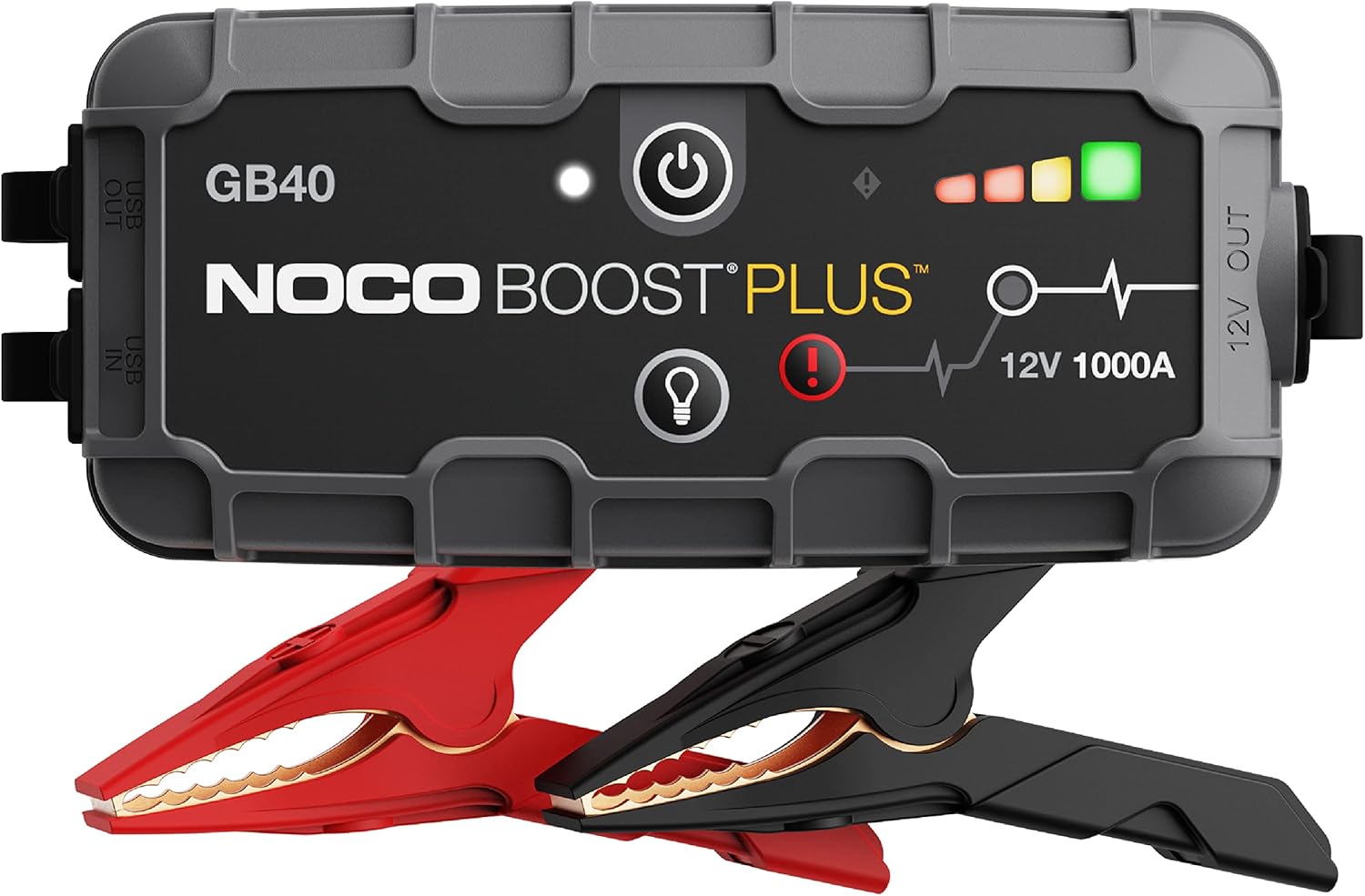
NOCO Boost Plus GB40 Jump Starter
A 1000A lithium jump starter that fits in your glovebox and works on any 12V battery. Your insurance against a dead 12V in a parking lot.
As an Amazon Associate, ThinkEV earns from qualifying purchases — at no extra cost to you.

Founder & Chief Editor
Vlad Pereira is the founder and chief editor of ThinkEV.ca, the Canadian electric-vehicle publication he writes and edits from Courtenay, British Columbia. He covers EV pricing, federal and provincial rebates, charging costs, and the Chinese manufacturers now entering Canada, from the buyer's side rather than the press-fleet side. ThinkEV is a venture of Vlad Pereira Online; his writing on health, income and the long game lives at vladpereira.com.
Frequently asked questions
How far behind Toyota is BYD right now?
Is the 29% China sales drop a one-month anomaly?
What does the second-gen Blade Battery actually change?
Which markets are BYD's real international volume plays?
Can Canadians actually buy a BYD today?
More EV & road-trip finds
Affordable upgrades worth a look — tap any to check the price on Amazon.
 ★ 4,626
HoogaLife Hanging Car Diffuser (2-Pack)
View on Amazon ★ 12,396
K KNODEL Car Trash Can with Lid
View on Amazon ★ 12,834
P3 Kill A Watt Electricity Usage Monitor
View on Amazon ★ 87
★ 87Car Window Sun Shades for Kids (4-Pack)
View on Amazon ★ 68
★ 68WeatherTech FloorLiner for Tesla Model 3
View on Amazon ★ 4,050
Touchscreen Mist Screen Cleaner Kit
View on Amazon ★ 314
★ 314Mini USB LED Ambient Lamps (4-Pack)
View on Amazon ★ 1,349
Cool Swinging Duck Dashboard Ornament
View on AmazonRead, Plan, Then Stay Current
Explore our expert articles to understand incentives and ownership costs, use the map to pressure-test charging reality, then subscribe so new EV coverage comes straight to you.
Continue Reading
BYD's Battery Shortage Is The Best News In EVs This Year
BYD Great Seagull: A Bigger $10,000 EV Hatch Is Coming
Denza Z9GT Spotted in Melbourne: 1000km Range, 9-Min Charge
BYD Denza Z9 GT Adds $50K Tri-Motor Trim to China's Top GT
Chinese EVs Will Reach the US, Tariffs or Not, Analysts Say