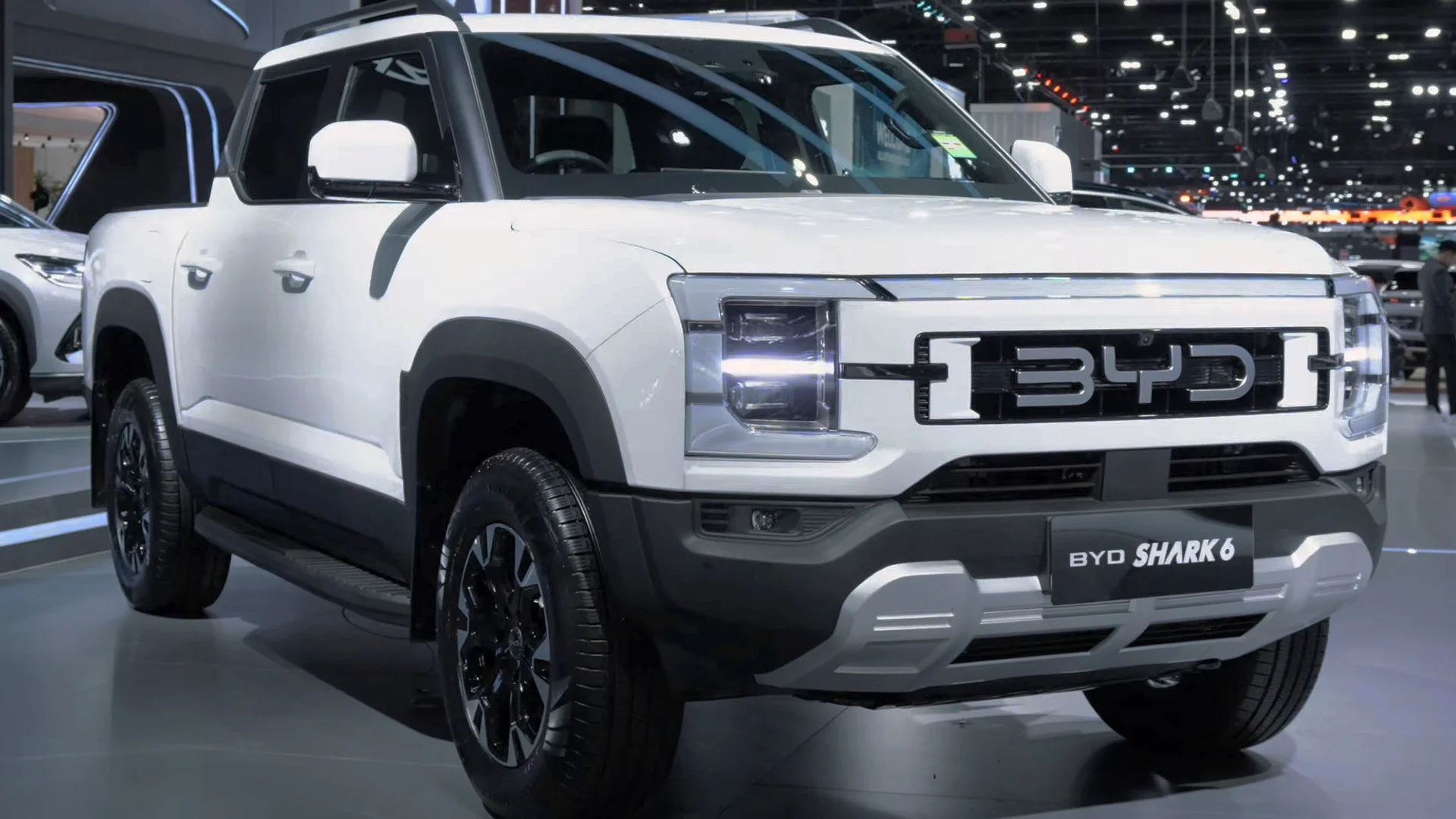
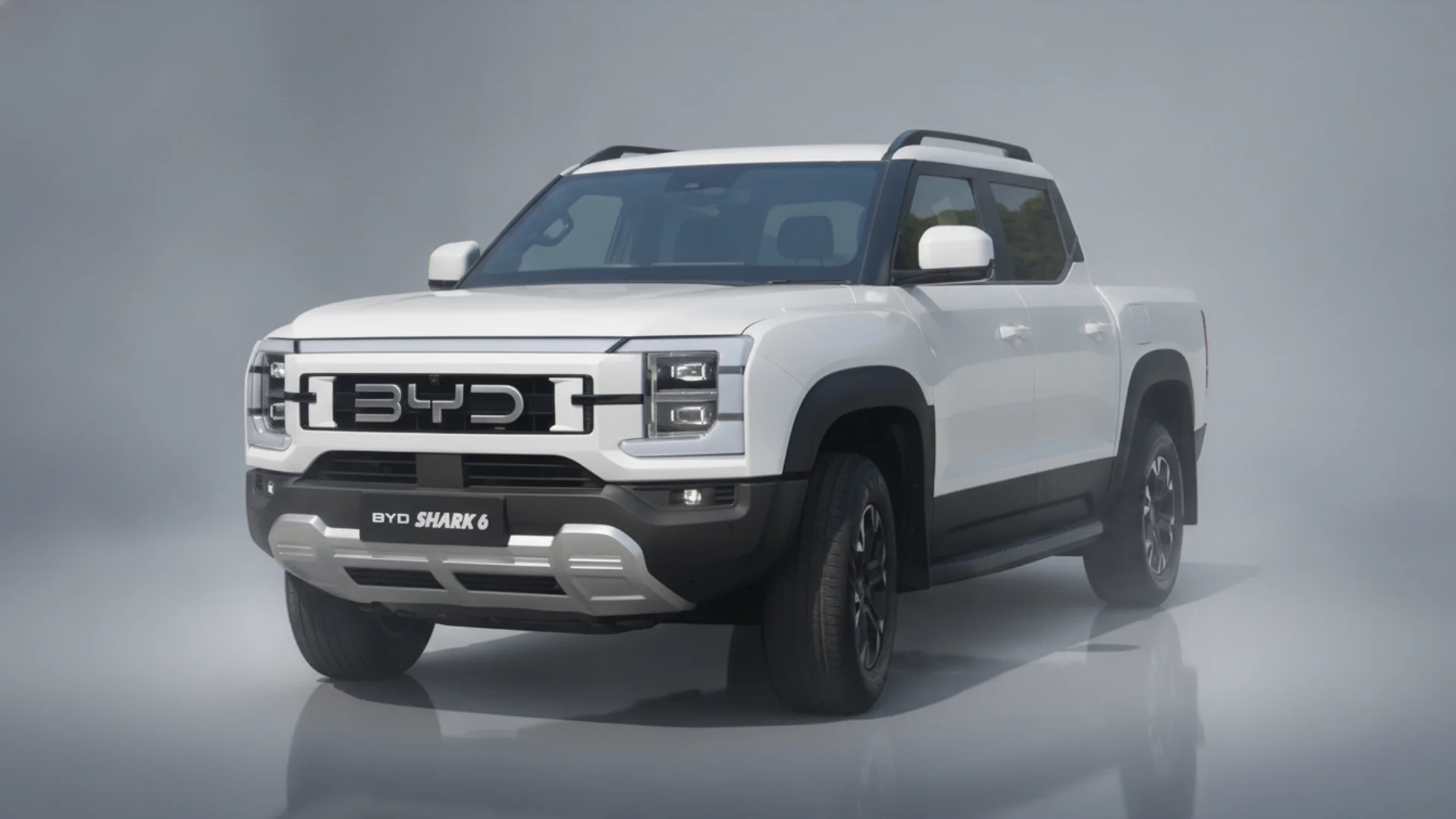
I'll put the BYD Shark's Canadian price band at $55,000 to $70,000 CAD for the base trim, and I refuse to round it to a single number. Anyone publishing a tighter figure right now is guessing past where the evidence actually goes.
That band is wide on purpose. Three variables move it: the January 2026 tariff cut from 100% to 6.1%, the 49,000-unit annual import quota, and a dealer markup layer that always lands on a first-year Chinese-brand debut in a market hungry for cheaper trucks. Any of those three can swing the final sticker by four figures. None of them are settled yet.
The question isn't whether the Shark will be cheaper than the incumbents. It will be. The question is by how much, and whether the buyer who walks into a BYD store in late 2026 actually captures the savings or watches them get absorbed by the dealer floor. That's the editorial position. Here is the work behind it.
Key takeaways
- Canada's January 2026 tariff cut from 100% to 6.1% is the only reason a BYD Shark at $55K–$70K is possible.
- The 49,000-unit annual import quota covers all Chinese-made vehicles, not just BYD, it will fill fast.
- At $62K–$66K transaction price, the Shark undercuts every battery-electric Canadian pickup by at least $9,000.
- Chinese-made EVs are excluded from federal iZEV rebates, so subtract $5,000 from every Ford Lightning comparison.
- Dealer markups of $3,000–$8,000 over MSRP are baked into any realistic first-year Shark transaction price.
The Price Band: Why $55K–$70K CAD Is the Answer
Start with what we know. BYD sells the Shark in Australia at roughly AUD $69,000 for the launch trim. Straight currency conversion to CAD lands near $61,000 today. That is a starting reference point, not a forecast, the conversion ignores tariff structure, homologation cost, and dealer margin.
Layer the tariff math on top. Prime Minister Mark Carney's January 2026 deal with Beijing cut Canada's tariff on Chinese-made EVs from 100 per cent to 6.1 per cent for a quota of up to 49,000 vehicles per year. At 100%, an AUD-equivalent $61,000 truck became a $90,000-plus landed cost, a non-starter for a pickup buyer. At 6.1%, the same truck lands closer to $65,000 before any dealer takes a cut. That is the floor.
The case against the floor is that 6.1% understates the real tariff load, because the deal carries quota administration cost and the importer-of-record overhead that BYD will price into MSRP rather than swallow. Concede the point partially: the effective landed cost is probably 1–2% higher than the nominal tariff rate. That still doesn't move the floor above $58,000. The 100%-to-6.1% delta is too large for administrative friction to erase.
The ceiling is the dealer markup layer. Any high-demand debut in the Canadian pickup segment carries a $3,000 to $8,000 markup over MSRP for the first six to twelve months. F-150 Lightning did it. Rivian R1T did it. The Shark will too, because demand will outrun the quota. So a $60,000 sticker becomes a $65,000–$68,000 transaction price.
That arithmetic is why I cap the band at $70,000 and not $75,000. Above $70,000 the competitive thesis falls apart, the truck stops undercutting the F-150 Lightning by a meaningful margin, and a chunk of the buyer pool walks back to the established dealer network. BYD knows this. The pricing will be disciplined to protect the gap.
I cannot give a tighter number than $55K–$70K because there is no official Canadian MSRP yet. Anyone publishing a single-dollar figure is extrapolating from the Australian price and ignoring the dealer layer, or they are extrapolating from the Chinese domestic price and ignoring the homologation cost. Both extrapolations are wrong by the same amount, in opposite directions. The band is the only honest reporting, and the defensible mid-trim band sits around $55K–$60K on the current evidence.
Why the Tariff Math Matters More Than the Sticker
The tariff cut is the entire story. Without it, there is no BYD Shark in Canada at any defensible price. With it, the conversation is about which buyers move fast enough to land inside the quota.
The 49,000-unit cap is for ALL Chinese-made vehicles, not just BYD, not just the Shark. BYD has hired an Ontario-based automotive retail consultancy to help establish up to 20 branded dealerships across the country. That dealer count tells me BYD is planning for a multi-thousand-unit Canadian volume in year one. If competing Chinese brands, Chery, Geely subsidiaries, MG, also tap the quota, exhaustion happens faster than the public timeline assumes.
This is the part most coverage gets wrong. The quota isn't a generous ceiling. It is a binding constraint that will lapse mid-year, and when it does, the residual import math reverts to the 100% tariff regime for any unit beyond 49,000. That makes Q3 2026 the critical purchase window. The buyer who waits for "more reviews" or "next year's trim" pays the full pre-deal tariff if the quota fills before they sign. The r/EVCanada thread modelling 49,000 BYD EVs at ~$49k selling out in minutes or hours overstates the speed but gets the direction right, a quota this small in a market this thirsty does not last twelve months.
PHEV architecture is also a quiet advantage on the customs side. Pure BEVs in Canada have triggered EV-specific import friction in some jurisdictions during disputes. A plug-in hybrid is classified differently and tends to clear faster. That is not a public BYD strategy statement, it is what the classification rules imply for any importer trying to move units before a quota closes. For the full PHEV architecture breakdown, the engineering rationale matters more than the customs trick.
The Carney deal also did not extend to the federal Electric Vehicle Availability Standard. Chinese-made vehicles remain excluded from iZEV-equivalent rebate stacking. Buyers who model the Shark against a Lightning need to subtract the $5,000 federal rebate from the Ford and add nothing back to the BYD. The price gap narrows by $5,000 once that adjustment lands, and the band still holds.
Gear worth having
As an Amazon Associate, ThinkEV earns a small commission from qualifying purchases — at no extra cost to you.

Lectron Level 2 J1772 Charger (40A, WiFi)
Smart WiFi charger with real-time energy monitoring. 40A / 9.6 kW, J1772 with a NEMA 14-50 plug, schedule charging right from your phone.
As an Amazon Associate, ThinkEV earns from qualifying purchases — at no extra cost to you.
What the Competition Is Actually Priced At, And Where BYD Slots
The comparison set: F-150 Lightning starts at roughly $69,000 CAD for the Pro trim. Silverado EV WT lands near $79,000. Ram 1500 REV is closer to $89,000 for early trims. Rivian R1T is a different category but worth naming, the R1T runs $90,000-plus in Canada, and it is a premium adventure truck, not a fleet workhorse.
At my band floor of $55,000, the Shark undercuts the Lightning by $14,000. At my band ceiling of $70,000, it matches the Lightning's starting price. The realistic transaction zone, $62,000 to $66,000, undercuts every battery-electric truck currently sold in Canada by a minimum of $9,000. That is not a marginal price advantage. That is a category disruption, and even at the high end of the Shark's expected Canadian band the truck slots well below every battery-electric pickup currently sold here.
The closer ICE comparison is the Toyota Tacoma hybrid, which starts near $47,000. The Shark's premium over the Tacoma is the price of larger battery content, more interior tech, and a plug-in capability the Tacoma can't match. Whether that premium is worth it is the buyer's call. It is defensible on spec sheet.
Gear worth having
As an Amazon Associate, ThinkEV earns a small commission from qualifying purchases — at no extra cost to you.

First Alert Auto Fire Extinguisher
A compact extinguisher sized for vehicles and bracket-mounted under the seat. Peace of mind for the price of lunch.
As an Amazon Associate, ThinkEV earns from qualifying purchases — at no extra cost to you.
What the Shark removes from the buyer's mental math is the range-anxiety discount BEV trucks have been carrying. The Lightning's standard-range trim offers roughly 380 km on a full charge in summer conditions, less in Canadian winter, and that figure collapses further under tow. The Shark, as a PHEV, offers electric-only operation for short trips and combustion backup for everything else. The range conversation never starts. For pickup buyers who tow more than they commute, that architecture choice matters more than the dollar difference, and the historical record of failed BEV pickup programs like the Ford Ranger EV and S10 EV is a useful reminder that pickup buyers reject range compromises faster than sedan buyers do.
I would not bet on the Lightning or the Silverado holding their current MSRPs once Shark inventory lands in Canadian dealerships. Ford and GM have responded to BYD price pressure in Australia and Europe by trimming margins. The same playbook arrives here in 2027. The named scenario to watch: Ford trims the Lightning Pro by $4,000–$6,000 within ninety days of the first Shark Canadian delivery. If that doesn't happen, it means Ford has decided the Shark won't move enough volume to threaten share, and that would be the strongest signal that BYD's dealer network gap is doing more work than the price advantage.
The Dealer Network Gap, The Risk the Price Doesn't Show
This is where the band stops being arithmetic and starts being operational risk. BYD has announced intent for up to 20 Canadian dealerships. As of this writing, zero are confirmed open. The retail consultancy hired by BYD is Ontario-based, which strongly implies a GTA-first rollout. Prairie buyers, Atlantic Canada buyers, and most of BC outside the Lower Mainland will be served by a sparse network, or no local network at all, in year one.
Service network density is the buried cost of a Chinese-brand debut. The Australian rollout showed it. Owners reported acceptable purchase experience, acceptable price, and frustrating post-sale support, software updates queued behind a small service workforce, warranty parts moving slowly through an untested supply chain, body shops unfamiliar with the platform unable to quote repairs. The price advantage stays on the window sticker. The friction shows up in month four.
The counter-argument is that BYD's home-charging story partially offsets the service-network gap, because a PHEV with a healthy electric range is mechanically simpler in daily use than a comparable ICE truck, fewer oil changes, less brake wear, regenerative drivetrain doing the work the service bay used to. Concede the point. It still doesn't help the buyer whose battery management system throws a code in Thunder Bay and the nearest authorized technician is in Mississauga.
I would not buy a first-year Shark in Saskatoon or Halifax. I would buy one in the GTA, in Vancouver, in Montreal, markets where the dealer density will support a real service experience from day one. That is an editorial call, not a universal recommendation. The buyer's calculus depends on where they live and how much risk they're willing to absorb on parts availability. Domestic-manufacture parallels matter here: a Kitchener-built Grizzl-E Classic Level 2 charger clears warranty in days because the supply chain is local; a BYD high-voltage component routed through a Shenzhen-to-Toronto warranty pipeline will not, regardless of how good the truck is.
The Ontario concentration also means provincial rebate dynamics matter more than usual. Quebec's provincial program is still active. BC's program lapsed. Ontario has no provincial rebate. A Toronto buyer paying $62,000 transaction price gets no provincial stacking; a Montreal buyer gets $4,000 off. That regional spread will distort early-year sales geography and probably push BYD to open Quebec stores quickly to capture the rebate-stacked demand.
Gear worth having
As an Amazon Associate, ThinkEV earns a small commission from qualifying purchases — at no extra cost to you.

Grizzl-E Classic Level 2 EV Charger (40A)
Canadian-made and rated for minus 40C winters. 40A / 9.6 kW, NEMA 14-50, indoor/outdoor, 24-ft cable. The charger built for Canadian weather.
As an Amazon Associate, ThinkEV earns from qualifying purchases — at no extra cost to you.
What Would Change This Thesis
I will name the conditions that would push me to revise the band, because an editorial position without exit conditions is just an assertion.
Quota exhaustion before the Shark arrives is the biggest risk. If Chinese-brand passenger EVs, Atto 3, Seal, Dolphin, fill the 49,000-unit cap by Q2 2026, the Shark either misses the window entirely or BYD pulls passenger inventory to make room. Either outcome moves the price band. A Shark imported above quota faces the 100% residual tariff. At that point, the band ceiling jumps to $90,000-plus and the competitive thesis is dead. The community-compiled BYD Canada lineup with provincial rebate breakdowns is the cleanest running count I've seen of which models are competing for that quota, worth bookmarking and watching weekly through Q1.
A material USD/CAD deterioration would also widen the ceiling without changing the floor. The Shark's component sourcing prices in USD-denominated parts. A 5% loonie decline against the dollar pushes landed cost up by roughly $2,500 per truck before any margin recovery, money that comes out of dealer take or buyer pocket.
The federal EVAP exclusion for Chinese-made vehicles staying in force matters more than it sounds. If Ottawa restores rebate eligibility, and there is political pressure to do so as Canadian buyers demand the cheaper option, the effective transaction price drops by $5,000 and the band floor moves to $50,000. I am not forecasting that change. I am flagging it as a thesis-shift trigger if it lands.
The single number that would invalidate the band entirely: a BYD Canada MSRP announcement above $72,000 for the base trim. Above that ceiling, the truck is priced against the Lightning rather than under it, and the disruptive thesis becomes a parity thesis. I would expect competitor response to be muted at parity pricing.
Gear worth having
As an Amazon Associate, ThinkEV earns a small commission from qualifying purchases — at no extra cost to you.

PULIDIKI Car Cleaning Gel (Detailing Putty)
Press it into vents, buttons, and seams and it lifts out dust you did not know was there. Weirdly satisfying, genuinely useful.
As an Amazon Associate, ThinkEV earns from qualifying purchases — at no extra cost to you.
The Editorial Position: Cover It Now, Revisit at Dealer Open
The Shark's Canadian MSRP isn't confirmed. That doesn't make this story premature. Canadian truck buyers are making purchase decisions in 2026, Lightning, Silverado EV, Tacoma hybrid, Tundra hybrid, gas F-150, and the $55K–$70K Shark band is already a relevant input to those decisions. Telling readers to wait for an official press release is a dodge.
The band is wide. It will narrow as the homologation finishes, as the first dealership confirms a date, and as BYD publishes a Canadian configurator. I will revisit when any of those move. Until then, $55K–$70K is the number to plan around, with the asterisks attached: dealer markup adds three to eight thousand, federal rebate stacking does not apply, and Q3 2026 is the quota window worth watching. If you want the running model-by-model view of what BYD is bringing into the quota and at what indicative price, the Canadian lineup tracker at Cardog is the cleanest I've found, and I'll be marking my band against it as confirmations roll in.
Gear worth having
As an Amazon Associate, ThinkEV earns a small commission from qualifying purchases — at no extra cost to you.

WixGear Magnetic Air Vent Phone Mount (2-Pack)
A magnet strong enough that your phone never flinches over potholes or rail crossings. Two in the box, one for each car.
As an Amazon Associate, ThinkEV earns from qualifying purchases — at no extra cost to you.

Founder & Chief Editor
Vlad Pereira is the founder and chief editor of ThinkEV.ca, the Canadian electric-vehicle publication he writes and edits from Courtenay, British Columbia. He covers EV pricing, federal and provincial rebates, charging costs, and the Chinese manufacturers now entering Canada, from the buyer's side rather than the press-fleet side. ThinkEV is a venture of Vlad Pereira Online; his writing on health, income and the long game lives at vladpereira.com.
Frequently asked questions
Does the federal EV rebate apply to the BYD Shark?
What happens to pricing if the 49,000-unit quota fills early?
Why is dealer markup included in the price band?
Does the Shark's PHEV classification affect import timing?
How does the Shark stack up against non-electric trucks?
More EV & road-trip finds
Affordable upgrades worth a look — tap any to check the price on Amazon.
 ★ 419
★ 419RGB Car Interior LED Strip Light
View on Amazon ★ 568
★ 568Personalized Photo and Text Keychain
View on Amazon ★ 21,304
Car Headrest Hooks (4-Pack)
View on Amazon ★ 21,310
Magnetic Car Phone Mount
View on Amazon ★ 121
★ 121Foldable Windshield Sun Umbrella
View on Amazon ★ 268
★ 268Anti-Slip Leather Steering Wheel Cover
View on Amazon ★ 12,051
Windex Electronics Screen Wipes
View on Amazon ★ 537
★ 537USB Star Projector Roof Light
View on AmazonRead, Plan, Then Stay Current
Explore our expert articles to understand incentives and ownership costs, use the map to pressure-test charging reality, then subscribe so new EV coverage comes straight to you.
Continue Reading
BYD Atto 3 Canada: Price, Range & EVAP Rebate (2026)
Home EV Charging Setup: The Basics for New Owners
BYD Shark 6 Canada 2026: Price Band, Specs, Incentive Reality
EV Battery Degradation: What's Normal and How to Slow It

Used Electric Cars in Canada: Best Buys for 2026