Key takeaways
- Used Leafs sell for $12,000–$28,000 depending on year, battery size, and condition.
- The Seagull is often modeled in the low-$20,000 range if the Canadian launch lands aggressively, but it doesn't qualify for the federal $5,000 EVAP rebate.
- Even if it lands in the low-$20,000s, you're paying full out-of-pocket sticker.
- Both are legitimate options for Canadians shopping under $25,000, but for very different reasons.
DECISION FRAME
Proven vs revolutionary pricing.
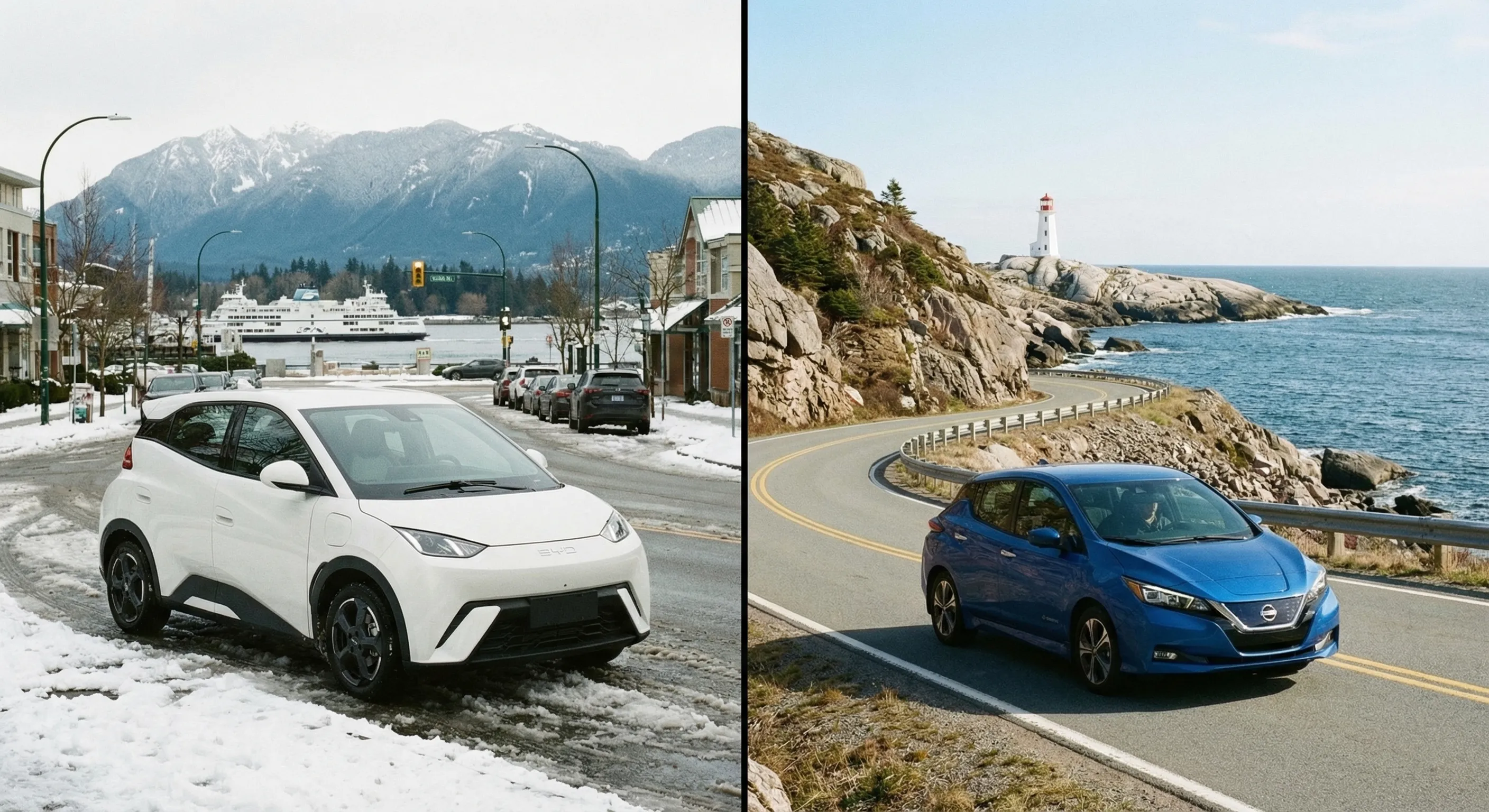
This comparison has a clear shape: one car you can buy today, one you're waiting for. The Nissan Leaf was discontinued after the 2024 model year, but thousands live on the Canadian used market, tested through prairie winters, Vancouver rain, and five years of Tim Hortons drive-throughs. The BYD Seagull is a new-car proposition from China, its Canadian pricing still forming, its tariff situation recently improved but not settled.
Used Leafs sell for $12,000–$28,000 depending on year, battery size, and condition. The Seagull is often modeled in the low-$20,000 range if the Canadian launch lands aggressively, but it doesn't qualify for the federal $5,000 EVAP rebate. Canadian-manufactured or rebate-eligible vehicles don't face that handicap. Chinese EVs are explicitly excluded from EVAP.
That exclusion is the Seagull's ceiling problem. Even if it lands in the low-$20,000s, you're paying full out-of-pocket sticker. A used Leaf at a similar transaction price may end up closer in net cost if it qualifies for provincial support. Know your province's rebate rules before you do any comparison math.
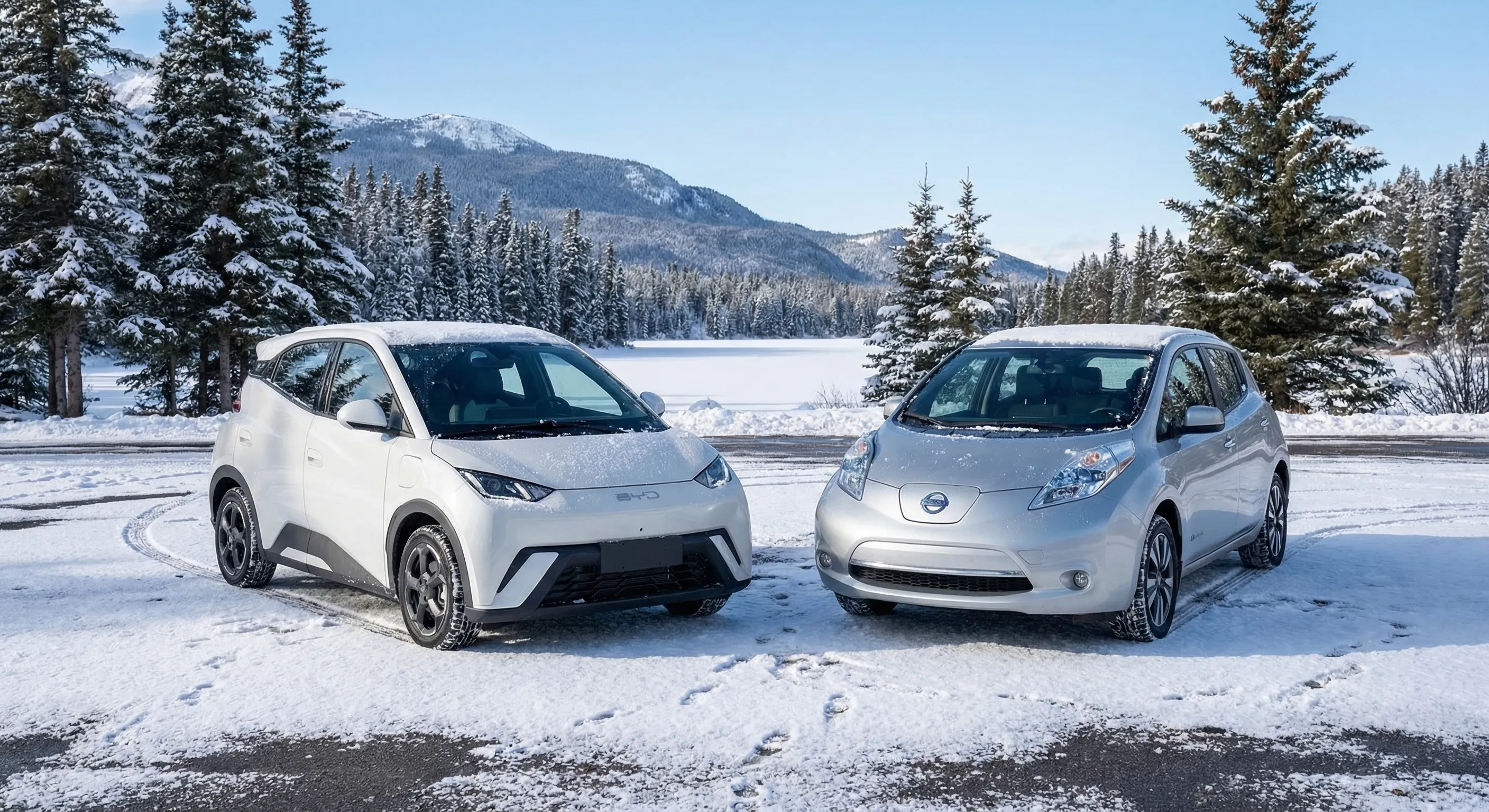
This also isn't a straightforward apples-to-apples matchup. The Seagull is a subcompact city car, shorter than a Honda Fit, closer in spirit to a Smart ForTwo than a Corolla. The Leaf is a compact hatchback, longer, wider, heavier, with more interior room and highway presence. They overlap on price, not on purpose. That distinction matters throughout this comparison, and I'll flag it in every section where size and intent affect the verdict.
The other factor worth stating upfront: the Seagull is the car BYD designed from scratch to be the world's cheapest EV. The Leaf is a decade-old platform that Nissan evolved incrementally and eventually abandoned. One represents where budget EVs are going. The other represents where they've been. Both are legitimate options for Canadians shopping under $25,000, but for very different reasons.
If you're specifically tracking the Seagull's Canadian timeline, our BYD Seagull Canada preview covers the tariff situation, expected specs, and pricing scenarios in detail.
Winner, Decision Frame: Used Leaf for right-now buyers. Seagull only for buyers who are comfortable waiting and treating the Canadian launch details as provisional.
PRICE
Seagull could be half the Leaf price.
Used Leafs in Canada currently list for:
- 2019–2020 (40 kWh): $15,000–$20,000
- 2022–2023 (40 kWh): $19,000–$24,000
- 2022–2024 (62 kWh): $23,000–$28,000
- 2016–2018 (30 kWh): $12,000–$16,000
The pricing spread on used Leafs is enormous because battery health varies wildly. A 2019 Leaf with 85% State of Health is a fundamentally different car than a 2019 Leaf at 96%. Same model year, same odometer, different usable range by 40 km or more. This is the hidden cost of buying used EVs with air-cooled batteries: the sticker price tells you less than the battery report.
The Seagull's Canadian entry price is still a scenario, not a published MSRP. If the lower-end forecasts prove right, it could undercut many used Leafs. But until BYD actually launches the car in Canada, the Leaf remains the only side of this comparison with real transaction prices.
Let's talk about what you would likely get if the Seagull lands near the low end of current estimates. On paper, that means a brand-new car, full factory warranty, zero degradation, and the predictability of a new battery. On the used-Leaf side, the trade-off is obvious: older vehicle, battery-health variation, and much less warranty coverage, but a product you can inspect today instead of theorize about.
Provincial rebates complicate the math further. British Columbia's CleanBC Go Electric program offers up to $4,000 on used EVs under certain conditions. Quebec's Roulez vert program has its own thresholds. Ontario offers nothing provincially. Alberta offers nothing. The Seagull won't qualify for any federal or provincial incentive tied to country of manufacture, but a used Leaf might qualify for used-vehicle provincial incentives depending on the year and your province's rules.
The honest risk: tariff policy can shift again. The Seagull's pricing isn't locked until it's on Canadian dealer lots. A used Leaf at $20,000 is a price you can verify today. A counter-argument: even if tariffs increase moderately, BYD's manufacturing cost advantage is large enough that the Seagull could still remain one of the cheapest new EVs in Canada. But that remains a launch thesis, not a finished price sheet.
For the full picture of what's available at these price points, see our most affordable EVs in Canada 2026 roundup.
Winner, Price: Seagull on paper, Leaf on certainty. If the Seagull lands aggressively, it could win this category cleanly. Until it's confirmed on a Canadian lot, the Leaf is the known quantity.
BATTERY
Seagull battery theory vs Leaf's documented used-battery reality.
This is where the Seagull has the stronger theoretical case on chemistry, and where the Leaf has the more documented real-world weakness.
The Seagull is widely described as an LFP-based small EV, and that is a big part of why it attracts attention in this price bracket. Broadly speaking, LFP chemistry is associated with strong thermal stability and durability. But Canadian buyers should still avoid treating any exact Seagull pack, cycle-life, or trim claim as final until Canadian specs are official.
The broad reason enthusiasts keep watching the Seagull is simple: if it really arrives with the kind of LFP-based value story people expect, it could look modern and durable for the money. But that is still a conditional statement, not a published Canadian ownership fact.
The Leaf's known weakness is easier to state because it is based on years of ownership history: Nissan's used Canadian Leafs are dealing with older battery architecture and less sophisticated thermal management than most modern EVs. That does not make every used Leaf a bad buy, but it does mean battery condition matters far more than it would on a brand-new vehicle with unknown but fresh hardware.
Here's what that means in practice. A used Leaf's battery health can diverge meaningfully from another Leaf of the same year and odometer because heat exposure, charging habits, and age all matter. That is why a battery-health check is not optional in this comparison.
The Seagull's battery architecture should, in theory, hold a durability advantage over an aging used Leaf pack at equal mileage. But "in theory" matters here. Until the Canadian-market car actually exists with known equipment and owners start putting kilometres on it, the Leaf keeps the stronger evidence base even while carrying the older hardware risk.
If you want the deeper science behind this, our guide on EV battery degradation covers the chemistry and the ownership patterns in more detail.
Gear worth having
As an Amazon Associate, ThinkEV earns a small commission from qualifying purchases — at no extra cost to you.
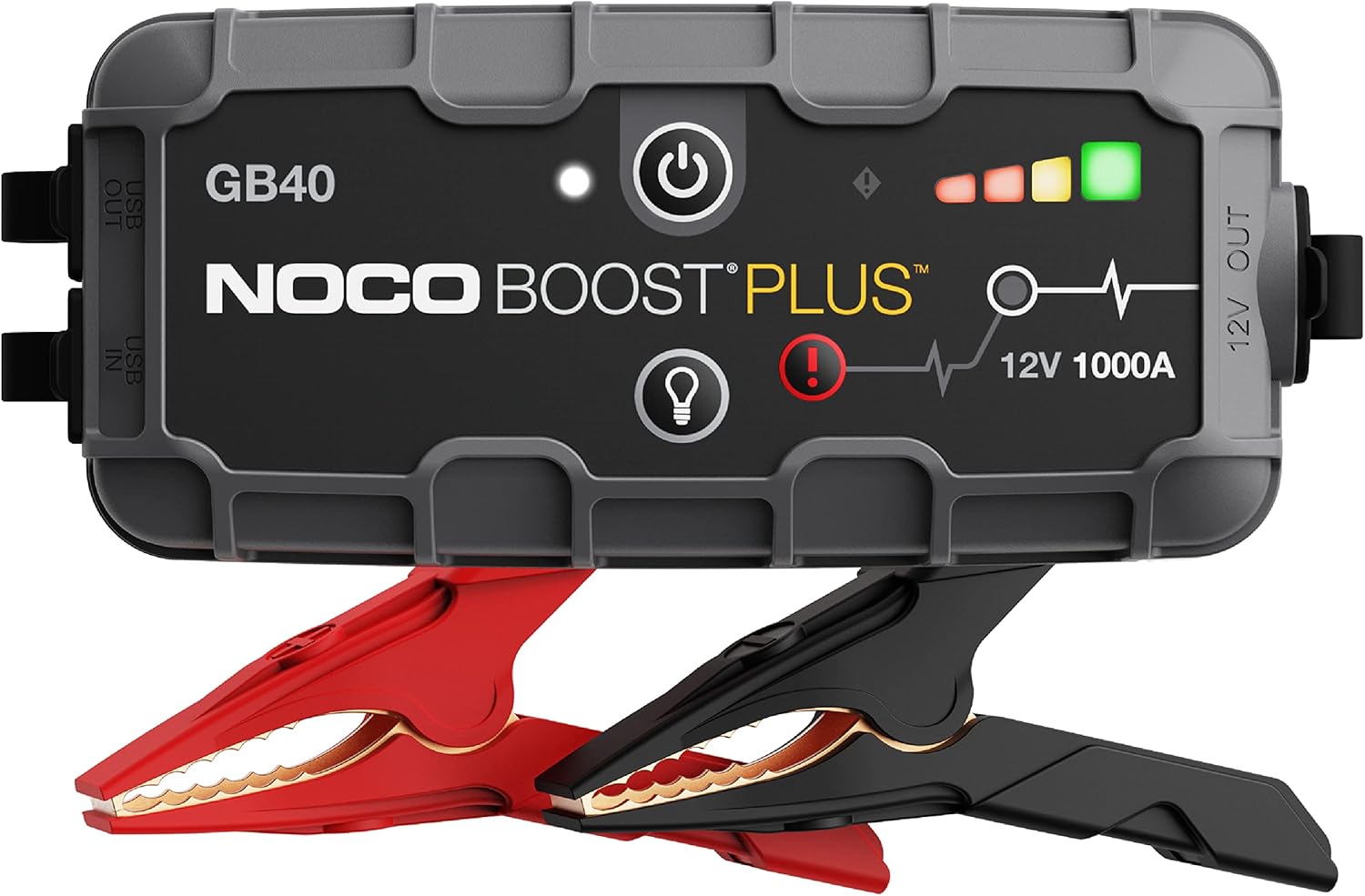
NOCO Boost Plus GB40 Jump Starter
A 1000A lithium jump starter that fits in your glovebox and works on any 12V battery. Your insurance against a dead 12V in a parking lot.
As an Amazon Associate, ThinkEV earns from qualifying purchases — at no extra cost to you.
Winner, Battery: Seagull on chemistry, Leaf on evidence base. The Seagull has the more modern battery story; the Leaf has the benefit of years of real ownership data.
RANGE
Seagull estimated range vs Leaf published range, but real-world tells a different story.
On paper, these two cars are closer on range than you'd expect given their size and price difference. The Seagull is typically discussed as a roughly 250–340 km class car depending on battery version, while the Leaf's 40 kWh and 62 kWh variants are rated at 240 km and 363 km respectively. Those are all controlled-condition numbers, not Canadian-owner guarantees.
Real-world range is where the story diverges.
The Seagull is a lightweight city car, and that helps efficiency. In temperate conditions, the higher-range version should be adequate for urban and suburban use. But once again, exact Canadian real-world outputs are still estimates rather than proven local data.
The Leaf is heavier, approximately 1,520 kg for the 40 kWh, 1,680 kg for the 62 kWh. That weight costs efficiency. A new 62 kWh Leaf delivers approximately 300–330 km in real-world temperate driving. A new 40 kWh Leaf delivers approximately 210–230 km. But you're not buying a new Leaf, you're buying a used one. A 2020 Leaf with 90% battery health has lost 24–36 km of its original range permanently. A 2019 model at 85% health has lost even more.
Summer range is generous for both cars. Warm batteries are happy batteries. Expect to hit or exceed rated range on both models from May through September in most Canadian cities. Air conditioning draws modest power compared to heating, maybe 5–8% of range on a hot day.
Winter range is where both cars suffer, but through different mechanisms. The safest headline is that both can lose a meaningful chunk of usable range in sustained cold. A healthier used 62 kWh Leaf and a higher-range Seagull could end up in a similar practical winter band, while smaller or more degraded packs leave much less margin.
Highway range is worse for both. At 110 km/h, aerodynamic drag dominates. The Seagull's small frontal area helps, but its modest motor means it's working harder at highway speeds. Expect 15–20% less range at sustained highway speeds compared to city driving. The Leaf handles highway speeds better dynamically (more power, more stable), but its range also drops 15–20% at sustained 110 km/h. Neither car is a comfortable highway road-tripper.
The practical takeaway: if your daily driving is under 100 km, either car handles it year-round without anxiety. If your daily driving is 100–200 km, you need the larger battery option on either car, and you need to plan for winter carefully. If your daily driving exceeds 200 km, neither of these cars is the right choice, look at something with a larger battery and faster DC charging.
Winner, Range: Tie, with different risks. The Seagull offers the promise of a fresh battery; the Leaf offers a known platform whose actual range can be verified before purchase.
CHARGING
Both slow DC. Home charging is the play.
Neither of these cars is a road-trip machine, and the charging specs confirm it.
The Leaf's DC fast charging peaks at 50 kW via CHAdeMO (older models) or CCS (2019+ models with the optional rapid charge port). At 50 kW, a 20–80% charge takes roughly 40–60 minutes depending on battery state and temperature. CHAdeMO is a dead standard, the network is shrinking as charger operators decommission those connectors in favour of CCS and NACS. Important clarification: not all Leafs have DC fast charging capability. Some base trims came without the rapid charge port. If you're buying used, verify that the car has the CHAdeMO or CCS port before assuming you can DC fast charge at all.
The Seagull is generally described as a modest-DC-charging city EV. Lower peak power is less painful when the battery is small, but buyers should be careful with exact connector and charging-speed claims until Canadian specs are official. That detail matters a lot in Canada.
For daily commuters, DC fast charging speed doesn't matter. Both cars are designed to be plugged in overnight on Level 2. On a 240V home charger pulling 32 amps, the Leaf's 40 kWh pack charges from empty in about 8 hours. The 62 kWh pack takes approximately 11.5 hours. The Seagull's 30 kWh pack charges in approximately 5–6 hours; the 39 kWh pack in about 7 hours. You wake up to a full battery either way.
Level 1 charging (standard 120V household outlet) is viable for low-mileage drivers. Both cars add approximately 6–8 km of range per hour on Level 1. If you drive 40 km per day, plugging in overnight on Level 1 replenishes your daily use in 5–7 hours. It's slow, it's inelegant, but it works, and it costs nothing to set up.
The real charging infrastructure question for used Leaf buyers is CHAdeMO availability. If you're buying a 2018 or earlier Leaf with CHAdeMO as the only DC fast charge option, check whether your nearest fast chargers still support it before you commit. FLO, Petro-Canada, and some Electrify Canada stations still maintain CHAdeMO connectors at select locations, but new installations are CCS or NACS only. Every year, more CHAdeMO connectors are decommissioned. This is a real, worsening operational concern, not a theoretical one.
One more charging nuance worth noting: the Leaf's air-cooled battery can throttle DC fast charging speeds when the pack is too hot or too cold. Multiple fast charges in a row, something you might attempt on a longer trip, can trigger thermal throttling that drops the charge rate well below 50 kW. The Seagull's Blade Battery pack has better thermal characteristics for repeated charging sessions, though its lower peak rate means the absolute speed advantage is marginal.
Winner, Charging: Leaf on certainty, Seagull on upside. The Leaf's downsides are well known, but so are its hardware realities. The Seagull could look cleaner on paper if the Canadian connector and trim details line up the way enthusiasts expect.

DRIVING
Seagull 75 hp city car vs Leaf 147 hp compact, they drive like different species.
This is where the class difference between these two cars becomes impossible to ignore.
The BYD Seagull makes 75 horsepower and 135 Nm of torque from its single electric motor. It's front-wheel drive. It weighs approximately 1,240 kg. Those numbers add up to a car that's genuinely quick off the line in urban traffic, 0–50 km/h in about 4 seconds, but runs out of enthusiasm above 80 km/h. Top speed is limited to 130 km/h. This is a city car, engineered for city driving, and it doesn't pretend otherwise.
The Nissan Leaf makes 147 horsepower and 320 Nm of torque. It's also front-wheel drive, but at 1,520–1,680 kg, it's significantly heavier. The acceleration trade-off roughly evens out, the Leaf does 0–100 km/h in about 7.9 seconds (40 kWh model) or 7.4 seconds (62 kWh model with the e+ motor's 214 hp). The Leaf feels more planted at highway speeds, handles merging with confidence, and doesn't feel strained at 110 km/h the way the Seagull will.
In the city, the Seagull is the better drive. Its light weight and tight turning radius make it nimble in traffic, easy to park, and responsive to steering input. It feels like a go-kart, in the complimentary sense. The ride is firm because there's minimal suspension travel and the wheelbase is short, but on smooth city streets, that firmness translates to directness. You feel connected to the road. Potholes and rough pavement are less forgiving, the Seagull transmits road imperfections into the cabin without much filtering.
The Leaf is the better highway car. Its longer wheelbase (2,700 mm vs the Seagull's 2,500 mm) provides more stability at speed. The suspension is softer, absorbing rough Canadian highways more gracefully. Wind noise is better controlled, the Leaf's cabin is quieter at 100+ km/h than the Seagull's, which suffers from thinner door seals and less sound insulation (a cost-cutting measure).
Steering feel is unremarkable on both cars. Both use electric power steering tuned for lightness at low speeds. Neither provides meaningful feedback through the wheel. The Leaf's steering is slightly heavier and more confidence-inspiring at highway speeds. The Seagull's is lighter and more direct at parking-lot speeds. Neither car is engaging to drive in the sporty sense, they're transportation appliances at different scales.
The Leaf offers Nissan's e-Pedal system, which allows one-pedal driving by increasing regenerative braking to the point where the car comes to a complete stop when you lift off the accelerator. It's one of the best one-pedal driving implementations in the industry, smooth, predictable, and genuinely useful in stop-and-go commuting. The Seagull has regenerative braking with adjustable levels, but early reports suggest it doesn't offer full one-pedal driving to a complete stop. You'll still use the brake pedal in the Seagull.
Cargo space favours the Leaf. The Leaf's hatchback boot offers 435 litres with the rear seats up, expanding to approximately 1,176 litres with them folded. The Seagull offers roughly 300 litres behind the rear seats, expanding to about 930 litres with them folded. For grocery runs and daily errands, both are adequate. For IKEA trips and moving day, the Leaf has a meaningful advantage.
Ride height and ground clearance are similar, both sit low, neither is suitable for gravel roads or deep snow without winter tires. The Seagull's lower weight actually works against it in deep slush, where heavier vehicles have more traction. The Leaf's extra weight helps it push through moderate accumulation.
Winner, Driving: Leaf for overall versatility, highway confidence, and cargo space. Seagull for pure city driving nimbleness. If your driving is 90% urban, the Seagull's size advantage is genuine. If you ever need highway capability, the Leaf is the only real option here.
INTERIOR AND TECHNOLOGY
Seagull basic but functional vs Leaf more refined, both are honest about their price.
The Seagull's interior is spartan by Canadian market standards. The global-market car typically features a 7-inch driver display and a 10.1-inch centre touchscreen running BYD's DiLink infotainment system. Smartphone integration and trim features can vary by market, so buyers should treat exact Canadian equipment as pending until the launch sheet is public. Climate controls are physical buttons and dials, which is actually a positive. The materials are hard plastics throughout, no soft-touch surfaces, no leather wrapping, no premium pretensions. The seats are fabric with manual adjustment. It looks and feels like exactly what it is: a cost-driven city EV.
That said, the Seagull punches above its weight in several areas. The centre screen is responsive and well-organized. The infotainment includes built-in navigation, Bluetooth audio, and vehicle settings in a clean interface. Over-the-air updates are supported on BYD's platform, meaning software improvements can arrive without a dealer visit. The driver display shows speed, range, battery percentage, and power consumption clearly.
The Leaf's interior, especially on 2022–2024 models, feels a generation ahead in fit and finish. Soft-touch materials on the dash top and door armrests. A 7-inch driver display (or 12.3-inch digital cluster on higher trims). An 8-inch centre infotainment screen with NissanConnect, Apple CarPlay, and Android Auto. The 2022+ models added wireless Apple CarPlay on SV and SL trims. Climate controls are a mix of physical buttons and touchscreen, functional, if not elegant.
The Leaf's standout tech feature is ProPILOT Assist on SV and SL trims, Nissan's Level 2 driver assistance system providing adaptive cruise control and lane centring. It's not autonomous driving, but for highway commutes, it meaningfully reduces fatigue. The Seagull offers basic driver assists, forward collision warning, automatic emergency braking, lane departure warning, but nothing approaching the Leaf's ProPILOT system in terms of integrated highway driving assistance.
Rear-seat space tells the class-difference story clearly. The Leaf's rear seat accommodates two adults in reasonable comfort for city drives. The Seagull's rear seat is tight, adults will feel cramped on anything longer than a short urban hop. Both cars technically seat four (the Seagull) or five (the Leaf). In practice, the Leaf is a genuine four-passenger car. The Seagull is a two-adults-and-maybe-two-kids car.
Visibility is good in both vehicles. The Leaf's higher seating position and larger greenhouse provide excellent sightlines. The Seagull's compact dimensions mean you can see the corners clearly, which helps in tight parking. Both offer rear-view cameras. The Leaf adds around-view monitoring on higher trims, the Seagull does not.
Sound systems are basic on both. The Leaf gets a 6-speaker system that's adequate for podcasts and acceptable for music. The Seagull's 4-speaker system handles calls and podcasts but won't impress anyone who cares about audio quality. Neither car is designed for audiophiles.
Build quality on used Leafs is generally excellent. Nissan built these cars in Oppama, Japan (and Smyrna, Tennessee for some North American models), and the assembly quality holds up over years. Panel gaps are tight, interior rattles are rare, and the drivetrain is remarkably reliable. The Seagull's build quality is an open question for the Canadian market, BYD's recent global models (Atto 3, Seal) have shown strong build quality in European and Australian reviews, but the Seagull is a lower-cost product built to different margins.
Winner, Interior and Technology: Leaf. Better materials, more space, ProPILOT Assist, and the confidence of a car that's been proven over years of real-world use. The Seagull's tech is competent for the price but can't match a car from a class above.
WINTER PERFORMANCE
LFP theory vs used-Leaf reality in Canadian cold, this section matters more than any other.
Canada isn't a normal market for affordable EVs. A car that works perfectly in Shenzhen or San Diego might be borderline unusable in Winnipeg in January. Winter performance isn't a nice-to-have category, it's the category that determines whether either of these cars actually functions as daily transportation for half the year.
Both the Seagull and the Leaf suffer meaningful range loss in cold weather. The question is how much, through what mechanism, and what the long-term consequences are.
The Seagull's winter story should be treated cautiously. Buyers should expect the usual unknowns that come with a small future EV in Canada: sensitivity to cold, dependence on thermal management, and a bigger gap between optimistic launch chatter and real winter ownership data.
Gear worth having
As an Amazon Associate, ThinkEV earns a small commission from qualifying purchases — at no extra cost to you.

Grizzl-E Classic Level 2 EV Charger (40A)
Canadian-made and rated for minus 40C winters. 40A / 9.6 kW, NEMA 14-50, indoor/outdoor, 24-ft cable. The charger built for Canadian weather.
As an Amazon Associate, ThinkEV earns from qualifying purchases — at no extra cost to you.
If the Canadian-market car supports effective battery preconditioning, that will matter a lot. Preconditioning while plugged in is the smart move for any EV in winter because it preserves stored energy for driving. But this is another area where exact Canadian functionality should be treated as unconfirmed until launch.
The practical winter takeaway is simpler than the precise estimates: a higher-range Seagull could work for many urban commuters, but it would still leave less margin than larger, faster-charging EVs. Any smaller-pack version would be much more sensitive to route length, parking conditions, and access to home charging.
The Leaf's winter behaviour is easier to discuss because owners have already lived with it. A healthy used 62 kWh Leaf can still be workable through winter for many commuters, while smaller or more degraded packs leave much less margin. The exact Seagull comparison should remain provisional until Canadian testing exists.
But here's the critical difference: the Leaf combines temporary cold-weather loss with the longer-term reality of used-battery wear. That is why winter shopping for a used Leaf should focus on actual state-of-health data, not just brochure range.
Cabin heating is a significant range consumer on both cars. The Leaf has known trim differences that matter here, while the Seagull's eventual Canadian winter equipment still needs confirmation. That uncertainty matters more than enthusiasts sometimes admit.
Seat heaters and a heated steering wheel are more efficient than blasting cabin heat. The Leaf offers both on mid and upper trims. The Seagull is expected to offer the winter-comfort basics buyers now expect in this class, but exact Canadian trim equipment still needs confirmation. Using seat heat at low blower settings instead of cranking the cabin to 23 degrees can save 10–15% of winter range on either car. It's the single most effective driver behaviour for winter EV efficiency.
Traction in winter conditions depends more on tires than on the car. Both vehicles are front-wheel drive with similar weight distribution. The Leaf's heavier weight provides a slight advantage in deep snow, as noted in the driving section. The Seagull's lighter weight means good winter tires are absolutely non-negotiable, and winter tires are non-negotiable for any vehicle in most of Canada, EV or otherwise.
One final winter note: the Seagull may still come with more winter-learning curve than a well-understood used Leaf simply because Canadian owners have not lived with it yet.
Winner, Winter Performance: Leaf. Not because it's perfect, but because its winter behaviour is much better documented for Canadian buyers.
SAFETY
Seagull 1-star Euro NCAP vs Leaf 5-star, the numbers don't tell the whole story, but they tell a story.
This is the section that will make some readers uncomfortable, and it should.
The BYD Seagull received a 1-star rating from Euro NCAP in its 2024 assessment. One star out of five. That's not a typo. The rating reflects several factors: limited standard safety equipment in the tested configuration, pedestrian protection performance, and the absence of certain active safety features that Euro NCAP now expects as standard. The adult occupant protection score was low, and the safety assist score, reflecting autonomous emergency braking, lane keeping, and speed assistance systems, was below the threshold for higher ratings.
The Nissan Leaf received a 5-star Euro NCAP rating when tested (2018 assessment, which covered the second-generation model sold through 2024). That rating reflected strong performance across adult occupant protection, child occupant protection, pedestrian safety, and safety assist systems.
Now, context matters enormously here. Euro NCAP's testing protocols have become dramatically more demanding since 2018. A 5-star 2018 rating and a 1-star 2024 rating are not directly comparable, the goalposts moved. A car that scored 5 stars in 2018 would likely score 3–4 stars under 2024 criteria. The Seagull's 1-star rating partly reflects the tougher 2024 protocol, not just the car's inherent safety performance.
But partly is doing a lot of work in that sentence. The Seagull is objectively less safe than the Leaf in a crash. It's smaller, lighter, has less crumple zone, and fewer airbags in the tested configuration. Physics doesn't care about price: a 1,240 kg subcompact hit by a pickup truck at 60 km/h is at a disadvantage compared to a 1,680 kg compact in the same collision. This is the fundamental safety trade-off of small, affordable cars, and it applies to every small car, not just the Seagull.
BYD's Blade Battery story does deserve some safety attention. BYD's own demonstrations and broader LFP reputation both point to better thermal stability than many nickel-rich battery narratives. But buyers should treat manufacturer demonstrations as supportive evidence, not as a blanket guarantee about every crash scenario or every future Canadian configuration.
The Leaf's battery safety record is also better than many people assume. But the practical conclusion here should stay simple: neither article section should oversell battery safety as a reason to ignore the broader crash-structure and active-safety gap between these two cars.
For a comprehensive look at how Chinese EVs perform in safety testing, see our Chinese EVs safety Euro NCAP ratings analysis.
Standard safety equipment on both cars (base configurations):
- Seagull: driver and front passenger airbags, ABS, electronic stability control, tyre pressure monitoring, reversing camera, forward collision warning, automatic emergency braking
- Leaf (2022+ SV/SL): 6 airbags, ABS, electronic stability control, tyre pressure monitoring, reversing camera, forward collision warning, automatic emergency braking, blind spot warning, rear cross-traffic alert, ProPILOT Assist (SV+)
The Leaf simply has more safety features as standard, especially on mid-trim and above. The Seagull's safety equipment list is adequate by global standards but thin by Canadian expectations. Canadian buyers cross-shopping at this price point against used Corollas and Civics expect a certain baseline of crash protection and driver assistance, the Leaf meets that baseline, and the Seagull falls short of it.
Winner, Safety: Leaf, clearly. Five-star crash rating (even under 2018 protocols), more airbags, more active safety features, and a decade-long safety track record. The Seagull's Blade Battery fire resistance is a genuine advantage in one specific scenario, but overall crash protection and safety assist features favour the Leaf decisively.
TOTAL COST OF OWNERSHIP
Five-year TCO: new Seagull vs used Leaf, the math might surprise you.
Purchase price is what gets you in the door. Total cost of ownership is what determines whether you made a good financial decision. Let's run the five-year numbers for both cars, assuming typical Canadian driving patterns of 15,000 km per year.
BYD Seagull (new, low-$20,000s scenario price):
- Purchase price: low-$20,000s scenario
- Federal/provincial rebates: $0 (excluded from EVAP; check provincial programs)
- Insurance (estimated, new vehicle, comprehensive): $1,800/year x 5 = $9,000
- Electricity (15,000 km/year, 15 kWh/100 km efficiency, $0.12/kWh average): $270/year x 5 = $1,350
- Maintenance (tires, brakes, wipers, cabin filter): $400/year x 5 = $2,000
- Warranty repairs: $0 (covered under factory warranty for most of the 5-year period)
- Depreciation: estimated 40% over 5 years = $8,000
- Five-year TCO: highly sensitive to final Canadian price and insurance
- Cost per km: not reliable until launch pricing is real
Used Nissan Leaf (2022 62 kWh, $25,000 purchase price, 93% battery health):
- Purchase price: $25,000
- Federal/provincial rebates: up to $4,000 depending on province (used EV programs)
- Net purchase: $21,000–$25,000
- Insurance (estimated, used vehicle, comprehensive): $1,500/year x 5 = $7,500
- Electricity (15,000 km/year, 17 kWh/100 km efficiency, $0.12/kWh average): $306/year x 5 = $1,530
- Maintenance (tires, brakes, wipers, cabin filter): $450/year x 5 = $2,250
- Out-of-warranty repairs (potential 12V battery, suspension bushings): $500 over 5 years
- Depreciation: estimated 30% over 5 years = $7,500 (used cars depreciate less as a percentage)
- Five-year TCO: approximately $36,280–$40,280
- Cost per km: approximately $0.48–$0.54
Used Nissan Leaf (2019 40 kWh, $17,000 purchase price, 88% battery health):
- Purchase price: $17,000
- Rebates: limited (most used-EV programs have age cutoffs)
- Insurance: $1,300/year x 5 = $6,500
- Electricity: $306/year x 5 = $1,530
- Maintenance: $500/year x 5 = $2,500 (older vehicle, more wear items)
- Out-of-warranty repairs: $1,000 over 5 years
- Depreciation: $4,000 over 5 years (already heavily depreciated)
- Five-year TCO: approximately $32,530
- Cost per km: approximately $0.43
The older, cheaper Leaf wins on raw TCO, primarily because it's already depreciated and insurance is lower. But it comes with real trade-offs: less range (and shrinking), no warranty, potential for battery health to drop below 80% during your ownership period. If the 40 kWh Leaf's battery drops to 75% health, you're looking at 140–150 km of summer range and under 110 km of winter range. At that point, the car's utility is genuinely compromised for many drivers.
The Seagull's TCO could be competitive with the nicer used Leafs, but this entire section depends heavily on launch price, trim, insurance, and service assumptions that are not settled yet.
For the broader picture on EV vs gas costs, our EV vs gas total cost of ownership analysis covers the full comparison including fuel savings.
Winner, Total Cost of Ownership: Leaf, because its math is real. The Seagull may become competitive, but right now its ownership model is still scenario-based.
AVAILABILITY
Used Leafs are on lots right now. Seagull depends on tariffs.
The Leaf was discontinued after the 2024 model year, but supply is not the issue, used examples are on dealer lots and private sale platforms in every major Canadian city. You can test drive one this weekend, inspect the car properly, and drive it home Monday. That accessibility matters when you need a car now, not in six months.
The used Leaf market is also mature and transparent. Tools like LeafSpy (a $20 OBD2 app) give you exact battery health data, state of health percentage, individual cell voltages, charge cycles. No other used EV has this level of community-built diagnostic tooling. You can walk onto a dealer lot with a $30 Bluetooth OBD2 adapter and know more about the battery than the salesperson does. That transparency is a genuine buying advantage.
Supply is strong across price points. A quick search on AutoTrader.ca or Facebook Marketplace in any major metro area returns dozens of Leaf listings. The market isn't tight, sellers are competing for buyers, which means negotiation leverage for you. Particularly on 2019–2020 models with the 40 kWh pack, supply exceeds demand in many markets. The Leaf's popularity in its era means parts availability is excellent, and any Nissan dealer can service it.
The Seagull's Canadian arrival is still a moving target. Canada's January 2026 tariff reduction to 6.1% under the 49,000-vehicle quota opened the door, but BYD hasn't announced confirmed Canadian dealer pricing or launch dates as of this writing. First deliveries could come in late 2026, or the timeline could slip further.
The used EV market explosion in Canada means the Leaf isn't the only affordable used option, either. The Hyundai Kona Electric, Chevrolet Bolt EV, and early Kia Niro EVs are all entering the used market at competitive prices. The Leaf's advantage over those alternatives is price, it's consistently the cheapest used EV with usable range in Canada.
BYD's dealer network in Canada is also an uncertainty. The company doesn't have established Canadian dealerships. Will they partner with existing dealer groups? Open standalone BYD stores? Sell direct-to-consumer? The sales and service infrastructure matters, especially for warranty claims and collision repair. A used Leaf can be serviced at any of the hundreds of Nissan dealers across Canada. A Seagull owner in 2027 might need to find a specialized BYD service centre that may or may not exist in their city.
Winner, Availability: Leaf, decisively. The Seagull doesn't exist on Canadian roads yet in any meaningful volume.
WHO SHOULD BUY WHICH
Specific buyer profiles for specific situations.
Buy the BYD Seagull if you are:
-
A single person or couple who drives primarily in the city. The Seagull is a city car. If your life involves mostly urban driving, commuting, errands, short trips, the Seagull's size is an advantage, not a limitation. Easier to park, easier to manoeuvre, cheaper to operate.
-
Someone who can wait and who is comfortable with launch uncertainty. The Seagull isn't here yet, and the best-case value story still depends on how Canada pricing and specs actually land.
-
A buyer who values new-car warranty and a fresh-start ownership experience. A new Seagull would remove many of the used-EV unknowns that make Leaf shopping more inspection-heavy.
-
A household that already has a larger vehicle for road trips and highway use. The Seagull makes an excellent second car, cheap to buy, cheap to insure as a secondary vehicle, and perfect for the daily commute and errand runs that consume 80% of most families' driving.
Buy the used Nissan Leaf if you are:
-
Someone who needs a car right now. The Leaf is available today. If your current car just died or your lease is up next month, waiting for the Seagull isn't realistic.
-
A driver who regularly uses the highway. The Leaf's 147 hp motor, longer wheelbase, and more substantial build make it genuinely comfortable at 100–110 km/h. The Seagull is legal on the highway but not comfortable on it.
-
A family that needs more interior space and cargo capacity. The Leaf seats five, has 435 litres of cargo space, and can handle the school-and-grocery routine without compromises. The Seagull is tight for a family.
-
A buyer who prioritizes crash safety. The Leaf's 5-star rating and comprehensive safety feature set make it the responsible choice for parents and safety-conscious buyers. The Seagull's 1-star rating is a legitimate concern.
-
Someone comfortable with used-car inspection and negotiation. If you know how to use LeafSpy, can assess a used EV carefully, and are comfortable negotiating on a private sale or at a dealer, you can still find genuine bargains in the Leaf market.
Buy neither if you:
-
Drive more than 200 km daily. Neither car has enough range for high-mileage daily driving, especially in winter. Look at the Chevrolet Bolt EUV, Hyundai Kona Electric, or Tesla Model 3 instead.
-
Need all-wheel drive for winter conditions. Neither car offers AWD. If you live on a rural road that isn't reliably plowed, consider the Subaru Solterra, Toyota bZ4X, or Hyundai Ioniq 5.
-
Want a car that can road-trip comfortably. Neither car charges fast enough or has enough range for comfortable long-distance travel. These are commuter cars, not touring machines.
VERDICT
For most Canadian buyers, the used Leaf is the better buy right now. The Seagull is the more interesting possibility.
Gear worth having
As an Amazon Associate, ThinkEV earns a small commission from qualifying purchases — at no extra cost to you.

PULIDIKI Car Cleaning Gel (Detailing Putty)
Press it into vents, buttons, and seams and it lifts out dust you did not know was there. Weirdly satisfying, genuinely useful.
As an Amazon Associate, ThinkEV earns from qualifying purchases — at no extra cost to you.
The call is straightforward:
If you need an affordable EV today, buy a used Leaf. Target a 2022–2024 model with the 62 kWh pack if budget allows, you get better range, a heat pump on higher trims, CCS charging capability, ProPILOT Assist, and the strongest combination of safety and technology in the Leaf lineup. Stick to certified pre-owned if possible, and get a pre-purchase inspection that includes a battery State of Health check. Below 88% health, negotiate hard or walk away.
If budget is truly tight, a 2019–2020 Leaf with the 40 kWh pack at $15,000–$18,000 is still a functional daily driver for urban commuters with short drives. Just know what you're getting: limited range, no fast charging on some trims, no heat pump, and a battery that's already aging. It's a tool, not a treasure, and priced accordingly.
If you can wait 12–18 months and want a new car with warranty coverage, watch the Seagull. It's a purpose-built affordable EV with a compelling battery story and no degradation baggage, but the Canadian value case still depends on price, specs, connector choice, and service support.
The Seagull still looks more modern on paper, newer platform, fresh-car warranty path, and a lower-sticker scenario if Canada pricing lands well. The Leaf wins on availability, safety, driving versatility, and the massive practical advantage of being a car you can inspect, test drive, and buy this afternoon.
Canadian budget EV buyers in 2026 have to decide which of those two facts matters more to their situation. The answer depends entirely on your timeline and your tolerance for uncertainty.
Overall Winner: Used Nissan Leaf (2026), because you can buy it today, verify its condition, and drive it home. The Seagull's potential is real, but potential doesn't get you to work on Monday.
Gear worth having
As an Amazon Associate, ThinkEV earns a small commission from qualifying purchases — at no extra cost to you.

WixGear Magnetic Air Vent Phone Mount (2-Pack)
A magnet strong enough that your phone never flinches over potholes or rail crossings. Two in the box, one for each car.
As an Amazon Associate, ThinkEV earns from qualifying purchases — at no extra cost to you.
Further Reading
- BYD Seagull Canada Preview 2026, Detailed look at pricing, specs, and tariff implications.
- Most Affordable EVs in Canada 2026, Budget-friendly EVs compared head to head.
- Used EV Market Explosion Canada 2026, Why the used EV market is booming and what it means for buyers.
- Chinese EVs Safety Euro NCAP Ratings, How Chinese EVs perform in crash testing and what the ratings mean.
- EV vs Gas Total Cost of Ownership Canada 2026, The full cost comparison including fuel savings.
- EV Battery Degradation: How Long Do EV Batteries Last, The science and real-world data on battery longevity.
Gear worth having
As an Amazon Associate, ThinkEV earns a small commission from qualifying purchases — at no extra cost to you.

Car Cup Holder Coasters (4-Pack)
Drop-in coasters that catch spills and crumbs so your cup holders stay clean. Rinse and reuse forever.
As an Amazon Associate, ThinkEV earns from qualifying purchases — at no extra cost to you.

Founder & Chief Editor
Vlad Pereira is the founder and chief editor of ThinkEV.ca, the Canadian electric-vehicle publication he writes and edits from Courtenay, British Columbia. He covers EV pricing, federal and provincial rebates, charging costs, and the Chinese manufacturers now entering Canada, from the buyer's side rather than the press-fleet side. ThinkEV is a venture of Vlad Pereira Online; his writing on health, income and the long game lives at vladpereira.com.
Frequently asked questions
Does the BYD Seagull qualify for the Canadian EVAP rebate?
Why does battery cooling matter when buying a used Leaf?
Can I charge either of these cars at home with a regular outlet?
Is CHAdeMO charging still supported in Canada?
How does the BYD Seagull's 1-star Euro NCAP rating compare to the Leaf's 5-star rating?
What's the real winter range for both cars in Canadian conditions?
Can I use LeafSpy to check battery health before buying a used Leaf?
Will BYD have service centres in Canada when the Seagull launches?
Is the BYD Seagull too small for Canadian roads?
More EV & road-trip finds
Affordable upgrades worth a look — tap any to check the price on Amazon.
 ★ 4,626
HoogaLife Hanging Car Diffuser (2-Pack)
View on Amazon ★ 4,424
Sun Visor Card and Document Organizer
View on Amazon ★ 12,834
P3 Kill A Watt Electricity Usage Monitor
View on Amazon ★ 87
★ 87Car Window Sun Shades for Kids (4-Pack)
View on Amazon ★ 68
★ 68WeatherTech FloorLiner for Tesla Model 3
View on Amazon ★ 4,050
Touchscreen Mist Screen Cleaner Kit
View on Amazon ★ 164
★ 164Solar-Powered LED Ambient Light
View on Amazon ★ 1,349
Cool Swinging Duck Dashboard Ornament
View on AmazonRead, Plan, Then Stay Current
Explore our expert articles to understand incentives and ownership costs, use the map to pressure-test charging reality, then subscribe so new EV coverage comes straight to you.
Continue Reading

Rivian R1T vs F-150 Lightning: Canada 2026 Test
EV vs Gas: 5-Year Cost of Ownership in Canada
BMW i4 vs Tesla Model 3: Is the $11K Premium Worth It?
BYD Atto 3 vs Hyundai Kona EV: The $35K Comparison
BYD Dolphin vs Chevy Bolt 2027: Cheapest EVs