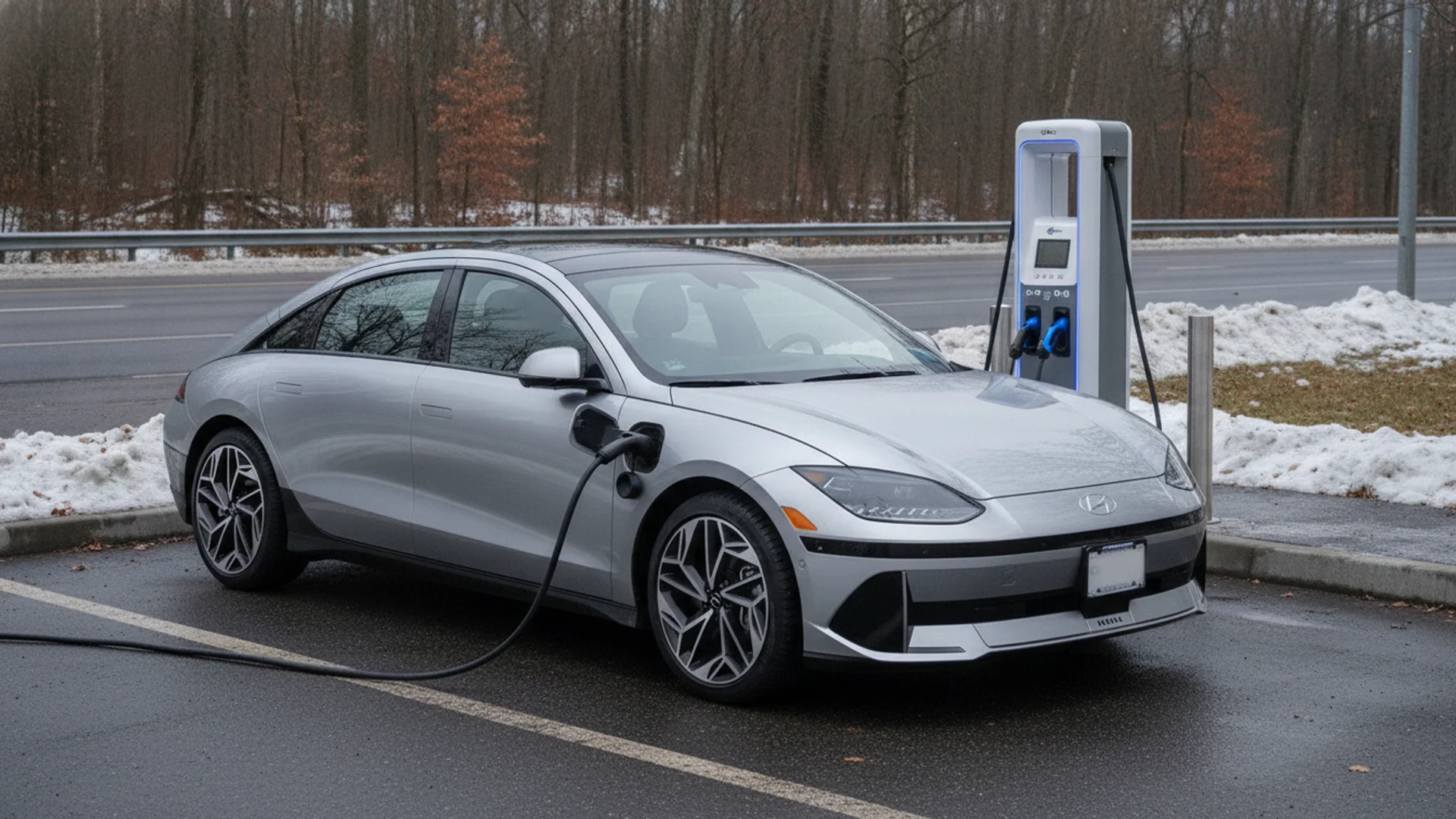
By 1900, electric cars outsold gasoline vehicles in the United States. The internal combustion engine didn't win on merit; it won on cheap oil and the infrastructure that followed. Canada's current tariff fight over Chinese EV imports, its scramble to build a domestic lithium-ion supply chain, is not the birth of a new technology. It is the correction of a century-long detour.
Key takeaways
- By 1900, electric cars made up 38% of the US auto market, outselling gasoline (22%) while steam held 40%.
- Robert Anderson built the first electric carriage in Scotland between 1832 and 1839, decades before the internal combustion engine was practical.
- In 1899, Belgian driver Camille Jenatzy became the first person to break 100 km/h, doing it in an electric car called "La Jamais Contente."
- New York City ran battery-swapping electric cabs in the 1890s, using a crane to change a depleted pack in under five minutes, the same idea Nio uses in 2026.
- Gasoline won on price, not merit: a Baker Electric cost about $2,800 (nearly $90,000 today) while Ford's 1908 Model T started at $850 and fell to $600 by 1912.
The history of the electric car is a methodical sequence of engineering breakthroughs, infrastructure failures, and policy pivots. It begins not in a Silicon Valley garage, but in the damp laboratories of 1830s Europe and the fledgling industrial centres of North America. When we ask "What was the first electric car?", we are not looking for a single inventor's patent, but for the convergence of two critical technologies: the electrochemical battery and the electromagnetic motor. This journey is one of immense technical ambition, where early pioneers grappled with the same laws of thermodynamics and energy density that occupy our modern engineers today.
The 19th-Century Paradox: Innovation Before Infrastructure
In the early 1800s, the "automotive" dream was largely a steam-driven fantasy. Steam engines were the titans of the Industrial Revolution, but their application to small-scale transport was fundamentally flawed by the weight of the boiler and the danger of high-pressure explosions. Into this vacuum stepped the early experimenters with electromagnetism.
The "paradox" of this era lies in the fact that electric propulsion was developed before we had a standardized grid to support it. Pioneers were building vehicles that required refined chemical fuels, batteries, that were, at the time, more akin to laboratory curiosities than industrial commodities. To understand the "first" electric car, we must look at the transition from static experiments to kinetic application.
The Experimental Genesis: 1832–1839
In the 1830s, the concept of a "car" did not exist in any modern sense. Transportation was defined by the biological limits of the horse or the massive, stationary potential of the steam engine. However, the data reveals a quiet revolution occurring in small-scale models across three continents.
Robert Anderson: The Scottish Prototype
Between 1832 and 1839, Robert Anderson, a Scottish inventor of some obscurity, developed what is historically recognized as the first crude electric carriage. Anderson's vehicle was less a practical automobile and more a proof of concept. It utilized primary cells, non-rechargeable batteries that relied on the chemical reaction of zinc and copper in an acid electrolyte.
From a modern policy and environmental perspective, this was a disaster: once the chemical reaction was exhausted, the battery was essentially toxic waste. However, as a technical milestone, Anderson proved that electricity could provide the torque necessary to move a full-sized chassis without the noise of a boiler or the mess of a horse. His carriage was reportedly seen on the streets of Aberdeen, though its range was limited by the weight of its primary cells and the inefficiency of its primitive motor.
Thomas Davenport: The Vermont Visionary
Simultaneously, across the Atlantic in Brandon, Vermont, Thomas Davenport was conducting parallel experiments that would lay the foundation for the American electric motor industry. Davenport, a blacksmith by trade, was fascinated by the electromagnetic magnets used in iron separation. In 1834, he built a small-scale electric motor and used it to power a small circular track, essentially the world's first electric railway model.
By 1837, Davenport had received U.S. Patent No. 132 for his "Improvement in Propelling Machinery by Magnetism and Electro-Magnetism." His work was methodical, focusing on the efficiency of the electromagnetic field. He even established a workshop in New York City and started a technical journal, The Electro-Magnet and Mechanics' Intelligencer. Despite his brilliance, Davenport died in poverty, having faced the same insurmountable hurdle as Anderson: the lack of a rechargeable energy storage system. The chemical cost of his primary batteries made his motor ten times more expensive to run than a steam engine.
Ányos Jedlik: The Hungarian Connection
The third pillar of this early era was Ányos Jedlik, a Hungarian priest and physicist. In 1828, Jedlik had already developed a primitive electric motor and used it to power a small model car. Jedlik's motor used an electromagnetic rotor and a commutator, the basic components of modern DC motors. While his work was largely confined to his university laboratory in Pest, it demonstrated that the intellectual capital for electric transport was distributed globally. The "car" was inevitable; the "rechargeability" was the missing link.
The Battery Breakthrough: 1859 and 1881
The transition from "toy" to "transport" required a leap in energy density. This leap occurred in two stages, both originating in France.
Gaston Planté and the Lead-Acid Revolution (1859)
In 1859, French physicist Gaston Planté invented the lead-acid battery. This was the first battery that could be recharged by passing a reverse current through it. In the context of 2026, where we debate the merits of solid-state vs. liquid electrolyte, the Planté cell was the original "enabling technology." It utilized two sheets of lead separated by rubber strips, rolled into a spiral and immersed in a solution of sulphuric acid.
However, Planté's initial design was still too heavy and inefficient for automotive use. The energy-to-weight ratio was poor, and the manufacturing process was slow. It took another two decades for the next major refinement.
Camille Alphonse Faure: Scaling the Solution (1881)
In 1881, Camille Alphonse Faure improved the design by coating the lead plates with a paste of lead oxides. This significantly increased the battery's surface area and capacity, allowing for the storage of enough energy to power a full-sized vehicle over meaningful distances.
This technical refinement triggered a sudden burst of activity. In 1881 alone, several electric vehicles debuted. The most notable was Gustave Trouvé's "Trouvé Tricycle." Trouvé, a prolific inventor of everything from electric boat motors to surgical lamps, debuted his three-wheeled cycle at the International Exhibition of Electricity in Paris. It was powered by a small electric motor and six of Faure's improved batteries. Trouvé's vehicle was not merely a model; it was a functional piece of urban infrastructure that he drove through the streets of Paris, reaching speeds of 12 kilometres per hour (7.5 mph).
The First Practical Electric Automobiles: 1884–1890
While Trouvé proved it was possible, it was Thomas Parker in London and William Morrison in the United States who moved the needle toward what we would recognize as a "car", a vehicle designed for utility, not just exhibition.
Thomas Parker: The English Architect of Electrification
In 1884, Thomas Parker built a high-capacity electric car in Wolverhampton, England. Parker was a significant figure in the Victorian era; he was the man responsible for electrifying the London Underground and the Liverpool Overhead Railway. His motivation for the electric car was remarkably modern: the reduction of smoke and noise in urban environments.
Parker's vehicle utilized his own patented high-efficiency dynamos and specialized rechargeable batteries. He was even photographed driving it, a rare and evocative image of a man in a top hat steering a vehicle that looked 50 years ahead of its time. Parker's work was the first to bridge the gap between "experimental vehicle" and "urban transport solution."
Andreas Flocken: The German Pioneer
In Germany, Andreas Flocken produced the "Flocken Elektrowagen" in 1888. It was essentially a high-wheeled carriage with a 0.7 kW motor. While modest by 2026 standards, it established the German engineering tradition in the electric space decades before the first Mercedes or BMW would burn a drop of gasoline. The Flocken car is widely considered the first "four-wheeled" electric car, moving away from the tricycle designs of Trouvé.
William Morrison: The American Spark (1890)
The most significant development for the North American market occurred in Des Moines, Iowa. Around 1890, William Morrison, a chemist, built a six-passenger electric wagon. It reached a top speed of 23 kilometres per hour (14 mph) and had a range that surprised his contemporaries.
Morrison's carriage was a sensation. When it was displayed at the 1893 Chicago World’s Fair (The World’s Columbian Exposition), it sparked a mania for electric transportation. Over 27 million people visited that fair, and for many, the sight of a "horseless carriage" that hummed rather than roared was the highlight of the "White City."
The Golden Age: 1890–1910
It is a historical fallacy to suggest that gasoline cars "won" from the start. The data from the turn of the century shows a market in flux. In the year 1900, the American automotive market was divided as follows:
- 40% of vehicles were powered by steam (external combustion).
- 38% were powered by electricity.
- 22% were powered by gasoline (internal combustion).
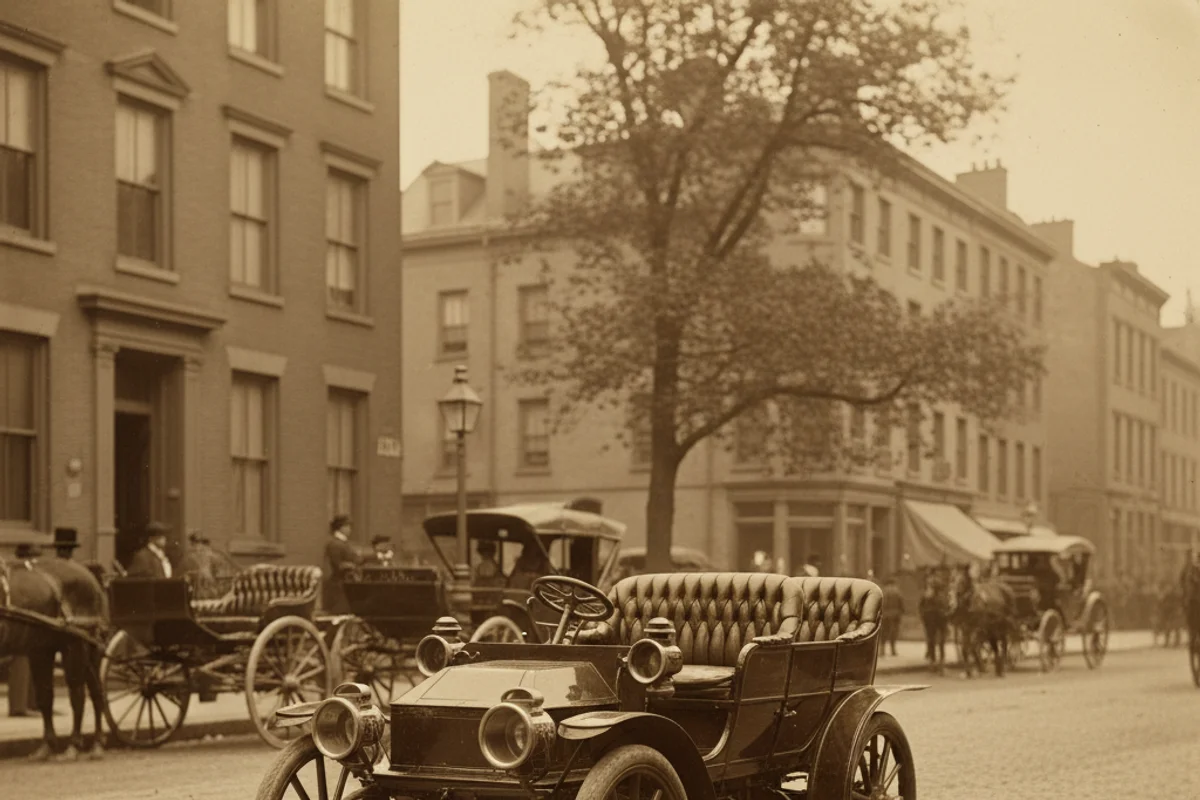
In major urban centres like New York City, Chicago, and Philadelphia, electric vehicles were the dominant choice. The reasons were methodical and evidence-based. Gasoline cars of the era were loud, vibrating machines that emitted noxious fumes and required a dangerous hand-crank to start, a process that frequently resulted in broken wrists or worse (a condition known as the "Ford fracture"). Steam cars were silent and powerful but required 30 to 45 minutes to "fire up" before they could be driven.
The electric vehicle, by contrast, was the epitome of 19th-century luxury and reliability. You simply turned a key or pushed a lever, and the vehicle moved instantly. There was no gear shifting, no smoke, and no vibration.
The "Lead Cab Trust" and NYC Infrastructure
By the late 1890s, New York City was the testing ground for the world's first electric vehicle infrastructure. The Electric Storage Battery Company (which eventually became Exide) backed the Electric Vehicle Company (EVC). The EVC operated a fleet of hundreds of electric hansom cabs in Manhattan.
This was not merely a taxi service; it was a sophisticated logistics operation. Recognizing the limitations of charging times, the EVC implemented a "battery swapping" system at their central stations, most notably at 1684 Broadway. A cab could pull in with a depleted battery, and a mechanical crane would swap it for a fully charged unit in under five minutes.
This 1890s solution is identical to the model currently employed by companies like NIO in 2026. At its peak, the EVC was the largest automotive manufacturer and fleet operator in the United States. They were so dominant that they were nicknamed the "Lead Cab Trust." Had it not been for a series of financial mismanagement scandals, a localized recession in 1907, and a public backlash against their monopoly, the trajectory of the American automotive industry might have remained electric.
The Hummingbird Taxis of London
Across the Atlantic, London was experiencing its own electric surge. In 1897, Walter Bersey introduced a fleet of electric taxis known as "Hummingbirds" due to the distinct sound of their motors. These vehicles were a staple of the London theatre district and were the first to receive approval from Scotland Yard. However, like the EVC in New York, Bersey’s fleet eventually succumbed to the high cost of battery maintenance and the lack of a standardized charging grid.
Gendered Marketing and the "Ladies' Car"
One of the most fascinating, and ultimately detrimental, aspects of the early EV era was how these vehicles were marketed. Because they were clean, quiet, and easy to start, manufacturers targeted women.
Brands like Detroit Electric, Baker Electric, and Milburn Wagon Company featured advertisements showing socialites driving their EVs to tea parties or shopping trips. A famous 1910 advertisement for Detroit Electric claimed: "The lady of the house can drive her Detroit Electric through the most crowded streets with ease and safety."
While this secured a high-end niche, it created a perception that electric cars were "un-masculine" or lacked the "power" required for serious, long-distance touring. Gasoline cars, with their noise and mechanical complexity, were marketed as adventurous machines for men. This social construct, combined with the technical limitations of the time, began to marginalize the EV just as the internal combustion engine began to scale. Even Clara Ford, Henry Ford's wife, famously preferred a Detroit Electric over her husband's Model T well into the 1920s.
Technical Milestones: Speed and Hybrids
Before the ICE took over, EVs held almost every major automotive record.
Breaking the Barrier: La Jamais Contente
In 1899, the Belgian driver Camille Jenatzy became the first person to break the 100 km/h (62 mph) barrier. He did so in an electric vehicle named "La Jamais Contente" (The Never Content). It was a torpedo-shaped car built of partinium, a lightweight alloy of aluminium, copper, and magnesium. Jenatzy's feat proved that electric motors were inherently superior in speed and acceleration to the early, primitive gasoline engines.
The First Hybrid: Lohner-Porsche
In 1900, a young engineer named Ferdinand Porsche developed the Lohner-Porsche "Semper Vivus." This was the world's first functional hybrid vehicle. It used an electric motor in the wheel hubs, powered by batteries that were recharged by two small gasoline engines acting as generators. Porsche's design was a century ahead of its time, solving the range anxiety that would eventually kill off his competitors' pure-battery vehicles. The wheel-hub motors were particularly innovative, eliminating the need for complex transmissions and driveshafts.
The Early Infrastructure: Battery Leasing and "Hydrants"
One of the most overlooked aspects of the 1900s EV era was the innovative infrastructure experiments.
The Hartford Battery Service
The Hartford Electric Light Company in Connecticut offered a "Battery Service" for owners of General Vehicle Company (GV) electric trucks. For a monthly fee plus a per-mile charge, the owner could buy the truck without a battery. They would then swap their depleted batteries for fresh ones at the utility's stations. This "Battery as a Service" (BaaS) model, which we treat as a 2024 innovation, successfully operated for over a decade in the early 20th century.
Curbside Charging
In NYC, the first "charging hydrants" appeared. These were small kiosks where an EV owner could plug in their vehicle while parked. The data from the New York Edison Company shows that they were aggressively promoting "off-peak" charging to balance the city's load, a strategy identical to the smart-grid management we are implementing in Canada in 2026.
Why the Electric Car Lost: A Policy and Data Analysis
The decline of the electric vehicle between 1910 and 1920 was not the result of a single failure, but a "perfect storm" of economic, technical, and geological shifts. As a policy analyst, I categorize these into five primary drivers.
1. The Mass Production Disruption (The Henry Ford Factor)
In 1908, Henry Ford introduced the Model T. While electric cars like the Baker Electric were selling for $2,800 (a luxury price point, equivalent to nearly $90,000 today), the Model T debuted at $850. By 1912, as Ford perfected the moving assembly line, the price of a gasoline car dropped to $600.
The data is stark: by 1912, an electric car was three to four times more expensive than a gasoline equivalent. Without subsidies or a carbon-tax framework (concepts non-existent in the 1910s), the market rationalized toward the cheaper option. Economies of scale were the primary executioner of the early EV.
2. The Electric Starter (1912)
Until 1912, the gasoline car's greatest weakness was the hand-crank. It was difficult and dangerous. In 1912, Charles Kettering and Cadillac introduced the electric self-starter. Ironically, it was an electric component that saved the gasoline engine. This invention eliminated the need for manual cranking and instantly nullified the electric car's primary competitive advantage: ease of use. Suddenly, the "women's car" features were available on "men's" gasoline cars.
3. The Texas Oil Boom: Spindletop
In the early 1900s, gasoline was often a discarded byproduct of kerosene production. However, the discovery of massive oil reserves in Texas (the Spindletop gusher in 1901) made crude oil incredibly cheap. By 1910, gasoline was widely available and affordable across the North American continent. Electricity, by contrast, was still a luxury limited to urban centres. In 1910, only 10% of American homes were electrified. Outside of the cities, there was no "grid" to charge an EV.
4. The Better Roads Movement and Inter-City Travel
As the United States and Canada began investing in inter-city highways (the "Better Roads" movement), the "range" of a vehicle became a critical metric. EVs were perfect for the 20-kilometre round trip in Toronto or New York, but they could not handle the 200-kilometre trek between cities. Gasoline offered an energy density (roughly 12,000 Wh/kg) that lead-acid batteries (30 Wh/kg) could not match. You could carry a spare can of fuel; you could not carry a spare room-sized battery.
5. The Financial Collapse of the EVC
The "Lead Cab Trust" (Electric Vehicle Company) failed not because its technology was bad, but because its financial engineering was reckless. They over-extended themselves through acquisitions and were caught in the Panic of 1907. When the company collapsed, it took much of the industry's R&D capital with it. Investors became wary of "electric ventures," shifting their money to the high-growth, high-profit world of internal combustion.
The Long Hiatus: 1920–1990
For seventy years, the electric car remained a footnote, surviving only in niche applications.
The Milk Float
In the United Kingdom, the "milk float" became the most successful application of EV technology. These low-speed delivery trucks were silent, which was essential for 5:00 AM residential deliveries, and their stop-start nature was perfectly suited to electric torque. At one point, Britain had the largest fleet of electric vehicles in the world, most of them delivering milk.
The Henney Kilowatt (1959)
In the late 1950s, the Henney Motor Company collaborated with Eureka Williams to produce the Henney Kilowatt. Based on the Renault Dauphine chassis, it was the first attempt at a modern, highway-capable EV. It used a 72-volt system and reached speeds of 60 km/h. Only about 100 were sold, mostly to electric utility companies.
The Lunar Rover (LRV): The Ultimate EV
In 1971, the most expensive and advanced EV ever built was deployed: the Boeing/Delco Lunar Roving Vehicle. It was an all-electric, four-wheel-drive vehicle powered by non-rechargeable silver-zinc potassium hydroxide batteries. The LRV proved that when reliability and performance in extreme environments are required, electricity is the superior choice. It remains, technically, the first car to be driven on another celestial body.
The 1970s Oil Crisis and the CitiCar
Following the OPEC oil embargo of 1973, the Sebring-Vanguard CitiCar became a brief sensation. It was a wedge-shaped, low-speed vehicle that remains a cult classic. Between 1974 and 1977, Sebring-Vanguard was the sixth-largest automaker in the US. However, with a top speed of 60 km/h and minimal safety features, it was never a threat to the established order.
The Modern Rebirth: 1990–2010
The real shift began in the late 1980s with the California Air Resources Board (CARB) mandates. California's policy required manufacturers to sell a certain percentage of Zero-Emission Vehicles (ZEVs) to continue doing business in the state.
General Motors EV1 (1996)
This led to the General Motors EV1, a car that proved modern consumers were ready for electric performance. The EV1 was a technical triumph but a political failure. GM eventually cancelled the programme and famously crushed most of the vehicles, an event immortalized in the documentary Who Killed the Electric Car?. Despite its fate, the EV1 inspired the founders of Tesla, who realized that the problem wasn't the battery, it was the business model.
The 2026 Perspective: Full Circle
As we sit in 2026, the parallels between the current market and the 1905 "Golden Age" are striking. We are once again in a period of "infrastructure catch-up." In 1905, the bottleneck was the lack of rural electricity; in 2026, the bottleneck is the rollout of Level 3 DC fast chargers along the Trans-Canada Highway and the upgrading of the urban distribution grid to handle home charging.
The Canadian Context: The Battery Belt
For Canada, this history is particularly resonant. We are currently building a "Battery Belt" that stretches from Windsor to St. Thomas to Bécancour.
- The NextStar Energy plant in Windsor (a joint venture between LG Energy Solution and Stellantis) is slated to be one of the largest in North America.
- The Volkswagen PowerCo plant in St. Thomas represents a multi-billion dollar bet on the permanency of the electric shift.
- The Northvolt project in Quebec leverages the province's cheap, green hydro-electricity, the same energy source that powered the earliest EVs in Montreal in the 1900s.
Policy Analysis: The 2024–2026 Shift
The 100% tariff on Chinese EVs implemented in October 2024 was a defensive manoeuvre to protect this nascent domestic industry. From a policy standpoint, it was a recognition that China had successfully "leapfrogged" the West by focusing on the EV as a strategic priority in the early 2010s, much as the US had focused on the ICE in the early 1900s.
As of 2026, the data shows that these tariffs, combined with the 2026 quota of 49,000 vehicles, have created a protected space for Canadian manufacturing to scale. We are trying to build in a decade what we allowed to atrophy for a century.
The Technology Delta
However, the data today is far more favourable to the EV than it was in 1912.
- Energy Density: We have moved from lead-acid (30 Wh/kg) to lithium-ion (250–300 Wh/kg) and now toward solid-state (450+ Wh/kg).
- Manufacturing Parity: In 2026, the total cost of ownership (TCO) for an EV has reached parity with ICE vehicles in most Canadian provinces, especially when considering the federal iZEV incentives and provincial rebates in places like Quebec and British Columbia.
- Policy Drivers: Unlike the 1910s, where policy was non-interventionist, the 2020s are defined by carbon pricing and zero-emission mandates. Canada's 2035 target for 100% ZEV sales is a hard policy floor that did not exist during the first electric era.
Conclusion: The Correction of a Detour
The "first" electric car was not a singular event; it was a decades-long technological evolution that reached its first peak before Henry Ford ever sold a Model T. From Robert Anderson’s Scottish carriage to the sophisticated battery-swapping cabs of 1890s Manhattan, the electric vehicle was the original vision for the automobile.
The gasoline era was not a natural progression of superior technology, but a temporary economic deviation fuelled by cheap oil, the lack of a distributed electrical grid, and the successful application of mass-production techniques to the internal combustion engine.
As we reintegrate electric propulsion into our national transport strategy, we aren't moving toward an uncertain future; we are returning to a proven past. We are finally completing the work that Robert Anderson, Thomas Parker, and William Morrison started nearly two centuries ago. The electric car is not a 21st-century invention; it is a 19th-century masterpiece that finally has the infrastructure and the chemistry it deserves.
Bottom line: The electric car isn't the future of transportation; it is the original, superior concept finally being liberated from the limitations of 19th-century energy storage. For the modern Canadian consumer, choosing an EV in 2026 is less about being a "pioneer" and more about finally joining a technological revolution that has been waiting for us for 140 years.
Gear worth having
As an Amazon Associate, ThinkEV earns a small commission from qualifying purchases — at no extra cost to you.

PULIDIKI Car Cleaning Gel (Detailing Putty)
Press it into vents, buttons, and seams and it lifts out dust you did not know was there. Weirdly satisfying, genuinely useful.
As an Amazon Associate, ThinkEV earns from qualifying purchases — at no extra cost to you.
Gear worth having
As an Amazon Associate, ThinkEV earns a small commission from qualifying purchases — at no extra cost to you.

WixGear Magnetic Air Vent Phone Mount (2-Pack)
A magnet strong enough that your phone never flinches over potholes or rail crossings. Two in the box, one for each car.
As an Amazon Associate, ThinkEV earns from qualifying purchases — at no extra cost to you.
Gear worth having
As an Amazon Associate, ThinkEV earns a small commission from qualifying purchases — at no extra cost to you.

NOCO Boost Plus GB40 Jump Starter
A 1000A lithium jump starter that fits in your glovebox and works on any 12V battery. Your insurance against a dead 12V in a parking lot.
As an Amazon Associate, ThinkEV earns from qualifying purchases — at no extra cost to you.

Founder & Chief Editor
Vlad Pereira is the founder and chief editor of ThinkEV.ca, the Canadian electric-vehicle publication he writes and edits from Courtenay, British Columbia. He covers EV pricing, federal and provincial rebates, charging costs, and the Chinese manufacturers now entering Canada, from the buyer's side rather than the press-fleet side. ThinkEV is a venture of Vlad Pereira Online; his writing on health, income and the long game lives at vladpereira.com.
Frequently asked questions
Did electric cars really come before the gasoline engine?
What was the market split between electric, steam and gasoline around 1900?
Why did gasoline win if electric was so popular?
Is battery swapping a new idea?
More EV & road-trip finds
Affordable upgrades worth a look — tap any to check the price on Amazon.
 ★ 1,866
70mai A810 4K Dual Dash Cam
View on Amazon ★ 121
★ 121Foldable Windshield Sun Umbrella
View on Amazon ★ 268
★ 268Anti-Slip Leather Steering Wheel Cover
View on Amazon ★ 2,941
Microfiber Cleaning Cloths (Multi-Pack)
View on Amazon ★ 164
★ 164Solar-Powered LED Ambient Light
View on Amazon ★ 568
★ 568Personalized Photo and Text Keychain
View on Amazon ★ 4,424
Sun Visor Card and Document Organizer
View on Amazon ★ 15,014
Spigen Tempered Glass for Tesla Model 3/Y
View on AmazonRead, Plan, Then Stay Current
Explore our expert articles to understand incentives and ownership costs, use the map to pressure-test charging reality, then subscribe so new EV coverage comes straight to you.
Continue Reading
BYD Atto 3 Canada: Price, Range & EVAP Rebate (2026)
Home EV Charging Setup: The Basics for New Owners
BYD Shark 6 Canada 2026: Price Band, Specs, Incentive Reality
EV Battery Degradation: What's Normal and How to Slow It

Used Electric Cars in Canada: Best Buys for 2026