Twelve minutes.
That is how long it took the Denza Z9GT to charge from 20% to 97% while sitting in a deep freeze at -22 degrees Fahrenheit (-30°C). If you live in the Prairies, or Northern Ontario, or anywhere else where the air hurts your face for four months of the year, you should be paying very close attention. The "EVs don't work in winter" argument just lost its most powerful talking point.
BYD is cracking the cold-weather problem that has challenged the entire industry for a decade. While most automakers are still refining how to keep a battery from bottlenecking when the mercury dips below zero, BYD just demonstrated that you can charge a flagship luxury EV nearly to full in the time it takes to grab a coffee and a donut.
The data is public. The video is out there. The implications for the Canadian market are massive.
Key takeaways
- The Denza Z9GT charged from 20% to 97% in just 12 minutes after being frozen at -30°C (-22°F) for 24 hours.
- This performance is driven by BYD's second-generation Blade Battery and advanced Pulse Heating technology.
- The session added enough energy for roughly 1,000 km of CLTC range, or about 750 km in real-world Canadian winter conditions.
- BYD's 1.5 MW "Flash" charging infrastructure is the backbone of this breakthrough, delivering speeds that dwarf current 350 kW standards.
- The breakthrough solves the primary hurdle for EV adoption in cold climates: drastic charging slowdowns in freezing weather.
The "Cold Gate" Is Dead
Every EV owner in Canada knows the "Cold Gate." You roll up to a 350 kW charger in February, plug in your $80,000 electric SUV, and watch in horror as it pulls a pathetic 35 kW because the battery pack is too cold to accept more. You sit there for an hour, wasting time and money, while the car uses its own energy just to warm up the cells.
It is the single most frustrating part of winter EV ownership. It is the reason people keep their gas cars for road trips.
BYD just killed that experience. By freezing a Denza Z9GT to -22°F for a full day and then slamming it with 1.5 megawatts of power, they proved that cold-weather charging is a solved engineering problem, not an inherent limitation of lithium-ion chemistry.
Twelve minutes to 97% is faster than most EVs charge on a perfect summer day in Southern California. In -30°C weather, it is a miracle.
We are moving from the "early adopter" phase where people tolerate winter inconveniences to the "mass market" phase where the car has to just work. If a car can charge this fast in a deep freeze, the "inconvenience" of winter ownership drops to near zero.
What Is a Denza Z9GT, Anyway?
If you haven't been following the Chinese market, Denza might sound like a new brand. It isn't. It started as a 50/50 joint venture between BYD and Mercedes-Benz back in 2010. At the time, Mercedes wanted a piece of the Chinese EV pie, and BYD wanted some German prestige.
For years, Denza was the forgotten child of the automotive world. The cars were... fine. They were basically Mercedes B-Class platforms with BYD guts. They didn't sell, they didn't inspire, and eventually, Mercedes started looking for the exit. In 2021, they diluted their stake to 10%, giving BYD full control over the brand's direction.
That was the best thing that ever happened to Denza.
Under BYD's solo leadership, Denza has been transformed into a high-end luxury powerhouse. They stopped trying to be a "budget Mercedes" and started trying to be a "technological leader." The result is the Z9GT.
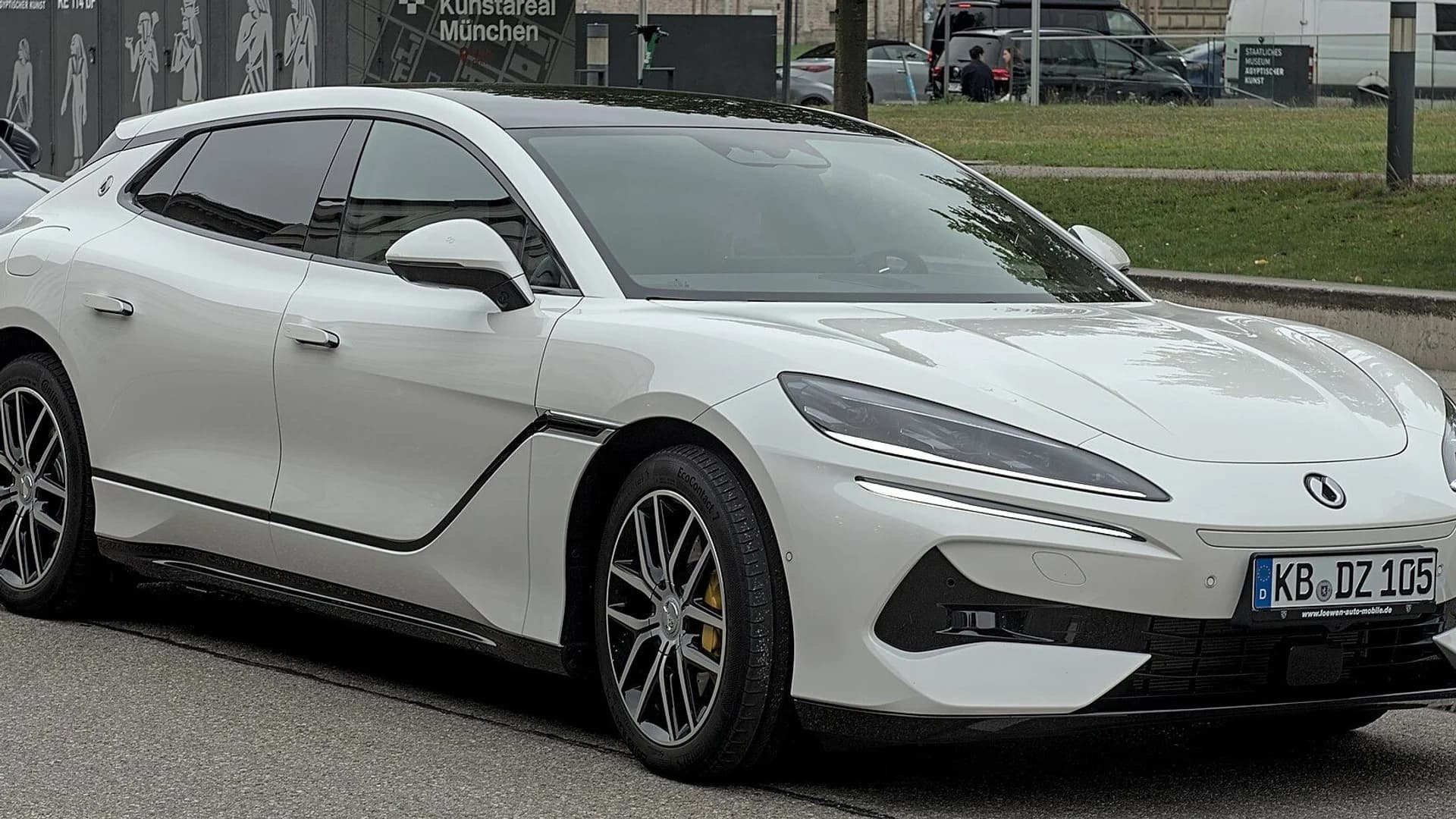
The Z9GT is the crown jewel of that pivot. It is a three-motor, 900-plus horsepower shooting brake that looks like a Porsche Panamera Sport Turismo had a baby with something from the future. It is fast, it is heavy, and it is packed with every piece of hardware BYD has in its arsenal.
It uses the e-Platform 3.0 Evo, which is BYD's most advanced architecture to date. It features independent rear-wheel steering, a 0-100 km/h time of roughly 3 seconds, and a level of interior luxury that makes the Tesla Model S look like a budget rental car.
But the tech under the skin is what matters for this test. The Z9GT is a rolling laboratory for BYD's 2nd Generation Blade Battery.
This is the car that BYD is using to show the world that they can do more than just build cheap commuters like the Dolphin and the Atto 3. They are going after the high-margin, high-performance territory that European brands have dominated for a century.
And they are using a deep freeze to prove their point.
The Secret Sauce: 2nd Gen Blade Battery and Pulse Heating
How did they do it? You can't just plug an LFP battery into a high-speed charger at -30°C and expect it to work. Usually, that’s a recipe for lithium plating, a condition where lithium ions coat the anode instead of entering it, leading to permanent capacity loss and even fire risk.
BYD's breakthrough rests on two pillars: the new Blade Battery chemistry and "Pulse Heating."
Let's start with the Blade Battery. When BYD launched the first Gen Blade in 2020, it was a revolution for Lithium Iron Phosphate (LFP). Most brands had dismissed LFP for premium cars because it lacked the energy density of NMC (Nickel Manganese Cobalt). BYD's "blade" form factor, long, thin cells that act as structural members of the pack, allowed them to fit more active material in the same space.
It was safer (it passed the nail penetration test without fire), it was cheaper, and it lasted longer. But it still sucked in the cold.
The 2nd Generation Blade Battery, which debuts in the Z9GT and the Yangwang U7, fixes the cold-weather ceiling. BYD has optimized the electrolyte and the separator to allow for faster ion transport even when the temperatures are plummeting. They’ve increased the "C-rate" capability, meaning the battery can handle massive amounts of current without cooking itself.
But chemistry alone isn't enough. You still need heat.
This is where "Pulse Heating" comes in. Traditional EVs use a PTC heater or a heat pump to warm a liquid coolant, which then circulates through the battery pack. It’s slow. It’s like trying to warm up a swimming pool with a hair dryer.
Pulse Heating is different. It uses the car's power electronics to send high-frequency current pulses directly into the battery cells. Instead of waiting for external heat to soak into the pack, the cells generate their own internal heat through resistance.
It’s like rubbing your hands together to stay warm, but at the atomic level.
By vibrating the ions within the cells themselves, the battery can raise its internal temperature at a rate of several degrees per minute. By the time you've finished plugging in and walking away to the convenience store, the battery has already "self-heated" into its optimal charging window.
This is "first principles" engineering. While Western brands are still trying to optimize the plumbing of their coolant loops, BYD is manipulating the physics of the cell.
1.5 Megawatts: This Is Not Your Level 2 Home Charger
Let's talk about the pipe this energy is coming through. To charge a car to 97% in 12 minutes, you need an insane amount of power.
BYD used their new "Flash Charging" stations for this test. These aren't your standard 50 kW or even 350 kW chargers. These are megawatt-class stations capable of delivering up to 1,500 kW.
For perspective, a standard Tesla Supercharger V3 caps out at 250 kW. Most "ultra-fast" chargers in Canada (like Electrify Canada or Ivy) hit 350 kW. BYD is playing a game that is four times faster.
Of course, the infrastructure isn't here in Canada yet. We are still arguing over whether to use NACS or CCS, and our grid is struggling to handle 50 kW dispensers in some rural areas. But the fact that the car can accept this power is the crucial first step.
Infrastructure always follows the hardware. When cars started being able to handle 350 kW, the 350 kW chargers started showing up. Now that BYD has a car that can handle 1.5 MW, the race for megawatt charging is officially on.
In Canada, this means that even on our "slow" 350 kW chargers, the Z9GT will likely hold its peak charging rate for the entire session. No tapering. No slowing down at 80%.
That is a massive win for efficiency. It clears out charging stations faster, reducing queues and making long-distance travel viable for everyone.
Think about a busy long weekend at a charger in Hope, BC. If every car took 45 minutes to charge, the line would be hours long. If every car took 12 minutes? The queue moves four times faster. You don't need four times the chargers; you just need faster cars.
BYD is solving a throughput problem as much as a range problem.
1,000 Kilometres of Range (With a Grain of Salt)
During the test, the Denza's "guess-o-meter" showed that the 12-minute charge added enough energy for roughly 626 miles, or 1,009 kilometres of range.
Before you get too excited, let's look at the numbers through a Canadian lens. The 1,000 km figure is based on the CLTC (China Light-Duty Vehicle Test Cycle). CLTC is famously optimistic. It involves a lot of low-speed city driving and very little high-speed highway cruising. It’s the "Instagram filter" of range ratings.
In a Canadian winter, pulling a trailer or driving at 110 km/h on the Coquihalla, you aren't getting 1,000 km. You’re probably looking at closer to 700 or 750 km on a full charge.
That’s still incredible.
A gas-powered Porsche Panamera gets about 600-700 km on a tank. If the Denza Z9GT can match that range while sitting in a deep freeze, the "EVs can't go the distance" argument is dead.
If you can add 750 km of real-world winter range in 12 minutes, you have officially reached parity with a gas station. You stop, you pee, you buy a coffee, and by the time you're back, the car is ready for another six hours of driving.
The "range anxiety" conversation changes from "will I make it" to "where do I want to stop." That is the psychological tipping point for EV adoption.
BYD didn't just add range; they added time. In the world of logistics and travel, that's the currency that actually matters.
The Canadian Winter Road Trip: Calgary to Edmonton
Let's put this into a practical scenario. Imagine you're driving from Calgary to Edmonton in mid-January. It's -28°C. The wind is howling across the highway.
In a typical 2024 EV, you'd be worried. Your range would be cut by 40% due to the cold and the heating requirements. You'd likely need to stop in Red Deer. You'd plug in, and because your battery is cold-soaked, you'd be pulling maybe 40 kW. You'd be sitting there for an hour, shivering in the car while it slowly sips power.
Total trip time: 4.5 to 5 hours.
Now imagine you're in the Denza Z9GT. You still stop in Red Deer, but because of Pulse Heating, your battery is already warm by the time you exit the highway. You plug in, and even on a "standard" 350 kW Canadian charger, you're pulling the full 350 kW from minute one.
In 10 minutes, you've added enough range to finish the trip and have plenty left for driving around Edmonton. You're back on the road before your coffee has even cooled down to drinkable temperatures.
Total trip time: 3 hours and 15 minutes. Basically the same as a gas car.
That is the difference between a "compliance car" and a "no-compromise car." BYD is building the latter.
Comparing the Giants: Tesla, Lucid, and Mercedes
How does this stack up against the best the West has to offer?
Tesla is the obvious benchmark. A Model S Plaid can charge at 250 kW. In ideal conditions, it takes about 25-30 minutes to go from 10% to 80%. In -30°C? Good luck. You’ll be lucky to hit 80% in 45 minutes after a long pre-conditioning session. Tesla's battery heating is good, but it's not "Pulse Heating" good.
Lucid is the current king of US charging speed. The Air can pull over 300 kW. In independent testing, it has gone from 0% to 50% in about 12.5 minutes. Again, that’s in a climate-controlled lab or a sunny day in Arizona. Lucid uses a high-voltage architecture, but they are still using NMC cells that have their own thermal bottlenecks in extreme cold.
Mercedes-AMG has a GT EV that accepts up to 600 kW. It claims 10% to 80% in 11 minutes under "ideal conditions." Note that phrasing: ideal conditions.
BYD just did 20% to 97% in 12 minutes while the car was literally covered in ice.
The gap isn't just a few kilowatts; it’s a generational divide. BYD is shipping technology today that Western manufacturers are still listing as "future goals" in their 2030 roadmaps.
If you are a legacy automaker in Detroit or Munich, this video is a genuine wake-up call. It is a direct demonstration of a technical lead measured in years, not months. There's an irony for Mercedes-Benz in particular: the Denza brand it co-founded now sets a cold-weather benchmark its own flagship EVs will have to answer.
Vertical Integration: The BYD Flywheel
Why can BYD do this while others struggle? The answer is vertical integration.
Most car companies are "assemblers." They buy cells from CATL, motors from Magna, and software from whoever will sell it to them. When they want to upgrade their charging speed, they have to negotiate with five different suppliers, all of whom have their own timelines and profit margins.
Gear worth having
As an Amazon Associate, ThinkEV earns a small commission from qualifying purchases — at no extra cost to you.

Grizzl-E Classic Level 2 EV Charger (40A)
Canadian-made and rated for minus 40C winters. 40A / 9.6 kW, NEMA 14-50, indoor/outdoor, 24-ft cable. The charger built for Canadian weather.
As an Amazon Associate, ThinkEV earns from qualifying purchases — at no extra cost to you.
BYD makes everything. They make the cells. They make the pack. They make the motors. They make the silicon carbide (SiC) chips that control the power flow. They even make the literal seats and the dashboards.
This means when an engineer in the battery division has an idea for Pulse Heating, they don't have to call a supplier in Korea. They walk down the hall to the power electronics division. They test it on a Monday and have a prototype on a Friday.
That is the speed that is winning the EV war.
The real advantage is iteration speed. BYD can update their hardware on a six-month cycle, while legacy makers are stuck in the traditional five-year model lifecycle. By the time a new Ford or GM model hits the showroom, the hardware inside it is already two generations behind what BYD is shipping in China.
This vertical integration is a flywheel. The more they build, the more they learn, and the cheaper it gets. And they are using that advantage to crush the competition on specs.
The "Shooting Brake" Revolution
Let's talk about the design of the Z9GT. It’s a "shooting brake", a fancy word for a high-performance wagon.
In North America, we've been told for decades that "wagons don't sell." We've been forced into SUVs because that's where the profit margins are. But in Europe and China, the shooting brake is the ultimate status symbol. It combines the utility of a hatch with the aerodynamics and handling of a sedan.
The Z9GT is designed to be a "Porsche killer." It’s aimed directly at the Taycan Cross Turismo and the Panamera.
By choosing this body style for their tech showcase, BYD is making a statement: "We aren't just building appliances. We are building enthusiasts' cars."
The Z9GT features tri-motor all-wheel drive, independent torque vectoring, and a suspension system that can adjust on the fly to handle everything from a track day to a potholed city street. It is a driver's car, through and through.
For Canada, this body style actually makes a lot of sense. It has the cargo space for your hockey gear or your camping supplies, but it sits lower to the ground, which means better range and better stability in winter winds.
I’d take a Z9GT over a bloated electric SUV any day of the week.
The Canadian Angle: Why This Matters for the North
Canada is the ultimate test for EVs. We have the distances, we have the terrain, and we have the brutal cold.
The common refrain from EV skeptics in rural Alberta or Northern Quebec is: "Call me when it works at -30."
Well, it works at -30.
The Denza Z9GT test is a direct answer to the most legitimate concern Canadian buyers have. If we want to hit our 2035 zero-emission targets, we need cars that don't become paperweights when the polar vortex hits.
We also need the 100% tariff conversation to evolve into a technology conversation. Right now, we are protecting a domestic industry that isn't building anything close to this tech. By keeping BYD and Denza out of the market (or making them prohibitively expensive), we are effectively denying Canadians access to the very technology that would make EVs viable for the entire country.
I'm not saying we should open the floodgates without a plan, but we need to realize that the "protection" we are buying comes at the cost of technical progress.
If we want to lead in the EV transition, we should be inviting BYD to build these 1.5 MW chargers in Moose Jaw and Saguenay. We should be studying how Pulse Heating can be integrated into our own supply chains.
Because right now, the future of winter driving is being written in Shenzhen, not Windsor.
The "Regen" Buffer: Why 97% and Not 100%?
One interesting detail from the BYD test: they stopped at 97%.
In most EVs, the last 10% of charging (from 90% to 100%) takes as long as the first 50%. The car slows down to protect the cells. But BYD says they stop at 97% to leave room for regenerative braking.
This is a brilliant, zero-BS engineering choice.
If you charge a car to 100% and then immediately drive down a hill or brake for a red light, there is nowhere for that energy to go. The battery is full. So the car has to use traditional friction brakes, which feel different and don't recover any energy.
By stopping at 97%, the Denza Z9GT ensures that "one-pedal driving" and energy recovery are available the second you pull away from the charger. It’s a tiny detail that shows they are thinking about the actual driving experience, not just chasing a "100%" headline.
It’s the kind of practical engineering that wins over long-term owners. It shows that BYD isn't just chasing specs; they are chasing usability.
The "Solid State" Red Herring
For years, the industry has been telling us to wait for "Solid State" batteries. We've been told that Solid State is the only way to get fast charging and cold-weather performance.
BYD just proved that LFP, the "old" and "cheap" chemistry, can do it right now.
While Toyota and others are promising Solid State by 2027 or 2028 (and usually in very limited numbers), BYD is mass-producing 2nd Gen Blade batteries today. They've shown that with better packaging, better electronics, and a better understanding of cell physics, you don't need a "miracle" chemistry to solve the EV problem.
You just need better engineering.
The focus on Solid State has become a convenient excuse for some legacy makers to slow down their current EV efforts. "Why invest in current tech when the magic battery is coming?" Well, the magic battery isn't here, but BYD's Blade 2.0 is.
If you're waiting for Solid State to make your move into EVs, you're going to find yourself in a very crowded and very behind-the-times waiting room.
Is This Just PR Theatrics?
I know what you're thinking. "It's a manufacturer-conducted test. Of course it looks good."
Fair. You should always be skeptical of manufacturer data. But here’s why I think this is more than just a PR stunt: the hardware exists.
We've seen the teardowns of the Blade Battery. We know the physics of Pulse Heating. We see the 1.5 MW chargers being rolled out across China. This isn't a "concept car" that will never see the light of day; the Z9GT is a production vehicle that people are buying right now.
The "stunt" was just showing what the hardware can do when pushed.
Is it representative of every charging session? No. You won't always have a 1.5 MW pipe available. But it sets the ceiling. It shows what is possible when you stop making excuses and start solving engineering problems.
Legacy automakers have spent the last five years framing winter range loss and slow charging as "just part of the deal." BYD just showed that it was a solvable engineering problem all along, one that simply hadn't been the priority.
The Future of the Denza Brand in Canada
Will we ever see the Z9GT in a showroom in Vancouver or Toronto?
As of right now, the path is murky. BYD is focusing on its core brand for the Canadian launch, Dolphin, Atto 3, Seal. Denza is their "Lexus" or "Genesis" equivalent, and those premium brands usually come later once the service network and brand recognition are established.
But the tech inside the Z9GT will come here. BYD is famous for its "technology cascade." What starts in the $100,000 Z9GT today will be in the $35,000 Atto 3 within eighteen months.
That is how they win. They don't hoard the tech for the rich; they use the halo cars to prove the tech and then scale it to the masses.
So even if you aren't in the market for a 900 hp shooting brake, you should be excited about what this means for the next generation of affordable BYD cars landing in Canada.
Winter-proof, flash-charging commuters for under $40,000, that’s what the cascade means for the next generation of affordable BYD cars landing in Canada.
The 6.1% Quota vs. The 100% Tariff
Canada's current trade policy is a mess of contradictions. We have a 100% tariff on Chinese EVs, but we also have a "negotiated" 6.1% tariff for a 49,000-vehicle annual quota.
This means that a limited number of BYD and Denza vehicles can technically enter the market without being price-prohibitive. But they are still excluded from the federal iZEV/EVAP rebates.
Why? Because the rebates are tied to where the car is built, not how good it is.
By excluding Chinese-built EVs from rebates, we are essentially taxing Canadians for wanting a car that actually works in winter. We are subsidizing "Western" cars that still struggle in -30°C while making the "Winter Champion" harder to afford.
It’s a policy that favors geography over engineering. And as any Canadian driver will tell you, the weather doesn't care about geography, it just cares about whether your car starts.
We need a policy that encourages the best technology to enter our market, regardless of where the factory is located. If we want to protect our jobs, we should be incentivizing BYD to build those factories here, using our lithium and our labor to build the world's best winter EVs.
But until that happens, we are just slowing down our own transition.
The Legacy Industry's Last Stand
We are at a turning point. The narrative that Chinese EVs are just "cheap copies" is officially dead. You don't copy your way to 1.5 MW charging at -30°C. You lead your way there.
European brands are recalibrating. Several American brands are leaning back toward hybrids. And BYD is just... executing.
They are operating at a speed and scale much of the industry is still building toward. While parts of the West debate whether to delay EV mandates, BYD is working to make those mandates beside the point, by making electric cars good enough that buyers simply prefer them.
If you can charge in 12 minutes in a blizzard, why would you ever want to stand in the wind at a gas pump?
The Z9GT test is a marker laid down. The message to engineers in Detroit and Stuttgart: the bar just moved, and it moved fast.
Closing that gap won't be quick. Western automakers are working within multi-year design cycles, leaning on outside suppliers, and balancing the transition against established gas-car businesses. BYD carries none of that weight, it is all-in on electric, and it shows.
Gear worth having
As an Amazon Associate, ThinkEV earns a small commission from qualifying purchases — at no extra cost to you.

EcoNour 27-inch Snow Brush and Ice Scraper
An aluminum brush and scraper combo that clears a windshield fast without scratching. Non-negotiable for Canadian mornings.
As an Amazon Associate, ThinkEV earns from qualifying purchases — at no extra cost to you.
The Polar Vortex Just Got Less Scary
For the average Canadian, the "Polar Vortex" usually means dead batteries and cars that won't start. For EV owners, it has meant long, cold waits at charging stations.
BYD just offered a glimpse of a future where that isn't true.
A future where you can drive through a Canadian winter with the same confidence you have in July. Where charging is a minor pause, not a major ordeal. Where the car is smarter than the weather.
It’s a future I want to live in. And I don't care if the car that gets us there is built in Shenzhen or Southwold, I just want it to work.
The Denza Z9GT works. And it works when it's -22 degrees.
The "EVs don't work in winter" argument ran out of road in Shenzhen.
Gear worth having
As an Amazon Associate, ThinkEV earns a small commission from qualifying purchases — at no extra cost to you.

Magnetic Windshield Snow Cover
Skip the scraping. Magnets hold it on, peel it off with the snow, and your defroster stops draining range on cold mornings.
As an Amazon Associate, ThinkEV earns from qualifying purchases — at no extra cost to you.

Founder & Chief Editor
Vlad Pereira is the founder and chief editor of ThinkEV.ca, the Canadian electric-vehicle publication he writes and edits from Courtenay, British Columbia. He covers EV pricing, federal and provincial rebates, charging costs, and the Chinese manufacturers now entering Canada, from the buyer's side rather than the press-fleet side. ThinkEV is a venture of Vlad Pereira Online; his writing on health, income and the long game lives at vladpereira.com.
Frequently asked questions
Is -22°F/-30°C really the 'worst case' for EV charging?
Will these 1.5 MW 'Flash' chargers come to Canada?
Does charging this fast in the cold damage the battery?
How much real-world range does 97% represent in a Canadian winter?
Why did BYD stop the test at 97%?
More EV & road-trip finds
Affordable upgrades worth a look — tap any to check the price on Amazon.
 ★ 68
★ 68WeatherTech FloorLiner for Tesla Model 3
View on Amazon ★ 8,681
Chemical Guys Complete Car Wash Kit
View on Amazon ★ 537
★ 537USB Star Projector Roof Light
View on Amazon ★ 4,626
HoogaLife Hanging Car Diffuser (2-Pack)
View on Amazon ★ 865
★ 865Collapsible Trunk Organizer
View on Amazon ★ 692
★ 692USB-A to USB-C CarPlay Adapter (3-Pack)
View on Amazon ★ 87
★ 87Car Window Sun Shades for Kids (4-Pack)
View on Amazon ★ 268
★ 268Anti-Slip Leather Steering Wheel Cover
View on AmazonRead, Plan, Then Stay Current
Explore our expert articles to understand incentives and ownership costs, use the map to pressure-test charging reality, then subscribe so new EV coverage comes straight to you.
Continue Reading
Denza Z9GT Spotted in Melbourne: 1000km Range, 9-Min Charge
BYD Aims to Outsell Toyota as China Sales Fall 29%
BYD's Battery Shortage Is The Best News In EVs This Year
BYD Denza B8 Suspension Trick Defeats Traffic Boot in Viral Clip

BYD Q3 Electric Semi Marks 150,000th Commercial NEV