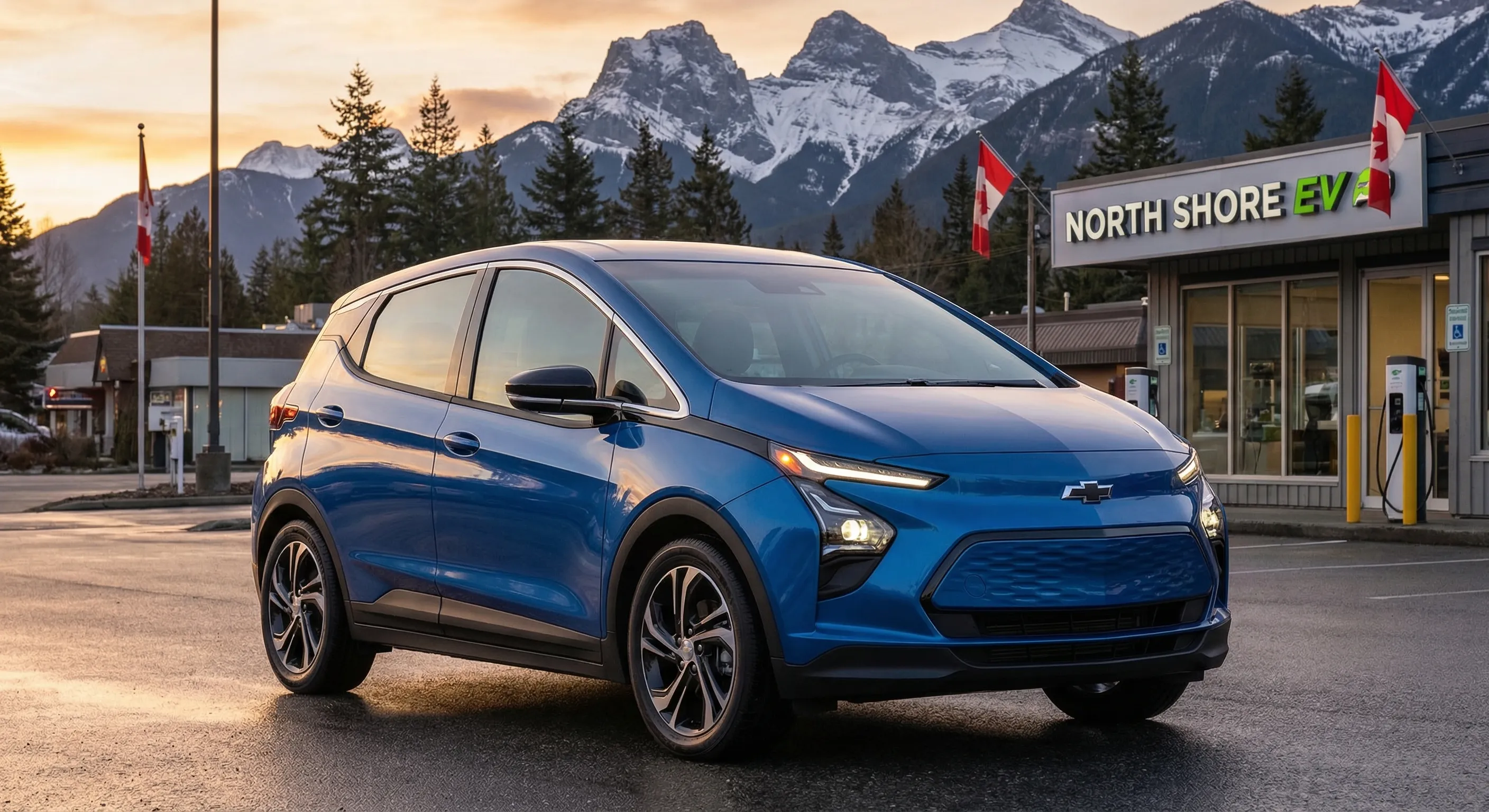
Every few weeks someone posts about it in an EV forum: "Canada's letting in 49,000 Chinese EVs at 6.1% tariff, can I just drive up to a BYD dealer in Vancouver and bring one home?"
It's a fair question. The U.S. slapped 100%-plus tariffs on Chinese-built EVs under the Inflation Reduction Act framework. Canada reduced theirs to 6.1% with a 49,000-vehicle annual quota starting January 2026. On paper, there's a massive arbitrage opportunity sitting right across the border. So what's the actual answer?
The short version: it doesn't work. Not for U.S. residents. And the reasons aren't some obscure technicality, they're layered, practical, and in some cases absolute. Let me walk through each one so you understand exactly why this door is closed, and the one narrow exception where it isn't.
Key takeaways
- U.S. residents cannot legally buy a Canadian-sold Chinese EV and drive it home to register, full stop.
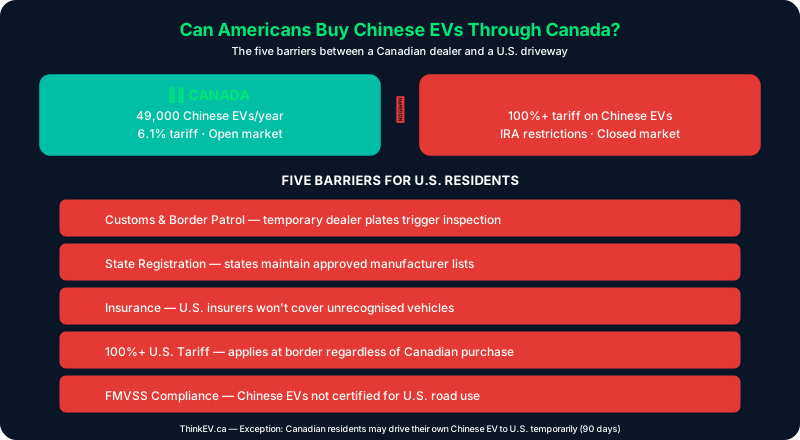
- Five separate barriers stack up: customs, registration, insurance, tariffs, and FMVSS compliance.
- Canada's 6.1% quota tariff does not transfer to U.S. imports, CUSMA/USMCA does not cover Chinese-origin vehicles.
- The one exception: Canadian residents temporarily driving their own Chinese EV into the U.S. (up to 90 days).
- On a $40,000 BYD bought in Canada, a formal U.S. import adds roughly $40,000 in tariffs, wiping out any price advantage, and U.S. DMVs still won't title a vehicle certified to CMVSS rather than FMVSS.
The Short Answer: No
Canada and the U.S. have two completely separate trade policies toward Chinese EVs. They happen to share a border, but they don't share a policy.
Canada negotiated a 49,000-vehicle annual quota with Chinese manufacturers. Vehicles that enter within that quota pay 6.1% import duty, a dramatic reduction from the 100% surtax the government imposed in October 2024. That deal governs vehicles imported into Canada, for sale in Canada, to Canadian residents.
The U.S. made a different call. Under the Inflation Reduction Act, Chinese-manufactured EVs face 100%-plus tariffs and are explicitly excluded from the Clean Vehicle Tax Credit. The Biden administration put those tariffs in place, and the Trump administration has maintained them. There's no indication that's changing in the near term.
When a U.S. resident buys a vehicle in Canada and tries to bring it home, they're not importing a "Canadian vehicle", they're importing the vehicle that vehicle is. Customs and Border Patrol looks at the country of manufacture on the vehicle identification documentation, not the country where you purchased it.
A BYD Atto 3 sold at a Richmond, B.C. dealer is still a Chinese-manufactured vehicle from U.S. Customs' perspective. No amount of Canadian retail transaction changes that. The tariff clock doesn't reset at the border.
The Five Barriers That Kill the Plan
Let's go barrier by barrier. Each one alone is enough to stop this from working. Together, they make it essentially impossible.
Barrier One: U.S. Customs and Border Protection
The first thing that happens when you try to drive a newly purchased vehicle from Canada into the U.S. is that a CBP officer sees temporary dealer plates. That's not normal cross-border traffic, it's a flag.
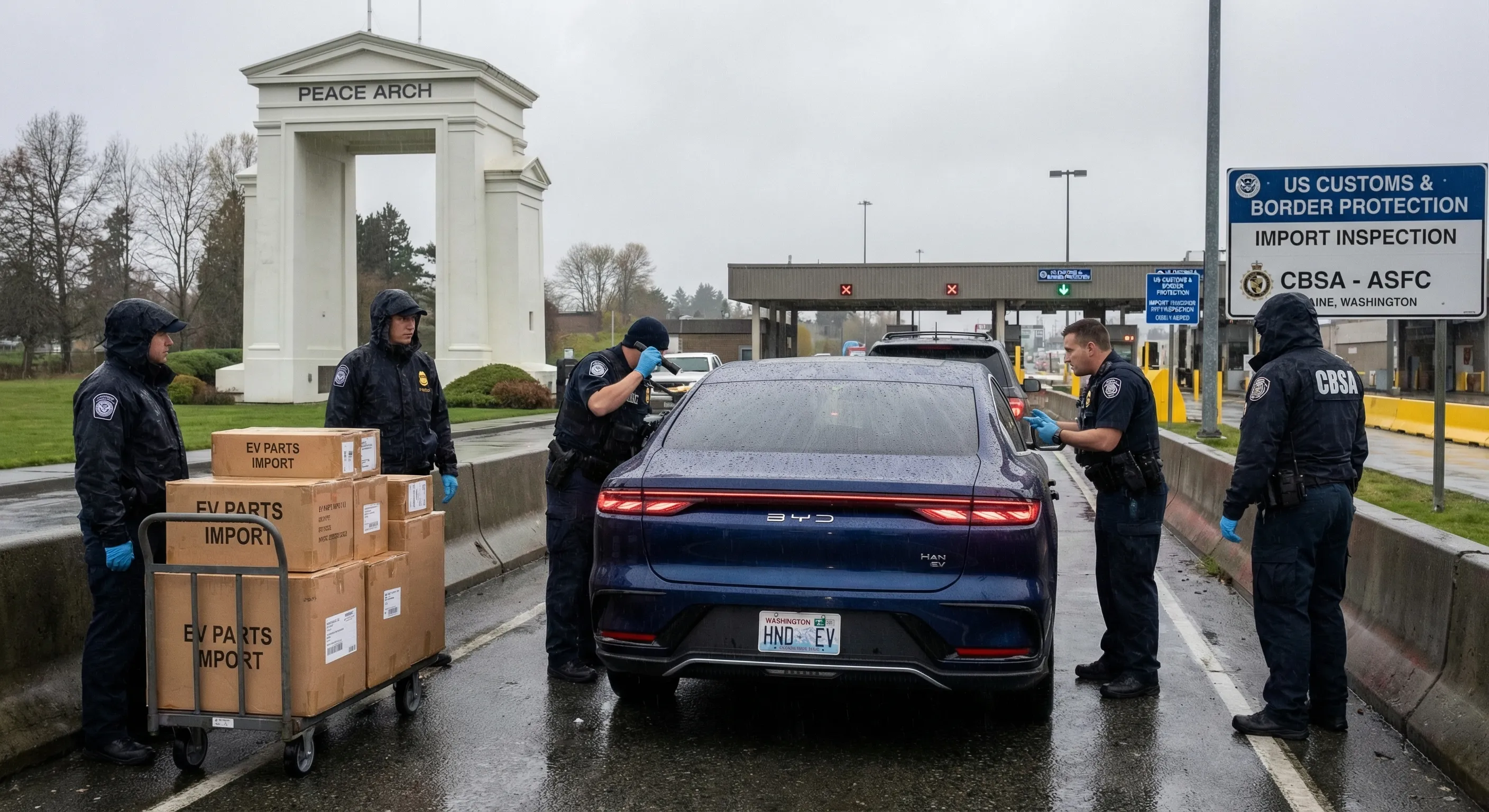
CBP officers have the authority to inspect vehicles at the border and verify they comply with U.S. import regulations. When you're driving a vehicle that isn't registered in any jurisdiction with temporary Canadian dealer plates, they'll want documentation: the bill of sale, the vehicle's country of manufacture, and proof that applicable duties have been paid.
For a Chinese-manufactured EV, there's no pathway to paying the applicable U.S. duty at the land border. You'd need a formal commercial import entry, customs brokers, proper documentation, the full commercial import process. That's not something you walk up to a border crossing with a new car and sort out on the spot.
In practice, CBP will either turn you around or seize the vehicle pending a formal import process. The "just drive it across" approach doesn't survive first contact with a customs officer.
Barrier Two: Vehicle Registration
Even if you somehow got the vehicle into the U.S., you couldn't register it in your home state.
State DMVs require vehicles to meet Federal Motor Vehicle Safety Standards (FMVSS) before they can be titled and registered. That's not a formality, it's a federal mandate. The FMVSS covers everything from crash structure to lighting specifications to airbag deployment timing.
Chinese EV manufacturers selling in Canada have certified their vehicles to Canadian Motor Vehicle Safety Standards (CMVSS). Those standards are similar to U.S. standards in many areas but are not identical and are not interchangeable for registration purposes. A vehicle certified to CMVSS is not certified to FMVSS. Your state DMV will not register it.
Some states also maintain lists of approved vehicle manufacturers and models. If BYD, Geely, or SAIC aren't on that list in your state, and they're not, because they've never sold vehicles there, you have a secondary hurdle on top of the FMVSS issue.
No FMVSS certification equals no registration. No registration equals you can't legally drive it on U.S. roads.
Barrier Three: Insurance
Let's say you tried to sort out registration somehow, you still can't insure it.
U.S. auto insurers write policies on registered vehicles with VIN records they can look up. If your vehicle isn't registered and doesn't appear in any U.S. database, most insurers simply won't write a policy for it. The ones who might would charge rates that make the vehicle economically unworkable, because they can't assess the risk on an unknown platform with no claims history in the U.S. market.
No insurance means you can't legally drive the vehicle on U.S. public roads. In most states it also means you can't register it (insurance is required before registration in many jurisdictions). These problems compound each other.
Barrier Four: Tariffs Still Apply
Even if you cleared every other hurdle, the U.S. tariffs on Chinese EVs would still hit you at the formal import stage.
The 100%-plus tariff on Chinese-manufactured EVs is an origin-of-manufacture tariff. It doesn't matter where the vehicle was sold, it matters where it was made. A BYD assembled in Shenzhen, sold in Vancouver, crosses into the U.S. and the tariff still applies based on Chinese manufacture. Canada's 6.1% quota deal is a bilateral arrangement between Canada and China. It has no bearing on U.S. import law.
This is worth understanding clearly: Canada's quota means vehicles enter Canada at 6.1%. Once they're Canadian-market vehicles, they stay Canadian-market vehicles. There's no mechanism by which buying one in Canada exempts it from U.S. tariffs. The tariff follows the vehicle's origin, not its last retail transaction.
If you went through a formal commercial import process (which, again, you can't just do at a land border), you'd owe something in the range of 100% of the vehicle's value in duties. A $40,000 BYD Atto 3 would cost you $40,000 in additional tariffs. The arbitrage disappears immediately.
Barrier Five: FMVSS and the 25-Year Rule
The only formal legal pathway for importing a non-FMVSS-compliant vehicle into the U.S. is bringing it to compliance before it can be registered. That means a Registered Importer (RI) modifying the vehicle to meet every FMVSS requirement, which can cost tens of thousands of dollars and isn't guaranteed to be possible for every vehicle.
There's also the "Show or Display" exemption, which allows import of vehicles that would otherwise be barred, but it's designed for collector cars and limited-production vehicles of "historical or technological significance." It has strict requirements, annual mileage limits (2,500 miles), and is reviewed case-by-case. It's not a pathway for someone who just wants to daily drive a cheaper EV.
The 25-year rule is the other option: vehicles 25 years or older are exempt from FMVSS and NHTSB bumper standards. That's how grey-market JDM imports work. It's obviously not applicable to a 2025 BYD.
There is no practical pathway that doesn't involve the tariff, FMVSS compliance costs, and a formal commercial import process. The math doesn't work.
The One Thing That CAN Work: The Canadian Resident Exception
Here's the narrow exception that keeps this question from being a total "no."
A Canadian resident who owns a Chinese-manufactured EV sold in Canada can drive that vehicle into the United States temporarily. CBP allows foreign residents to bring their personal vehicles across the border for tourist and business visits, typically up to 90 days. This is well-established practice for any Canadian driving to the U.S. with their car.
So yes: if you're a Canadian living in B.C. who bought a BYD Sealion 6 last month, you can absolutely drive it down to Seattle for a weekend, or road trip to California. The vehicle is yours, you're a Canadian resident, and temporary personal use doesn't trigger the commercial import rules.
What this means in practice is that Americans will encounter Chinese EVs on U.S. roads driven by Canadians visiting on holiday. That's not a loophole that benefits American buyers, it just means the cars will be visible, which will likely increase the "can I get one of those?" question frequency.
A U.S. resident cannot buy one at a Canadian dealer, park it at a friend's house in Vancouver, and "visit" frequently. CBP has seen every version of this. The vehicle's registration address, the buyer's residency, and the pattern of border crossings all factor into whether something is classified as personal use or an attempted import.
Gear worth having
As an Amazon Associate, ThinkEV earns a small commission from qualifying purchases — at no extra cost to you.

VIOFO A229 Pro 4K Dash Cam
4K front plus 2K rear with parking mode and GPS. Your silent witness for insurance claims, with always-on sentry recording while parked.
As an Amazon Associate, ThinkEV earns from qualifying purchases — at no extra cost to you.
The CUSMA/USMCA Angle, Why It Doesn't Help
A lot of people assume that the Canada-U.S.-Mexico Agreement creates some kind of free movement of vehicles between the three countries. That's not how it works.
CUSMA/USMCA provides tariff-free trade for vehicles that meet the agreement's rules of origin, specifically, vehicles with sufficient North American content. A vehicle qualifies as "CUSMA originating" based on where its parts were made and where final assembly happened, not where it was most recently sold.
Chinese-manufactured EVs don't meet CUSMA rules of origin. They're built in China, with Chinese-made components, assembled in Chinese factories. Buying one at a Canadian dealer doesn't change its origin. CUSMA rules of origin are assessed at the factory level, not the retail level.
This is exactly how the IRA's domestic content requirements work on the U.S. side. Vehicles must be assembled in North America to qualify for the Clean Vehicle Tax Credit, and their battery minerals must come from approved countries. A BYD built in Shenzhen doesn't qualify regardless of where you buy it.
The short version: CUSMA doesn't create a loophole for Chinese vehicles through Canada. It was specifically designed with these rules of origin requirements to prevent third-country goods from using Canada as a pass-through to access the U.S. market duty-free. The Chinese EV situation is exactly what that provision was written to prevent.
What About Re-Badging or Canadian Assembly?
This comes up too: what if a Chinese manufacturer opened a Canadian assembly plant? Could they build vehicles in Canada, sell them in the U.S., and get CUSMA treatment?
Theoretically, yes, if the Canadian content met CUSMA rules of origin thresholds (75% North American content for passenger vehicles). But no Chinese manufacturer has done this, and the current trade environment makes it unlikely in the near term. Building a factory is a multi-billion-dollar, multi-year proposition. Chinese automakers are still figuring out whether the Canadian market itself is commercially viable before they'd consider that investment.
Some Chinese manufacturers have explored licensing arrangements with North American manufacturers, or assembly partnerships where final assembly would happen in North America. Those deals could eventually create CUSMA-qualifying vehicles. But that's a very different product from a vehicle assembled in China, it's not a workaround, it's a genuinely new supply chain.
There's also no "re-badging" shortcut. A vehicle with Chinese-made components assembled in Canada would have to genuinely meet the content thresholds, not just carry a different nameplate. Customs authorities test for this.
Cross-Border Driving: What's Actually Practical
If you're a Canadian who owns a Chinese EV and you're planning a cross-border trip, here's what you should know.
Your vehicle crosses fine as a personal-use vehicle. You'll declare it at the border, CBP may ask questions (Chinese EV brands are still unfamiliar to many officers), and you'll drive through. Keep your ownership documents with you, registration, insurance, and something showing you're a Canadian resident.
Gear worth having
As an Amazon Associate, ThinkEV earns a small commission from qualifying purchases — at no extra cost to you.
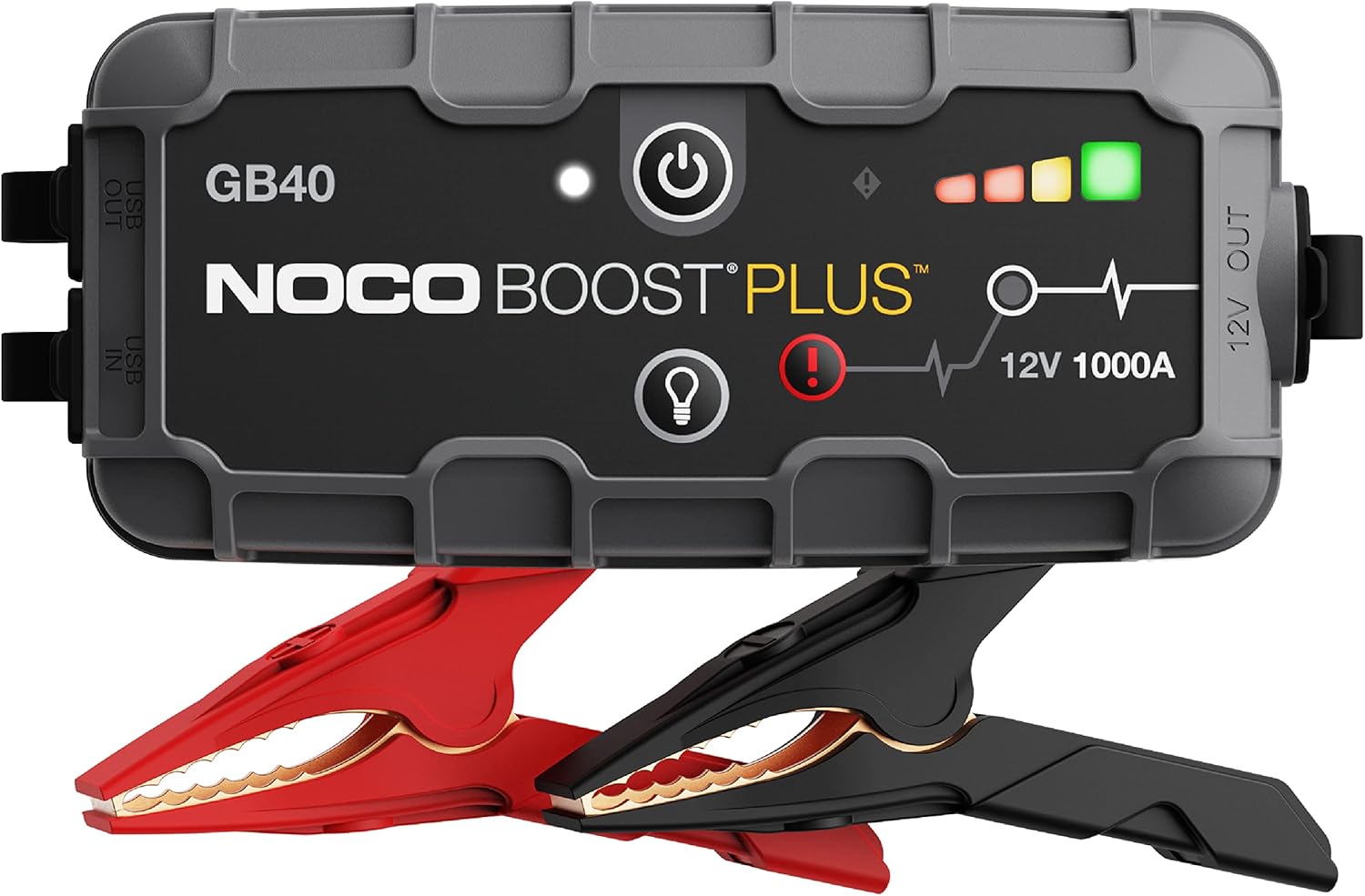
NOCO Boost Plus GB40 Jump Starter
A 1000A lithium jump starter that fits in your glovebox and works on any 12V battery. Your insurance against a dead 12V in a parking lot.
As an Amazon Associate, ThinkEV earns from qualifying purchases — at no extra cost to you.
A dash cam is worth having for any cross-border drive, especially in an unfamiliar vehicle on unfamiliar roads. The VIOFO A229 Pro is a solid choice, good night vision for those U.S. interstate overnights, and it doesn't eat your 12V battery when parked.
One practical note: charging your Chinese EV in the U.S. is straightforward if it has CCS1 connectors, which most Canadian-market Chinese EVs do. Electrify America, EVgo, and ChargePoint all use CCS. Tesla's Supercharger network is open to non-Tesla vehicles with a NACS adapter. For a weekend trip to Seattle or a run down the I-5, you're fine.
Gear worth having
As an Amazon Associate, ThinkEV earns a small commission from qualifying purchases — at no extra cost to you.

Grizzl-E Classic Level 2 EV Charger (40A)
Canadian-made and rated for minus 40C winters. 40A / 9.6 kW, NEMA 14-50, indoor/outdoor, 24-ft cable. The charger built for Canadian weather.
As an Amazon Associate, ThinkEV earns from qualifying purchases — at no extra cost to you.
For longer U.S. road trips in any EV, carrying a portable jump starter is good practice, not for the EV's drive battery, but because a dead 12V auxiliary battery will strand you the same way it would in any car. The NOCO Boost GB40 handles most passenger vehicles and fits under a seat.
See our EV Road Trip Charging Guide for Canada for route-planning specifics that also translate well to Canada-U.S. corridor trips.
What About the Future?
This is the interesting question. The current situation isn't necessarily permanent.
There are a few scenarios where the calculus changes:
Scenario one: U.S. policy reversal. If a future administration reduces or eliminates Chinese EV tariffs, whether through a trade deal, WTO pressure, or a domestic political shift, the import picture changes entirely. At that point, Chinese EVs could enter the U.S. directly, making the Canada detour unnecessary anyway.
Scenario two: FMVSS certification. If BYD or another Chinese manufacturer decides to formally certify their vehicles to FMVSS standards, they could pursue official U.S. market entry. That's a significant investment and regulatory process, but it's the only legitimate path to U.S. retail sales. Some manufacturers have reportedly explored this.
Scenario three: North American assembly. As mentioned earlier, a Chinese manufacturer building in Canada or Mexico with sufficient CUSMA content could produce vehicles that enter the U.S. tariff-free and qualify for the Clean Vehicle Tax Credit. That's a 5-10 year horizon at minimum, but it's a real pathway.
None of these scenarios involve U.S. residents shopping at Canadian dealers. They all require structural changes to either U.S. policy or Chinese manufacturer strategy. The "buy it in Vancouver" plan doesn't work under any of these scenarios, it just wouldn't be necessary if the policy environment changed.
What's clear from the data is that Chinese EV manufacturers aren't sitting still. BYD is already the largest EV manufacturer in the world by volume. The quality gap between Chinese EVs and their Western competitors is narrowing rapidly. The U.S. market is large enough that serious manufacturers will want access eventually. How that access happens, through policy, through local manufacturing, through partnerships, is the real story to watch.
For now, if you're American and you want a Chinese EV, you're waiting for Washington. That's the only answer that's actually honest.
What Canadian Buyers Should Know
Since most people reading this on ThinkEV are Canadian, here's the takeaway that actually applies to you.
Canada's 49,000-vehicle quota at 6.1% tariff is a real policy change that's bringing real Chinese EVs to Canadian showrooms in 2026. BYD, Volvo (whose EX30 is Chinese-manufactured), and others are or will be available at Canadian dealers. The reduced tariff has already brought prices down from what they'd be under the old 100% surtax.
These vehicles don't qualify for the federal EVAP rebate, that requires manufacture in Canada or an FTA country, and China doesn't qualify. But the base prices, especially for BYD, are competitive enough that the math can still work depending on your situation.
See our Chinese EV Brands Coming to Canada guide for a full breakdown of what's arriving and when, and our Canada's Chinese EV Quota Explained post for how the 49,000-unit quota actually works in practice.
The one thing to be aware of if you own a Chinese EV and regularly cross the border: you're fine. Bring your documents. Don't expect the U.S. to have any record of your vehicle's make in their systems, BYD, SAIC, and Geely aren't in U.S. DMV databases, so CBP may need a moment. Be patient, be prepared to explain what it is, and you'll drive through.
Gear worth having
As an Amazon Associate, ThinkEV earns a small commission from qualifying purchases — at no extra cost to you.
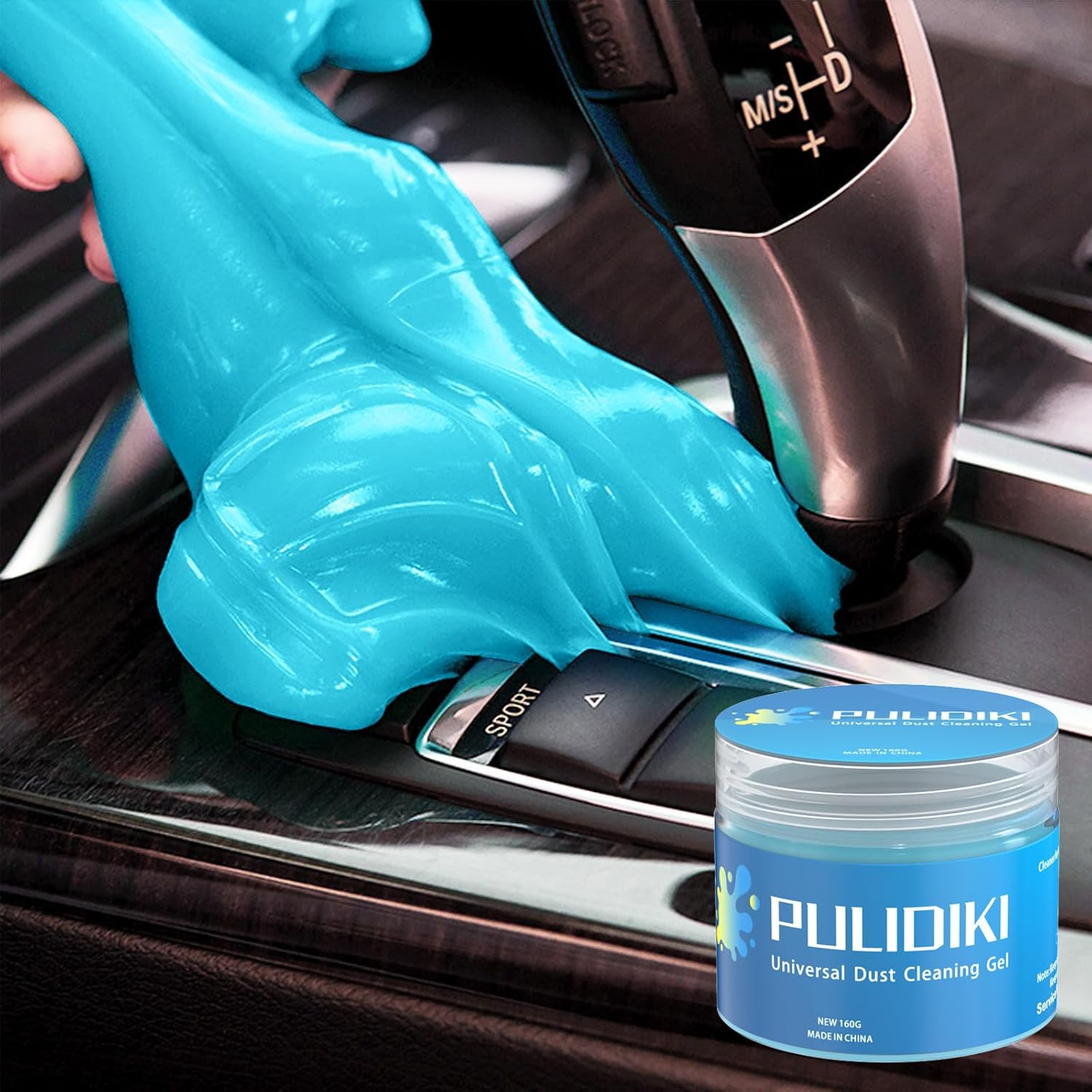
PULIDIKI Car Cleaning Gel (Detailing Putty)
Press it into vents, buttons, and seams and it lifts out dust you did not know was there. Weirdly satisfying, genuinely useful.
As an Amazon Associate, ThinkEV earns from qualifying purchases — at no extra cost to you.
Related Reading
- Chinese EV Brands Coming to Canada: Complete Guide, Every brand and model arriving in Canada under the 2026 quota, with pricing and availability timelines
- Canada's Chinese EV Quota Explained, How the 49,000-vehicle annual quota system actually works and what it means for Canadian buyers
- EV Road Trip Charging Guide Canada, Planning cross-Canada (and cross-border) charging stops for any EV
Gear worth having
As an Amazon Associate, ThinkEV earns a small commission from qualifying purchases — at no extra cost to you.

WixGear Magnetic Air Vent Phone Mount (2-Pack)
A magnet strong enough that your phone never flinches over potholes or rail crossings. Two in the box, one for each car.
As an Amazon Associate, ThinkEV earns from qualifying purchases — at no extra cost to you.

Founder & Chief Editor
Vlad Pereira is the founder and chief editor of ThinkEV.ca, the Canadian electric-vehicle publication he writes and edits from Courtenay, British Columbia. He covers EV pricing, federal and provincial rebates, charging costs, and the Chinese manufacturers now entering Canada, from the buyer's side rather than the press-fleet side. ThinkEV is a venture of Vlad Pereira Online; his writing on health, income and the long game lives at vladpereira.com.
Frequently asked questions
Can I drive a Chinese EV from Canada to the U.S.?
What tariffs would I pay importing a Chinese EV to the U.S.?
Can I register a Chinese EV in my U.S. state?
Will the U.S. ever allow Chinese EVs?
What is the 25-year import rule, and does it help?
More EV & road-trip finds
Affordable upgrades worth a look — tap any to check the price on Amazon.
 ★ 1,083
Crystal Push-Start Button Ring (2-Pack)
View on Amazon ★ 12,396
K KNODEL Car Trash Can with Lid
View on Amazon ★ 848
★ 848Coiled USB-C to USB-C Car Cable (2-Pack)
View on Amazon ★ 119
★ 119Foldable Waterproof Trunk Organizer
View on Amazon ★ 392
★ 392Large Cup Holder Adapter (32-40oz)
View on Amazon ★ 8,681
Chemical Guys Complete Car Wash Kit
View on Amazon ★ 55
★ 55LED Car Door Logo Projector Light
View on Amazon ★ 401
★ 401Crochet Daisy Rear-View Mirror Charm
View on AmazonRead, Plan, Then Stay Current
Explore our expert articles to understand incentives and ownership costs, use the map to pressure-test charging reality, then subscribe so new EV coverage comes straight to you.
Continue Reading

Your First EV in Canada, The No-BS 2026 Buying Guide
Chinese EV Service in Canada: What Buyers Should Know
The 10 Most Affordable EVs You Can Buy in Canada in 2026
Buy or Lease an EV in Canada? The 2026 Answer
Tesla Sales Collapsed 60% in Canada, Should I Still Buy One?