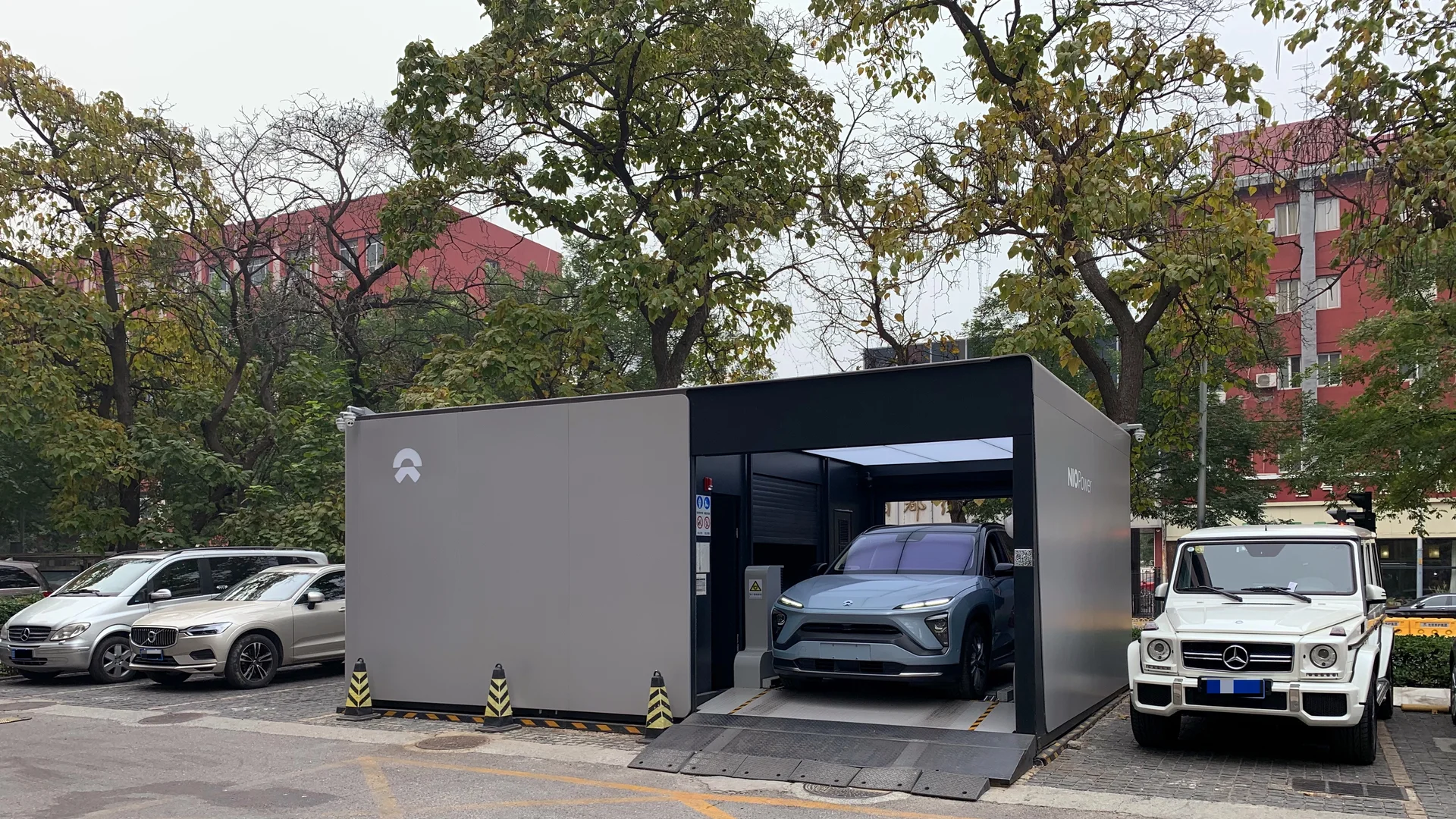
A depleted NIO battery disappears into the floor, a full one locks in, and 2 minutes 24 seconds have elapsed. No app fumble, no charging curve, no coffee break stretched to twenty-eight minutes because the last 10% always takes longer than the first 80%. The driver stays in the seat. The car does the rest.
NIO's customers swapped more than 1 million batteries in a single week, with the highest day of that sprint hitting 170,585 batteries, and that wasn't even the all-time record. The gimmick charge has become harder to make with a straight face.
Key takeaways
- NIO's Gen 4 swap station replaces a depleted pack in 2 minutes 24 seconds, fully automated, driver stays seated.
- In May 2026, NIO logged its millionth swap in a single week, with one day hitting 170,585 batteries.
- Each Gen 4 station costs $500,000–$1 million to build; NIO's 3,750-station Chinese network represents billions in capital.
- China's regulation requiring packs below 60% capacity to exit passenger service made the swap network economically inevitable there.
- BYD runs 2,000+ swap stations almost exclusively for taxis and fleets, the math works for commercial drivers, not commuters.
Quick Answer: How Long Does a NIO Battery Swap Actually Take?
A Gen 4 NIO swap takes 2 minutes 24 seconds, door-to-door. That is less time than refueling a combustion car if you count the walk to the pump and the tap of the credit card. The station holds 23 fully charged packs at any moment and can process up to 480 swaps per day.
There is no attendant. The driver pulls onto an alignment plate, initiates the sequence by app or voice command, and stays in the vehicle. Robotic arms below the floor do the work.
The commercial model matters as much as the mechanics. NIO's Battery-as-a-Service (BaaS) plan separates the battery from the vehicle purchase, lowering the sticker price and turning the battery into a monthly subscription. You do not own the pack. You own the right to swap it, indefinitely, as long as the fee is paid.
That last sentence is the whole business model in one line. Ownership of the most expensive part of the car has been unbundled and turned into a service contract. Whether that is an elegant financial innovation or a permanent lease depends on how long you plan to keep the car.
Gear worth having
As an Amazon Associate, ThinkEV earns a small commission from qualifying purchases — at no extra cost to you.

Lectron Level 2 J1772 Charger (40A, WiFi)
Smart WiFi charger with real-time energy monitoring. 40A / 9.6 kW, J1772 with a NEMA 14-50 plug, schedule charging right from your phone.
As an Amazon Associate, ThinkEV earns from qualifying purchases — at no extra cost to you.
How the Swap Station Works, Step by Step
The mechanics are boring, which is a compliment when the goal is fleet-scale reliability.
The vehicle pulls forward onto an alignment plate. Sensors confirm the position; the app or voice command initiates the sequence. The car locks its parking brake. An underfloor robotic arm unbolts the battery pack, NIO uses a standardized mechanical interface across model generations, so the same station serves an ES6, an ET7, and everything in between without operator intervention.
The depleted pack slides out and into the station's internal rack. A fully charged pack, pre-conditioned to ambient temperature, slides in and locks. Fasteners torque. The vehicle wakes, runs a self-test, confirms the connection, and reports ready.
State-of-health checks happen automatically during the swap. A pack that has drifted below spec is flagged, cycled out of active rotation, and routed to slower diagnostic charging or retirement. The driver never sees this happen. The pack that goes into the car is one the station's software has already decided is fit for service.
NIO completed more than 500,000 battery swaps by May 2020, which sets the baseline for how far the numbers have moved since. Six years later they are logging a million a week.
The standardization piece is the load-bearing engineering decision. Every NIO vehicle since the ES8 accepts the same physical pack format, with software-defined differences in usable capacity. That is what makes a single station relevant to the entire fleet. It is also what makes the network closed, see the next section but one.
The Numbers Behind the Network
The raw counts tell a story that is difficult to argue with even from a skeptical starting position.
NIO passed its 100,000,000th battery swap earlier in 2026, having delivered a cumulative 5.28 billion kWh through the network. The million-swap week arrived in May 2026. The single-day peak sits at 170,585, and the Gen 4 station rollout raises the theoretical daily ceiling well above that as older sites are upgraded.
The physical footprint: roughly 3,750 swap stations in China as of mid-2026, plus a handful in Norway and other European pilot markets. Canada: zero. That is not a rounding error, there is no NIO retail presence, no station, no timeline that has been publicly committed.
The cost structure is the ceiling on how fast this grows. Each Gen 4 station is estimated at $500,000 to $1 million to build, before land, permitting, and grid interconnection. Multiply by 3,750 and you arrive at a capital program in the billions of dollars, funded through a mix of NIO's balance sheet, government support, and strategic partners including CATL and Sinopec. This is not a bootstrapped consumer product. It is industrial infrastructure treated as such.
For context, a DC fast-charging station in Canada with four 350 kW stalls typically comes in below $1 million all-in. The swap station buys you speed and battery-health management; the DC fast charger buys you cross-brand compatibility. Different bets, different unit economics, and the correct answer depends on whether you are optimizing for a captive fleet or a mixed public.
Gear worth having
As an Amazon Associate, ThinkEV earns a small commission from qualifying purchases — at no extra cost to you.

Magnetic Car Phone Mount
Snaps your phone to the dash or vent so navigation and charging apps stay in view. The cheapest upgrade that makes every EV drive easier.
As an Amazon Associate, ThinkEV earns from qualifying purchases — at no extra cost to you.
Why It Works in China and Struggles Everywhere Else
Three things line up in China that do not line up in Canada, and each one is load-bearing.
First, regulation. Chinese battery-health rules require EVs whose packs have degraded below roughly 60% of original capacity to exit passenger service. That creates a structural demand for pack refresh that ownership does not solve, a swap network with active state-of-health management does. The rule made the network economically inevitable in a way no charging network is inevitable in Canada.
Gear worth having
As an Amazon Associate, ThinkEV earns a small commission from qualifying purchases — at no extra cost to you.

Grizzl-E Classic Level 2 EV Charger (40A)
Canadian-made and rated for minus 40C winters. 40A / 9.6 kW, NEMA 14-50, indoor/outdoor, 24-ft cable. The charger built for Canadian weather.
As an Amazon Associate, ThinkEV earns from qualifying purchases — at no extra cost to you.
Second, ecosystem closure. NIO's swap only works with NIO vehicles on a BaaS plan. That is a feature, not a bug: standardization across a single brand is achievable, standardization across BYD, Tesla, Hyundai, and Ford is a diplomatic exercise nobody has attempted. BYD's own Super e-Platform represents a complete overhaul in propulsion, power electronics, and battery architecture, and its packs do not fit a NIO station any more than a Tesla pack does. The Chinese market accepts this fragmentation because scale within each brand is enough. Canada would not clear the threshold on any single brand alone.
Third, the charging alternative. Canada's DC fast-charging density, while patchier than the reader-friendly maps suggest, is closing the gap that swap was designed to fill. Ten-minute 350 kW sessions on an 800V architecture do not match a 2-minute-24-second swap, but they are close enough that the marginal willingness-to-pay for the swap experience falls sharply outside a taxi or ride-hail context.
BYD's approach is instructive. It operates more than 2,000 swap stations in China, but almost exclusively for taxis and delivery fleets, not retail buyers. A three-minute swap for a driver whose income depends on uptime is a different value proposition than a three-minute swap for a commuter who charges at home overnight. The commercial fleet is the beachhead where the math works. The consumer market, even in China, is where NIO is the outlier rather than the norm.
The pattern outside China follows the same logic. The technical case for why Chinese EVs entering Canada is competition worth welcoming sits in a separate post, but the swap network specifically is the piece least likely to travel. It requires either a single brand at national scale (which no market outside China has) or a regulator willing to mandate cross-brand pack standards (which no regulator has attempted since Better Place went bankrupt in 2013).
Gear worth having
As an Amazon Associate, ThinkEV earns a small commission from qualifying purchases — at no extra cost to you.

ChargePoint Home Flex Level 2 Charger (50A)
Premium 50A / 12 kW charger with the best app ecosystem. Hardwired or NEMA 14-50, with real-time energy tracking and smart scheduling.
As an Amazon Associate, ThinkEV earns from qualifying purchases — at no extra cost to you.
What Battery Swapping Would Actually Require to Scale in Canada
The gap is not technical. NIO has proven the engineering. The gap is structural, and it has four components that all have to close together.
Standardized battery form factors across brands. Currently zero cross-brand compatibility exists in the North American market. Even within a single brand, Tesla, say, pack formats have shifted across model generations. A national swap network needs an agreed physical interface, a shared safety standard, and a data protocol that lets any car report its state-of-charge and state-of-health to any station. This does not exist. Nobody is credibly working on it at the consumer level.
Capital support analogous to charging buildout. NRCan's charging infrastructure programs and the provincial equivalents have poured public money into Level 2 and DC fast-charger deployment for the better part of a decade. No equivalent program exists for swap. The $500K–$1M per station figure that NIO is spending in China would need a matching public commitment here, and that commitment would have to survive the political case that the money is better spent on the charging network that already has cars connected to it. That case is difficult to lose.
The fleet-first sequencing. Taxis, ride-hail, last-mile delivery, and municipal vehicles are the realistic first market. Their uptime economics carry the swap premium; their vehicles are homogeneous within each operator; their duty cycles are predictable enough to size a station for. The BYD 5-minute charging story points at the retail alternative that is arriving faster than any swap program could, but retail is the wrong first target regardless. Fleet is where swap either proves itself or does not.
A regulator willing to nudge. China's 60%-capacity rule is the piece Anglosphere policy conversations tend to skip. Without a mandate that forces pack refresh at end-of-service-life, the marginal owner never faces the choice that makes swap economics work. Transport Canada has not signaled interest in this direction, and there is no reason to expect it to.
I'd put Canadian consumer swap infrastructure at 10+ years out absent a regulatory nudge, and probably longer. The charging gap is narrowing faster than the swap economics are flipping. A 400 km fast-charge in ten minutes is not a 2-minute-24-second swap, but it is close enough that the case for building parallel infrastructure evaporates for the consumer driver. The energy-density fundamentals that make faster charging possible are moving in the direction that makes swap less necessary, not more.
The scenario that flips this: a fleet operator, think a national ride-hail platform or a delivery company running thousands of identical vehicles, commits to a captive swap network as an operational bet on driver uptime. That is a plausible 2028–2030 story. The retail consumer story is not.
The number to watch is not the count of Canadian swap stations, which will remain zero. It is whether any Canadian fleet operator announces a pilot in 2027 or 2028. If one does, the model has legs here. If none does, NIO's million-a-week remains a Chinese phenomenon, impressive, instructive, and geographically bounded.
Gear worth having
As an Amazon Associate, ThinkEV earns a small commission from qualifying purchases — at no extra cost to you.

Magnetic EV Charger Plug Cover
A magnetic cap that keeps rain, road salt, and grit out of your home charger handle between sessions.
As an Amazon Associate, ThinkEV earns from qualifying purchases — at no extra cost to you.

Founder & Chief Editor
Vlad Pereira is the founder and chief editor of ThinkEV.ca, the Canadian electric-vehicle publication he writes and edits from Courtenay, British Columbia. He covers EV pricing, federal and provincial rebates, charging costs, and the Chinese manufacturers now entering Canada, from the buyer's side rather than the press-fleet side. ThinkEV is a venture of Vlad Pereira Online; his writing on health, income and the long game lives at vladpereira.com.
Frequently asked questions
Does the BaaS subscription make financial sense long-term?
Can NIO swap stations serve other EV brands?
Why do BYD's swap stations stay out of the consumer market?
What killed Better Place, and is NIO different?
Is 350 kW fast charging close enough to make swap irrelevant?
More EV & road-trip finds
Affordable upgrades worth a look — tap any to check the price on Amazon.
 ★ 119
★ 119Foldable Waterproof Trunk Organizer
View on Amazon ★ 392
★ 392Large Cup Holder Adapter (32-40oz)
View on Amazon ★ 12,051
Windex Electronics Screen Wipes
View on Amazon ★ 164
★ 164Solar-Powered LED Ambient Light
View on Amazon ★ 546
★ 546Funny Headrest Face Covers (2-Pack)
View on Amazon ★ 979
★ 979Leather Headrest Purse Hook
View on Amazon ★ 55,938
WixGear Magnetic Air Vent Phone Mount (2-Pack)
View on Amazon ★ 61
★ 61Toddler Car Seat Snack and Cup Tray
View on AmazonRead, Plan, Then Stay Current
Explore our expert articles to understand incentives and ownership costs, use the map to pressure-test charging reality, then subscribe so new EV coverage comes straight to you.
Continue Reading
Which EVs Should Be Charged to 100%? The LFP Exception
Why Chinese EV Interiors Feel a Generation Ahead
Public EV Charging in Canada: Networks and Payment
Public EV Chargers in Canada: 33,000 Now, 447,000
How Long to Charge an EV: The Three Numbers That Matter