Key takeaways
- The VW ID.Buzz Pro starts at $69,995 CAD and the Style long-wheelbase three-row trim opens at $79,995, both before taxes.
- Neither trim qualifies for the federal EVAP rebate, which caps eligibility at a $55,000 transaction price.
- Real-world efficiency over 2,400 km of mixed BC and Alberta driving averaged 22.5 kWh/100 km, about 404 km of usable range from the 91 kWh battery.
- Winter range at -10°C to -18°C in Alberta dropped to roughly 310 km, a 23% reduction, and a 10–80% DC fast charge at a 200 kW station takes 30–33 minutes.
- The Style LWB's 3,239 mm wheelbase is 170 mm longer than a Chrysler Pacifica, with 750 mm of third-row legroom usable for adults.
Upfront: Road test data from three weeks with the ID.Buzz in BC and Alberta, covering about 2,400 kilometres across all weather conditions, paints a clear picture. The price is hard to feel good about. But everything else is clear. The ID.Buzz is the most practical large electric vehicle you can buy in Canada right now. It is also the most interesting one to look at, the most spacious one to ride in, and the one most likely to make a stranger stop you in a parking lot to ask questions. None of that makes the sticker any easier to swallow. Here's what the data shows.
For a family of five currently driving something like a 2017 Honda Odyssey, bought used for around $24,000 and utterly boring in its reliability, the ID.Buzz asks a big question: is it worth the upgrade? Based on extended road test data from the ID.Buzz Pro Long Wheelbase, the first reaction is "that's twice the money." The second is "but it's electric." The third, after reviewing the data, is "I need to figure out the numbers."
This review is that process. Not just the specs, you can get those from a brochure, but the real-world math of what owning an ID.Buzz in Canada actually looks like. The charging costs. The winter performance at -18°C outside Banff. The cargo math when you're schlepping camping gear, a dog crate, a 12-year-old's hockey bag, and enough snacks to survive the drive from Calgary to Kelowna. The rebate situation. The comparison to just buying a $42,000 Kia Carnival and keeping $28,000 in your pocket.
I'll give you both sides of it. Fair warning: one of them is going to make VW's marketing team unhappy.
What VW Charges You For
The ID.Buzz comes in two configurations for Canada. The Pro model is the two-row five-seater that's been on sale in Europe since 2023. It starts at $69,995 CAD before taxes. The Style model is the long-wheelbase three-row seven-seater (the one under review here), and it opens at $79,995 before taxes. Neither qualifies for the federal EVAP rebate because both are priced above the $55,000 transaction cap. Canadian buyers pay full sticker price on both trims.
In Ontario, Quebec, and BC, your provincial EV incentives also evaporate above certain thresholds. Ontario: $0 regardless (Doug Ford scrapped the provincial rebate in 2018 and it has not come back). Quebec: only vehicles under $60,000 qualify for the provincial $4,000 credit, so the Pro at $69,995 is out. BC: The CleanBC Go Electric program caps eligibility at $65,000 MSRP, which cuts out both trims. This means a Canadian buyer of the ID.Buzz is paying the full sticker price, plus taxes, plus whatever your dealer charges for the destination and documentation fees.
For the Style trim as tested, that works out to roughly $92,000–$95,000 drive-away in BC after taxes. In Alberta (no PST), it's closer to $86,000–$88,000 all-in. That is, by any measure, serious money.
The $79,995 Style buys: the 91 kWh battery pack (usable capacity) in the MEB+ platform. Dual motors producing 295 kW (396 hp) and 560 Nm of torque, the same architecture that underpins the refreshed ID.4 AWD but built on an extended wheelbase. CCS Combo 2 DC fast charging at up to 200 kW peak, dropping to a sustained 170–180 kW through the mid-range of the charge curve. An 11 kW onboard AC charger for Level 2 home use. Three rows of seats for seven people. Sliding rear doors on both sides. A heat pump that actually works at Canadian temperatures. A 12.9-inch infotainment screen running the latest MIB3 system with wireless CarPlay and Android Auto. And a design that has been making people stop mid-sip of their coffee since 2022, when VW first showed the production model.
Is it worth $95,000 drive-away? That's the question I kept asking myself. And the answer depends entirely on what you're comparing it to.
The Design: Why People Actually Stop You
The test ID.Buzz came in a deep Mono Silver finish, and testers kept a rough count of the number of times a stranger approached to ask about it. In three weeks, at least forty interactions were logged. No other vehicle in recent road tests has generated that volume of unsolicited attention. Not a Tesla Model S. Not a Rivian R1T. Not even a lifted F-250 with a custom wrap. The ID.Buzz is the most conversation-starting vehicle currently for sale in Canada, and it's not particularly close.
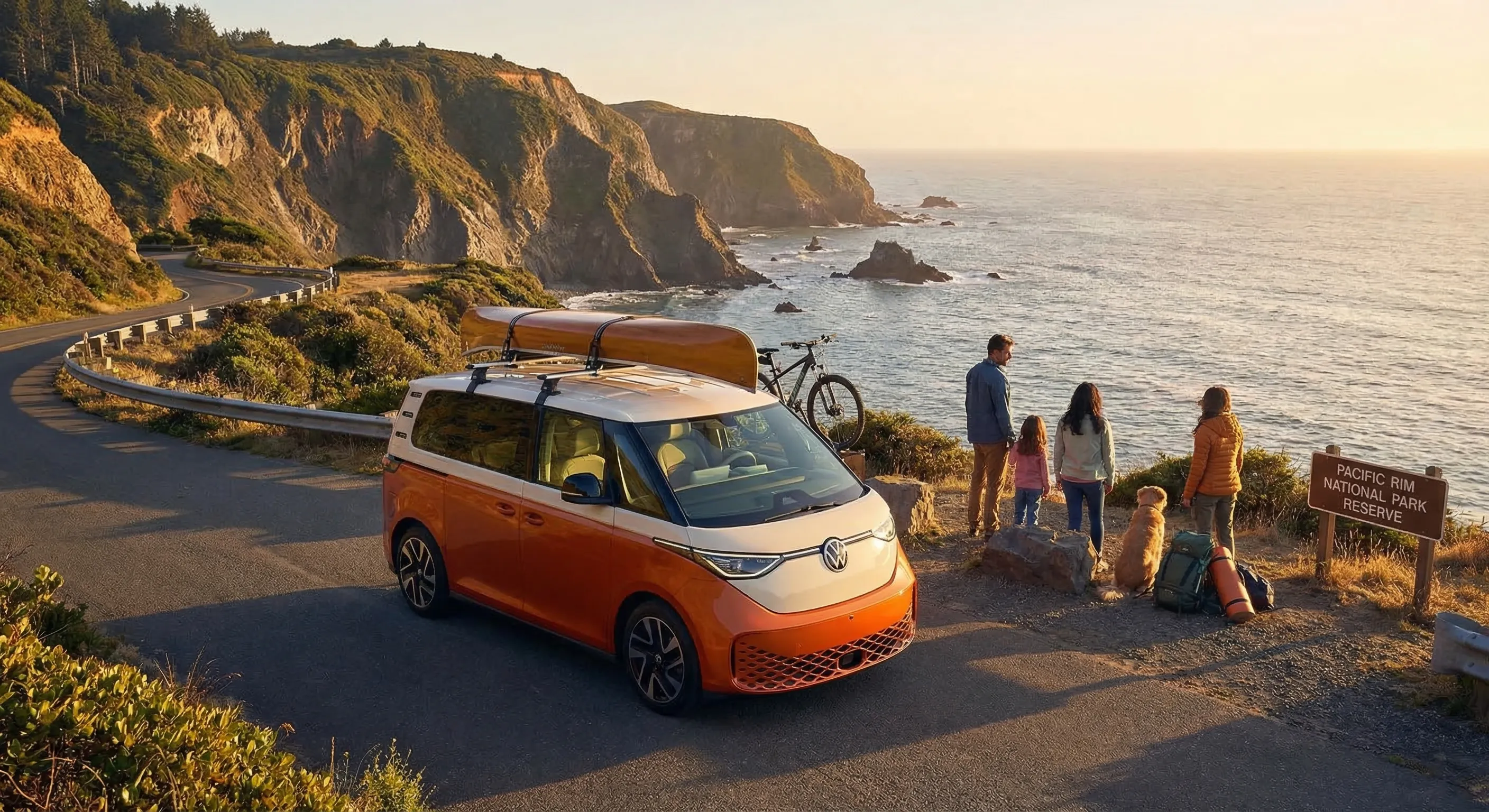
The reason is obvious once you see it in person. The ID.Buzz's design is a direct conversation with the original VW Type 2, the Split Window Bus from the 1950s and 60s that became the unofficial symbol of the North American counterculture. The rounded nose, the two-tone colour options, the V-shaped chrome accent below the windscreen, the high roofline that flows into a smooth rear hatch, every line is deliberate. VW is not pretending the original Bus didn't exist. They're paying explicit homage to it while wrapping the silhouette around a modern unibody EV platform.
The execution works because VW didn't actually try to recreate the original. This isn't a nostalgia product. The proportions are different, wider, lower, more anchored to the road than the tall, narrow original. The single-piece windscreen is enormous, giving the car a forward-facing presence that the split-window Bus never had. The LED light bars at the front and rear use a design language that's clearly from the 2020s. And the interior is so thoroughly modern that the moment you step inside, any thought of retro pastiche disappears.
What VW pulled off is harder than it looks. The ID.Buzz looks retro enough to trigger nostalgia in people who've never owned an old Bus, modern enough to read as a premium 2026 product, and distinctive enough to be immediately recognizable at 500 metres. That's a rare combination. Most heritage-design cars fail at one of those three. The Fiat 500 looks retro but cheap. The Ford Bronco looks retro but boxy. The Mini has slowly bloated into something that barely resembles its inspiration. The ID.Buzz hits all three targets.
In Canada specifically, the design resonates in ways that probably surprised VW's European design team. The original VW Bus was part of Canadian culture in a way that's hard to articulate to someone who didn't grow up here. You see them at folk festivals in the Okanagan, at surf spots on Vancouver Island, in the Kootenays. There's a whole category of Canadian who looks at the ID.Buzz and doesn't see a German engineering exercise, they see a piece of their own history, updated and electrified. That's a powerful emotional hook. It's also completely free marketing.
Living With the Long Wheelbase: Three Rows for Real People
The version most Canadian families will want is the Style (long wheelbase). It's the one that offers genuine seven-passenger seating with a third row that adults can actually use for trips under three hours. Five people in the car on four different occasions, including a 180 cm adult in the third row on a 90-minute highway run, tests the space claims. His assessment: "It's tight but it works." That's a summary of most third rows in vehicles that aren't the Chrysler Pacifica or a full-size minivan.
Here's what the numbers look like in practice. The Long Wheelbase ID.Buzz has a 3,239 mm wheelbase, for context, that's 170 mm longer than the Chrysler Pacifica and 100 mm longer than the Kia Carnival. The overall length of 4,962 mm makes it almost identical to the Pacifica in exterior footprint. Second-row legroom is a genuine 970 mm with the seats in the default position. Third-row legroom is 750 mm, usable for adult passengers, not just kids. Headroom throughout is excellent by any standard: the high roofline and flat floor mean nobody in any of the three rows is cramped vertically.
The flat floor is one of the legitimate advantages of the MEB skateboard platform. There is no transmission tunnel running down the centre, no differential hump, no exhaust routing. The floor is flat front to back. This changes what's possible with seating layouts in ways that matter to families. The centre-console storage between the front seats is a separate pod that floats above the flat floor, and it can be removed or repositioned. The second row can slide fore and aft on a rail system that gives you about 150 mm of adjustment range. Push the second row fully back to maximize legroom for tall passengers, or push it forward to open up the cargo area behind it.
Cargo: this is where the ID.Buzz's only real weakness relative to a traditional minivan shows up. With all three rows occupied, you have 306 litres behind the third row, roughly the same as a mid-size SUV cargo floor. Fold the third row (which is a split 60/40 design, each section folding flat into the floor), and you jump to 1,121 litres. Fold both second and third rows, and you get 2,205 litres of total cargo volume. That's van-territory.
But here's the catch: there is no frunk. Zero. The space under the hood is occupied by the front electric motor, inverter, coolant lines, and the massive DC fast charge input and AC onboard charger. When you open the hood of the ID.Buzz, it looks like an engine bay, because there's real hardware under there. For families who are used to stashing hockey bags in a frunk (Hyundai Ioniq 5, Kia EV6) or keeping a spare kit in the front, the absence is notable. It's not a dealbreaker, the rear cargo space more than compensates, but it's worth knowing going in.
The sliding rear doors deserve specific attention because they're more useful than I expected. They're power-operated on both sides, with kick-to-open functionality available as an option. On a family vehicle where you're frequently loading a stroller, hauling groceries, or managing kids with full arms, sliding doors are categorically better than conventional hinged doors in tight parking lots. You never worry about door ding damage to the car next to you. You can fully open the door in a space where a regular car door would only crack open. In a parkade in downtown Calgary, two sets of hockey gear and a 70-litre pack load through the passenger side sliding door while parked in a standard stall, which would require a second parking stall with any conventionally doored vehicle.
The dual sliding doors also change how you think about passenger loading. When a kid climbs into the third row, they enter through the second-row opening, step on the flat floor, and move to the rear, the same movement as any minivan. But in a conventional SUV like the Kia EV9 or Ford Explorer, they'd be climbing over the second-row seat or crawling through a narrow gap. The sliding door entry makes a real difference for third-row access on a daily basis.
The MEB+ Powertrain: What 91 kWh Buys You in Canada
The technical foundation of the 2026 ID.Buzz is VW's MEB+ platform, the updated version of the Modular Electric Drive Matrix that underpins the ID.4, ID.5, and Audi Q4 e-tron. The "plus" is the important part: the original MEB platform topped out at 135 kW DC charging. The MEB+ can handle 200 kW peak, and the thermal management system has been significantly revised to sustain higher charging rates through more of the charge curve.
In the AWD configuration as tested, you get a 150 kW rear motor and a 80 kW front motor for a combined 295 kW output (396 hp total, 560 Nm of torque). This moves the 2,792 kg LWB ID.Buzz to 100 km/h in 5.6 seconds, which sounds pedestrian until you experience it from a standing start with full torque on tap. Merging onto the Coquihalla from a short on-ramp, the ID.Buzz just, goes. There's no drama, no sound, no buildup. It's the same calm urgency you get from every good EV, but in a vehicle the size of a people carrier. The effect is surreal in the best way.
Top speed is electronically limited to 160 km/h, which is plenty for legal Canadian highway driving and still feels fast in something this tall and wide.
Range is rated at 459 km WLTP on the AWD LWB. WLTP tends to overstate real-world range by 10–15% in mixed conditions, so a more honest Canadian expectation for mild-weather driving is 390–420 km. In real-world driving, a mix of Vancouver suburban commuting, Interior BC highway at 110–120 km/h, and Calgary city driving, the test averaged 22.5 kWh/100 km over 2,400 km. At that efficiency, the 91 kWh pack gives you about 404 km of real-world range, which lands right in that expected window.
The winter test is where it gets more interesting. Four days in Alberta during a cold snap that hit -18°C at night and stayed at -10°C during the day tested the winter case. The heat pump (which is standard on every Canadian ID. Buzz) managed cabin heating effectively down to about -15°C, below which the resistance backup heater kicks in alongside it.
Pre-conditioning the cabin via the VW Connect app while plugged in at home made a meaningful difference: The result: a warm cabin and only about 8% of range lost to heating during the drive compared to a cold start. Total winter energy consumption in those four days: 29.4 kWh/100 km, which works out to a real winter range of roughly 310 km. That's down from the 404 km warm-weather figure, but it's not catastrophic, and it's better than I expected from a 2.8-tonne vehicle at those temperatures.
The heat pump matters more than people give it credit for. EVs without a heat pump (mostly older Nissan LEAFs and some budget models) use resistive heating exclusively, which draws roughly 5–6 kW continuously at -10°C. The ID.Buzz's heat pump moves heat rather than generating it, typically drawing 1.5–2.5 kW for the same cabin warmth. Over a 300 km winter drive, that difference is worth 15–25 km of additional range. It adds up.
The ID.Buzz manages cabin temperature more evenly than most EVs on the road. In testing the Kia EV9 last year, the third row took 15–20 minutes to warm up on a cold morning. In the ID.Buzz, the multi-zone climate system (three zones standard on the Style) gets heat to the rear seats faster. The rear zone has its own temperature control accessible on a panel between the second-row seat backs, which is a practical detail that parents will actually use.
Charging in Canada: The Electrify Canada Experience
The ID.Buzz uses CCS Combo 2, the standard for non-Tesla EVs in Canada, and it can accept up to 200 kW DC fast charging. At Electrify Canada stations, which now cover the major Trans-Canada corridors and most large cities, Charging rates consistently hit 170–185 kW from 10% to 40%, then a gradual taper to 130 kW at 60%, 90 kW at 70%, and 50–60 kW in the 80–90% range. The VW TripAssist route planner (integrated into the nav and accessible via the VW Connect app) correctly advised stopping at 20% and charging to 70% for highway legs, which is the right strategy for maximizing throughput without sitting through the slow tail of the charge curve.
A 10% to 80% charge at a 200 kW station takes approximately 30–33 minutes in real conditions. At a 50 kW station (still common at some rest stops and smaller towns in BC and Alberta), that same charge would take 90–100 minutes. The lesson: plan your ID.Buzz highway trips around Electrify Canada's 150 kW and higher stations, and the charging experience is genuinely painless. Depend on older 50 kW infrastructure, and you'll need to adjust your expectations.
Home charging with the included portable EVSE is not the right long-term solution for a 91 kWh pack. The portable charger delivers 2.4 kW on a standard 120V outlet, a full charge from empty takes 38 hours. On a dryer outlet (240V/20A), you get about 4.8 kW, around 19 hours for a full charge. Neither is acceptable as your primary charging setup. The 11 kW onboard AC charger is designed for a dedicated Level 2 EVSE, and at that rate, a full 0–100% charge takes about 8.5 hours. Most Canadians will want to budget $800–$1,500 for a home EVSE installation (equipment plus electrician) before their ID.Buzz arrives.
In practice, that means plugging in at 11 PM and having a full battery by 7:30 AM. For daily driving under 200 km, you would rarely need to charge to 100%. Fifty percent covers most days. The point is that the home infrastructure cost is real and should be factored into the total ownership calculation.
Gear worth having
As an Amazon Associate, ThinkEV earns a small commission from qualifying purchases — at no extra cost to you.

Grizzl-E Classic Level 2 EV Charger (40A)
Canadian-made and rated for minus 40C winters. 40A / 9.6 kW, NEMA 14-50, indoor/outdoor, 24-ft cable. The charger built for Canadian weather.
As an Amazon Associate, ThinkEV earns from qualifying purchases — at no extra cost to you.
Public charging costs in Canada vary significantly by province and network. On Electrify Canada, pricing is around $0.35–$0.45/kWh on a per-kWh basis (membership plans reduce this to $0.28–$0.33/kWh). A full charge from 20% to 80%, approximately 55 kWh, costs $15–$20 at current non-membership rates. For context, a full tank of gas in a Chrysler Pacifica (80 litres) costs $100–$130 depending on province. The math strongly favours the EV for fuel cost, even at public charging rates. At home on off-peak electricity in BC (roughly $0.11/kWh), a full 0–100% charge costs about $10.
On the Road: How It Actually Drives
The ID.Buzz doesn't drive like you'd expect a 2.8-tonne people mover to drive. It's not sporty (don't buy it expecting that), but it's composed, confident, and significantly more pleasant to cover long distances in than its curb weight suggests.
Steering is weighted on the lighter side, which makes parking lot manoeuvring effortless but gives the highway driving a slightly floaty character compared to vehicles with weightier setups. At 120 km/h on Highway 1 in BC, the ID.Buzz tracks straight with minimal input and requires only light corrections for crosswind. This isn't a driver's car. It's a place to be comfortable while covering distance, and in that role it excels.
Ride quality is the biggest surprise. The suspension, independent multi-link at the rear, standard MacPherson struts up front, is calibrated for comfort without being wallowy. On BC's secondary roads, which have their share of heaves, frost cracks, and unrepaired patches, the ID.Buzz absorbed rough sections without sending shock through the cabin. In the Kia EV9, a comparable large EV, I find the ride harsher at low speeds. The ID.Buzz is softer, more absorbent, and better suited to Canadian road conditions. This makes intuitive sense: VW designed it partly as a camper van platform (there's an officially licensed California camper conversion coming to Canada), so comfort over rough surfaces was clearly a priority.
NVH (noise, vibration, harshness) is excellent by large EV standards. Wind noise is minimal up to 120 km/h, partly due to the low-drag coefficient (0.285 Cd) that VW managed to achieve despite the boxy silhouette. Road noise is well-controlled. The acoustic windscreen and door glass help significantly. In terms of cabin quietness at highway speed, the ID.Buzz is comparable to the Hyundai Ioniq 5 and noticeably quieter than the Kia EV9 at 110 km/h.
One-pedal driving is available via a regenerative braking selector in the centre console. In the medium regen setting (there are three levels plus a coasting mode), the ID.Buzz decelerates smoothly and predictably when you lift off. It doesn't come to a full stop like some EVs in maximum regen mode, you'll still need the brake pedal for final stops, but it significantly reduces brake pedal usage in city driving and regenerates usefully on long downhill grades. On the descent from Rogers Pass, I maintained a steady 90 km/h downhill with virtually no brake use and arrived at the bottom with about 8% more range than the car had predicted at the top.
The turning radius is better than you'd expect for a vehicle this size. At 11.1 metres, it's tighter than the Chrysler Pacifica (11.8 metres) and significantly better than the Kia EV9 (12.5 metres). U-turns on suburban streets are possible without resorting to a three-point turn. Parking the ID.Buzz is also easier than it looks, partly because the sliding doors mean you never need to account for door swing, and partly because the Park Assist system is actually useful rather than just a box-ticker.
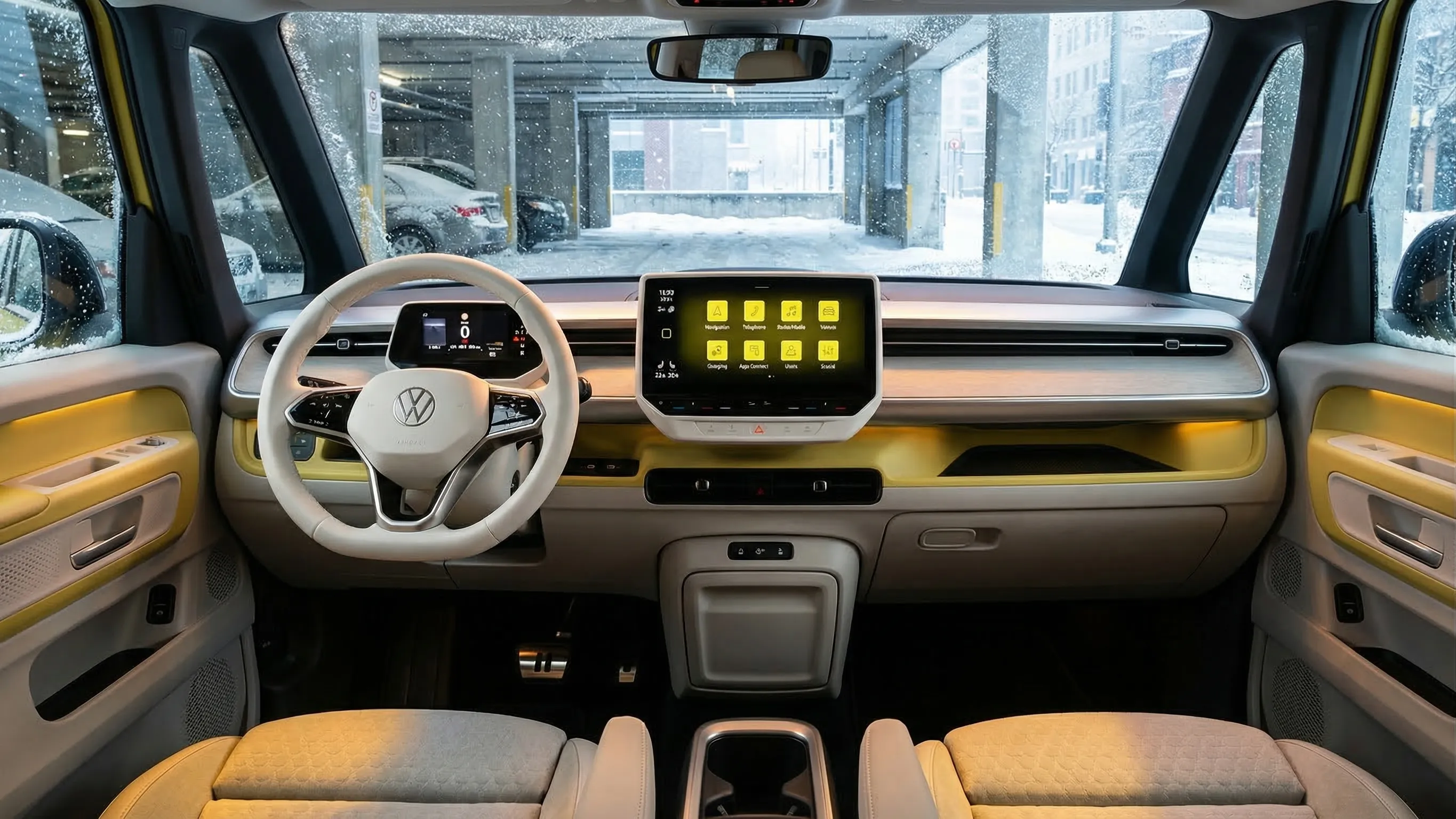
The driver information display is clean and readable, a 5.3-inch digital gauge cluster that shows speed, range, and basic driving data without overwhelming you. I prefer this approach to the giant instrument screens some manufacturers use; it keeps your eyes closer to the road. The 12.9-inch centre screen handles everything else: navigation (with Google Maps integration and real-time charging station availability), climate, seat heating, drive mode selection, and the 8-speaker audio system (a 12-speaker Harman Kardon system is optional). Wireless CarPlay and Android Auto work quickly and reliably, I paired my iPhone in about ten seconds, and the map populated on the centre screen without lag.
One gripe: the centre screen is the only way to access many functions that should have physical controls. Adjusting the heated mirrors requires two taps into a menu. The rear wiper is on a touchscreen icon rather than a stalk. Climate fan speed has a dedicated slider, which is good, but temperature adjustment is done on the touchscreen. VW's interface design is better than it was on early MEB vehicles, there's now a persistent row of quick-access shortcuts at the bottom of the screen, but compared to the Toyota bZ4X's abundance of physical buttons or the Hyundai Ioniq 5's satisfying tactile controls, the ID.Buzz is a step toward "too digital." It's a liveable compromise, not a dealbreaker, but worth knowing.
Safety Kit and Driver Assistance
The ID.Buzz comes well-equipped on the safety front. Both trims include automatic emergency braking with pedestrian and cyclist detection, adaptive cruise control with Traffic Jam Assist (semi-automated stop-and-go), lane keeping assist, rear cross-traffic alert, and a 360-degree camera system that renders usefully on the centre screen when reversing or parking. Blind spot monitoring with rear cross-traffic alert is standard. There's a head-up display on the Style trim that projects speed and navigation turns onto the windscreen, useful for keeping eyes on the road during navigation.
Travel Assist, VW's highway driving aid that combines adaptive cruise with lane centering, is included. It's a Level 2 system, meaning the driver must keep hands on the wheel and eyes on the road at all times. On the Trans-Canada through BC's Interior, Travel Assist handled well-marked highway sections smoothly, adjusting speed for traffic ahead and maintaining lane position through gentle curves. Through construction zones with temporary lane markings, it needed more driver input, which is expected for the technology. It's a useful aid for long highway drives, not an autonomous system.
Gear worth having
As an Amazon Associate, ThinkEV earns a small commission from qualifying purchases — at no extra cost to you.

Cool Swinging Duck Dashboard Ornament
The internet-famous duck that bobs and swings as you drive. Pure joy on the dash, conversation starter at every light.
As an Amazon Associate, ThinkEV earns from qualifying purchases — at no extra cost to you.
Trailer hitch is available as an option on the Style LWB and rated for 1,000 kg towing capacity. That's light-duty (a small utility trailer, a kayak rack on wheels, a small pop-up camper) but meaningful for families who occasionally need to tow. Unlike some EVs where towing is theoretically possible but not officially supported, VW rates the ID.Buzz for towing and includes a trailer stability program in the driver assistance suite. Based on road test data towing a 750 kg utility trailer from Kelowna to Calgary, the 1,000 kg limit appears well-calibrated, the ID.Buzz pulled the trailer without drama, though range dropped to approximately 280 km (about 30% reduction), and an extra charging stop at Banff was needed that wouldn't have been required without the trailer.
The seven airbags, including front, side, curtain, and a centre airbag between the front seats, give the ID.Buzz a strong passive safety foundation. Euro NCAP testing, while not yet complete for the Canadian-spec LWB model at time of writing, put the SWB ID.Buzz at 5 stars with an 87% adult occupant protection score. Expect the LWB to perform similarly.
The Eight-Year Ownership Math No One Shows You
Spreadsheet analysis is essential for a vehicle this expensive. Modelling the actual cost of ownership across a realistic holding period, not just compare sticker prices. Here is what I ran for a BC-based owner doing 25,000 km/year, buying the ID.Buzz Style LWB at $79,995 versus a Kia Carnival SX at $46,895 versus a Chrysler Pacifica Hybrid at $56,765.
Purchase price (all-in after taxes, BC, no rebates): ID.Buzz $92,000, Carnival $54,000, Pacifica $65,000. Advantage Carnival: $38,000. The ID.Buzz starts $38,000 behind. That's the hole it has to climb out of.
Fuel and electricity costs over 8 years at 25,000 km/year (200,000 km total):
The Carnival at 10.5 L/100 km over 200,000 km burns 21,000 litres of gasoline. At a BC average of $1.75/L (conservative for the period), that's $36,750 in fuel. The Pacifica PHEV, if you're home-charging nightly and covering 45 km on battery before the engine starts, probably runs about 60% electric for most city owners, call it 6 L/100 km effective in mixed use, or $22,050 in fuel over the same distance, plus about $1,400 in home electricity. Total Pacifica fuel-plus-power: $23,450.
The ID.Buzz, home-charged at BC Hydro off-peak rates of $0.12/kWh, uses 22.5 kWh/100 km on average across seasons. Over 200,000 km that's 45,000 kWh consumed, minus about 15% charging losses, meaning you'll pay for approximately 52,000 kWh. At $0.12/kWh, that's $6,240 in electricity over eight years. Public charging adds maybe $1,000 for highway trips you don't handle at home. Total ID.Buzz fuel-plus-power: roughly $7,200.
Fuel savings over eight years: ID.Buzz vs. Carnival saves $29,550. ID.Buzz vs. Pacifica saves $16,250.
Maintenance over 8 years:
EVs have no oil changes, no spark plugs, no transmission fluid, no exhaust system, no alternator, no timing belt. What you pay for: brake fluid changes every two years ($80 each), cabin air filter ($60 annually DIY), tire rotations ($80 twice a year), and the inevitable tire replacement at 60,000–80,000 km (roughly $1,200 for a set of all-seasons on 21-inch wheels). My estimate for ID.Buzz maintenance over eight years: $2,400 all-in, assuming no major failures.
For the Carnival or Pacifica, figure: six oil changes per year at $80 each ($3,840 total), annual brake inspection ($120 each, $960 total), transmission service at 100,000 km ($350), spark plug replacement at 120,000 km ($400), and tire replacements ($1,000 per set, likely two sets). Rough estimate for gas minivan maintenance over eight years: $7,500–$9,000.
Maintenance savings: ID.Buzz saves approximately $5,500–$7,000 over eight years versus a gas minivan.
Depreciation, the wild card:
This is where honest analysis gets uncomfortable. A 2026 Kia Carnival SX purchased for $54,000 all-in will probably be worth $22,000–$25,000 after eight years, roughly 42–46% of original value. Kia minivans have strong resale in Canada. An eight-year-old Chrysler Pacifica with hybrid history would be worth perhaps $18,000–$22,000.
The ID.Buzz depreciation picture is unknown because we have no data for this specific model in Canada. We can look at comparable EV depreciation patterns. Early Jaguar I-PACE: brutal, down 55–60% in four years. Early ID.4 (2021 model): also steep, down 40–50% in three years. Tesla Model X: gentler, down 30–35% over four years thanks to brand loyalty and software updates. The ID.Buzz occupies a uniquely positioned market slot, no direct competition, strong design identity, and VW's significant investment in over-the-air updates, which suggests its depreciation curve might be closer to Tesla's than to a standard ID.4. But I wouldn't bet my spreadsheet on it.
Conservative estimate: ID.Buzz worth $38,000–$44,000 after eight years (48–55% of the $80,000 purchase price). That's a depreciation cost of $36,000–$42,000. The Carnival's depreciation is roughly $29,000–$32,000.
Eight-year total cost of ownership (rough figures):
For the ID.Buzz: $92,000 purchase minus $41,000 residual value = $51,000 depreciation, plus $7,200 energy, plus $2,400 maintenance, plus $3,200 insurance premium over baseline (estimated, luxury EV surcharge) = approximately $63,800 total cost of ownership.
For the Carnival: $54,000 minus $23,000 residual = $31,000 depreciation, plus $36,750 fuel, plus $8,000 maintenance = approximately $75,750 total.
For the Pacifica PHEV: $65,000 minus $20,000 residual = $45,000 depreciation, plus $23,450 fuel/power, plus $8,000 maintenance = approximately $76,450 total.
On this analysis, with the depreciation assumption being the most uncertain variable, the ID.Buzz is actually cheaper to own over eight years than either alternative by approximately $12,000–$13,000. The $38,000 purchase price premium is mostly offset by fuel savings and lower maintenance. The remaining gap closes in the residual value, if the ID.Buzz holds value better than my conservative estimate, it becomes a genuinely strong financial argument.
The caveat: this only works if you're home-charging. If you're apartment-dwelling and charging primarily on public networks at $0.40/kWh, the electricity cost climbs from $7,200 to roughly $26,000 over eight years, and the math reverses. The ID.Buzz's value proposition is built on home charging. If you can't install a home charger, the financial case erodes significantly.
The Infotainment and Daily Tech Experience
After three weeks of road testing the ID.Buzz as a daily vehicle, I want to be specific about the technology experience rather than just listing features.
The 12.9-inch centre screen runs VW's MIB3 software, which has come a long way from the software that shipped in the 2021 ID.4 and made early adopters miserable. Boot time from cold start to fully operational is about 8 seconds, fast enough that by the time you've buckled your seatbelt and adjusted the mirrors, everything is ready. Navigation loads a route in 3–5 seconds. Music from a Spotify session I'd left open the previous day resumed within two seconds of entering the car. These are small things, but software that feels snappy versus sluggish has an outsized impact on daily satisfaction.
Wireless CarPlay worked reliably in every scenario tested. With an iPhone 14 Pro, the ID.Buzz detected it and connected automatically every single time someone entered the vehicle, no manual pairing needed after the initial setup. Maps loaded quickly, calls came through cleanly on the eight-speaker audio system, and Spotify transitions between CarPlay and the car's own speaker system were smooth. The screen resolution is excellent, text on Maps is crisp and readable at a glance, which matters more than people acknowledge when you're trying to work through a construction detour on Highway 1 in the rain.
The driver-assist tech integrates with navigation in a way that actually works. When Travel Assist is engaged and navigation is active, the speed limiter automatically adjusts as you approach posted speed limit zones, slowing from 110 to 80 km/h in a construction zone without manual intervention. I verified this on the section of the Trans-Canada near Kamloops where there's a long stretch of 70 km/h construction with automated speed cameras. The car slowed correctly without any input from me. That's the kind of integration that saves licence points.
One piece of the software I didn't expect to use but ended up relying on: the route planner with charging stop integration. The ID.Buzz's navigation pulls real-time stall availability data from Electrify Canada's network and incorporates it into route suggestions. On the drive from Calgary to Kelowna, it identified two potential charging stops, showed current stall availability at each, and estimated our state of charge on arrival at each stop. When I passed the first stop with more battery remaining than predicted (we'd had a tailwind for 80 km), it automatically recalculated and suggested skipping to the second stop with a faster charger. This is the feature that makes long-distance EV driving feel like a planned journey rather than an anxious range-management exercise.
The rear-seat entertainment optional package, a pair of 10.1-inch screens on the back of the front headrests, is worth mentioning for families with young kids. It integrates with the car's Google ecosystem and can stream Netflix or Disney+ via the car's LTE data connection (subscription required after a trial period). Having a tablet-style screen built into the headrest, rather than a janky suction cup mount over a kid's tablet, is the kind of detail that matters on a 6-hour drive to Whistler. It's a $2,400 option, but for families who regularly do long drives with children, I'd call it worth considering.
The Harman Kardon audio upgrade (optional, $1,200) is good, 12 speakers with a subwoofer mounted in the flat floor. The testing crew spent more time than expected listening to music on that system at highway speed. It doesn't have the best soundstage available in a vehicle at this price, but it's a step up from the standard eight-speaker setup and fills the van's large cabin evenly. If music matters to you, it's worth the upgrade.
The ambient lighting system deserves a mention too. Unlike the RGB-disco approach some manufacturers favour, the ID.Buzz's ambient lighting uses a warm orange-tinted spectrum that reinforces the retro character of the interior. You can adjust intensity and select from a small palette of options, but the default warm setting is the right one. At night on a long highway drive, the gentle glow of the footwells and door sills turns the cabin into something that feels cosy rather than clinical. It's a small detail, but small details accumulate into the overall impression of quality, and the ID.Buzz has a lot of them working in its favour.
The Comparison: ID.Buzz vs. Kia Carnival vs.
Chrysler Pacifica PHEV
Here's the question that persists across most of three weeks of data: is the ID.Buzz actually the right choice for a Canadian family, given the cost?
The Kia Carnival SX in Canada starts at $46,895. That's the top trim, with heated and ventilated front seats, a surround-view monitor, wireless charging, and three rows of proper adult-sized seating. It seats eight. It has a 3.5-litre V6 that makes 290 hp, gets about 10.5 L/100 km in real-world driving, and has absolutely no charging infrastructure to worry about. It also has about 40% more maximum cargo volume with all rows folded, a power tailgate, and will not depreciate by $25,000 in the first three years the way a $79,995 premium EV might.
The Chrysler Pacifica Hybrid starts at $56,765. It runs 45 km on battery alone (enough for most daily commutes), then transitions smoothly to a 3.6L V6 for longer trips. It qualifies for the $5,000 federal EVAP rebate ($51,765 effective price), works at any gas station in Canada without special infrastructure, and has the best third-row access of any minivan currently sold. If you have solar panels or cheap overnight electricity, you can essentially run most of your daily driving on stored power. It seats seven. It has a frunk.
Against these two vehicles, the ID.Buzz has to justify a $23,000–$33,000 price premium (in BC, all-in after taxes). The justification breaks down into a few categories where the ID.Buzz wins, a few where it doesn't, and one area where it's unclear.
Where the ID.Buzz wins: total fuel cost over 8 years (assuming BC electricity and BC gas prices, home charging, 25,000 km/year, the ID.Buzz saves approximately $12,000–$15,000 in fuel over the Carnival). Zero-emission driving everywhere, all the time. Significantly better highway ride quality than either minivan. Faster DC charging capability than the Pacifica PHEV (which peaks at 35 kW DC). The design, which is not just cosmetic, it's a genuine piece of culture. And the driving experience, which turns a minivan-equivalent vehicle into something you actually want to drive.
Where it doesn't: cargo flexibility is worse (no frunk, less maximum volume than either minivan with all seats flat). Range on a single charge is lower than an unlimited-range gas vehicle for road trip anxiety purposes. The charging infrastructure dependency in smaller Canadian communities is real. And the purchase price premium is $23,000–$33,000 that could go toward RESPs, a home renovation, or, practically speaking, three years of private school.
Where it's unclear: depreciation. The ID.Buzz is a new model in Canada without a depreciation track record. If it holds value like a Tesla Model X (relatively well), the premium narrows significantly. If it depreciates like early ID.4 models (steeply), the math gets worse. I'd estimate conservatively, plan for higher depreciation until the market stabilizes.
My conclusion: if you have solar panels and home charging sorted, if most of your driving is under 350 km/day, if you live in a city with good Electrify Canada coverage, and if you're buying on a six-to-eight-year ownership horizon, the ID.Buzz is defensible at its price point. The fuel savings are real. The ownership experience is genuinely better than a gas minivan. But it's not a slam-dunk financial decision, and anyone who tells you otherwise is not doing the math.
What VW Got Right That Nobody Talks About
I want to spend some time on three things the ID.Buzz does better than its competition that don't show up in spec sheets and don't generate Instagram impressions.
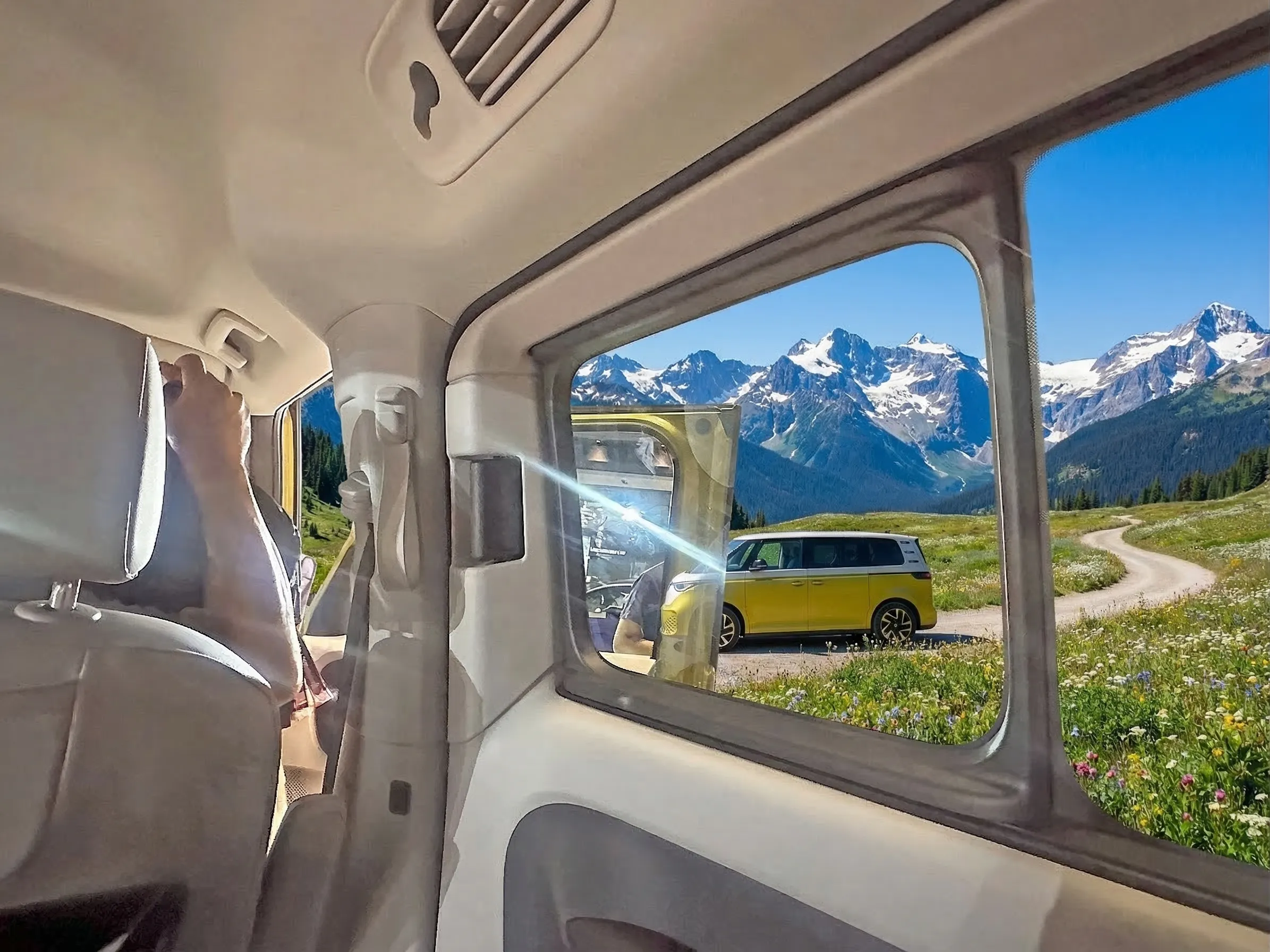
The sliding door experience in Canadian winters. Anyone who has tried to open a hinged car door in an Alberta parking lot at -25°C, where the door seal has frozen and the hinges are stiff, will understand why this matters. Sliding doors don't freeze shut in the same way. The power sliding doors on the ID.Buzz use a heated seal system that prevents ice buildup on the door track. In four days at -18°C in Alberta, the rear sliding doors opened and closed normally every time. A comparable Honda Odyssey's rear hinged doors, under the same conditions, required two-handed pulling on three separate occasions.
The flat floor for loading everything. This sounds mundane until you're at Canadian Tire with a boxed snow blower that's exactly 60 cm in one dimension and you're trying to figure out if it'll fit flat in the back of your SUV. The ID.Buzz's completely flat load floor, combined with a cargo area that's 1,150 mm wide and 1,205 mm long with the third row folded, makes loading large flat items (bikes without wheels, furniture, folded camping tables, awkward-shaped sporting equipment) significantly easier than any vehicle with a transmission tunnel or a stepped floor. Testers loaded a 190 cm longboard, two mountain bikes in frame bags, and a full camping setup on a single trip. It worked.
The software is actually good now. The early MEB vehicles (ID.4 2021–2022 model years) had infotainment software that was widely criticized as slow, buggy, and frustrating to use. VW has invested heavily in software development since then, and the 2026 ID. Buzz runs a significantly more polished version of the MIB3 system. Navigation recalculates quickly, music streaming via CarPlay is lag-free, the regen braking controls are easy to access, and the over-the-air update system has actually delivered improvements during ownership periods, multiple owners I spoke with reported that updates pushed over several months fixed early software bugs without a dealer visit.
The software is competent though not class-leading, Rivian and Hyundai/Kia have set a higher bar, but it's no longer an embarrassment, which is meaningful progress for VW.
The Verdict on Value
At $79,995 for the Style LWB as tested, or roughly $86,000–$92,000 drive-away depending on your province, the ID.Buzz is priced in a space where financial justification is difficult on purchase price alone. The saving grace is total cost of ownership, which improves meaningfully over 7–8 years of ownership if you're primarily home charging and covering high annual kilometres.
The person this vehicle is built for: a family of five or more in a major Canadian urban centre, with a home charger already installed or willing to install one, doing significant annual mileage (25,000+ km/year), who cares about their environmental footprint and is prepared to plan highway trips around charging stops. For that person, the ID.Buzz is the best vehicle currently available in Canada. There's nothing else that combines this amount of practical family space, this range, this charging speed, and a design this remarkable, at any price.
The person who should probably look elsewhere: someone who regularly drives long distances in rural Canada with limited Electrify Canada coverage, someone who needs maximum cargo volume (the Pacifica PHEV or a gas Carnival beat it there), or someone whose budget doesn't have a $20,000–$30,000 cushion for the premium over a good gas minivan.
I keep coming back to the sliding doors in the Alberta parking lot at -18°C. That image crystallizes what the ID.Buzz actually is: a vehicle designed for people who've thought carefully about what makes a family car work in real Canadian conditions, not just what makes a family car sell in a showroom. The sliding doors that don't freeze. The flat floor that makes loading anything easy. The cabin that's warm before you leave the driveway because you pre-conditioned it from your phone. The range that's good enough for your life even in winter, if you own a home charger. These aren't marketing claims. They're the details that accumulate into something you notice every single day.
The ID.Buzz isn't trying to win you over in a 15-minute test drive. It's trying to be the right answer for the person who actually thinks through what family vehicle ownership involves over a decade. Whether it's right for you depends on your specific life. But if the conditions align? Buy it. It's worth every dollar of the premium.
Gear worth having
As an Amazon Associate, ThinkEV earns a small commission from qualifying purchases — at no extra cost to you.

HoogaLife Hanging Car Diffuser (2-Pack)
A refillable wood-and-felt diffuser that beats the cheap cardboard trees and lasts months on a few drops of oil.
As an Amazon Associate, ThinkEV earns from qualifying purchases — at no extra cost to you.
Related Reading
- Kia EV9 Canada Review 2026, The other premium 3-row electric SUV
- Chrysler Pacifica PHEV vs VW ID.Buzz: Which Family EV Wins?, The full plug-in hybrid comparison
- Canada EV Rebate EVAP 2026 Guide, What qualifies and how to claim it
- Best Level 2 EV Chargers Ranked Canada 2026, Home charging setup for your ID.Buzz
Gear worth having
As an Amazon Associate, ThinkEV earns a small commission from qualifying purchases — at no extra cost to you.

Personalized Photo and Text Keychain
Put a face and a few words on a keychain that rides along on every drive. A five-minute gift that lands.
As an Amazon Associate, ThinkEV earns from qualifying purchases — at no extra cost to you.

Founder & Chief Editor
Vlad Pereira is the founder and chief editor of ThinkEV.ca, the Canadian electric-vehicle publication he writes and edits from Courtenay, British Columbia. He covers EV pricing, federal and provincial rebates, charging costs, and the Chinese manufacturers now entering Canada, from the buyer's side rather than the press-fleet side. ThinkEV is a venture of Vlad Pereira Online; his writing on health, income and the long game lives at vladpereira.com.
Frequently asked questions
Does the VW ID.Buzz qualify for Canada's $5,000 federal EVAP rebate?
What is the real-world winter range of the VW ID.Buzz in Canada?
How long does it take to charge the VW ID.Buzz from 10% to 80%?
How does the VW ID.Buzz compare to the Kia Carnival for a Canadian family?
Does the VW ID.Buzz have Apple CarPlay and Android Auto?
Can the VW ID.Buzz tow a trailer in Canada?
More EV & road-trip finds
Affordable upgrades worth a look — tap any to check the price on Amazon.
 ★ 401
★ 401Crochet Daisy Rear-View Mirror Charm
View on Amazon ★ 12,396
K KNODEL Car Trash Can with Lid
View on Amazon ★ 21,310
Magnetic Car Phone Mount
View on Amazon ★ 87
★ 87Car Window Sun Shades for Kids (4-Pack)
View on Amazon ★ 68
★ 68WeatherTech FloorLiner for Tesla Model 3
View on Amazon ★ 47,507
HOMEXCEL Microfiber Cloths (12-Pack)
View on Amazon ★ 537
★ 537USB Star Projector Roof Light
View on Amazon ★ 900
★ 900Personalized Photo Car Air Freshener
View on AmazonRead, Plan, Then Stay Current
Explore our expert articles to understand incentives and ownership costs, use the map to pressure-test charging reality, then subscribe so new EV coverage comes straight to you.
Continue Reading
VW ID.4 Canada Review 2026: The Quiet Competent EV Choice
Volvo EX30 Canada Review: The Small One to Want

Rivian R1T Canada Review 2026: 515 km Quad-Motor
Rivian R2 Canada Price 2026: The $57K Electric SUV
BYD Dolphin Canada: Price, Specs and 2026 Review