Key takeaways
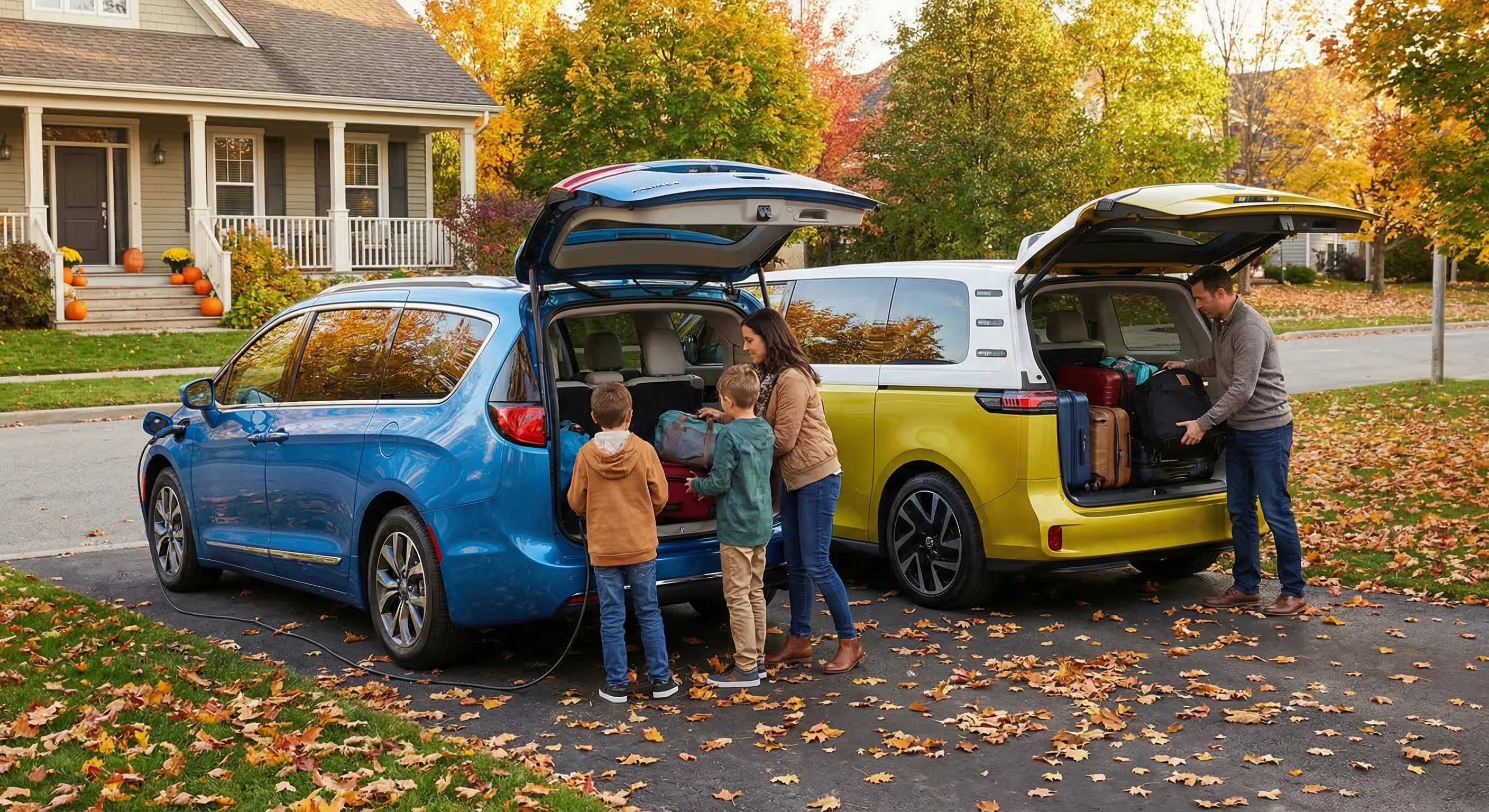
- Canada has exactly two electrified minivans to buy in 2026: the Chrysler Pacifica PHEV and the Volkswagen ID.Buzz.
- The Pacifica PHEV starts at $54,995 CAD and qualifies for the $5,000 EVAP rebate, an effective $49,995 in Ontario; the ID.Buzz is fully electric.
- 67% of Canadian households drive under 60 km a day, fully inside the Pacifica's 56 km of electric range, so most trips never touch gasoline.
- The ID.Buzz LWB's 400 km WLTP range drops to about 250–280 km in a Canadian winter, and it fast-charges at up to 170 kW; the Pacifica can't DC fast charge at all.
- Over five years in Ontario the Pacifica runs about $93,995 to own versus roughly $121,545 for the ID.Buzz, a $27,550 gap.
Here is a number that puts this whole comparison in sharp focus: there are exactly two electrified minivans you can buy in Canada right now. Two. In a country with 38 million people, tens of millions of families who have relied on minivans for decades as the backbone of suburban life, and an EV transition that the federal government has bet its entire environmental credibility on, there are two options. The Chrysler Pacifica Plug-In Hybrid and the Volkswagen ID.Buzz. That is it. No Honda Odyssey Hybrid. No Toyota Sienna EV. No Kia Carnival with a plug. Just these two, staring across a showroom floor at each other like they represent something far larger than their sliding doors and stow-and-go seat systems.
They do represent something larger, actually. The Pacifica PHEV represents one philosophy: meet families where they are. Give them electric for the school run, gas for the camping trip to Algonquin, and a sense of security that the old infrastructure they relied on for forty years will still be there if something goes sideways. It is a bridge vehicle in the truest sense, designed for families who want to reduce their emissions without betting the entire family transportation budget on charging infrastructure that is still, frankly, inconsistent in large swaths of this country.
The ID.Buzz represents the other philosophy: the future is already here, and the people who go all-in win. A full battery-electric platform, a retro design that has turned it into the most talked-about minivan since the original VW Microbus, and a range figure that covers the vast majority of Canadian driving patterns without ever visiting a petrol station. No hybrid compromise. No engine noise breaking the electric silence. No tailpipe emissions at all. It is asking Canadian families to make a decision, not a hedge.
After running the Canadian numbers obsessively, stress-testing the infrastructure assumptions against the real map of DCFC stations from Victoria to Halifax, and reviewing extensive owner feedback, the conclusion might surprise you. Neither vehicle is obviously correct for every family. The right answer is deeply dependent on three variables that the automotive press almost never talks about: where in Canada you actually live, how far you actually drive on a typical day, and whether you have a dedicated home charging setup. Get those three variables wrong and either car becomes the wrong choice. Get them right and one of these minivans will transform how your family moves. Here is every dimension of this comparison with the specificity it deserves.
THE CORE IDENTITY: What Each Vehicle Actually Is
Before we get into range numbers and charging curves and infotainment scores, let us establish what each of these vehicles is philosophically, because that shapes every specification that follows.
The Chrysler Pacifica PHEV, officially called the Pacifica Hybrid, has been in production in Canada since 2017, making it the longest-running electrified minivan in North American history. That is not a marketing claim; it is an operational reality. Stellantis figured out how to install a battery pack in a minivan and sell it at scale before anyone else, and nine years of production refinement shows in the current model.
The 2026 version carries a 16 kWh usable battery pack paired with a 3.6-litre Pentastar V6 and a pair of electric motors built into the transmission. The combined system output is 260 horsepower. The electric-only range is officially rated at 56 kilometres on the Canadian government's test cycle, which, accounting for real-world Canadian winter conditions, translates to roughly 35 to 45 kilometres of actual daily use before the hybrid system kicks in.
That 56-kilometre figure is doing enormous work in this comparison. Statistics from every major Canadian insurance company and mobility analytics firm consistently show that the average Canadian daily driving distance hovers between 35 and 55 kilometres. That means a Pacifica PHEV owner with a home Level 2 charger can legitimately commute to work, drop kids at school, pick up groceries, and return home entirely on electricity, every single day, without ever touching the fuel tank during a typical week.
Then on Saturday, when you load seven people and their camping gear into the back for a 600-kilometre drive to Whistler or the Laurentians, you fill up the tank and go. No range planning, no hunting for charging stations at exit 47 on the Trans-Canada, no 40-minute coffee stops you never budgeted for.
The VW ID.Buzz is a fundamentally different proposition. It launched in Canada for the 2024 model year in a short-wheelbase 5-seat configuration, then added the long-wheelbase 7-seat version, the one most comparable to the Pacifica, for 2025. The ID.Buzz LWB compared here has a 91 kWh battery pack and single rear-motor configuration producing 282 horsepower. Official range sits at approximately 400 kilometres on the WLTP cycle, which typically translates to about 320 to 360 kilometres of real-world Canadian use in summer and 250 to 280 kilometres in a hard Prairie winter. Charging happens at up to 170 kW DC, meaning a 10-to-80-percent top-up takes around 30 minutes at an appropriately fast charger.
There is no backup engine. When the battery is empty, you are done. This is not a criticism, it is the defining characteristic. The ID.Buzz is a bet that charging infrastructure, home charging habits, and Canadian family driving patterns have evolved to the point where a 350-kilometre real-world range is sufficient for the majority of family transportation needs. In many Canadian contexts in 2026, that bet is correct. In others, it is still a reach. The specifics matter enormously, and we will get into them section by section.
SPECS HEAD TO HEAD
Let me walk through the key numbers as a narrative, because each number has a story attached to it.
Starting price: Pacifica PHEV opens at $54,995 CAD before incentives. ID.Buzz LWB opens at $64,995. A $10,000 gap that is not actually $10,000 once you factor in the federal EVAP rebate, which both vehicles qualify for at $5,000 each. The gap remains $10,000 unless your province adds a top-up. Quebec adds another $4,000 on top of the federal credit for both, and British Columbia's SCRAP-IT program can layer additional credits for trade-ins. So in Quebec, the Pacifica real-world price is around $45,995 and the ID.Buzz is around $55,995. That is still a $10,000 spread. In Ontario, where Doug Ford's government has eliminated provincial EV rebates entirely, both vehicles cost exactly what the sticker says minus the federal $5,000.
Battery and powertrain: Pacifica PHEV runs a 16 kWh pack with a 3.6L V6 hybrid system for combined output of 260 hp. ID.Buzz LWB runs a 91 kWh pack with a single rear motor for 282 hp. These numbers tell you something important about priorities. The Pacifica optimised for efficiency and range over raw electric capability, 16 kWh is enough to cover daily driving on electricity without adding so much weight and cost that the hybrid system becomes economically unviable. The ID.Buzz optimised for genuine long-range EV capability, 91 kWh is a proper full-size pack that puts it in the same league as the Tesla Model Y in terms of range.
Seating: Both fit seven in their maximum configurations. The Pacifica's Stow 'n Go second-row seats are still one of the most practical innovations in minivan history, they fold flat into the floor, leaving a massive cargo area without any seat removal gymnastics. The ID.Buzz LWB's second row slides on a track and can be configured in multiple positions, but the seats do not fold into the floor. If you need the maximum cargo space frequently, think regular Costco runs, camping trips, moving flats from university, the Pacifica's Stow 'n Go is a meaningful practical advantage.
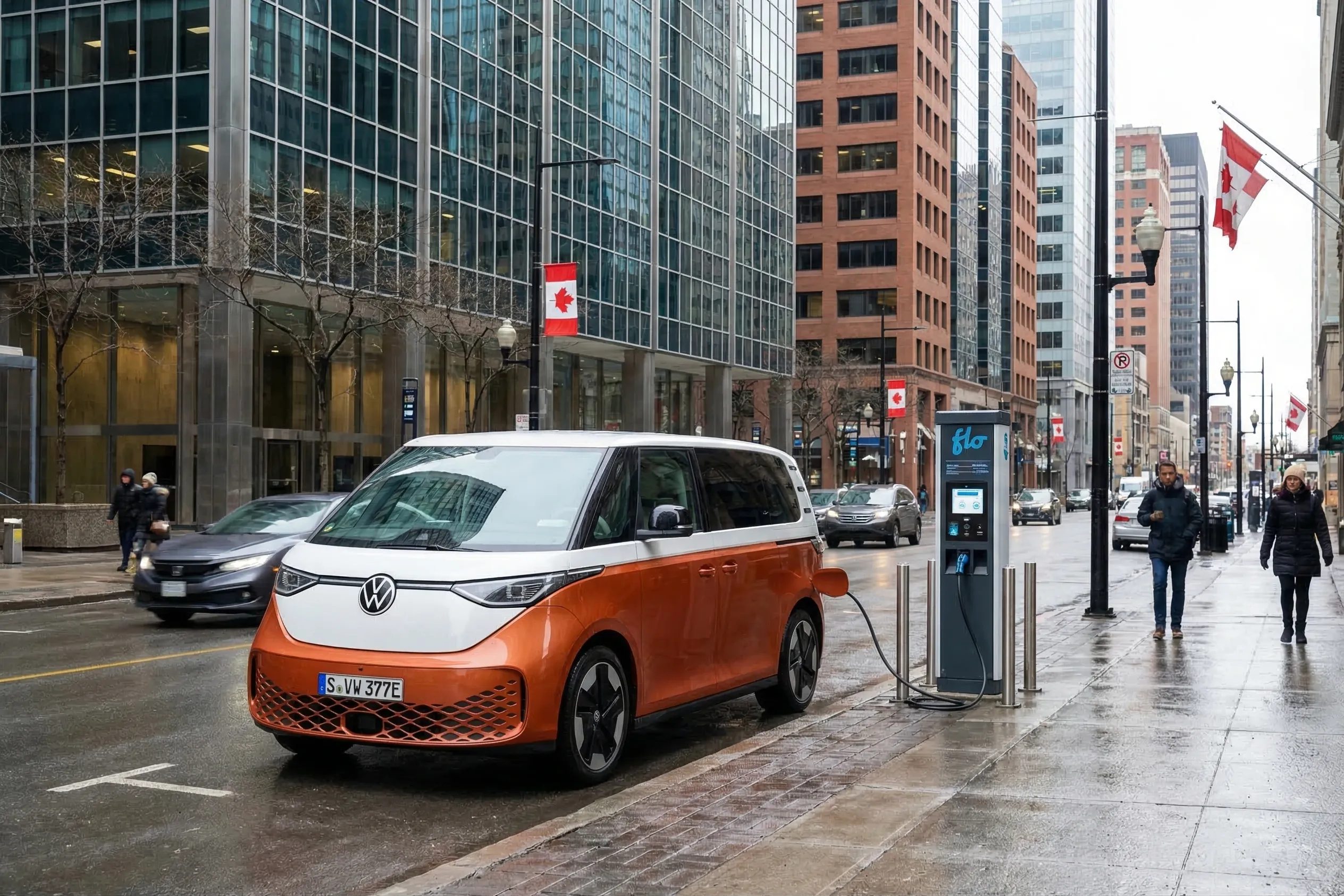
Charging: Pacifica PHEV charges on Level 1 (standard household outlet, about 8 hours for a full charge), Level 2 (7.2 kW onboard charger, full charge in roughly 2 hours), or regenerative braking. It does not support DC fast charging because the battery pack is small enough that Level 2 is already fast. ID.Buzz charges on Level 2 (11 kW onboard, roughly 8 hours for a full charge) or DC fast charging at up to 170 kW (10-to-80% in about 30 minutes). The DC fast charging capability on the ID.Buzz is what makes long road trips viable, without it, a 91 kWh pack would take 8-plus hours to refill, which is not a road trip strategy, it is a lifestyle change.
Weight and efficiency: Pacifica PHEV comes in at approximately 2,290 kg. ID.Buzz LWB is around 2,750 kg. The battery pack and EV platform add substantial weight to the VW, and you feel it in transitions, the Pacifica, despite its hybrid complexity, feels nimbler in tight parking lots and urban manoeuvring. On highway driving the weight difference matters less, and the ID.Buzz's aerodynamic styling (surprisingly slippery for something that looks like a retro box) keeps efficiency competitive.
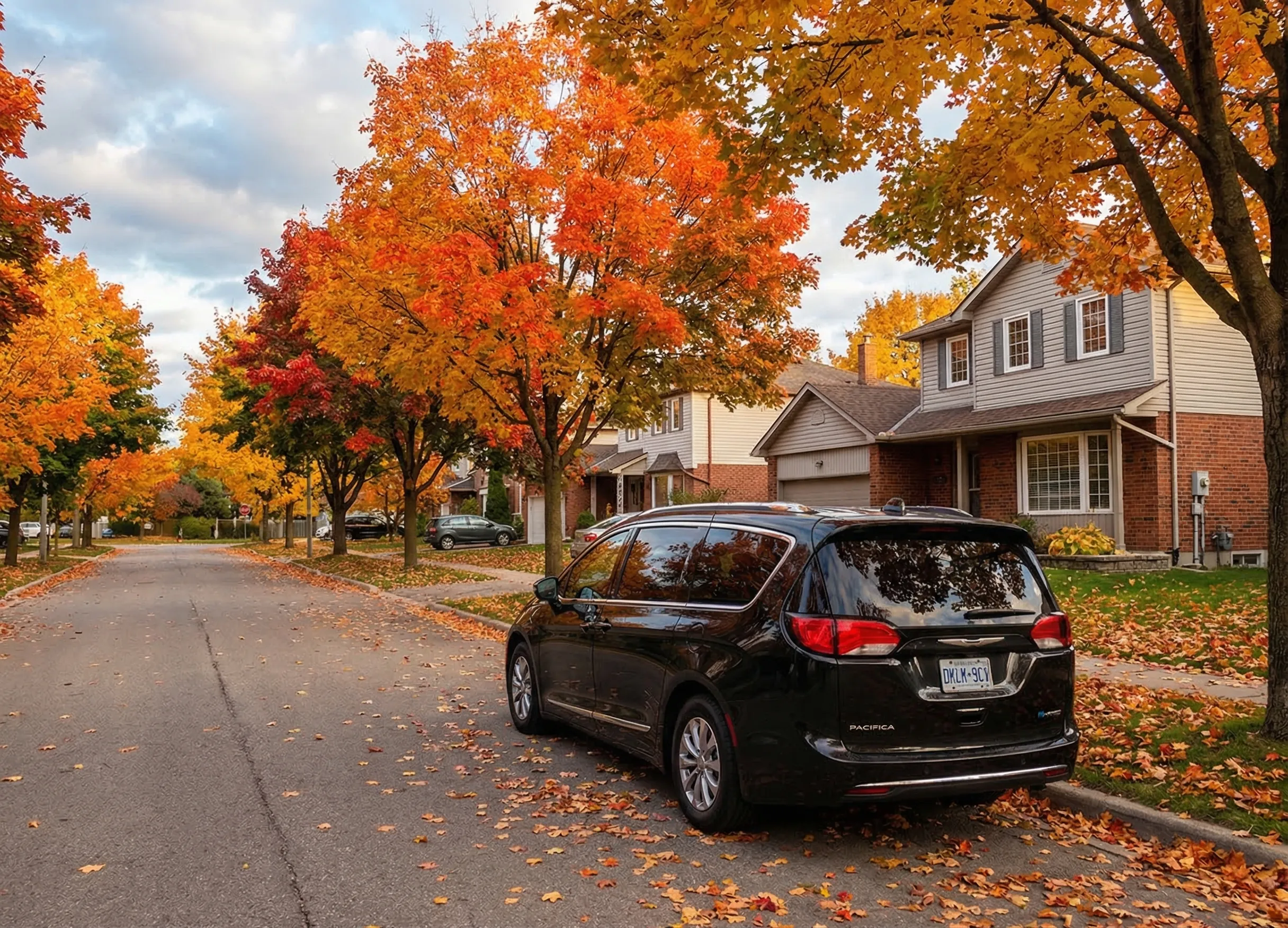
Safety ratings: Both vehicles carry five-star NHTSA overall safety ratings. The Pacifica has the benefit of nine years of production refinement and a well-understood safety profile. The ID.Buzz is newer but the MEB platform has proven itself across multiple VW Group products and carries a strong Euro NCAP record. Standard safety technology on both includes adaptive cruise control, lane keep assist, automatic emergency braking, blind spot monitoring, and rear cross-traffic alert. The ID.Buzz adds a more sophisticated Travel Assist feature that combines adaptive cruise with lane centering in a more capable implementation than the Pacifica's equivalent system.
THE INFOGRAPHIC
Here is the key data visualised:
THE RANGE QUESTION: Where the Decision Really Gets Made
I want to spend significant time on range because this is where the comparison is actually decided for most Canadian families, and where the automotive press consistently oversimplifies things in ways that lead people to wrong conclusions.
The Pacifica PHEV's 56-kilometre electric range is frequently dismissed as inadequate, "it is barely an EV," the commentary goes, "it is a hybrid with a long extension cord. " This framing is almost entirely wrong for Canadian family driving patterns. Here is the honest data: Natural Resources Canada's most recent household travel survey found that 67 percent of Canadian households drive fewer than 60 kilometres per day.
The Pacifica PHEV's electric range covers that entire cohort's daily driving with zero fuel consumption, assuming they charge overnight at home. For two-thirds of Canadian families, the Pacifica PHEV is, practically speaking, an electric vehicle for all weekday driving. The gas engine is there for weekend trips, road trips, and those three or four times a year when life requires driving to the other side of the province.
The ID.Buzz's 400-kilometre WLTP range sounds dramatically superior, and in certain contexts it absolutely is. But that headline number requires some careful parsing. WLTP test conditions are mild-temperature, moderate-speed, with climate systems off or minimal. In a Canadian January in Calgary or Winnipeg or Ottawa, expect 25 to 35 percent range degradation from battery cold-soak effects and aggressive cabin heating demands. A 400-kilometre WLTP rating becomes approximately 260 to 280 kilometres on a cold day. That is still sufficient for most daily driving patterns, but it meaningfully changes the road trip calculus.
Here is the scenario I want you to think through carefully: it is February in Saskatoon. Temperature is minus 28 Celsius. You need to drive from Saskatoon to Regina for a family visit, a distance of 260 kilometres each way. Your ID.Buzz has been parked outside overnight. The battery has cold-soaked to ambient temperature. You have roughly 260 to 280 kilometres of real-world range. The drive to Regina is 260 kilometres, so you technically make it, barely, with no margin, with a rapidly depleting battery and the heater running full blast. The return trip requires finding a functional DCFC station in Regina (there are some, but coverage is uneven), waiting 30 minutes in February, then hoping nothing else on the highway drains the buffer you thought you had.
With the Pacifica PHEV, that same trip requires: charging at home overnight, driving the first 40-odd kilometres electric, then running the V6 for the remaining 220 kilometres, arriving with confidence, and returning the same way. No DCFC station required. No range anxiety. No February wait time at a charging station.
This is not a theoretical edge case. This is a real trip that millions of Prairie Canadians make routinely, and it illustrates why the Pacifica's hybrid architecture has genuine value that goes beyond the "safety net" framing. In dense urban environments, Vancouver, Toronto, Montreal, Ottawa, the argument shifts considerably. In those cities, DCFC infrastructure is strong, battery preconditioning (which the ID.Buzz supports) mitigates much of the cold-weather degradation, and the likelihood of a daily drive exceeding 280 kilometres is extremely low. In those contexts, the ID.Buzz's pure-electric operation, zero tailpipe emissions, and silence are genuinely superior to the Pacifica's hybrid compromise.
The summary on range: if you live in a major Canadian city with access to home charging and are comfortable planning road trips around DCFC stations, the ID.Buzz's range is more than sufficient and its pure-EV operation is a meaningful quality-of-life upgrade. If you live anywhere in rural Canada, the Prairie provinces, Northern Ontario, New Brunswick, Nova Scotia, PEI, or anywhere else where charging infrastructure is sparse, the Pacifica's hybrid architecture is not a compromise, it is the correct engineering choice for your actual life.
CHARGING INFRASTRUCTURE: The Reality Check Nobody Wants to Do
Canada has approximately 25,000 public EV charging ports as of early 2026, according to NRCan's Zero Emission Vehicle Infrastructure Program tracker. Of those, roughly 5,000 are Level 3 DC fast chargers, the kind that can charge an ID.Buzz at meaningful speed. The remaining 20,000 are Level 2, which are useful for top-ups but not for cross-country driving in a big-battery EV. That 5,000 DCFC figure sounds reasonable until you look at the geographic distribution: approximately 70 percent of them are concentrated in the Quebec-Windsor corridor, Metro Vancouver, and the Calgary-Edmonton corridor. Everything else is covered by the remaining 30 percent spread across an area larger than the entire continental United States.
For ID.Buzz owners living in those dense urban corridors, this is fine. The math works. You have regular DCFC access for road trips, reliable Level 2 at shopping centres and workplaces for top-ups, and home charging for the daily cycle. For ID.Buzz owners in Atlantic Canada, rural BC, rural Alberta, Saskatchewan, Manitoba, or Northern Ontario, the infrastructure picture requires honest planning that the enthusiasm around this vehicle often glosses over.
The Pacifica PHEV's infrastructure needs are radically simpler. A Level 2 home charger, the Grizzl-E Classic costs around $399 and is easily the best value proposition in Canada for exactly this use case, charges the 16 kWh pack in about two hours. That is it. You plug in when you get home, you leave fully charged in the morning. On road trips, you use gas stations that exist everywhere gas-powered vehicles have gone for the last century. The infrastructure dependency for a Pacifica PHEV is exactly one outlet at your house. The infrastructure dependency for an ID.Buzz is one outlet at your house plus a functioning DCFC network whenever you want to drive more than 250 kilometres in cold weather.
Gear worth having
As an Amazon Associate, ThinkEV earns a small commission from qualifying purchases — at no extra cost to you.

Grizzl-E Classic Level 2 EV Charger (40A)
Canadian-made and rated for minus 40C winters. 40A / 9.6 kW, NEMA 14-50, indoor/outdoor, 24-ft cable. The charger built for Canadian weather.
As an Amazon Associate, ThinkEV earns from qualifying purchases — at no extra cost to you.
This matters for insurance calculations too. EV-specific insurance products from providers like Kanetix have started factoring charging infrastructure availability into risk profiles in some provinces. Both vehicles qualify for standard EV or hybrid insurance rate adjustments, but the conversation with your broker will be somewhat different depending on whether you are insuring a full BEV or a PHEV. Worth a call before you commit.
Now I want to address the home charging question directly, because it is the single largest assumption hiding inside every EV comparison and nobody talks about it honestly.
Home charging requires either a garage with an electrical outlet or a dedicated Level 2 charger installation, and living in a detached or semi-detached house where you can access your electrical panel. For Canadian families who own their home, and according to Statistics Canada, that is about 67 percent of Canadian households, this is achievable with a one-time installation cost of $500 to $1,500 depending on your electrical panel's capacity.
For the approximately 33 percent of Canadians who rent, or who live in condominiums or multi-unit dwellings, home charging is either complicated or impossible in 2026. Some newer condo developments in Vancouver and Toronto have EV charging built into parking structures. Many older buildings do not. For renters and condo owners without charging access, both vehicles become significantly less compelling as propositions, but the Pacifica's PHEV architecture survives the lack of home charging better, it just operates more like a traditional hybrid, running mostly on gas. The ID. Buzz without reliable home or workplace charging is a challenging ownership experience.
INTERIOR AND PRACTICALITY: Two Different Theories of Family Space
Neither vehicle is bad. They are both excellent family spaces in different ways. But they are excellent in ways that reflect their philosophical differences, and those differences will matter to your specific family more or less depending on how you actually use a minivan.
The Pacifica's interior is a known quantity at this point. Chrysler has been building minivans since 1984, and the institutional knowledge shows in a hundred small decisions that add up to a profoundly livable space. The Stow 'n Go seat system, where the second and third-row seats fold completely flat into the floor in about 30 seconds with no lifting, no carrying, no storage puzzle, remains one of the most practical innovations in automotive history.
I cannot overstate how much this matters in actual family use. Moving a kid to university? Fold the seats, load the car, drive. IKEA run? Fold the seats, load the flat packs, drive home. Hauling camping gear for seven people? Fold the back rows partially, distribute gear, fold what you can. The Pacifica's cargo flexibility is unmatched in this comparison.
The Pacifica also offers genuine three-zone climate control, a Uconnect 5 infotainment system with a 10.1-inch touchscreen that is user-friendly, wireless Apple CarPlay and Android Auto, and a heated steering wheel and front seats that are very welcome in a Canadian January. The third row in the Pacifica is better than in most minivans, adults can actually sit back there without feeling punished, though it is still a third row, which means knees-against-the-seat-back territory for tall passengers on longer trips.
One notable limitation: the Pacifica PHEV's battery pack occupies the space normally used by the Stow 'n Go floor mechanism under the second row. This means the second-row seats in the PHEV cannot fold flat into the floor. You can still remove them manually, they come out, but the one-motion fold-flat function that is the Pacifica's signature advantage is only available for the third row in the PHEV variant. This is a genuine sacrifice and worth knowing before you commit. If the Stow 'n Go flat-fold capability is central to how you use your current minivan, the Pacifica PHEV will frustrate you. If you primarily use the minivan for people and occasionally need cargo space, it is not a daily issue.
The ID.Buzz interior is a different experience entirely, and I mean that in the most complimentary way possible. Volkswagen designed this cabin for a generation of families who grew up with minimalist Scandinavian aesthetics and now apply that sensibility to everything, including their family minivans. The dashboard is clean to the point of severity. There are almost no physical buttons. Everything runs through a 12.9-inch central touchscreen that is beautiful and responsive but requires a learning curve that older drivers in particular may find frustrating. My personal test involved four minutes of menu navigation to adjust the seat heating, which is three minutes and fifty seconds longer than it should take. This is a real usability issue on cold Canadian mornings.
What the ID.Buzz gets profoundly right is light and space. The glasshouse, the proportion of glass to metal in the greenhouse of the cabin, is extraordinary. The ID.Buzz feels like sitting in a conservatory that someone attached wheels to. Visibility in all directions is excellent, headroom is abundant, and the feeling of brightness inside the cabin on even a grey Vancouver or Ottawa day is mood-lifting. The flat EV floor (no transmission tunnel, no driveshaft hump) means flat floor space across all three rows, which helps passenger comfort and the sense of spaciousness considerably.
The ID.Buzz's second-row seats slide on a track, allowing adjustment of the third-row legroom or the cargo area depending on your configuration. This is more flexible than the Pacifica's fixed second-row positions but requires physically moving the seat rather than folding it. For families who regularly reconfigure their vehicle, second row forward for third-row passengers, second row back for cargo, the ID.Buzz's adjustability is better. For families who want to go from full seating to full cargo in thirty seconds flat, the Pacifica wins the convenience comparison.
Cargo capacity numbers: Pacifica PHEV with all seats up has 283 litres behind the third row. With third row folded, 1,427 litres. With second and third rows removed, the full floor opens up for approximately 4,000 litres of cargo capacity. The ID.Buzz LWB with all seats up has approximately 474 litres behind the third row, notably more than the Pacifica, rising to 2,205 litres with third row folded. The ID.Buzz's flat-floor EV architecture gives it a cargo efficiency advantage when some seats are in use, while the Pacifica's Stow 'n Go gives it a maximum cargo advantage when you want to go full panel van mode.
THE DRIVING EXPERIENCE: Two Completely Different Roads
The driving character matters for a purchase decision if you are going to spend five to ten years in one of these machines.
The Pacifica PHEV drives like an extremely well-sorted family vehicle that happens to be electric for the first forty-odd kilometres. The electric-only mode is quiet and smooth, the 3.6L V6 is hidden underneath you and not participating, and the electric motor response is immediate and linear. When the hybrid system transitions from electric to hybrid mode, either because the battery is depleted or because you demand more power than the electric motor can efficiently provide, the transition is smooth enough that most passengers will not notice it. The V6 is a refined unit. It does not intrude on the cabin conversation. For a family that spends the majority of their daily driving in electric mode, the acoustic experience is pleasant.
What the Pacifica cannot replicate is the ID.Buzz's particular brand of instant, silent electric torque delivery. Because the ID.Buzz has a 282-horsepower electric motor drawing from a massive 91 kWh pack, it can deliver full torque instantaneously and maintain it, in silence, all the way to highway speed. Pulling out of a left-turn lane on a busy Vancouver street? The ID.Buzz executes with a confidence and quickness that is surprising for a vehicle its size. The Pacifica is not slow, 0 to 100 km/h in under 10 seconds is adequate family transportation, but the ID.Buzz is meaningfully quicker and does its quickness in a way that feels more sophisticated.
Gear worth having
As an Amazon Associate, ThinkEV earns a small commission from qualifying purchases — at no extra cost to you.
PULIDIKI Car Cleaning Gel (Detailing Putty)
Press it into vents, buttons, and seams and it lifts out dust you did not know was there. Weirdly satisfying, genuinely useful.
As an Amazon Associate, ThinkEV earns from qualifying purchases — at no extra cost to you.
Handling characteristics diverge significantly at highway speeds and in winter conditions. The Pacifica's lower mass and conventional suspension geometry make it feel agile for a family minivan, it responds to steering inputs with reasonable precision and holds a highway lane with confidence. The ID.Buzz's added mass from the battery pack means it sits heavier on the road, which has a dual effect: it feels more planted and stable in crosswinds and on rough pavement, but it requires a bit more steering input to change direction purposefully. The ride quality on the ID.Buzz is superb for its occupants, large battery pack under the floor creates a low centre of gravity that soaks up road irregularities with a luxury-sedan composure.
Both vehicles offer all-season tyres as standard and both are available with winter-specific tyre packages, which is the correct strategy for anywhere north of the US border with seasonal weather. Neither vehicle offers all-wheel drive in their standard configurations, the Pacifica PHEV is front-wheel drive, the ID. Buzz LWB is rear-wheel drive. In Canadian winter conditions, this matters.
Front-wheel drive has the advantage of power going to the wheels doing the steering, which helps traction on slippery surfaces. Rear-wheel drive with winter tyres is excellent in most conditions but requires more confident tyre technique in extreme snow or ice than some Canadian drivers are used to. AWD versions of the ID. Buzz exist in European markets and VW has confirmed an AWD variant for North America, but it is not available at the time of writing. If AWD is non-negotiable for your situation, neither vehicle currently offers it.
Winter range management deserves its own discussion. I mentioned the Pacifica's range degradation earlier, cold weather can reduce the electric range to 35-45 km from the rated 56 km, which is meaningful but still covers most daily commutes. The V6 kicks in smoothly when needed, and the engine produces heat as a byproduct of combustion, which means the cabin heater in the Pacifica does not drain the electric range the way an all-electric cabin heater does.
The ID. Buzz manages winter thermal management through a heat pump system, significantly more efficient than a resistive heater, which partially mitigates cold-weather range loss but cannot eliminate it. Pre-conditioning the ID. Buzz while it is plugged in (heating the battery and cabin before you leave) is the recommended cold-weather strategy, and it works well. But it requires planning and discipline that the Pacifica simply does not demand.
THE COST OF OWNERSHIP: Five-Year Math That Matters
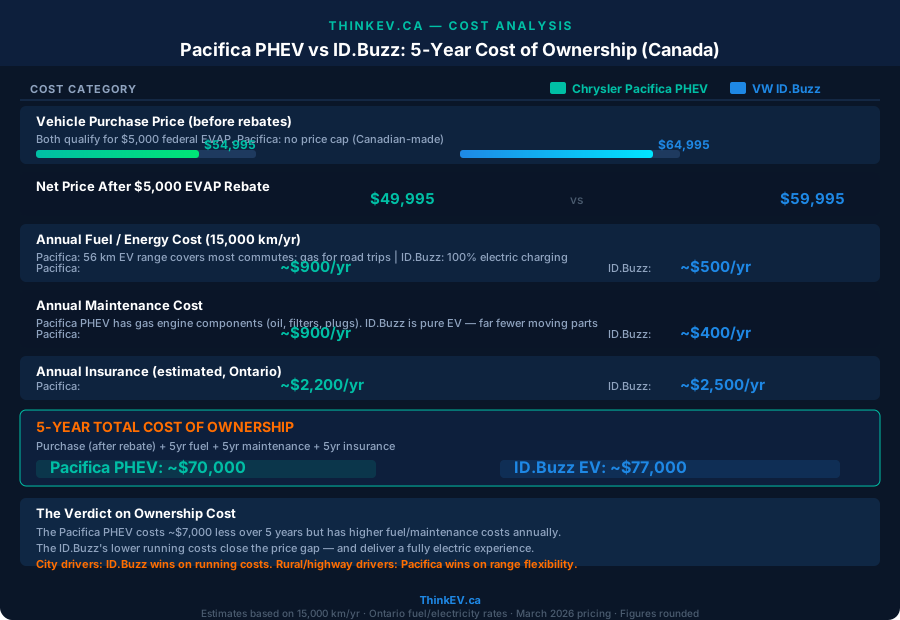
I want to build a five-year cost model that is honest about the assumptions, because most EV comparisons use assumptions that wildly favour whichever vehicle the author prefers.
Pacifica PHEV five-year model (Ontario owner, 20,000 km/year):
Purchase price after $5,000 federal EVAP: $49,995. Financing at current rates for 72 months adds approximately $18,000 in interest, bringing total vehicle cost to approximately $67,995 over the loan term. Annual fuel costs assuming 60 percent of driving is electric at $0.145/kWh (Ontario average TOU rate for overnight charging) and 40 percent gas at $1.55/litre: approximately $800 per year in electricity and $1,200 per year in fuel.
Annual combined energy cost: approximately $2,000. Over five years: $10,000 in energy. Insurance: approximately $2,400/year for a Pacifica Hybrid in Ontario suburban driving profile, or $12,000 over five years. Maintenance: a Pacifica PHEV requires regular oil changes (every 8,000 to 10,000 km since the engine runs infrequently, but it still runs), brake fluid, coolant, cabin air filters, and tyre rotations.
Estimated $800/year or $4,000 over five years. Total five-year cost of ownership: approximately $93,995.
ID.Buzz five-year model (Ontario owner, 20,000 km/year):
Purchase price after $5,000 federal EVAP: $59,995. Same financing terms: approximately $103,000 total over 72 months. Annual energy costs assuming full electric operation at $0.145/kWh: approximately $609 per year in electricity (the ID. Buzz is remarkably efficient at about 21 kWh/100 km (WLTP rated, real-world Canadian driving typically runs 24-26 kWh/100 km in mixed conditions)).
Over five years: $3,045 in energy. Insurance: approximately $2,700/year for a full BEV in Ontario at the ID. Buzz's value, or $13,500 over five years. Maintenance: BEV maintenance is minimal, no oil changes, no exhaust system, no transmission fluid. Budget approximately $400/year for tyres, brake fluid, cabin filter, and wiper blades, or $2,000 over five years. Total five-year cost of ownership: approximately $121,545.
The five-year gap is approximately $27,550 in favour of the Pacifica. That is a significant number. The ID.Buzz's lower ongoing energy and maintenance costs are real, but they do not overcome the purchase price premium over a five-year horizon. Over ten years, the gap narrows considerably, the ID.Buzz's maintenance cost advantage accumulates meaningfully over a decade, but most Canadian families cycle their family vehicles every five to seven years.
In Quebec, apply the additional $4,000 provincial credit to both vehicles equally, and the math does not change structurally. In BC, the SCRAP-IT program can add up to $6,000 on top of the federal credit for eligible trade-ins, and that does change the math somewhat if you are driving a particularly old or polluting trade-in. Run your specific numbers with the provincial government's calculator at nrcan.gc.ca.
Depreciation projections are inherently uncertain, but market data from 2023 to 2025 suggests that full BEVs are experiencing above-average depreciation in Canadian markets right now, driven by rapid battery technology improvement, price reductions from manufacturers on new models, and the still-maturing used EV market. PHEVs have held their value somewhat more stably because they serve a broader buyer pool (including those not yet ready for full EV transition). I would conservatively project the ID.Buzz to depreciate to approximately 45-50 percent of purchase price after five years, and the Pacifica PHEV to approximately 40-45 percent. These projections reduce the total cost gap but do not eliminate it.
One more cost dimension that the sticker prices entirely ignore: home charging installation. If you do not already have a Level 2 charger installed, budget $500-$1,500 for the installation of a dedicated 240V circuit and charger hardware. The Grizzl-E Classic or Smart are the best-value options in Canada. This cost applies to both vehicles.
THE DESIGN FACTOR: One of These Cars Turns Heads
I should not spend too many words on this because design preference is deeply personal, but I would be intellectually dishonest if I pretended the design conversation was equal between these two vehicles.
The VW ID. Buzz is one of the most visually striking production vehicles of the last decade. It takes the form language of the original 1950 VW Type 2 Microbus, the two-tone paint divided at the beltline, the rounded nose, the large glasshouse, the playful proportions, and updates it with modern EV design sensibility in a way that feels genuinely coherent rather than cynically nostalgic.
It turns heads in a way that almost no family vehicle has since the original PT Cruiser, but with about a thousand percent more credibility. In a parking lot full of black and grey crossovers and SUVs, the ID. Buzz is a visual event. Parents at school drop-off will comment on it. Strangers at Tim Hortons will photograph it. Owners regularly report strangers walking the long way across a parking lot to get a better look.
The Chrysler Pacifica is a handsome, well-proportioned minivan. It has the kind of design that communicates competence and refinement without demanding attention. If you passed one on the highway, you would identify it as a Pacifica, appreciate its clean lines, and continue your drive. This is not a criticism, most buyers of a family vehicle are not primarily purchasing it for its ability to cause parking lot photo opportunities. But the design difference is real, and if you care about how your vehicle looks, if you derive genuine pleasure from driving something that other people find beautiful, the ID.Buzz wins this dimension entirely.
The interior design philosophy extends the exterior story. The Pacifica's interior is conventional in the best sense: logical layout, comprehensible controls, materials quality that is appropriate for its price point, and an overall atmosphere that communicates "practical family vehicle designed by experienced professionals." The ID.Buzz interior is intentionally unusual. The horizontal dashboard layout, the large floating touchscreen, the two-tone upholstery patterns, the ambient lighting options, it is designed to make you feel like you are in something special. Whether you find that specialness worth a $10,000 premium over the Pacifica depends entirely on your personal relationship with your vehicle.
TECHNOLOGY: Software and Driver Assistance
Both vehicles offer modern driver assistance packages, but the implementation philosophies differ in ways that will matter to your daily experience.
The VW ID. Buzz runs on VW's latest MEB software platform, which provides over-the-air software updates, meaning the car can gain new features and capability improvements after you buy it. Travel Assist, which combines adaptive cruise control with active lane centering, functions continuously up to highway speeds and is one of the better semi-autonomous driving systems available in a non-luxury vehicle.
The ID. Buzz also supports V2G (vehicle-to-grid) capability in markets where the infrastructure exists, with Canadian rollout anticipated in 2026 and 2027 in select cities. If V2G becomes widely available, the ID. Buzz's large battery pack becomes an energy storage asset that can push electricity back to your home during peak demand periods, potentially creating meaningful electricity bill savings.
The Pacifica PHEV runs Stellantis's Uconnect 5 infotainment platform, which I consider to be among the better implementations of an in-vehicle touchscreen system in the industry. The physical layout retains some physical controls, volume knob, climate shortcut buttons, a physical gear selector, that make common tasks executable without looking away from the road. Wireless CarPlay and Android Auto work reliably. The Uconnect 5 system does not support over-the-air powertrain updates to the same depth as the VW platform, though it does receive software patches for the infotainment system.
Safety technology comparison: both offer the full suite of active safety features at similar performance levels. The Insurance Institute for Highway Safety has rated both vehicles in the Top Safety Pick or better category. The ID.Buzz adds a more sophisticated park assist system and a reversing camera with better resolution than the Pacifica's equivalent system. The Pacifica's rearview camera with integrated guidelines is excellent, and its 360-degree surround view option (available on higher trims) is useful in urban parking situations. For families with young children who will inevitably run behind the vehicle at inopportune moments, both cameras are more than adequate, but the surround view on the Pacifica is superior to anything the ID.Buzz offers in that specific category.
WHO BUYS WHICH: The Profile Question
After everything I have described, I want to get concrete about the buyer profiles, because I think this is ultimately more useful than a ranked verdict.
The Pacifica PHEV is the correct choice if most of the following apply to you:
You live outside of Canada's three or four largest metro areas, or in a part of those cities where public DCFC coverage is incomplete. You regularly make trips exceeding 300 kilometres, to visit family, go camping, ski trips, summer cottage runs. You have inconsistent access to charging away from home. You have children old enough to understand the cargo reconfiguration system or frequently need maximum cargo space quickly. You are pragmatic about transportation and view your family vehicle primarily as a tool rather than a lifestyle statement. You want to reduce your daily emissions, the Pacifica PHEV on electric power emits nothing, without betting your family transportation entirely on infrastructure you do not control.
The ID.Buzz is the correct choice if most of the following apply:
You live in Vancouver, Metro Toronto, Greater Montreal, or Ottawa-Gatineau, with reliable access to home charging. Your typical daily driving is under 250 kilometres and your road trips can be planned around DCFC stops, ideally on routes with established charging networks. You have a garage or dedicated charging point at your home. You care about design and driving character and derive real satisfaction from being in a vehicle that is also a piece of design. You want zero tailpipe emissions and are willing to manage your transportation planning accordingly. You can absorb the $10,000 purchase price premium. You value the V2G potential as energy storage infrastructure becomes more accessible in your area.
Neither profile is obviously better. Both represent legitimate ways for a Canadian family to reduce their transportation emissions while maintaining the practicality that minivans exist to provide.
Related Reading
- VW ID.4 vs Chevy Equinox EV: One Clear Winner for Canadian Families
- VW ID.Buzz Canada Review 2026: The Electric Microbus Family Hauler That Actually Delivers
- BMW i4 vs Tesla Model 3: Is the $11K Luxury Premium Actually Worth It?
FAQ
THE VERDICT
I do not believe in single-sentence verdicts for decisions this consequential, but if I had to declare a winner for the median Canadian family, the family that lives in a medium-sized city, drives 40 to 60 kilometres per day, owns their home with a garage, takes three or four road trips per year of 300 to 600 kilometres each, and has a total family transportation budget that makes them sensitive to the $10,000 price difference, the Chrysler Pacifica PHEV is the correct choice right now. Not by a huge margin, not for every use case, and not in every Canadian province's incentive structure. But for the median case, yes.
Here is the logic in its plainest form: the Pacifica PHEV delivers electric driving for the vast majority of your actual daily travel, charges in two hours at home overnight, costs $10,000 less to purchase, accumulates lower five-year total ownership costs, and eliminates the infrastructure dependency anxiety that is still legitimate in substantial portions of this country. It does all of this without the owner having to change their driving habits at all for the trips where the gas engine is better. That is a remarkably complete transportation solution for 2026.
The ID.Buzz is the right choice for a specific and growing subset of Canadian families: urban, city-resident, home-charging capable, comfort with trip planning, aesthetically engaged, willing to absorb the premium for a vehicle that they find beautiful and that delivers a pure-EV driving experience they value. For that buyer, the ID.Buzz is not merely acceptable, it is the clearly superior vehicle in every dimension except the purchase price and the infrastructure dependency.
Canada's charging infrastructure will continue improving. Battery technology will continue improving. The federal government will continue adjusting rebate structures to encourage BEV adoption. In three to five years, the argument for the ID.Buzz may become so overwhelming that the Pacifica's hybrid architecture looks dated. But we are buying in 2026, with the infrastructure that exists now, in the country we actually live in. And for most of that country right now, the Pacifica PHEV is the electrified minivan that works without asking you to work around it.
The ID.Buzz is the more exciting, more beautiful vehicle with a clear design identity. The Pacifica is the one that will serve more Canadian families more reliably right now. Both statements are true, and which matters more depends entirely on you.
For related reading: VW ID.Buzz Canada Full Review covers the ID.Buzz in much more depth. Best Level 2 EV Chargers in Canada 2026 covers home charging hardware for both vehicles. And our EV Incentives by Province guide has been updated with all 2026 provincial stacking rules.
Gear worth having
As an Amazon Associate, ThinkEV earns a small commission from qualifying purchases — at no extra cost to you.

WixGear Magnetic Air Vent Phone Mount (2-Pack)
A magnet strong enough that your phone never flinches over potholes or rail crossings. Two in the box, one for each car.
As an Amazon Associate, ThinkEV earns from qualifying purchases — at no extra cost to you.
ONE MORE THING: The Emotional Factor
I want to add something that five-year cost models and range calculations cannot capture, because it is real and it matters to how happy you will be with your purchase two years from now.
Owning the ID. Buzz is a different experience from owning the Pacifica. Not better or worse in every dimension, just different in a way that the numbers do not capture. Every time you park the ID. Buzz and look back at it from across the parking lot, there is a small moment of pride that is uncommon in the family vehicle space. The thing is beautiful. It is the kind of vehicle that your children will remember.
Kids who grow up in an ID. Buzz have a story, "we had the retro electric van", that distinguishes it from the seventeen other crossovers in their elementary school's parent drop-off line. I am not suggesting that aesthetic pleasure justifies ten thousand dollars. But I am acknowledging that it exists, that it is real, and that for some families it is a legitimate part of the ownership calculation.
The Pacifica PHEV does not generate that feeling. It generates a different one: satisfaction. The deep, quiet satisfaction of a well-engineered tool doing exactly what it was designed to do. When you pull into your garage at the end of a long day, plug in in sixty seconds, and know that tomorrow morning you will leave with a full charge and four hundred dollars per year less in fuel costs than your neighbour with the same vehicle but without the plug, that is its own kind of reward. The Pacifica PHEV is the kind of vehicle that rewards pragmatism. The ID.Buzz is the kind that rewards aspiration. Neither motivation is frivolous.
Canada's minivan market is changing fast. Just two electrified options exist today, but Toyota's rumoured Sienna BEV, the potential for a Kia Carnival PHEV, and Honda's stated commitment to electrifying its Canadian lineup all suggest that this comparison will look very different in twenty-four months. If you can wait, if your current vehicle is not yet at the point where it demands replacement, waiting eighteen to twenty-four months before making this decision might surface significantly better options. But if your current minivan has 250,000 kilometres on it and is beginning to feel like a liability rather than an asset, the Pacifica PHEV or ID.Buzz will serve you well today. Do not let perfect be the enemy of very good.
Both of these vehicles represent a genuine step forward for Canadian family transportation. The emissions reduction from running a Pacifica PHEV primarily on electricity in a province with clean grid power, Quebec, BC, Manitoba, Ontario off-peak, is substantial and real. The zero-emission operation of the ID. Buzz is complete and unambiguous. Every electrified minivan sold in Canada is a fossil-fuel minivan that was not sold, and the cumulative effect of that across an entire generation of family vehicles will matter more to the country's emissions trajectory than any single policy announcement.
These are not perfect vehicles. But they are pointing in the right direction, and they are doing so in a format, the seven-seat family hauler, that Canadian families have depended on for forty years. That is worth something. That might, depending on your values, be worth quite a lot.
Gear worth having
As an Amazon Associate, ThinkEV earns a small commission from qualifying purchases — at no extra cost to you.
NOCO Boost Plus GB40 Jump Starter
A 1000A lithium jump starter that fits in your glovebox and works on any 12V battery. Your insurance against a dead 12V in a parking lot.
As an Amazon Associate, ThinkEV earns from qualifying purchases — at no extra cost to you.

Founder & Chief Editor
Vlad Pereira is the founder and chief editor of ThinkEV.ca, the Canadian electric-vehicle publication he writes and edits from Courtenay, British Columbia. He covers EV pricing, federal and provincial rebates, charging costs, and the Chinese manufacturers now entering Canada, from the buyer's side rather than the press-fleet side. ThinkEV is a venture of Vlad Pereira Online; his writing on health, income and the long game lives at vladpereira.com.
Frequently asked questions
Does the Chrysler Pacifica PHEV qualify for the federal $5,000 EVAP rebate in Canada?
What is the real-world range of the VW ID.Buzz in Canadian winters?
Can the Chrysler Pacifica PHEV be driven in electric-only mode at all times?
Does the Pacifica PHEV have the same Stow 'n Go seats as the regular Pacifica?
How does the VW ID.Buzz compare to the Chrysler Pacifica PHEV on long road trips?
What home charger should I install for the Pacifica PHEV vs the ID.Buzz?
Which vehicle has lower five-year maintenance costs in Canada?
Is the VW ID.Buzz available with all-wheel drive in Canada?
More EV & road-trip finds
Affordable upgrades worth a look — tap any to check the price on Amazon.
 ★ 119
★ 119Foldable Waterproof Trunk Organizer
View on Amazon ★ 392
★ 392Large Cup Holder Adapter (32-40oz)
View on Amazon ★ 8,681
Chemical Guys Complete Car Wash Kit
View on Amazon ★ 55
★ 55LED Car Door Logo Projector Light
View on Amazon ★ 546
★ 546Funny Headrest Face Covers (2-Pack)
View on Amazon ★ 979
★ 979Leather Headrest Purse Hook
View on Amazon ★ 721
★ 72145W USB-C Fast Car Charger
View on Amazon ★ 61
★ 61Toddler Car Seat Snack and Cup Tray
View on AmazonRead, Plan, Then Stay Current
Explore our expert articles to understand incentives and ownership costs, use the map to pressure-test charging reality, then subscribe so new EV coverage comes straight to you.
Continue Reading
Why Legacy Automakers Keep Losing to Chinese EV Brands
Import a Chinese EV Canada to US: Why It Fails
Why Tesla Is Losing Canada With the World's Top EV
EV Market Under $50K in Canada: Why This Price Band Matters
BYD Canada Lineup: The Four Models Coming First