Key takeaways
- The Rivian R2 supports DC fast charging up to 200 kW, reaching 10–80% on the standard battery in about 23 minutes.
- Its frunk holds about 330 litres, roughly triple the Tesla Model Y's, plus a through-body gear tunnel reachable from either side.
- At -10°C to -20°C the R2 Standard's real-world range is an estimated 264–312 km, easing to about 240–264 km in -30°C Prairie cold.
- Ground clearance runs 216 mm standard and 295 mm with the air suspension raised, versus 165 mm for the Model Y, and it tows a confirmed 1,588 kg.
- As of early 2026 Rivian has only five Canadian service centres, Toronto, Vancouver, Montreal, Calgary, and Ottawa, with nothing yet in Edmonton, Saskatoon, or Thunder Bay.
Rivian has been operating in an uncomfortable place for the past three years: building excellent electric trucks and SUVs that most Canadians will never buy. The R1T starts at around $89,900. The R1S starts at around $87,000. Both are capable, well-built machines with real adventure credentials, but they are luxury products, if your household income isn't in the top quartile, a Rivian wasn't in your driveway. That's not a brand built for volume. That's a niche product with terrific PR.
The R2 changes the equation. Not completely, not overnight, but materially. Starting somewhere in the $57,000 to $66,000 CAD range depending on configuration, the R2 is Rivian's first real attempt at the mid-tier EV market, the segment where Tesla's Model Y, Ford's Mustang Mach-E, and Hyundai's Ioniq 5 have been fighting for supremacy for years. Rivian is arriving late to this fight. But it's arriving with credentials that none of its competitors have: a proven platform, real off-road capability, and a brand identity that resonates with the outdoor-active demographic that Canada has in abundance.
This isn't just a smaller, cheaper R1S. That framing undersells what Rivian has done with the R2. Yes, it shares the R1 platform's foundational architecture. Yes, it's shorter, lighter, and less powerful than its siblings. But the R2 was engineered from the outset to operate on a different cost structure, built at a new dedicated facility in Normal, Illinois rather than being slotted alongside the R1 on an existing line. That matters for quality, for production volume, and for long-term pricing stability.
For Canadian buyers, the R2 arrives in a market that has specific needs: cold weather range, AWD capability, charging infrastructure outside the Tesla ecosystem, and enough cargo space for a real life. I've spent considerable time working through every available spec, every confirmed detail, and every meaningful comparison to understand whether the R2 delivers on those needs or whether it's a compromise too far. Here's what the data actually says.
Why the R2 Exists: The Strategic Play
Rivian didn't build the R2 because it felt like it. It built the R2 because the financial picture demanded it.
The company went public in 2021 at a valuation that made mainstream automakers nervous. Then reality set in: low production volume, high per-unit cost, and a customer base too narrow to support the capital investment the company had made. The R1T and R1S are remarkable vehicles, but they were never going to fund a company at scale on their own. Rivian needed volume. Volume requires lower prices. Lower prices require a smaller, cheaper vehicle built on a leaner manufacturing foundation.
The R2 is that vehicle. But Rivian's approach to building it says something important about the company's engineering culture: rather than stripping back the R1 and calling the result affordable, Rivian engineered the R2 to be a platform in its own right. The reduced sticker price comes from size, manufacturing efficiency, and fewer luxury appointments, not from cutting corners on fundamentals like chassis rigidity, battery chemistry, or thermal management.
That distinction matters enormously for Canadian buyers. A stripped-back version of a $87,000 truck that's been value-engineered to hit $57,000 is a different product than a vehicle purpose-built at that price point with its own manufacturing economics. The R2 is the latter.
There's also a strategic context specific to the Canadian market. Rivian's service network, currently limited to five major cities, will face real pressure as R2 volume ramps. More on this in the service section below.
What We Know: Specs and Confirmed Details
Rivian has been more forthcoming with R2 specs than most automakers manage for pre-production vehicles, and what they've confirmed paints a clear picture of where this vehicle lives.
Dimensions: The R2 sits at approximately 4,770 mm long, meaningfully shorter than the R1S at 4,945 mm, and just slightly longer than a Tesla Model Y at 4,750 mm. Width comes in around 1,935 mm, which puts it in the same lane as most mainstream compact SUVs. Ground clearance is listed at 216 mm in its standard setting, rising to 295 mm with the air suspension raised. For comparison, a Tesla Model Y has 165 mm of ground clearance. The R2 is not going to feel like a truck on Canadian roads, but it's also not going to ground out on a logging road the way a Model Y would.
Battery and range: Two configurations appear to be on the way. A standard battery estimated at approximately 65 kWh and a larger pack in the 80-85 kWh range for the higher trim. Estimated ranges sit at approximately 480 km for the standard configuration and 530+ km for the larger pack on a summer NRCan-equivalent cycle. Real-world Canadian winter range will be lower, more on that in the dedicated winter section.
Powertrain options: The R2 will launch with two variants: a rear-wheel drive single-motor configuration and an all-wheel drive dual-motor version. The AWD system uses motors at both axles, consistent with the R1's architecture, and will include torque vectoring between the rear wheels. The RWD version is the price-entry point; the AWD is what most Canadian buyers will want and should buy.
Charging: Rivian equipped the R2 with a North American Charging Standard (NACS) connector, which means it has access to Tesla's Supercharger network in addition to every CCS station in Canada via an adapter. Peak DC fast charging is rated at up to 200 kW. At that rate, a 10-to-80% charge on the standard battery takes approximately 23 minutes under optimal conditions. Level 2 AC charging is supported up to 11.5 kW.
Frunk and cargo: This is where Rivian's architectural philosophy shows up clearly. The R2 has a front trunk, a frunk, with approximately 330 litres of usable space. That's not an afterthought; that's a properly designed storage area. Total cargo volume with the rear seats folded is estimated at approximately 1,100 litres. For a vehicle in this size class, that's generous. The Model Y manages around 854 litres. The Mach-E offers approximately 1,420 litres with seats down, though at the expense of frunk space.
Tow rating: Confirmed at 1,588 kg (3,500 lbs). Not a truck-class number, but appropriate for a compact SUV and sufficient for a small travel trailer, a boat, or a loaded utility trailer, the actual use cases for most Canadian buyers who say they need towing capacity.
Gear tunnel: Rivian included a version of the gear tunnel concept from the R1T, adapted for the R2's form factor. The through-body storage tunnel accessible from either rear side provides weatherproof, lockable storage that's separate from the cargo area. It's a small feature with outsized utility for anyone who carries equipment they don't want loose in the cabin.
Size and Where It Fits
Compact SUV is the correct classification for the R2, but the segment category alone doesn't capture where it lands in practice.
Park it next to a Tesla Model Y and you're looking at nearly identical exterior footprints, the R2 is roughly 20 mm longer and about 60 mm wider. They'll occupy the same parking space. They have similar silhouettes. But the R2 sits visibly higher, has more aggressive terrain-capable cladding, and has a presence that reads as more purposeful than the Model Y's smooth, aerodynamically optimised shape. They're not the same vehicle category wearing different clothes.
The Hyundai Ioniq 5 makes for a more apt comparison in terms of the buyer they're both targeting. Both offer approximately the same range. Both have serious AWD capability. Both sit above the "basic EV" price floor and below the luxury tier. The Ioniq 5 is a better urban commuter with sharper interior design and a flatter floor. The R2 is a more capable off-pavement vehicle with more cargo versatility and, frankly, better brand energy for the outdoor-active demographic.
That brand energy matters in Canada. Rivian has cultivated an identity around adventure, outdoor recreation, and an active lifestyle that resonates strongly in British Columbia, Alberta, and rural Ontario in ways that a Korean automaker's product simply doesn't. This isn't about objective quality, Hyundai's engineering is excellent. It's about whether a vehicle fits how buyers see themselves, and for a meaningful slice of the Canadian market, a Rivian feels like the right answer in a way that few other EVs do.
In urban markets, Toronto, Vancouver, Montreal, the R2's size is manageable. It's not a small car by any measure, but it's not the brick that the R1S is either. Underground parking structures that the R1S can't enter won't be a problem. Tight city streets that make an F-150 Lightning feel comically oversized won't be a problem. The R2 is a city-capable compact SUV that can do genuine light off-road work and not feel apologetic about either use.
Pricing: The Picture
Rivian's confirmed starting price for the R2 in the US is $45,000 USD. In Canadian dollars at current exchange rates, that translates to approximately $63,000 CAD before any adjustments. The actual Canadian MSRP will be set closer to launch, and Canadian prices for American-manufactured vehicles typically land higher than direct currency conversion suggests once import duties, transport costs, and market adjustments are factored in.
The realistic Canadian price range:
- R2 Standard (RWD, standard battery): approximately $57,000–$61,000 CAD
- R2 Dual Motor AWD (larger battery): approximately $63,000–$68,000 CAD
- Potential Adventure Package upgrade: $3,000–$5,000 estimated
The federal iZEV/EVAP rebate applies to vehicles under $55,000 for passenger vehicles, $60,000 for SUVs and trucks, before the $5,000 federal rebate is eliminated. At $57,000–$61,000, the R2 Standard sits right at the edge. Whether Rivian prices it to qualify will be a deliberate strategic decision, a $59,990 Canadian price on the base config would qualify buyers for the $5,000 federal rebate, dropping the effective price to $54,990. That's a meaningful move.
Provincial incentives add further complexity:
- British Columbia: CleanBC GO Electric program offers up to $4,000 on qualifying vehicles. If the R2 Standard qualifies, effective price could drop to approximately $50,000–$51,000 with both federal and provincial incentives stacked.
- Quebec: Roulez vert program offers up to $4,000. Quebec has been the strongest EV adoption market in Canada, and Rivian will need a compelling Quebec presence.
- Ontario: Zero provincial incentives under the current government. Ontario buyers are on full-sticker reality.
- Alberta: No provincial EV incentives. Same full-sticker reality.
The comparison grid: Tesla Model Y Long Range AWD comes in at approximately $59,990 CAD and does not qualify for federal rebates (exceeds the $50,000 EVAP cap). Ford Mustang Mach-E Select RWD starts at $44,690 CAD and qualifies for the $5,000 EVAP rebate. Hyundai Ioniq 5 starts at around $49,999 and qualifies. Kia EV6 LIGHT RWD at $48,995 qualifies. The R2's pricing, if managed carefully, puts it squarely in this tier, competing on equal incentive footing with established rivals.
What the R2 doesn't have to apologise for on price is what you get at that price: genuine AWD capability, significant off-road clearance, a frunk, a gear tunnel, and Rivian's software platform. The Model Y at $60,000 doesn't have a frunk of consequence, has no off-road pretension, and doesn't have Rivian's outdoorsy feature set. The Mach-E Select RWD at $44,690 is competent but derivative. The Ioniq 5 is excellent but urban-focused. The R2 is the most practical vehicle in this price tier for buyers who need more than a commuter.
Gear worth having
As an Amazon Associate, ThinkEV earns a small commission from qualifying purchases — at no extra cost to you.

Grizzl-E Classic Level 2 EV Charger (40A)
Canadian-made and rated for minus 40C winters. 40A / 9.6 kW, NEMA 14-50, indoor/outdoor, 24-ft cable. The charger built for Canadian weather.
As an Amazon Associate, ThinkEV earns from qualifying purchases — at no extra cost to you.
The R1 Platform Advantage
One of the most significant things Rivian did when designing the R2 was refuse to build it from scratch. The R2 shares its fundamental platform architecture with the R1T and R1S: the same multi-motor layout philosophy, the same skateboard battery platform concept, the same proprietary software stack.
That's a massive head start for a vehicle that had to be engineered to a new cost point. Starting from a proven platform means Rivian already knows what the suspension geometry does under load, how the thermal management system behaves in extreme cold, how the software handles wheel-speed management across four independent motors. They didn't have to learn those lessons again. They brought the answers to the R2's design from day one.
The R2's chassis is narrower and shorter than the R1's, which required real engineering work to adapt the architecture rather than simply scaling it down. The suspension geometry was re-tuned for the R2's lower weight and different weight distribution. The battery pack was redesigned for the R2's smaller floor footprint. But the foundational systems, the motor technology, the power electronics, the software architecture, are all descended from production-proven R1 hardware.
For Canadian buyers, this matters most in the context of cold weather reliability. The R1T and R1S have accumulated real-world data across Canadian winter conditions over three years of ownership. That data has fed back into software updates that improved battery preconditioning, thermal management efficiency, and cold-start range. The R2 benefits from all of that learning without having to repeat the painful early-owner experience.
The shared platform also means that Rivian's service network, already familiar with R1 hardware, can service the R2 without extensive retraining. Parts overlap between R1 and R2 reduces service costs and improves parts availability. For a brand with a still-developing service footprint in Canada, this is a practical advantage that's easy to overlook.
Design: The Rivian Language in a Smaller Body
Rivian's design language is unmistakable, and the R2 carries it well. The squared-off headlights connected by the full-width LED light bar. The flat hood. The aggressive front bumper with functional tow points. The flared wheel arches. The minimal body creases that emphasise proportion over complexity. All of it translates from the R1 into the R2's smaller body without looking like a compressed copy.
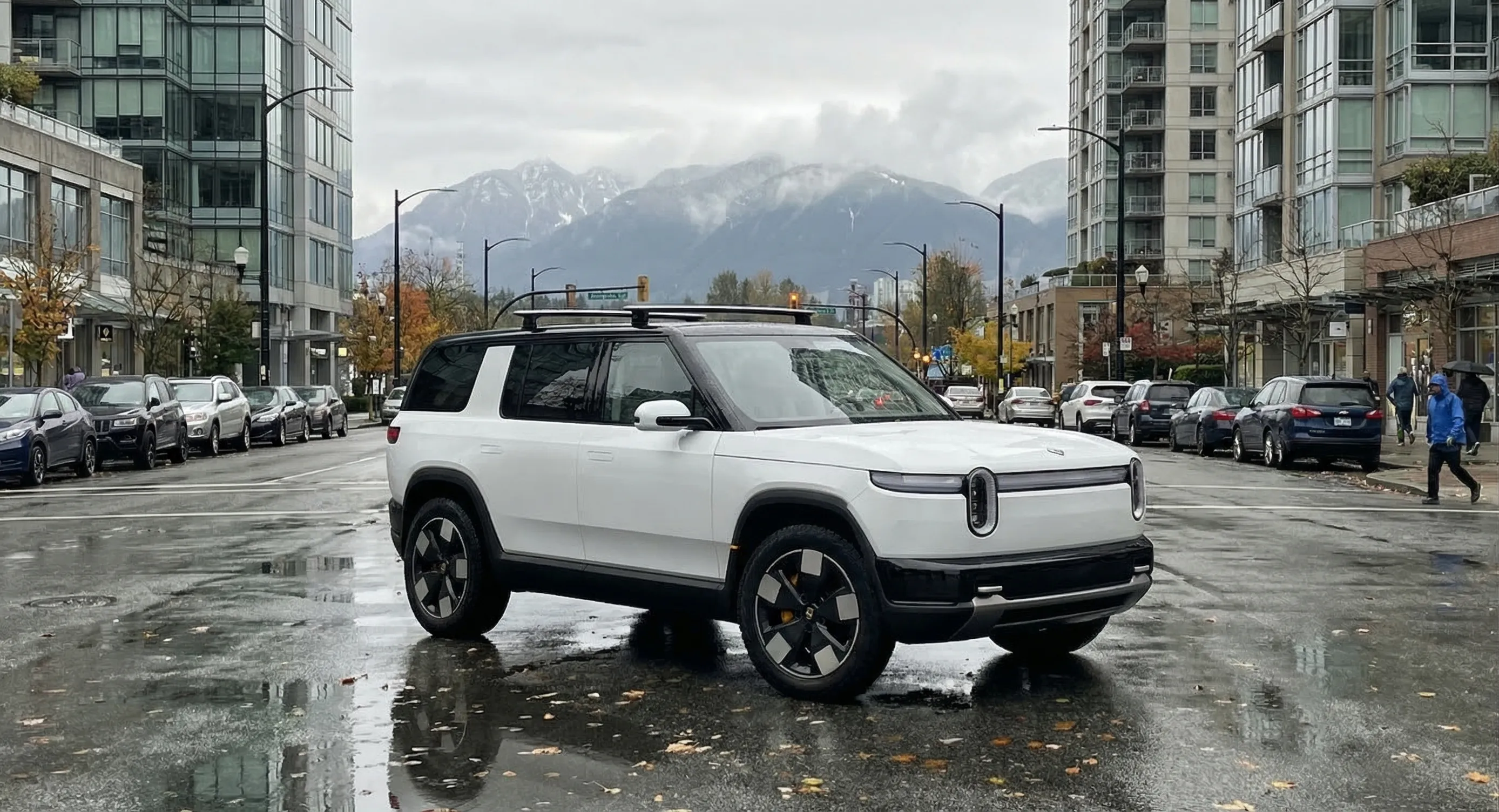
The front fascia is notably cleaner than the R1's. The R2 loses some of the R1's aggressive cladding in the interest of slightly better aerodynamics, remember, this is a vehicle that needs to extract maximum range from a smaller battery, and aerodynamic drag at highway speeds is the single largest determinant of range. Rivian reportedly targeted a drag coefficient around 0.30 Cd, which is higher than Tesla's obsessively optimised vehicles but reasonable for a vehicle with this much vertical surface and genuine off-road clearance.
The interior takes a different direction than the R1's and that's intentional. The R2 is not trying to be a smaller R1S. Where the R1S offers available premium materials and a truck-scale dashboard, the R2 takes a cleaner, more functional approach. The central touchscreen is a large portrait-orientation display, Rivian has shifted from widescreen to portrait format for the R2, a sensible change that concentrates information in a natural eye-line position. The driver gets a full digital instrument cluster. The overall impression is a clean, well-organised cabin that doesn't try to impress you with material opulence but doesn't feel plasticky or budget-constrained either.
Rivian made a decision that reflects how they understand their buyer: the R2 retains physical controls for the most frequently used functions. Volume knob. Climate controls you can reach without looking at a screen. This is a direct contrast to Tesla's all-screen philosophy, and it's the right call for a vehicle that people will use in winter while wearing gloves, or while working through rough terrain with their eyes on the trail ahead. Practicality over minimalism.
Seat options will include fabric and a synthetic material Rivian calls "Forest Edge", no animal leather is available, consistent with Rivian's stated sustainability commitments. Colour options include a set of choices that skew toward muted, earthy tones that align with the outdoor brand identity. Limestone, Glacier White, Midnight Black, and Rivian Green are expected to be among the Canadian launch colours.
Roof options are important for Canadian buyers: a panoramic glass roof is expected to be available, with a solid roof for those who prioritise structural rigidity or heat management. In Canada's varied climate, baking summers in the Prairies, blinding sun on BC mountain roads, -40°C Prairie winters, the choice of roof configuration is a legitimate decision, not just aesthetics.
Range: What the Numbers Mean in Canada
Range claims from automakers are optimistic by design. The testing cycles they're measured on, whether it's WLTP, EPA, or the NRCan-equivalent mixed cycle, don't fully replicate the conditions Canadian drivers actually face. Let's translate the estimated 480–530 km summer rating into something useful.
Summer conditions (15–25°C, mixed city-highway): Expect approximately 85–90% of rated range in real-world mixed driving. That's 408–450 km for the standard configuration and 450–477 km for the larger pack. Both are more than sufficient for every common Canadian inter-city route. Toronto to Ottawa is 450 km, doable on a single charge in summer in the larger pack, requiring one charge stop in the standard configuration if you're not starting fully charged.
Fall/spring shoulder season (0–10°C): Range drops to approximately 75–80% of rated. That's 360–400 km for the standard, 400–424 km for the larger pack. Still completely workable for daily use and most weekend trips.
Winter conditions (-10 to -20°C): This is the real test. Cold weather reduces battery efficiency significantly, reduced electrolyte conductivity, additional energy draw from cabin heating, and increased rolling resistance from winter tires all contribute. Expect approximately 55–65% of rated range at sustained cold temperatures. For the standard configuration, that's 264–312 km. For the larger pack, approximately 291–344 km. At -30°C in a Prairie winter, the numbers compress further, roughly 50–55% of rated range, putting the standard pack at 240–264 km.
Those winter numbers need context. The average Canadian commute is approximately 26 km each way, 52 km round trip. Even the standard R2's worst-case winter range of 240 km covers nearly five days of that commute. With home charging every night or every other night, winter range is not a problem for the majority of Canadian drivers. It becomes a planning consideration for long-distance winter road trips, Edmonton to Calgary (300 km), Toronto to Kingston (262 km), where a charging stop may be needed in severe cold that wouldn't be necessary in summer.
Heat pump: Rivian's R2 is confirmed to include a heat pump for cabin heating, which is the single most important feature for cold-weather range preservation. A heat pump can be two to three times more efficient than resistive heating in moderate cold. At -15°C, the heat pump makes a meaningful difference. At -35°C, when heat pumps lose effectiveness and supplemental resistive heating kicks in, the gap narrows. But for the vast majority of Canadian winter driving, the cold but not extreme temperatures that define most of a Canadian winter below 40°N latitude, the heat pump delivers real range savings.
Battery preconditioning: Rivian's app allows you to schedule the R2 to precondition the battery and cabin before your departure time, using grid power rather than battery power. In winter, preconditioned batteries perform significantly better on first-kilometre range and charging speed. This is not optional in a Prairie winter, it's a standard part of the ownership routine, and the R2's implementation of it will directly affect the winter ownership experience.
Charging: The NACS Advantage
The R2's adoption of the NACS (North American Charging Standard) connector is one of the most consequential decisions Rivian made. It means the R2 has access to Tesla's Supercharger network, over 800 stalls across Canada at last count, with continuous expansion along every major travel corridor.
For a CCS-only vehicle like the BMW i4 or an older Hyundai Ioniq 5, cross-country travel in Canada requires careful planning around Electrify Canada, Petro-Canada, and various regional networks, all of which have reliability records that range from "adequate" to "genuinely frustrating." Superchargers are different. They work. Consistently, reliably, at the advertised speed.
The R2's peak DC charging rate is up to 200 kW. On a 350 kW Electrify Canada station, it will draw that full 200 kW (network permitting). On a Supercharger station, it will draw whatever Supercharger V3 hardware can provide, typically 250 kW for Tesla's own vehicles, but third-party vehicles on the network often see somewhat reduced rates due to hardware handshake constraints. The practical result: expect 150–180 kW sustained on most Supercharger stations, which still delivers a 10-to-80% charge on the standard battery in approximately 25–30 minutes. That's competitive.
For context:
- Tesla Model Y LR on Supercharger: peak ~170 kW, 10–80% in approximately 25 minutes
- Ford Mustang Mach-E on CCS: peak 150 kW, 10–80% in approximately 38 minutes
- Hyundai Ioniq 5 on CCS: peak 240 kW (800V), 10–80% in approximately 18 minutes
The Ioniq 5's 800V architecture gives it a genuine charging speed advantage over the R2's 400V system. That gap matters if you're doing multiple long charging stops per day. It matters less for the occasional road trip with one or two planned charging stops.
Home charging: Level 2 charging at 11.5 kW adds approximately 55–60 km of range per hour. For the standard battery at approximately 65 kWh, a full charge from near-empty takes about 6–7 hours, plug in after dinner, fully charged by 1 AM. Monthly home charging costs are entirely manageable:
- British Columbia (BC Hydro, Step 1 rate ~$0.10/kWh): approximately $35–$45/month for average driving
- Ontario (off-peak TOU ~$0.076/kWh): approximately $28–$38/month
- Quebec (Hydro-Québec ~$0.075/kWh): approximately $27–$36/month
- Alberta (regulated rate ~$0.15/kWh): approximately $50–$65/month
A good Level 2 home charger is the single highest-return investment an EV owner makes. The Grizzl-E Classic Level 2 charger handles Canadian winters reliably, is rated for outdoor installation, and is built for the -40°C conditions that a Prairie installation might see. Plan for $800–$1,200 installed. Every dollar of that pays back in charging convenience.
Gear worth having
As an Amazon Associate, ThinkEV earns a small commission from qualifying purchases — at no extra cost to you.
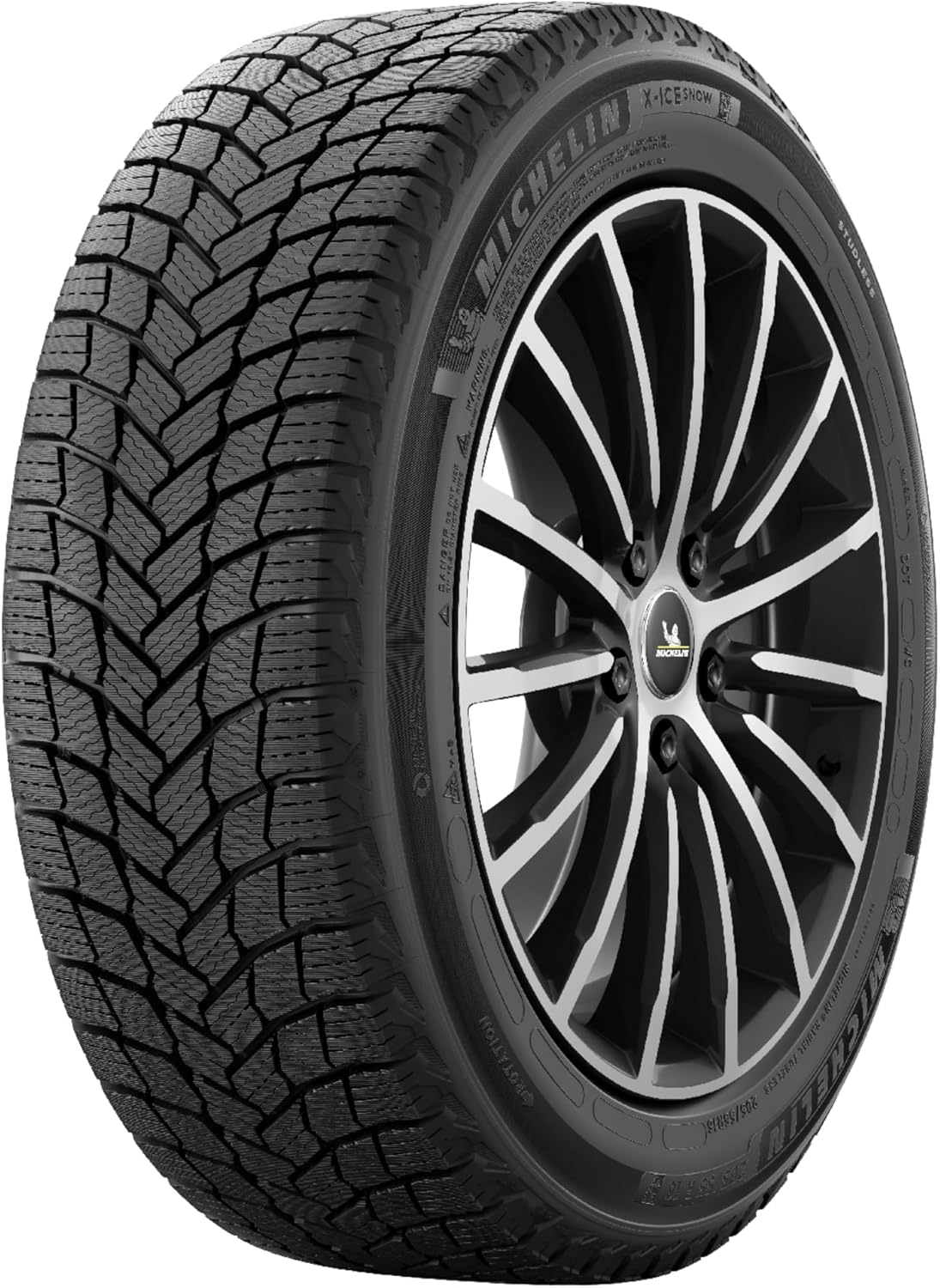
Michelin X-Ice Snow Tires (EV-rated)
EV-specific winter tires with low rolling resistance that recover up to 15 percent of cold-weather range. Mandatory in Quebec, smart everywhere else.
As an Amazon Associate, ThinkEV earns from qualifying purchases — at no extra cost to you.
Winter Performance: The Real Test
Winter performance in Canada is not a feature, it's a qualification test. A vehicle that doesn't work in a Canadian winter doesn't work in Canada. Let me be specific about what the R2 will need to demonstrate.
AWD as the correct configuration: The R2 RWD will struggle in serious winter conditions. Rear-wheel drive and Canadian winters are an awkward combination, manageable with excellent winter tires, but why accept the limitation when the AWD variant provides real security? The dual-motor AWD configuration with independent motor control at each axle enables torque vectoring that no mechanical differential can match. On an icy intersection or a snow-covered off-ramp, the computer can redistribute torque to the wheel with traction in milliseconds. Buy the AWD.
Winter tires are mandatory: No all-season tire performs adequately in Canadian winter conditions. The R2's 21-inch or 22-inch standard wheels mean winter tire sets will carry a real cost, budget $1,200–$1,800 for a quality set of steel wheels and winter tires in appropriate sizes. Steel wheels are preferable to alloys for winter use; corrosion protection and lower replacement cost if you scrape a curb on a snowy street. Michelin X-Ice, Bridgestone Blizzak, and Continental VikingContact are the correct answers in this size range.
Gear worth having
As an Amazon Associate, ThinkEV earns a small commission from qualifying purchases — at no extra cost to you.

PULIDIKI Car Cleaning Gel (Detailing Putty)
Press it into vents, buttons, and seams and it lifts out dust you did not know was there. Weirdly satisfying, genuinely useful.
As an Amazon Associate, ThinkEV earns from qualifying purchases — at no extra cost to you.
Ground clearance advantage: The R2's 216 mm standard ground clearance (295 mm raised) is a genuine functional advantage in Canadian winter. It's the difference between clearing a freshly plowed snowbank at a driveway entrance versus bottoming out. It's the difference between reaching a parking spot at the back of an unplowed lot versus stopping at the entrance. For Canadians outside the main urban centres, anyone doing a regular rural drive, anyone with a driveway that doesn't get immediate plowing attention, this matters on a regular basis.
Battery cold soak management: A battery that sits outside overnight at -25°C in a Winnipeg January needs active management before it will accept a fast charge or deliver full performance. The R2's battery thermal management system should handle this competently, Rivian's R1 platform has been battle-tested in Prairie winters and the R2 inherits that thermal management architecture. Still: plug in the car when you park it. Winter charging is partly about adding range, but it's also about keeping the battery in its thermal operating window. An R2 left unplugged overnight at -30°C will wake up cold, slow, and unwilling to charge quickly. Five minutes of forethought prevents a lot of frustration.
Precondition aggressively: Use the Rivian app to set a departure time and let the car precondition for 30–45 minutes before you need it. You're using grid power to warm the battery and cabin, not battery power. You leave with a warm car, a full battery, and full regenerative braking available immediately. This is the standard good EV winter practice, and it applies doubly to a vehicle you've spent $60,000+ on.
Rivian's Canada Service Footprint
This is the honest problem with Rivian in Canada, and it deserves direct attention rather than a brief footnote.
As of early 2026, Rivian operates service centres in Toronto, Vancouver, Montreal, Calgary, and Ottawa. That's five cities in a country where the next largest metro, Edmonton, doesn't have one, and where the vast majority of the geography is hours from any of them. For R1 owners, who were self-selected early adopters willing to accept some service friction, this has been workable. They planned around service appointments, used the mobile service trucks for routine items, and drove to a service centre for anything complex.
The R2 targets a different buyer. The buyer who would cross-shop a Model Y or a Mustang Mach-E is not primarily an adventure enthusiast or tech early adopter. They're a practical household buyer who needs their vehicle serviced the way they service every other vehicle they've owned: conveniently. Rivian's service network is not yet built for that buyer.
What Rivian has going for it: the R2 is simpler mechanically than a combustion vehicle and has fewer wear parts. Brake pads last longer because regenerative braking does most of the work. There's no oil to change, no timing belt, no transmission fluid. Routine maintenance is minimal. The cases where a physical service visit is unavoidable, collision repair, suspension work, a complex electrical fault, are less frequent than with a gas vehicle. But they happen, and when they happen in Saskatoon or Thunder Bay, the nearest Rivian service centre being four or more hours away is a real problem.
Rivian needs to expand its Canadian service network ahead of R2 volume deliveries. They know this. The question is whether the expansion keeps pace with demand. If you're buying an R2 and your nearest service centre is in a major city you'd normally not visit, factor the service accessibility question into your decision honestly.
How It Compares: The Competitive Grid
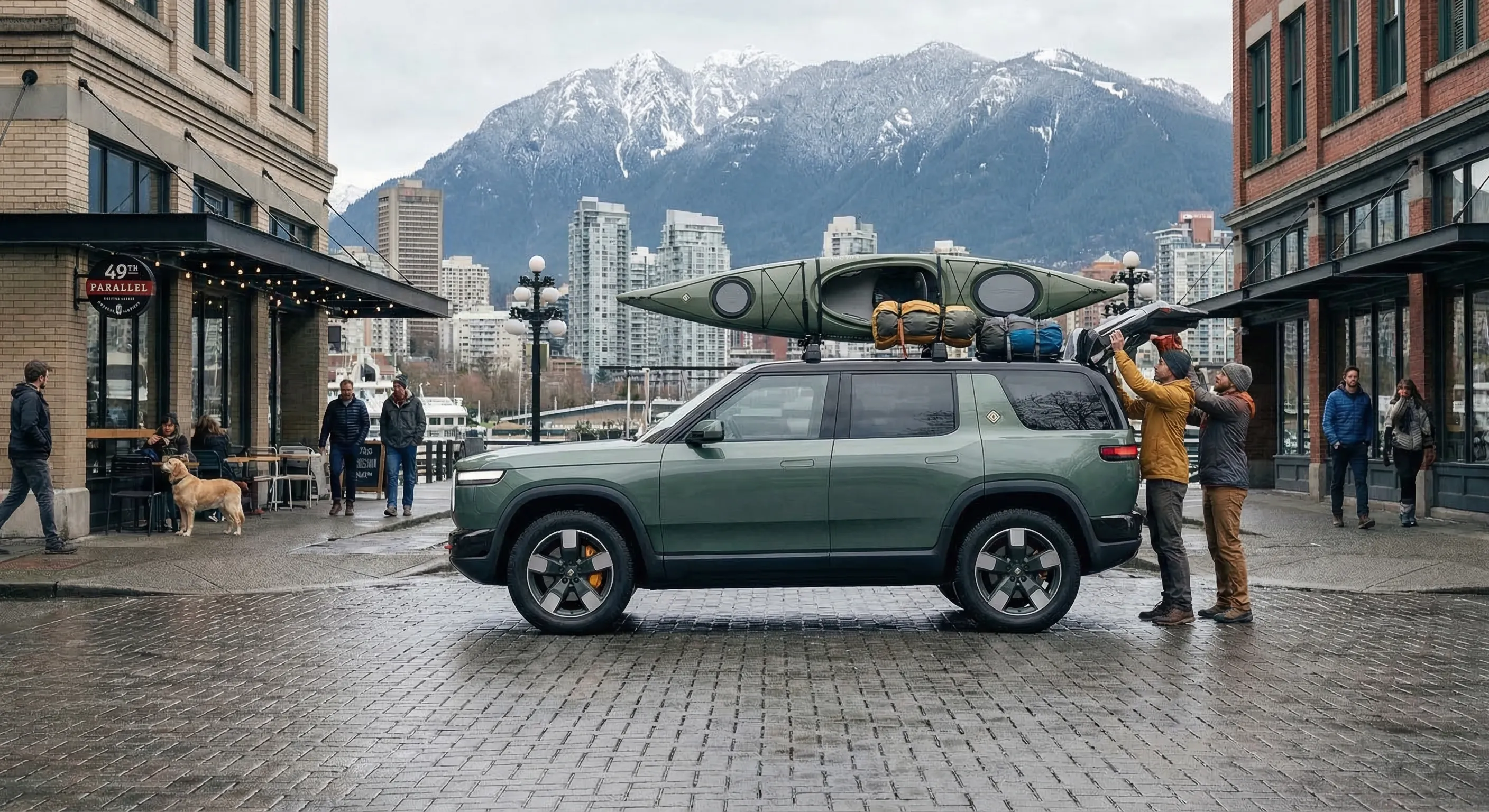
Rivian R2 versus Tesla Model Y Long Range AWD:
The Model Y is the benchmark in this segment because it's the best-selling EV in Canada. It's excellent, good range, great charging network, capable AWD, competitive cargo space. The R2 competes on similar price and similar range, and where it wins clearly is ground clearance, off-road capability, cargo versatility (the frunk, the gear tunnel), and brand differentiation. Where the Model Y wins is service network, OTA update cadence, and the Supercharger experience as a native first-party user rather than a third-party guest. The R2 is the better vehicle for buyers who need occasional capability beyond pavement. The Model Y is the better vehicle for buyers who prioritise a smooth urban and charging experience.
Rivian R2 versus Ford Mustang Mach-E GT:
The Mach-E has tried hard to find a differentiated identity and largely succeeded in building a capable, sporty-feeling SUV with legitimate AWD. Its 480V charging architecture is a real charging speed advantage. The GT variant has strong performance credentials. Where the R2 wins decisively: brand energy, off-road capability, frunk, and Rivian's software platform (which is better than Ford's FordPass/SYNC). Where the Mach-E wins: a more established service network, the Ford dealer infrastructure for collision repair, and the EVAP rebate qualification on lower trims. At similar transaction prices, the R2 is the more interesting vehicle. The Mach-E is the safer choice for someone who just wants a reliable EV with an established service path.
Rivian R2 versus Hyundai Ioniq 5 AWD:
This is the hardest comparison. The Ioniq 5 has 800V ultra-fast charging that delivers on its speed promise, an award-winning interior design, and Hyundai's extensive dealer network across Canada. It's excellent in every dimension it competes on. The R2's advantages are off-road capability, ground clearance, frunk, gear tunnel, and outdoor brand identity. The Ioniq 5's advantages are charging speed, interior design, and the Hyundai dealer network. Buyers who primarily care about charging speed and urban experience belong in the Ioniq 5. Buyers who want a more versatile vehicle for diverse Canadian terrain belong in the R2.
Rivian R2 versus Kia EV6 AWD:
Similar story to the Ioniq 5, same platform, same 800V architecture, similar price range. The EV6 is slightly more driver-focused, more aerodynamic, and arguably better to drive. The R2 is more cargo-capable, more off-road capable, and more differentiated. For most practical buyers, the choice comes down to whether you want the faster charging and more dynamic driving of the EV6, or the more versatile, adventure-capable R2.
The Federal Rebate Question
The federal EVAP rebate is a legitimate planning variable for Canadian R2 buyers, but the bar is high. EVAP pays $5,000 only when a vehicle's final transaction value lands at or under $50,000, there's no separate, higher SUV cap, and the only no-cap exemption is for EVs built in Canada (the R2 is built in the U.S.). With the R2 widely expected to open above C$60,000 in Canada, it would take unusually aggressive pricing on a stripped configuration to slip under the $50,000 ceiling.
Whether any Canadian R2 configuration lands under the $50,000 ceiling is a business decision Rivian will make closer to launch, and at the R2's expected price point, it's a long shot. The $5,000 matters where it applies, especially in Ontario and Alberta with no provincial top-up, but for most R2 trims it simply won't be on the table. Watch this space.
Provincial programs in BC and Quebec generally require federal eligibility, so if the R2 sits above the $50,000 federal ceiling it likely misses those too. Plan around the unrebated price, and if Rivian does sneak a base trim under the cap, treat any rebate as upside, not the baseline. Even unrebated, the R2's capability profile is its real argument against an Ioniq 5 or EV6.
The incentive picture has some additional complexity. British Columbia's CleanBC GO Electric program requires vehicles to be on the federal EVAP-approved list, which means Rivian needs to have the R2 approved by Transport Canada and included in the federal program. Given the R1T and R1S are already on the Canadian market and Transport Canada-compliant, the R2's compliance pathway is relatively smooth, but there's timing uncertainty. Early Canadian deliveries may precede program qualification.
Production Timeline and Canadian Delivery
Rivian began R2 production at its Normal, Illinois facility in late 2025. The ramp-up schedule through early 2026 is focused on US deliveries first, a standard playbook for American automakers introducing a new vehicle.
Canadian deliveries are realistically targeting a 2026 window, with pre-order reservation holders likely seeing first deliveries in the second half of 2026 based on Rivian's stated intentions. Reservation pricing allows Canadians to lock in their position in the delivery queue now with a fully refundable deposit.
The production ramp trajectory matters for Canadians because Rivian has historically been conservative with production estimates and then faced challenges meeting even those conservative targets. The R1 launch involved significant delays and quality ramp issues that frustrated early reservation holders. Rivian has been transparent about those challenges and has invested substantially in manufacturing process improvements at the Normal facility.
The R2 benefits from being built at a single dedicated facility rather than sharing a production line with the R1 trucks. Dedicated production simplifies quality management and allows process optimisations specific to the R2's components. Whether that translates to a smoother ramp than the R1's is something only production data will confirm, but the structural conditions are more favourable.
For Canadian buyers who want an R2 in 2026, reserve now and stay patient. The queue will be long, the ramp will be gradual, and Canadian allocations will be a fraction of US volume. That's not unique to Rivian, it's standard practice for US EV launches in the Canadian market. The best position is an early reservation with realistic expectations about timing.
The Market Impact: What Changes
The R2's entry into the Canadian mid-tier EV market has implications that go beyond Rivian's own sales numbers.
It brings legitimate off-road capability into a price tier where it hasn't existed before. The Model Y, Mach-E, and Ioniq 5 all claim outdoor versatility in their marketing, but none of them have the ground clearance, the frunk storage, the gear tunnel, or the genuine AWD torque management of the R2. For Canadian buyers who actually use their vehicles for outdoor recreation, and there are a lot of them, the R2 creates an option that didn't previously exist at this price.
It puts competitive pressure on Ford specifically. The Mustang Mach-E has been Rivian's closest aspirational competitor in the mid-tier SUV EV space, and the R2 is a more compelling product in most respects. If Rivian can execute the R2 launch cleanly, reasonable delivery timelines, no major quality issues, service network expansion, Ford will need to respond with either a stronger Mach-E update or a different product.
It validates the $57,000–$65,000 price tier as the most important battleground in Canadian EVs for the next three years. Tesla, Hyundai, Kia, Ford, and now Rivian are all competing aggressively in this space. That's genuine competition, which is genuinely good for buyers. Prices will stay under pressure. Feature sets will improve. The buyer who walks into this market in 2027 will have more choice and more value than the buyer today.
It also raises the question of what Rivian does next. The R3, a smaller, even more affordable EV, has been teased, and if the R2 succeeds, Rivian will be in a position to press further into accessible price tiers. A Rivian at $45,000 CAD changes the conversation again. But that's a future product; the R2 is the present reality, and it's a meaningful one.
Ownership Cost Over Five Years
Let's build a realistic five-year cost picture for the R2 AWD in Ontario (no provincial incentive, worst case) versus a comparable gas SUV and a Tesla Model Y LR.
Rivian R2 AWD (Ontario, no incentives applied):
- Purchase price: approximately $66,000 CAD
- Home charging electricity (annual, ~15,000 km driven): approximately $480/year at Ontario TOU off-peak
- Public charging: approximately $200–$400/year for occasional top-ups
- Maintenance (brake fluid, tire rotation, cabin air filter, wiper blades): approximately $300–$500/year
- Insurance (Ontario, adult driver, $66K vehicle): approximately $2,400–$3,000/year
- Winter tire set (budget for Year 1): approximately $1,500
- Level 2 charger installation (Year 1): approximately $1,000
5-year cost before resale value: approximately $96,000–$104,000
Comparable gas SUV (Toyota RAV4 XLE, Ontario):
- Purchase price: approximately $40,000 CAD
- Fuel (annual, 15,000 km at 8.1L/100km, average $1.65/L): approximately $2,000/year
- Maintenance (oil changes, filters, brakes, spark plugs, transmission service): approximately $1,000–$1,500/year
- Insurance: approximately $2,000–$2,400/year
- Winter tires: approximately $1,200
5-year cost before resale: approximately $68,000–$75,000
Tesla Model Y LR AWD (Ontario, no incentives):
- Purchase price: approximately $59,990 CAD
- Home charging: approximately $380/year
- Maintenance: approximately $250–$400/year
- Insurance: approximately $2,200–$2,800/year
- Winter tires: approximately $1,400
5-year cost before resale: approximately $86,000–$93,000
The R2 carries a higher five-year total cost than both alternatives, primarily because of its higher purchase price. But resale value changes the picture. Rivian R1 vehicles have held their value reasonably well in the Canadian market, better than most European EVs, somewhat below Tesla. If the R2 retains 55–60% of its value at five years (conservative estimate for a well-maintained EV from a brand with active model support), the $66,000 R2 AWD has approximately $36,000–$40,000 in residual value at resale. Net cost of ownership over five years: approximately $56,000–$68,000. That closes the gap with the RAV4 substantially.
For buyers in BC or Quebec where incentive stacking can bring the effective R2 Standard price to around $50,000–$52,000, the five-year ownership cost picture becomes genuinely competitive with a comparable gas SUV when fuel savings are fully accounted for.
What to Actually Do: The Buying Decision
If you're seriously considering the R2, here's the decision framework that cuts through the noise.
Buy the AWD, not the RWD. The Canadian winter makes this a practical requirement in any province outside Metro Vancouver. The torque management advantage of dual motors on ice is not a marginal improvement, it's a meaningful safety and capability upgrade. The price premium for AWD is approximately $6,000–$9,000 CAD and is justified.
Reserve now if you're serious. The deposit is refundable. The queue is real. Every month you wait puts you further back in Canadian delivery allocation. If you ultimately decide not to buy, you lose nothing. If you decide you want one in 2026, you'll be glad you reserved in early 2026 rather than waiting.
Check your provincial incentive situation. Quebec and BC buyers get meaningful stacking that materially changes the effective price. Ontario and Alberta buyers pay full sticker and need to do the math with that reality accounted for. The federal rebate eligibility question will be resolved before Canadian launch; watch the Rivian Canada configuration page for the confirmed MSRP relative to the $60,000 SUV threshold.
Plan your service access. Look up where the nearest Rivian service centre is from your home. If it's within 2 hours, this is a manageable consideration. If it's 4+ hours, have an honest conversation with yourself about whether you're comfortable with that service geography for a vehicle you're going to depend on. Mobile service handles routine items well; collision repair and complex faults require a physical facility.
Budget for winter tires in Year 1. They're not optional. $1,200–$1,800 for a proper winter setup in the R2's wheel sizes. Build it into your purchase budget rather than discovering the expense later.
Think about home charging. If you have a garage or a dedicated parking space with a 240V outlet, you're set. If your living situation is a downtown apartment with no dedicated parking and limited charging access, the R2's range is adequate for several days of commuting on public charging alone, but the ownership experience will be less convenient than for someone charging at home every night. Be honest about your charging situation before committing.
FAQ
The R2 Fills A Gap No One Else Has
The Rivian R2 is the vehicle Rivian needed to build and, more importantly, it's a vehicle Canada needed someone to build. There hasn't been a mainstream-priced electric SUV with genuine off-road capability, serious cargo versatility, and compelling brand identity in this country. The R2 fills that gap.
It's not a perfect product and it doesn't arrive into a perfect situation. The service network needs to expand. The timing relative to Canadian delivery is uncertain. The pricing will determine whether rebate eligibility improves the value equation or clips it. The AWD premium is real money on top of an already significant purchase price.
But none of those concerns undermine the fundamental case. The R2 is a well-engineered vehicle built on proven architecture, priced at a level that creates genuine competition with the best-selling EVs in Canada, and differentiated in ways that the competition can't easily match. It makes the mid-tier EV segment more interesting than it's been in years. For the Canadian buyer who wants an EV that can handle their actual life, the commute, the Costco run, the weekend with gear, the cottage in shoulder season, the ski trip in February, the R2 is the first vehicle in this price class that checks every box.
Reserve now. Buy the AWD. Get winter tires. Check your service access. That's the complete buying checklist.
Gear worth having
As an Amazon Associate, ThinkEV earns a small commission from qualifying purchases — at no extra cost to you.

WixGear Magnetic Air Vent Phone Mount (2-Pack)
A magnet strong enough that your phone never flinches over potholes or rail crossings. Two in the box, one for each car.
As an Amazon Associate, ThinkEV earns from qualifying purchases — at no extra cost to you.
Related Reading
Gear worth having
As an Amazon Associate, ThinkEV earns a small commission from qualifying purchases — at no extra cost to you.
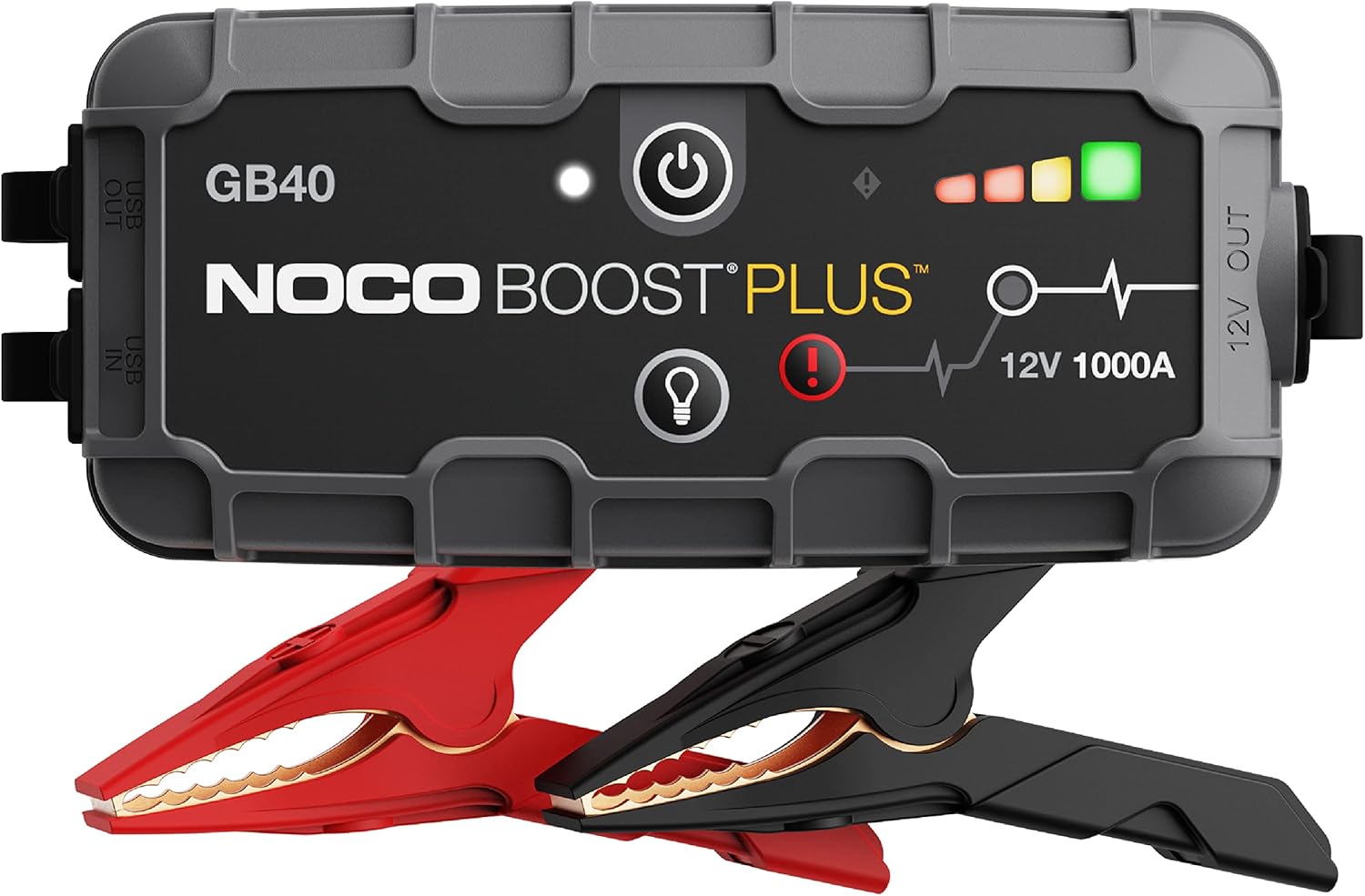
NOCO Boost Plus GB40 Jump Starter
A 1000A lithium jump starter that fits in your glovebox and works on any 12V battery. Your insurance against a dead 12V in a parking lot.
As an Amazon Associate, ThinkEV earns from qualifying purchases — at no extra cost to you.

Founder & Chief Editor
Vlad Pereira is the founder and chief editor of ThinkEV.ca, the Canadian electric-vehicle publication he writes and edits from Courtenay, British Columbia. He covers EV pricing, federal and provincial rebates, charging costs, and the Chinese manufacturers now entering Canada, from the buyer's side rather than the press-fleet side. ThinkEV is a venture of Vlad Pereira Online; his writing on health, income and the long game lives at vladpereira.com.
Frequently asked questions
+
+
+
+
+
+
+
+
More EV & road-trip finds
Affordable upgrades worth a look — tap any to check the price on Amazon.
 ★ 61
★ 61Toddler Car Seat Snack and Cup Tray
View on Amazon ★ 17,839
Qifutan Vent Phone Mount (Military-Grade Clip)
View on Amazon ★ 12,051
Windex Electronics Screen Wipes
View on Amazon ★ 164
★ 164Solar-Powered LED Ambient Light
View on Amazon ★ 401
★ 401Crochet Daisy Rear-View Mirror Charm
View on Amazon ★ 979
★ 979Leather Headrest Purse Hook
View on Amazon ★ 297
★ 297360-Degree One-Hand Dashboard Phone Mount
View on Amazon ★ 87
★ 87Car Window Sun Shades for Kids (4-Pack)
View on AmazonRead, Plan, Then Stay Current
Explore our expert articles to understand incentives and ownership costs, use the map to pressure-test charging reality, then subscribe so new EV coverage comes straight to you.
Continue Reading
Kia EV5 Canada Review 2026: The $48K Electric SUV
Rivian R1T Canada Review 2026: 515 km Quad-Motor
Ford Mustang Mach-E Review 2026: Still Worth It?
7 Chinese EVs Under $35,000 Coming to Canada
Volvo EX30 Canada Review: The Small One to Want