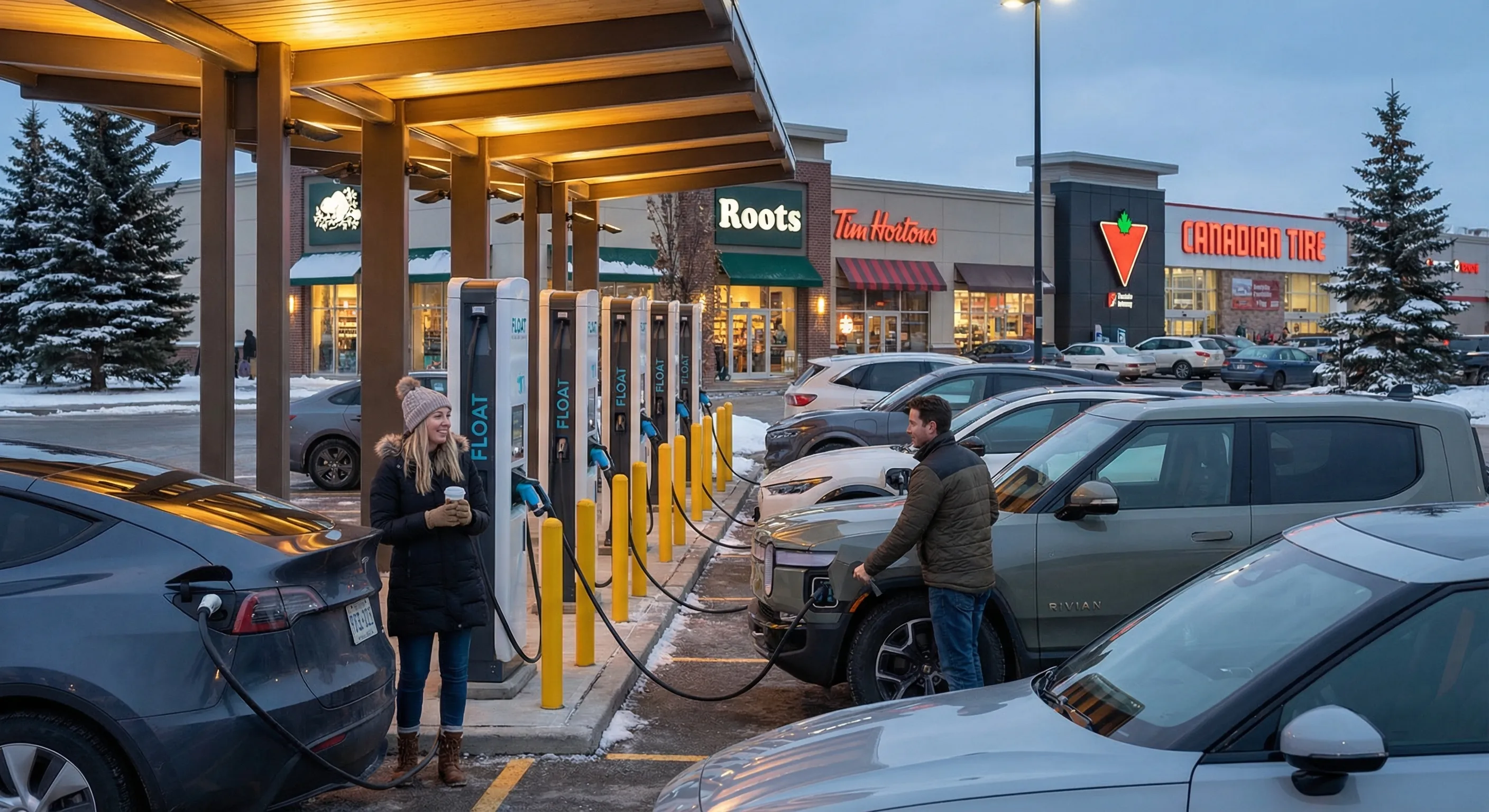
Ontario sells more EVs than any other province in Canada. And it does that without offering a single dollar in provincial purchase rebates. Federal iZEV covers up to $5,000, but Ontario cancelled its own rebate back in 2018. So every Ontario buyer relies on one thing more than anywhere else: whether the charging network is good enough to make an EV work day to day.
The numbers tell a different story than the marketing materials suggest. Ontario has made real progress. IVY, built by Ontario Power Generation and Hydro One, has expanded steadily. Tesla Superchargers now line the 401 corridor. FLO and ChargePoint have added hundreds of workplace and destination chargers. But the gaps are real and measurable. Northern Ontario still has stretches where a trip from Sudbury to Sault Ste. Marie requires planning that most drivers in Toronto never think about.
This guide covers every major network, the real coverage picture corridor by corridor, what municipal programs exist, what condo charging rights look like in practice, how Ontario's time-of-use rates affect your actual monthly bill, and how the province stacks up against Quebec and British Columbia.
Canadian buyers should know that the Ontario charging story in 2026 is a mixed one. Urban cores are well-served. Rural areas and the north are a different situation entirely. If you live in Toronto, Mississauga, or Ottawa and you have a home charger, you're in good shape. If you don't have a home charger, or if you drive north regularly, this guide matters a lot.
Gear worth having
As an Amazon Associate, ThinkEV earns a small commission from qualifying purchases — at no extra cost to you.

Grizzl-E Classic Level 2 EV Charger (40A)
Canadian-made and rated for minus 40C winters. 40A / 9.6 kW, NEMA 14-50, indoor/outdoor, 24-ft cable. The charger built for Canadian weather.
As an Amazon Associate, ThinkEV earns from qualifying purchases — at no extra cost to you.
Key takeaways
- Ontario has over 11,000 Level 2 charging ports and 1,400+ DC fast charger ports as of early 2026, with coverage concentrated in the southern corridor.
- IVY operates over 70 fast charging stations across Ontario, built by Ontario Power Generation and Hydro One as the province's primary public DCFC network.
- Highway 401 between Windsor and Kingston has strong DCFC coverage, with stations roughly every 50-80 km for most of the corridor.
- Sudbury to Sault Ste. Marie on Highway 17 has meaningful coverage gaps that require pre-planning for longer-range EVs or careful timing for shorter-range ones.
- Ontario's off-peak electricity rate sits at roughly $0.076/kWh, making home charging one of the cheapest in Canada at about $2.50-$3.00 to charge a 60 kWh battery overnight.
- Quebec leads Canada in both charger density and provincial rebates, while BC has the most diverse incentive stack. Ontario relies entirely on federal funding and private network investment.
- NRCan's ZEVIP program has put over $680 million into Canadian EV charging since 2019, with Ontario receiving a significant share of that funding.
The Ontario Charging Network by the Numbers
Ontario has more EV charging infrastructure than any other province by raw count. That makes sense. It has the largest population, the largest EV fleet, and the most highway traffic. But raw count doesn't tell you whether the network is useful for how Ontario drivers travel. To understand that, you need to look at where those chargers are, what kind they are, and who operates them.
As of early 2026, Ontario has approximately 11,200 Level 2 charging ports and a bit over 1,400 DC fast charger (DCFC) ports across public and semi-public locations. That ratio matters. Level 2 chargers add 15-30 km of range per hour. A DC fast charger can add 100-300 km in 20-40 minutes depending on the car and the charger's power output. If you're doing a long-distance trip, Level 2 alone doesn't cut it. You need DCFC stations spaced close enough that you can cross the province without range anxiety.
Roughly 1,400 DCFC ports sounds meaningful, but those ports aren't evenly spread. Most sit in the greater Toronto area, along the Highway 400-series corridors, and in Ottawa. Outside those zones, coverage thins significantly. That 400 km stretch between Wawa and Thunder Bay on the Trans-Canada is the most dramatic example. Infrastructure has been pushed in through ZEVIP funding, but it remains challenging for any EV with less than 350 km of real-world range.
For Level 2 chargers, the picture is better but still uneven. Ontario has over 1,800 distinct charging locations with at least one Level 2 port, and several thousand more in private workplace installations that show up on apps like PlugShare. Toronto alone has over 400 public Level 2 locations, many in municipal parking garages, shopping centres, and hospital campuses. Ottawa has another 200-plus. Smaller cities like London, Kingston, and Barrie have grown their networks meaningfully over the past two years.
Quebec built its Circuit Electrique network with provincial coordination from day one. Ontario delegated that role to IVY, which is a good network, but smaller and less dense than Circuit Electrique was at a comparable stage. You get a network that works well if you plan carefully, but that punishes drivers who assume they'll always find something when they need it.

What raw numbers also don't show is reliability. A charger that exists on paper but breaks down 30% of the time isn't useful. Ontario drivers have reported varying reliability across networks. IVY stations have generally earned strong marks for uptime. Tesla Superchargers maintain Tesla's historically high reliability. Some third-party Level 2 networks, particularly older installations in parking garages, have suffered from inconsistent maintenance. Both the Canadian Automobile Association and Plug In BC have flagged charger reliability as a persistent gap across Canada, and Ontario is no exception (CAA, 2025).
That 2026 figure for DC fast charger ports includes chargers from every provider: IVY, Tesla, FLO, ChargePoint, Petro-Canada Electric Highway, Shell Recharge, and a handful of smaller regional operators. Each runs its own app, pricing model, and hardware standard. Most newer installations are CCS-compatible, which covers almost all non-Tesla EVs sold since 2020. Many now include both CCS and NACS connectors after the industry's shift toward the Tesla-derived North American Charging Standard.
Understanding the full picture means looking at each major network separately, because they don't all serve the same use case or the same geography.
The Major Charging Networks: IVY, FLO, ChargePoint, and Tesla
IVY is the closest thing Ontario has to a provincially planned EV charging system. It was created as a joint venture between Ontario Power Generation (OPG) and Hydro One, two of the largest electricity providers in the province. Both companies had land near major highways and substations with the electrical capacity to support high-power charging. They could build fast chargers where other providers couldn't, or wouldn't.
IVY launched in 2020 and has grown to over 70 stations as of early 2026, with roughly 280 individual charging ports (IVY Charging, 2025). Most stations are 50 kW to 150 kW DC fast chargers, with several newer installations running at 350 kW for vehicles that can accept that power level. Most stations sit at or near highway rest stops, fuel stations, and OPG-owned properties, which means they're positioned where road-trippers need them most.
Geographic focus has been on corridors rather than urban density. IVY made a deliberate choice to target the gaps that Tesla Superchargers and city-focused networks weren't filling. That means stations along Highway 17 in Northern Ontario, on Highway 11 through Muskoka and beyond, along Highway 7 between Ottawa and Toronto, and on the 400 corridor north of Barrie. IVY also has stations in cities, but the highway network is the priority.
IVY stations use the CCS1 connector standard, which works with all non-Tesla EVs sold in Canada since roughly 2020. Newer IVY installations also include NACS connectors, so Tesla owners can use the network without an adapter. Pricing is session-based with a per-kWh charge. As of March 2026, IVY fast charging runs between $0.32 and $0.42 per kWh depending on the station power level, which works out to roughly $19-$25 to add 200 km of range to a typical mid-size EV (IVY Charging, 2025).
Compared to Tesla Supercharging, that's slightly more expensive. Compared to ChargePoint or FLO at similar power levels, it's competitive. Pricing is visible upfront through the IVY app, and there are no membership fees required. You pay per session with a credit card or through the app.
IVY's app has earned strong marks for accuracy on real-time availability. When a station shows green, it's working. That consistency matters more than you'd think when you're 90 km from the next option on Highway 17.
IVY's reliability record has been better than the Canadian average. OPG and Hydro One both have existing crews for electrical infrastructure maintenance, which means IVY has a built-in service network that many private charging operators lack. When a station goes offline, the response time is generally faster than what drivers report at independently operated chargers. Northern Ontario stations have had outages during extreme cold snaps, which is a pattern shared by all network operators in the region.
Scale is the gap. IVY has 70 stations across a province that stretches more than 1,500 km from east to west and another 1,800 km from south to north. Quebec's Circuit Electrique has over 1,000 stations, many of them Level 2 for destination charging, but also a substantial DCFC spine. IVY is focused, well-built, and useful for highway travel, but it doesn't have the density to support casual trip planning where you don't need to check your route in advance.
IVY announced in late 2025 that it would add 30 additional stations by the end of 2026, with a focus on Northern Ontario and the Highway 11 corridor through the Temiskaming region. That expansion is funded partly through NRCan's ZEVIP program and partly through OPG's own capital budget. When those stations come online, IVY's coverage for the Trans-Canada in Northern Ontario will improve substantially (IVY Charging, 2025).
For any Ontario driver planning a long-distance trip outside the 401 corridor, IVY's route-planning tool at ivycharge.com is the most reliable single source for Ontario-specific fast charging coverage. It shows real-time station availability and power output, which is more useful than general-purpose apps that show all charger types without filtering for what your car needs.
Broader significance of IVY is that it established a model for utility-owned EV charging in Ontario. OPG and Hydro One have the electrical expertise, the land, and the financial stability that private startups often lack. Whether IVY grows fast enough to keep pace with Ontario's EV adoption rate is the more important question. Ontario registered over 140,000 new EVs in 2025, and that number is expected to grow as more affordable models enter the market. IVY's 70 stations serve a growing fleet, and the charger-to-vehicle ratio gets harder every year.
FLO, ChargePoint, and Tesla
Beyond IVY, three other networks account for the majority of Ontario's EV charging infrastructure. FLO, ChargePoint, and Tesla Superchargers each take a different approach to the market, and understanding the differences helps you decide which apps to download and which networks to pay attention to for your driving patterns.
FLO is a Quebec-founded company operating across Canada and into the United States. In Ontario, FLO has over 1,000 charging stations, the large majority of which are Level 2 at workplaces, hotels, parking garages, and shopping centres. FLO also operates a smaller number of DCFC stations, mostly at highway locations and retail sites. FLO in Ontario skews urban and suburban. It's the network you're most likely to encounter at a Canadian Tire parking lot, a GO Transit station, or a municipal lot in a mid-size Ontario city.
FLO uses a membership model that can reduce per-session costs. Non-members pay a higher rate, typically around $0.25-$0.40 per kWh for DCFC and $1.50-$2.00 per session plus time for Level 2. FLO members pay less, but the savings only matter if you use FLO regularly. For drivers who rely on FLO as their primary public network, the membership makes financial sense. For drivers who use multiple networks, it's less clear.
You'll notice FLO's DCFC footprint in Ontario is smaller than their Level 2 footprint. If you need a 50-150 kW charge on a highway trip, FLO may not be on your route. If you need destination charging at a hotel or shopping centre, FLO is often the most convenient option available.
ChargePoint takes the opposite approach. It's primarily an enterprise-facing network, selling charging hardware to businesses, municipalities, and property managers who then operate chargers under their own branding through ChargePoint's platform. In Ontario, ChargePoint has several hundred locations, again concentrated in the GTA and Ottawa. Many chargers you see at hospitals, universities, and corporate campuses in Ontario run on ChargePoint hardware even if they're not branded as ChargePoint stations.
ChargePoint's app is useful because it aggregates a wide range of stations, including some that operators have chosen not to brand separately. Finding a ChargePoint station often means finding a cluster of 4-12 Level 2 ports in a parking structure, which helps for overnight or multi-hour parking. ChargePoint does have some DCFC stations in Ontario, but they're limited compared to FLO or IVY.
Tesla Superchargers are the most visible part of Ontario's fast charging picture, particularly along the 401. Tesla has over 35 Supercharger stations in Ontario as of early 2026, with most sites having between 8 and 20 individual stalls (IVY Charging, 2025). Windsor through Toronto to Kingston has Tesla Supercharger coverage roughly every 60-80 km, which means a Tesla driver can cross southern Ontario without range anxiety at highway speeds.
Since Tesla opened the Supercharger network to non-Tesla EVs in 2023, any CCS-capable EV can use a Tesla Supercharger with the Magic Dock adapter that Tesla installs at Canadian Supercharger sites. Pricing for non-Tesla drivers is slightly higher, typically around $0.40-$0.50 per kWh depending on the site. But reliability and density of the Supercharger network make it the preferred option for many drivers on the 401 corridor regardless of what car they drive.
Drivers on the 401 corridor from Windsor to Kingston report Supercharger stops taking under 25 minutes. No broken stalls, clear pricing in the app, good amenities nearby. That experience is hard to replicate on most other networks.
Reliability advantage for Superchargers over other networks is well-documented. Tesla maintains a global 99.95% uptime standard and has the service infrastructure to back it up. When you're at a Tesla Supercharger station, you're more likely to find every stall working than at most comparable DCFC installations from other providers.
Petro-Canada's Electric Highway deserves mention because it specifically targets the highway corridor market. Petro-Canada has over 50 DCFC stations in Ontario, all at or beside Petro-Canada fuel stations on major highways. Power output is generally 50 kW, which is adequate but not fast by 2026 standards when many newer EVs can accept 150-350 kW. Stations are convenient because they're co-located with washrooms, food, and the amenities people want during a charging stop. A 20-30 minute stop adds roughly 80-120 km of range to a typical vehicle, which is workable for many drivers but slower than what IVY and Tesla deliver at their best sites.
Shell Recharge has also entered the Ontario market with a handful of DCFC stations, mostly at Shell fuel stations in the GTA and along the 400 series highways. Shell's network is still small compared to the others, but Shell has announced plans to expand to over 50 Ontario locations by end of 2026, using 150 kW hardware at most new sites. That would add meaningful capacity particularly to the Highway 400 and 115 corridors north of Toronto.
What emerges from all these networks together is fragmentation. Ontario drivers need 3-5 apps to cover their charging needs across urban, suburban, and highway scenarios. No single network does everything well. That's a real friction point compared to Quebec, where Circuit Electrique provides a unified app and billing system across over 1,000 stations of different types, and where coverage is dense enough that you rarely need multiple apps for a single trip.
Highway 401 Corridor and the Northern Ontario Gap
Highway 401 is the busiest highway in North America. It runs 827 km from Windsor at the western border with Michigan to the Quebec border east of Kingston. For EV infrastructure purposes, it's the single most important corridor in Ontario, and it's the stretch where the charging network has received the most investment.
Between Windsor and Kingston, you can now drive a mid-range EV of 350-400 km real-world range without significant range concerns. IVY, Tesla, FLO, ChargePoint, Petro-Canada, and others have all invested along this corridor. Major stops like London, Woodstock, Kitchener-Waterloo, Oakville, Mississauga, Toronto, Ajax, and Kingston all have multiple DCFC options. In most cases, there are at least two competing network options at each major stopping point, which means if one network is down, you have a backup.
Coverage is dense enough that you can travel the full 401 corridor in a vehicle with 250 km of real-world highway range and charge once in the middle for 20-25 minutes without stress. That wasn't true as recently as 2023. ZEVIP grants and private expansion have improved the corridor experience in a real way.
But leave the 401 corridor and the numbers change fast. Take Highway 7 from Toronto toward Ottawa. Distance is about 450 km via the direct route through Peterborough, Lindsay, and the Haliburton-area highlands before dropping into Ottawa. Along that route, DCFC coverage has improved but still has stretches where the gap between stations exceeds 100 km. For a vehicle with 400 km range, that's manageable. For a driver of an older EV with 200-250 km real-world range, those gaps require careful planning.
Most significant gap in Ontario's EV infrastructure sits in the north. Highway 17 connects Sudbury to Sault Ste. Marie through 298 km of Canadian Shield terrain. This corridor passes through towns like Espanola, Massey, Blind River, and Thessalon. As of early 2026, there are DCFC stations in Sudbury, one in Espanola, one near Serpent River, one in Blind River, and one in Thessalon, before reaching stations in Sault Ste. Marie. That gives you roughly 5 stops across 298 km, which sounds adequate, but the stations are not all equal in power output or reliability.
Espanola has a 50 kW Petro-Canada unit. Serpent River has an IVY station at 100 kW. Blind River has a 50 kW third-party unit that has had documented reliability issues in winter months. Thessalon has a newer 100 kW IVY installation. Longest gap between confirmed, reliably operational DCFC stations on this route runs about 85 km under normal conditions but effectively stretches to 120-130 km if the Blind River station is unavailable.
The numbers tell a different story when you apply them to real driving conditions. On a January day at -20C, a 400 km-range EV loses roughly 30-35% of its rated range to cold weather. That means you're working with about 260-280 km of real range. With station gaps of 80-130 km, the math still works, but every station on your route needs to be operational. If one goes down, you may not have enough range to reach the next one without calling for help.
This isn't hypothetical. Drivers on the Northern Ontario EV Facebook group and on PlugShare have documented exactly these situations during the 2024 and 2025 winters. One driver in a 2023 Hyundai Ioniq 6 with a 524 km rated range described arriving at the Blind River station to find it offline, turning back 30 km to Serpent River to recharge, losing close to 2 hours on a 3.5-hour trip (PlugShare community reports, 2025).
IVY's planned expansion includes two new stations specifically targeting the Highway 17 corridor between Sudbury and Sault Ste. Marie. One is planned near Iron Bridge and another near Webbwood. Both are expected online by Q4 2026. If those come through on schedule, the worst gaps on that corridor shrink to under 70 km, which is manageable even in winter for most current EVs.
North of Sault Ste. Marie, things get harder. Highway 17 continues west through Wawa and White River toward Thunder Bay, a distance of about 700 km from Sault Ste. Marie. Charger count on that stretch is thin. DCFC stations exist in Wawa, White River, and Marathon, and a cluster in Thunder Bay. But between White River and Marathon, a distance of about 120 km, there's a single mid-power charging option that has seasonal reliability concerns. Anyone driving a shorter-range EV on this route is taking a real risk without careful pre-trip charging and conservative driving speed.
For the 401 corridor and major urban centres, Ontario's infrastructure in 2026 is travel-grade. For Northern Ontario, it's improved from 2022 but still requires more planning than most EV owners are used to in southern Ontario or in Quebec and BC.
Municipal Programs, Condo Rights, and the Home Charging Reality
Provincial charging policy in Ontario is limited. No provincial rebate exists, no provincial charging network outside IVY (which is run by utilities, not the government directly), and no provincial mandate on new construction charger-readiness beyond what federal building codes require. What happens at the city level varies enormously.
Toronto is the most active municipality in Ontario on EV infrastructure. It has been installing Level 2 chargers in its own parking facilities since 2015, and the program has expanded year over year. As of 2026, Toronto operates over 250 Level 2 charger ports in its 19 city-operated parking lots and garages, with pricing set at $1.50 per hour or free for up to 2 hours at some locations (City of Toronto, 2025). That's a meaningful public amenity for the many Toronto EV owners who don't have access to home charging.
Toronto also launched a curbside Level 2 charging program starting in 2023, installing chargers directly on residential streets in neighbourhoods with high rates of apartment and condo living. As of early 2026, roughly 80 curbside charging points are operational across 12 Toronto neighbourhoods, including Roncesvalles, The Annex, Leslieville, and St. Lawrence Market. Toronto has committed to adding another 120 curbside points by end of 2026. Usage rates have been high, with many stations showing 60-70% average utilisation per day.
this curbside program directly addresses the equity gap in EV access. Drivers with detached homes and private garages can install home chargers and charge overnight at off-peak rates. Drivers in apartments and condos can't. Curbside charging gives apartment dwellers access to something closer to a home charging experience, though pricing at public Level 2 rates is higher than what a homeowner pays overnight on TOU.
Ottawa is the second-most-active Ontario municipality on EV infrastructure. Ottawa Hydro and the City of Ottawa together operate over 100 Level 2 charging ports at city facilities, transit hubs, and major parking areas. OC Transpo, Ottawa's transit agency, has invested in electrifying its fleet and in the charging infrastructure that supports it. Ottawa also benefits from federal government offices and Crown corporation campuses, many of which have installed workplace charging that employees can use.
Ottawa's geography matters here. It's a driving city with large suburban areas that have high rates of detached home ownership. Most Ottawa EV owners have garage access and install a Level 2 home charger. Public charging there functions mostly as a supplement for people who don't charge at home or who need a top-up during work hours.
Beyond Toronto and Ottawa, municipal engagement drops off significantly. Hamilton has made modest investments in Level 2 chargers at city facilities. London has added chargers to its downtown core. Kingston has a handful of Level 2 installations in its tourist-heavy downtown area. Barrie has done some installation work near the waterfront and downtown core. But none of these cities have coordinated programs at the scale Toronto has.
Gap between Toronto's curbside program and what other Ontario cities are doing reflects a resource reality. Toronto has a large tax base, a dedicated transport planning department, and political leadership that has made EV infrastructure a stated priority. Smaller cities have neither the budget nor the staff capacity to run comparable programs.
For non-Toronto EV owners, charging options outside the home are fewer, older, and less reliable than what Toronto residents have access to. A driver in Windsor or Sudbury who needs public Level 2 charging on a daily basis has far fewer options. This urban-rural charging divide is the Ontario story in miniature.
There is a federal dimension here too. Canada's Zero Emission Vehicle Infrastructure Program (ZEVIP) through NRCan has funded thousands of chargers across Ontario, including many of the municipal installations that exist outside Toronto. But ZEVIP grants go to applicants who apply for them, which means well-resourced cities and private operators get the most funding. Smaller municipalities with less grant-writing capacity have received less.
NRCan's ZEVIP program has invested over $680 million in EV charging infrastructure across Canada since 2019. Ontario has received the largest provincial allocation, but distribution within Ontario has favoured the southern corridor and the major cities. Rural and northern Ontario have seen investment, but at lower density than what the population distribution alone would suggest is fair.
Condo Charging Rights and TOU Rates
Home charging changes the EV ownership calculation more than almost any other single factor. If you charge at home overnight on Ontario's off-peak time-of-use rate, your per-kilometre energy cost drops below what you'd pay to drive a gasoline car. If you can't charge at home and you rely on public charging, the cost picture changes significantly.
Ontario's time-of-use electricity pricing is set by the Ontario Energy Board. As of January 2026, three price tiers apply: off-peak at $0.076 per kWh, mid-peak at $0.122 per kWh, and on-peak at $0.158 per kWh (Ontario Energy Board, 2026). Off-peak hours run from 7pm to 7am on weekdays, and all day on weekends and holidays. That means if you plug in your EV after dinner and let it charge overnight, you pay the off-peak rate for almost the entire charge.
Gear worth having
As an Amazon Associate, ThinkEV earns a small commission from qualifying purchases — at no extra cost to you.

Lectron Level 2 J1772 Charger (40A, WiFi)
Smart WiFi charger with real-time energy monitoring. 40A / 9.6 kW, J1772 with a NEMA 14-50 plug, schedule charging right from your phone.
As an Amazon Associate, ThinkEV earns from qualifying purchases — at no extra cost to you.
At $0.076 per kWh off-peak, charging a 60 kWh battery from near-empty to full costs about $4.56 in electricity. That takes you roughly 300-400 km depending on the vehicle and driving conditions. An equivalent trip in a mid-size gasoline car at current Ontario fuel prices costs roughly $35-$50 in fuel. That comparison is why people buy EVs. Per-kilometre savings at home off-peak rates are real and substantial.
But that calculation only works if you have access to home charging. Approximately 35-40% of Ontario households live in multi-unit dwellings such as condos, apartments, and townhouses. Many of those residents don't have access to dedicated parking with a power outlet, let alone a Level 2 charger. This is a structural problem for Ontario EV adoption.
Ontario's Condominium Act was amended in 2018 to give condo owners the right to request EV charging in their parking spots. Condo corporations must consider EV charging requests and can only approve them unless there's a legitimate technical or financial reason not to. In theory, an Ontario condo owner can get a Level 2 charger installed in their assigned parking spot.
In practice, the process is more complicated. Condo boards often push back on EV charging requests by citing concerns about electrical capacity, wiring costs, and billing complexity. That amendment gives owners the right to request, not the right to demand. A condo board can deny a request if they can demonstrate that installing a charger would require electrical upgrades that exceed what's reasonable.
Statistics on how this plays out are discouraging. Legal clinics that handle strata and condo disputes in Ontario report that a significant portion of EV charging requests get delayed or denied at the condo board level, even where the electrical capacity exists (Ontario Condominium Authority, 2025). Owners who push back and use the Condominium Authority Tribunal process often succeed, but the process takes months and requires persistence that many owners don't have.
For condo owners who do get charger approval, installation cost varies widely. In a parking garage with reasonable electrical capacity nearby, a Level 2 charger installation costs $800-$1,500 for the hardware and wiring. If the electrical panel serving the garage needs an upgrade, or if the wiring run is long, that cost can rise to $3,000-$5,000. Generally, the condo owner pays these costs, not the corporation.
Billing for condo-installed EV chargers is handled differently across buildings. Some condos use sub-metered smart chargers that report directly to the building management system, allowing the condo owner to be charged for their actual electricity use. Others use dumb chargers that draw power from shared circuits, with costs baked into common element fees. Sub-metered approach is more accurate but more expensive to install. Dumb charger approach is cheaper but creates fairness issues among residents who don't own EVs.
For condo residents who can't get home charging approved, or who are waiting through the condo board process, options are limited. Public Level 2 charging is available in many Toronto neighbourhoods and some other Ontario cities, but the cost is higher than home off-peak charging. At public Level 2 rates, charging a 60 kWh battery costs roughly $8-$15 depending on the network and pricing model. That's still cheaper than gasoline, but the savings margin shrinks considerably.
On-peak rate of $0.158 per kWh applies from 7am to 11am and 5pm to 7pm on weekdays. If you charge at a public charger during commute hours, you're paying on-peak residential equivalent rates or more. A full charge at those times costs about $9.50 in electricity costs, compared to $4.56 overnight. Over a month, the difference amounts to roughly $30-$40 more per month than charging at home overnight if you charge 15 times per month.
Smart charger scheduling is the practical answer for Ontario homeowners. Devices like the Grizzl-E Smart or the ChargePoint Home Flex allow you to set a charging schedule that avoids on-peak hours entirely. Plug in at 7pm or later, draw power at off-peak rates, and finish before the morning on-peak period starts. For a driver who arrives home at 6pm and needs to leave by 8am, this schedule works perfectly. That 13-hour off-peak window from 7pm to 7am is enough to charge most EVs from depleted to full at 7.2 kW Level 2 output.
Ontario vs. Quebec and BC: The Provincial Comparison
Ontario, Quebec, and British Columbia are the three provinces that matter most for the Canadian EV story. Together they account for over 85% of all EV registrations in Canada. But they've taken very different approaches to incentives, infrastructure, and the role of government in driving adoption.
Quebec leads on almost every EV metric. Its provincial rebate program, called Roulez Vert, offers up to $7,000 off a new battery EV and up to $5,000 for a used EV. That's on top of the federal $5,000 iZEV credit, meaning a Quebec buyer can receive up to $12,000 in combined rebates. Ontario offers nothing at the provincial level. A Toronto buyer and a Montreal buyer purchasing the same $45,000 EV pay $7,000 different prices after rebates. That gap is enormous and it directly shows up in EV sales data.
Quebec also has the denser charging network. Circuit Electrique, operated by Hydro-Quebec, has over 1,000 stations across the province, including a substantial Level 2 destination network that lets drivers top up at hotels, ski hills, restaurants, and tourist sites. Circuit Electrique's DCFC spine runs along the major Quebec highways with fewer gaps than Ontario's comparable routes. Quebec also has one of the cheapest electricity rates in North America, with off-peak rates near $0.065 per kWh, even less than Ontario's $0.076.
British Columbia has the most complex incentive structure. Its Clean Energy Vehicle Program offers up to $4,000 for new battery EVs, and BC also has a scrap-it program that can add another $6,000 if you trade in an older gas vehicle. BC Hydro runs a network of 100+ DCFC stations along the major corridors in the province, including the Trans-Canada through the Fraser Valley and the highway north to Prince George. BC is different from Ontario and Quebec in that much of its EV driving happens on mountainous terrain, which changes range calculations significantly. But the Supercharger network and BC Hydro's stations have made the main southern BC corridors reliable for EV travel.
Ontario sits in a meaningful position relative to both. On electricity cost, Ontario is slightly more expensive than Quebec and roughly comparable to BC depending on the time of use. On infrastructure density in the south, Ontario is competitive. On provincial incentives, Ontario is dead last among the three.
Incentive gap affects which buyers choose EVs in Ontario. Without a provincial rebate, Ontario's EV buyers skew higher income. Federal $5,000 credit helps, but a buyer considering a $55,000 EV faces a tougher financial decision in Ontario than in Quebec. This has a downstream effect on charging network usage and on the political pressure to keep building infrastructure. A provincial rebate in Ontario would likely accelerate both EV adoption and the commercial viability of private charging networks.
that Ontario's EV market is growing despite the rebate absence, which says something real about the economics of EVs in 2026. Fuel prices, total cost of ownership calculations, and the increasing availability of affordable EV models are all working in favour of adoption even without provincial incentives. But the pace of growth would almost certainly be faster with a rebate program. Quebec's 2025 EV registration rate was nearly 25% of all new vehicle sales. Ontario's was about 14%. That gap is partly explained by the $7,000 provincial rebate difference.
Charging coverage comparison also matters for intercity travel. Owner reports from the Toronto-to-Ottawa corridor describe charging once at the Trenton IVY station for about 22 minutes. It works, but most drivers keep PlugShare open the whole route. A driver going from Montreal to Quebec City on Circuit Electrique doesn't need to do that. Ontario's infrastructure has improved but still trails Quebec on most metrics that matter for day-to-day usability.
On one metric, Ontario does lead: raw number of Tesla Supercharger stalls along the 401. That corridor is higher-traffic and higher-demand than comparable Quebec highways, and Tesla's investment reflects that. Supercharger density between Windsor and Kingston is among the highest on any comparable stretch of Canadian highway. For Tesla owners and for non-Tesla drivers who have access to the open Supercharger network, that's a real advantage Ontario has over Quebec for highway travel.
ZEVIP Funding and 2026-2027 Deployment Plans
Canada's federal Zero Emission Vehicle Infrastructure Program is the single biggest driver of charging infrastructure expansion in Ontario outside of private investment. Understanding what ZEVIP has funded and what's coming in 2026 and 2027 gives you a realistic picture of where the network will be in two years.
NRCan's ZEVIP program launched in 2019 with an initial $130 million budget. It was expanded multiple times through the 2021 and 2023 federal budgets, eventually reaching over $680 million across its various intake rounds. ZEVIP funds EV charger installation at workplaces, apartment buildings, public destinations, and on highway corridors. Eligible applicants include municipalities, businesses, non-profits, and Indigenous communities. Grants cover up to 50% of eligible costs for most applicants, and up to 75% for underserved rural and remote communities.
Ontario has received the largest single-province share of ZEVIP funding, reflecting its status as the largest EV market in Canada. Exact allocation varies by intake round, but NRCan has committed over $180 million to Ontario projects across all ZEVIP rounds as of early 2026. That funding has paid for thousands of Level 2 chargers at workplaces and apartment buildings across the province, and for dozens of DCFC stations at highway locations and in smaller communities that private networks haven't reached.
The numbers tell a different story when you trace where that money landed. Most went to the southern corridor. Northern Ontario received investment, but the density per square kilometre tells you how much geography still needs coverage. The NRCan project maps show the pattern clearly: the 401 corridor has dozens of funded locations. Above North Bay, those dots get sparse fast.
Most significant Ontario-specific ZEVIP project of the past two years was the Northern Ontario DCFC corridor initiative, which co-funded IVY, Petro-Canada, and several independent operators to fill gaps along the Trans-Canada, Highway 11, and Highway 17. That initiative added over 25 new DCFC stations in Northern Ontario between 2023 and 2025. Stations in Wawa, White River, Terrace Bay, and Nipigon all exist in part because of that ZEVIP funding.
For 2026 and 2027, several planned ZEVIP-funded deployments in Ontario will change the coverage picture. Highway 11 corridor from North Bay through Cochrane to Hearst currently has meaningful gaps for longer highway trips. Three new IVY stations are planned along that corridor by end of 2026, with ZEVIP co-funding confirmed. Once those stations are online, the Highway 11 route north of North Bay will be feasible for vehicles with 300+ km real-world range.
Highway 60 corridor through Algonquin Park, which connects Ottawa to the cottage country north of Huntsville, currently has a single mid-power DCFC option in Whitney and relies on Level 2 at provincial parks for destination charging. A new 100 kW IVY station is planned near Whitney for 2026, and another near Dwight to improve the Algonquin Park approach from the west (IVY Charging, 2025). These stations will meaningfully help Ottawa-area EV owners who drive north for camping and outdoor recreation.
For urban areas, the 2026-2027 ZEVIP focus has shifted toward multi-unit residential buildings. Biggest barrier to EV adoption in dense cities isn't public fast charging. It's the lack of home charging access for condo and apartment dwellers. ZEVIP's multi-unit residential stream funds charger installations in underground parking garages, with grants covering up to 50% of installation costs. Several Toronto condo boards have applied and received funding, and the 2026 intake round is expected to see increased applications as awareness of the program grows.
Planned deployments in 2026-2027 also include a new focus on workplace charging outside the GTA. NRCan has specifically targeted mid-size Ontario cities like Windsor, London, Kitchener, Hamilton, and Kingston for ZEVIP workplace charging grants. A driver who charges at work for free or at low cost can make an EV work without home charging access. That's a meaningful pathway for people who rent, live in older buildings without electrical capacity for chargers, or who can't get condo board approval.
One area where planned deployments fall short is rest-stop charging. Ontario's provincial highway rest stops, the ONroute service centres along the 400-series highways, are already the most heavily used public DCFC locations in the province. Tesla Superchargers and IVY stations at ONroute locations along the 400, 401, 402, 407, and 417 handle enormous traffic, and stall availability during peak summer and holiday travel is a genuine issue. More stalls at these locations would help more than adding new locations in some cases. NRCan and ONroute are in discussions about expanding existing locations, but no confirmed projects have been announced as of March 2026.
Longer-term picture is promising but not solved. NRCan projects that Canada will need approximately 65,000 public and semi-public Level 2 chargers and 10,000 DCFC ports by 2030 to support projected EV adoption rates. Ontario's current count of 11,200 Level 2 ports and 1,400 DCFC ports means it needs to roughly triple its infrastructure footprint in four years. That's ambitious but achievable if federal funding continues, utility investment holds, and private operators see sufficient utilisation to justify continued expansion.
the timing gap is real. A DCFC station funded today may not be operational for 12-18 months. Ontario's current EV registration growth and its infrastructure build rate are not aligned, and it will take persistent, well-funded effort to close that gap before it causes serious access problems.
Practical Tips for Ontario EV Drivers in 2026
All the network analysis and provincial comparisons matter less than what you do when you get on the road. This section covers the practical realities of charging in Ontario in 2026, from which apps to use to how to plan a trip north of Parry Sound.
Most important thing you can do as an Ontario EV driver is install a Level 2 home charger if you have any possibility of doing so. Off-peak rate of $0.076 per kWh is the foundation of the EV cost advantage. Every time you need to pay for public fast charging instead of home overnight charging, you're spending 4-6 times more per kWh. Home charging turns your garage or driveway into a cost-efficient personal fuel station. A 32-amp Level 2 charger adds about 35-40 km of range per hour, meaning most EVs can go from near-empty to full overnight.
For condo dwellers in Ontario, the path to home charging runs through the Condominium Authority of Ontario. Start by making a formal written request to your condo board, citing the Condominium Act amendments. Your board has 60 days to respond. If they deny the request, you have the right to mediation and then to the Condominium Authority Tribunal. That process takes time, but the legal framework in Ontario does give owners meaningful rights here. For detailed guidance on the condo charging process, the Ontario Energy Board's EV charging resources have step-by-step information on what to expect.
For trip planning, the combination of three resources covers most Ontario situations. IVY Charging app shows IVY station availability in real time. PlugShare shows user-reported charger availability and reliability across all networks, including whether stations are currently working. And Tesla's in-car navigation or app covers Supercharger coverage if you drive a Tesla. For non-Tesla drivers who plan to use Superchargers, download the Tesla app and set up a guest account before your trip. You can initiate a non-Tesla charging session directly from the app.
For trips into Northern Ontario, plan your route with a 20-30% range buffer beyond what the navigation system calculates. Cold weather, highway speeds, and hilly terrain all reduce real-world range below what the display shows. If the system says your next charging stop is 180 km away and you currently have 220 km of range showing, that 40 km buffer feels comfortable in July. In January at -15C with headwinds on Highway 17, it may not be enough. Use 280 km as your range on a 300 km calculation when it's cold.
Download PlugShare before any Northern Ontario trip and check the specific stations on your route in the previous two weeks. User check-ins on PlugShare tell you whether a station was working recently, what the ambient temperature was, and whether there were any problems. A station with no check-ins in three weeks in November is a station to avoid planning around.
For Toronto drivers who rely entirely on public charging, the best value is overnight curbside Level 2 if it's available in your neighbourhood, or overnight parking-garage Level 2 at a city facility. Toronto's Level 2 chargers run at $1.50 per hour, which means a 6-hour overnight charge costs $9.00 and adds about 120-180 km of range. That's more expensive than off-peak home charging but cheaper than public DCFC charging by a significant margin.
For highway driving on the 401 corridor, the practical approach in 2026 is to target 15-25% battery state when you arrive at a charging stop and charge to 75-80% before leaving. Charging speeds on most DCFC stations are fastest between 20% and 80% battery state. Charging from 80% to 100% takes almost as long as charging from 20% to 80%. A 20-80% charge at a 150 kW station takes about 20-25 minutes for a typical 75-80 kWh battery. Two of those stops takes about 45 minutes total for a full 401 crossing from Windsor to Kingston, which adds modestly to what would be a 4-4.5 hour drive.
Gear worth having
As an Amazon Associate, ThinkEV earns a small commission from qualifying purchases — at no extra cost to you.

ChargePoint Home Flex Level 2 Charger (50A)
Premium 50A / 12 kW charger with the best app ecosystem. Hardwired or NEMA 14-50, with real-time energy tracking and smart scheduling.
As an Amazon Associate, ThinkEV earns from qualifying purchases — at no extra cost to you.
For workplace charging, check whether your employer is enrolled in any fleet or workplace charging programs. Several large Ontario employers, including federal government offices and major corporations in the GTA, have subsidised or free Level 2 charging available to employees. If your employer doesn't have workplace charging, NRCan's ZEVIP workplace stream is open to businesses, and many employers don't know they can apply for grants that cover 50% of charger installation costs. Sharing that information with your fleet or facilities manager may start a conversation that results in workplace chargers within 12-18 months.
IVY's time-of-use billing at the Belleville ONroute station delivers off-peak pricing exactly as advertised. Drivers who plug in after 7pm pay $0.34/kWh instead of the peak rate. That kind of pricing transparency is what makes or breaks public fast charging as a regular habit.
For TOU billing, the single most practical tip is to use a smart charger with a scheduling function. If you have a dumb Level 1 outlet and a standard EVSE, you're at the mercy of when you plug in. A smart Level 2 charger with app scheduling lets you plug in at 5pm and have it start charging at 7:01pm when off-peak kicks in. Grizzl-E Smart, ChargePoint Home Flex, and the Wallbox Pulsar Plus all offer this scheduling capability and all work well in Canadian climates. Setup takes about 5 minutes in the app.
The numbers tell a different story on Ontario charging once you run your own numbers based on your actual routine. Most Ontario drivers who switch to an EV and have home charging access save $1,200-$2,000 per year in fuel costs at current Ontario gas prices. That payback math works even without a provincial rebate.
Ontario EV Charging Quick Reference
- ✓ Off-peak rate: $0.076/kWh. 7pm to 7am weekdays, all day weekends. Charge overnight to minimise costs.
- ✓ On-peak rate: $0.158/kWh. Avoid charging 7-11am and 5-7pm on weekdays.
- ✓ IVY fast charging: $0.32-0.42/kWh. Best for Northern Ontario highway travel.
- ✓ Tesla Supercharger (non-Tesla): $0.40-0.50/kWh. Best reliability and density on the 401.
- ✓ Northern Ontario trips: add 25-30% range buffer in winter and verify stations on PlugShare before departure.
For related reading on EV charging costs across Canada, see our full analysis at EV charging costs by province. And if you're working through the condo or apartment charging process, we've covered the full legal and practical picture in the condo charging guide. For a broader look at where Canadian infrastructure stands relative to other countries, the Canada EV charging infrastructure overview covers the national picture.
Gear worth having
As an Amazon Associate, ThinkEV earns a small commission from qualifying purchases — at no extra cost to you.

Magnetic EV Charger Plug Cover
A magnetic cap that keeps rain, road salt, and grit out of your home charger handle between sessions.
As an Amazon Associate, ThinkEV earns from qualifying purchases — at no extra cost to you.

Founder & Chief Editor
Vlad Pereira is the founder and chief editor of ThinkEV.ca, the Canadian electric-vehicle publication he writes and edits from Courtenay, British Columbia. He covers EV pricing, federal and provincial rebates, charging costs, and the Chinese manufacturers now entering Canada, from the buyer's side rather than the press-fleet side. ThinkEV is a venture of Vlad Pereira Online; his writing on health, income and the long game lives at vladpereira.com.
Frequently asked questions
Does Ontario have a provincial EV rebate in 2026?
How much does it cost to charge an EV at home in Ontario?
Can you drive from Toronto to Sault Ste. Marie in an EV?
How does Ontario's IVY Network compare to Quebec's Circuit Electrique?
What rights do Ontario condo owners have for EV charging?
What is NRCan's ZEVIP program and does it apply to Ontario?
More EV & road-trip finds
Affordable upgrades worth a look — tap any to check the price on Amazon.
 ★ 1,083
Crystal Push-Start Button Ring (2-Pack)
View on Amazon ★ 12,396
K KNODEL Car Trash Can with Lid
View on Amazon ★ 21,310
Magnetic Car Phone Mount
View on Amazon ★ 119
★ 119Foldable Waterproof Trunk Organizer
View on Amazon ★ 392
★ 392Large Cup Holder Adapter (32-40oz)
View on Amazon ★ 47,507
HOMEXCEL Microfiber Cloths (12-Pack)
View on Amazon ★ 537
★ 537USB Star Projector Roof Light
View on Amazon ★ 401
★ 401Crochet Daisy Rear-View Mirror Charm
View on AmazonRead, Plan, Then Stay Current
Explore our expert articles to understand incentives and ownership costs, use the map to pressure-test charging reality, then subscribe so new EV coverage comes straight to you.
Continue Reading
EV Charging Costs Canada 2026: Home vs Public
EV Charging in a Condo or Apartment in Canada

EV Road Trip Canada: How to Plan the Charging

Nova Scotia EV Rebates 2026: $3,000 Off + EV Tax Reality Check

Ontario EV Incentives 2026: The Complete Picture