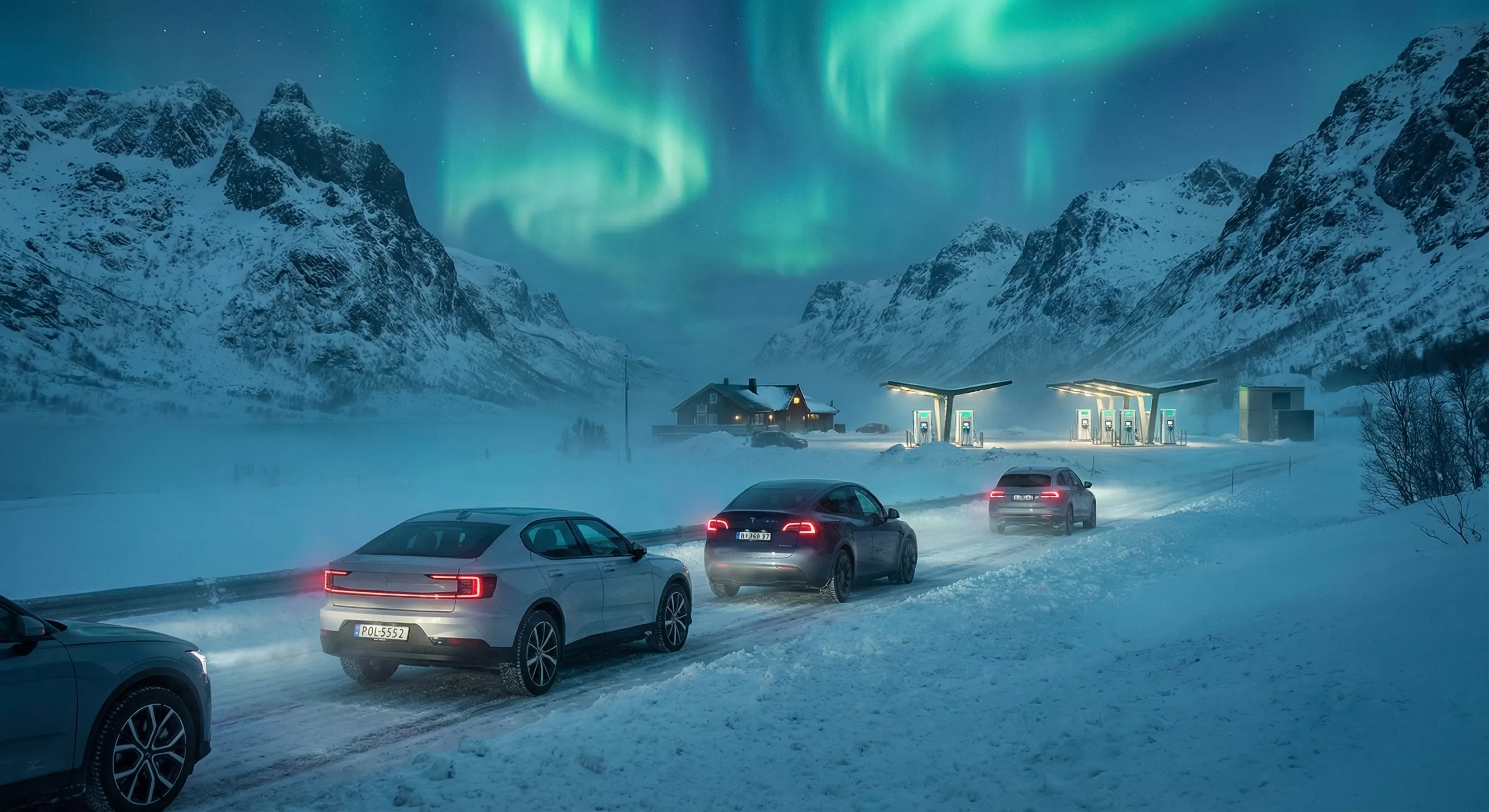
At -20°C, a Hyundai IONIQ 6 rated for 581 km might deliver 340. The EPA number was never lying, the cold just rewrites the math, and the math involves three separate physical systems that all get worse at the same time.
Winter range loss is the single most misunderstood feature of owning an EV in Canada. It's not one thing going wrong. It's chemistry, cabin heat, and charging physics compounding on each other, and each one responds to different habits. Get the mechanism right and you can claw back most of the loss. Treat it as a black box and you'll spend the winter anxious about a dashboard number that was never designed to survive a Prairie January.
Key takeaways
- At -20°C, a rated-581-km IONIQ 6 may deliver only 340 km, three separate systems fail simultaneously.
- AAA's 2026 data found roughly 39% range loss at -7°C, before cabin heating is even counted.
- A resistive cabin heater pulls 3–5 kW continuously, up to 25% of highway energy consumption at -15°C.
- Heat pumps on the IONIQ 6, Model Y, and EV6 recover 10–15 percentage points of winter range versus resistive-only vehicles.
- A heated steering wheel draws 50 watts; the cabin heater doing equivalent work draws sixty times that.
Quick Answer: How Much Range Do You Actually Lose?
Between 14% and 39%, depending on the vehicle, the temperature, and how you drive. That's the band from the Canadian Automobile Association's on-road testing, Motor Trend confirmed the same directional pattern in its own cold-weather test, noting that driving EVs in cold winter weather comes with a few compromises compared to gas-powered counterparts, but once you know the ropes it's relatively simple to plan around. AAA's 2026 update found roughly 39% range loss at -7°C before cabin heating gets factored in. Recurrent's rolling study of more than 30,000 vehicles confirms the variance is real: not all EVs degrade equally, and the spread between the best and worst performers in winter is wider than the spread in summer.
The rated range is a lab artifact. The cold range is your operating range. Plan the winter around the second number and the anxiety disappears; plan around the first and you'll be white-knuckling every trip past Barrie.
One thing to get out of the way: winter range loss is not battery degradation. The capacity comes back when the pack warms up. You are not damaging anything by driving in the cold, you are just temporarily operating a chemistry that prefers 20°C.
Gear worth having
As an Amazon Associate, ThinkEV earns a small commission from qualifying purchases — at no extra cost to you.

Lectron Level 2 J1772 Charger (40A, WiFi)
Smart WiFi charger with real-time energy monitoring. 40A / 9.6 kW, J1772 with a NEMA 14-50 plug, schedule charging right from your phone.
As an Amazon Associate, ThinkEV earns from qualifying purchases — at no extra cost to you.
The Battery Chemistry Problem: Ions Slow Down
An electric car uses electrical energy as the primary source of propulsion, which means every joule that moves the car has to first move through the electrolyte inside the battery pack. Below 0°C, that electrolyte gets thicker. Lithium ions move more slowly between the anode and cathode, internal resistance rises, and a meaningful fraction of the energy you pull from the pack is lost as heat inside the cells before it ever reaches the motor.
Three practical consequences follow.
First, usable capacity drops. The kilowatt-hours are still in the pack, the battery management system just can't extract them at the rate you're asking for without over-stressing cold cells. Some BMS software will lock a portion of the charge below a threshold temperature specifically to protect cell longevity. Your state-of-charge display may show 80%; the number of kilometres actually available to you might behave like 65%.
Second, regenerative braking weakens or shuts off entirely until the pack warms. Regen is one of the biggest efficiency advantages an EV has over a gas car in stop-and-go traffic, and it's the first thing a cold pack surrenders. In a Toronto winter commute, traffic light, brake, traffic light, brake, losing regen roughly doubles the range penalty you'd expect from chemistry alone. The car is now dissipating kinetic energy as friction heat in the brake pads instead of putting it back in the pack.
Third, the pack's peak power output falls. Acceleration feels softer. In extreme cold (-25°C and below), some vehicles will limit output specifically to protect cells that can't safely deliver their rated current. The car isn't broken. It's cold.
None of this is new physics. Lithium-ion batteries in phones, laptops, and power tools do the same thing, you've probably seen a phone die at 40% on a ski hill. Scaled to a 77 kWh pack pushing a 2,000 kg vehicle up Highway 400, the same effect becomes visible as a range number.
The Cabin Heat Problem: Resistive Heating Is the Real Culprit
Here is the piece that surprises people, because it doesn't involve the battery at all: for many EVs, in many conditions, the cabin heater draws more energy than the chemistry penalty costs you.
A gasoline engine produces enormous amounts of waste heat. Cabin heating in an ICE car is essentially free, you're using energy the engine was going to reject anyway. An EV has no such waste. A resistive cabin heater is an electric element pulling directly from the traction pack, typically 3 to 5 kW continuously to hold a comfortable cabin at -15°C. At highway speeds, where the drivetrain itself might be pulling 15–20 kW to maintain 110 km/h, the heater is a 25% surcharge on your energy consumption for as long as it runs.
Heat pumps change the math. A heat pump moves heat rather than generating it, which means it can deliver two to three units of cabin warmth for every unit of electricity it consumes. In practical terms, a heat pump cuts cabin heating energy draw by roughly 50–60% compared to a resistive element in the temperature range where most Canadian winter driving happens. Tesla, Hyundai, Kia, and BMW now offer heat pumps on select models, the IONIQ 6, Model Y, and Kia EV6 are the ones most often cited in real-world winter comparisons.
Gear worth having
As an Amazon Associate, ThinkEV earns a small commission from qualifying purchases — at no extra cost to you.
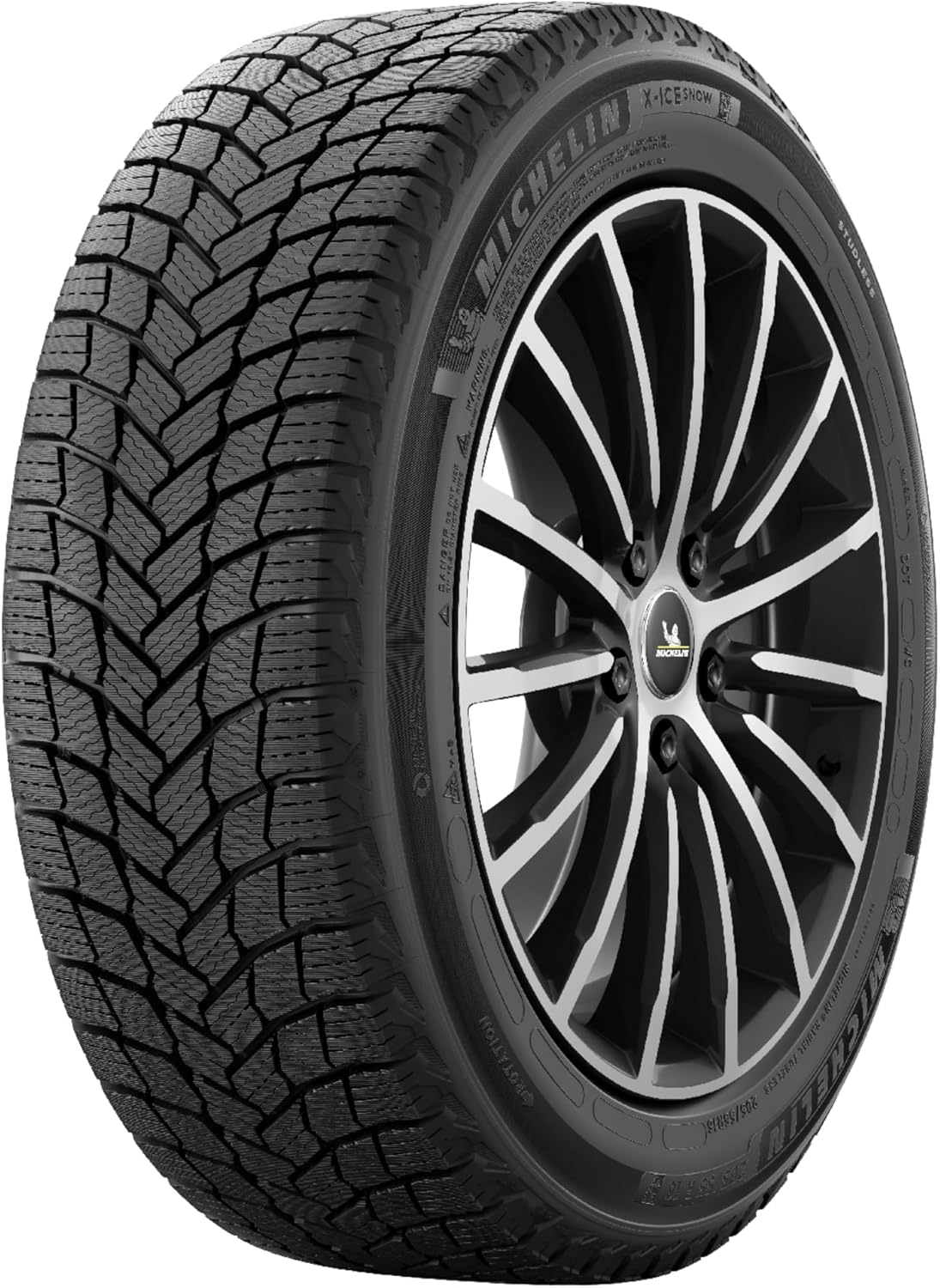
Michelin X-Ice Snow Tires (EV-rated)
EV-specific winter tires with low rolling resistance that recover up to 15 percent of cold-weather range. Mandatory in Quebec, smart everywhere else.
As an Amazon Associate, ThinkEV earns from qualifying purchases — at no extra cost to you.
Below about -10°C, heat pump efficiency starts to fall, and most vehicles blend in resistive heating to compensate. The advantage narrows. But even at -20°C a heat pump vehicle typically outperforms an equivalent resistive-only vehicle by 10–15 percentage points of range in mixed driving. If you're shopping specifically for a Canadian winter, checking the heat-pump spec is arguably more important than checking the rated range. For a deeper model-by-model breakdown, CAA's 14-EV Canadian winter test shows exactly which vehicles hold up when the temperature drops.
The other thing worth doing: use seat and steering wheel heat before you touch the climate controls. Warming the surfaces that touch your body directly is dramatically more efficient than heating the entire air volume of the cabin. A heated steering wheel draws about 50 watts. A cabin heater doing the same subjective work draws sixty times that.
Gear worth having
As an Amazon Associate, ThinkEV earns a small commission from qualifying purchases — at no extra cost to you.

Grizzl-E Classic Level 2 EV Charger (40A)
Canadian-made and rated for minus 40C winters. 40A / 9.6 kW, NEMA 14-50, indoor/outdoor, 24-ft cable. The charger built for Canadian weather.
As an Amazon Associate, ThinkEV earns from qualifying purchases — at no extra cost to you.
The Charging Physics Problem: Why Topping Up Takes Longer
The third mechanism is charging, and it has its own separate physics. A cold battery cannot accept DC fast charge at its rated speed, the same internal resistance that limits discharge also limits acceptance. The BMS throttles incoming current to keep cell temperatures inside the safe window. What was a 30-minute session in July becomes a 45-minute session in January, and you're paying for the same number of kilowatt-hours plus the overhead of a longer stall session in the cold.
Some vehicles handle this well. The Porsche Taycan and Hyundai IONIQ 6 will pre-condition the pack en route to a fast charger if you route through the vehicle's navigation, the car actively warms the battery to its optimal charging window before you arrive. Plug in cold and the first 10 minutes are essentially the pack warming itself up on the charger's dime; plug in pre-conditioned and you're at full acceptance rate from the moment the handle clicks in. That's the difference between a 25-minute stop and a 45-minute one.
For the deeper math on how much cold weather slows fast charging, the winter DC fast charging breakdown walks through the numbers by temperature and battery chemistry.
The overnight charging story is simpler and more important. Plugging in at home overnight keeps the pack at operating temperature via shore power, you're spending grid electricity, not pack electricity, to hold the battery warm. This is the single highest-ROI cold-weather habit in EV ownership, and it costs almost nothing on residential rates. A pack that sits at -25°C in a driveway all night starts the morning at -25°C and has to warm itself using its own energy just to deliver rated performance. A pack that sits plugged in starts at 15°C and delivers close to summer range from the first kilometre.
Gear worth having
As an Amazon Associate, ThinkEV earns a small commission from qualifying purchases — at no extra cost to you.

EcoNour 27-inch Snow Brush and Ice Scraper
An aluminum brush and scraper combo that clears a windshield fast without scratching. Non-negotiable for Canadian mornings.
As an Amazon Associate, ThinkEV earns from qualifying purchases — at no extra cost to you.
Four Habits That Actually Move the Needle
Most of the winter range loss you read about is measured on cold-soaked vehicles driven cold. That's the worst case. The habits below close a meaningful fraction of the gap, and none of them require buying a different car.
Pre-condition while plugged in. Every modern EV lets you schedule departure or trigger a warm-up from the app. Do it. Warming the cabin and the pack on shore power costs pennies from the grid and zero from your usable range. If you can only adopt one habit, this is it.
Time your charging to complete just before departure. A pack that finished charging at 2 a.m. and sat until 7 a.m. in a -20°C driveway has lost most of the thermal benefit of the charge. Set the charge to complete 15–20 minutes before you leave. The pack rolls out of the driveway warm.
Use seat and wheel heat first, cabin heat second. Warm the surfaces touching your body, then use the cabin heater on a low setting to hold ambient rather than to overpower it. Reduce fan speed after the initial warmup. The delta on a two-hour drive is real, often 20 to 30 kilometres of range preserved.
Plan charging stops 10–15% earlier than summer. Cold packs charge slower, and you have less usable buffer to begin with. Arriving at a fast charger with 5% in January is not the same experience as arriving with 5% in July. Build the trip around 15%-arrival, not 10%-arrival, and the stress evaporates. Norway's -27°C El Prix testing is a useful reference for how different vehicles behave at the extreme end of the range.
None of this is complicated. The winter range problem is not a mystery and it's not a defect. It's three well-understood physical mechanisms, each with a habit that mitigates most of the loss. The dashboard number in February will never match the dashboard number in July. Once you stop expecting it to, the car works fine.
Gear worth having
As an Amazon Associate, ThinkEV earns a small commission from qualifying purchases — at no extra cost to you.

Magnetic Windshield Snow Cover
Skip the scraping. Magnets hold it on, peel it off with the snow, and your defroster stops draining range on cold mornings.
As an Amazon Associate, ThinkEV earns from qualifying purchases — at no extra cost to you.

Founder & Chief Editor
Vlad Pereira is the founder and chief editor of ThinkEV.ca, the Canadian electric-vehicle publication he writes and edits from Courtenay, British Columbia. He covers EV pricing, federal and provincial rebates, charging costs, and the Chinese manufacturers now entering Canada, from the buyer's side rather than the press-fleet side. ThinkEV is a venture of Vlad Pereira Online; his writing on health, income and the long game lives at vladpereira.com.
Frequently asked questions
Does cold weather permanently shrink my EV's battery capacity?
Which drains more range in winter: the battery or the heater?
Is a heat pump actually worth it for Canadian winters?
Why does regenerative braking disappear on cold mornings?
Why does DC fast charging take longer in January than July?
More EV & road-trip finds
Affordable upgrades worth a look — tap any to check the price on Amazon.
 ★ 401
★ 401Crochet Daisy Rear-View Mirror Charm
View on Amazon ★ 12,396
K KNODEL Car Trash Can with Lid
View on Amazon ★ 308
★ 308Coiled Lightning Car Cable for iPhone (2-Pack)
View on Amazon ★ 61
★ 61Toddler Car Seat Snack and Cup Tray
View on Amazon ★ 17,839
Qifutan Vent Phone Mount (Military-Grade Clip)
View on Amazon ★ 47,507
HOMEXCEL Microfiber Cloths (12-Pack)
View on Amazon ★ 164
★ 164Solar-Powered LED Ambient Light
View on Amazon ★ 900
★ 900Personalized Photo Car Air Freshener
View on AmazonRead, Plan, Then Stay Current
Explore our expert articles to understand incentives and ownership costs, use the map to pressure-test charging reality, then subscribe so new EV coverage comes straight to you.
Continue Reading
Which EV Actually Works in a Canadian Winter?
Public EV Chargers in Canada: 33,000 Now, 447,000

EV Highway vs City Range: Why They Flip
Longest-Range Electric Cars You Can Buy in Canada (2026)
What BYD's Solid-State Battery Means for Canada