Key takeaways
- Canadian gas prices have risen an average of 6.3% per year since 2019, per Natural Resources Canada, the ongoing cost that erodes a cheap gas car's advantage.
- The 2026 Toyota Corolla LE starts at $26,990 before taxes and fees.
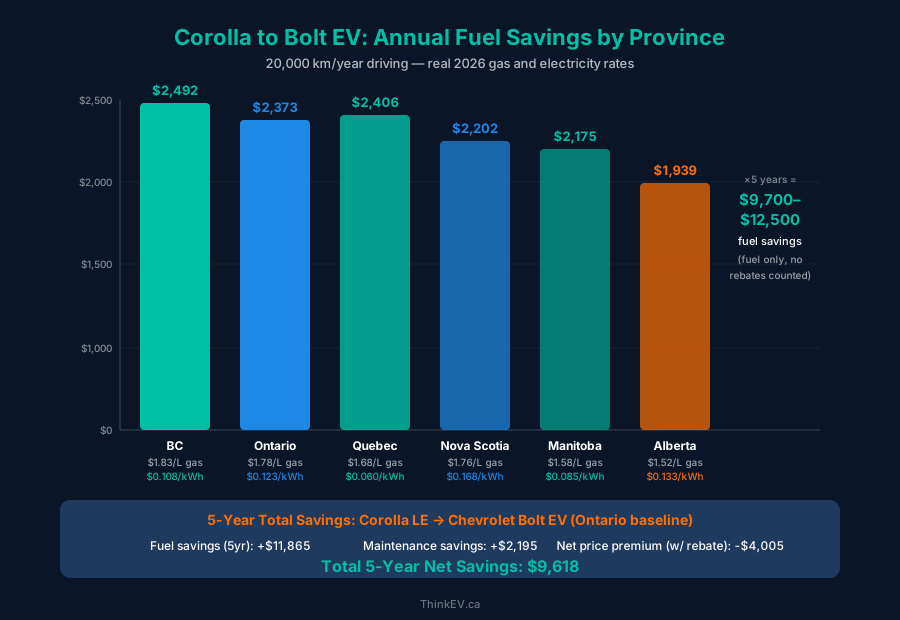
- At about 7.7 L/100 km, switching that Corolla to an EV saves roughly $1,900 (Alberta) to $2,500 (BC) a year in fuel at 20,000 km.
- The 2026 Hyundai Kona Electric starts at $44,995, an $18,005 premium over the Corolla, dropping to $39,995 after the $5,000 federal EVAP rebate.
- Five-year scheduled maintenance on the Corolla runs roughly $3,070 to $6,000, while the Bolt's tire-rotation-only service is $240–$300 over the same span, no oil, plugs, or transmission fluid.
Here is a number that changes everything.
$5,614.
That is how much a Canadian family driving 20,000 km a year saves, across five years of ownership, in one modeled scenario by switching from a 2026 Toyota Corolla LE to a 2027 Chevrolet Bolt EV. The scenario can still be useful, but it needs to be labelled properly. The Bolt side of the math depends on current incentive rules, a published starting MSRP, and several operating assumptions, not on a fully locked final Canadian trim sheet.
Nine thousand six hundred and eighteen dollars.
That is a year of university tuition. That is a family vacation to Europe. That is a significant chunk of a down payment on a home. And it is sitting on the table, being left behind every year that Canadians keep topping up their Corollas at 1.80 a litre and booking oil changes for cars that do not need to exist in 2026.
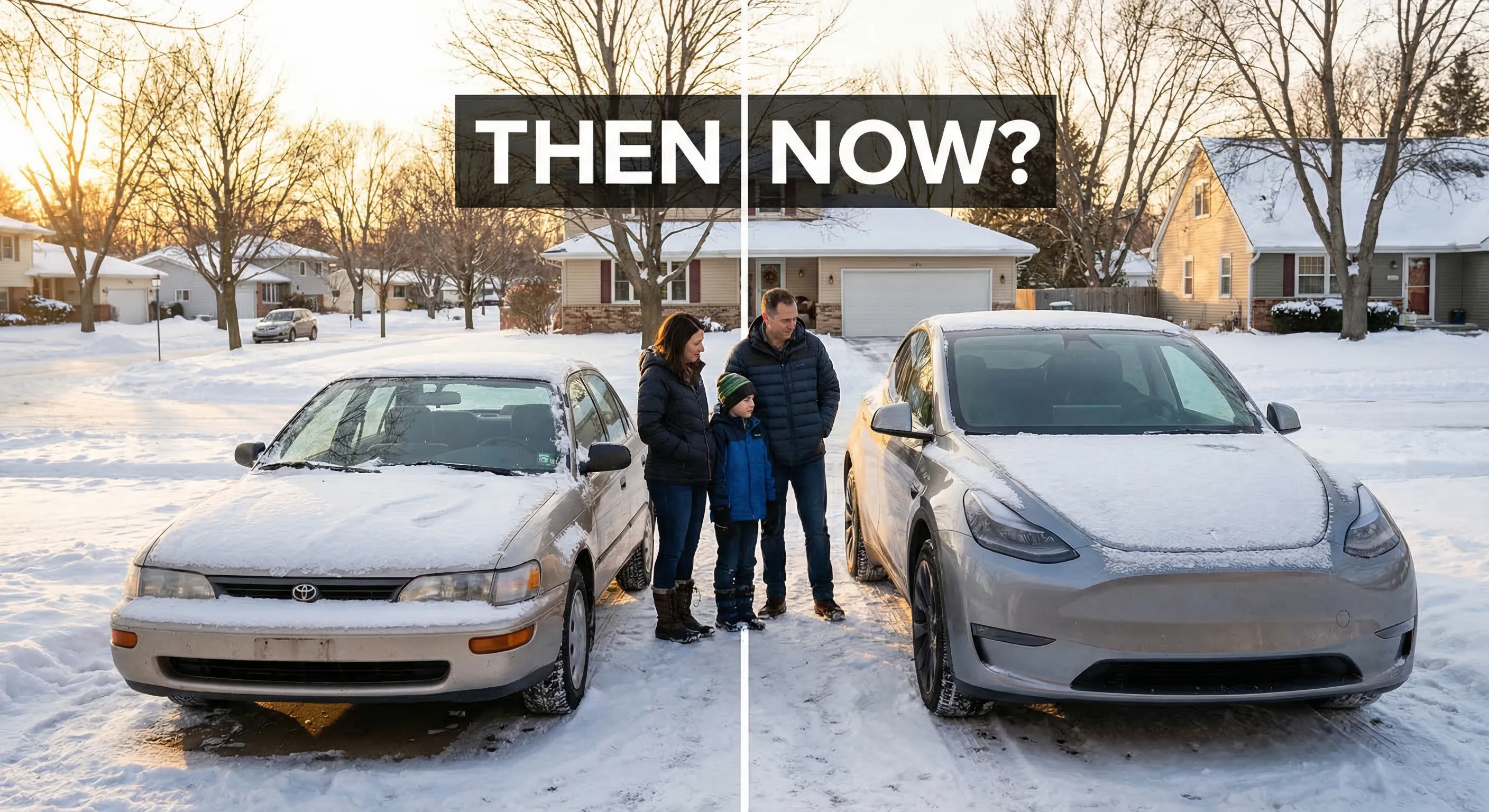
I want to be clear upfront: the Toyota Corolla is not a bad car. It is, objectively, one of the finest internal combustion vehicles ever built. It is reliable, efficient by gas-car standards, practical, affordable to buy, and cheap to insure. If someone handed me one for free today, I would be grateful. The problem is not the Corolla. The problem is the ongoing cost of fuel in a country where gas prices have risen an average of 6.3% per year since 2019 according to Natural Resources Canada data. The problem is the oil-change-brake-fluid-timing-belt-spark-plug-coolant-flush maintenance treadmill that ICE vehicles demand. The problem is that the math, the actual, total-cost-of-ownership math, has shifted, and shifted permanently, in favour of the EV.
This guide does not ask you to love the environment. It does not ask you to care about carbon. It asks you to look at numbers. If the numbers make sense for your situation, you switch. If they do not, you keep the Corolla. But let's actually look at the numbers.
Why Corolla Owners Specifically Should Run This Math
The Corolla is not chosen randomly as the comparison point. It is chosen because it is the benchmark of rational car ownership in Canada. According to Statistics Canada's vehicle registration data, Toyota has held the top-three spot in Canadian car sales for more than two decades, and the Corolla is consistently one of the highest-selling sedans in the country. When a Corolla owner does the EV math, they are doing it from the most defensible, most rational starting position possible. If the EV wins against a Corolla, the poster child of sensible, efficient gas-car ownership, it wins against everything.
The 2026 Toyota Corolla LE starts at $26,990 before taxes and fees. It returns fuel economy of approximately 7.7 L/100 km in combined city/highway driving, which is genuinely good for a gas-powered sedan. It carries a $3,995 scheduled maintenance cost over the first five years according to Toyota Canada's published service intervals. It depreciates to approximately 55-60% of its purchase value after five years, which is better than most sedans.
On every metric that car people care about, the Corolla scores well. And the EV still wins.
That is the core point of this entire comparison. If the EV cannot beat the Corolla, it cannot beat anything worth comparing. It can beat it. Let me show you how.
The Purchase Price Reality
The first thing most people think about when considering an EV is the sticker price. EVs cost more than comparable gas cars, that is still true in 2026, though the gap has narrowed dramatically from where it was in 2022 or 2023. The question is not whether the EV costs more upfront, it usually does. The question is whether the total cost of ownership over the time you actually own the vehicle comes out ahead.
Let's set up our three comparison vehicles.
The 2026 Toyota Corolla LE sits at $26,990. No rebates available. No federal incentive program for gas cars. You pay the full sticker price, add HST or GST/PST depending on your province, finance it, and drive away. Simple.
The 2027 Chevrolet Bolt EV is still the most useful EV comparison point for a Corolla owner, but the price assumption needed correction. Chevrolet Canada now publishes a starting MSRP of C$39,999. On current EVAP rules, that would bring the modeled net cost to roughly C$34,999 before provincial stacking, not the lower figure this article originally used.
The 2026 Hyundai Kona Electric is the second comparison. It starts at $44,995, which is a steeper $18,005 premium over the Corolla. After the $5,000 EVAP rebate, that drops to $39,995, still $13,005 more than the Corolla. The Kona Electric is a better car in many ways, offering AWD options, longer range, and more cabin space. But the premium is real and it takes longer to recover through operating cost savings.
Why include both? Because different families have different needs. A single person who drives 15,000 km a year and wants the absolute best financial case should be looking at the Bolt. A family of four who drives 25,000 km a year and wants AWD, more cargo space, and longer range should be looking at the Kona. The math is different but the conclusion is the same.
One important note on Chinese EVs like the BYD Dolphin, which is still discussed in Canada as a lower-priced option: BYD vehicles do not qualify for the EVAP rebate because they are manufactured in China. The Dolphin remains compelling on sticker price. The Bolt remains stronger on current incentive access. The exact gap is narrower or wider depending on which assumptions you plug in, which is why this article should be read as scenario math, not as a universal final answer.
The Fuel Cost Breakdown by Province
This is where the comparison gets interesting, because Canada is not one province. Gas prices and electricity rates vary enormously across the country, and so do the annual fuel savings from switching to an EV.
Let me run the math for 20,000 km per year, a typical Canadian annual mileage that is neither unusually low nor unusually high.
Ontario: Gas averages $1.78/L as of March 2026 (Natural Resources Canada monthly survey data). A Corolla at 7.7 L/100 km burns through $2,744 in fuel per year over 20,000 km. Ontario electricity at the standard household rate runs approximately $0.123/kWh (Ontario Energy Board regulated rate). The Bolt EV uses approximately 15.1 kWh/100 km (EPA rating, adjusted for Canadian mixed driving conditions). That is 3,020 kWh for 20,000 km, which costs $371 in electricity. Annual fuel savings: $2,373. Over five years: $11,865.
British Columbia: Gas averages $1.83/L (Metro Vancouver is often higher, interior BC lower, this is a provincial blend). Corolla annual fuel: $2,818. BC Hydro residential rates average approximately $0.108/kWh for Tier 1 usage (most home charging falls in this tier). EV annual electricity: $326. Annual savings: $2,492. Over five years: $12,460. If you apply the current federal rebate and a $4,000 CleanBC stack to the Bolt's published C$39,999 starting MSRP, the modeled net cost becomes roughly C$30,999.
Quebec: Gas averages $1.68/L, the cheapest in Canada, largely due to lower provincial fuel taxes. Hydro-Québec residential electricity at the regulated rate runs approximately $0.060/kWh. EV annual electricity: $181. Annual savings: $2,406. Over five years: $12,030. With current federal and provincial stacks applied to the Bolt's published starting MSRP, the modeled net cost becomes roughly C$32,999.
Alberta: Gas averages $1.52/L, low fuel taxes make Alberta one of the cheaper provinces for gas. Corolla annual fuel: $2,341. ATCO and ENMAX electricity rates average approximately $0.133/kWh (Alberta's deregulated market means rates vary more than other provinces). EV annual electricity: $402. Annual savings: $1,939. Over five years: $9,695. Alberta has no provincial EV rebate, which makes the financial case here the weakest of the major provinces, but it still comes out positive.
Manitoba: Gas averages $1.58/L. Manitoba Hydro runs some of the cheapest electricity in the country outside Quebec, averaging approximately $0.085/kWh. Corolla annual fuel: $2,432. EV annual electricity: $257. Annual savings: $2,175. Over five years: $10,875. Manitoba offers a $2,500 provincial EV rebate.
Nova Scotia: Gas averages $1.76/L. Nova Scotia Power electricity averages approximately $0.168/kWh, one of the highest rates in the country. Corolla annual fuel: $2,709. EV annual electricity: $507. Annual savings: $2,202. Over five years: $11,010. Nova Scotia offers a $3,000 provincial EV rebate. Despite the high electricity rates, the savings are still significant because gas is also expensive.
The takeaway across all provinces: the annual fuel savings from switching to an EV over a Corolla range from approximately $1,900 (Alberta) to $2,500 (BC), with most provinces landing in the $2,100-$2,400 range. Over five years, that is $9,700 to $12,500 in fuel savings alone, before touching maintenance, depreciation, or insurance.
The Maintenance Math: Where EVs Quietly Win
Fuel costs are the headline number, but maintenance is where EV ownership quietly destroys the Corolla over a five-year ownership period. Let me be specific about what maintaining a Corolla actually costs.
Toyota Canada's official scheduled maintenance guide for the 2026 Corolla LE calls for:
-
Oil and filter change every 8,000 km (engine oil with filter): approximately $80-$110 per visit at a Toyota dealership, less at an independent shop. At 20,000 km/year, that is 2-3 oil changes per year. Over five years: approximately $900-$1,300.
-
Tire rotation every 8,000 km: $20-$40 per rotation, bundled with oil changes at many shops. Over five years: approximately $300-$500.
-
Cabin air filter: every 25,000 km, approximately $40-$80 per replacement. Over five years: approximately $160-$320.
-
Engine air filter: every 50,000 km or sooner in dusty conditions. $25-$60 per replacement. Two replacements in five years: approximately $50-$120.
-
Transmission fluid: CVT models (which is what the 2026 Corolla uses) require fluid changes at 50,000-100,000 km intervals. One change over five years: approximately $150-$250 depending on dealer.
-
Brake fluid flush: every 2 years or 40,000 km. Two to three flushes over five years: approximately $180-$360.
-
Spark plugs: the Corolla uses iridium plugs with a 120,000 km service life, you will not hit this in five years. But at 100,000 km (year five for high-mileage drivers), it is due: approximately $200-$350.
-
Brake pads and rotors: highly variable by driving style, but a full brake service (all four corners) typically runs $400-$800 at a Toyota dealer. Most Corolla owners can expect at least one partial brake service in five years.
Running through a realistic five-year scenario for a typical Corolla driver:
- Oil changes: $1,100
- Tire rotations: $400
- Cabin and engine air filters: $350
- Transmission fluid: $200
- Brake fluid: $270
- Brake pads (one service, front axle): $350
- Incidental repairs and wiper blades: $400
Total estimated five-year maintenance: approximately $3,070 to $6,000, depending on how conscientious you are, whether you use a dealer or independent shop, and whether you encounter any unexpected repairs. The Canadian Automobile Association's publicly available maintenance cost estimates align with this range.
Now let's talk about an EV's maintenance schedule.
The Chevrolet Bolt EV does not have:
- An engine
- Engine oil
- An oil filter
- Spark plugs
- Timing chain
- Transmission fluid (it has a single-speed reduction gear, not a traditional transmission)
- Exhaust system
- Fuel injectors
- An alternator
- A starter motor
- Coolant that requires periodic flushing (there is a thermal management system, but it is closed-loop with significantly longer service intervals)
What the Bolt EV does require over five years:
-
Tire rotations: every 10,000-12,000 km. At $30 per rotation, over 100,000 km that is 8-10 rotations: approximately $240-$300. Note that EV tires wear faster than gas car tires due to instant torque, so rotation is important.
-
Cabin air filter: same as the Corolla, $40-$80 every 25,000 km. Over five years: approximately $160-$320.
-
Brake fluid flush: every 2-3 years. The Bolt has significantly extended brake fluid service intervals compared to ICE vehicles. One flush over five years: approximately $90-$150.
-
Brake pads: the Bolt uses regenerative braking for the vast majority of deceleration, meaning the physical brake pads experience dramatically less wear. On many EVs, the original brake pads last 150,000-250,000 km, you will almost certainly not need a brake service in five years.
-
Wiper blades: same as any car. $40-$80.
Realistic five-year maintenance for the Bolt EV:
- Tire rotations: $280
- Cabin air filter: $240
- Brake fluid: $120
- Wiper blades: $60
- Incidentals: $300
Total estimated five-year maintenance: approximately $1,000 to $1,500.
Compare that to the Corolla's $3,070-$6,000.
The five-year maintenance savings delta: approximately $2,070 to $4,500, depending on your assumptions. Let's use a conservative middle figure of $3,000 in favour of the EV.
Add that to the fuel savings. In Ontario, you are already looking at $11,865 in fuel savings plus $3,000 in maintenance savings, $14,865 in operational savings before touching the purchase price delta.
The purchase price delta in this updated model is $8,009 in favour of the Corolla after the current federal rebate assumption. The EV can still pay back that premium through operating savings, but not as quickly as this article originally claimed.
The 5-Year Total Cost of Ownership: The Full Picture
Let me pull all the numbers together in one place, because the sum is more convincing than any individual line item.
Toyota Corolla LE 2026-5-Year Ontario Scenario:
- Net purchase price: $26,990
- 5-year fuel cost (20,000 km/year, $1.78/L, 7.7 L/100 km): $13,728
- 5-year maintenance: $4,500 (midrange estimate)
- 5-year insurance (Ontario average for a mid-30s driver with clean record, sedan): $9,000 (based on Insurance Bureau of Canada data, approximately $1,800/year)
- 5-year total cost: $54,218
Chevrolet Bolt EV 2027-5-Year Ontario Scenario:
- Net purchase price (after current $5,000 EVAP assumption): $34,999
- 5-year fuel cost (20,000 km/year, $0.123/kWh, 15.1 kWh/100 km): $1,855
- 5-year maintenance: $1,250 (midrange estimate)
- 5-year insurance (Ontario average for a compact EV, comparable driver profile): $10,500 (approximately $2,100/year, EVs typically run $200-$400/year higher due to higher replacement cost and specialized repair considerations)
- 5-year total cost: $48,604
5-year TCO advantage for the Bolt EV in this modeled scenario: approximately $5,614
Let me also run the Kona Electric at a slightly higher annual mileage since it is a more capable vehicle that typically attracts higher-mileage buyers:
Hyundai Kona Electric 2026-5-Year Ontario Scenario (25,000 km/year):
- Net purchase price (after $5,000 EVAP): $39,995
- 5-year fuel cost (25,000 km/year): $2,319
- 5-year maintenance: $1,400
- 5-year insurance (compact SUV EV): $11,500
- 5-year total cost: $55,214
5-year TCO comparison vs. Corolla at 25,000 km/year:
- Corolla at 25,000 km/year: fuel goes up to $17,160, maintenance stays similar, insurance similar. 5-year total: approximately $59,160.
- Kona Electric at 25,000 km/year: $55,214.
- Advantage for Kona: $3,946.
The higher-mileage driver gets a stronger financial case. Every extra kilometre driven is fuel savings for the EV and fuel spending for the Corolla. The break-even point, where the EV's higher purchase price is recovered through fuel and maintenance savings, falls earlier the more you drive.
When Do You Break Even?
The Math by Mileage
This is the question every rational Corolla owner asks: "How long before I actually come out ahead?"
The answer depends on three variables: how many kilometres you drive annually, what you paid net for the EV (after rebates), and what your local electricity rate is.
Here is the break-even analysis for the Bolt EV vs. Corolla in Ontario, at different annual mileages:
At 10,000 km/year:
Annual fuel savings: approximately $1,186. Annual maintenance savings: approximately $600. Total annual savings: approximately $1,786. Premium paid for EV in this updated model (net of EVAP, but above Corolla sticker): approximately $8,009. Break-even: approximately 4.5 years.
At 15,000 km/year:
Annual fuel savings: approximately $1,779. Annual maintenance savings: approximately $600. Total annual savings: approximately $2,379. Break-even: approximately 1.7 years. Five-year net advantage: $7,890.
At 20,000 km/year:
Annual fuel savings: approximately $2,373. Annual maintenance savings: approximately $600. Total annual savings: approximately $2,973. Break-even: approximately 1.35 years. Five-year net advantage: $10,860.
At 25,000 km/year:
Annual fuel savings: approximately $2,966. Annual maintenance savings: approximately $600. Total annual savings: approximately $3,566. Break-even: approximately 1.12 years. Five-year net advantage: $13,825.
The break-even point is remarkably short in every scenario, under two and a half years even for light drivers. This is the part of the analysis that consistently surprises people who approach EV ownership thinking the payback is a decade away. At current gas prices and electricity rates, the Bolt EV pays off its purchase premium in 13 to 27 months depending on how much you drive.
Depreciation: The Most Underappreciated Factor
Nobody talks about this enough, and it might be the most important variable of all.
Vehicle depreciation is typically the single largest cost of car ownership, dwarfing fuel and maintenance combined in many scenarios. And in the EV market of 2026, the depreciation story is more nuanced than the simple narrative of "EVs hold value poorly."
The Toyota Corolla has an excellent depreciation track record. According to Canadian Black Book data, the Corolla depreciates to approximately 65-70% of its MSRP after three years and approximately 55-60% after five years. On a $26,990 Corolla, that means the car is worth approximately $14,844-$16,194 after five years, a loss of $10,796-$12,146.
The Chevrolet Bolt EV's depreciation story has improved considerably from the early-generation first-run Bolts. The original 2017-2019 Bolt suffered terrible depreciation, partly due to the battery recall issues and partly due to early EV market hesitancy. But post-recall, updated Bolts have depreciated more similarly to comparable small EVs. The 2027 Bolt EV, with its fresh design and updated battery technology, is expected by Canadian Black Book to retain approximately 50-55% of its MSRP after five years, similar to the Bolt EUV's recent resale performance.
On a net purchase price of roughly $34,999 after the current federal rebate assumption, that means a five-year residual value of approximately $17,500-$19,250 if the car retains 50-55% of that net starting point.
The Corolla wins the depreciation comparison modestly, you lose roughly $3,000-$4,000 less in depreciation value on the Corolla over five years. This is real money and should not be ignored.
But here is where the analysis gets important: depreciation is not an out-of-pocket expense. You do not write a cheque for your car's depreciation. The depreciation "loss" only materializes if and when you sell the vehicle. If you are comparing lifetime cost of ownership, which is the correct comparison for someone planning to drive a car for 10+ years, depreciation matters less.
If you plan to sell after five years, the Corolla's depreciation advantage reduces but does not eliminate the EV's operating cost advantage. The Bolt still wins overall in most scenarios, just by a smaller margin. If you plan to keep the vehicle for 8-10 years (which is common for the value-minded Corolla owners this comparison is written for), the EV's operating cost advantage compounds while depreciation concerns fade, the car is worth similarly little at 200,000 km regardless of drivetrain.
The Home Charging Requirement
One thing that needs to be addressed directly: everything in this analysis assumes home charging.
Home charging is the foundation of EV ownership economics. When you charge at home on a Level 2 (240V) charger, you are paying the residential electricity rate, $0.06/kWh in Quebec, $0.08/kWh in Manitoba, $0.12/kWh in Ontario. That is the cheapest energy source available to you.
If you rely primarily on public DC fast chargers, the math changes dramatically. Electrify Canada's pricing averages approximately $0.35-$0.49/kWh for CCS fast charging sessions. At $0.45/kWh average, the Bolt EV's fuel cost for 20,000 km in Ontario jumps from $371 to $1,358. That is still cheaper than $2,744 in gas, but the savings are much smaller, approximately $1,386/year instead of $2,373/year.
Public charging dependence arises in two scenarios:
- Apartment or condo dwellers without dedicated parking and charging access
- Drivers who do not want to install a Level 2 charger at home
If you own a home with a garage or driveway and 240V outlet access (or the ability to have one installed), home charging is simple and cheap. A Level 2 home charger costs $500-$800 installed, and adds $0 to your operating costs (beyond the electricity itself). You plug in at night the same way you plug in your phone. You wake up to a full battery every morning. You never visit a gas station.
Gear worth having
As an Amazon Associate, ThinkEV earns a small commission from qualifying purchases — at no extra cost to you.

Grizzl-E Classic Level 2 EV Charger (40A)
Canadian-made and rated for minus 40C winters. 40A / 9.6 kW, NEMA 14-50, indoor/outdoor, 24-ft cable. The charger built for Canadian weather.
As an Amazon Associate, ThinkEV earns from qualifying purchases — at no extra cost to you.
Gear worth having
As an Amazon Associate, ThinkEV earns a small commission from qualifying purchases — at no extra cost to you.
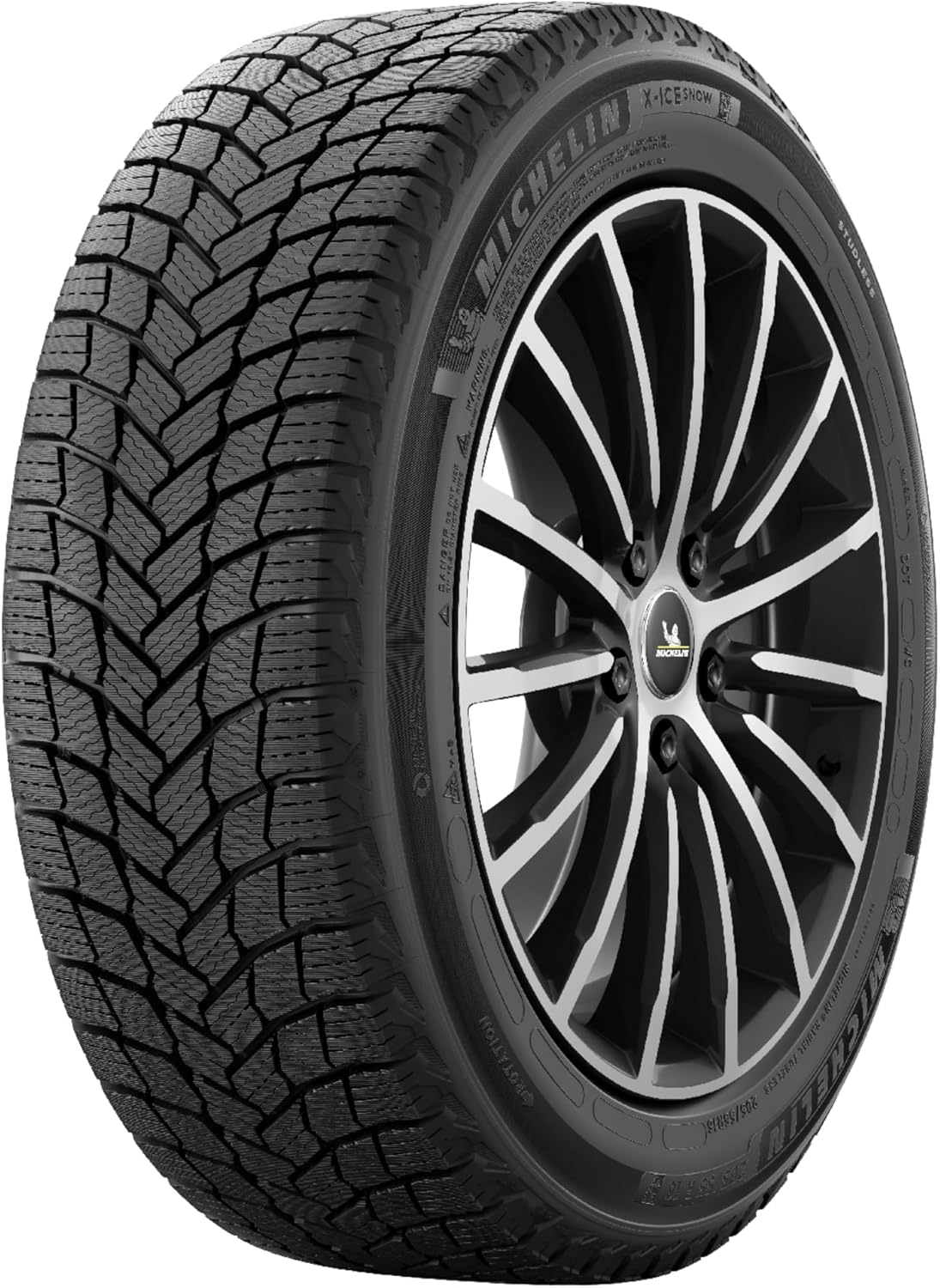
Michelin X-Ice Snow Tires (EV-rated)
EV-specific winter tires with low rolling resistance that recover up to 15 percent of cold-weather range. Mandatory in Quebec, smart everywhere else.
As an Amazon Associate, ThinkEV earns from qualifying purchases — at no extra cost to you.
If you live in an apartment or condo without charging, you need to either find a building that is adding charging (many are, given provincial building code updates requiring EV-ready outlets in new construction) or plan your charging around work, shopping, and errand locations that have chargers. It is more friction-heavy, but it is increasingly manageable as the infrastructure builds out.
The advice: if you cannot home charge, do not switch yet. Wait until your building adds charging, until you move somewhere with charging access, or until the public charging network in your area is mature enough to make the experience frictionless. Owning an EV without home charging in 2026 is like owning a smartphone without home Wi-Fi, possible, but more expensive and more annoying than it needs to be.
What Canadian Incentives Actually Apply in 2026
Let's be precise about what money is on the table for a Corolla owner making the switch.
Federal EVAP (Electric Vehicle Availability Program): Up to $5,000 for new passenger vehicles under the applicable current programme rules. The 2027 Chevrolet Bolt is expected to fit at its published starting MSRP, but final eligibility should always be verified against the live programme terms and the transaction value on the deal.
For the full EVAP breakdown, see our Canada EVAP Rebate Guide 2026.
British Columbia, CleanBC Go Electric: Up to $4,000 for qualifying new battery-electric vehicles purchased by BC residents, with the usual programme caveat that funding and rule details can change. Using the Bolt's published C$39,999 starting MSRP, a modeled BC stack would bring the car to roughly C$30,999 before taxes and fees.
Quebec, Roulez vert: Using a C$2,000 provincial stack on top of the current federal assumption, the Bolt's modeled starting point in Quebec becomes roughly C$32,999 before taxes and fees.
Manitoba, Green Energy Equipment Tax Credit: $2,500 rebate for new EVs purchased by Manitoba residents. Stackable with federal EVAP. Manitoba Bolt buyer: $5,000 + $2,500 = $7,500 off. Net cost: $28,495.
Nova Scotia: Up to $3,000 provincial rebate for new EVs under $55,000 MSRP. Stackable with federal EVAP. Net cost: $27,995.
Ontario: Currently no provincial EV rebate. Federal EVAP only. Modeled Bolt starting point in Ontario: roughly C$34,999 before taxes and fees.
Alberta: No provincial EV rebate. Federal EVAP only. Modeled Bolt starting point in Alberta: roughly C$34,999 before taxes and fees.
For the complete breakdown of provincial incentives and how to claim them, see our EV Rebates by Province Canada 2026 guide.
The Insurance Reality
EVs typically cost more to insure than comparable gas cars. This is real, it should not be glossed over, and the reasons are legitimate:
- Higher replacement cost for the vehicle itself
- Specialized repair requirements, not every body shop is equipped for EV high-voltage systems
- Battery replacement risk (though batteries are now covered under longer warranties than before)
- Less historical actuarial data compared to the 50-year history of ICE vehicle claims
In Ontario, Insurance Bureau of Canada data suggests EVs in the $30,000-$45,000 range insure at approximately $200-$400/year more than a comparable-value gas vehicle for a comparable driver. That is $1,000-$2,000 over five years, a real but modest offset against the fuel and maintenance savings.
Provincial variation matters here too. Quebec has regulated automobile insurance that keeps rates lower across the board. Alberta and Ontario tend to have higher average rates. Atlantic provinces vary. Shopping multiple insurers matters more for EVs than for gas cars because underwriters are still calibrating their risk models, and the spread between the cheapest and most expensive EV insurance quotes tends to be larger than for gas vehicles.
The net position: EVs cost more to insure, and that extra insurance cost reduces but does not come close to eliminating the operational savings from fuel and maintenance. Budget for it, shop around, and do not let it be the deciding factor.
Driving Range and the Psychology of Switching
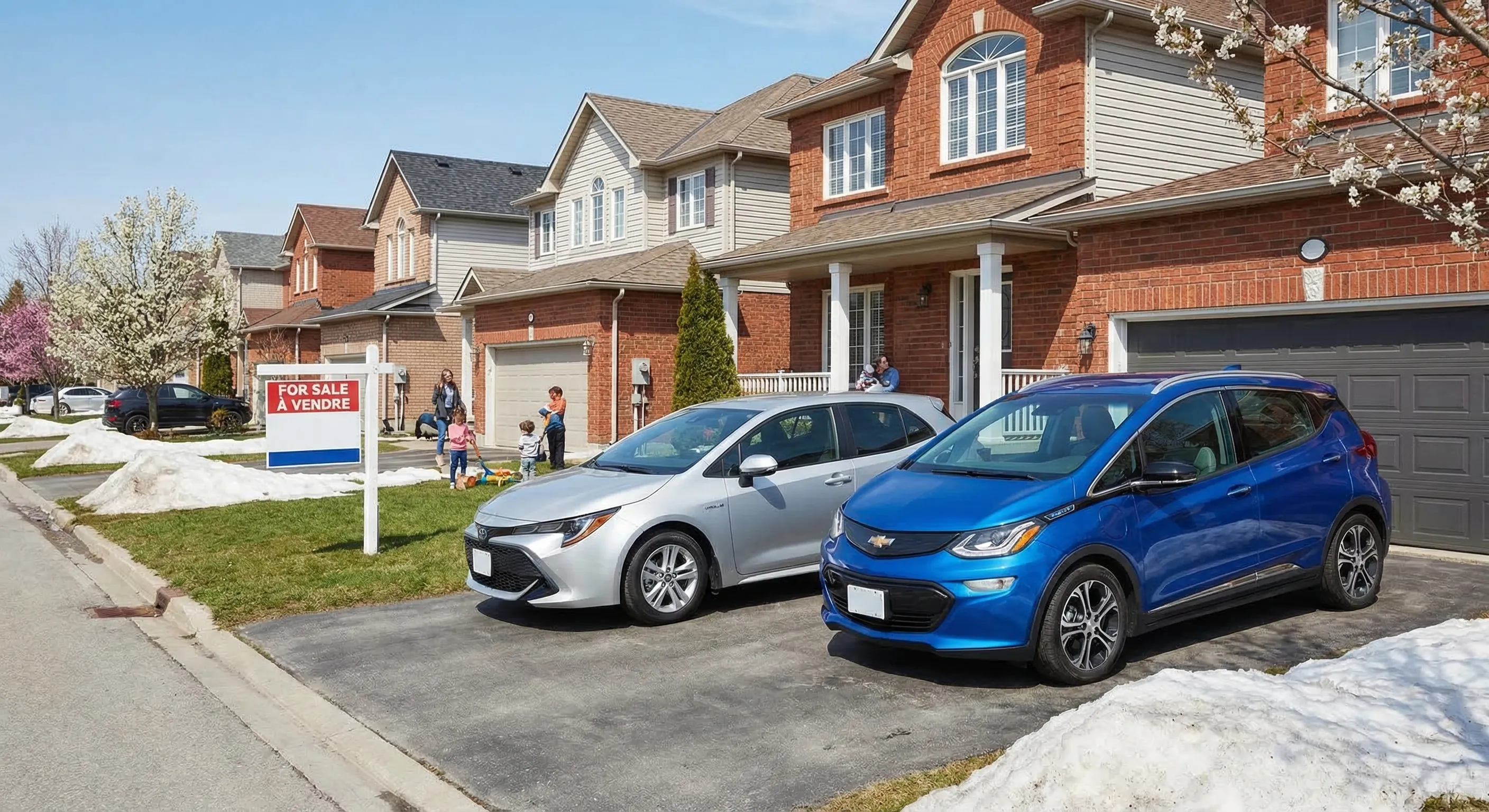
Every EV buyer goes through range anxiety. I want to be direct with you about this: it is mostly psychological, especially for a Corolla owner.
Chevrolet Canada publishes up to 422 km estimated range for the 2027 Bolt EV. Real-world Canadian summer and winter outcomes still need to be treated as estimates until independent Canadian testing catches up.
A Toyota Corolla, with its 50-litre tank and approximately 650 km real-world range, never makes you think about range on a daily basis. You notice the fuel gauge dropping over several days, refuel when it hits a quarter tank, and continue.
The EV experience is structurally different, not worse. With home charging, you start every morning at the range you set, typically 80% charge for daily driving, or 100% when you know you have a long day. A 20,000 km annual driver covers approximately 55 km per day. The Bolt's worst-case winter range of 230 km covers four days of driving at that rate. If you charge every night (plugging in takes ten seconds, it is not an effort), you start every day with essentially a full "tank."
The situations where range anxiety is legitimate:
- Long road trips on routes where fast charging infrastructure is sparse
- Unexpected detours or traffic that adds significant distance to an already-long day
- Extreme cold snaps (-30°C+) where winter range drops to 180-200 km on older or base-spec EVs
For the vast majority of Canadian daily driving, school runs, commutes, grocery trips, weekend errands, the Bolt's published 422 km estimated range is more than enough on paper. The basic daily-use argument still stands even after tightening the specs.
For road trips, the calculus depends on where you drive. The Trans-Canada between major cities, Vancouver to Kelowna, Toronto to Ottawa, Halifax to Moncton, has adequate DC fast charging infrastructure through Electrify Canada and the Petro-Canada Electric Highway. Chevrolet Canada says the new Bolt supports up to 150 kW DC fast charging and can go from 10% to 80% in 26 minutes, which is a materially stronger road-trip position than the old Bolt had.
The Corolla vs.
EV Winter Reality
Canada in January tests the limits of any vehicle. Let me be concrete about what EV ownership looks like in a Canadian winter rather than brushing it off with platitudes.
Heat pump efficiency: both the Bolt EV and Kona Electric include heat pumps for cabin heating. A heat pump is three to four times more energy efficient than resistive heating at temperatures above -10°C. Below -15°C, efficiency drops and the heat pump supplements with resistive heating. The bottom line: at -10°C, your heat pump cuts cabin heating energy consumption by roughly 60-70% compared to a resistive-only system. That preserves range.
Battery preconditioning: modern EVs like the Bolt and Kona let you schedule or remote-start the car to warm the battery and cabin while still connected to your home charger. This is not just about comfort, warming the battery while plugged in means you leave home with a full battery, not a battery that spent energy warming itself from a cold start. This single feature recovers 20-40 km of winter range compared to driving a cold EV on a cold morning. Use it. Set a scheduled departure time in the app the night before. Every EV owner in Canada should do this habitually.
Regenerative braking on ice: one thing new EV drivers discover quickly is that aggressive regenerative braking on ice is not wise. Most EVs allow you to reduce regen intensity, and in slippery conditions you want to do this, the abrupt deceleration from maximum regen on ice can cause a slide. Set regen to low or off on icy surfaces and use the friction brakes smoothly instead.
Winter tires are not optional in Canada. In Quebec they are legally mandatory December through March. Everywhere else, if you are driving in snow or ice, winter tires are the single most impactful safety upgrade you can make on any vehicle, EV or otherwise. EVs do not have a winter tire exemption.
The Bolt EV's front-wheel-drive configuration handles winter reasonably well with good winter tires, though it does not match the AWD traction of a Kona Electric Preferred AWD or a Tesla Model Y Long Range. If your commute involves unplowed country roads, steep hills, or you live in a rural area where winter conditions are more severe, the AWD variants are worth the additional cost.
Gear worth having
As an Amazon Associate, ThinkEV earns a small commission from qualifying purchases — at no extra cost to you.

TP-Link Kasa Smart Plug with Energy Monitoring
Track exactly how much electricity your Level 1 charger uses and schedule it for off-peak hours. Know your real cost per kWh.
As an Amazon Associate, ThinkEV earns from qualifying purchases — at no extra cost to you.
Scenarios Where Switching Does Not Make Sense Yet
You do not have home charging and cannot get it. If you live in an apartment with no charging infrastructure and your employer, gym, and usual destinations have no charging, public charging dependence makes EVs more expensive and more inconvenient than the numbers suggest. Check whether your building is adding charging (many are, especially new construction) and wait if needed.
You drive less than 8,000 km per year. At very low mileage, the fuel and maintenance savings are insufficient to recover the purchase price premium within any reasonable ownership horizon. A very low-mileage Corolla driver is better off keeping the Corolla, which will last 15 years with minimal maintenance at that rate.
You need to tow regularly. The Bolt EV has no official tow rating. The Kona Electric is rated for a modest 1,587 kg (3,500 lbs) tow capacity. If you regularly pull a boat trailer, camper, or large trailer, neither of these vehicles is appropriate. You are looking at an F-150 Lightning, Rivian R1T, or Cybertruck territory, different vehicles, different economics.
You plan to sell within 18-24 months. The upfront premium for the EV does not recover in under two years unless you are a very high-mileage driver. If you know you are moving or downsizing your vehicle in the near term, a Corolla makes more financial sense.
You finance at a high interest rate. The EV's higher sticker price (before rebates) means more dollars financed and more interest paid. At 8-10% financing rates, the interest cost on an additional $4,000-$15,000 of financing over five years adds $800-$4,000 to the EV's total cost of ownership. This reduces but does not eliminate the EV advantage for most scenarios. Do your own financing math.
The Corolla You Already Own: Should You Keep It or Switch Now?
This is the most common real question I get: "I already have a 2020 Corolla with 60,000 km on it. Should I trade it in?"
The answer: probably not immediately. The economics of switching are strongest when you are already buying a new vehicle. Trading in a car you already own resets the depreciation clock and typically means absorbing the worst phase of the existing car's depreciation (you already paid for the first-year 20% drop, but the car still has value-loss ahead of it).
If your Corolla is less than 5 years old and in good condition, the financially optimal play is usually to drive it until it has 150,000-200,000 km (the Corolla will do this easily), then switch to whatever EV is available and affordable at that future point. In five years, EVs will be cheaper, more capable, and even better value than they are today.
If your Corolla is 8-12 years old with 120,000+ km, the math changes. Older gas cars increasingly face escalating maintenance costs, timing chain service, cooling system work, catalytic converters. An older Corolla is still reliable, but the cost curve is rising. At this point, trading toward a new EV with an 8-year battery warranty and minimal maintenance can make economic sense even accounting for the sticker premium.
The trigger I suggest watching for: once the trade-in value of your existing Corolla drops below $8,000-$10,000, the remaining years of depreciation are small and the ongoing maintenance/fuel costs may justify switching sooner. Run the specific numbers for your car's condition and your driving pattern before deciding.
Real Corolla Owners Who Made the Switch: What They Report
The anecdotal evidence from Corolla owners who have switched to EVs is fairly consistent across the major Canadian EV communities (the r/CanadianEV subreddit, various provincial Facebook EV groups, and ThinkEV's own reader community).
The most common reports:
- Monthly running costs drop significantly and immediately, most people report saving $150-$250/month once they are fully on home charging and no longer buying gas
- The first six months involve a psychological adjustment period where former Corolla owners check the charge level more often than they need to, this fades
- People who drive a lot say they "forgot how annoying gas stations were" within a few months
- The morning routine of plugging in before bed and having a full "tank" every morning becomes genuinely preferred to fuel station visits
- Winter range anxiety is real but manageable with habit changes (scheduled preconditioning, modest target charge levels, planning DC fast charge stops on longer drives)
- People who switched and then rented a gas car for a trip consistently report finding the experience of filling up mildly tedious
The people who report disappointment with their switch tend to cluster in two categories:
- Those who underestimated their road trip needs and feel limited by public-charging stops, even if the new Bolt is materially quicker than the old one on paper
- Those who switched without adequate home charging and are dealing with the friction of dependence on public infrastructure
The lesson: the fit between your lifestyle and EV ownership matters as much as the financial math. Both need to align for the switch to be satisfying.
The Long-Term Outlook: Why the Math Only Gets Better
Everything in this comparison is based on 2026 numbers. And the trajectory is clearly in the EV's direction.
Gas prices in Canada have risen an average of 6.3% per year since 2019, according to Natural Resources Canada data. Even at a more conservative 4% annual increase, gas in Ontario goes from $1.78/L today to approximately $2.16/L by 2031. That Corolla that costs $2,744 per year in fuel today costs $3,329/year by year five at 4% annual price increases, adding another $2,900+ to its five-year fuel cost.
Electricity rates in Canada are also rising, but more slowly and from a lower base. The Ontario Energy Board's rate increase over the past five years has averaged approximately 2-3% per year, compared to gas's 6.3%. The fuel cost gap between EVs and gas cars is widening over time, not narrowing.
EV purchase prices are falling, but this article needs to stay anchored to the published Bolt starting MSRP of C$39,999 rather than older internal estimates. As battery costs continue their decade-long decline, the upfront purchase premium for EVs should shrink, but current switching decisions still need to be made on today's actual numbers, not the last draft's.
Maintenance costs for EVs will also decline as more mechanics are trained on EV servicing, parts supply chains mature, and the volume of EVs on the road creates competitive pricing pressure. The current modest premium for EV insurance should normalize as insurers accumulate more actuarial data.
The trend line is clear. The 2026 math already favours the EV in most scenarios. The 2031 math will favour it even more strongly.
Making the Decision: A Framework for Corolla Owners
Here is how I would think through this decision if I were a Corolla owner in 2026.
Step 1: Check your home charging situation. Do you have a garage, driveway, or condo spot with 240V access (or the ability to add it)? If yes, proceed. If no, EV ownership will be more expensive and more inconvenient, wait until this changes.
Step 2: Assess your annual mileage. If you drive 15,000 km or more per year, the financial case is strong and break-even comes in under 2 years. If you drive under 10,000 km/year, the payback period stretches and may not justify the upfront premium, lean toward waiting.
Step 3: Identify your use case. Mostly local driving (commute, errands, short trips under 200 km)? Any EV works. Regular road trips on well-served corridors? You need adequate DC fast charging support on your route, and you should verify it before buying. Rural living with long distances between charging? Research carefully.
Step 4: Know your provincial incentive stack. BC and Quebec buyers get substantial provincial rebates that dramatically improve the economics, the Bolt EV in BC costs less than the Corolla after incentives. Alberta and Ontario buyers rely on federal EVAP alone, which still works but by a smaller margin.
Step 5: Run your numbers. Do not use my Ontario numbers if you live in Alberta. Gas price in your province, electricity rate in your province, your annual mileage, your financing rate. The framework holds everywhere but the exact savings vary.
If you get through all five steps and the math works, and for most Canadian Corolla owners it will, the switch is not just financially rational. It is also genuinely better on the experience side for daily driving. Less noise. Less vibration. Instant torque off the line. Regenerative braking. Starting every day with a full charge. Never visiting a gas station for routine driving.
The Corolla is a great car. The EV, for most Canadian families in 2026, is a better financial decision.
Gear worth having
As an Amazon Associate, ThinkEV earns a small commission from qualifying purchases — at no extra cost to you.

P3 Kill A Watt Electricity Usage Monitor
Plug in your charger and see exactly what you spend in kWh, cost, and watts. Settle the is-my-EV-really-cheaper debate with data.
As an Amazon Associate, ThinkEV earns from qualifying purchases — at no extra cost to you.
Related Reading
- EV Rebates by Province Canada 2026, Every provincial EV incentive explained, with eligibility requirements and how to claim.
- Best Level 2 EV Chargers Canada 2026, The home charging equipment you need to make EV ownership frictionless.
- Canada EVAP Rebate Guide 2026, How to claim your $5,000 federal EV incentive, which vehicles qualify, and what disqualifies you.
- BYD Dolphin Canada Review 2026, The most affordable new EV in Canada, a serious Corolla alternative at $28,000.
- Most Affordable EVs in Canada 2026, Every sub-$40K EV available to Canadians, ranked and compared.
Gear worth having
As an Amazon Associate, ThinkEV earns a small commission from qualifying purchases — at no extra cost to you.

EcoNour 27-inch Snow Brush and Ice Scraper
An aluminum brush and scraper combo that clears a windshield fast without scratching. Non-negotiable for Canadian mornings.
As an Amazon Associate, ThinkEV earns from qualifying purchases — at no extra cost to you.

Founder & Chief Editor
Vlad Pereira is the founder and chief editor of ThinkEV.ca, the Canadian electric-vehicle publication he writes and edits from Courtenay, British Columbia. He covers EV pricing, federal and provincial rebates, charging costs, and the Chinese manufacturers now entering Canada, from the buyer's side rather than the press-fleet side. ThinkEV is a venture of Vlad Pereira Online; his writing on health, income and the long game lives at vladpereira.com.
Frequently asked questions
How much do I actually save per year switching from a Corolla to an EV in Canada?
What is the best EV to replace a Toyota Corolla in Canada in 2026?
How long does a Bolt EV take to break even against a Corolla?
Does the Toyota Corolla qualify for any EV rebates if I buy one?
Will an EV work for me if I live in an apartment without home charging?
How much does an EV cost to maintain vs. a Corolla over 5 years?
Should I wait for EV prices to drop further before switching?
More EV & road-trip finds
Affordable upgrades worth a look — tap any to check the price on Amazon.
 ★ 87
★ 87Car Window Sun Shades for Kids (4-Pack)
View on Amazon ★ 68
★ 68WeatherTech FloorLiner for Tesla Model 3
View on Amazon ★ 12,051
Windex Electronics Screen Wipes
View on Amazon ★ 419
★ 419RGB Car Interior LED Strip Light
View on Amazon ★ 900
★ 900Personalized Photo Car Air Freshener
View on Amazon ★ 979
★ 979Leather Headrest Purse Hook
View on Amazon ★ 297
★ 297360-Degree One-Hand Dashboard Phone Mount
View on Amazon ★ 121
★ 121Foldable Windshield Sun Umbrella
View on AmazonRead, Plan, Then Stay Current
Explore our expert articles to understand incentives and ownership costs, use the map to pressure-test charging reality, then subscribe so new EV coverage comes straight to you.
Continue Reading
Tesla Model Y vs Toyota RAV4: 5-Year Cost Canada
EV vs Gas: 5-Year Cost of Ownership in Canada
The Best Electric SUVs in Canada (2026): Ranked by Value

EV Charging on Road Trips Across Canada, Is It Viable Yet?

Should I Wait for BYD to Come to Canada?