Key takeaways
- The Rivian R1S and Tesla Model X both cost north of $95,000 and both seat seven.
- Both far exceed the $50,000 final transaction value cap.
- The Long Range model is rated at approximately 543 km, and the Plaid at roughly 499 km.
DECISION FRAME
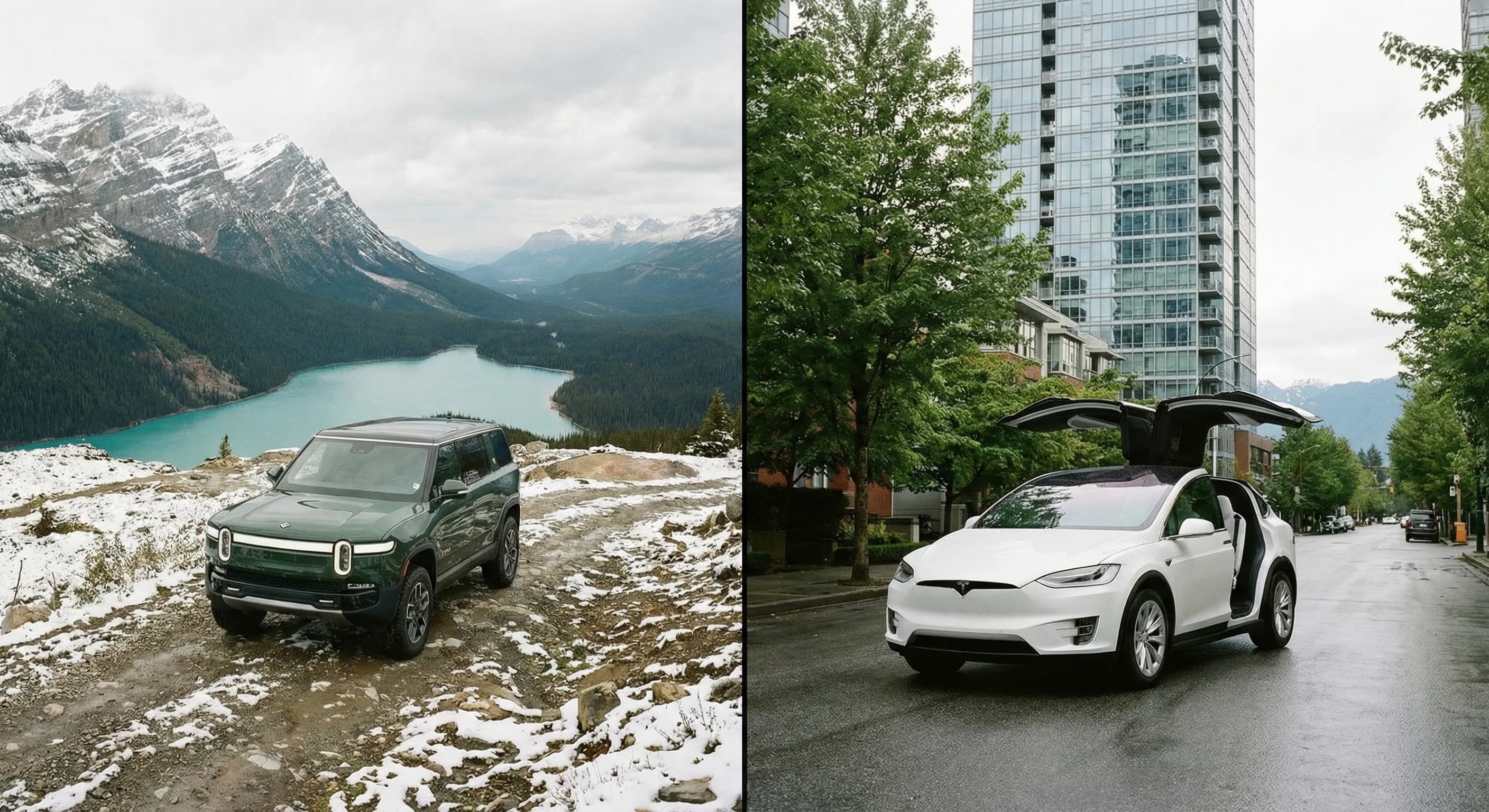
The Rivian R1S and Tesla Model X both cost north of $95,000 and both seat seven. That's where the similarities end. These two vehicles represent fundamentally different ideas about what a premium electric SUV should be, and the right choice depends entirely on how you plan to use it.
The R1S is built for people who actually leave pavement. It has real ground clearance (368 mm with air suspension raised), a quad-motor AWD system that delivers independent torque to each wheel, and water fording capability up to 1,067 mm. If you're driving the logging roads of BC's interior, heading to a backcountry campsite in Algonquin, or working through an unplowed rural road in January, the R1S treats these as normal driving conditions. It's not a luxury SUV that can tolerate a gravel road, it's a genuine off-road vehicle that happens to have a premium interior.
The Model X is built for people who want the fastest, most technologically advanced family hauler money can buy. It accelerates to 100 km/h in 2.5 seconds in Plaid trim, has the largest touchscreen in any production vehicle (17 inches), and benefits from Tesla's mature software ecosystem and Supercharger network. Its falcon-wing doors are a statement piece. If your driving is primarily highway kilometres between Canadian cities, school runs, and the occasional road trip, the Model X does all of that at a level of speed and technology that nothing else in this class matches.
Neither qualifies for the federal EVAP rebate. Both far exceed the $50,000 final transaction value cap. This is a purely out-of-pocket decision.
CAPABILITY
The R1S has genuine off-road hardware. Its quad-motor system produces 835 hp and can vector torque to individual wheels, which means it can keep moving even when one or two wheels lose traction entirely. The adjustable air suspension offers 152 mm of travel, going from a highway-low setting for efficiency to full-height for rock crawling. There are dedicated drive modes for snow, sand, rock crawl, and rally. Approach angle is 35.5 degrees, departure angle is 30 degrees, and breakover angle is 25.6 degrees. These are numbers that would embarrass most traditional body-on-frame SUVs.
The Model X is AWD with dual motors (or tri-motor in Plaid), and it handles well on paved roads and packed snow. But it has 174 mm of ground clearance with no adjustment, a lower approach angle, and no off-road drive modes. In a Canadian winter on plowed roads, the Model X is perfectly capable, its traction control is excellent and the low centre of gravity from the battery pack makes it surprisingly stable. But it's not designed for unpaved terrain, and pushing it beyond maintained roads risks expensive underbody damage.

For Canadian winters specifically, both vehicles handle well. The R1S's advantage shows up on genuinely rough conditions, unplowed cottage roads, icy gravel, deep snow. The Model X's advantage shows up on the highway, where its lower drag coefficient and highway-tuned suspension deliver a smoother, quieter, more efficient ride.
RANGE AND CHARGING
The Model X has the range advantage. The Long Range model is rated at approximately 543 km, and the Plaid at roughly 499 km. Real-world highway driving in Canadian conditions (mixed temperatures, highway speeds) typically delivers 420-470 km for the Long Range and 380-430 km for the Plaid. Winter drops that by 20-30%, so expect 300-370 km in cold weather.
The R1S with the Large Pack (131.8 kWh) is rated at approximately 483 km. Real-world driving delivers roughly 370-420 km in moderate conditions and 280-340 km in winter. The Max Pack option pushes the rating to approximately 507 km but adds weight and cost.
Gear worth having
As an Amazon Associate, ThinkEV earns a small commission from qualifying purchases — at no extra cost to you.
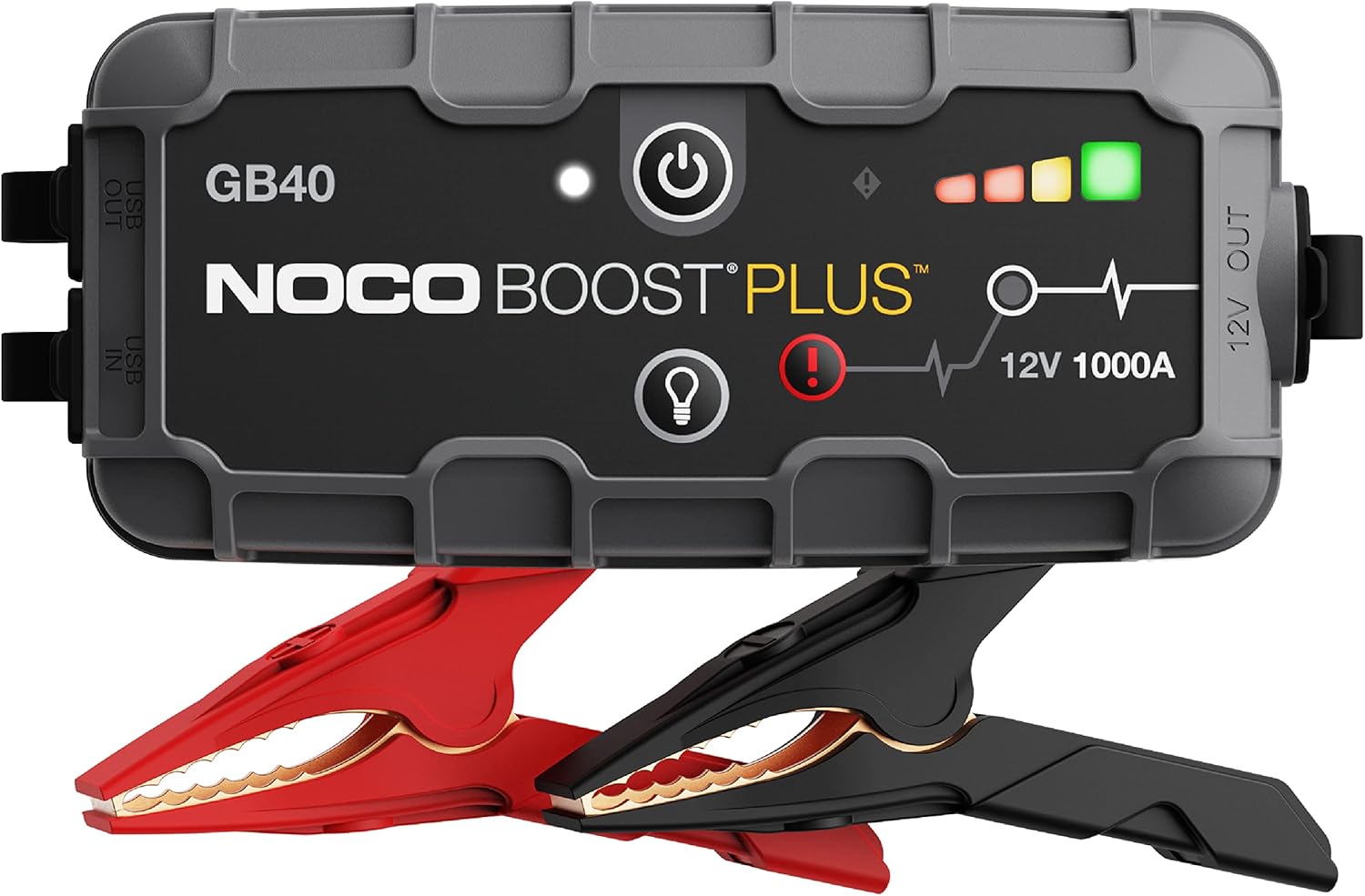
NOCO Boost Plus GB40 Jump Starter
A 1000A lithium jump starter that fits in your glovebox and works on any 12V battery. Your insurance against a dead 12V in a parking lot.
As an Amazon Associate, ThinkEV earns from qualifying purchases — at no extra cost to you.
Charging is where Tesla's ecosystem advantage is most visible. The Model X charges at up to 250 kW on Tesla Superchargers, and Canada has over 800 Supercharger stalls in well-positioned locations along every major highway corridor. A 10-80% charge takes about 30 minutes. The Supercharger network's reliability and coverage in Canada is unmatched.
The R1S charges at up to 215 kW DC, using CCS (and now NACS via adapter). Rivian's own Adventure Network has a handful of Canadian locations but nowhere near Tesla's coverage. You'll rely primarily on Electrify Canada, Petro-Canada Electric Highway, and FLO stations, all of which work fine but are less numerous and occasionally less reliable than Superchargers. A 10-80% charge takes approximately 35 minutes.
Gear worth having
As an Amazon Associate, ThinkEV earns a small commission from qualifying purchases — at no extra cost to you.

Grizzl-E Classic Level 2 EV Charger (40A)
Canadian-made and rated for minus 40C winters. 40A / 9.6 kW, NEMA 14-50, indoor/outdoor, 24-ft cable. The charger built for Canadian weather.
As an Amazon Associate, ThinkEV earns from qualifying purchases — at no extra cost to you.
For a road trip from Calgary to Vancouver, the Model X owner has a smooth Supercharger corridor. The R1S owner needs to plan stops more carefully using Electrify Canada and Petro-Canada stations. Both can do the trip, but the Model X makes it effortless.
INTERIOR AND THIRD ROW
The R1S interior leans toward outdoor durability blended with premium materials. The wood accents are real, the materials are chosen for resistance to dirt and moisture, and the overall vibe is "high-end mountain lodge." The front seats are heated and ventilated, the dashboard has a clean design with a 15.6-inch touchscreen, and there's a massive powered frunk (front trunk) that the Model X matches with its own.
The Model X interior is pure tech showcase. The 17-inch tilting touchscreen dominates the dash, the yoke steering wheel (or optional round wheel) is polarizing, and the second row has articulating seats that tilt and slide forward to access the third row. The falcon-wing doors make loading kids into car seats dramatically easier in tight parking spots, this is one of those features that sounds like a gimmick until you use it daily.
Third row: the R1S has a genuinely usable third row for adults up to about 5'10". Legroom is tight but not punishing, and there's actual headroom. The Model X's third row is slightly less spacious, it works for children and shorter adults, but taller passengers will feel cramped. Both vehicles fold the third row flat for cargo.
Gear worth having
As an Amazon Associate, ThinkEV earns a small commission from qualifying purchases — at no extra cost to you.
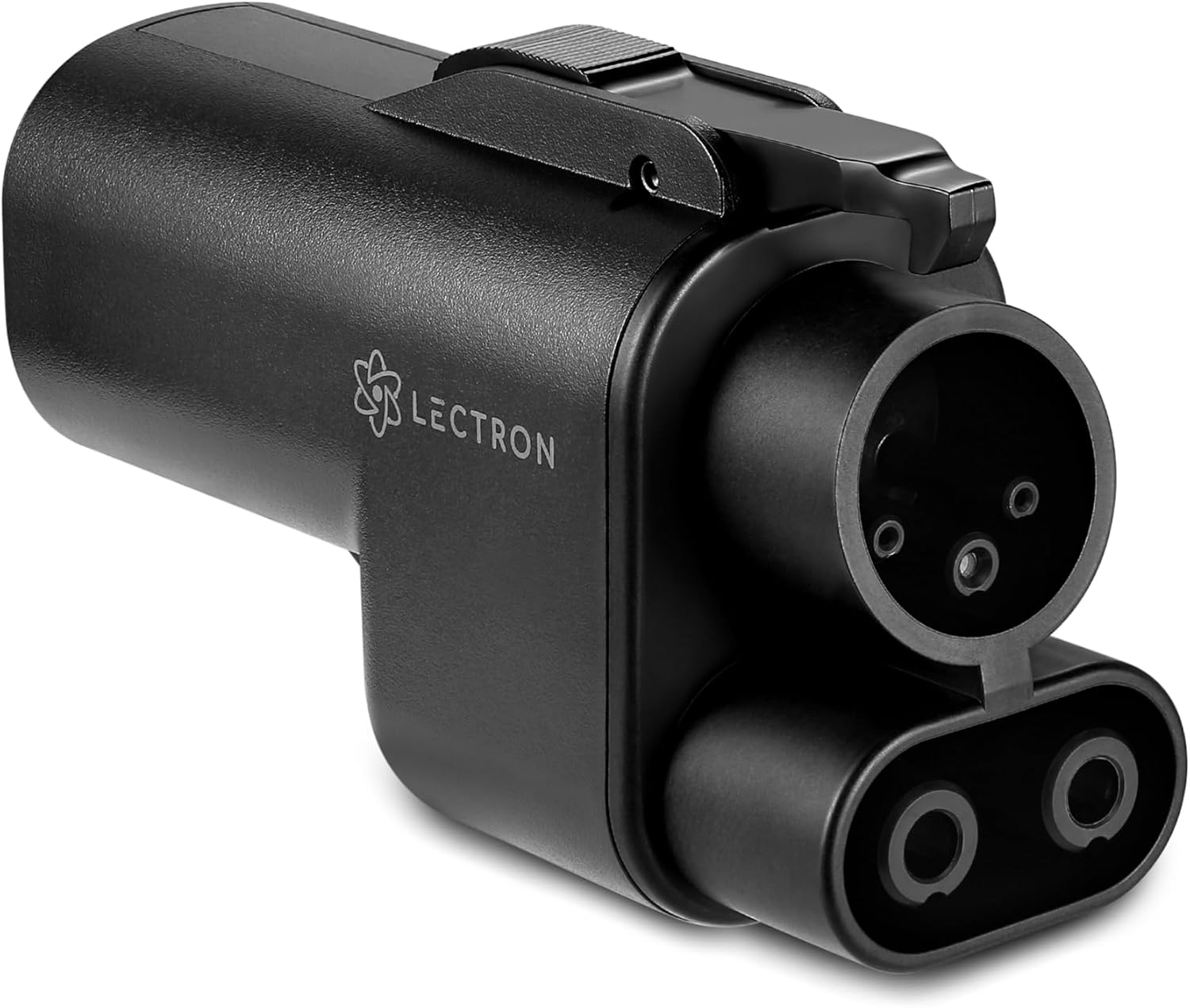
Lectron NACS to CCS Fast-Charge Adapter
Unlock every CCS fast charger for your Tesla, up to 500A DC. Never get stranded at a non-Tesla DC station again.
As an Amazon Associate, ThinkEV earns from qualifying purchases — at no extra cost to you.
Cargo space with the third row up: R1S has approximately 1,050 litres behind the third row, Model X has approximately 700 litres. With all seats folded: R1S offers roughly 2,100 litres, Model X roughly 2,614 litres. The Model X's hatchback shape gives it more total volume, while the R1S's boxier rear end makes loading bulky items easier.
PRICE
The R1S starts at approximately $95,900 CAD for the Dual-Motor model and climbs past $110,000 for the Quad-Motor with the Adventure Package. The Model X starts at approximately $120,990 CAD for Long Range and $145,990 for Plaid.
Neither vehicle qualifies for the $5,000 federal EVAP rebate, both far exceed the $50,000 final transaction value cap. There are no provincial rebates that apply at these price points in any Canadian province. This is full-price territory.
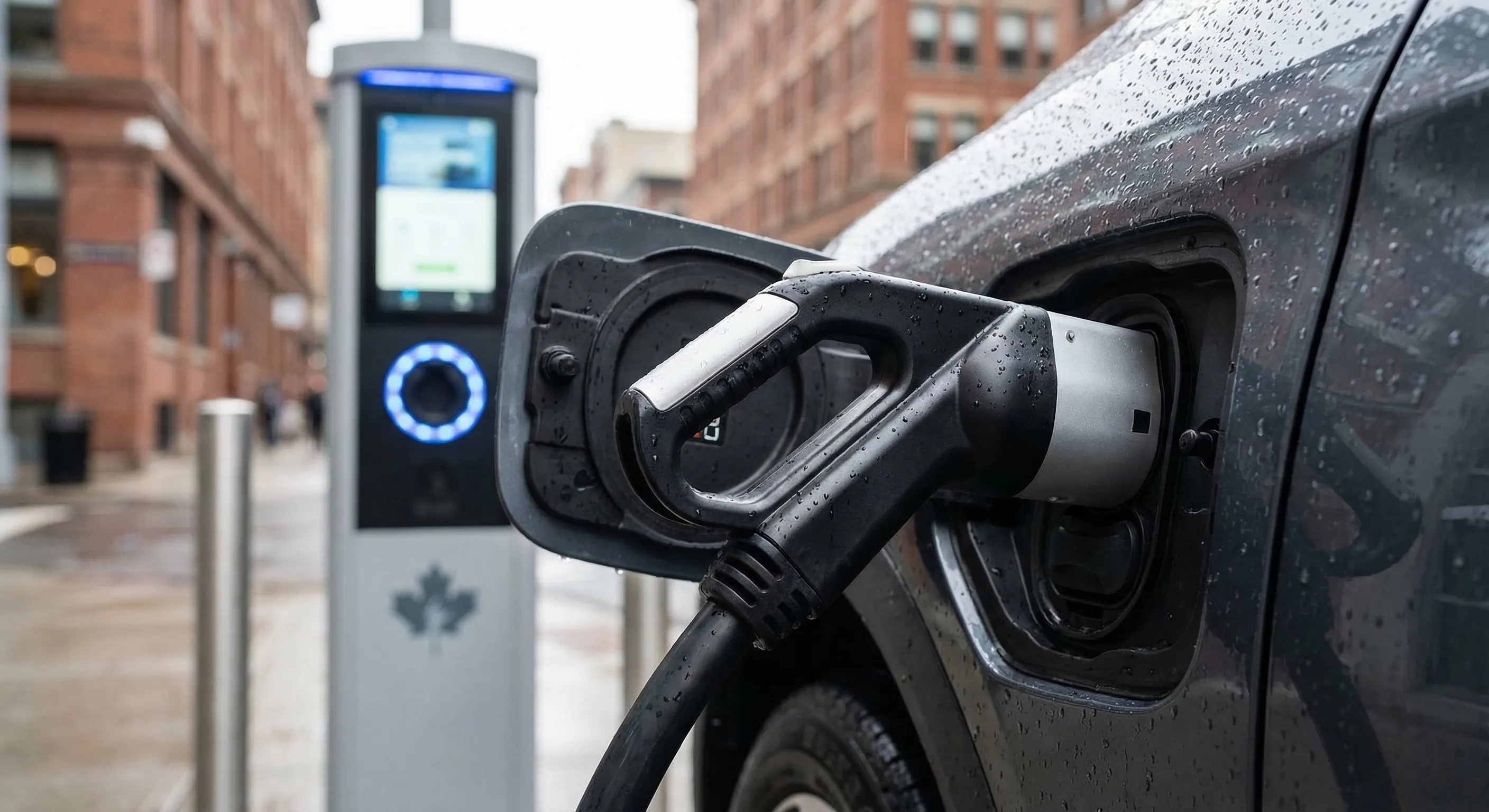
The R1S's lower starting price, roughly $25,000 less than the Model X, is a significant gap. For many buyers, the Rivian represents "premium" while the Tesla represents "luxury." Whether the Model X's extra speed, range, and charging network justify a $25,000 premium is a personal calculation. If charging convenience and sheer performance are your priorities, the Model X earns it. If you want a more capable all-terrain vehicle with a still-excellent interior at a lower price, the R1S is the smarter buy.
VERDICT
If you leave pavement regularly, cottage country, ski resorts with unplowed access roads, backcountry camping, rural properties, the R1S is the clear choice. No other electric SUV in Canada matches its off-road capability, and its on-road manners are perfectly comfortable for daily driving. It's $25,000 cheaper than the Model X and has a more usable third row.
If your driving is 95% paved roads and you want the fastest, most technologically polished electric SUV available, the Model X wins. The Supercharger network alone is worth thousands in convenience over the ownership period, and the Plaid's acceleration is in a class of its own. The falcon-wing doors solve a real problem for families with car seats.
The Model X is the better highway cruiser and tech machine. The R1S is the better all-rounder and adventure vehicle. Both are exceptional, but they're built for different lives.
Gear worth having
As an Amazon Associate, ThinkEV earns a small commission from qualifying purchases — at no extra cost to you.

Tesla Key Card Holder with AirTag Slot
Stop fishing the keycard out of your wallet, and slot an AirTag in case the car wanders off in a lot.
As an Amazon Associate, ThinkEV earns from qualifying purchases — at no extra cost to you.
Related Reading
- Tesla Model Y Juniper Canada Review, Tesla's best-selling EV, refreshed for 2026.
- Kia EV9 vs Hyundai Ioniq 9, The affordable three-row EV alternative.
- EV Rebates by Province Canada 2026, Every provincial and federal rebate compared.
Gear worth having
As an Amazon Associate, ThinkEV earns a small commission from qualifying purchases — at no extra cost to you.
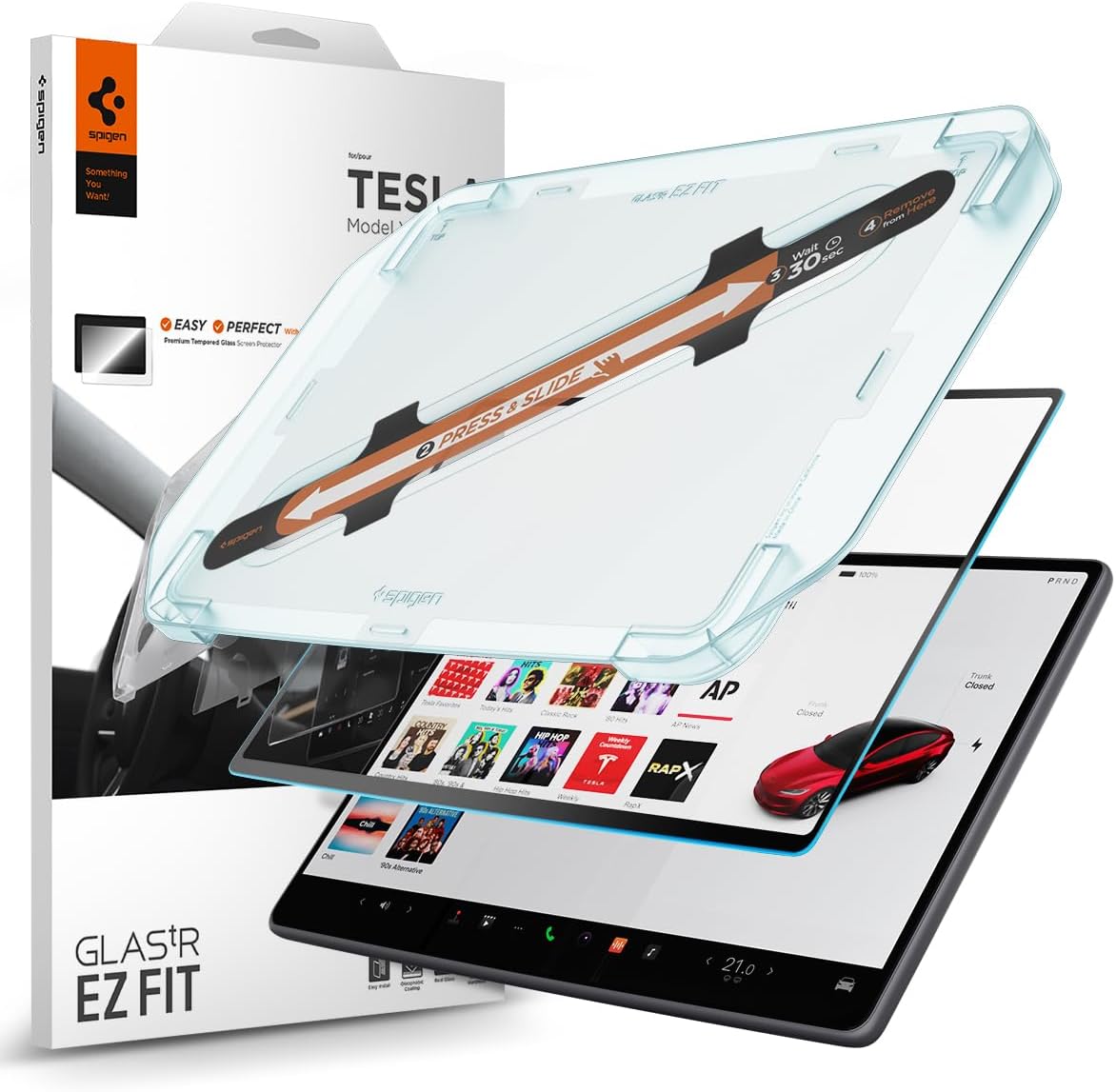
Spigen Tempered Glass for Tesla Model 3/Y
Tempered-glass protection for the touchscreen that kills fingerprints and scratches. Two minutes to install, lasts the life of the car.
As an Amazon Associate, ThinkEV earns from qualifying purchases — at no extra cost to you.

Founder & Chief Editor
Vlad Pereira is the founder and chief editor of ThinkEV.ca, the Canadian electric-vehicle publication he writes and edits from Courtenay, British Columbia. He covers EV pricing, federal and provincial rebates, charging costs, and the Chinese manufacturers now entering Canada, from the buyer's side rather than the press-fleet side. ThinkEV is a venture of Vlad Pereira Online; his writing on health, income and the long game lives at vladpereira.com.
Frequently asked questions
Does either the Rivian R1S or Tesla Model X qualify for EVAP?
Which one handles Canadian winters better?
Can the R1S use Tesla Superchargers?
Which has the better third row?
More EV & road-trip finds
Affordable upgrades worth a look — tap any to check the price on Amazon.
 ★ 61
★ 61Toddler Car Seat Snack and Cup Tray
View on Amazon ★ 17,839
Qifutan Vent Phone Mount (Military-Grade Clip)
View on Amazon ★ 12,051
Windex Electronics Screen Wipes
View on Amazon ★ 314
★ 314Mini USB LED Ambient Lamps (4-Pack)
View on Amazon ★ 401
★ 401Crochet Daisy Rear-View Mirror Charm
View on Amazon ★ 979
★ 979Leather Headrest Purse Hook
View on Amazon ★ 17,242
LISEN Mini USB-C Car Charger (54W)
View on Amazon ★ 87
★ 87Car Window Sun Shades for Kids (4-Pack)
View on AmazonRead, Plan, Then Stay Current
Explore our expert articles to understand incentives and ownership costs, use the map to pressure-test charging reality, then subscribe so new EV coverage comes straight to you.
Continue Reading
Rivian R1T vs F-150 Lightning: Canada 2026 Test
EV vs Gas: 5-Year Cost of Ownership in Canada
BMW i4 vs Tesla Model 3: Is the $11K Premium Worth It?
BYD Atto 3 vs Hyundai Kona EV: The $35K Comparison
BYD Dolphin vs Chevy Bolt 2027: Cheapest EVs