Key takeaways
- Manitoba and PEI buyers stack $4,000 provincial on top of the federal $5,000 for about $9,000 combined, the best in Canada in 2026. Ontario offers $0 provincial.
- Quebec is down to $2,000 (ending Dec 31, 2026), and BC, Nova Scotia, New Brunswick, Newfoundland and the Yukon have ended their rebates, but Ontario's cancellation was a deliberate political choice back in 2018.
- Ontario had one of the most generous EV incentive programs in North America at $14,000, then cancelled it.
- A vehicle with more than 400 km of range collected the full $14,000.
Ontario cancelled a $14,000 EV rebate in July 2018. Eight years later, the province still offers $0 provincial incentive, while a Manitoba or PEI buyer standing in a dealership on the same day, buying the same vehicle, walks out $4,000 ahead.
Manitoba and PEI buyers stack $4,000 provincial on top of the federal $5,000, about $9,000 combined. Quebec adds $2,000 (a combined $7,000), though its program ends December 31, 2026. The provincial map has thinned out since 2024, BC, Nova Scotia, New Brunswick, Newfoundland and the Yukon have all wound down their rebates, but Ontario stands apart for a different reason: it cancelled one of the most generous EV programs in North America, on purpose, in 2018, and has refused to reinstate anything since.
Ontario contributes zero. An Ontario resident and a Manitoba or PEI resident standing in dealerships on the same day, buying identical vehicles, walk out paying $4,000 apart, and a Quebec buyer $2,000 apart. It's a smaller gap than it was when Quebec offered $7,000, but it's still money a different political party in Ontario once offered, and that several jurisdictions still do.
This is not a complicated policy debate. It is a clear political choice, and the consequences are visible in the data: Ontario's EV adoption rate is lower than it should be given the province's income levels, population density, and manufacturing capacity. The gap between what Ontario could be doing and what it is actually doing on electric vehicle policy represents one of the more significant policy failures in the province's recent history, and that's a competitive field.
What follows is a complete accounting of how Ontario got here, why it has stayed here, what it has actually cost Ontario residents in real dollars, how the province compares to its neighbours in detail, and what the realistic prospects are for change. I am not going to tell you that there's hope on the horizon and everything will work out. I am going to tell you exactly where things stand, because that is what you need to make informed decisions.
The $14,000 Rebate That Existed, Then Didn't
Ontario had one of the most generous EV incentive programs in North America. It ran from 2010, initially as a modest program, through several expansions until it reached its maximum structure in 2017: up to $14,000 on eligible battery-electric vehicles, with the amount scaled to vehicle range in a tiered structure. A vehicle with more than 400 km of range collected the full $14,000. Shorter-range vehicles collected proportionally less. Plug-in hybrids qualified for lower amounts.
At its peak, Ontario's program was more generous than anything available in BC or Quebec at the time. The province also operated a separate used EV rebate, contributing $1,000 toward used electric vehicle purchases, a feature that several other provinces still lack in 2026. For buyers of vehicles like the Chevrolet Bolt EV, which launched in Canada at around $38,000, the Ontario rebate reduced the effective purchase price to approximately $24,000. For Tesla Model 3 buyers in the $50,000 range, the incentive closed a substantial affordability gap.
Then the June 2018 provincial election happened. Doug Ford and the Progressive Conservative Party won a majority government on a platform explicitly critical of the previous Liberal government's spending priorities. Within weeks of taking office, in July 2018, the new government cancelled the Electric Vehicle Incentive Program entirely, along with 758 other renewable energy contracts under what the government called a "cap-and-trade wind-down" and a broader effort to reduce Ontario's debt. The EV rebate program was framed as a luxury that the province could not afford.
There was no transition period. No phase-out. Buyers who had deposits on vehicles but had not yet taken delivery found their rebates cancelled mid-purchase. The Ontario government set up a small hardship fund for those specific cases, but the overall message was unambiguous: the incentive era in Ontario was over.
The immediate market effect was not subtle. EV sales in Ontario, which had been climbing steadily, dropped sharply in the second half of 2018. Dealers reported cancelled orders. The parking lots of EV-curious buyers who had been waiting for a favourable moment to buy suddenly had less reason to pull the trigger. The province's EV market share, which had been among the higher ones in Canada outside of BC and Quebec, contracted.
What the Ford government said publicly was that the program was too costly and benefited primarily wealthy buyers who could afford premium vehicles. What was actually true was that the program cost money, that it was politically associated with the previous Liberal government, and that eliminating it was ideologically consistent with the new government's economic priorities. Both things can be simultaneously accurate. But the "wealthy buyer" framing deserves interrogation, because it is still being used today to justify continued inaction, and it does not hold up particularly well under scrutiny.
The "Luxury for the Rich" Argument, And Why It's Mostly Nonsense
The argument that EV rebates primarily benefit wealthy buyers is the most common justification offered for Ontario's continued non-participation in provincial incentive programs. It sounds reasonable at first pass. It is less convincing on closer examination.
The factual basis for the claim: early EV adopters, from roughly 2012 to 2017, skewed toward higher-income households. Vehicles like the original Tesla Model S, which started at $70,000 and above, were objectively luxury products. Even the first generation Nissan Leaf and Chevrolet Volt, while more accessible, still required a disposable income premium over comparable gas vehicles. If you analyzed the demographics of early Ontario EV rebate recipients, you would find that higher-income households were disproportionately represented. That part of the argument is historically defensible.
Here is where it falls apart as a justification for current policy: the market has moved. The 2026 EV market is not the 2016 EV market. The Chevrolet Equinox EV starts at $37,498. The Hyundai Ioniq 6 Standard Range starts at approximately $42,000. The Kia EV6 Standard Range comes in around $43,000. The Tesla Model 3 Standard Range starts at approximately $44,990. These are not luxury vehicles. These are family cars and commuter vehicles at price points broadly comparable to mid-range SUVs and sedans. A Honda CR-V Hybrid starts at $38,000. A Toyota RAV4 XLE runs about $40,000. The assertion that EV buyers are an elite demographic is simply not accurate as a description of the 2026 market, and making policy for 2026 based on 2014 demographics is either lazy or convenient.
The second problem with the equity argument is that rebates, if they are poorly designed, can be made more equitable rather than eliminated. Quebec's Roulez vert program, in some iterations, has included income-tested tiers and additional support for buyers outside major urban centres. The federal EVAP program is available regardless of income but excludes the most expensive vehicles by design. BC's CleanBC Go Electric program included income caps at higher tiers. If equity is the real concern, the policy response is to design better rebates, not to offer no rebates at all, which leaves the lowest-income buyers in the worst position because they lack both the provincial support and the financial buffer to pay full market price for an EV.
The third and most fundamental problem: the equity argument is selective. Ontario has not eliminated all programs that disproportionately benefit higher-income residents. The province maintains homebuyer incentives, various business tax credits, and infrastructure investments that accrue primarily to landowners and business owners, demographics that skew substantially higher-income than the average EV buyer. The inconsistency in applying "this benefits wealthy people" as a decision criterion reveals that the principle is being applied instrumentally rather than consistently. It is used to justify a predetermined outcome, not to drive policy reasoning.
None of this means there are no legitimate arguments for a different approach to EV incentives, there are, but the "only rich people benefit" framing is not one of the serious ones.
What $7,000 Actually Means: The Real-World Impact on Ontario Buyers
Let me make this concrete, because abstract policy debates about provincial incentives can obscure the actual financial stakes for individual buyers.
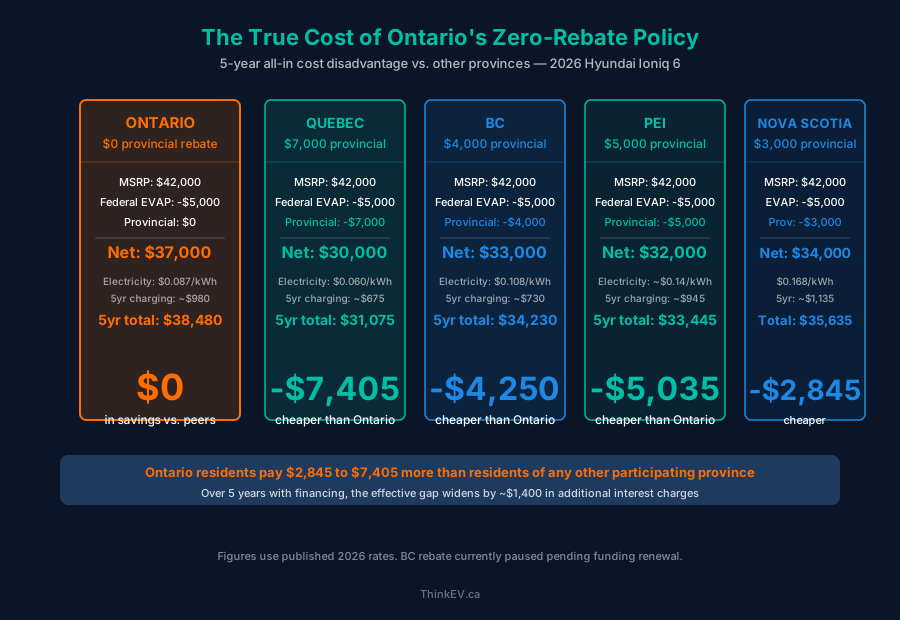
A person in Charlottetown or Winnipeg looking at a 2026 Hyundai Ioniq 6 Standard Range, priced at approximately $42,000, is eligible for $5,000 federal EVAP plus $4,000 provincial (PEI or Manitoba), for a combined $9,000. Their effective price, before taxes, is approximately $33,000. For the same vehicle, a person in Toronto is eligible for $5,000 federal and zero provincial, about $37,000. The $4,000 gap is not a rounding error: it is a year's lease payments on a mid-range vehicle, or a meaningful fraction of a first-home down payment.
Over a five-year ownership period, that $7,000 upfront gap widens further when financed. At 6.5 percent interest on a 72-month term, that $7,000 gap in financed amount translates to approximately $8,400 in total payments, the $7,000 principal plus roughly $1,400 in additional interest charges. The Ontario buyer doesn't just pay $7,000 more for the vehicle. They pay more for the financing of the vehicle.
On the operational side, the picture is more nuanced. Ontario's electricity rates are high by Canadian standards, among the highest in the country, thanks to the province's complex distribution and generation cost structure, the legacy of the provincial debt retirement charge, and the costs of the natural gas and nuclear generation mix. A typical Ontario residential rate runs approximately $0.087 per kWh during off-peak hours (with mid-peak at $0.122 and on-peak at $0.182) under Time-of-Use pricing, compared to $0.06 per kWh on Hydro-Québec's residential rate.
An EV owner charging the equivalent of 15,000 km per year, a common annual mileage, uses approximately 2,250 kWh of electricity. At Ontario's off-peak rate of $0.087, that's $196 per year in charging costs. At Quebec's rate of $0.06, it's $135. The operational gap is not as large as the purchase-price gap, but it accumulates. Over five years, the charging cost difference adds another $305 to the Ontario buyer's all-in cost of EV ownership compared to their Quebec counterpart.
So in total, accounting for the missing provincial rebate, the financing cost of that missing rebate, and five years of higher electricity costs, an Ontario EV buyer faces an all-in cost disadvantage of roughly $9,285 compared to a comparable Quebec buyer over the first five years of ownership. And that assumes Ontario's electricity rates don't change, which is not a safe assumption, they have a historical tendency to move upward.
These are not hypothetical numbers. These are real costs borne by real Ontario families who chose to buy electric vehicles in good faith, in a province where the government has decided that those families' transition costs are not a public priority.
The Ford Government's Position, What They've Actually Said
To be accurate about this, it's worth examining what the Ontario government has actually said publicly about EV incentives since 2018, because the reasoning has evolved and the official position is not entirely dismissive of electric vehicles.
The Ford government's critique in 2018 was primarily fiscal, the program cost too much, it benefited wealthy buyers, and it was part of a broader Liberal spending approach that the new government was unwinding. This was the explicit public rationale.
Since then, the government has periodically made statements suggesting it prefers infrastructure investment over direct consumer subsidies. The province has allocated funding to highway charging infrastructure and has pointed to provincial support for EV manufacturing, most notably, the Volkswagen gigafactory in St. Thomas and the Stellantis-LG battery plant in Windsor, both of which received substantial Ontario government support, as evidence of commitment to electrification without direct consumer rebates.
This is a real distinction worth taking seriously. The Ford government has been willing to spend significant public money on EV manufacturing, on the theory that supporting domestic production creates jobs and positions Ontario within the global EV supply chain without the "giveaway" optics of consumer rebates. The St. Thomas Volkswagen facility alone is projected to create 3,000 direct jobs; the Windsor battery plant is expected to employ around 2,500. These are not trivial investments. The province committed over $1 billion in incentives toward these facilities, making Ontario's total public investment in EV manufacturing among the largest of any sub-national government in North America.
The philosophical position, then, appears to be: public money for EV production is acceptable because it creates employment; public money for EV consumption is not acceptable because it subsidizes individual purchases. This is a coherent position, even if you disagree with the conclusion. You can believe that industrial policy is a legitimate use of public funds and consumer subsidies are not, and the Ontario government's actions over the past eight years are broadly consistent with that belief.
The problem with this position is that manufacturing investment and consumer incentives are not substitutes, they address different market failures and serve different goals. Building a battery plant in Windsor does not help a teacher in Scarborough afford a down payment on an Ioniq 6 today. The supply chain investment and the consumer affordability investment operate on entirely different time horizons and affect entirely different groups of people. Presenting manufacturing support as a substitute for consumer rebates is a rhetorical manoeuvre, not a policy argument. It conflates "we are doing something about EVs" with "we are addressing the specific barrier that prevents consumers from adopting EVs," which is the purchase price premium.
There is also a question of consistency. Ontario's Auto-Producing Regions of Canada, the Southern Ontario auto corridor, Windsor, the parts suppliers in Whitby and Ajax and Cambridge, are heavily invested in EV supply chains. The provincial government supporting those supply chains is also, implicitly, supporting a future where those factories need demand for the vehicles they produce. If Ontario's consumers are not buying EVs at rates competitive with Quebec and BC, the province's supply chain advantage is less valuable to the companies that built those factories. The Volkswagen CEO is not indifferent to whether Canadians are buying EVs. Manufacturing support without demand-side support is building capacity for a market that isn't being created as fast as it could be.
How Ontario Compares: Province by Province, in Real Numbers
It is worth going through this systematically, because the comparison is often presented in aggregate terms that obscure the specific differences.
Quebec, $7,000 combined maximum (provincial $2,000 + federal $5,000): Quebec's Roulez vert provides $2,000 on new BEVs (MSRP under $65,000), down from $7,000 in 2024, and the program ends entirely on December 31, 2026. It also offers $1,000 on used EVs and $600 toward a Level 2 home charger. It has run in various forms since 2012, but it is now sunsetting.
British Columbia, federal $5,000 only (provincial rebate ended): BC's CleanBC Go Electric passenger rebate was paused in May 2025 and ended in November 2025, with the province stating that consumer rebates are now primarily Ottawa's responsibility. BC still offers BC Hydro's $350 home-charger rebate, but on the vehicle a BC buyer now gets the same federal $5,000 as an Ontarian.
Manitoba, $9,000 combined maximum (provincial $4,000 + federal $5,000): Manitoba's MPI rebate provides $4,000 on a new BEV or PHEV (Tesla and Chinese-made EVs excluded). It was extended in Budget 2026 and runs until its $25-million fund is exhausted, currently the best provincial stack in the country, tied with PEI.
Prince Edward Island, $9,000 combined maximum (provincial $4,000 + federal $5,000): PEI's rebate provides $4,000 on a new BEV / $2,000 on a new PHEV (revised down from $5,750 in June 2025; Tesla excluded), plus a charger incentive. From a province of ~180,000 people, that is a striking commitment next to Ontario's zero.
Nova Scotia, federal $5,000 only (provincial rebate ended April 2025): Nova Scotia's provincial light-duty EV rebate ended in April 2025.
New Brunswick, federal $5,000 only (provincial rebate ended July 2025): New Brunswick's EV rebate ended in July 2025.
Newfoundland and Labrador, federal $5,000 only (provincial rebate ended March 15, 2026): Newfoundland's $2,500 BEV rebate ended March 15, 2026.
Yukon, federal $5,000 only (provincial rebate ended March 31, 2026): The Yukon Good Energy passenger rebate ended March 31, 2026.
Saskatchewan, $5,000 (federal EVAP only, no provincial rebate): Saskatchewan, like Ontario and Alberta, offers no provincial rebate. The province's political environment around EV policy has been sceptical, tracking with Alberta's posture.
Alberta, $5,000 (federal EVAP only, no provincial rebate): Alberta has been explicit about its position: no provincial EV rebate, no ZEV mandate, and active opposition to federal ZEV sales targets in the courts.
The Ontario comparison with Alberta and Saskatchewan is the one the Ford government implicitly invites, look, we're not the only province without a rebate. What that comparison obscures is that Ontario is by far the largest of the three holdouts, more than ten times the population of Saskatchewan and triple the population of Alberta, which means its policy choices have proportionally larger impact. Ontario is also significantly wealthier on a per-capita basis than most of the provinces that do offer rebates, which makes the fiscal-responsibility framing less credible. Nova Scotia's GDP per capita runs about 25 percent lower than Ontario's. PEI's per-capita income is substantially below Ontario's. Both provinces find the fiscal room to support EV rebates that Ontario does not.
Ontario's EV Adoption Rate: What the Adoption Data Shows
The provincial government does not publish a particularly accessible accounting of how Ontario's EV adoption rate compares to other provinces. But the data exists, and it tells a story.
Electric vehicles represented approximately 12 to 14 percent of new light-duty vehicle registrations in British Columbia in the period before its rebate paused, a rate driven by a combination of the provincial rebate, a high-density urban population, and a consistent cultural orientation toward environmental policy. Quebec's EV adoption rate has been among the highest in Canada for years, consistently in the 20 to 25 percent of new vehicle sales range in recent years, the result of a long-running, stable incentive program and significant public transit investment that has made electrification part of the general transportation identity.
Ontario's EV adoption rate for new vehicle sales has tracked in the 8 to 12 percent range over the same period. For a province with higher average income than BC, a large urban population that is structurally well-suited to EV ownership (short commutes, access to home charging, strong electricity grid), and the province's self-described identity as Canada's automotive capital, this is a modest number. It is also demonstrably below what it could be with provincial incentive support.
The comparison most useful to the Ford government's argument is Ontario versus Alberta: both offer only the federal EVAP rebate, and Alberta's EV adoption rate is substantially lower than Ontario's, perhaps 4 to 6 percent of new vehicle sales. The government would argue that Ontario is performing reasonably well even without provincial incentives. The problem with this comparison is that Alberta has structural factors that suppress EV adoption beyond the rebate question: colder winters with more severe range degradation, longer driving distances in rural communities, an economy more directly tied to fossil fuel employment, and a cultural orientation around pickup trucks and large SUVs.
Ontario's relative advantage over Alberta is explained more by these structural factors than by any provincial policy virtue.
The comparison that matters is Ontario versus Quebec, same country, broadly comparable economic structure, large urban population, similar grid characteristics, similar demographics. Quebec's EV adoption rate is roughly double Ontario's. It is not double because Quebec has better roads or warmer winters or a different culture around transportation. It is double, in substantial part, because Quebec makes EVs $7,000 cheaper at the point of purchase. Price sensitivity matters. Policy levers that change price work.
The Manufacturing Argument: Why VW and Stellantis Don't Fill the Gap
I want to address the manufacturing argument directly, because it is the one the Ontario government makes most seriously and it deserves a real response.
Ontario has attracted extraordinary EV manufacturing investment. The Volkswagen PowerCo battery gigafactory in St. Thomas, a $7 billion investment, backed by $1.3 billion from the Ontario government and $700 million from the federal government, will be one of the largest battery manufacturing facilities in North America when it reaches full production. The Stellantis-LG Energy Solution joint venture battery plant in Windsor, supported by comparable public investment, represents another massive commitment. Add in Honda's planned EV transition at its Alliston assembly plant, supported by a $2.5 billion federal-provincial package, and Ontario has made production-side commitments that are impressive.
These investments will create jobs. They will embed Ontario within the global EV supply chain. They represent real economic value for the province and will generate tax revenue for years.
But here's what they don't do: they don't make EVs cheaper for a person standing at an Ontario dealership today. The VW battery plant in St. Thomas will not be in production until 2027 at the earliest. The Honda Alliston EV transition is a multi-year project. The Stellantis Windsor battery plant will supply cells that eventually end up in vehicles assembled elsewhere. None of this near-term or mid-term manufacturing activity reduces the sticker price of a vehicle that exists right now.
The argument that manufacturing investment substitutes for consumer incentives assumes a time horizon irrelevant to the buyer making a purchase decision in 2026. It is perfectly coherent to support EV manufacturing and also to support consumer incentives, they are not mutually exclusive policy instruments, they operate on entirely different time scales, and they address entirely different market participants. The federal government has understood this; it supports both EV manufacturing through industrial policy and EV adoption through the EVAP consumer rebate. Ontario's position, production yes, consumption no, is the outlier.
There is also a political economy question worth raising here: if Ontario's population is not buying EVs at a competitive rate relative to peer provinces, the province's political leverage in future negotiations with EV manufacturers is weaker. Companies like Volkswagen, Honda, and Stellantis are not indifferent to consumer demand. They locate manufacturing in regions that have credible EV adoption trajectories. Ontario's combination of subsidised production capacity and depressed consumer incentives is an unusual posture that could eventually create a contradiction: a province producing EVs at scale for markets that are growing faster than its own.
Who Actually Gets Hurt: The Equity Analysis Ontario Gets Wrong
The government's equity argument for not offering rebates, that they benefit wealthy buyers, is worth examining from the other direction: who actually bears the cost of not having rebates?
The answer is not uniformly distributed. The households least affected by Ontario's missing provincial rebate are the wealthiest ones, specifically, households for whom the additional $7,000 in vehicle cost represents a small fraction of their available capital, who can comfortably finance the gap, and who have meaningful access to home charging. These buyers were going to purchase an EV regardless of whether the province offered $7,000 or $0.
The households most affected by Ontario's missing provincial rebate are those in the $60,000 to $90,000 annual income range, earning enough to consider an EV as a realistic possibility, but not enough for the purchase price premium to be irrelevant. In this range, $7,000 is the difference between "this vehicle fits in our budget with reasonable financing" and "this vehicle doesn't fit in our budget." These are the buyers who are most responsive to price signals, most affected by the province's inaction, and least well-served by the government's stated equity rationale.
Rural Ontario presents its own equity dimension. Access to charging infrastructure outside major urban centres remains uneven, and it is genuinely true that range anxiety is a more significant barrier for a buyer in Thunder Bay or Kenora than for one in Toronto or Ottawa. But this is an argument for additional support for rural buyers, perhaps through a rural supplement or a separate charging infrastructure program, not for no support at all. The government has not offered rural-targeted alternatives; it has offered nothing.
The equity case for provincial inaction is also weakened by the composition of what Ontario has chosen to spend money on in the years since cancelling the EV rebate. The province has invested substantially in highway expansion, in particular the controversial 413 highway proposal. It has funded tax cuts that delivered disproportionate benefit to higher-income households through income tax adjustments.
It allocated over $2 billion in manufacturing incentives to VW and Stellantis, company shareholders who are not predominantly lower-income Ontario residents. The selective application of equity principles to consumer EV rebates, while accepting every other category of spending that benefits more-advantaged groups, reveals that equity is a rhetorical frame rather than a consistent policy principle.
Gear worth having
As an Amazon Associate, ThinkEV earns a small commission from qualifying purchases — at no extra cost to you.

Grizzl-E Classic Level 2 EV Charger (40A)
Canadian-made and rated for minus 40C winters. 40A / 9.6 kW, NEMA 14-50, indoor/outdoor, 24-ft cable. The charger built for Canadian weather.
As an Amazon Associate, ThinkEV earns from qualifying purchases — at no extra cost to you.
The Federal EVAP Program: What Ontario Residents Are Actually Working With
Since Ontario offers nothing provincially, the federal EVAP rebate is everything available to Ontario EV buyers who want government support. Understanding it in detail is not optional, it is the entire financial picture.
The federal Electric Vehicle Availability Program launched February 16, 2026, replacing the iZEV program which ran from 2019 through early 2026. The tier structure is:
- $5,000 for fully battery-electric vehicles (BEV) and hydrogen fuel cell vehicles (FCEV)
- $2,500 for plug-in hybrids with 50 km or more of all-electric range
- $1,500 for plug-in hybrids with less than 50 km of electric range
The $50,000 price cap applies to the "final transaction value", base MSRP plus dealer-installed options and accessories plus dealer fees, excluding taxes and freight. This is different from the sticker price, and the distinction matters. A vehicle at $48,500 MSRP can exceed the cap after dealer fees, add-ons, and optional accessories are included. Ask for the final transaction value as EVAP defines it before committing to a deal. Some dealers are not scrupulous about making this clear.
One critical exception to the $50,000 cap: vehicles manufactured in Canada have no price cap under EVAP. This is federal industrial policy designed to support domestic production, specifically, the Ontario-built Chevrolet Equinox EV (Ingersoll) and the Chevrolet Blazer EV (also Ingersoll). For Ontario buyers specifically, this makes the Equinox EV an unusually strong value proposition: the full $5,000 federal rebate regardless of trim level, built in Ontario by Ontario workers. The Equinox EV from approximately $37,498 after the $5,000 rebate is $32,498 before taxes, competitive with gas-powered crossovers of comparable size and significantly more capable than it looks on paper.
Country of origin matters under EVAP. Vehicles must be manufactured in Canada or a free trade agreement partner country, US, Mexico, EU, South Korea, Japan, and other CUSMA/CETA/CPTPP parties. This excludes China. BYD, NIO, Xpeng, Zeekr, and other Chinese-manufactured EVs do not qualify for EVAP regardless of the tariff situation. The 6.1 percent tariff rate established in January 2026 is a separate policy instrument from EVAP's country-of-origin requirement. A lower tariff doesn't unlock federal rebate eligibility.
The EVAP rebate is a lifetime limit, one per person for the program's five-year run. Use it on a 2026 purchase, and you're ineligible in 2029 when it comes time to replace that vehicle. This constraint should inform which vehicle you choose. Don't waste your one EVAP claim on a vehicle that barely qualifies or one you're not confident about. Be deliberate.
Which EVs Actually Make Sense for Ontario Buyers in 2026
Given the federal-only reality, let me be concrete about which vehicles offer the strongest value proposition for Ontario buyers in 2026.
The Chevrolet Equinox EV is the vehicle I'd look at first for most Ontario buyers. Built in Ingersoll, an Ontario community, which means no price cap under EVAP, the full $5,000 rebate regardless of trim, and a base price from $37,498 (before taxes, after rebate: approximately $32,498). The Equinox EV has adequate range for most Canadian driving patterns (around 420 km EPA on the LT trim), and the domestic sourcing matters both for the rebate eligibility and as a soft political statement to anyone paying attention. For the affordability-focused Ontario buyer, it is the most financially optimised option currently available.
The Hyundai Ioniq 6 Standard Range from approximately $42,000 ($37,000 after the $5,000 EVAP rebate) is aerodynamically exceptional and has a strong long-range version for buyers who need it. Built in South Korea under FTA terms, EVAP-eligible on the Standard Range but potentially cap-constrained on the Long Range depending on dealer fees. Check your final transaction value before finalising.
The Kia EV6 Standard Range from approximately $43,000 ($38,000 after rebate) is a strong all-rounder with good highway performance. Same South Korea manufacturing as the Ioniq 6, same EVAP eligibility cautions on higher trims.
The Tesla Model 3 Standard Range from approximately $44,990 ($39,990 after rebate). Built in Fremont, California, FTA eligible as US-manufactured. Borderline on the cap; dealer fees can push you over $50,000. The Tesla experience is polarising, but the hardware is legitimately good for the price point when the rebate is applied. Worth noting that the currently fraught public perception of the Tesla brand in Canada, particularly in the wake of Elon Musk's political interventions and the Ontario-US trade tensions active through early 2026, has created meaningful discounting activity and waiting-list-free inventory that was not present two years ago.
The Volkswagen ID.4 from approximately $45,995 ($40,995 after rebate). Built in Chattanooga, Tennessee, US-manufactured, FTA-eligible. A sensible, if uninspiring, European-engineered option that fits into the sub-$50,000 final transaction window with room to spare on most trims.
The Nissan Leaf from approximately $38,000 ($33,000 after rebate). An ageing platform but still fully eligible and inexpensive by 2026 EV standards. For buyers in urban Ontario where longer range is less critical and charging access is reliable, the Leaf remains a legitimate option.
What Ontario buyers should specifically check EVAP eligibility on: the Tesla Model Y RWD base ($49,990) is now on Transport Canada's official EVAP eligible list, it qualifies, but watch dealer fees to keep the final transaction value under $50,000. Higher Model Y trims (Long Range AWD at $59,990, Performance at $69,990) and the Model 3 Long Range ($54,990) do not qualify. Also check the BMW i4 or i5 (typically above cap), the Mercedes EQE and EQS (well above cap), and any Chinese-manufactured EV regardless of price.
Why This Isn't Changing Under the Current Government
False hope is worse than a clear-eyed assessment.
Doug Ford's Progressive Conservative government won re-election in 2022 and is governing with majority support heading into what would be a 2026 election cycle. The government has shown no indication of reversing its position on EV consumer incentives. The premier has been vocally critical of federal environmental policy, has participated in litigation around the federal carbon price, and has framed the EV transition, when he addresses it at all, in terms of industrial investment rather than consumer support.
The political calculus is not mysterious. Ontario's 905 belt, the suburban ring around Toronto where provincial elections are frequently won and lost, is full of gas-powered pickup trucks and SUVs. The median Ford government voter is not an early adopter in search of government-subsidised Tesla money. The base is sceptical of environmental spending, receptive to messages about fiscal discipline, and not particularly mobilised around EV adoption as a political priority.
Provincial incentives for EV purchases would require the government to spend money, would generate criticism from its own coalition about wasteful green spending, and would not obviously deliver proportional electoral benefit. The political upside for a Ford government offering EV rebates is not apparent. The political downside is visible.
The NDP under Marit Stiles have staked out a more supportive position on EV incentives, and a change in government would likely see some form of rebate program reinstated, the Liberal government that cancelled it in its final years and the NDP have both been more receptive to this kind of consumer support. But the NDP are not governing, and the most current polling does not put them in an imminently competitive position for a majority government.
The federal Liberal government under Mark Carney, which took office following the March 2025 election, has maintained the EVAP program and been supportive of EV adoption nationally. Federal support is not going anywhere. But federal support cannot fill the $7,000 gap that Ontario's inaction creates relative to Quebec, that gap is entirely within provincial jurisdiction, and it will remain until a different provincial government makes a different choice.
Gear worth having
As an Amazon Associate, ThinkEV earns a small commission from qualifying purchases — at no extra cost to you.

PULIDIKI Car Cleaning Gel (Detailing Putty)
Press it into vents, buttons, and seams and it lifts out dust you did not know was there. Weirdly satisfying, genuinely useful.
As an Amazon Associate, ThinkEV earns from qualifying purchases — at no extra cost to you.
The Charging Infrastructure Substitute: What the Province Actually Invested
To be fair to the Ford government's alternative strategy, it is worth examining what Ontario has actually done on charging infrastructure, since that is the stated substitute for consumer rebates.
The province has participated in federally funded charging programmes, including the Zero Emission Vehicle Infrastructure Program (ZEVIP), which has deployed charging stations at community locations, workplaces, and highway corridors across Ontario. The QEW, Highway 400 corridor, the 401 through Southern Ontario, and the Trans-Canada in Northern Ontario have seen meaningful charging infrastructure expansion under these programs, primarily federal dollars, with some provincial co-investment.
Ontario Power Generation (OPG), the province's primary electricity generator, has been among the more active utilities in Canada on EV charging infrastructure investment. OPG's Ivy charging network has built out stations at highway service centres, shopping centres, and community locations, and the network is meaningfully larger and more reliable than it was three years ago. For the 401 corridor specifically, the charging situation has improved from inadequate to workable for modern long-range EVs.
The province also passed the Green Energy Act repeal and various regulatory changes that affected how commercial charging operators could sell electricity, changes that were controversial and created some regulatory uncertainty for charging network investment, but which have largely been resolved. The net effect on charging availability has been somewhat delayed build-out relative to other provinces, but not a dramatic regression.
Where Ontario's infrastructure-focused approach falls short: it has done essentially nothing for residential affordability. Home charging infrastructure, a Level 2 EVSE installation, costs $800 to $2,000 in Ontario. Provinces like Quebec, PEI, and Manitoba have offered rebates on charger installation. Ontario has not. This is a significant gap, because access to home charging is the single largest determinant of EV ownership satisfaction.
Buyers without a dedicated home charging solution are significantly less likely to own an EV, significantly more likely to return one, and significantly more likely to report dissatisfaction. The infrastructure investment in public charging, while genuinely useful, does not substitute for the daily convenience of home charging, and the province has offered no support for the latter.
Five-Year Financial Model: Ontario vs.
Quebec, Real Numbers
Let me close the comparison with a complete five-year financial model for an Ontario buyer versus a Quebec buyer purchasing the same vehicle.
Vehicle: 2026 Hyundai Ioniq 6 Standard Range, $42,000 MSRP
Purchase price comparison:
- Ontario buyer: $42,000 - $5,000 federal EVAP = $37,000 before tax
- Quebec buyer: $42,000 - $5,000 federal EVAP - $7,000 Roulez vert = $30,000 before tax
- Ontario-Quebec gap at purchase: $7,000
Financing comparison (72-month term, 6.5% interest rate):
- Ontario total financing cost on $37,000 at 6.5% for 72 months: approximately $44,700 total (about $7,700 in interest)
- Quebec total financing cost on $30,000 at 6.5% for 72 months: approximately $36,200 total (about $6,200 in interest)
- Financing gap over 72 months: approximately $8,500
Five-year electricity costs (20,000 km annually, approximately 16 kWh/100 km = 3,200 kWh/year):
- Ontario off-peak (TOU, approximately $0.087/kWh): $278/year x 5 years = $1,390
- Quebec (Hydro-Québec, approximately $0.06/kWh): $192/year x 5 years = $960
- Electricity cost gap over five years: $430
Five-year total ownership cost disadvantage for Ontario buyer versus Quebec buyer:
- Purchase gap at financing: approximately $8,500
- Electricity gap: approximately $430
- Total Ontario disadvantage: approximately $9,285 over five years
This is a real, material cost difference created entirely by provincial policy. It is not offset by differences in vehicle quality, performance, warranty, or ownership experience. The Ontario buyer and the Quebec buyer own identical cars. The Ontario buyer's government has decided they should pay approximately $9,300 more for the privilege.
For buyers on the margin, those for whom an EV is possible but the premium over a comparable gas vehicle is a real consideration, this difference is often decisive. It explains why Ontario's adoption rate is lower than Quebec's. It is not a mystery.
The Longer-Term Consequences Ontario Isn't Accounting For
There is a version of this story that focuses entirely on immediate dollars and misses the compound effects. Those compound effects deserve discussion.
First: Ontario's slower EV adoption means its emissions profile declines more slowly than peer provinces. The province is already facing significant pressure on its 2030 climate targets. Transportation is the second-largest source of Ontario's greenhouse gas emissions, after buildings. A materially higher EV adoption rate, achievable with provincial incentives, as the Quebec data demonstrates, would contribute measurably to hitting those targets. The province's decision to forgo consumer incentives has direct implications for its climate commitments, which are not simply abstract goals but binding obligations that will require either achievement or explanation.
Second: the federal government's patience on EV policy has limits. Ottawa has signalled clearly that provinces that lag on EV adoption will face growing federal policy pressure. ZEV mandates, carbon pricing impacts on transportation fuels, and ongoing federal programme design all create a gravitational pull toward higher adoption that provinces cannot indefinitely resist. Ontario's position is stable for now, but the federal trajectory is not neutral, it is consistently toward higher EV standards, and provinces that have not built domestic adoption momentum will face steeper adjustment costs when that pressure becomes unavoidable.
Third: consumer familiarity effects are real and compounding. Quebec's high EV adoption rate means a substantial proportion of Quebec households have direct experience with EV ownership. That experience, positive, in the large majority of cases, creates word-of-mouth adoption momentum that is independent of future incentive availability. Ontario's lower adoption rate means fewer Ontario households have first-hand experience, fewer conversations at the school pickup recommending EVs, fewer normalised sightings in driveways and parking lots. The cultural familiarity gap between provinces, while not easily quantifiable, is real and growing.
Fourth: automotive sector alignment. Ontario's auto manufacturers, General Motors in Ingersoll, Honda in Alliston, Stellantis in Windsor, are investing heavily in EV production. They need customers. Ontario's consumers, whose government has offered them no incentive to buy the vehicles those factories are making, represent an underutilised market. The disconnect between Ontario's production ambitions and its consumption policy is not sustainable indefinitely.
What Would Actually Work: A Framework for Ontario If It Changed Course
I am not offering this as a prediction of what will happen, I have already explained why the current government is unlikely to change course. But the question of what a responsible Ontario EV incentive design would look like is worth answering, because eventually a different government will face this question and the framework matters.
A well-designed Ontario programme would likely include:
A direct purchase rebate in the $4,000 to $6,000 range, income-tested at the upper end, on qualifying new BEVs under $55,000. The income test should phase out above approximately $150,000 household income, high enough to include middle-income buyers for whom the incentive meaningfully changes the purchase calculus, but limiting the political optics of subsidising luxury purchases. This is roughly the BC model, and it is the appropriate template.
A separate used EV rebate of $2,000 to $3,000, specifically targeted at buyers with household incomes below $100,000. Used EVs are where working-class access to electrification actually lives. The 2026 used market has Chevrolet Bolts in the $18,000 to $22,000 range, used Ioniq 5 units approaching $30,000, early Tesla Model 3 units in the $25,000 to $30,000 range. These are vehicles that middle-income households can access if the used-side economics are supported. Ontario's complete inaction on used EVs is, if anything, more indefensible than its inaction on new.
A Level 2 charger installation rebate of $500 to $750, covering partial hardware and installation costs, to remove the home charging friction that prevents otherwise-motivated buyers from completing the transition. This is low-cost relative to vehicle rebates and has disproportionate impact on satisfaction and retention.
A rural supplement, perhaps an additional $1,500 to $2,000, for buyers in census-defined rural communities, to compensate for higher infrastructure investment and greater range dependence. This is the equity-focused element the government's current framing demands but doesn't actually implement.
None of this would cost Ontario more than $400 to $600 million annually at current adoption rates, well within the scale of other provincial programme expenditures, and substantially below the manufacturing incentives Ontario already approves without apparent fiscal consternation.
What Ontario Residents Should Do With This
I am going to be precise about what the policy analysis means for individual buyers, because some people reading this are trying to make a car purchase decision and deserve a direct answer, not just a policy lecture.
If you live in Ontario and are considering an EV in 2026, the practical advice is this:
The provincial rebate is not coming back before you need to make a decision. Plan around the federal EVAP rebate alone. $5,000 is real money, use it well. Prioritise qualifying vehicles, specifically those with final transaction values cleanly under $50,000 (or Canadian-built vehicles where no cap applies). The Chevrolet Equinox EV is the single clearest EVAP play for the Ontario market right now.
Do not wait for Ontario policy to change. A decision to delay a purchase by two years in hopes that a new provincial government will offer $4,000 or $7,000 in rebates is a financial decision. Run the numbers: two more years of gasoline at current prices, including Ontario's carbon pricing impact on pump prices, versus buying now with only the federal $5,000. In most scenarios for moderate-to-high-mileage drivers, buying now with the federal rebate and banking the fuel savings beats waiting for a provincial rebate that may or may not materialise in the next four years.
Invest in home charging from day one. Ontario has no charger installation rebate, but the economics still favour it strongly. A $1,200 installed Level 2 unit in a standard Ontario garage, charging at off-peak rates and eliminating commercial charging costs, pays back in under two years for most drivers. Thereafter it reduces your operating cost advantage and dramatically improves daily ownership experience. Don't skip this.
Factor in Ontario's electricity rates honestly. Ontario TOU off-peak rates are not low. They are workable, and they are still dramatically cheaper than gasoline. But do not assume the stunning operating cost savings you might have seen cited for BC or Quebec buyers, their electricity is materially cheaper. At $0.087 per kWh off-peak (with mid-peak at $0.122 and on-peak at $0.182), Ontario's home charging costs are at the higher end of the Canadian spectrum. The EV operating advantage in Ontario is real and substantial; it is just smaller than the BC and Quebec case studies suggest.
Track EVAP eligibility updates. The programme is five years old as of this writing and is running. But any federal programme can be modified or capped, the iZEV programme before it was modified multiple times. Natural Resources Canada maintains the current vehicle eligibility list at nrcan.gc.ca. Check it within a week of your purchase. Vehicle eligibility can change as sales quotas are hit for specific models.
Ontario's policy failure on EV incentives is real, documented, and consequential. It has cost Ontario residents an estimated $1-1.5 billion in aggregate purchasing disadvantage (roughly 20,000 EVs/year × $7,000 average incentive gap × 8 years) relative to Quebec and BC. It has slowed adoption in ways that are measurably visible in the registration data. It has been sustained by a government that made an ideological choice in 2018 and has not revisited it despite eight years of evidence that the choice costs its own constituents.
None of that changes the practical reality you operate in. The $5,000 federal rebate exists. The Equinox EV is built in Ingersoll. The TOU rates are manageable. The Ioniq 6 is genuinely excellent. The savings versus gasoline are real even without provincial support. Make the best decision you can with what actually exists, and vote accordingly the next time Queen's Park is on the ballot.
Sources: Natural Resources Canada EVAP programme documentation, Roulez vert programme guidelines, CleanBC Go Electric programme data, Statistics Canada vehicle registration data, provincial budget documents, and Ontario Ministry of Transportation reports.
Gear worth having
As an Amazon Associate, ThinkEV earns a small commission from qualifying purchases — at no extra cost to you.

WixGear Magnetic Air Vent Phone Mount (2-Pack)
A magnet strong enough that your phone never flinches over potholes or rail crossings. Two in the box, one for each car.
As an Amazon Associate, ThinkEV earns from qualifying purchases — at no extra cost to you.
Related Reading
Gear worth having
As an Amazon Associate, ThinkEV earns a small commission from qualifying purchases — at no extra cost to you.
NOCO Boost Plus GB40 Jump Starter
A 1000A lithium jump starter that fits in your glovebox and works on any 12V battery. Your insurance against a dead 12V in a parking lot.
As an Amazon Associate, ThinkEV earns from qualifying purchases — at no extra cost to you.

Founder & Chief Editor
Vlad Pereira is the founder and chief editor of ThinkEV.ca, the Canadian electric-vehicle publication he writes and edits from Courtenay, British Columbia. He covers EV pricing, federal and provincial rebates, charging costs, and the Chinese manufacturers now entering Canada, from the buyer's side rather than the press-fleet side. ThinkEV is a venture of Vlad Pereira Online; his writing on health, income and the long game lives at vladpereira.com.
Frequently asked questions
Does Ontario offer any provincial EV rebate in 2026?
What federal EV rebate is available to Ontario buyers?
What is the best EV value for Ontario buyers right now?
Why did Ontario cancel its EV rebate in 2018?
How much more does it cost to own an EV in Ontario than in Quebec?
Will Ontario reinstate EV rebates under the Ford government?
Does Ontario offer any rebate for Level 2 home charger installation?
Is there any rebate for used EVs in Ontario?
More EV & road-trip finds
Affordable upgrades worth a look — tap any to check the price on Amazon.
 ★ 308
★ 308Coiled Lightning Car Cable for iPhone (2-Pack)
View on Amazon ★ 119
★ 119Foldable Waterproof Trunk Organizer
View on Amazon ★ 392
★ 392Large Cup Holder Adapter (32-40oz)
View on Amazon ★ 4,050
Touchscreen Mist Screen Cleaner Kit
View on Amazon ★ 314
★ 314Mini USB LED Ambient Lamps (4-Pack)
View on Amazon ★ 1,083
Crystal Push-Start Button Ring (2-Pack)
View on Amazon ★ 4,424
Sun Visor Card and Document Organizer
View on Amazon ★ 297
★ 297360-Degree One-Hand Dashboard Phone Mount
View on AmazonRead, Plan, Then Stay Current
Explore our expert articles to understand incentives and ownership costs, use the map to pressure-test charging reality, then subscribe so new EV coverage comes straight to you.
Continue Reading
Municipal EV Incentives Canada 2026: City by City
EV Adoption Is Not Slowing Down: What the Data Says
Stop Waiting: The Best Time to Buy an EV Is Now

Chinese EVs in Canada: Security Politics vs Value
The Best Electric SUVs in Canada (2026): Ranked by Value