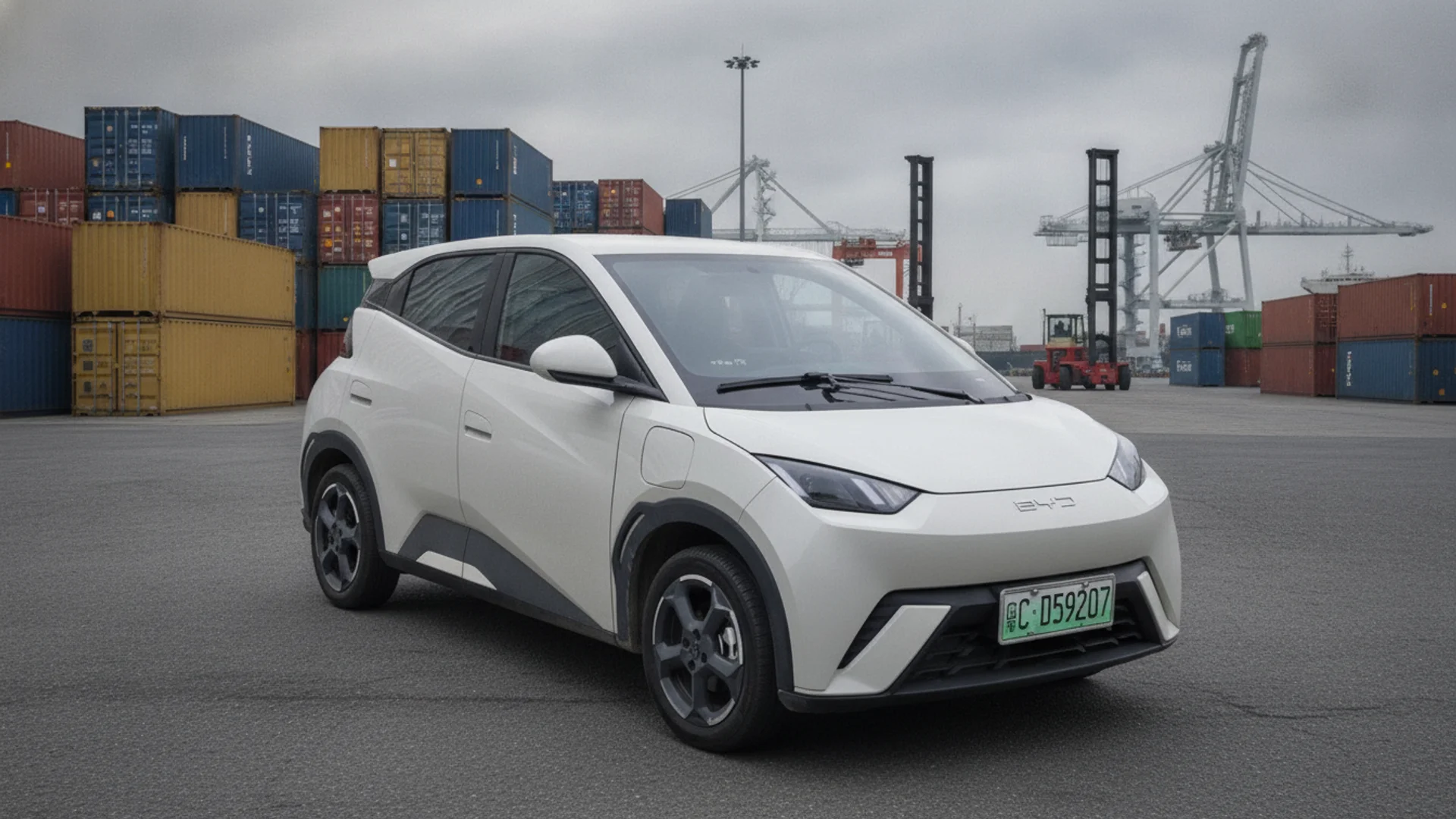
My brother pulled the car over on a July afternoon because I asked him to, and he did not ask why. We were about three minutes from his house. The building behind the fence was BYD's first factory in Brazil, on Avenida Antônio Buscato in the cargo terminal district of Campinas, and it has been there since 2015. I grew up two and a half kilometres south of it, in Vila Padre Anchieta. I had to fly in from Vancouver to find out it was there.
That factory does not build cars. It builds the chassis for electric buses, and it built its thousandth one in late August, roughly thirty a week now against about two hundred in total by 2023. In July, the month I was standing outside it, BYD accounted for 74.1% of every electric bus registered in Brazil. A second plant across town has been making solar panels since 2017. There is a research agreement with Unicamp going back to the same period.
Nobody else in the car found any of this remarkable.
Key takeaways
- BYD was Brazil's fourth best-selling car brand overall in the first half of 2026 with 99,029 registrations, ahead of Hyundai, and third at retail. It ranked ninth a year earlier.
- The Dolphin Mini was Brazil's best-selling retail car of any powertrain in the first quarter of 2026, the first fully electric model to manage it.
- Brazil left its EV import tax near zero from 2015 to 2023, then raised it in steps to 35% by July 2026. The factories arrived in between.
- BYD supplies 70% of the electrified fleet on the 99 ride-hailing platform, about 25,000 of 34,000 cars.
- Canada's own door opened in March 2026 at 6.1% within a 49,000 vehicle annual quota, with joint-venture conditions Brazil never asked for.
The cars were silent. The streets were not.
I used ride-hailing constantly for three weeks, in Campinas and for a weekend in Rio, and I never once heard an engine start. Every car was fully electric. In Brazil that narrows it to the Dolphin family almost by definition, because the hybrids in BYD's range announce themselves the moment the petrol engine wakes up, and these never did.
Which fits the numbers. The Dolphin Mini sold 29,665 units in the first half of 2026 and topped Brazil's retail sales chart outright in the first quarter, 6,077 of them in March alone. When you sit in the back of enough of them you stop noticing the car and start noticing the road.
Large parts of Campinas, including the older central neighbourhoods, are surfaced in paralelepípedos, cut stone setts rather than asphalt. In a petrol car you never hear them properly. In a silent one the stone is the loudest thing in the cabin, a hard continuous roar coming up through the floor rather than from anywhere ahead of you. I found it oddly pleasant. That lasted about a week.
It also happens to be the one genuine weakness in the ownership case. A Brazilian long-term test found the Dolphin's front tyres at half their tread life by 13,740 kilometres, and named the car being untropicalized for local road conditions as part of the reason. Those conditions are the stone. Everything else on the ownership ledger runs in the electric car's favour in Brazil, and the road surface is the exception that eats tyres. Canadian buyers will meet a different version of the same problem, since our winters and our frost heaves are their own kind of untropicalized. Our full Dolphin review goes deeper on where that car is strong and where it is not.
I asked every driver who seemed willing, and none of them had to think about the arithmetic. They ran it out loud, immediately, the way people do with a number they have already checked many times.
I did not know it at the time, but Campinas sits inside a corridor 99, the local rival to Uber, has been working since 2022, alongside São Paulo, Sorocaba, Jundiaí and Itu. They have been paying drivers to go electric. The platform and its partners have put more than 332 million reais into that effort and reported active electric-vehicle drivers growing more than 200% in a single year. BYD supplies about 70% of 99's electrified fleet, roughly 25,000 cars of 34,000. In June, BYD cut the Dolphin Mini to 109,990 reais, with a lower price again for drivers buying under the federal Move Brasil programme and lower still for taxi plates. In August, Banco do Brasil began financing those purchases for app and taxi drivers at under 1% a month.
The effect on a working driver is not subtle. One outlet followed a driver covering 261 kilometres in a day for about 33 reais of electricity, roughly 12 centavos per kilometre, against something closer to 100 reais a day of petrol for the same distance. A gig-driver fintech called GigU looked at more than 56,000 drivers across 22 states this spring and found electric drivers running a median net margin of 57% against 36.8% for petrol drivers, earning 21.86 reais an hour against 12.85. GigU sells services to those drivers, so read the number with that in mind. It still matches the per-kilometre maths from the other direction.
Gear worth having
As an Amazon Associate, ThinkEV earns a small commission from qualifying purchases — at no extra cost to you.

Grizzl-E Classic Level 2 EV Charger (40A)
Canadian-made and rated for minus 40C winters. 40A / 9.6 kW, NEMA 14-50, indoor/outdoor, 24-ft cable. The charger built for Canadian weather.
As an Amazon Associate, ThinkEV earns from qualifying purchases — at no extra cost to you.
Keep the scale in proportion, though. Brazil has roughly 1.7 million registered app drivers, and the electrified fleet is a small fraction of that. What Brazil has proven is not that everyone switched. It is that for the people who drive for a living, the switch pays for itself in under five years and often in under three, and that those are the people who moved first.
A showroom in the neighbourhood where I learned to dance
I walked past a BYD store in Cambuí on my way back from visiting my old ballet school, and stopped at the window for longer than I meant to. Cambuí is childhood ground for me. It is now also a place where you can buy a Chinese electric car on a Tuesday afternoon, from one of two BYD showrooms in the city.
A man from the dealership was outside on a smoke break and we talked for a few minutes. He was cheerful about the June price cut and cheerful about the taxi pricing, and he talked about the Camaçari plant in Bahia the way you talk about something that has already settled the argument. Cars have been coming off that line since October 2025. It went to two shifts in March. He mentioned the import tax reaching 35% in July, which by then was a fact about imported cars rather than about his.
Brazil kept the EV import tax at effectively nothing from 2015 through 2023, which is how BYD walked in and built a brand here. Then it raised the tax in steps, 10%, 18%, 25%, and 35% this July. By the time the wall was finished, BYD was assembling cars inside it, at a complex on the site of a Ford plant that Ford had abandoned, employing 5,500 people and turning out 100,000 vehicles in its first nine months. Brazil never wrote a local-production requirement into the deal. It simply made importing progressively less attractive than building, and then waited. It worked.
Gear worth having
As an Amazon Associate, ThinkEV earns a small commission from qualifying purchases — at no extra cost to you.

PULIDIKI Car Cleaning Gel (Detailing Putty)
Press it into vents, buttons, and seams and it lifts out dust you did not know was there. Weirdly satisfying, genuinely useful.
As an Amazon Associate, ThinkEV earns from qualifying purchases — at no extra cost to you.
What Canada inherits
Canada took the opposite route to a similar place. We held a 100% surtax from October 2024. Then, in January 2026, we agreed to drop it to 6.1% inside a quota of 49,000 vehicles a year, growing 6.5% annually, with a rising share reserved for cheaper cars and an expectation of majority Canadian-owned joint ventures within three years. The Government of Canada's own backgrounder sets out the terms, and we track the shifting detail in our Canadian tariff explainer. Chinese-built cars remain outside the federal EVAP rebate regardless of price, which is a country-of-origin rule rather than a judgment about the cars.
Brazil got the factory without asking for it. Canada asked first. Both approaches are defensible, and Canada's has the advantage of being written down.
What Brazil suggests is coming next here is less about the cars than about who buys them. The first Canadians to benefit will not be enthusiasts. They will be the people whose vehicle is a cost of doing business: rideshare drivers, couriers, trades running a van, small operators watching fuel and maintenance come off the monthly bill. That is who moved first in Brazil, because that is who the arithmetic reaches first. The four models BYD has lined up for Canada are aimed squarely at that band of the market.
The rest follows the fleet rather than leading it. Chargers get built where cars already are. Service networks arrive after the sales do. Brazil's public charging grew 42% in a year to more than 25,000 points and still sits at nearly twenty vehicles per charger, because the fleet grew faster than the network could follow.
Eleven years after BYD's first Brazilian factory opened, my brother could drive past it without a second thought. No announcement, no ribbon, just a building on the way to somewhere else, until someone visiting from another country asked him to pull over.
Gear worth having
As an Amazon Associate, ThinkEV earns a small commission from qualifying purchases — at no extra cost to you.

WixGear Magnetic Air Vent Phone Mount (2-Pack)
A magnet strong enough that your phone never flinches over potholes or rail crossings. Two in the box, one for each car.
As an Amazon Associate, ThinkEV earns from qualifying purchases — at no extra cost to you.

Founder & Chief Editor
Vlad Pereira is the founder and chief editor of ThinkEV.ca, the Canadian electric-vehicle publication he writes and edits from Courtenay, British Columbia. He covers EV pricing, federal and provincial rebates, charging costs, and the Chinese manufacturers now entering Canada, from the buyer's side rather than the press-fleet side. ThinkEV is a venture of Vlad Pereira Online; his writing on health, income and the long game lives at vladpereira.com.
Frequently asked questions
Is BYD really outselling Hyundai in Brazil?
Why did Brazil raise its EV import tax after encouraging imports?
Do electric cars actually save Brazilian drivers money?
When will Canadians see the same effect?
More EV & road-trip finds
Affordable upgrades worth a look — tap any to check the price on Amazon.
 ★ 419
★ 419RGB Car Interior LED Strip Light
View on Amazon ★ 546
★ 546Funny Headrest Face Covers (2-Pack)
View on Amazon ★ 21,304
Car Headrest Hooks (4-Pack)
View on Amazon ★ 308
★ 308Coiled Lightning Car Cable for iPhone (2-Pack)
View on Amazon ★ 119
★ 119Foldable Waterproof Trunk Organizer
View on Amazon ★ 392
★ 392Large Cup Holder Adapter (32-40oz)
View on Amazon ★ 4,050
Touchscreen Mist Screen Cleaner Kit
View on Amazon ★ 537
★ 537USB Star Projector Roof Light
View on AmazonRead, Plan, Then Stay Current
Explore our expert articles to understand incentives and ownership costs, use the map to pressure-test charging reality, then subscribe so new EV coverage comes straight to you.
Continue Reading
Chinese EVs in Canada: 15,603 In, Still No BYD
BYD Great Seagull: A Bigger $10,000 EV Hatch Is Coming
BYD Denza Z9 GT Adds $50K Tri-Motor Trim to China's Top GT
How BYD Builds EVs So Cheaply: The Vertical Integration Playbook
BYD Seal 06 DM-i: 128 km EV Range, $14K USD Starting Price