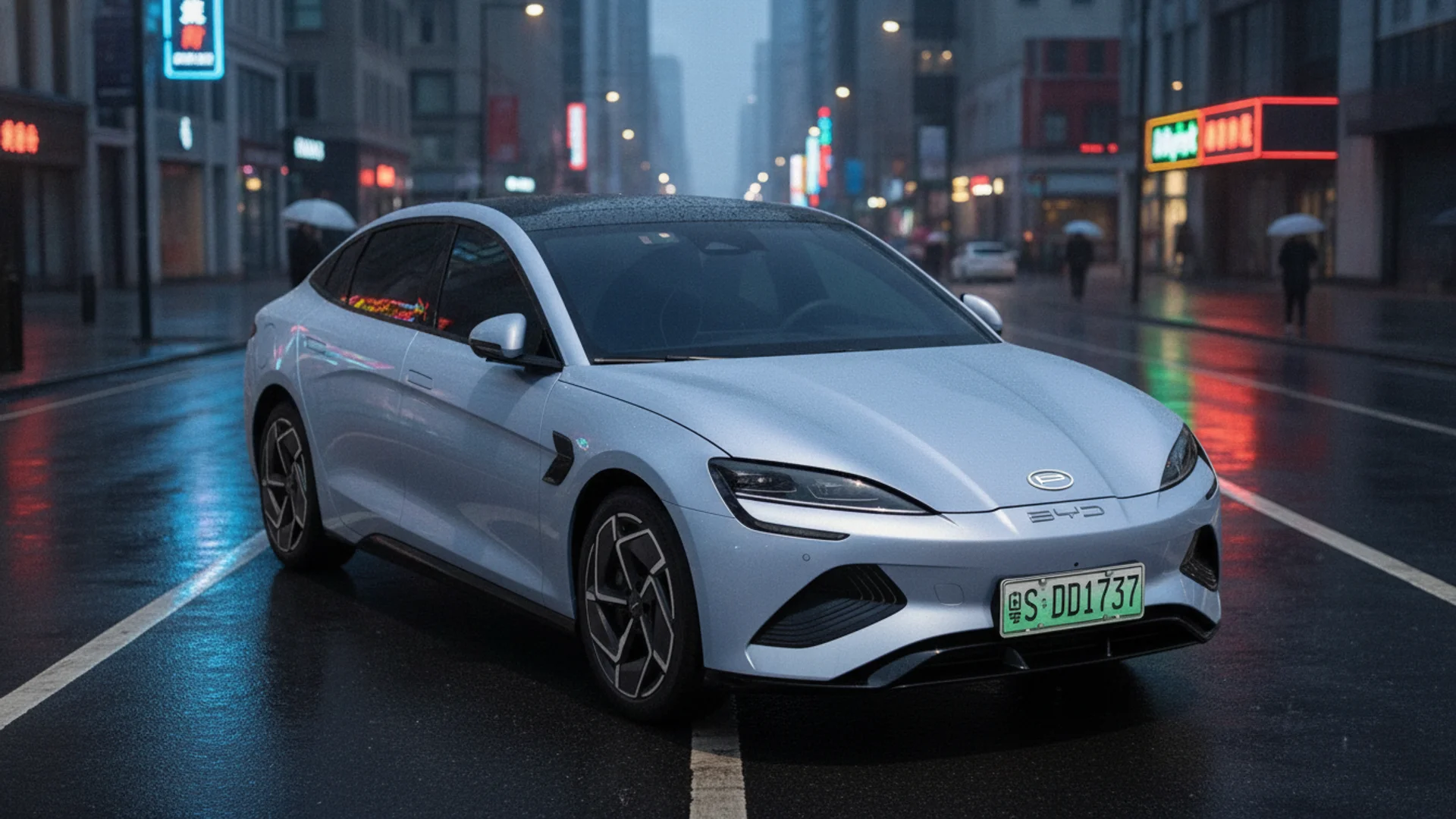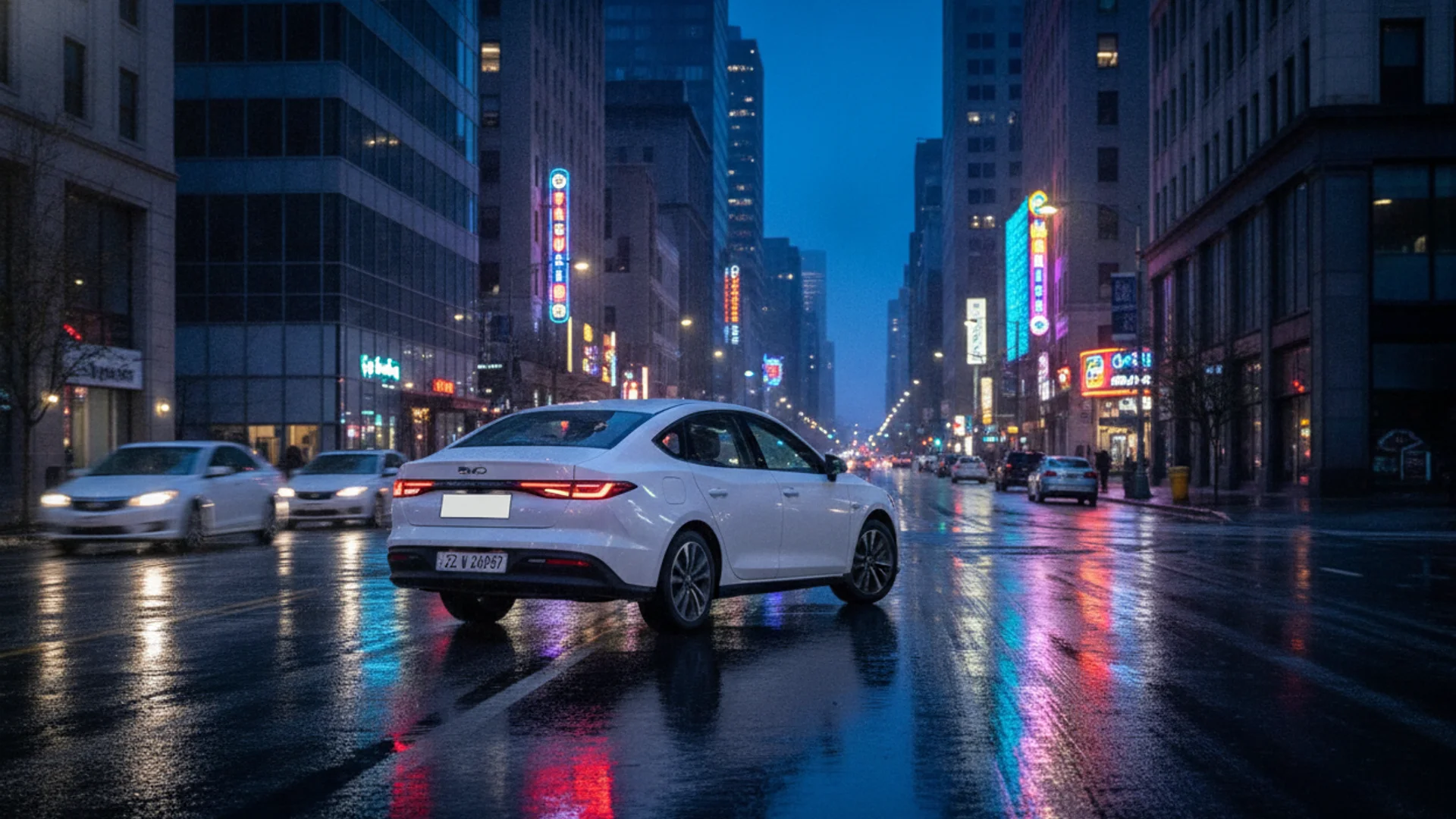
Japan's longest-running auto-market protection scheme isn't a tariff, it's a measurement standard. The kei-class rulebook governs length, width, height, engine displacement, and by extension, who is permitted to sell a small car cheaply to a Japanese buyer. BYD spent three years learning to fit inside it. The Racco is a battery electric kei car manufactured by BYD Auto in 2026 for the Japanese market, the carmaker's attempt at an electric kei car for Japan and the first and only dedicated pure kei car model from a non-Japanese brand.
That framing matters, because the Racco is not a downsized export. It is a vehicle engineered backwards from a statute, then forwards into one of the few major markets where a Chinese EV can enter without a punitive tariff waiting at the port. What waits instead is a subsidy architecture that quietly costs Racco buyers ¥430,000 at the register. The price the reader sees on the sticker is not the price the market actually clears at.
Key takeaways
- BYD's Racco is the first kei EV from any non-Japanese brand, cleared 320 km WLTC, beating Nissan Sakura's 180 km.
- Japan's subsidy structure hands domestic kei EVs ¥430,000 more in government support than the Racco qualifies for.
- BYD engineered the Racco backwards from Japan's strict kei dimensions, not by shrinking an existing export platform.
- LFP chemistry chosen over NMC for calendar-life durability, a deliberate bet on how kei buyers actually use cars.
- 1,002 orders in two weeks suggests the ¥430,000 subsidy gap isn't killing demand, at least at launch.
Quick Answer: What the BYD Racco Actually Is
The Racco is a battery-electric kei car, Japan's smallest legal car class, defined by dimensions (roughly 3.4 metres long, 1.48 metres wide) and a power ceiling that historically capped combustion engines at 660 cc. For EVs, the class rewrites itself around motor output. BYD built to those numbers rather than shrinking an existing platform. Jalopnik framed the project as a side quest no other non-Japanese brand has completed before, which is the correct register, this is not a market-entry play, it is a regulatory-fit exercise wearing market-entry clothes.
Three trims sit on the price sheet. The entry 200 uses a smaller 20 kWh pack good for roughly 160 km. The 300 Plus and 300 Premium share a 35.84 kWh lithium iron phosphate pack. Sold exclusively in Japan, the BYD Racco offers a range of 199 miles and targets kei EVs from local OEMs. That 320 km WLTC figure on the 300-series trims is the number that matters, no Japanese kei EV has cleared it. The Nissan Sakura, the segment's current benchmark, sits at 180 km on the same test cycle. BYD's own launch materials call the Racco the first kei EV in Japan to break the 300 km barrier, and no domestic response is public yet.
The Racco is not coming to Canada, or to Europe, or to Australia. This is a Japan-only product engineered for a Japan-only regulatory box. Any comparison to a Canadian or American EV market misses the design brief entirely. If you want the deeper policy math, the Racco's role as a test of global tariff regimes covers the ground the spec sheet doesn't.
Gear worth having
As an Amazon Associate, ThinkEV earns a small commission from qualifying purchases — at no extra cost to you.

Lectron Level 2 J1772 Charger (40A, WiFi)
Smart WiFi charger with real-time energy monitoring. 40A / 9.6 kW, J1772 with a NEMA 14-50 plug, schedule charging right from your phone.
As an Amazon Associate, ThinkEV earns from qualifying purchases — at no extra cost to you.
Specs and Trims: The Three-Tier Lineup
The pricing sheet reads cleanly, which is unusual for a Japanese launch. Entry sits at ¥2.145M, around $13,600 USD at the launch-week rate. A ¥150,000 government grant drops the effective entry below ¥2M. The two higher trims start at ¥2.398M and ¥2.497M, both carrying the 35.84 kWh LFP pack for 320 km of WLTC range.
The chemistry choice is deliberate. Lithium iron phosphate gives up energy density to nickel-manganese-cobalt but wins on cycle life, thermal stability, and a more forgiving cold-weather floor. For a kei car that will spend most of its life on short urban trips and overnight AC charging, the trade lands the right way. Kei buyers keep cars for years. LFP holds its capacity through those years better than the alternative.
An LFP kei car is worth pausing on, because the segment has quietly standardized on cheaper nickel-manganese chemistries at this size. LFP is heavier per kilowatt-hour, and in a 3.4-metre car every kilogram is contested. BYD is betting that Japanese buyers value the calendar-life story more than the acceleration story, which is a reasonable read of a segment where 0-60 times have never sold a single unit. The bet only fails if a domestic response ships a comparable pack at a lower delivered price inside eighteen months, which is not currently on any published roadmap.
Power sliding doors come on the higher trims, a genuinely useful feature in dense Japanese parking, where opening a door wide enough to get a child seat out often means opening it into the neighbour's bumper. The Racco's packaging is a reminder that kei cars are not merely small cars; they are cars designed around Japanese urban geometry, and the small details compound.
The 199-mile figure is WLTC, not WLTP or EPA. WLTC is calibrated for the driving patterns Japanese regulators observed on Japanese roads, which means the number is defensible on the roads the Racco will actually see. Extrapolating it to a North American commute is exactly the mistake the export-model reflex teaches. Don't.
The Subsidy Gap That Resets the Price Comparison
Here is where the sticker price stops telling the whole story. Japan operates a kei EV subsidy that pays out unevenly, and the unevenness is the entire point. Domestic-brand kei EVs qualify for up to ¥580,000 in government support, while Chinese imports cap out at ¥150,000, roughly $3,500 versus $900 USD. That is a ¥430,000 structural gap between a Racco and a subsidized Nissan Sakura, before municipal top-ups.
The municipal subsidies stack, and they stack for the domestic side. Tokyo, Yokohama, and several prefectural programmes add another layer that the Racco largely cannot access. The subsidy architecture is not designed to punish Chinese vehicles; it is designed to reward Japanese production. The Racco is caught in the difference between those two framings, and the difference is measured in yen.
An honest objection: the gap sounds punitive on paper, but Japanese buyers have absorbed larger price deltas for foreign cars before, particularly in premium segments where a European badge routinely costs 30 percent more than a comparable domestic sedan and still sells. The rebuttal is that the kei class isn't a badge-driven segment. Nobody buys a kei car to signal anything. Kei buyers optimize on delivered price, insurance, parking dimensions, and residual, the four axes on which a subsidy penalty compounds. A ¥430,000 gap in the Lexus segment is invisible. A ¥430,000 gap in a class where the entire vehicle costs ¥2M is the whole conversation.
This is structural, not temporary. It is not a tariff that expires on a review date. It is a policy design that rewards local manufacture, which the Racco does not do, BYD builds the Racco in China and ships it. Nothing about the kei-class regulatory compliance changes that calculation. The Racco is a legal kei car; it is not a domestically produced kei car. The subsidy code sees the second half of that sentence, not the first.
Gear worth having
As an Amazon Associate, ThinkEV earns a small commission from qualifying purchases — at no extra cost to you.

AstroAI Portable Tire Inflator
One tap, it inflates to your exact PSI then stops automatically. Low tires cost 5 to 10 percent of your range, so this pays for itself in a week.
As an Amazon Associate, ThinkEV earns from qualifying purchases — at no extra cost to you.
Compare this to Canada's own approach. The federal EVAP rebate pays up to $5,000 for a BEV, caps at a $50,000 final transaction value, and excludes China-built vehicles on country-of-origin grounds. No BYD model qualifies for EVAP at any price. Japan uses the same lever with a different fulcrum: not exclusion, but a punitive tier. The mechanism is softer. The intent is the same. If you want to see the same architecture playing out across the segment, Chery's kei-market joint venture is the next data point worth watching.
Gear worth having
As an Amazon Associate, ThinkEV earns a small commission from qualifying purchases — at no extra cost to you.

Digital Tire Pressure Gauge
Low tires quietly cost 5 to 10 percent of your range. A 10-second check with an accurate digital gauge keeps every kWh on the road.
As an Amazon Associate, ThinkEV earns from qualifying purchases — at no extra cost to you.
Early Demand: 1,002 Orders in Two Weeks
BYD is going where no foreign brand has gone before. The Chinese EV giant officially launched Racco on July 28, its first electric kei vehicle, specifically designed to crack open Japan's tiny-car market, long dominated by domestic brands like Nissan, Honda, Toyota, and Suzuki. Two weeks in, the order book crossed 1,002 units according to CnEVPost's tracking.
A thousand orders is a signal. It is not a verdict. Japan's kei segment moves roughly two million units per year across all brands and all powertrains. A thousand orders on a two-week launch is a rounding error against that volume, and the buyer profile matters more than the count. Early-adopter Japanese buyers who are willing to absorb a ¥430,000 subsidy penalty are not the cohort that decides whether the Racco reaches meaningful share. That cohort waits for the residual data, the used-market pricing signals, and the second-owner reviews. Those data points do not exist yet.
For scale, the Nissan Sakura collected roughly 23,000 pre-orders in its own first two weeks in 2022, on a comparable price band and inside a fully domestic subsidy stack. The Racco is not competing on that curve, and pretending otherwise flatters the launch beyond what the numbers support. What the 1,002 figure does prove is that BYD's dealer plan cleared its first physical bottleneck, cars are being ordered by people who can walk into a showroom, which two years ago was not a foregone conclusion for a Chinese brand in Japan.
The obvious pushback is that a launch order book skews toward EV enthusiasts and BYD loyalists who were going to sign anyway, and the real test starts once that pool exhausts around month three. That is fair, and it is precisely why the monthly registration curve matters more than the launch total. A launch spike that decays sharply by October tells one story; a flatter curve that holds through the winter tells a different one. The Sakura's own trajectory decayed roughly 60 percent from launch-month peak to steady-state monthly volume, and even at that decay it held segment leadership. The Racco's floor is the number worth watching, not its ceiling.
The competitive set is not gentle. Japanese manufacturers including Nissan, Honda, Suzuki and Daihatsu have never faced a foreign entrant in this segment, and each has decades of dealer, service, and residual-value infrastructure the Racco has to build from zero. The 320 km range advantage is real, and it is the Racco's single strongest card. Whether it plays against a subsidy gap this large is the question the next twelve months answer.
Gear worth having
As an Amazon Associate, ThinkEV earns a small commission from qualifying purchases — at no extra cost to you.
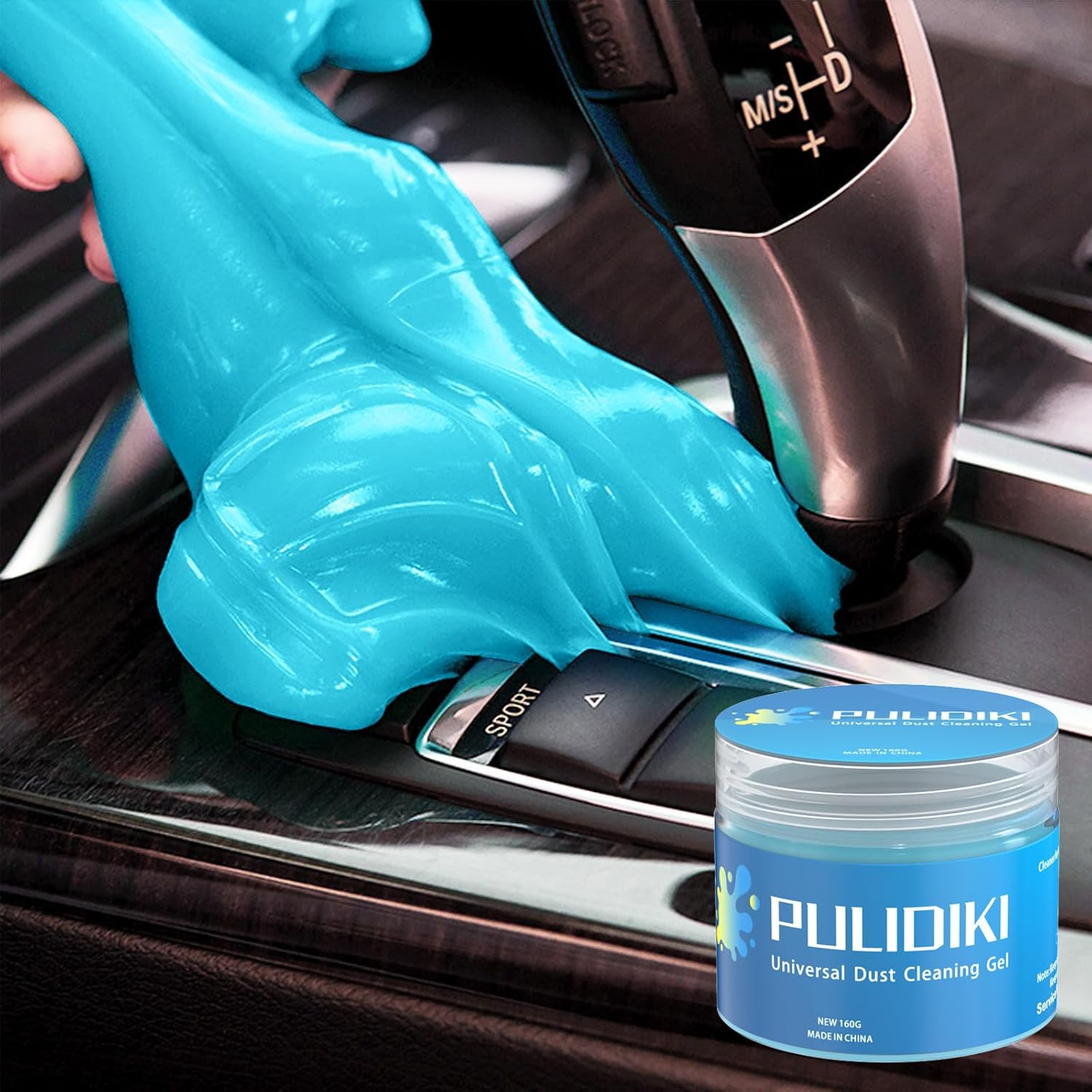
PULIDIKI Car Cleaning Gel (Detailing Putty)
Press it into vents, buttons, and seams and it lifts out dust you did not know was there. Weirdly satisfying, genuinely useful.
As an Amazon Associate, ThinkEV earns from qualifying purchases — at no extra cost to you.
Should You Wait or Buy Now, and Who Is This Actually For
The buyer case for the Racco is narrower than the launch coverage suggests. At ¥2.145M pre-subsidy, the entry Racco looks price-competitive against the Sakura's ¥2.6M-ish sticker. Once the subsidy difference lands, the effective delivered prices sit within a much tighter band, and the domestic offer includes a service network the Racco is still building.
The clean argument for the Racco is range. 320 km on the WLTC cycle is genuinely useful for a driver whose kei-car use extends beyond the daily urban loop, a household with weekend trips, a small-business owner covering multiple neighbourhoods, or anyone in a suburb where the Sakura's 180 km starts eating into the trip planning. That reader is a real reader. That reader also has to accept the subsidy hit and the residual uncertainty in exchange for the range.
The residual question is the one no spec sheet answers. Chinese brands have not been in the Japanese kei market before. There is no five-year price curve, no auction-house data, no fleet-return benchmarks. Japanese buyers historically resell kei cars into a mature secondary market at predictable prices. The Racco enters that market as an unknown, and the unknown is priced in immediately at the second sale, whether or not the first owner planned for it.
Two dated checkpoints are worth writing down. First, the monthly Japan Automobile Dealers Association registration figures through Q4 2026, if Racco monthly registrations settle above 1,500 units by December, the launch order book was a leading indicator rather than a curiosity spike. Second, the twelve-month residual on the 300 Plus trim, which arrives in mid-2027. If it holds within 10 percentage points of a comparable Sakura, the subsidy gap becomes the only meaningful economic penalty and the Racco is a straightforward buy for the range-limited kei household. If it drops further than that, the total cost of ownership tilts back to the domestic offer even without the subsidy support. A third checkpoint worth pinning: whether any domestic OEM announces a 300 km-plus kei EV at a comparable delivered price before the 2027 Tokyo Motor Show. If Nissan or Honda closes the range gap while retaining the ¥580,000 subsidy tier, the Racco's single strongest card is neutralized and the buy case narrows to badge-curious enthusiasts. Until all three signals land, the Racco is a bet on BYD's ability to build a service and resale reputation in a market that has never had to price one for a Chinese brand.
Gear worth having
As an Amazon Associate, ThinkEV earns a small commission from qualifying purchases — at no extra cost to you.

WixGear Magnetic Air Vent Phone Mount (2-Pack)
A magnet strong enough that your phone never flinches over potholes or rail crossings. Two in the box, one for each car.
As an Amazon Associate, ThinkEV earns from qualifying purchases — at no extra cost to you.

Founder & Chief Editor
Vlad Pereira is the founder and chief editor of ThinkEV.ca, the Canadian electric-vehicle publication he writes and edits from Courtenay, British Columbia. He covers EV pricing, federal and provincial rebates, charging costs, and the Chinese manufacturers now entering Canada, from the buyer's side rather than the press-fleet side. ThinkEV is a venture of Vlad Pereira Online; his writing on health, income and the long game lives at vladpereira.com.
Frequently asked questions
Why does the Racco cost more than its sticker price suggests?
Does the 320 km range hold up in real-world driving?
Why did BYD choose LFP chemistry instead of nickel-manganese?
Is BYD planning to bring the Racco to Canada?
What does 1,002 orders in two weeks actually tell us?
More EV & road-trip finds
Affordable upgrades worth a look — tap any to check the price on Amazon.
 ★ 55
★ 55LED Car Door Logo Projector Light
View on Amazon ★ 1,083
Crystal Push-Start Button Ring (2-Pack)
View on Amazon ★ 21,304
Car Headrest Hooks (4-Pack)
View on Amazon ★ 308
★ 308Coiled Lightning Car Cable for iPhone (2-Pack)
View on Amazon ★ 119
★ 119Foldable Waterproof Trunk Organizer
View on Amazon ★ 392
★ 392Large Cup Holder Adapter (32-40oz)
View on Amazon ★ 4,050
Touchscreen Mist Screen Cleaner Kit
View on Amazon ★ 164
★ 164Solar-Powered LED Ambient Light
View on AmazonRead, Plan, Then Stay Current
Explore our expert articles to understand incentives and ownership costs, use the map to pressure-test charging reality, then subscribe so new EV coverage comes straight to you.
Continue Reading
BYD Racco: The 20 kWh Kei EV and Tariff Rules
BYD Seagull Go vs Hyundai Kona EV: The Spec Sheet

10–97% in 9 Min: Sunwoda Joins the Flash Charging Race
Chery Lines Up a Kei Car for Japan, Squeezing Suzuki
How BYD Builds EVs So Cheaply: The Vertical Integration Playbook