Japan's kei-car box is 3.4 metres long and governed by law. BYD built its smallest EV to fit inside it, deliberately. The Racco, also marketed as the BYD Sea Otter, is not a downsized export. It is a vehicle engineered backwards from a statute, then forwards into one of the few major markets where a Chinese EV faces a 0% import tariff. BYD read a rulebook better than the incumbents who wrote it.
That distinction matters more than the spec sheet. The 20 kWh battery, the 3.4 metre length, the cap on motor output, and now the electric power sliding doors that feature in BYD's smallest EV, every one of these decisions traces to a regulatory line drawn by the Japanese Ministry of Land, Infrastructure, Transport and Tourism, not to an engineering preference inside Shenzhen. The Racco, BYD's first electric kei car, will go on sale this summer, and BYD has declared that a "small EV revolution" has begun after revealing the interior and a few more details ahead of its launch.
This is a regulatory-economics analysis of why this particular vehicle exists, where it can legally and commercially be sold, and what its market-entry strategy tells us about how Chinese automakers are now reading global tariff regimes: picking the openings, ignoring the walls, and engineering to whichever box the host country happens to draw. The product is the premise. The map is the story.
The verdict up front: the Racco is a buy signal for BYD's Japan thesis, a wait signal for European observers watching Hungarian assembly come online, and a skip for any Canadian or American consumer hoping this lands at their dealer. The reasons sit in three different regulatory codes.
Key takeaways
- BYD sized the Racco's 20 kWh battery to stay under the kei GVW ceiling, not because of cell technology limits.
- Japan's kei classification cuts annual automobile tax from ¥30,500–¥110,000 down to roughly ¥10,800.
- Power sliding doors solve Japan's shako shōmei parking-certificate system, not a luxury spec choice.
- BYD enters Japan at 0% tariff while Canadian and American buyers have no viable path to this vehicle.
- BYD's vertical integration on cells and motors lets it absorb kei EV development costs incumbents like Suzuki cannot spread globally.
What the Kei-Car Standard Actually Requires, By Law
Japan's kei (軽, "light") classification is the most distinctive vehicle category in any developed-market regulatory regime. It is also the oldest, dating to 1949, and it has been progressively tightened rather than relaxed. Under current rules administered by Japan's Ministry of Land, Infrastructure, Transport and Tourism (MLIT), a kei vehicle must measure no more than 3.4 metres in length, 1.48 metres in width, and 2.0 metres in height. Engine displacement is capped at 660 cc for combustion variants. For electric variants, the equivalent regulatory constraint is a motor output ceiling of 47 kW (approximately 63 horsepower), set under the Road Vehicles Act. The box is small, the box is hard, and the box is precisely where the Racco lives.
The Racco lands squarely against the dimensional ceilings. Designed like other smaller Kei Car models in the Japanese markets, it has a boxier front and rear sections, coming in just short of 3.4 metres in length, 1.48 metres wide and 1.8 metres in height. Two metres of height was available; BYD chose 1.8 metres. The width hits the maximum. The length sits within a few centimetres of the legal cap. This is not a vehicle that grew into its dimensions, it was drawn against them.
The classification carries statutory tax and insurance benefits that ordinary passenger vehicles do not access. Annual automobile tax on a kei is approximately ¥10,800 versus ¥30,500 to ¥110,000 for standard passenger classes, a gap of roughly ¥20,000 to ¥99,000 per year depending on engine displacement of the standard-class alternative. Mandatory insurance, weight tax, and inspection fees scale similarly. Over a typical seven-year ownership cycle, the kei classification saves a household between ¥200,000 and ¥600,000 in non-fuel ownership cost. That is the regulatory tailwind any kei EV inherits the moment it qualifies.
The case against treating the kei envelope as a competitive moat runs as follows: the dimensional box is open to any OEM willing to engineer to it, including Toyota, Honda, Suzuki, and Daihatsu, all of whom have decades of platform-specific tooling depreciated against the segment. A Chinese entrant should, in theory, find it harder to win here than in an open midsize segment where its scale advantages translate directly. The rebuttal is that the segment's incumbents have under-invested in electrification, Nissan and Mitsubishi excepted, because the engineering economics of a 660 cc combustion kei are too thin to fund a parallel EV programme. BYD's vertical integration on cells, motors, and inverters lets it absorb the EV development cost across a global volume base the kei incumbents do not have. The moat exists; it just protects the wrong producers.
Sliding doors are not legally mandated. They are, however, the practical answer to the second regulatory pressure shaping the kei segment: urban parking minimums. Japan's shako shōmei ("garage certificate") system requires proof of off-street parking before vehicle registration in most urban areas. The off-street spaces that satisfy this requirement are frequently narrower than 2.3 metres. A conventional hinged door cannot reliably open against that envelope. An electric offering by BYD could really help put BYD on Japanese consumers' shortlist in the years to come, as the brand looks at aggressive expansion plans in what appears to be one of the toughest markets globally for foreign brands.
Power sliding doors, then, are not a luxury feature in this segment. They are a regulatory-adjacent expectation, the consequence of an unrelated rule (parking) shaping what counts as a competitive product. BYD is matching that expectation rather than challenging it. The implication is structural: when an OEM enters a market by engineering to the regulatory contours rather than testing them, it signals a long horizon. Short-horizon entrants cut features to hit price; long-horizon entrants spend the bill of materials to clear unwritten consumer baselines. This is the latter.
The 20 kWh Battery: Regulatory Fit, Not Technical Ceiling
The pack size has attracted disproportionate attention in early coverage, mostly because 20 kWh sounds small against the 60–80 kWh midsize-EV norm. The framing is wrong. The Racco's battery is not a technology constraint, BYD's Blade and second-generation Blade chemistries scale well past 100 kWh in other products. The 20 kWh figure is a regulatory fit, and treating it as a cost-cutting choice misses the entire engineering thesis.
Kei vehicles operate under a gross vehicle weight ceiling that, in practice, sits near 880 kg for passenger variants once cargo and occupant allowances are factored in. A 20 kWh LFP pack at current cell-level energy density (roughly 160 Wh/kg pack-integrated) contributes approximately 125 kg before structural enclosure. Doubling to 40 kWh would add 125 kg more, pushing the platform past kei GVW limits and forfeiting the statutory tax benefit. The pack is sized to preserve the classification, not to maximise range.
Range itself sits at the segment-standard floor. At the show, a slide at the BYD stand revealed that the Racco will come equipped with two battery packs, with the smaller 20 kWh pack delivering around 200 km of range, and a larger 30 kWh battery pack delivering around 300 km of range. Earlier teasers had pegged the entry pack lower, BYD's smallest EV was teased with a tiny battery and limited range, initially reported as 180 km on the 20 kWh configuration. The 20 km uplift between teaser and confirmed spec likely reflects WLTC versus JC08 cycle measurement, not a hardware change.
Either figure is adequate to the use case. Japan's average daily passenger-vehicle trip distance is 16.5 km according to MLIT mobility surveys, and the median kei trip is shorter still. A 180–200 km usable range covers roughly nine to twelve average days of urban driving on a single charge. For households using the kei as a second vehicle, the dominant ownership pattern, the math is more than sufficient.
The chemistry choice carries a Canadian caveat worth flagging, even though Canada is not a target market. BYD's LFP cells lose 30–40% of usable capacity at -20°C compared to room-temperature performance, a wider loss than NMC chemistry sees under identical conditions. For Japan's southern and central markets, Tokyo, Osaka, Nagoya, winter low temperatures rarely reach -10°C, and the cold-weather penalty is manageable. For Hokkaido and northern Tōhoku, a 20 kWh nominal pack delivering 200 km in summer realistically delivers 120–140 km in January. For a deeper analysis of how LFP chemistry behaves in genuinely cold conditions, see the technical breakdown of which EVs survive a Canadian winter.
The segment benchmark is consistent. Suzuki's eWagon R, scheduled for 2026 launch, uses a 20 kWh pack. The Honda N-One EV concept, shown at Japan Mobility Show 2024, was disclosed at 17 kWh. Nissan's Sakura, the current segment volume leader, ships a 20 kWh battery. BYD has matched the convention precisely, neither over-engineering for marketing copy nor under-cutting on cost. That is what regulatory-fit engineering looks like.
The buy/wait/skip read on battery sizing:
- Buy the 30 kWh variant if the household has a single vehicle and routinely runs intercity legs above 150 km.
- Buy the 20 kWh variant if it is a second car and 90% of trips are sub-30 km urban runs.
- Wait if BYD has not yet published JC08 efficiency numbers above 9 km/kWh, that data point determines whether the 20 kWh real-world range clears 220 km or stalls near 180 km.
- Skip if the buyer lives north of Sendai. The LFP cold-weather loss is real and the dealer network thins out fast above the 38th parallel.
The forecast worth committing to: if BYD ships a 30 kWh variant at sub-¥3 million sticker, it will outsell the 20 kWh variant within eighteen months despite the latter's superior tax math. The reason is range anxiety as a purchase-decision factor that survives ownership-cost rationality, the same behavioural pattern that pushed Tesla's Model 3 Long Range to outsell the Standard Range in every market where both were offered at launch. What would change my mind: confirmed JC08 efficiency numbers above 9 km/kWh on the 20 kWh pack, which would deliver real-world range closer to 220 km and collapse the rational gap. The first three months of Sakura-vs-Racco comparison shopping at Japanese dealers will surface this in survey data quickly.

Gear worth having
As an Amazon Associate, ThinkEV earns a small commission from qualifying purchases — at no extra cost to you.

WeatherTech FloorLiner for Tesla Model 3
Deep-channel liners that trap every drop of slush and salt. The difference between a ruined interior and a showroom-fresh cabin after a Canadian winter.
As an Amazon Associate, ThinkEV earns from qualifying purchases — at no extra cost to you.
Japan Market Access: Tariffs, EVAP, and BYD's Regulatory Standing
Japan's import tariff regime is the structural reason the Racco launches in Tokyo and not Toronto. Japan imposes a 0% Most-Favoured-Nation (MFN) tariff on passenger electric vehicles. There is no countervailing duty against Chinese-origin EVs. There is no quota. There is no rules-of-origin escalator. A BYD-built vehicle landed at the port of Yokohama pays the same import duty as a Volkswagen, which is to say, none. This is, frankly, an embarrassment for every G7 trade ministry that spent 2024 building tariff walls without checking whether Tokyo intended to build one too.
This is the single largest tariff differential against any other major market BYD currently sells into. Canada's tariff on Chinese-origin EVs sits at 6.1% as of January 2026, having been reduced from 100% under a 49,000-vehicle annual quota. The European Union imposes a 35.3% countervailing duty on BYD specifically, confirmed in November 2024 following the provisional measures of October 2024. The United States maintains a 100% Section 301 tariff on Chinese EVs, in place since May 2024 and unchanged through the current administration. Brazil charges 35% through 2026 under a transitional schedule.
Against that backdrop, Japan is the path of least resistance. The country also offers what is functionally an industrial subsidy on the demand side: the Clean Energy Vehicle (CEV) subsidy programme administered by METI provides up to ¥650,000 per vehicle for kei EVs meeting efficiency criteria. The Racco's powertrain efficiency will determine its precise eligibility tier, but the segment-standard payout for kei EVs has been in the ¥500,000–¥650,000 range across the 2023–2025 fiscal years. That subsidy, applied against a likely sticker price of ¥2.5–2.8 million, drops the effective transaction price by roughly 20%.
BYD's regulatory standing in Japan is already established. BYD revealed at the Tokyo Motor Show that the new electric hatchback would be known as the 2026 BYD Racco, which translates from Japanese to BYD "Sea Otter". The naming choice itself signals localisation intent. BYD has sold the Atto 3 and Dolphin in Japan since 2023, operates a dealer network across major metropolitan areas, and has navigated Japan's type-approval pathway under the TRIAS (Trilateral Review Inspection Approval System) framework. Type approval for the Racco is a process step, not a structural barrier, the platform's compliance work is already partially amortised against BYD Japan's existing sales operation.
The TRIAS process does assess sliding-door safety and pedestrian-protection standards separately from the broader vehicle approval. Power-actuated sliding doors carry additional review under the Japan-specific interpretation of UN Regulation No. 11. This is administrative friction, not denial, every Toyota Sienta and Honda Freed sold in Japan has cleared the same review. But it adds 30–60 days to a homologation timeline that would otherwise run faster.
The counter-case on Japan as an open market deserves a hearing. Foreign-brand passenger-vehicle market share in Japan sits below 6% across all powertrains, the lowest figure of any G7 economy, and that floor has been stable for two decades despite zero formal trade barriers. The explanation is not tariff but distribution: the keiretsu dealer networks that move Toyota, Honda, Nissan, and Suzuki product are vertically tied to those manufacturers, and independent dealers willing to carry foreign brands cluster in Tokyo, Osaka, and Nagoya at insufficient density to support nationwide service coverage. BYD's response has been to build a standalone dealer footprint, 100+ locations announced for end-2025, but at a fraction of Suzuki's roughly 3,000-outlet kei network. The distribution gap is the real moat, and it does not appear on any tariff schedule. For a parallel analysis of how distribution constraints, rather than headline tariff rates, actually gate Chinese-brand entry into a developed market, see the breakdown of foreign-OEM dealer-network economics in protected markets.
Multi-Jurisdiction Comparison: Where the Racco Can and Cannot Go
The Racco's regulatory geography is best read in table form. The same vehicle, identically engineered, faces dramatically different commercial economics depending on which port it lands at.
| Market | Tariff on Chinese EVs | Federal/National Incentive Eligibility | Commercial Viability for Racco |
|---|---|---|---|
| Japan | 0% MFN | CEV subsidy ¥500–650K (eligible) | Confirmed launch, summer 2026 |
| Canada | 6.1% post Jan 2026 (49K quota) | EVAP $5,000 rebate (excluded) | Tariff-viable, incentive-locked-out |
| European Union | 35.3% countervailing on BYD | Member-state schemes (varies) | Commercially marginal |
| United States | 100% Section 301 | $7,500 IRA credit (excluded) | Not viable |
| United Kingdom | 10% MFN + ROO pressure | No federal purchase grant since 2022 | Possible, no confirmed plan |
| Brazil | 35% transitional through 2026 | Limited state-level incentives | Not target, domestic plant prioritised |
The Canadian case is the most instructive contrast. Under the federal Incentives for Zero-Emission Vehicles (iZEV) programme, referred to here as EVAP for editorial consistency, vehicles must be manufactured in a country with which Canada has a free-trade agreement to qualify for the $5,000 federal rebate. Chinese-origin vehicles are categorically excluded. The 6.1% MFN tariff is commercially absorbable on a vehicle with a presumptive landed cost in the C$22,000–25,000 range. The EVAP exclusion is not. A C$25,000 Racco that would compete head-on against a $30,000 incentive-eligible alternative becomes a $25,000 vehicle competing against effectively $25,000 alternatives. The margin disappears. For the underlying tariff and quota mechanics, see the BYD Seagull market-access analysis, which walks through the same regulatory structure applied to a different BYD product.
The European Union case is starker. The 35.3% countervailing duty applied specifically to BYD, distinct from the lower rates applied to SAIC and Geely, was the outcome of the European Commission's anti-subsidy investigation concluded in November 2024. Applied to a Racco landed at €20,000, the duty adds €7,060 before VAT. The kei vehicle's structural advantage in the European A-segment evaporates. BYD's European strategy, accordingly, has pivoted to Hungarian assembly (announced for 2025 commencement), a regulatory workaround that places BYD vehicles under EU rules of origin and outside the countervailing duty's scope.
The named comparison worth drawing here is the Dacia Spring, the closest European-market analogue to what the Racco would attempt if duties allowed. The Spring, built by Renault subsidiary Dacia at Dongfeng's Shiyan plant in China, was Europe's third-best-selling retail EV in 2023 at roughly 67,000 units, before the countervailing duty schedule pushed its landed cost up by approximately €1,500 per unit in late 2024. (Dacia drew a lower tariff than BYD due to a different cooperation classification during the EC investigation.) The Spring's sticker sits near €19,500 pre-incentive; a Racco at the BYD rate would land closer to €27,000 before VAT, and no member-state purchase grant currently bridges that gap for a kei-format vehicle that European consumers do not have a pre-existing tax preference for. The product would survive in Italy and France on novelty alone; it would not become a programme. The way Japan solves the small-EV regulatory question with a 0% tariff and a structural tax class, and the way the EU answers it with a 35% wall and no equivalent micro-class incentive, those are not two roads to the same destination. They are two destinations.
The United States is not a question. Section 301 tariffs at 100% on Chinese-origin EVs, layered onto a base 2.5% MFN, render the Racco commercially unviable without third-country assembly. BYD has no announced North American assembly plans that would change this. The IRA's $7,500 consumer credit requires assembly in North America and battery sourcing from non-Foreign Entity of Concern jurisdictions, Chinese-origin batteries are explicitly excluded under 30D Treasury guidance. Two regulatory walls, layered.
Brazil sits in an unusual middle position. The 35% transitional tariff is real, but BYD's Camaçari plant, purchased from Ford and converted to EV production, opens in 2025 with capacity allocated to the Dolphin Mini, Yuan Plus, and other mid-size models. The Racco is not on the announced production list. Brazil's market wants larger vehicles; the kei format does not translate to a country with abundant parking, longer trip distances, and no equivalent tax-class incentive.
Gear worth having
As an Amazon Associate, ThinkEV earns a small commission from qualifying purchases — at no extra cost to you.
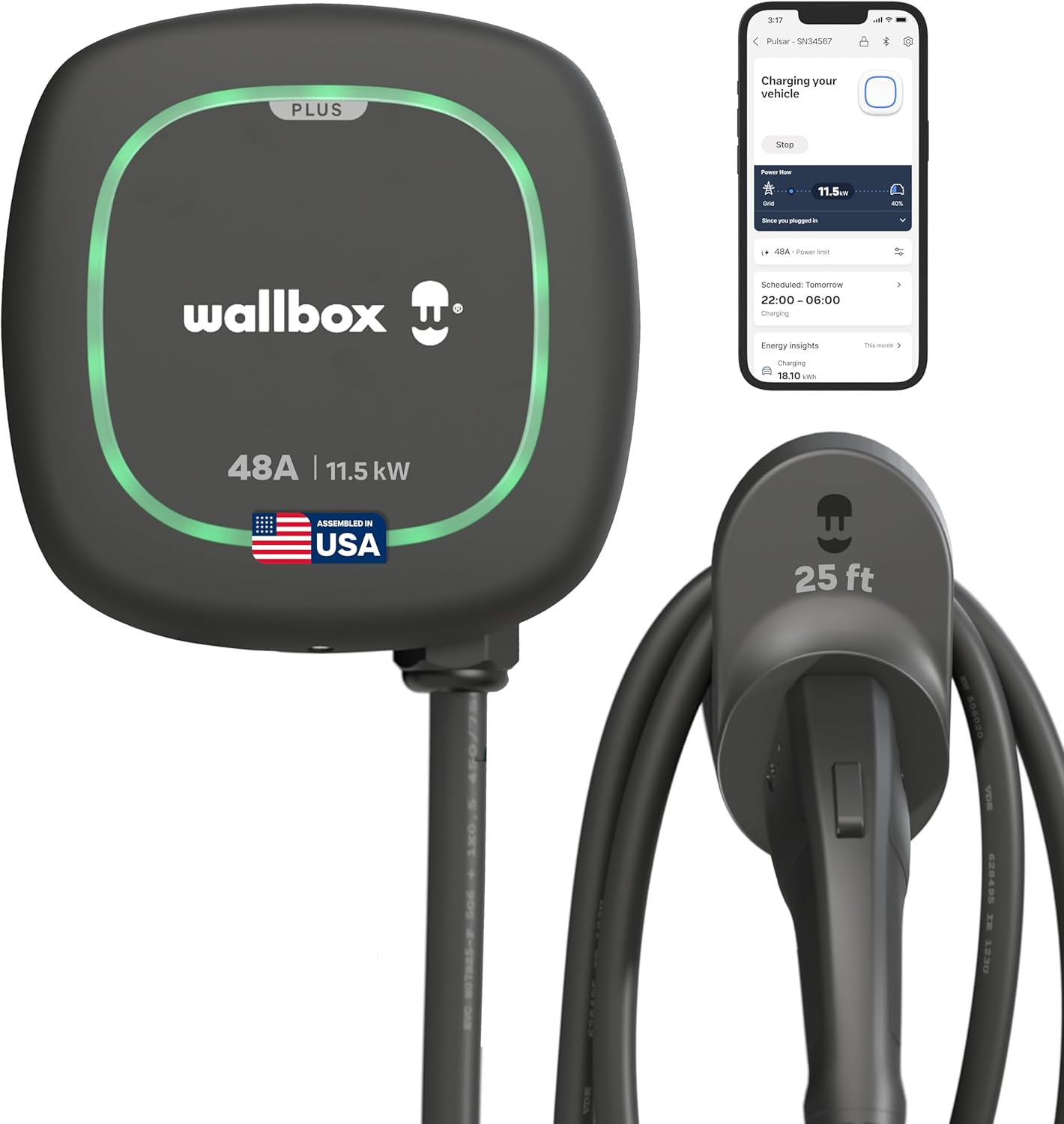
Wallbox Pulsar Plus 48A Level 2 Charger
Compact, sleek charger with app control and power sharing for two EVs. 48A / 11.5 kW, NEMA 14-50. Looks as good as your EV.
As an Amazon Associate, ThinkEV earns from qualifying purchases — at no extra cost to you.
Power Sliding Doors as a Regulatory-Adjacent Feature
The sliding-door decision deserves treatment on its own because it inverts a common assumption about how Chinese OEMs enter mature markets. The assumption is that Chinese entrants undercut on features to hit price. The Racco does the opposite, and that inversion is the most important strategic signal in the entire programme.
Power-actuated sliding doors carry mass and complexity penalties that are non-trivial in a weight-constrained kei platform. A single electric sliding-door mechanism adds approximately 15–25 kg per side over a conventional hinged door, call it 30–50 kg across the vehicle. On a platform whose entire competitive position depends on staying under the kei GVW ceiling, that mass budget is real money. It must be recovered elsewhere, typically by removing structural redundancy, downsizing battery, or accepting reduced payload.
Power sliding doors also require compliance with UN Regulation No. 11 (door latches and hinges) and ECE Regulation 26 (external projections), with additional Japan-specific safety interpretations administered through TRIAS. Each adds homologation cost and time. None of this is unrecoverable, but none is free.
The reason BYD is paying these costs is that Toyota's Sienta and Honda's Freed have made power sliding doors the consumer baseline in Japan's compact people-mover and tall-wagon segments. The Nissan Roox and Suzuki Spacia, both kei-class, ship with the feature. A new entrant without sliding doors would be competing on a spec disadvantage that no price point compensates for in the relevant buyer demographic, primarily women aged 30–55 driving daily school runs and grocery trips, where the door-as-feature is loaded with parking-lot and child-restraint use cases.
What this actually means: BYD has accepted the higher BOM cost to clear the unwritten consumer expectation. That is a market-entry move, not a cost-disruption move. The Racco is not trying to win on price-versus-features; it is trying to match incumbent quality at a competitive price, then sell on the cumulative cost-of-ownership advantage that the kei classification confers regardless of brand. The strategic posture is closer to Hyundai's 1990s US entry than to the price-disruption playbook BYD has used elsewhere. For broader context on BYD's product strategy and what its technology choices signal across markets, see the analysis of what BYD's solid-state battery roadmap means for buyers.
This feature decision is a tell. An OEM in cost-disruption mode would skip the powered actuation, ship manual sliders, and let early reviews complain. An OEM building for a decade-long market presence pays the bill. BYD has paid the bill.
The second-order implication concerns warranty and parts logistics. Power sliding-door mechanisms are statistically the highest-warranty-claim component on Japanese minivans, with Toyota Sienta and Honda Freed both running door-actuator replacement rates above class average through years three to five of ownership. A foreign entrant carrying that warranty exposure across a thin dealer network amplifies cost-per-claim, every replacement requires either trained service technicians at the local dealer or recovery transport to a regional service centre. BYD Japan's stated investment in a dedicated parts distribution centre at Yokohama, announced alongside the Atto 3 launch in 2023, looks less like aspirational infrastructure and more like a prerequisite once the sliding-door commitment is read into the warranty math. For a closer look at how dealer-network density actually determines whether a foreign EV brand survives in a protected market, see the analysis of distribution as the real barrier to Chinese EV entry.
Market-Share Stakes: Japan's Kei EV Segment Is Nascent But Fast
The total addressable market is large and the EV penetration within it is small. Both facts matter, and the gap between them is the opportunity BYD is pricing into the Racco programme.
Kei vehicles accounted for 37.9% of all Japan new-vehicle registrations in calendar year 2024 according to Japan Automobile Importers Association data, roughly 1.6 million units against a total market of approximately 4.2 million. Within that 1.6 million, fully electric models accounted for less than 2%, a segment of approximately 30,000 vehicles annually, dominated by two products.
The Nissan Sakura and its Mitsubishi-badged twin, the eK Cross EV, sold a combined 53,000 units in fiscal year 2023, with Sakura accounting for roughly 70% of the volume. FY2024 numbers softened as the novelty premium wore off and CEV subsidy budgets exhausted earlier in the fiscal year. The segment has demonstrable demand at a 20 kWh, 180 km, ¥2.5 million price point, but it is currently served by precisely two products from a single corporate alliance.
BYD's Japan total sales across all models reached approximately 2,600 units in calendar 2024. The Racco is targeted at a sales volume one order of magnitude larger, internal BYD Japan briefings have referenced a 15,000–20,000 unit annual target by FY2027. That figure would represent roughly 5% of the Sakura's current segment share and would establish the Racco as the first Chinese vehicle to achieve meaningful kei-segment penetration.
The subsidy environment will gate this. Japan's CEV subsidy budget for kei EVs has historically exhausted between months six and nine of each fiscal year (Japan's fiscal year runs April through March). When the budget runs out, kei EV sales drop measurably, the demand is incentive-elastic at the margin. BYD's launch timing into a summer 2026 window places initial sales into FY2026's second-half subsidy environment, which is structurally weaker. A first-year sales target above 8,000–10,000 units will require pulling forward FY2027 demand or absorbing post-subsidy price compression. Neither is fatal, but both compress margin in year one.
The counter-thesis to BYD's volume target deserves stating plainly: Nissan launched the Sakura into an empty segment with a 70-year domestic brand reputation and dealer relationships dating to the 1960s, and still saw FY2024 volume compress as the novelty wore off. A Chinese entrant launching into a now-contested segment without the brand equity and with one-thirtieth the dealer density is structurally asking for less than half of Sakura's peak, call it 10,000 to 12,000 units in year one under a charitable forecast. The 15,000–20,000 figure assumes BYD captures conquest sales from Sakura owners considering their second EV purchase, which requires Sakura owners to have had a brand-souring experience that the available customer-satisfaction data does not currently support.
The bet I would watch, and I would put real capital behind it, is whether BYD pre-positions inventory before the FY2026 subsidy budget allocation in April, or whether it allows the launch to slip into the post-allocation window. Pre-positioning signals confidence in volume; slipping signals margin discipline. The financial structure of the Racco programme will be visible in that timing call within the next sixty days.
Gear worth having
As an Amazon Associate, ThinkEV earns a small commission from qualifying purchases — at no extra cost to you.

Grizzl-E Classic Level 2 EV Charger (40A)
Canadian-made and rated for minus 40C winters. 40A / 9.6 kW, NEMA 14-50, indoor/outdoor, 24-ft cable. The charger built for Canadian weather.
As an Amazon Associate, ThinkEV earns from qualifying purchases — at no extra cost to you.
Gear worth having
As an Amazon Associate, ThinkEV earns a small commission from qualifying purchases — at no extra cost to you.

Lectron Level 2 J1772 Charger (40A, WiFi)
Smart WiFi charger with real-time energy monitoring. 40A / 9.6 kW, J1772 with a NEMA 14-50 plug, schedule charging right from your phone.
As an Amazon Associate, ThinkEV earns from qualifying purchases — at no extra cost to you.
Policy Implication: The Racco as a Template for Regulatory Arbitrage
Strip the marketing language away and the Racco programme is a single thesis: engineer to the host country's regulatory box, accept the resulting product constraints, and enter the market through the regulatory door that other producers have left open.
Japan's combination of 0% import tariff, statutory tax preference for kei-class vehicles, and demand-side CEV subsidies is unique among major markets. The Racco is the first Chinese EV explicitly engineered to that combination. If it succeeds at the 8,000–15,000 unit-per-year range, it establishes a template, and the template is portable.
India's L7e quadricycle classification has a similar structure: dimensional and power constraints in exchange for tariff and tax preference. The EU's L6e and L7e micro-car categories carry analogous treatment. Both segments are currently dominated by domestic or European producers who have not faced credible Chinese competition because the price disruption that Chinese OEMs typically deploy is constrained by these segments' regulatory ceilings on size and power. The Racco demonstrates the alternative, match the regulatory envelope, ship the consumer-expected features, win on cost-of-ownership rather than sticker price. I would bet on at least one of these markets seeing a BYD or Geely entry within 24 months of the Racco's first-year sales data.
The corollary is uncomfortable for Canada and the EU. Tariff regimes designed to give domestic OEMs breathing space against Chinese price disruption do not address the regulatory-arbitrage strategy the Racco represents. A 6.1% Canadian tariff is irrelevant if the Chinese OEM is not pricing aggressively in the first place, and the EVAP exclusion only matters if the alternative vehicles are themselves eligible. As more Chinese product enters tariff-friendly markets and accumulates global volume, the cost basis falls, the engineering capability deepens, and the regulatory walls erected elsewhere protect less than they were designed to.
The forecast I would commit capital to: within thirty-six months, at least one G7 country currently relying on tariff defence will pivot to a regulatory-fit defence, either a Buy-Domestic content requirement layered on top of the existing tariff, or a Canadian-style FTA-origin restriction on consumer incentives. Tariffs without origin-of-incentive rules leave too much surface area exposed. The signal that this pivot is imminent will be a member-state proposal at the European Council to tie national EV purchase grants to EU-content thresholds rather than vehicle-class criteria. France floated something close to this in early 2024 and withdrew under industry pressure; the proposal will return, and the second iteration will pass.
The three signals worth watching, in order of how soon they resolve:
- FY2026 subsidy timing. Whether BYD pre-positions inventory before the April allocation or slips into post-allocation pricing. Resolves within sixty days.
- TRIAS sliding-door approval timeline. A clean 30-day homologation says BYD Japan has the regulatory relationship locked; a 90-day drift says the dealer-network and warranty exposure conversation is harder than the press releases suggest.
- Second kei product within twelve months. A follow-on announcement converts the Racco from a one-shot experiment into a platform strategy. Silence converts it into a hedge.
Three signals, all visible in public regulatory filings. The Racco is not just a small car. It is the first datapoint in a strategy other Chinese OEMs will copy if it works.
Gear worth having
As an Amazon Associate, ThinkEV earns a small commission from qualifying purchases — at no extra cost to you.

ChargePoint Home Flex Level 2 Charger (50A)
Premium 50A / 12 kW charger with the best app ecosystem. Hardwired or NEMA 14-50, with real-time energy tracking and smart scheduling.
As an Amazon Associate, ThinkEV earns from qualifying purchases — at no extra cost to you.

Founder & Chief Editor
Vlad Pereira is the founder and chief editor of ThinkEV.ca, the Canadian electric-vehicle publication he writes and edits from Courtenay, British Columbia. He covers EV pricing, federal and provincial rebates, charging costs, and the Chinese manufacturers now entering Canada, from the buyer's side rather than the press-fleet side. ThinkEV is a venture of Vlad Pereira Online; his writing on health, income and the long game lives at vladpereira.com.
Frequently asked questions
Will the Racco ever qualify for Canada's EV incentives?
Does the 20 kWh battery limit how useful this car actually is?
Why didn't Toyota or Honda just build this first?
Is the power sliding door actually a meaningful feature here?
What would it take for a Chinese kei EV to reach Europe?
More EV & road-trip finds
Affordable upgrades worth a look — tap any to check the price on Amazon.
 ★ 268
★ 268Anti-Slip Leather Steering Wheel Cover
View on Amazon ★ 8,681
Chemical Guys Complete Car Wash Kit
View on Amazon ★ 537
★ 537USB Star Projector Roof Light
View on Amazon ★ 1,083
Crystal Push-Start Button Ring (2-Pack)
View on Amazon ★ 865
★ 865Collapsible Trunk Organizer
View on Amazon ★ 297
★ 297360-Degree One-Hand Dashboard Phone Mount
View on Amazon ★ 119
★ 119Foldable Waterproof Trunk Organizer
View on Amazon ★ 392
★ 392Large Cup Holder Adapter (32-40oz)
View on AmazonRead, Plan, Then Stay Current
Explore our expert articles to understand incentives and ownership costs, use the map to pressure-test charging reality, then subscribe so new EV coverage comes straight to you.
Continue Reading
BYD Racco 2026: Kei EV With 320 km Range at ¥2.145M

Chery Lines Up a Kei Car for Japan, Squeezing Suzuki
BYD Seal Canada: Demand Is Real, the Car Is Not Here
BYD Sealion 06: What It Takes to Reach Canada

Chinese EVs in Canada: 15,603 In, Still No BYD