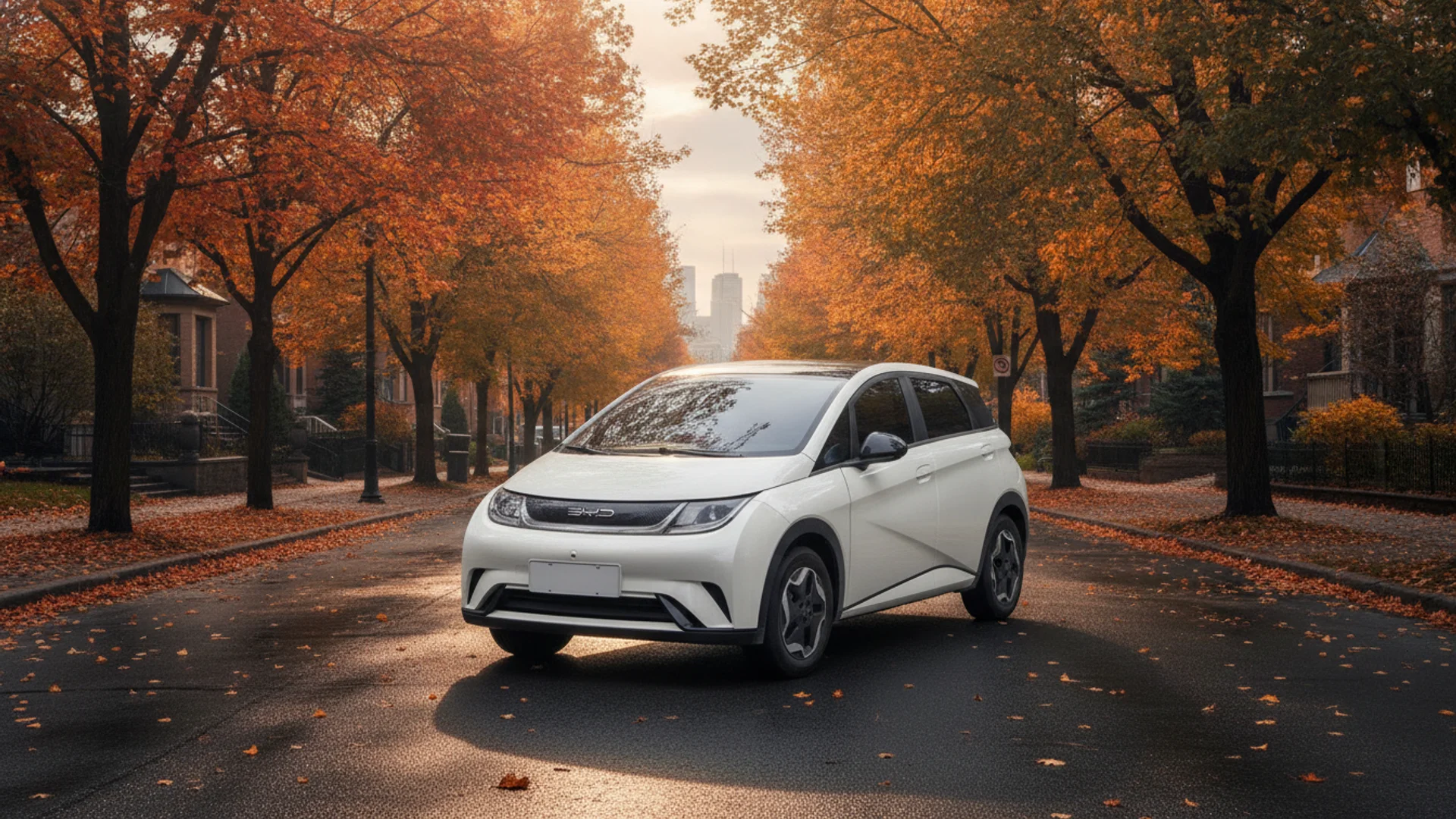
A roof-mounted LiDAR sensor sits atop a car that costs less than a used Honda Civic. Read that sentence twice. Something has fundamentally shifted in how the automotive industry prices intelligence.
Key takeaways
- The 2026 BYD Seagull launched in China on May 11, 2026 with a LiDAR-equipped trim at roughly 90,900 yuan (about $13,300 USD), the first A00-class EV to offer roof-mounted LiDAR.
- That LiDAR trim costs about half the $27,495 USD Chevrolet Bolt EUV, which offered only camera-based assistance at any price.
- BYD's God's Eye B is a Level 2+ driver-assist stack, not Level 3, fusing one roof LiDAR with cameras and ultrasonics on the DiPilot 300 platform.
- The LiDAR Seagull is China-only; its export twin, the Dolphin Surf, ships with cameras and basic Level 2 assistance, and there is no confirmed Canadian price or date.
The 2026 BYD Seagull launched in China on May 11 with a configuration that, eighteen months ago, would have read as a typo. The 2026 BYD Seagull starts at 69,900 yuan ($10,290), while the LiDAR-equipped version starts at 90,900 yuan. That LiDAR trim works out to roughly $13,300 USD at current exchange rates, and the 2026 Seagull now becomes the first A00-class EV to offer roof-mounted LiDAR, a feature usually associated with more expensive vehicles.
The interesting part isn't the price. The interesting part is what the price reveals about the manufacturing posture underneath it.
The Hardware That Wasn't Supposed to Be Here
LiDAR was, until recently, the technology that justified premium badges. Volvo's EX90 wears one. The Mercedes EQS uses a Valeo unit to enable Level 3 traffic-jam autonomy in narrowly defined conditions. Lucid, NIO's ET-series, the Polestar 3, all premium vehicles, all sold north of $70,000 in markets where they reach buyers. The sensor was the marker. If you saw a small black bulge on the roof of a car, you knew the sticker had a comma in an uncomfortable place.
The A00 segment, China's regulatory classification for the smallest passenger cars, sits at the opposite pole. These are sub-four-metre vehicles aimed at urban commuters, second cars, and first-time buyers stepping out of e-bikes and scooters. The category is defined by what it leaves out: leather, large displays, aluminium body panels, expensive sensor stacks. Cost floors are the entire point.
So when BYD bolts a LiDAR to the Seagull's roof and asks for 90,900 yuan, the category's internal logic breaks. The model becomes the first mini car in the Chinese EV market to support LiDAR. The system BYD calls "God's Eye B", a tier below the full God's Eye A stack reserved for the Han and Seal, turns a city runabout into a vehicle with sensing hardware Tesla doesn't sell at any price. My honest read: this is the most consequential A00 launch in a decade, not because the car is great in absolute terms, but because of what it forces every other affordable-EV programme to answer for.
The Jalopnik framing captures the awkwardness for Western product planners well: add the so-called "God's Eye B" lidar-enhanced driver-assistance system, a feature you can't even get on the fanciest new Tesla, and you'll still pay a mere ¥90,900 or $13,400.
What changed? Not the laws of physics. The cost curve of the underlying components. Chinese LiDAR suppliers, Hesai, RoboSense, Seyond, spent the last three years collapsing per-unit prices through volume manufacturing aimed almost entirely at the domestic auto industry. Falling LiDAR costs and domestic suppliers have pushed advanced sensing into sub‑RMB100,000 EVs. When a sensor that cost roughly $1,000 in 2022 costs a small fraction of that in 2026, what was once a premium-segment differentiator becomes a line item the cheapest car on the lot can absorb.
God's Eye B: What the System Actually Does
Precision matters here, because the temptation when a Chinese OEM announces an ADAS package is to either dismiss it as marketing theatre or assume it equals Waymo. Neither is right, and the distinction is where the engineering judgment lives.
God's Eye B is BYD's mid-tier driver-assistance stack. It is not the full God's Eye A system that ships on the company's flagship Han and Seal models, which uses three LiDAR units and a more powerful compute platform. God's Eye B uses a single roof-mounted LiDAR, fused with the camera and ultrasonic sensors already standard on the Seagull, processed through BYD's DiPilot 300 platform. The top 2 px versions come w/ Lidar + DiPilot-300 & DiLink-150 to have the sensor & compute for latest smart car tech.
Here is the call I'd make on the capability set: this is Level 2+ with redundant sensing, not Level 3, and anyone selling it as more than that is overreaching. Highway-pilot functions, adaptive cruise with lane centring, automated lane changes triggered by the indicator, and limited point-to-point navigation on mapped expressways, are where the system will earn its keep. Urban assist is supported but conservative; full city navigation-on-autopilot of the kind BYD demonstrates in the Han L is not part of the B-tier feature set. The framing is that buyers are getting a redundant sensor modality and an OTA-ready compute platform, they are not getting a hands-off commute.
The architecture matters more than the feature list, and this is where I think most coverage is missing the story. DiPilot 300 is a centralized compute platform, one domain controller running the perception, planning, and actuation logic, OTA-updatable from BYD's cloud. This is the same architectural approach Tesla and the better Chinese OEMs have converged on. The patchwork of domain controllers that defined the pre-2020 ADAS world, separate boxes for cruise, parking, lane-keeping, each from a different Tier 1, is what Western legacy programmes are still climbing out of. A Seagull on DiPilot 300 has more architectural headroom than a 2025 Mach-E has, and the Mach-E costs four times as much.
What this means for the Seagull buyer is concrete: the car gets better after they buy it. New behaviour models, new mapped roads, new edge-case handling roll out over the air, just as Tesla owners have come to expect and as Ford Mach-E owners have not. The hardware is forward-compatible because the compute stack was designed to be. That's a meaningful capability for a car at this price.
A LiDAR sees in conditions cameras struggle with, backlit dawn, hard shadows, sudden tunnel entries, and provides range information directly rather than inferring it from disparity. Whether BYD's software fully exploits the hardware in city environments is a separate question, and one worth watching as owner reports accumulate. The hardware itself is real.
Vertical Integration as Engineering Philosophy
Here is where the Seagull stops being a product story and becomes a philosophy story.
BYD manufactures, in-house, the components that other automakers buy at retail. The Blade Battery, the LFP cell that ships in the Seagull, comes from FinDreams Battery, a BYD subsidiary. The e-axle integrating motor, inverter, and transmission is also FinDreams, also in-house. The power electronics use silicon-carbide MOSFETs from BYD Semiconductor. The infotainment software stack is developed by BYD's own software arm. Even the seats, in many cases, come from a vertically owned supplier.
Now extend that logic to LiDAR. BYD doesn't make its own LiDAR sensors, but it places domestic-supplier orders at a volume that no Western OEM can match. When the company specifies a Hesai or RoboSense unit for the Seagull programme, the conversation is about marginal manufacturing cost plus a thin supplier margin, not the loaded retail price that a Stellantis or a Volkswagen would face buying the same hardware from Valeo or Luminar.
Each owned layer removes a supplier margin. Each volume-leveraged purchase removes another. The Seagull's bill of materials is a stack of these compressions, and the visible output is a price point that looks impossible from outside the vertical-integration model.
This is not a recent strategic pivot. BYD started as a battery company in 1995, made its first car in 2003, vertically integrated motor production by the early 2010s, launched BYD Semiconductor's automotive chip business in 2004, and spun out FinDreams as named subsidiaries in 2020. The Seagull's LiDAR trim is the visible product of decisions made over three decades. Western automakers looking at the price and asking "how do they do that?" are asking the wrong question. The answer was set in the 2000s, and my reading is that this is the part of the story that's been most consistently underestimated by industry analysts outside China.
Contrast this with the supplier posture of, say, Ford on the Mustang Mach-E. The battery cells are LG and SK. The electric motors are from a joint-venture with Magna. The ADAS sensors are Mobileye. The infotainment is partially Google-licensed. Each layer is a margin paid to a Tier 1 or Tier 2. None of those suppliers are wrong choices, Ford got to market faster by not building cell capacity from scratch, but the cumulative cost stacks up at every interface.
The Seagull doesn't prove that vertical integration is the only viable EV strategy. It proves that, at the cheap end of the market where margin per unit is measured in hundreds rather than thousands of dollars, the integrated player has a structural advantage that's almost impossible to close from outside. You can't acquire your way to the Seagull's cost structure. You have to build it over twenty years.
For Canadian readers tracking how this affects what they'll actually be able to buy, the tariff math and timing question for the Seagull's eventual North American arrival is the more immediate concern, but the engineering case underneath the price is what makes that arrival worth tracking in the first place.
What the 69,900 Yuan Base Trim Tells You
Most coverage will spend its word count on the LiDAR variant because the LiDAR variant is the headline. My read is the opposite: the more remarkable engineering story is the base trim, and it's the one that should be making boardrooms nervous in Wolfsburg and Dearborn.
Gear worth having
As an Amazon Associate, ThinkEV earns a small commission from qualifying purchases — at no extra cost to you.

PULIDIKI Car Cleaning Gel (Detailing Putty)
Press it into vents, buttons, and seams and it lifts out dust you did not know was there. Weirdly satisfying, genuinely useful.
As an Amazon Associate, ThinkEV earns from qualifying purchases — at no extra cost to you.
Launched in China on May 11, the updated Seagull keeps its starting price at 69,900 yuan, about $10,300. That figure is unchanged from the prior generation. Inside that unchanged price, BYD added range, earlier Seagull variants topped out around 305 km of CLTC range; the 2026 base now reaches further, with the upper trims extending toward what Digital Trends described as an updated compact EV's price starts from 69,900 yuan, which is around $10,300, in China, and tops out at 85,900 yuan, which is around $12,600.
Hold those numbers in your head:
- Base price held flat at 69,900 yuan ($10,300 USD)
- Top trim reached 90,900 yuan ($13,300 USD) with LiDAR included
- Range increased meaningfully on every trim
- Sensor stack went from camera-only to optional LiDAR
- Compute platform upgraded from DiPilot 100 to DiPilot 300 on top trims
- Battery chemistry remained Blade LFP, proven, cheap, hard to set on fire
None of that cost increase made it to the customer. That's the line worth underlining.
The way to read this isn't as a generous business decision. It's as evidence of internal cost compression, BYD's bill of materials on the 2026 Seagull is meaningfully cheaper to produce than the 2024 version was, and the company chose to absorb the compression as feature uplift rather than price reduction. Why? Because at 69,900 yuan, the Seagull is already category-defining; cutting further would commoditize the segment in ways BYD's competitors couldn't follow. Adding capability widens the value gap instead, and in my view that's the strategically harder move, it raises the bar everyone else has to meet.
The CLTC test cycle is famously optimistic in a way the EPA cycle is not. A 305 km CLTC Seagull is probably a 220-240 km real-world range vehicle in mixed urban-highway driving, and less in cold weather. But the comparison isn't to a Lucid Air or a Tesla Model S, it's to the actual alternatives in the A00 segment in China and, eventually, in the export markets where the car is sold as the Dolphin Surf. Against a Wuling Hongguang Mini at roughly 170 km, a Seagull at 305 km is a different category of usefulness.
The honest version of this story is that the floor didn't rise when the ceiling went higher. That's the engineering achievement worth naming.
The Comparison That Makes Western Engineers Uncomfortable
This is where the post turns difficult to write, because the temptation is to slip into mockery, and the cars on the comparison list don't deserve it.
The Chevrolet Bolt EUV, discontinued in 2023, replaced for 2026 by a redesigned model, sold for around $27,495 USD in its final year, with camera-based ADAS and no LiDAR option at any price. The replacement reportedly slots in around the same price band with similar sensing. The Renault 5 E-Tech, currently one of Europe's most-talked-about affordable EVs, lists from around €25,000 with Level 2 driving assistance based on cameras and radar. The incoming VW ID.2, scheduled for European launch in late 2026, is projected to start near €25,000 with a confirmed camera-only ADAS architecture.
None of those vehicles are failures. The Renault 5 is genuinely well-designed; the new Bolt addresses real Bolt-buyer complaints; the ID.2 is the closest VW has come to a credible affordable EV strategy. Comparing them to a Seagull on most product attributes is not a clean exercise. The Seagull is smaller. The cabin materials are less developed. The crash homologation for European and North American markets has not been certified at the time of writing. These are real differences.
But the gap in sensing capability per dollar is not a rounding error. The Seagull buyer paying $13,300 gets a roof-mounted LiDAR feeding a centralized compute platform with OTA updates. The Bolt EUV buyer paying $27,495 gets cameras and a less integrated software stack. The ID.2 buyer paying €25,000 gets cameras. Whatever you think of the products as wholes, the per-dollar sensing-and-software gap is real, and my read is that it widens, not narrows, the longer BYD iterates against a stationary Western product slate.
The read for Western engineers is this: the gap doesn't close by adding LiDAR to a Bolt. It closes by restructuring how the next-generation product is sourced, integrated, and updated. That's an organizational change measured in product cycles, not in months. The cars currently in showrooms are the products of decisions made in 2021 and 2022. The cars that will compete with the 2028 Seagull are being scoped now, and if those scoping decisions still assume Tier 1 sensor procurement at retail margins, the gap will be larger in 2028 than it is today.
Gear worth having
As an Amazon Associate, ThinkEV earns a small commission from qualifying purchases — at no extra cost to you.

WixGear Magnetic Air Vent Phone Mount (2-Pack)
A magnet strong enough that your phone never flinches over potholes or rail crossings. Two in the box, one for each car.
As an Amazon Associate, ThinkEV earns from qualifying purchases — at no extra cost to you.
What This Signals About BYD's Export Ambitions
The LiDAR Seagull is, for now, a China-market product. The Dolphin Surf, the export identity the Seagull wears in Europe, Australia, and parts of Latin America, does not ship with the God's Eye B stack. The export variant has cameras and basic Level 2 assistance, similar in capability to its Western competition. Reuters and CnEVPost have both reported that LiDAR-equipped Seagull variants are not currently slated for export, a position consistent with BYD's broader pattern.
There are reasons for this. Regulatory approval for advanced ADAS varies enormously by jurisdiction. European Type Approval for LiDAR-equipped vehicles requires certification of perception edge cases, fallback behaviours, and human-machine interface elements that BYD has not yet completed for export markets. Australian Design Rules are similarly demanding on validation. The company is also wary, plausibly, of shipping a feature into a regulatory environment where a single high-profile incident could create homologation problems for the entire export programme.
But the pattern is worth naming, because it's consistent across BYD's lineup. The Han L sold in China has L3 city-pilot capabilities the Han exported to Norway does not. The Seal in China has a more advanced infotainment stack than the Seal Australia gets. The Dolphin in Mexico is, in software terms, a generation behind the Chinese Dolphin.
BYD tests advanced hardware domestically, then pushes a slightly-behind product to export. The lag has been narrowing, from 18-24 months in 2022 to roughly 9-12 months on current programmes, but it persists.
The question for Canadian and European buyers tracking how Chinese EVs are entering Canadian inventory through the first import permits isn't whether the LiDAR Seagull eventually crosses borders. It probably will. The question is how long the export-spec lag stays acceptable to buyers who can read the Chinese press and see what the domestic version offers.
Three scenarios are worth watching. First, BYD compresses the lag to under six months, treating ADAS parity as a competitive priority, likely in markets where it's competing against Tesla. Second, BYD maintains the lag indefinitely as a regulatory and brand-risk hedge, treating domestic and export as fundamentally different products, likely in Europe where Type Approval makes parity expensive. Third, the export markets get a different feature mix entirely, perhaps better cold-weather conditioning, perhaps different infotainment partnerships, perhaps stronger physical safety equipment, and the ADAS gap stays in place as a fair trade.
My bet over the next twelve months: the Dolphin Surf gets a quiet OTA upgrade adding LiDAR-prepared software to vehicles already shipped to Europe, even without the sensor installed. That would be the tell that BYD is treating the export feature gap as a sequencing problem, not a permanent product decision. If instead the export and domestic stacks visibly diverge, different domain controllers, different cloud backends, different update cadences, then the two-product strategy is hardening, and Western buyers should plan for a longer wait before the technology in the Chinese press becomes the technology in their driveway.
For readers tracking the broader picture, our complete guide to Chinese EVs in Canada sets the regulatory and competitive backdrop the Seagull is eventually going to enter. The same vertical-integration playbook is visible in BYD's overall 2026 strategy, BYD is aiming for 13% growth this year frames the volume story the Seagull is part of. And the wider slate of new EV brands arriving in Canadian showrooms shows how the export-spec gap looks from this side of the Pacific.
The Seagull with LiDAR isn't the end of a story. It's the moment when the trajectory becomes impossible to ignore.
Gear worth having
As an Amazon Associate, ThinkEV earns a small commission from qualifying purchases — at no extra cost to you.
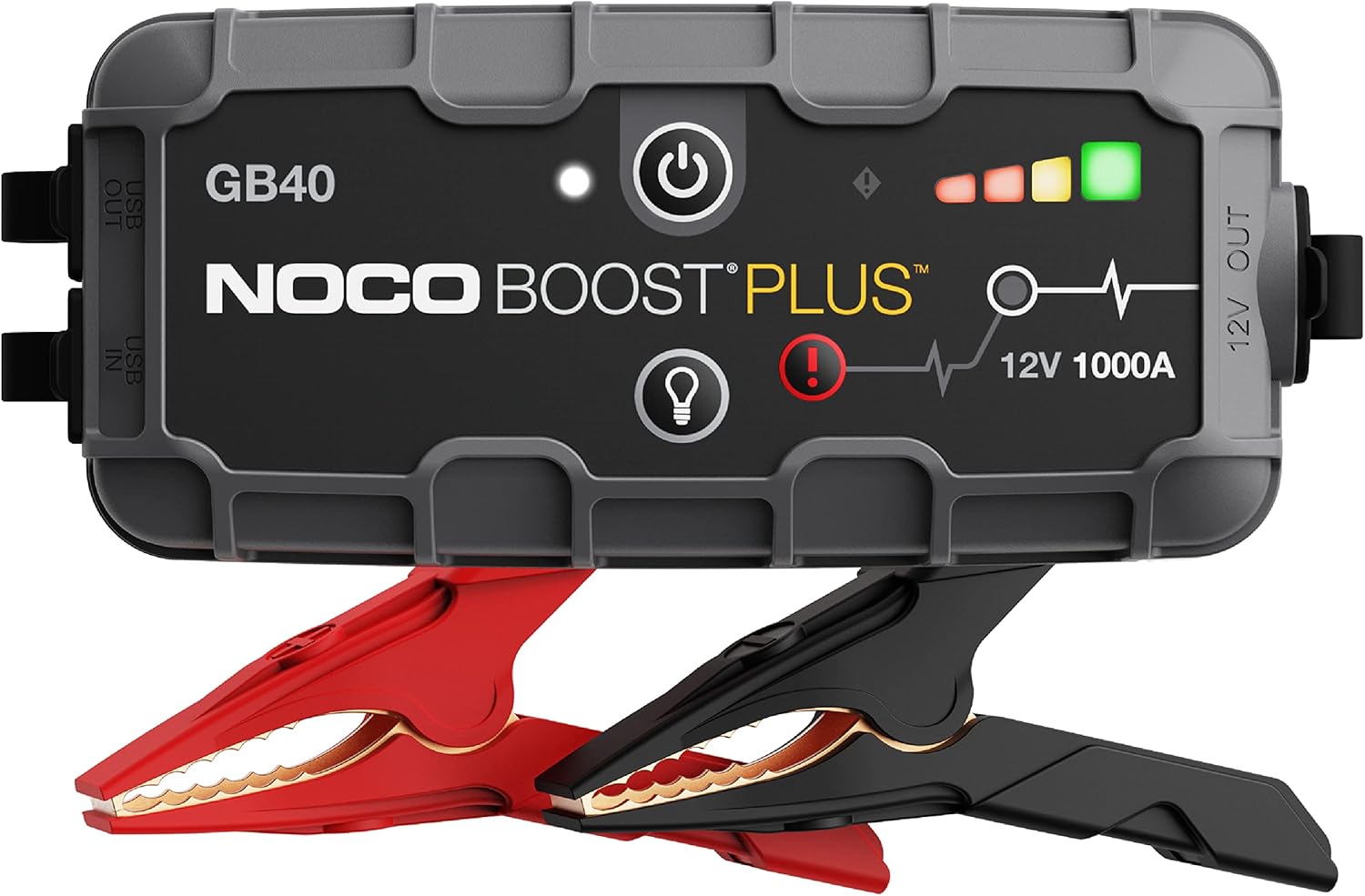
NOCO Boost Plus GB40 Jump Starter
A 1000A lithium jump starter that fits in your glovebox and works on any 12V battery. Your insurance against a dead 12V in a parking lot.
As an Amazon Associate, ThinkEV earns from qualifying purchases — at no extra cost to you.

Founder & Chief Editor
Vlad Pereira is the founder and chief editor of ThinkEV.ca, the Canadian electric-vehicle publication he writes and edits from Courtenay, British Columbia. He covers EV pricing, federal and provincial rebates, charging costs, and the Chinese manufacturers now entering Canada, from the buyer's side rather than the press-fleet side. ThinkEV is a venture of Vlad Pereira Online; his writing on health, income and the long game lives at vladpereira.com.
Frequently asked questions
Is the LiDAR-equipped BYD Seagull coming to Canada or the US?
Can God's Eye B drive the car by itself?
Does BYD make its own LiDAR sensor?
How does the Seagull's price compare to affordable EVs in North America and Europe?
More EV & road-trip finds
Affordable upgrades worth a look — tap any to check the price on Amazon.
 ★ 164
★ 164Solar-Powered LED Ambient Light
View on Amazon ★ 568
★ 568Personalized Photo and Text Keychain
View on Amazon ★ 21,304
Car Headrest Hooks (4-Pack)
View on Amazon ★ 1,866
70mai A810 4K Dual Dash Cam
View on Amazon ★ 121
★ 121Foldable Windshield Sun Umbrella
View on Amazon ★ 268
★ 268Anti-Slip Leather Steering Wheel Cover
View on Amazon ★ 2,941
Microfiber Cleaning Cloths (Multi-Pack)
View on Amazon ★ 419
★ 419RGB Car Interior LED Strip Light
View on AmazonRead, Plan, Then Stay Current
Explore our expert articles to understand incentives and ownership costs, use the map to pressure-test charging reality, then subscribe so new EV coverage comes straight to you.
Continue Reading
BYD Great Seagull: A Bigger $10,000 EV Hatch Is Coming
Xiaomi's Xring D100 Chip Targets 2027 Driver-Assist Debut
BYD God's Eye: The Next Self-Driving Generation
BYD Seagull Canada: Real Price, Real Specs, Real Wait
How BYD Builds EVs So Cheaply: The Vertical Integration Playbook