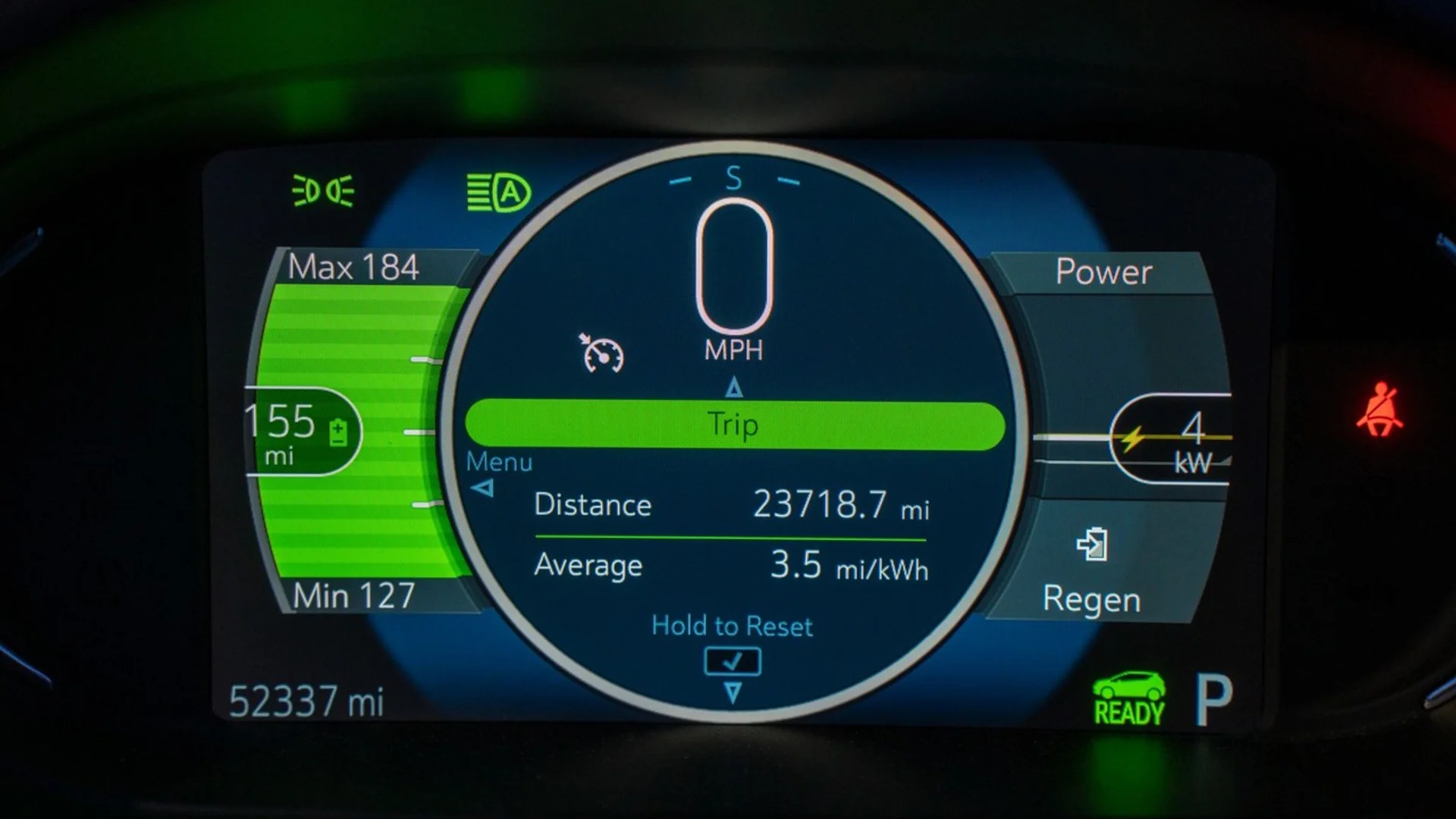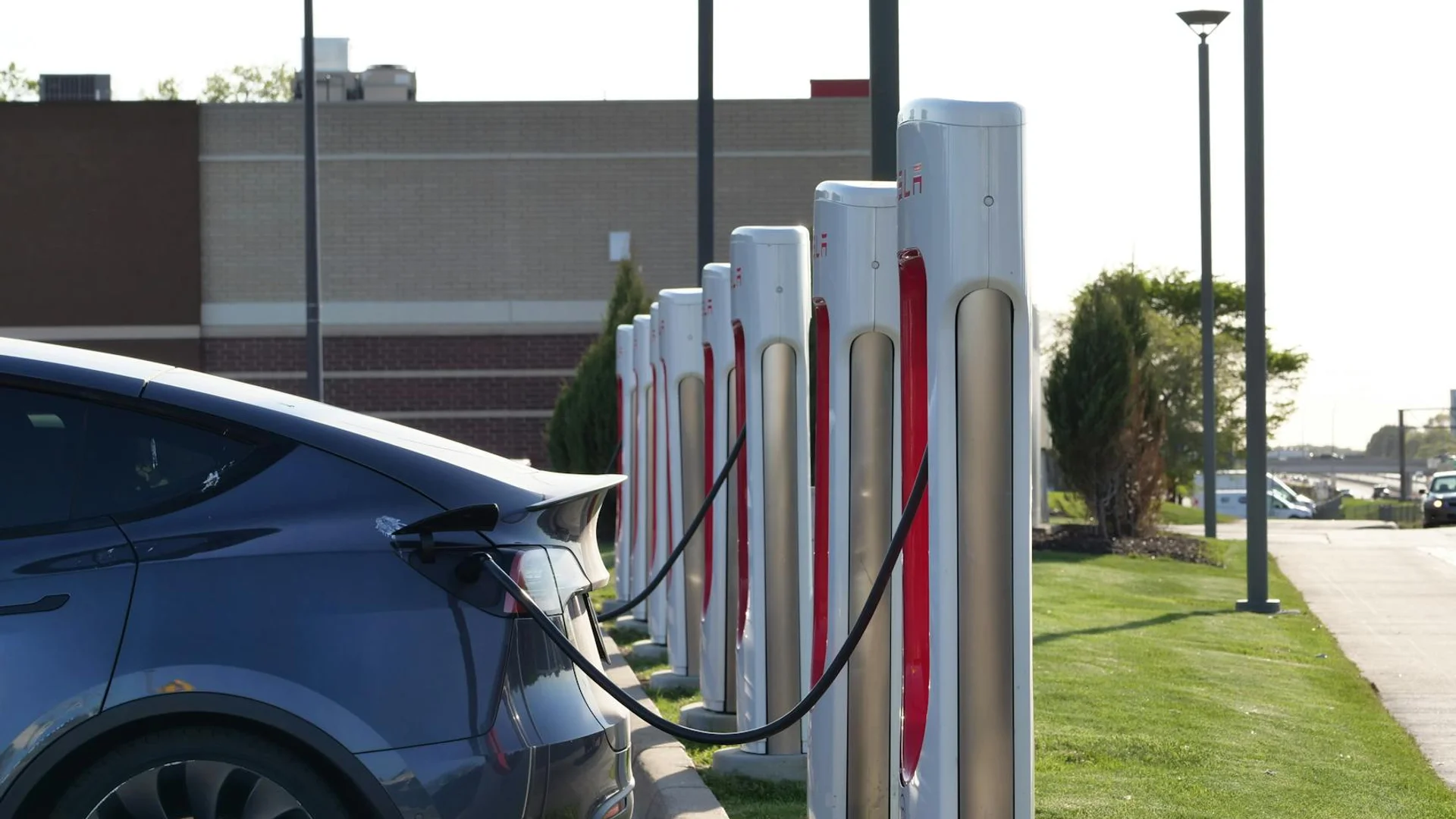
You pull up to a Tesla Supercharger in your Hyundai IONIQ 6 and wonder: why can't I just plug in? The stall is free. The app says you're welcome. But the cable is the wrong shape, and there's no helpful little flap on the handle that flips open to reveal a CCS1 plug. That flap, Tesla's Magic Dock, is the thing you keep reading about. It exists. It's real. It's just not at this stall, and probably not at the next one either.
Key takeaways
- The Tesla-branded CCS1-to-NACS adapter costs about $35 CAD from tesla.com/ca, the cheapest, most reliable way for a non-Tesla EV to use Superchargers in Canada.
- Canada has 250-plus Supercharger locations with several thousand stalls, opened to non-Tesla EVs in late 2023 through the Tesla app.
- Non-Tesla drivers pay $0.48–$0.58 per kWh at Canadian Superchargers in BC and Ontario, around $0.40 in Quebec, with a membership cutting 20–25%.
- Ford (Lightning, Mach-E, E-Transit), GM (Equinox, Blazer, Silverado, new Bolt), and Rivian (R1S, R1T) ship native NACS ports on 2025-and-later builds, no adapter needed.
- Petro-Canada's Electric Highway has Canada's lowest DC rates at roughly $0.27–$0.33 per kWh, and about 70% of Electrify Canada's 2026 build is dual-cable, so no adapter at those new sites.
Here's the honest version: there is no universal magic dock for non-Tesla chargers in Canada yet, and Tesla's own Magic Dock rollout north of the border has been slow enough that most drivers will never see one. The good news is that you don't really need it. A $35 adapter, the Tesla app on your phone, and a bit of pre-trip planning get you the same outcome, access to the largest fast-charging network in the country, regardless of what's stamped on your tailgate.
What Is a "Magic Dock" and Why Tesla Has One
Magic Dock is Tesla's built-in CCS1 adapter, integrated directly into the Supercharger handle. You walk up, lift the handle, and a small CCS1 connector slides out from inside the NACS plug. No fumbling, no extra cable in your frunk, no compatibility guessing. It debuted in the US in early 2023 at a handful of pilot stations and has expanded since, but mostly in states with high non-Tesla EV density. Canada got the network opening; it didn't really get the dock.
The reason Tesla built it is straightforward. The NACS connector is smaller, lighter, and cheaper to manufacture than CCS1, roughly half the volume of the CCS1 inlet and a fraction of the cable weight. Tesla wasn't going to retrofit thousands of stalls with a second cable, and they didn't have to, the Magic Dock keeps the hardware footprint identical while extending the network to roughly every modern non-Tesla EV sold in North America.
In Canada, only a handful of pilot Magic Dock stalls have been spotted, mostly in Ontario corridors. The vast majority of Canadian Superchargers, including the busy Highway 401 stops, the Trans-Canada coverage through BC's interior, and the Quebec network east of Montreal, are still standard NACS-only stalls. Which means if you want to use them with a non-Tesla EV, you bring your own adapter.
This isn't a complaint, just the lay of the land. Tesla opened the doors. The welcome mat is a piece of moulded plastic you carry in the door pocket.
Can Non-Tesla EVs Use Canadian Superchargers Right Now?
Yes. As of late 2023, the Tesla app lets owners of most modern non-Tesla EVs charge at Canadian Superchargers. You download the app, create an account, add your vehicle and a payment method, and the app shows you which Supercharger stations near you are open to non-Tesla vehicles. Not every station qualifies, the older V2 stalls without enough cable length to reach a non-Tesla charge port are excluded, and a few high-traffic locations are still Tesla-only by design.
The flow at the stall is simple. Plug in using your adapter, open the app, tap "Charge Your Non-Tesla," select the stall number, and the session starts. Pricing is per-kWh and varies by station and time of day, generally $0.48 to $0.58 per kWh in BC and Ontario, slightly lower in Quebec where hydro pricing pulls the rate down to around $0.40. There is a Tesla membership plan that reduces the per-kWh rate by 20–25%, but for occasional use the pay-as-you-go pricing is fine.
A few practical notes for first-timers:
- The cable is short, typically 2.1 metres from stall to handle. Park nose-in if your charge port is at the front (Lucid, some Hyundai/Kia), and back-in if it's at the rear-left (most EVs). Centre-rear charge ports, the Tesla standard, fit best at Tesla stalls, which is exactly why Tesla put them there.
- Some stalls won't initiate a session if your vehicle handshake doesn't match what the app expects. If the first stall fails, move to the adjacent one. This is firmware, not a defect.
- Charging speeds are throttled at V3 Superchargers for non-Tesla vehicles in some cases, but the throttle is usually small (10–15%). You'll still hit close to your car's CCS1 peak, figure roughly 150 kW on an IONIQ 5, 130 kW on a Mach-E, in most situations.
The bigger picture: Canada has roughly 250+ Supercharger locations, several thousand individual stalls, and a network density along major corridors that nothing else can match. Opening that to non-Tesla EVs effectively doubled the fast-charging coverage available to a Mach-E or IONIQ 5 owner overnight. That's the part that matters.
Gear worth having
As an Amazon Associate, ThinkEV earns a small commission from qualifying purchases — at no extra cost to you.
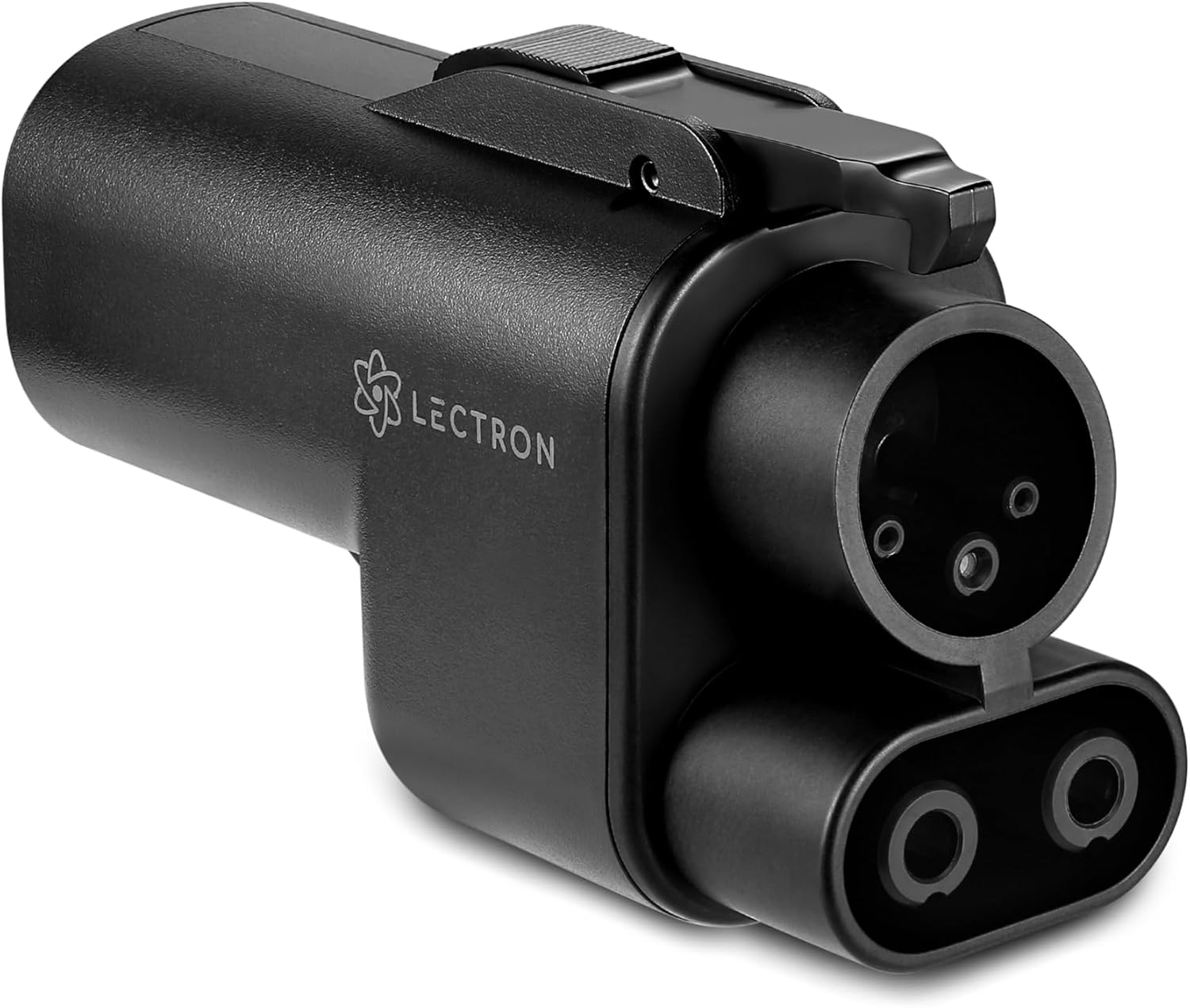
Lectron NACS to CCS Fast-Charge Adapter
Unlock every CCS fast charger for your Tesla, up to 500A DC. Never get stranded at a non-Tesla DC station again.
As an Amazon Associate, ThinkEV earns from qualifying purchases — at no extra cost to you.
Which Adapters Actually Work, and Where to Buy Them in Canada
If you only read one sentence in this section, read this one: buy the Tesla-branded adapter, skip Lectron entirely, and treat third-party listings as a backup. Tesla sells an official CCS1-to-NACS adapter through tesla.com/ca for around $35 CAD. It's the most reliable option, certified for use on Tesla's own network, it ships from Canadian inventory, and warranty handling is straightforward if anything goes wrong. For a single accessory you'll keep in the door pocket of a $50,000+ vehicle, paying retail to the network operator is the right move.
Third-party adapters do exist on Amazon.ca and through specialty EV retailers. Lectron is the best-known brand and the one I'd specifically avoid, the handshake-failure complaints on Reddit and the EV forums are concentrated there, and the price ($200–$300 CAD) is six times what Tesla charges for a part that just works. A2Z Typhoon is the better third-party option if you genuinely can't get the Tesla one in stock, but at $400+ CAD it's hard to justify. Compatibility varies by vehicle make, model year, and firmware revision. The Tesla-branded adapter doesn't have those issues because it was designed by the same company that wrote the firmware on both ends.
If you drive a Ford, GM, or Rivian product from model year 2025 or later, check your charge port before buying anything. The transition to native NACS is well underway:
- Ford, F-150 Lightning, Mustang Mach-E, and E-Transit are shipping with NACS ports on 2025+ builds in North America. Earlier models can use a Ford-supplied adapter.
- General Motors, Chevrolet Equinox EV, Blazer EV, Silverado EV, and the new Bolt are NACS-native on 2025–2026 builds.
- Rivian, R1S and R1T transitioned to NACS for 2025 model year vehicles in production.
Hyundai, Kia, Stellantis (Jeep, Dodge, Chrysler), Volkswagen, BMW, Mercedes, Polestar, and Volvo are still CCS1 on the lots in Canada as of mid-2026. Most have announced NACS transitions for 2026 or 2027 model years, but if you're shopping right now and buying a non-GM, non-Ford EV, plan on the adapter being part of your kit.
One quiet warranty note: using a third-party adapter on a Supercharger is not technically a manufacturer-approved use of the charge port on every vehicle. The risk of a denied warranty claim is small, chargers don't typically cause vehicle-side faults, but the Tesla-branded adapter avoids the question entirely because Tesla is the network operator and the adapter manufacturer.
What About Going the Other Direction, Tesla Owners on CCS Networks?
The flip side of all this is just as relevant. If you drive a Tesla, your NACS port doesn't plug into an Electrify Canada, FLO, or ChargePoint DC fast charger without an adapter going the other direction, NACS-to-CCS1. Tesla sells this one too, for around $250 CAD. It's not cheap, but it's not optional if you want full network access on a long road trip.
Why does it matter? Because Supercharger coverage in Canada is excellent along the main corridors but thin in some specific places. The drive from Calgary to Banff is fine. The drive from Thunder Bay to Sault Ste. Marie still leans on a mix of networks. Quebec north of Saguenay is the same, Electrify Canada and FLO fill gaps Tesla doesn't.
Electrify Canada operates more than 900 stalls nationally, with a fast-growing footprint along the Trans-Canada and in major metros. FLO is the largest Canadian-owned network with thousands of stations, though many are Level 2 rather than DC fast. ChargePoint, BC Hydro, and Petro-Canada round out the network mix. A Tesla owner who's never road-tripped outside Supercharger coverage is missing roughly half the country.
There's also a use case nobody talks about: workplace and destination charging. Many hotels, ski resorts, and office buildings installed CCS1 J1772 hardware before NACS was even a public standard. The NACS-to-J1772 adapter is the one Tesla bundles with newer vehicles, and that one's free, not $250.
Is a True Universal "Magic Dock" Coming for Non-Tesla Chargers?
The question is fair, and the answer is mostly no, at least not in the bidirectional sense. The story isn't really magic docks versus adapters either: it's that dual-cable stations kill the need for both.
No major non-Tesla charger manufacturer has announced a Magic-Dock-style built-in adapter that flips between NACS and CCS1 inside the handle. What's happening instead is simpler and arguably better: dual-cable stations. New Electrify Canada installations through 2026 increasingly include both a CCS1 cable and a NACS cable at every stall, roughly 70% of their 2026 build pipeline is dual-cable by design. FLO's newer DC fast hardware ships with dual connectors. Petro-Canada's expansion is dual-cable by default.
This is the actual convergence path. SAE J3400, the formal standardisation of NACS as a North American standard, went through the working-group process in 2023–2024 and is now the reference spec that new chargers in Canada are being built against. New means new. Existing CCS1-only stations aren't being retrofitted overnight, and the Canadian charging map will be mixed for several more years.
What this means in practice:
- 2026–2027, Mixed network. Carry the adapter that matches your car's port. CCS1 cars need a NACS adapter for Tesla; NACS cars need a CCS1 adapter for Electrify Canada and similar.
- 2028–2029, Most new charger installations are dual-cable. Most new vehicles sold are NACS-native. The adapter becomes a road-trip backup rather than a daily-use item.
- 2030+, CCS1 starts feeling like J1772 does today: still present, still works, but mostly on older hardware in less-trafficked locations.
There's no single moment where Canada wakes up and the connectors converge. It's a gradient. The reason carrying a $35 adapter matters so little is precisely because the gradient is moving in a direction that solves the problem from both ends, networks are converging the hardware, manufacturers are converging the ports, and the awkwardness of the current moment fades out without anyone needing to invent a true universal magic dock.
The honest version of the question "is a universal magic dock coming?" is this: the industry's answer is dual-cable stations, not magic docks. It's less elegant, but it's already happening.
Charging Costs Compared: Supercharger vs. Electrify Canada vs. FLO
Everyone Googles this expecting a $50 swing per road trip. It's more like $20, and that's before you factor in that the cheapest network is often nowhere near where you actually need to stop. Here's the breakdown for DC fast charging at typical urban-corridor stations as of mid-2026:
- Tesla Supercharger (non-Tesla rate), $0.48 to $0.58 per kWh in BC and Ontario, dropping to roughly $0.40 in Quebec. The Tesla membership plan at about $13 CAD per month reduces the per-kWh rate by 20–25%, which makes sense for anyone using Superchargers more than twice a month.
- Electrify Canada, $0.42 to $0.55 per kWh pay-as-you-go. The Pass+ membership at around $7 CAD per month drops the rate to roughly $0.32 per kWh. Heavy users break even on the membership at about 30 kWh per month of charging, which is one decent road-trip stop. If you fast-charge more than twice a month, the $7 is the easiest yes in the EV ownership column.
- FLO DC fast, $0.30 to $0.45 per kWh depending on province and station. FLO doesn't push a paid membership the same way; pricing is more uniform, and that's a quiet win for occasional users who don't want to track three apps.
- Petro-Canada Electric Highway, Roughly $0.27 to $0.33 per kWh at most stations. Often the best per-kWh rate available on a road trip, though the network is thinner than Electrify Canada.
If I had to pick one network as a Canadian non-Tesla driver, it'd be Electrify Canada with Pass+, denser than Petro-Canada, cheaper than Tesla, and the membership math works at one road trip a month. Tesla is the second app on the phone, not the first.
A real-world example: filling a 60 kWh battery from 20% to 80%, call it 36 kWh of energy delivered, costs roughly $17–$21 on Supercharger pay-as-you-go, $11–$13 on Electrify Canada with Pass+, $15–$16 on FLO, and $10–$12 on Petro-Canada Electric Highway. The spread is real, but it's smaller than most people expect. On a long trip with three stops, you're looking at maybe $20 difference between the most and least expensive networks. Convenience and location matter more than per-kWh on most road trips.
Home charging, by contrast, is dramatically cheaper everywhere, typically $0.08 to $0.14 per kWh on residential time-of-use rates in most provinces, which is why anyone with a driveway and a Level 2 charger does the vast majority of their charging at home. Public fast charging is the exception, used for trips longer than the daily commute. Build your math around that and the network rates feel less stressful.
Gear worth having
As an Amazon Associate, ThinkEV earns a small commission from qualifying purchases — at no extra cost to you.

Grizzl-E Classic Level 2 EV Charger (40A)
Canadian-made and rated for minus 40C winters. 40A / 9.6 kW, NEMA 14-50, indoor/outdoor, 24-ft cable. The charger built for Canadian weather.
As an Amazon Associate, ThinkEV earns from qualifying purchases — at no extra cost to you.
FAQ: Your Adapter and Cross-Network Questions Answered
What to Watch Next
The adapter question will be a non-issue faster than most people expect, and the build data already shows why. Not because someone invents a true universal magic dock; the engineering and certification path for a bidirectional connector inside one handle is genuinely hard, and no manufacturer has signalled they're working on it. The convergence happens the boring way: every new charger built in Canada from 2026 onward ships dual-cable, and every new EV sold from 2027 onward ships NACS-native. By 2028, the adapter becomes a road-trip backup the way a paper map is a road-trip backup. You carry it, you almost never need it.
The interesting part is what happens to the older CCS1-only stations in the meantime. Electrify Canada has signalled it will retrofit dual cables at high-traffic stops. FLO and Petro-Canada are doing the same on their newer hardware. But there will be a long tail of single-connector stations, both CCS1-only legacy and NACS-only Supercharger stalls without the Magic Dock, that stay single-connector for years. The map gets mixed. The adapter stays useful.
For Canadian buyers shopping for an affordable EV today, the practical answer is simple: ask what charge port the car has, ask what adapter ships with it, and budget $35 for the one it doesn't. If you're cross-shopping the 2027 Chevy Bolt's Canadian spec sheet, you're already on the NACS side of the line, Supercharger access is built in. If you're looking at a 2025 Hyundai IONIQ 6 or Kia EV6, you're on the CCS1 side, and the adapter is your bridge. The BC and Ontario rebate stacks move the math more than the per-kWh spread between networks ever will.
The bigger frame, beyond the connector wars, is that public fast charging keeps getting denser and cheaper while home charging on coal-heavy grids still beats burning gasoline on emissions math. The connector you plug in matters far less than the fact that you're plugging in at all. The Magic Dock is a clever piece of engineering. The CCS1-to-NACS adapter is a $35 piece of moulded plastic. Both solve the same problem. Buy the Tesla one, leave it in the door pocket, and stop thinking about it, the connector wars resolve themselves while you're driving.
Gear worth having
As an Amazon Associate, ThinkEV earns a small commission from qualifying purchases — at no extra cost to you.

Tesla Key Card Holder with AirTag Slot
Stop fishing the keycard out of your wallet, and slot an AirTag in case the car wanders off in a lot.
As an Amazon Associate, ThinkEV earns from qualifying purchases — at no extra cost to you.

Founder & Chief Editor
Vlad Pereira is the founder and chief editor of ThinkEV.ca, the Canadian electric-vehicle publication he writes and edits from Courtenay, British Columbia. He covers EV pricing, federal and provincial rebates, charging costs, and the Chinese manufacturers now entering Canada, from the buyer's side rather than the press-fleet side. ThinkEV is a venture of Vlad Pereira Online; his writing on health, income and the long game lives at vladpereira.com.
Frequently asked questions
Will using a third-party CCS adapter void an EV warranty in Canada?
Almost certainly not, but the answer depends on the manufacturer and the failure mode. Adapters don't damage charge ports under normal use, they're passive electrical pass-throughs. Where warranty questions get sticky is if a specific adapter brand has been linked to a vehicle-side fault. The Tesla-branded CCS1-to-NACS adapter is the safest choice because it's certified for use on the network and made by a recognised hardware company. If you're driving a 2024+ Ford, GM, Hyundai, or Kia and want zero ambiguity, buy the manufacturer-approved or Tesla-branded adapter rather than a $250 Amazon listing from a brand you've never heard of.
Which 2025–2026 EV models come with NACS built in, no adapter needed?
Ford F-150 Lightning, Mustang Mach-E, and E-Transit on 2025+ builds. General Motors' Chevrolet Equinox EV, Blazer EV, Silverado EV, GMC Sierra EV, Cadillac Lyriq, and the new Bolt EV are NACS-native on 2025–2026 production. Rivian R1S and R1T transitioned for 2025 model year vehicles. Honda Prologue and Acura ZDX (which share GM's platform) are NACS-native. Most other brands, Hyundai, Kia, Stellantis, Volkswagen, BMW, Mercedes-Benz, Polestar, Volvo, Subaru, Toyota, Lexus, Nissan, Mazda, are still shipping CCS1 in Canada as of mid-2026, with NACS transitions announced for 2026 or 2027 model years.
Does the Tesla app work for non-Tesla charging without a Tesla vehicle account?
Yes. You create a Tesla account from the app, add a payment method, and add your non-Tesla vehicle to the account profile. You don't need to own a Tesla vehicle to use the app for Supercharger sessions. Plate and VIN entry is optional in most regions, though it speeds up some session flows. Pay-as-you-go works with any credit card; the membership plan is also open to non-Tesla owners.
Are there Magic Dock stalls at any Canadian Supercharger locations yet?
A small number, mostly in Ontario along the 401 corridor and a couple of high-traffic locations in the GTA and Montreal. The rollout in Canada has been slower than in the US, and the Tesla app doesn't always flag Magic Dock stalls separately from regular non-Tesla-open stalls. Practically, plan on bringing your own CCS1-to-NACS adapter. If you happen to land at a Magic Dock stall, you can leave the adapter in the door pocket, the dock does the work.
Can buyers claim a federal iZEV rebate for an adapter purchase alone, without a new EV?
No. The federal iZEV program covers eligible new zero-emission vehicles only, with rebates up to $5,000 on qualifying purchases or leases. Adapters and accessories aren't covered. Some provinces have separate home-charger rebate programs, Quebec's Roulez vert program has offered rebates on residential Level 2 chargers, and BC's CleanBC has occasionally funded home charging, but no Canadian rebate program covers a public-network adapter as a standalone purchase. The $35 for the Tesla adapter is out of pocket. Treat it as a cable in the door pocket, not a tax-deductible expense.
More EV & road-trip finds
Affordable upgrades worth a look — tap any to check the price on Amazon.
 ★ 268
★ 268Anti-Slip Leather Steering Wheel Cover
View on Amazon ★ 8,681
Chemical Guys Complete Car Wash Kit
View on Amazon ★ 164
★ 164Solar-Powered LED Ambient Light
View on Amazon ★ 1,349
Cool Swinging Duck Dashboard Ornament
View on Amazon ★ 865
★ 865Collapsible Trunk Organizer
View on Amazon ★ 1,866
70mai A810 4K Dual Dash Cam
View on Amazon ★ 121
★ 121Foldable Windshield Sun Umbrella
View on Amazon ★ 392
★ 392Large Cup Holder Adapter (32-40oz)
View on AmazonRead, Plan, Then Stay Current
Explore our expert articles to understand incentives and ownership costs, use the map to pressure-test charging reality, then subscribe so new EV coverage comes straight to you.
Continue Reading
Public EV Chargers in Canada: Which Count Is Right
Is NACS Standardization a Mistake? A 2026 Guide
EV Charging From a Dryer Outlet: How to Do It Safely
Rivian's Charging Network Hits 1,007 Stalls in 2026

Rivian Canada 2026: R1T, R1S Prices and R2 Release Date