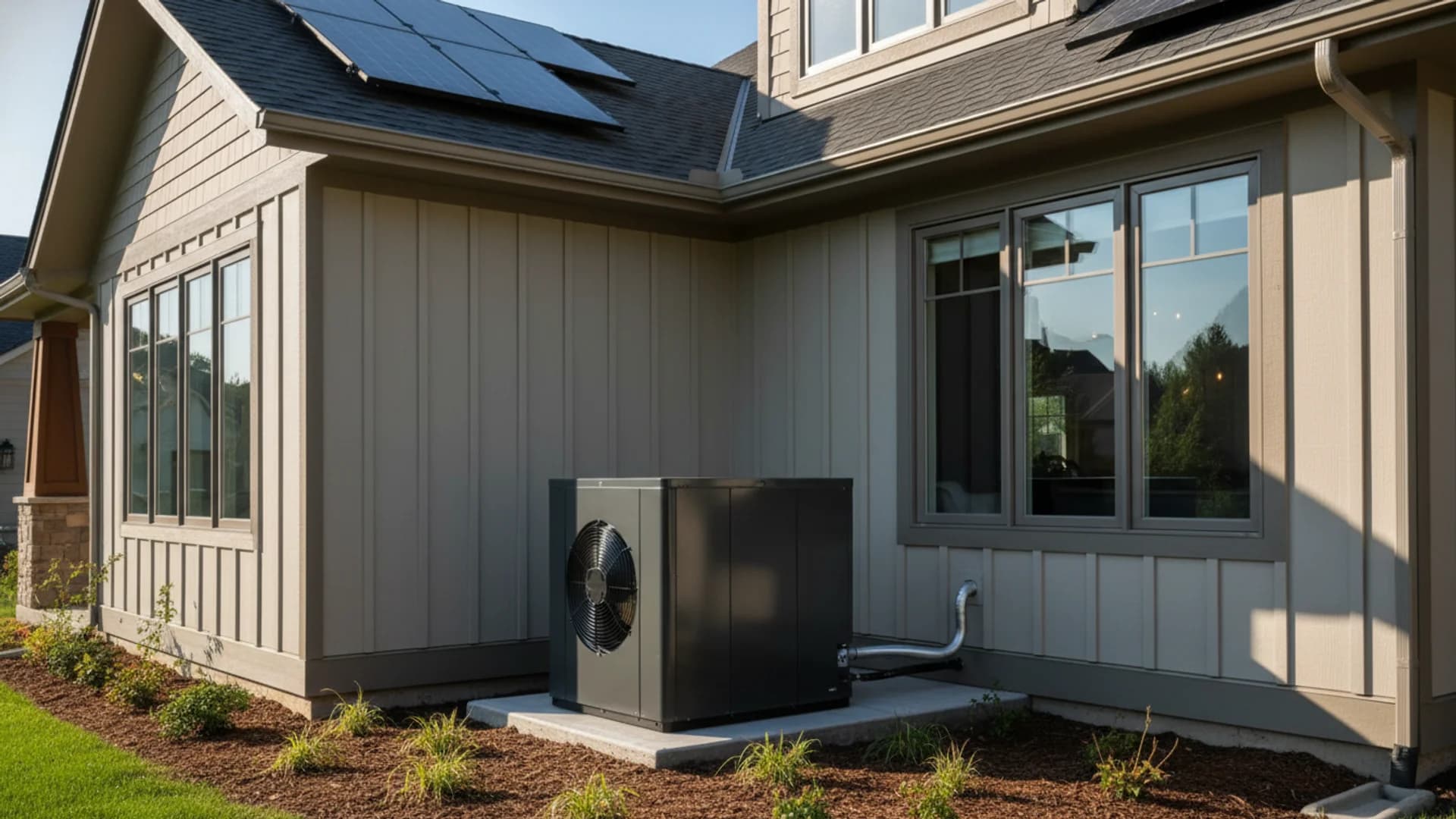
The rebate was supposed to replace your gas furnace with a heat pump. The new guidance says it can only replace your electric furnace with a heat pump. That is the entire policy, compressed into a single sentence, and it tells you which energy system the Department of Energy has decided to defend.
Today, the Department of Energy issued guidance that will create confusion, make it significantly harder for households to access funds to upgrade polluting or inefficient appliances, and disrupt programs already approved and underway. The phrasing inside the press releases will be about administrative clarification and statutory consistency. The engineering choice underneath the phrasing is something else, a deliberate redesign of which appliance swaps qualify for federal money, executed without a single new line of legislation. Read the guidance as code, not as politics, and the architecture of the reversal becomes obvious.
Key takeaways
- DOE's new guidance blocks gas-to-electric swaps, disqualifying heat pumps, heat pump water heaters, and electric dryers from HEEHRA rebates.
- Congress sized the $9 billion IRA rebate programme around gas-using households, the new interpretation strands half that funding.
- No legislation passed; DOE rewrote eligible upgrade definitions via administrative guidance, which the next administration can reverse just as fast.
- States already disbursing funds face retroactive rule conflicts: contractors quoted jobs and households signed contracts under the old definitions.
- Heat pump water heaters run at roughly 300% efficiency versus 60% for a condensing gas unit, the appliances removed are the programme's actual carbon-reduction engine.
What the IRA Actually Promised, and Who Designed It
The Inflation Reduction Act built its home-energy architecture around fuel-switching. Measures included $9 billion in home energy rebate programmes aimed squarely at residential energy costs by focusing on improvements to home energy efficiency. The phrase "energy efficiency" in the statutory text was never neutral. It was the legislative wrapper around a specific engineering thesis: that the cheapest path to lower household emissions and lower household bills runs through replacing combustion appliances with electric ones.
The High-Efficiency Electric Home Rebate Act, HEEHRA, the programme name that matters here, was not designed as a generic upgrade fund. It was designed for the household that still heats water with gas, dries clothes with gas, and warms rooms with gas, and wants to stop. The economics were built around that population because that is where the marginal carbon dollar buys the most reduction. A household swapping an old electric resistance water heater for a heat pump water heater saves real energy. A household swapping a gas water heater for a heat pump water heater saves more, and decouples from a fossil fuel supply chain entirely.
Low- and moderate-income earners were named in the statute as the primary beneficiaries because the upfront cost differential, the reason most households stay on gas, disappears once a $1,750 rebate covers the appliance premium. State programmes spent two years standing up the administrative machinery to deliver that money. Program administrators should review Sections 3.3.2 and 4.3.2 in the Home Energy Rebates Program Requirements document, those references describe the legal scaffolding states built their programmes against, the scaffolding that just shifted.
The case against this framing is the agency's own line: that the statute uses the phrase "high-efficiency electric" and never explicitly mandates fuel-switching, so a narrower reading is defensible textualism rather than engineering reversal. The rebuttal sits in the appropriation arithmetic. Congress sized the programme against the population of gas-using households because the Building Performance Association and the drafters' own analyses costed the rebate against that population. A textualist reading that excludes fuel-switching strands roughly half the obligated funding against a customer base that does not need it, electric-resistance households are not the marginal-carbon population the dollars were sized for. The textual argument survives only if you accept that Congress allocated $9 billion to subsidise marginal efficiency upgrades for households already off gas. That is not what the conference report says.
The Guidance Mechanism: How a Reinterpretation Becomes a Demolition
No bill passed. No floor vote happened. The DOE simply restated what the program's "eligible upgrades" mean, and the new definition requires electric-to-electric swaps only. A household replacing an electric resistance water heater with a heat pump qualifies. A household replacing the gas water heater next to it, the actual carbon target, does not.
Administrative guidance is the tendon of federal energy policy, and that is the mechanism to study closely. It is fast, it is flexible, it requires no congressional choreography, and it can be rewritten by the next administration with the same speed it was written by the last one. The IRA's drafters chose the rebate vehicle partly because rebates ship faster than tax credits, they put money in households' hands at point-of-sale, not at the following April's tax filing. That speed came from administrative architecture. The same architecture is now the reversal vector.
The cross-reference layer adds the second cut. Eligible appliances must also satisfy ENERGY STAR criteria, a separate programme with its own evolving definitions, its own administrative gatekeeping. Tightening the ENERGY STAR overlay does not require touching the IRA at all. It just narrows the qualifying-equipment list quietly, in a separate document, on a separate timeline. Two layers of guidance, neither of them legislation, both of them load-bearing.
States already disbursing funds now face a retroactive rule conflict. Contractors quoted jobs against the old definitions. Households signed contracts expecting the rebate to land. Programme administrators face the unpleasant arithmetic of which commitments to honour and which to walk back. The DOE's own integration guidance had spent two years telling states how to braid these rebates into existing utility programmes, that scaffolding is what now has to be unwound.
Gear worth having
As an Amazon Associate, ThinkEV earns a small commission from qualifying purchases — at no extra cost to you.

Magnetic Windshield Snow Cover
Skip the scraping. Magnets hold it on, peel it off with the snow, and your defroster stops draining range on cold mornings.
As an Amazon Associate, ThinkEV earns from qualifying purchases — at no extra cost to you.
Engineering the Exit: What Gets Removed and Why It Was Chosen
Examine the list of appliances explicitly removed from gas-replacement rebate scope:
- Heat pumps (space heating)
- Heat pump water heaters
- Electric dryers
Then look at what they have in common. These are the three highest-impact fossil-fuel displacement appliances available to a residential household. They are also, not coincidentally, the three appliances that pull the most demand off the gas distribution network when installed.
The selection is not random. A heat pump replaces both a furnace and an air conditioner, one piece of equipment, two combustion sources eliminated. A heat pump water heater is the single most efficient water-heating technology a household can install, operating at roughly 300% efficiency against the 60% of a condensing gas unit. An electric dryer ends a household's dependence on a gas line that often exists solely to serve the dryer. Remove these three from rebate eligibility for gas-to-electric swaps and you have removed the program's actual carbon-reduction engine. What remains, electric-to-electric upgrades, is a marginal efficiency play, not an electrification play.
The choice of what to keep eligible reveals the worldview. An electric-to-electric upgrade preserves the gas hookup. It preserves the gas meter. It preserves the distribution-network customer count that gas utilities use to justify infrastructure investment to state regulators. The household's energy mix does not change. The grid's role does not expand. The fossil supply chain stays intact. This is what the guidance is engineering for, not a different efficiency outcome, but a different topology.
Read this against the agency's parallel work. The DOE spent 2025 issuing emergency orders to keep coal generation online, citing grid reliability. The same agency now narrows the residential programme that would have reduced peak electric demand and shrunk the residential gas customer base. The two moves are coherent. They describe an energy system that keeps both fuels in service, indefinitely, against the original IRA design that pointed at a single-fuel residential future. The forthcoming municipal incentive layer that cities are building elsewhere becomes more interesting in this context, local governments treating federal retreat as a market they have to fill.
Compare the mechanism to the House-passed bills that would repeal the rebate authority outright and weaken DOE's appliance efficiency standards. Those bills would deliver the same outcome through statute, slower, more durable, and reversible only by a future Congress. The guidance route delivers a faster cut with a lower legitimacy floor: any subsequent administration can restore the original eligibility list with another memo. The trade is speed against permanence, and the agency chose speed because the legislative path was not guaranteed to land in this session. The two tracks are not redundant; they are a belt-and-suspenders attempt to make sure the reversal sticks under at least one of the two procedural regimes.
Gear worth having
As an Amazon Associate, ThinkEV earns a small commission from qualifying purchases — at no extra cost to you.

ChargePoint Home Flex Level 2 Charger (50A)
Premium 50A / 12 kW charger with the best app ecosystem. Hardwired or NEMA 14-50, with real-time energy tracking and smart scheduling.
As an Amazon Associate, ThinkEV earns from qualifying purchases — at no extra cost to you.
The Households Left Holding the Wiring
The economics now invert against the program's stated beneficiaries. A heat pump water heater costs roughly $1,500 to $2,000 more than a gas equivalent at install. The $1,750 HEEHRA rebate was calibrated to erase that gap, that was the entire point of the number. Without the rebate available for gas-to-electric, the household weighing the swap sees only the upfront premium, not the lifetime energy savings, and the gas appliance wins on the showroom floor.
This is fossil-fuel lock-in delivered by economic friction rather than by mandate. No one tells the household it cannot electrify. The household simply decides it cannot afford to. The decision compounds across a twenty-year appliance lifetime. A water heater installed in 2026 will still be burning gas in 2046. A furnace replaced today will define the household's heating fuel through to mid-century. The rebate programme was a fifteen-year electrification bet because that is how long appliances last. Reversing it in 2026 forecloses a generation of household decisions.
Contractors and trainees absorb the second wave. The Building Performance Association spent IRA-era money training the workforce, heat pump installers, weatherization technicians, electrification project managers, on the assumption that the rebate-driven demand pipeline would absorb them. That demand pipeline just collapsed for the largest swap category. The training investment does not disappear, but the labour market for it shrinks against the workforce that was sized for it. State programmes mid-deployment face the same problem at higher dollar volume: contracts written, contractors mobilised, projects scheduled, funding now in rule conflict.
Gear worth having
As an Amazon Associate, ThinkEV earns a small commission from qualifying purchases — at no extra cost to you.

TP-Link Kasa Smart Plug with Energy Monitoring
Track exactly how much electricity your Level 1 charger uses and schedule it for off-peak hours. Know your real cost per kWh.
As an Amazon Associate, ThinkEV earns from qualifying purchases — at no extra cost to you.
What 'Administrative Reinterpretation' Reveals About Policy Durability
The structural lesson from this reinterpretation is clear: the IRA's tax credit provisions, Section 25C of the Internal Revenue Code, the residential energy efficient property credit, sit in statute. Reinterpreting them requires Congress. The rebate programmes sit in agency guidance. Reinterpreting them requires a memo. The IRA's architects chose both vehicles deliberately: tax credits for durability, rebates for speed. The speed-versus-durability tradeoff was made in good faith and lost on the durability side within four years of enactment.
This matters beyond the immediate programme. Every piece of energy policy faces the same architecture choice. Statute is slow but sticky. Guidance is fast but reversible. A programme designed to ship money quickly into low-income households was always going to live in guidance, because the statute-route would have taken until 2025 to disburse the first dollar. The same flexibility that made HEEHRA functional in 2024 makes it dismantlable in 2026.
The lesson is not that the IRA's drafters chose wrong. The lesson is that residential electrification policy needs both layers, fast guidance to deploy, statutory backstops to preserve. The current guidance can be unwound by the next administration; the underlying statutory authority cannot. Programmes that want to survive administration changes need their core eligibility definitions written into law, not into agency interpretation. The next iteration of federal electrification policy, whenever it gets written, will be drafted by people who have just watched what happens when it isn't.
Canada faces an adjacent question on its own provincial rebate infrastructure, programmes that live in cabinet decision rather than statute have the same reversibility profile. Alberta's missing provincial EV rebate is not an oversight; it is a demonstration of what happens when electrification policy lives at the discretion of a single ministry. The same dynamic shows up in the federal iZEV programme's lapsing-and-renewing history, programmes that depend on annual cabinet authorization carry the same fragility profile as DOE guidance.
Gear worth having
As an Amazon Associate, ThinkEV earns a small commission from qualifying purchases — at no extra cost to you.

P3 Kill A Watt Electricity Usage Monitor
Plug in your charger and see exactly what you spend in kWh, cost, and watts. Settle the is-my-EV-really-cheaper debate with data.
As an Amazon Associate, ThinkEV earns from qualifying purchases — at no extra cost to you.
Where the Resilience Is, and Whether It Holds
Some of the program's structure survives the guidance. State programmes that built their own statutory authority, programmes where state legislatures wrote the eligibility rules rather than incorporating federal definitions by reference, have independent footing. Those programmes can continue delivering gas-to-electric rebates as long as the state funding stream holds. The states that wrote their programmes as pure federal pass-throughs do not have that protection.
Legal challenge is the second resilience vector. Programme advocates argue the guidance contradicts the statute's plain text on fuel-switching intent, and the administrative-procedure case is non-trivial. The litigation timeline runs years, though, and the disbursement timeline runs months. Even a successful challenge restores the programme after most of the funding window has already closed. The damage is done at the deployment phase, not at the eventual-resolution phase.
House bills to formally repeal the rebate authority are still moving. If they pass, the guidance becomes redundant, the statutory authority itself disappears, and the legal-challenge route closes with it. If they fail, the guidance remains the operative document, and the next administration's first task on electrification policy is rewriting it. Either way, the program's 2024-2026 deployment window is the entire window it was going to get under current federal posture.
Municipal substitution is where the real-world adjustment is already visible. Cities are stepping into the gap with locally-funded equivalents, Ann Arbor's match for lost federal EV tax credits is the template, and similar models are emerging for residential electrification. The arithmetic is harsh: cities have an order of magnitude less money than the federal programme had. But the political durability is higher. A municipal council that funds a heat pump rebate this year is not subject to a DOE guidance rewrite next year. The local-government layer becomes the resilience layer by default, the same way provincial and municipal EV incentives in Canadian jurisdictions stack against federal volatility.
Here is what would change my read: a federal court enjoining the guidance on Administrative Procedure Act grounds within twelve months, or a state attorney-general coalition securing a preliminary injunction that protects in-flight programmes during litigation. Either outcome would convert the rebate window from "closing" to "contested" and pull contractor and household behaviour back toward electrification swaps on the expectation that the rule survives challenge. Absent that, the indicators to watch are narrower and more operational: which states publish guidance of their own re-affirming gas-to-electric eligibility under state statutory authority, which utilities adjust their on-bill financing programmes to fill the federal gap, and which appliance manufacturers cut heat-pump production runs for the 2027 model year. The manufacturer signal arrives first, Rheem, A. O. Smith and Bosch are sized against demand curves drawn in 2024, and a quiet downward revision in heat-pump SKU counts is the leading indicator that the industry has priced in the reversal.
Bottom line: the guidance is not a clarification. It is a redesign of which households can afford to leave the gas system, executed at the administrative layer because the legislative layer was unavailable. The engineering choice of what to remove, heat pumps, heat pump water heaters, electric dryers, is the policy. Watch the state programmes that hold their ground, watch the litigation that tests the statutory-intent argument, and watch which cities decide federal retreat is a market they have to enter. The next architecture of residential electrification policy is being drafted right now in the response to this one.
Gear worth having
As an Amazon Associate, ThinkEV earns a small commission from qualifying purchases — at no extra cost to you.

PULIDIKI Car Cleaning Gel (Detailing Putty)
Press it into vents, buttons, and seams and it lifts out dust you did not know was there. Weirdly satisfying, genuinely useful.
As an Amazon Associate, ThinkEV earns from qualifying purchases — at no extra cost to you.

Founder & Chief Editor
Vlad Pereira is the founder and chief editor of ThinkEV.ca, the Canadian electric-vehicle publication he writes and edits from Courtenay, British Columbia. He covers EV pricing, federal and provincial rebates, charging costs, and the Chinese manufacturers now entering Canada, from the buyer's side rather than the press-fleet side. ThinkEV is a venture of Vlad Pereira Online; his writing on health, income and the long game lives at vladpereira.com.
Frequently asked questions
Does this change affect Canadian home energy rebate programmes too?
Can states override the new guidance and keep fuel-switching eligible?
What happens to contractors who already quoted gas-to-electric jobs?
Why does ENERGY STAR eligibility matter separately from the rebate rules?
Is there any legislative fix that could reverse this interpretation?
More EV & road-trip finds
Affordable upgrades worth a look — tap any to check the price on Amazon.
 ★ 9,349
Auto Detailing Brush Set (10-Piece)
View on Amazon ★ 314
★ 314Mini USB LED Ambient Lamps (4-Pack)
View on Amazon ★ 568
★ 568Personalized Photo and Text Keychain
View on Amazon ★ 27,769
Car Cup Holder Coasters (4-Pack)
View on Amazon ★ 15,014
Spigen Tempered Glass for Tesla Model 3/Y
View on Amazon ★ 121
★ 121Foldable Windshield Sun Umbrella
View on Amazon ★ 268
★ 268Anti-Slip Leather Steering Wheel Cover
View on Amazon ★ 4,050
Touchscreen Mist Screen Cleaner Kit
View on AmazonRead, Plan, Then Stay Current
Explore our expert articles to understand incentives and ownership costs, use the map to pressure-test charging reality, then subscribe so new EV coverage comes straight to you.
Continue Reading
Tesla Q3 2026 Earnings: Flat Revenue, Falling Profits

BYD Denza B8 Suspension Trick Defeats Traffic Boot in Viral Clip

Zenos E10 Returns at £115,000, A Different Car Entirely
Jaecoo J5 EV Uber Discount: $31,500 Fleet Math Changes
VW ID.4 80% Charge Cap Rolls Out This Week, With Opt-Out