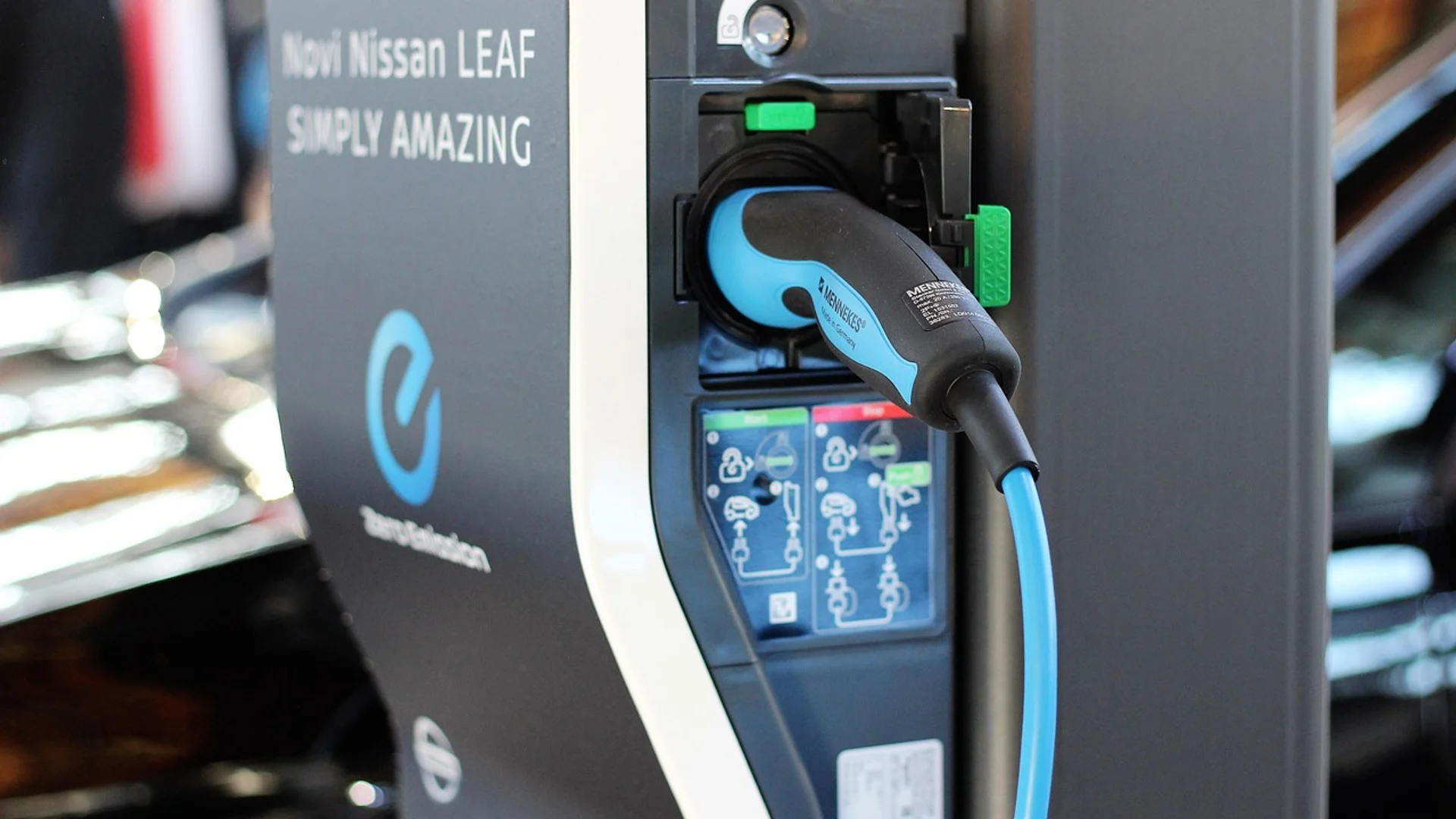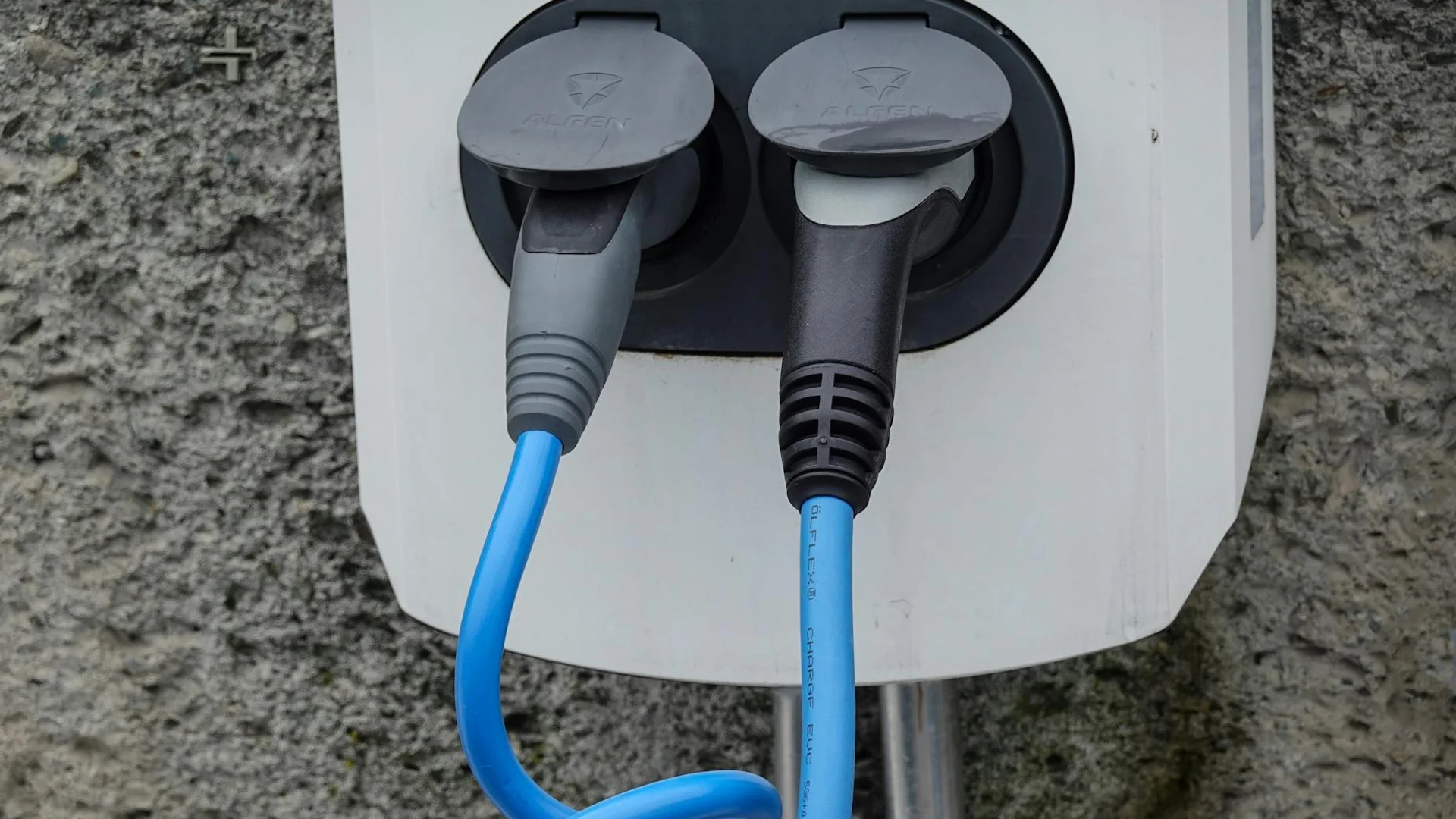
Two BMWs, one 50-amp circuit, and a nightly negotiation over who plugs in first. That's the shape of the problem before anyone calls it a problem. The charger works. Both cars charge. The household functions. And then one Tuesday somebody arrives home at 11 p.m. with 12% battery and a 7 a.m. flight, and the plug-in dance stops being charming.
The instinct at this point is to shop. Browse dual-head chargers, price out a second circuit, ask the internet what brand to buy. That instinct skips the actual question. The right way to charge two EVs from one residential panel isn't a product decision. It's an engineering decision about how to ration a finite electrical budget across two cars whose onboard chargers each want the whole circuit. The product comes later, and frankly, the product matters less than the math.
Most two-EV households don't need a service upgrade. Most don't need two separate 50-amp circuits either. The actual problem is understanding what the panel is telling you, then picking a load-management strategy that matches it.
Key takeaways
- A 50A breaker delivers only 40A of usable EV charging current, the NEC's 80% continuous-load rule is non-negotiable.
- Static load sharing wastes capacity; a 25A/25A split caps a single car at 6 kW even when the other side is empty.
- Dynamic load management uses a CT clamp at the panel to redistribute unused amps in real time between both vehicles.
- Canadian 200A service usually supports two 40A EV circuits, but the detached garage sub-panel or feeder gauge is the real bottleneck.
- The Cadillac Vistiq's onboard charger negotiates draw from 0.72 kW to 11.5 kW, the car adapts to what the EVSE offers.
The Plug-In Dance: Why Sharing One Charger Eventually Breaks
The classic two-EV-one-charger arrangement works the way most household compromises work: it survives on the assumption that the two parties will rarely want the same thing at the same time. The fact that we don't do a lot of driving is a big factor as to why this arrangement works well, averaging around 8,000 miles per year per vehicle is the kind of usage profile where one cable and a habit of swapping plugs after dinner is genuinely sufficient.
The friction accumulates slowly. A late return. An unexpected day trip. A car loaned to a teenager who returns it at 6%. The shared-charger arrangement is robust against average days and brittle against outliers, and outliers are exactly when you need the charger to just work.
The hardware compounds the issue. A 9.6 kW charger on a 50-amp circuit is already operating at the continuous-load ceiling, the National Electrical Code's 80% rule caps a 50A breaker at 40A of sustained draw, which at 240V is 9.6 kW. There is no headroom for a second simultaneous load on that same circuit without intervention. The circuit is full.
The vehicles want more, not less. A BMW iX accepts up to 11 kW AC through its onboard charger. The Cadillac Vistiq advertises an 11.2 kW onboard charger, and importantly, modern EVs negotiate their actual draw with the EVSE in real time, the car is not a fixed load. As one practitioner in the discussion thread put it, the Vistiq doesn't pull 11.2 kW unconditionally; it "automatically adjusts to a range, anything from 0.72 kW to 11.5" depending on what the charger offers. That's a critical piece of the engineering picture, and we'll come back to it.
The point for now is structural. One 50A circuit can power one car at 9.6 kW or two cars at roughly 4.8 kW each. It cannot power two cars at 9.6 kW. No clever wiring changes that. The question isn't whether to add a second car. It's how to budget a fixed circuit across two of them, or whether to grow the budget itself.
What Your Panel Is Actually Telling You
Before the charger decision, the panel decision. And the panel decision has two separate constraints that homeowners routinely conflate: total service capacity, and breaker slot availability. Both matter. Neither alone tells you what you can actually run.
The U.S. housing stock remains one of the oldest in the developed world, the median U.S. home was built in 1979, when 100-amp service was standard. The collision of aging electrical infrastructure and rapidly rising EV ownership is what has pushed dynamic load balancing from a niche feature to a mainstream consideration. Two 40A+ EV circuits on a 100A panel consume 80% of the entire service before the furnace, the dryer, or the oven get a vote. That's not a viable configuration; it's a recipe for nuisance trips on cold January mornings.
Canadian homes are typically better off, 200A service has been the residential standard for new builds since roughly the mid-1990s, but the panel rating is not the bottleneck most people hit first. The bottleneck is the feeder gauge to a detached garage, the sub-panel rating, or simply the number of empty slots. A 200A main panel with three open single-pole slots and a 60A sub-panel feed to the garage gives you a very different problem than a 100A main with twelve open slots. The amperage available where you actually want to charge is the number that matters.
The electrician's pencil math is worth internalizing. Continuous loads, anything drawing for three hours or more, which EV charging always is, must be derated by 20%. A 50A breaker is rated for 40A of continuous draw. A 40A breaker is rated for 32A. A 30A breaker is rated for 24A. The breaker number on the panel is the maximum instantaneous current; the usable EV charging current is always 80% of that. Misreading this is the single most common source of "but it says 50 amps" confusion in two-EV planning.
The math gets interesting when you combine it with load calculation. Canadian Electrical Code Section 8 requires a calculated load for the dwelling, including EV chargers, that fits within the service rating. A 200A service can typically accommodate two 40A EV circuits plus existing loads, but only after the calculation, not as a blanket assumption. Some homes flunk the calculation because of electric heat, a hot tub, or an existing 60A range circuit consuming budget the homeowner forgot about.
Provided your property has, or can upgrade to, the requisite power supply needed, it's entirely possible to get two EV chargers installed at one address. However, there are many factors that need to be considered, including having chargers installed with smart load management capabilities and getting permission from your energy supplier, which may make it harder than it's worth. That last clause is the one most installers won't lead with. Sometimes the right answer to "should I add a second 40A circuit?" is "you can, but you shouldn't have to."
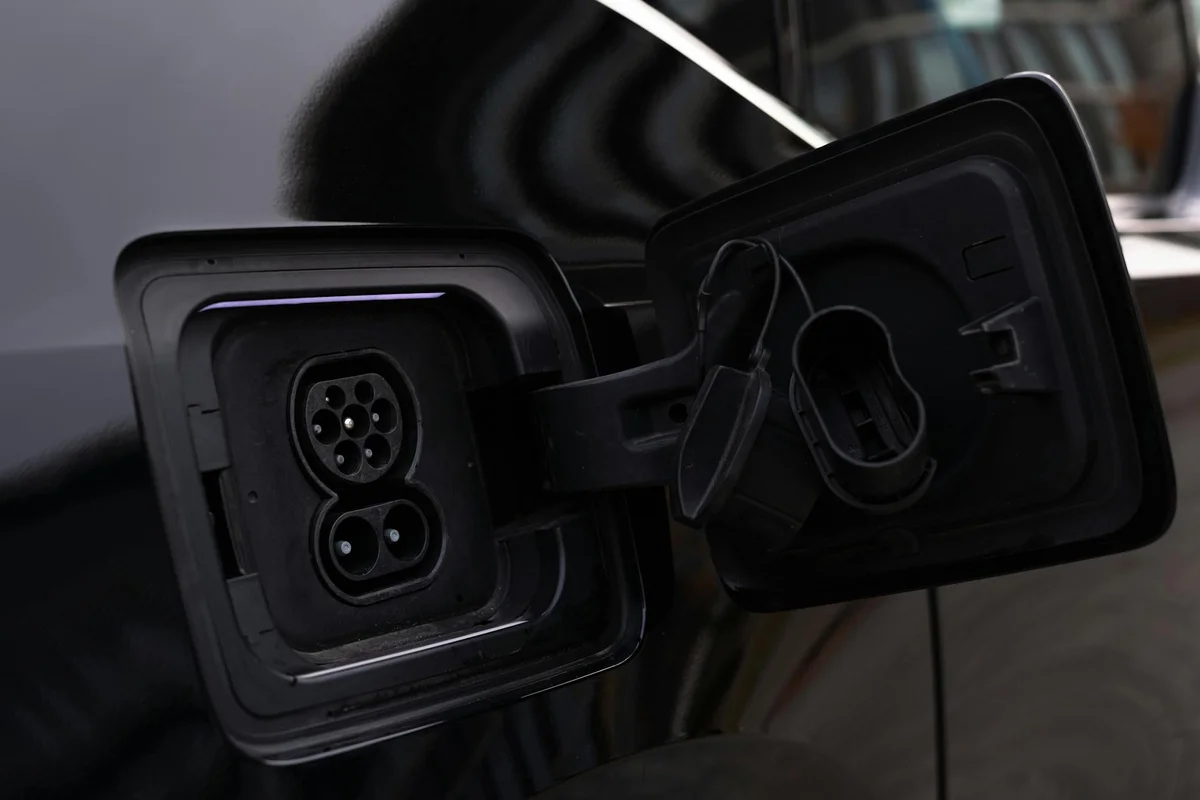
Gear worth having
As an Amazon Associate, ThinkEV earns a small commission from qualifying purchases — at no extra cost to you.

Lectron Level 2 J1772 Charger (40A, WiFi)
Smart WiFi charger with real-time energy monitoring. 40A / 9.6 kW, J1772 with a NEMA 14-50 plug, schedule charging right from your phone.
As an Amazon Associate, ThinkEV earns from qualifying purchases — at no extra cost to you.
Load Management: Static, Dynamic, and Why the Difference Matters
This is where the engineering forks. Once you accept that two EVs will sometimes want to charge simultaneously and that the circuit is finite, the question becomes how the electrons get allocated. There are two answers, and they are not equivalent.
Static load management is the simpler one. Two chargers share a circuit budget, say, 50 amps, and each is permanently configured to draw a fixed maximum: 25A and 25A, or 32A and 16A if you've designated a primary vehicle. Whether the other car is plugged in or not, the allocation doesn't change. It's mechanical, predictable, and cheap to implement. It's also wasteful: when only one car is charging, it can't borrow the other's allocation, so a 25A/25A split delivers a maximum of 6 kW to a single vehicle even when the other side of the garage is empty.
Dynamic load balancing is the smarter one. The software constantly monitors usage, distributes available power evenly, and adapts to the building's changing energy demands. The enabling hardware is a current transformer, a CT clamp, installed at the panel's main feed, which reads real-time household consumption and feeds the data back to the charger's logic board. When the dryer cycles off, the charger sees the freed capacity and ramps up. When the oven preheats, it ramps down. The cars are never starved; the house is never tripped.
Applied to two chargers on a shared circuit, dynamic management compounds the win. Two chargers reading a 50A circuit budget and the household's live draw can route 40A to a single car when the other isn't plugged in, then split 20A/20A when both are active, then redistribute as one car hits its battery's taper threshold and starts asking for less. The system behaves like a small, dumb traffic cop with very fast reflexes.
The economic argument for dynamic management has shifted in the last two years. InsideEVs noted in its 2025 best EV charger roundup that both power-sharing and dynamic load management have become key differentiators in the mid-to-upper-price charger segment. What used to be a commercial-fleet feature has migrated down to the $700–$1,000 residential price band, which is where most two-EV households are shopping anyway.
The practical implication is worth stating plainly. Two 20A circuits on a dynamic-sharing controller, yes, two separate breakers, sharing a coordinated budget, will outperform a single 50A circuit split statically into 25A/25A in almost every real-world scenario. The reason is that real EV charging is bursty: cars rarely both pull full power for the full session. A dynamic system harvests the bursts; a static system leaves them on the table. For deeper context on how individual chargers handle this kind of negotiation, the engineering comparison of Canada's best Level 2 chargers lays out which units do load sharing properly versus which are wearing the feature as a sticker.
The Hardware Decision: Dual-Head, Twin Chargers, or One Smart Unit
Now the product question, which only becomes coherent after the engineering one is settled. Three architectures, three different sets of trade-offs.
The dual-head charger puts two cables in one enclosure, served by one circuit. The Grizzl-E Duo is the canonical example: the $899.99 price point positions this as a premium option, though you're essentially getting two chargers in one enclosure. The underlying Grizzl-E platform has years of proven performance in single-port units. Installation requires a dedicated 40-amp circuit, and the 24.2-pound weight means secure wall mounting is essential. Enphase makes a similar product, a rugged EVSE with dual cords, offered in 40 amp or 50 amp versions, running off of one circuit.
The dual-head approach has one decisive advantage and one decisive limitation. The advantage is that it eliminates the second-circuit problem entirely, one breaker, one wire run, one enclosure, internal load management handled by the unit. Multi-EV households wanting a single-unit solution with built-in load management will appreciate the simplicity. Homes with garage space constraints benefit from one enclosure instead of two separate chargers. The limitation is geometry: both cars have to park within reach of one mounting location. If the two vehicles park on opposite sides of a two-bay garage, you're either running a 25-foot cable across the floor or you're not solving the problem with a dual-head unit.
The twin-charger architecture installs two physically separate EVSEs, each on its own circuit, with a load-sharing controller coordinating them. This is the configuration that fits most North American garages: one charger per parking spot, cables short, mounting clean. The controller, sometimes a dedicated box, sometimes built into the chargers themselves via a daisy-chain or Wi-Fi link, handles the budget arithmetic. Emporia, Wallbox, and Tesla's universal Wall Connector all support this topology. One Reddit commenter described the planning posture well: routing conduit to one side of the garage and installing a hardwired 48A charger, with a NEMA 14-50 outlet on the other side of the garage off of the same circuit, and choosing an EV charger that can load manage on the same circuit if a second one gets installed eventually. That's the staged version of the same architecture.
The third option is the one nobody mentions in the brochures: one charger, a habit, and an honest acceptance that the second car charges from a 120V plug. A Level 1 trickle at 1.4 kW recovers about 60 km of range overnight, which for a low-mileage second vehicle is genuinely enough. It's not elegant, but it costs zero, and it deserves to be on the decision tree.
Gear worth having
As an Amazon Associate, ThinkEV earns a small commission from qualifying purchases — at no extra cost to you.

AstroAI Portable Tire Inflator
One tap, it inflates to your exact PSI then stops automatically. Low tires cost 5 to 10 percent of your range, so this pays for itself in a week.
As an Amazon Associate, ThinkEV earns from qualifying purchases — at no extra cost to you.
The arithmetic on shared circuits is where buyers often get caught off-guard. If both chargers are active simultaneously on a 40A budget, each delivers roughly 16A of usable continuous current, about 3.8 kW per car. That sounds slow until you do the second piece of math: 3.8 kW for eight overnight hours is 30 kWh, which is roughly 150 km of range. The Cadillac Vistiq's 11.5 kW ceiling matters during the day, when you want a fast top-up before a road trip. It doesn't matter at 2 a.m. on a Tuesday.
Gear worth having
As an Amazon Associate, ThinkEV earns a small commission from qualifying purchases — at no extra cost to you.

Magnetic EV Charger Plug Cover
A magnetic cap that keeps rain, road salt, and grit out of your home charger handle between sessions.
As an Amazon Associate, ThinkEV earns from qualifying purchases — at no extra cost to you.
When the Vehicles Themselves Do the Negotiating
The most useful shift in residential EV charging over the last five years isn't on the wall. It's in the cars. Modern EVs are not fixed loads. The onboard charger, not the EVSE, determines the final draw, and modern onboard chargers modulate continuously based on the pilot signal the EVSE broadcasts.
This is the engineering reality that makes shared circuits viable. When a Wallbox or a Tesla universal connector tells the car "you may draw up to 24 amps," the car's onboard charger obediently clamps to 24 amps. When the EVSE updates the signal to "now you may draw 32 amps," the car ramps up within seconds. There is no mechanical contactor switching, no current spike, no damage. The car is a participant in the negotiation, not a victim of it.
The vehicle thread quoted earlier captures it precisely: a Vistiq's 11.2 kW onboard charger "automatically adjusts to a range, anything from 0.72 kW to 11.5. The EV 'charger' can control that on the fly." This is true of the BMW i-series, the Cadillac Ultium platform, every Tesla since the Model S refresh, and effectively every EV sold since 2022. Older EVs, early Leafs, certain Bolts, some pre-2018 Model 3s, are less graceful, sometimes stopping the session entirely when the offered current drops below a threshold rather than ramping smoothly. The threshold is usually around 6 amps, which is the SAE J1772 minimum.
The deeper protocols extend this further. ISO 15118, sometimes marketed as "Plug & Charge", allows the vehicle and the EVSE to exchange identity, billing, and scheduling information bidirectionally. OCPP, the Open Charge Point Protocol, lets a household's charging infrastructure integrate with utility demand-response signals. Both protocols are arriving in residential hardware now, having matured first in commercial fleets. The implication for a two-EV garage is that scheduled and priority charging, "my car gets 80% by 6 a.m., yours gets whatever's left", is no longer a fantasy feature.
The philosophical contrast is interesting and worth naming. Older EV charging architecture treated the session as a hardware problem: the EVSE was a glorified relay, the car drew whatever the breaker allowed, and any mismatch produced a tripped circuit. The Cadillac Ultium platform, and Tesla's, and Hyundai's E-GMP, and the new BMW Neue Klasse, treats the session as a software problem. The charger publishes an offer; the car accepts the offer; both adjust in real time. The hardware is identical to what it was a decade ago. The intelligence is new.
This matters for the dual-charger decision because it means the worst-case scenario most homeowners worry about, "what if both cars try to draw maximum power and trip the breaker?", has been engineered out of existence at the vehicle level, provided the EVSEs are properly configured to publish coordinated offers. The cars will accept the offer. They were built to.
The Panel Upgrade Question: Math Before Commitment
A 200A service upgrade in Canada runs roughly $1,500 to $4,000, depending on utility involvement, mast replacement, meter relocation, and whether the existing service drop is overhead or buried. In some Ontario municipalities the utility-side work is free; in others it's $2,000 of the total. The number is wide because the variables are wide. What's consistent is that it's a non-trivial expense, and it's almost always the wrong place to start.
Start with the load calculation instead. The Canadian Electrical Code provides the formula; any licensed electrician can run it in under thirty minutes. A typical 2,200-square-foot Canadian home with a gas furnace, an electric water heater, and one EV charger calculates somewhere around 90–110 amps of peak load on a 200A service. Adding a second 40A EV circuit pushes the calculation toward 130–150 amps, still comfortably inside the 200A budget. Adding a third, say, an electric water heater swap or a heat pump, is where things start to bind.
If the calculation comes back inside the service rating, the upgrade is unnecessary. What you may still need is sub-panel work: a dedicated 60A or 100A garage sub-panel fed from the main, which provides the breaker slots and physical wiring infrastructure for two EV circuits without touching the meter or the utility side. Sub-panel installation typically runs $800–$1,800 in Canada, and it solves the breaker-slot problem that masquerades as a service-capacity problem.
Smart panels are the third path. Span and Lumin both make residential panels that integrate utility-grade metering and circuit-level control into the main panel itself. Software constantly monitors usage, distributes available power evenly, and adapts to changing energy demands, except now it's monitoring at the panel rather than at the charger, which gives the algorithm visibility into every load in the house. Installed cost runs $3,000–$5,000, comparable to a service upgrade plus a sub-panel, with the upside that the system continues paying dividends as more loads electrify. The case for a smart panel strengthens considerably if a heat pump, an induction range, or a third EV is in the five-year plan. The engineering case for treating your garage outlet as a real circuit, not an afterthought, makes a related point about why the panel-side decisions matter more than the charger-side ones.
The honest electrician's answer to most two-charger problems is sub-panel feeds, not main upgrades. The reason is that the bottleneck is rarely the service drop, it's the wiring inside the wall between the main panel and the garage. A 100-foot run of 6 AWG copper to a 60A sub-panel solves the geometry and the slot count simultaneously, and it costs a quarter of what a full upgrade does.
Gear worth having
As an Amazon Associate, ThinkEV earns a small commission from qualifying purchases — at no extra cost to you.

Magnetic Cable Clips (8-Pack)
Tiny magnetic clips that tame charging cables, phone cords, and cabin clutter. Stick them anywhere metal.
As an Amazon Associate, ThinkEV earns from qualifying purchases — at no extra cost to you.
What the Right Setup Actually Looks Like
For the household that started this piece, two BMWs, a 50-amp circuit, a desire to stop the plug-in dance, the cleanest path is two 30-amp circuits sharing the existing 50A budget via a dynamic load controller. Two Wallbox Pulsar Plus units, or two Emporia EV Chargers, or a paired Tesla Universal Wall Connector setup, configured to share a 50A parent budget with priority going to whichever vehicle has the lower state of charge.
If the geometry is wrong, if both cars park on the same side of the garage, or if pulling a second wire run is genuinely impractical, the dual-head Grizzl-E or Enphase unit on the existing 50A circuit is the right answer. One enclosure, two cables, internal load management, no second breaker required. The capital cost is roughly equivalent to two budget standalone chargers. The labour cost is dramatically lower.
Priority assignment is the feature most buyers underuse. The default in most dual-controller setups is equal split. The better configuration in most households is asymmetric: primary vehicle gets 32A whenever it's plugged in, secondary vehicle gets the remainder. This matches actual household behaviour, one driver typically commutes more, one car typically returns lower, and it ensures the high-demand vehicle is never starved by the low-demand one. For households on time-of-use rates, layering a scheduled-charging policy on top of priority assignment (the way Canadian time-of-use windows interact with Level 2 charging is worth understanding before configuring) compounds the savings.
The engineering decision that ages well is sizing for the worst-case vehicle, not the current fleet. The Vistiq's 11.5 kW onboard charger is roughly the residential ceiling for the next five years; cars beyond that mostly belong to DC fast charging at public stations, not AC at home. A 40A circuit per bay, with dynamic load sharing back to the panel, covers any EV likely to enter the household between now and 2030. Spending more buys headroom you won't use; spending less buys constraints you'll have to undo.
What I'd watch next is the smart-panel category. The $3,000–$5,000 installed price is high enough today that the math only works for households planning two more electrified loads after the second EV. If that price falls to $2,000 over the next two product cycles, which is plausible given Span's recent funding rounds and Lumin's commercial-channel expansion, the smart panel becomes the default residential answer to multi-load electrification, and standalone load-sharing controllers become a transitional product. The bet I'd make today: dual-EV households buying in 2027 will be choosing between two smart panels and a dual-head EVSE on a regular panel, not between three different load-sharing topologies on legacy hardware.
The plug-in dance ends not when you buy a second charger. It ends when you decide how the electrons get rationed and let the hardware enforce the decision. The product is downstream of the math. Get the math right and almost any of the major-brand chargers will do the job. Get it wrong and the most expensive setup in the catalogue will still leave somebody arguing about who plugs in first.
For wider context, see tesla and evgo's 1,000 new fast chargers: what it means for canadian ev owners and tesla-like magic dock for non-tesla chargers? what canadian drivers need to know.
Gear worth having
As an Amazon Associate, ThinkEV earns a small commission from qualifying purchases — at no extra cost to you.

Grizzl-E Classic Level 2 EV Charger (40A)
Canadian-made and rated for minus 40C winters. 40A / 9.6 kW, NEMA 14-50, indoor/outdoor, 24-ft cable. The charger built for Canadian weather.
As an Amazon Associate, ThinkEV earns from qualifying purchases — at no extra cost to you.

Founder & Chief Editor
Vlad Pereira is the founder and chief editor of ThinkEV.ca, the Canadian electric-vehicle publication he writes and edits from Courtenay, British Columbia. He covers EV pricing, federal and provincial rebates, charging costs, and the Chinese manufacturers now entering Canada, from the buyer's side rather than the press-fleet side. ThinkEV is a venture of Vlad Pereira Online; his writing on health, income and the long game lives at vladpereira.com.
Frequently asked questions
Can a Canadian home's 200A panel actually handle two EV chargers?
What does a CT clamp actually do in this setup?
Does static load sharing damage the cars over time?
When does it actually make sense to add a second dedicated circuit?
Do all dual-head EV chargers include dynamic load management?
More EV & road-trip finds
Affordable upgrades worth a look — tap any to check the price on Amazon.
 ★ 55
★ 55LED Car Door Logo Projector Light
View on Amazon ★ 568
★ 568Personalized Photo and Text Keychain
View on Amazon ★ 21,304
Car Headrest Hooks (4-Pack)
View on Amazon ★ 1,944
VIOFO A229 Pro 4K Dash Cam
View on Amazon ★ 121
★ 121Foldable Windshield Sun Umbrella
View on Amazon ★ 268
★ 268Anti-Slip Leather Steering Wheel Cover
View on Amazon ★ 96,686
PULIDIKI Car Cleaning Gel (Detailing Putty)
View on Amazon ★ 164
★ 164Solar-Powered LED Ambient Light
View on AmazonRead, Plan, Then Stay Current
Explore our expert articles to understand incentives and ownership costs, use the map to pressure-test charging reality, then subscribe so new EV coverage comes straight to you.
Continue Reading
How Long to Charge an EV: The Three Numbers That Matter
EV Charger on a 100-Amp Panel: Skip the Upgrade
Level 1 vs Level 2 EV Charging: Which to Choose
Picking a 240V EV Charger for Your Canadian Garage

How to Find a Trusted EV Charger Installer Near You in Canada