Ford just created a whole new company. Not a division. Not a team. A subsidiary.
That tells you everything about how serious this is.
Ford has officially unveiled Ford Energy, a wholly owned subsidiary that will manufacture and sell U.S.-assembled battery energy storage systems (BESS) for utilities, data centres, and large industrial customers. The press release dropped today. Half the financial commentariat read it as Ford backing away from electric vehicles. They read it wrong, and they read it lazily.
Here is the honest version, stripped of the cable-news framing. Ford found a customer base that pays on time, signs multi-year contracts, and doesn't care about quarterly consumer sentiment. So Ford built a company to sell to that customer base. The EV strategy didn't die, it just got a sibling that might pay the bills while the consumer EV market sorts itself out. That is not a retreat. That is a hedge with a factory attached.
Key takeaways
- Ford Energy operated in stealth mode for nearly a year before today's formal press release.
- Lisa Drake reports directly to Vice Chair John Lawler, deliberately insulated from Ford Model e's EV politics.
- The Kentucky plant conversion targets at least 20 GWh annually, enough to supply roughly 80-100 hyperscale data centre campuses.
- U.S.-assembled BESS earns automatic domestic-content advantages in federal procurement and utility regulatory filings.
- The $2 billion commitment targets utilities and data centres with contracted demand, not volatile consumer EV buyers.
Ford Energy Is Real, and the Stealth Mode Was Intentional
Here's the part the cable-news takes missed entirely. Ford Energy didn't launch today. It launched almost a year ago. Today was just the press conference.
Today we mark the formal introduction of Ford Energy. For the better part of a year, we have operated quietly to build a foundation for this business. We haven't just been planning; we have been executing, securing supply chains, readying manufacturing sites and aligning technology with the demand curve. That's the company's own framing, and for once the corporate language is doing actual work.
Stealth mode in industrial businesses is rare. You hide a software product because competitors can clone it overnight. You hide a heavy-manufacturing pivot because you don't want utilities, data centres, and analysts pricing your launch into expectations before you've poured the concrete. Ford did the second thing. On purpose.
Lisa Drake is running it. She was named to lead the energy business earlier this year, and she reports directly to Vice Chair John Lawler, not to Ford Model e, not to the consumer-vehicle organization, not to anybody whose bonus depends on F-150 Lightning unit volumes. That reporting line matters more than the press release. It tells you the org chart was designed so EV politics can't sink the energy business and energy can't get raided to subsidize EV.
The Kentucky plant conversion is the second tell. Ford isn't waiting for a new greenfield site. The factory exists, the workforce exists, the grid interconnect exists. You only do that if you've already done the math on what the building can produce and when. Real businesses pour concrete before press releases. Vapor pours press releases before concrete.
The interesting part is what Ford chose not to say today. No splashy logo reveal. No "energy ecosystem" slogan. No smart-home tie-in pitch. The company that practically invented American consumer brand marketing went weirdly minimalist, and that restraint reads as confidence. They don't need the hype because they already have the customer conversations locked in behind NDAs.
20 GWh Annually Is Not a Pilot Program
Twenty gigawatt-hours per year. Let that number sit for a second.
Ford Energy is targeting at least 20 GWh of BESS deployment annually to data centres, utilities, and large commercial and industrial customers in the United States, per Drake's own framing of the business. That figure puts the subsidiary ahead of most pureplay storage companies on day one, not behind them. The number isn't aspirational, it's the throughput the Kentucky plant is being engineered around.
For scale: a single hyperscale data centre campus today might want a couple hundred megawatt-hours of storage. Twenty GWh a year is enough to outfit roughly 80 to 100 of those campuses every twelve months. Or to firm up a meaningful chunk of a regional grid. Or to back-stop most of the new AI infrastructure coming online in the U.S. Southeast and Texas. Pick whichever framing scares you the most.
This is not a learn-by-doing pilot. This is a production line designed to be running near capacity from the year it commissions. Pilots don't get $2B and a converted assembly plant. Pilots get a press release and a corner of an existing factory.
The Kentucky factory matters here for a second reason beyond speed. U.S.-assembled BESS is politically armoured in a way that imported product is not. Federal procurement, defence-adjacent data centres, and utility cost-recovery filings all favour domestic content. Ford doesn't have to make a tariff argument. The factory location makes it for them, automatically, in every regulatory filing the customer files downstream.
Residential is also on the roadmap, eventually. Ford has signaled it will offer battery cells for residential energy storage applications down the line, though that's a second-wave product. The first wave is utility-scale. That ordering is correct. Sell to the customer who buys 200 megawatt-hours at a time before you try to sell to the customer who buys 13 kWh.
The technical fundamentals of why energy density per cell is the number that actually matters work the same for stationary storage as they do for vehicles. The chemistry doesn't care what enclosure it sits in, and that's part of why Ford can credibly pivot at all. Same cells, different box.
Gear worth having
As an Amazon Associate, ThinkEV earns a small commission from qualifying purchases — at no extra cost to you.

Heavy-Duty Outdoor Timer (Preconditioning)
Schedule your Level 1 charger or block-heater outlet, rated for the outdoors. Warm the battery on grid power before you leave, not on your range.
As an Amazon Associate, ThinkEV earns from qualifying purchases — at no extra cost to you.
The $2 Billion Bet Nobody Is Calling a Bet
Ford is committing roughly $2 billion to this. That's not a side project budget. That's a "the board signed off on this being a real arm of the company" budget.
And nobody is calling it a bet.
The financial press framed today's news as Ford pivoting away from EVs because Detroit pivoting away from anything makes a better headline than Detroit quietly building a new revenue line. Yahoo Finance ran the $2B figure as a "shakeup to EV strategy." The Detroit Free Press framed it as Ford shifting away from producing large electric vehicles. Those framings are not wrong on the consumer side, Ford has clearly trimmed its big-EV ambitions. But they treat the energy business as the consolation prize. It isn't. It's the upside.
Consumer EV demand is lumpy. Tariff regimes shift. Rebate programmes expire. Interest rates move buyer behaviour month to month. Try modeling a five-year P&L on that. Now try modeling a five-year P&L on a signed BESS contract with a hyperscaler whose data centre is already permitted and under construction. You see the problem.
Grid storage demand isn't lumpy. AI training capacity is being commissioned on a schedule that doesn't care about election cycles. Data centre developers have signed power purchase agreements they have to honour. Utilities are facing summer peak loads that already break records every year. The customer for a 100 MWh storage system is a developer with a closing date, not a shopper deciding between two crossovers in a dealership on a Saturday.
Stripped of the marketing language, here's what Ford did. They looked at two businesses, one with volatile demand and thin margins, one with contracted demand and harder-to-disrupt economics, and decided to put serious capital into the second while keeping a hand in the first. That's not a retreat. That's portfolio construction. Mature industrial companies have been doing this for a century. Detroit just took longer than most to admit batteries had become the actual product.
The cynical read is that Ford is hedging consumer EV losses with a business that doesn't depend on showroom traffic. The cynical read happens to be correct, and also good strategy. Hedges are how mature industrial companies survive demand cycles. The era when Detroit's only product was a vehicle is over. Ford figured that out before GM and before Stellantis. Watch for them to be copied within eighteen months.
Why Ford and Why Now, Read the Room
The timing isn't a coincidence. The timing is the whole story.
Data centre buildout in the U.S. is accelerating faster than utility planning cycles can handle. Hyperscalers want power yesterday. Some are signing direct nuclear deals. Some are building behind-the-meter solar plus storage. All of them need battery backup at scales that didn't exist five years ago. The bottleneck right now is supply of large-format BESS, not demand for it. Anyone telling you otherwise is selling something.
Tesla figured this out years ago and built Megapack into a quietly enormous business. BYD is already shipping container-scale storage globally. The U.S. market has room for at least one more credible domestic supplier with manufacturing scale. Ford has manufacturing scale by default. The leap from automotive battery packs to stationary storage is shorter than outsiders assume, the cells are similar, the thermal management is similar, the BMS architecture is similar. What changes is the enclosure, the inverter integration, and the service model. Three problems Ford's engineers can solve in their sleep.
Gear worth having
As an Amazon Associate, ThinkEV earns a small commission from qualifying purchases — at no extra cost to you.

ChargePoint Home Flex Level 2 Charger (50A)
Premium 50A / 12 kW charger with the best app ecosystem. Hardwired or NEMA 14-50, with real-time energy tracking and smart scheduling.
As an Amazon Associate, ThinkEV earns from qualifying purchases — at no extra cost to you.
Ford is late to this market. That's true. But late and funded with $2B and a Kentucky plant is a very different "late" than late and starting from scratch. The competitive moat in BESS isn't IP, it's manufacturing throughput and bankable warranties. Ford can offer both faster than most newcomers. A utility procurement officer will sign with the company that can deliver containers on schedule and stand behind a 15-year warranty. Ford has been honouring warranties on industrial equipment longer than most BESS startups have existed.
There's also a late-2025 breadcrumb everyone missed. Ford telegraphed its 2026 restructuring last December and named storage as a growth pillar. Ford Energy's launch as a wholly owned subsidiary is the operational expression of that telegraph. The analysts who treated December as boilerplate are now writing surprised columns. Reading filings would have helped.
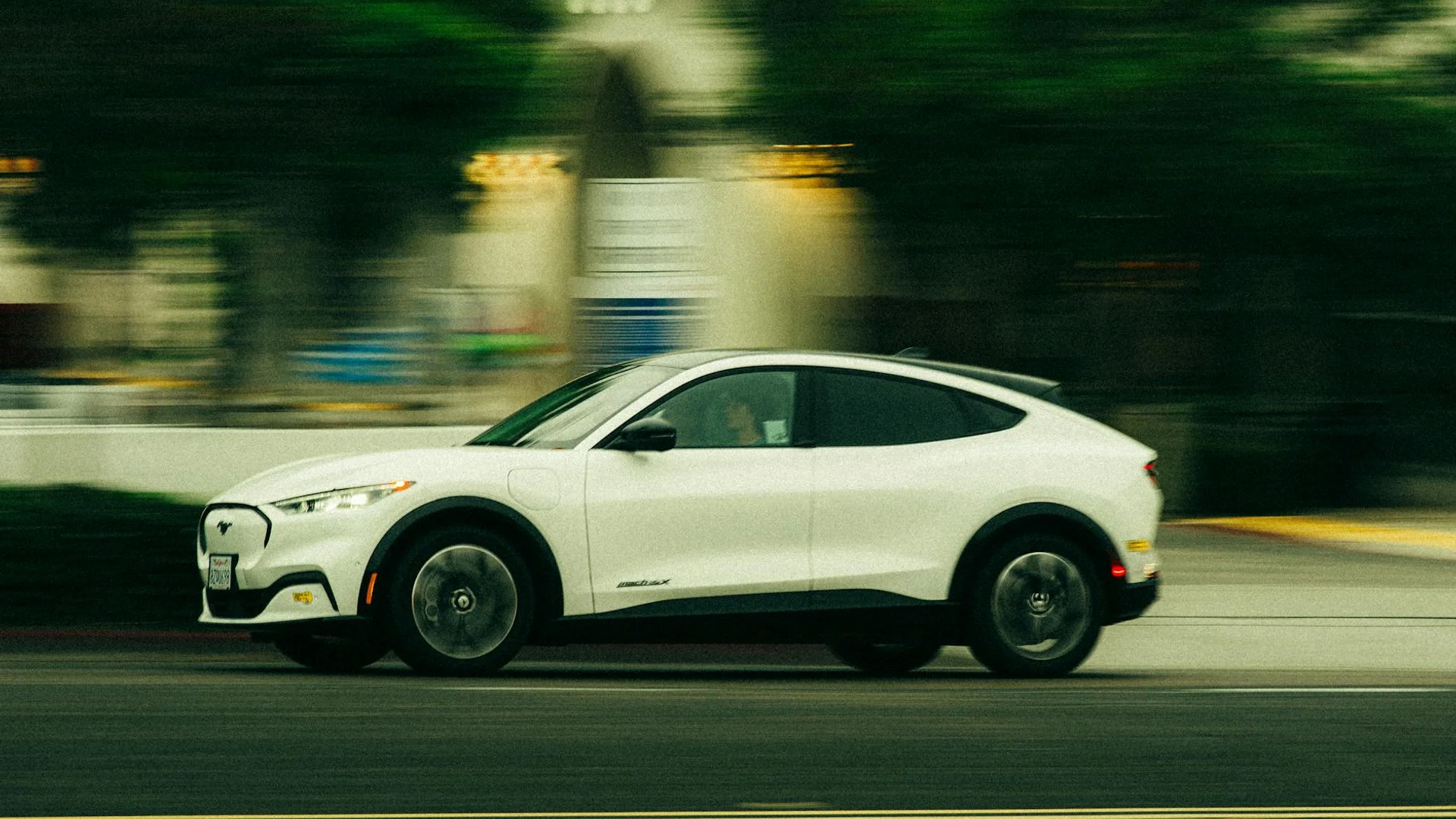
Ford's broader pivot from a vehicle-only company to a multi-product industrial player has been visible for a while if you knew where to look. The Mach-E was the first signal that Ford could ship a competitive EV at all, and Ford Energy is the signal that Ford thinks batteries are a bigger business than the vehicles they go into.

Gear worth having
As an Amazon Associate, ThinkEV earns a small commission from qualifying purchases — at no extra cost to you.

Car Cup Holder Coasters (4-Pack)
Drop-in coasters that catch spills and crumbs so your cup holders stay clean. Rinse and reuse forever.
As an Amazon Associate, ThinkEV earns from qualifying purchases — at no extra cost to you.
The Community Reaction: Skeptics, Believers, and the People Who've Seen This Before
The discourse split predictably within hours.
EV diehards on X are frustrated. The framing in those circles: Ford is abandoning consumer electrification right when momentum was building. Some of that frustration is fair, Ford has visibly pulled back on big-EV ambitions. Some of it is misread, Ford Energy doesn't subtract from the EV roadmap, it just doesn't add to it either. Two separate businesses, two separate balance sheets, two separate sets of incentives. The EV team still has to ship EVs.
Energy-sector accounts are cautiously bullish. The repeated line: this is the first U.S. automaker to acknowledge in production scale that batteries are a bigger business than the vehicles they go into. Tesla figured that out, but Tesla isn't really an automaker anymore, it's an energy and software company with a car factory bolted on. Ford explicitly acknowledging the same logic is new, and the timing matters. Detroit doesn't admit Tesla was right about anything unless the math has become impossible to argue with.
Then there's the third group, the one nobody pays attention to but should. The legacy energy operators. The people who've watched a hundred companies announce battery plans and ship nothing. Their take is the most interesting: Ford Energy is structured correctly. Separate subsidiary. Direct reporting to vice chair, not to a divisional VP. President with manufacturing credibility. Kentucky plant already named and already converting. That structure is unusual for vaporware. Vaporware usually announces a task force.
The cynical takes aren't wrong that Ford has execution problems. They are wrong that the Ford Energy org structure is set up to inherit those problems. The whole point of spinning a subsidiary is so it doesn't.
I'd bet on this shipping closer to schedule than the consensus expects. Not because I trust Ford as an institution to deliver, Ford has missed plenty of dates, but because the structure was designed by people who clearly didn't trust Ford as an institution either. The separation is the tell. When a company builds a subsidiary specifically so it can be insulated from the parent's politics, somebody senior already lost an argument about what happens when you don't.
For readers tracking which legacy automakers are quietly winning the transition, the Ford story sits alongside a broader shift in what counts as an EV company at all. The companies that survive the next five years won't be the ones with the most EV models. They'll be the ones with the most diversified battery revenue.
Gear worth having
As an Amazon Associate, ThinkEV earns a small commission from qualifying purchases — at no extra cost to you.

Car Seat Gap Filler (Universal)
Blocks the black-hole gap beside the seat so phones, keys, and fries stop disappearing into it.
As an Amazon Associate, ThinkEV earns from qualifying purchases — at no extra cost to you.
What This Means for the Grid, and for Ford's Balance Sheet
Utility-scale BESS is one of the few clean energy segments with locked-in offtake demand. That's the part to internalize.
Solar developers chase projects. Wind operators chase wind. EV manufacturers chase consumers. BESS suppliers, when they're tied to utility or data-centre contracts, chase signed paper. The customer has already committed capex, regulatory filings, and grid interconnect to a project before they cut a purchase order for storage. The supplier's job is to deliver on a schedule, not to find demand. That is a fundamentally different sales motion than anything Ford has run before, and it's a much easier one to forecast.
It's a fundamentally better business than selling F-150 Lightnings into a tariff-distorted, rebate-dependent, interest-rate-sensitive consumer market. It's a worse business than software margins, sure. But for a heavy-industrial player with deep manufacturing assets, contracted demand at industrial scale is the closest thing to a financial moat that physical-goods companies get. You don't have to be Tesla to win this game. You just have to ship on time and stand behind the warranty.
If Ford Energy hits even half of its 20 GWh deployment target consistently, it stabilizes Ford's revenue mix in a way that consumer EVs alone never could. F-150 Lightning sales go up and down with gas prices, rebate programmes, and dealer inventory. A signed five-year BESS contract with a hyperscaler does not. The accountants like the second one a lot more, and they should. The equity analysts will catch up in about two quarters.
There is real execution risk. The Kentucky plant has to ship on schedule. The first major utility contract has to deploy without a thermal incident. The first data centre customer reference has to be glowing. None of that is automatic, and Ford's track record with new product launches is genuinely mixed. But the structural setup is sound. The question is operational discipline, not strategy. Strategy questions are harder to fix than execution questions, and Ford got the strategy right.
The real story today isn't the announcement. It's whether the first containers leave Kentucky on the date Ford has internally committed to. That's the metric I'd watch. Mark the calendar twelve months out and check. If the containers ship, the story is real. If they slip more than a quarter, the cynics get to write their column.
If Ford Energy ships on time, the rest of Detroit will follow within eighteen months. GM has battery joint ventures it could spin similarly. Stellantis is further behind but watching closely. The auto industry has been searching for a non-cyclical revenue line for forty years. Ford may have just shown them where it was hiding the whole time.
And the rest of us get a more stable grid out of the deal. Not the worst trade.
Gear worth having
As an Amazon Associate, ThinkEV earns a small commission from qualifying purchases — at no extra cost to you.

K KNODEL Car Trash Can with Lid
A leakproof bin with a lid that actually contains the mess and straps neatly behind a seat or console.
As an Amazon Associate, ThinkEV earns from qualifying purchases — at no extra cost to you.

Founder & Chief Editor
Vlad Pereira is the founder and chief editor of ThinkEV.ca, the Canadian electric-vehicle publication he writes and edits from Courtenay, British Columbia. He covers EV pricing, federal and provincial rebates, charging costs, and the Chinese manufacturers now entering Canada, from the buyer's side rather than the press-fleet side. ThinkEV is a venture of Vlad Pereira Online; his writing on health, income and the long game lives at vladpereira.com.
Frequently asked questions
Does Ford Energy change anything for Canadian EV buyers?
Will Ford Energy products ever reach Canadian homes?
Why Kentucky, does U.S. assembly matter for a Canadian buyer?
Is 20 GWh a year actually achievable for a first-year operation?
Who is actually running Ford Energy day-to-day?
More EV & road-trip finds
Affordable upgrades worth a look — tap any to check the price on Amazon.
 ★ 392
★ 392Large Cup Holder Adapter (32-40oz)
View on Amazon ★ 8,681
Chemical Guys Complete Car Wash Kit
View on Amazon ★ 164
★ 164Solar-Powered LED Ambient Light
View on Amazon ★ 1,083
Crystal Push-Start Button Ring (2-Pack)
View on Amazon ★ 4,424
Sun Visor Card and Document Organizer
View on Amazon
TP-Link Kasa Smart Plug with Energy Monitoring
View on Amazon ★ 119
★ 119Foldable Waterproof Trunk Organizer
View on Amazon ★ 17,839
Qifutan Vent Phone Mount (Military-Grade Clip)
View on AmazonRead, Plan, Then Stay Current
Explore our expert articles to understand incentives and ownership costs, use the map to pressure-test charging reality, then subscribe so new EV coverage comes straight to you.
Continue Reading
Ford Recalls 86,543 Mach-E EVs Over Window Trim

Ford Re-Recalls 387,000 Vehicles Over Bad Repairs
Nissan Pixo: Europe Gets a Renault Twingo in Nissan Clothes

BYD Great Seagull: A Bigger $10,000 EV Hatch Is Coming

10–97% in 9 Min: Sunwoda Joins the Flash Charging Race