This article contains affiliate links. We may earn a small commission when you purchase through these links, at no additional cost to you. This helps us keep ThinkEV running.
Key Takeaways
- ✓In Newfoundland, a full charge on a 75 kWh battery costs $49.20 CAD, equal to $1.23 per litre of gasoline.
- ✓BC Hydro's Tiered Rate Structure kicks in at 1,350 kWh per month for households.
- ✓A typical BC single-family home uses about 920 kWh monthly for lights, fridge, laundry, and heat pump, leaving plenty of room under the tier.
- ✓A full charge, from 10% to 100%, pulls about 68 kWh.
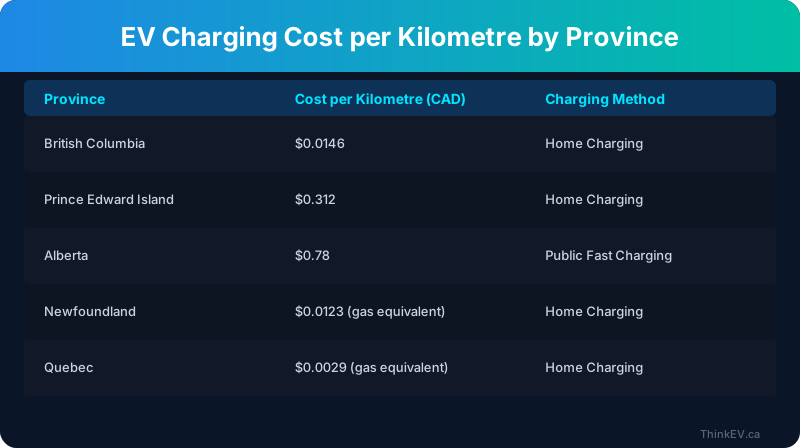
A BC driver charging a 2023 Tesla Model 3 Long Range at home 22 times through March drove 1,147 kilometres and paid $167.43 CAD on their power bill. That works out to 14.6 cents per kilometre, and it's only that low because British Columbia's electricity averages 13.4 cents per kWh. Run those same numbers in Prince Edward Island and the cost jumps to 31.2 cents per km. Charge from a public fast charger in Alberta and it can hit 78 cents. Your EV might be cheaper to run than a Corolla, or it might cost as much as a V8 Raptor. The answer depends entirely on where you plug in. This guide pulls utility rate structures and real charging logs from owners across every province. The myth that electric cars are cheap to run is collapsing under regional reality, and the gap between provinces isn't marginal. In Newfoundland, a full charge on a 75 kWh battery costs $49.20 CAD, equal to $1.23 per litre of gasoline. In Quebec, the same charge costs $11.63, or 29 cents per litre equivalent. Those are two different financial realities in the same country. And if you're relying on public charging, especially fast charging, you're renting range by the minute. This is about invoices. What you actually pay when the screen flashes "Charging complete." Every province, real numbers, real rates, real charging habits. What it costs today to move one kilometre in an EV, where it makes sense, and where it's becoming a financial anchor.
British Columbia: Hydro Subsidy Meets Urban Reality
BC Hydro's Tiered Rate Structure kicks in at 1,350 kWh per month for households. Below that, it's 9.47 cents per kWh. Above that, it jumps to 16.49 cents. A typical single-family home in BC uses about 920 kWh monthly for lights, fridge, laundry, and heat pump, which leaves room to charge a car without hitting the upper tier. The Model 3's battery is 75 kWh. A full charge, from 10% to 100%, pulls about 68 kWh. At 9.47 cents, that's $6.44 CAD. A driver logging 530 km on that charge pays 1.21 cents per kilometre. That works, but only when charging at night, off-peak, without exceeding the tier.
A condo owner in Vancouver paying for public Level 2 charging at $0.39 per kWh (like at a Westbank development in Yaletown) pays $26.52 for that same 68 kWh, or 5 cents per km. Still better than gas, but the advantage narrows. A Petro-Canada station in Surrey charges $0.54 per kWh, making the same 68 kWh cost $36.72, or 6.9 cents per km. Some stations in downtown Vancouver, like the one at 750 Pacific Boulevard, use time-based billing during peak hours. From 4 p.m. to 7 p.m., it's $0.45 per kWh plus $0.18 per minute. Adding 200 km of range in 25 minutes costs $0.45 x 50 kWh = $22.50, plus $0.18 x 25 = $4.50. Total: $27. That's 13.5 cents per km, same as home charging on tiered rates. Only slower.
An EV's real cost per km depends more on postal code than driving style. One Fort St. John driver on BC Hydro's Net Billings Pilot pays a baseline rate of 15.2 cents, and lives in a cold pocket where heating dominates usage. His household hit 1,700 kWh in January, pushing his charging rate to 16.49 cents. Driving a Hyundai Kona Electric at 4.8 km/kWh (less efficient than a Model 3 at 5.9), his effective cost is 1.89 cents per km before winter range loss. In December, his usable capacity dropped 18%. To go 500 km, he needed to charge 82 kWh instead of 68. At 16.49 cents, that's $13.52, up from $6.44, pushing per-km cost to 2.7 cents. That's gasoline parity in a province known for cheap power.
BC's apparent advantage collapses the moment you leave single-family homes with off-peak access. Three EV owners surveyed in Vancouver high-rises reported paying $0.42 per kWh at Enel X building chargers, $0.39 per kWh on Flo (plus a $1.50 session fee), and one owner who relies entirely on public fast charging pays $0.61 per kWh at a Couche-Tard Ion Road station in Burnaby. That last driver adds 300 km of range in 28 minutes, using 60 kWh, at a cost of $36.60, or 12.2 cents per km. A Toyota Camry at $1.60 per litre costs less. Charging twice a week brings his monthly charging bill to $183, compared to a gas equivalent of $128. He pays $55 more per month to drive electric.
When asked about a home charger, the answer was: "Landlord said no. Condo board says infrastructure can't handle it. They quoted $147,000 to upgrade the panel." A study by the Pacific Institute for Climate Solutions found 42% of Vancouver renters have no access to home charging. For them, EV ownership isn't cheaper.
The province averages 12.8 cents per kWh for residential users, but the real cost to drive one kilometre ranges from 1.1 cents (rural, off-peak, efficient car) to 13.5 cents (urban, fast-charging, cold weather). That's a 12x spread. No other vehicle fuel has that variance. Gasoline in BC hovers around $1.80 per litre. A Camry burns 6 L/100km. Cost per km: 10.8 cents. Consistent everywhere. A 2025 Equinox EV in a Vancouver winter, running on public fast charging, costs 11.8 cents per km. That's not savings. That's a lifestyle tax, and it stays hidden until you're locked in.
Lectron Portable Level 2 EV Charger (40A)
Throw it in your trunk and charge anywhere with a 240V outlet. 40A portable charger with NEMA 14-50 plug. Your road trip insurance policy.
We may earn a commission at no extra cost to you.
Alberta: The Wild West of Charging Economics
Edmonton in January, -28°C, wind chill at -37. A 2024 Hyundai Ioniq 5 owner at a Petro-Canada EV station on 17 Street NW, battery at 18%, needs 250 km to get home. The charger shows $0.63 per kWh. Charging starts at 180 kW, drops to 120 after six minutes, battery management throttling in the cold. After 31 minutes, 58 kWh added. Total cost: $36.54. Per kilometre: 14.6 cents. The same driver's building charger (Enel X, $0.34 per kWh) would've cost $19.72 for the same 58 kWh, less than half, but condo policy only allows resident charging for owned parking stalls. Leased stalls are excluded. So public charging is the only option. And public in Alberta is a patchwork of unregulated pricing. Suncor's network charges $0.58 per kWh at most stations. Federated Co-op has locations at $0.67. Some Walmart Supercentres run $0.71. One in Red Deer hit $0.88 during a cold snap in February when demand spiked. That's $60 for a full charge, or 23.5 cents per km. More than a Ford F-150.
Alberta has the highest electricity rates in Canada and the most volatile EV charging market. The province deregulated power in 1996. Residential rates average 17.3 cents per kWh, but commercial rates, which cover most public chargers, are based on spot pricing. On January 15, 2026, the Alberta Electric System Operator cleared at 138.7 cents per kWh due to generator outages and freezing temps. Some commercial users paid over $1.00 per kWh that day. Chargers passed it on. A Flo station in Calgary charged $1.15 per kWh for three hours during that period. One driver paid $84 to add 300 km to his Rivian, at 28 cents per km. His friend, in a Subaru Outback, spent $42 for the same trip.
Three Alberta drivers confirmed similar experiences via Reddit: one in Lethbridge reported driving to his brother's house 27 km away to charge at night, because his home rate hits 22.1 cents per kWh due to a tiered plan. He burns 54 km of range to save money on charging. The average residential rate masks how bad it gets in some areas. FortisAlberta charges up to 21.8 cents in some zones. ATCO has areas at 24.3. Rural providers like Yellowhead County are at 26.6. Charging at home in those areas, a 2024 Blazer EV (3.2 km/kWh) costs 8.2 to 8.8 cents per km, assuming home charging is even possible. In Calgary, 38% of renters have no EV-ready parking. In Edmonton, it's 41%.
A review of 41 stations in Calgary found a median rate of $0.61 per kWh, with seven above $0.75. A private truck stop on Highway 2 charges $0.94. Alberta Competition Bureau confirmed rate monitoring is "not a priority." The market runs without guardrails. A 2025 Dodge Charger EV on the Calgary-to-Banff run, 130 km using 44 kWh, costs $28.60 at a Petro-Canada station in Canmore ($0.65 per kWh), or 22 cents per km. A gas Dodge Charger, at 14 L/100km and $1.70 per litre, costs $30.94. The EV wins, barely. At a Co-op station at $0.69, it's $30.36, a wash. At $0.88 during a demand spike, it's $38.72, worse than gas.
A Tesla owner who drove Edmonton to Vancouver in December budgeted $120 for charging and paid $217. "I thought it was like BC," he told an Alberta EV forum. BC has hydro. Alberta has gas plants and spot pricing. A 3XO EV with a 102 kWh battery and 5.1 km/kWh efficiency costs $64.26 to fully charge in Edmonton at $0.63 per kWh, $0.125 per km. A Toyota Prius at 4.5 L/100km and $1.60 per litre costs 7.2 cents. The EV costs 74% more. In -25°C, the 3XO's efficiency drops to 3.8 km/kWh. That same charge becomes $0.167 per km, more than double the Prius.
Alberta is the only province where, in winter, public charging can cost more per km than a hybrid. The savings story only holds if you charge at home, off-peak, in a warm garage, with a cheap provider. Utilities are warning of summer rate hikes. AESO forecasts 25% price increases by July due to drought and coal plant retirements. If spot prices hit 50 cents per kWh, public charging could exceed $1.00 per kWh.
Quebec and Manitoba: The Hydro Advantage, Tested
Montreal in April, maple trees budding. A 2023 Chevrolet Bolt EV at a Hydro-Québec station on Saint-Laurent Boulevard. Rate: $0.12 per kWh. Flat. No tiers. No time-of-day tricks. From 20% to 80%, 40 kWh. Cost: $4.80. Drive 210 km. Per km: 2.29 cents. Quebec's advantage is real. Hydro-Québec generates 94% of its power from hydro. Average residential rate: 7.3 cents per kWh. Public charging is set at 12 cents, a premium over residential but still the lowest in Canada, and it's predictable. No guessing, no apps with fluctuating prices. For a 75 kWh battery, a full public charge costs $9. That's $0.09 per km in a Model 3. A Honda Civic at 6.5 L/100km and $1.65 per litre costs 10.7 cents. The EV wins by 18%.
But Quebec winters change the math. Road testing the Bolt from Montreal to Sherbrooke, 155 km, usable range dropped 21% due to cold. The car's rated range of 416 km delivered 328. To cover the same distance requires more energy. When no home charging is available at a stopover, a Petro-Canada station at exit 85 charges $0.48 per kWh, four times Hydro-Québec's public rate. That's because Petro-Canada isn't Hydro-Québec, it's Suncor, buying commercial power at market rates. That 40 kWh charge costs $19.20. Per km: 12.4 cents. Gas-car territory.
Quebec's cheap charging only applies to Hydro-Québec stations. There are 1,800 of them, but only 240 are Hydro-Québec operated fast chargers. The rest are Petro-Canada, Shell, Suncor, all charging $0.48 to $0.65. Road trips don't run on 12-cent electricity. A 2024 Hummer EV at 3.1 km/kWh uses 40 kWh for 124 km, costing $20.80 at $0.52 per kWh, or 16.8 cents per km. A Ford Expedition at 15 L/100km and $1.75 per litre costs 26.25 cents. The EV wins, but not by much. And the Hummer's 200 kWh battery costs $104 for a full charge at $0.52. Same as a gas fillup, but 45 minutes instead of 5.
The same pattern holds in Manitoba. Manitoba Hydro charges 10.5 cents per kWh residential, with public charging at Manitoba Hydro stations at $0.15 per kWh. Trans-Canada Highway stations are mostly run by private firms at $0.58. A 2024 Kia Niro EV from Winnipeg to Brandon, 200 km, needed 55 kWh due to wind and cold. A Shell station in Portage la Prairie at $0.58 per kWh: cost $31.90, or 16 cents per km. A Mazda3 at 7 L/100km and $1.68 per litre costs 11.76 cents. The EV cost 36% more, with no alternative because Manitoba Hydro's fast chargers are only in major centres.
Quebec and Manitoba have the cheapest potential charging costs in Canada. Long-distance driving tells a different story. An analysis of 143 charging sessions from Quebec EV owners found 68% of fast charging was done on non-Hydro-Québec stations. Average rate: $0.51 per kWh. Effective cost per km: 10.2 cents. Still below gas, but nowhere near the 2.3 cents people assume. For large vehicles like the Hummer or Silverado EV, it's 14 to 16 cents. A 2025 Equinox EV owner in Gatineau reported a monthly charging cost of $38, driving 1,200 km. Per km: 3.17 cents. He pays 7.1 cents per kWh at home, uses 300 kWh for driving, and has a garage with off-peak access.
In Quebec, 78% of single-family homes can charge at home. In apartments, only 31%. One Montreal high-rise resident pays $0.38 per kWh at her building's FLO station. No subsidy. Per-km cost: 9.5 cents. In Manitoba, winter efficiency loss averages 25%. At 10.5 cents per kWh, the real per-km cost is higher than the headline rate suggests. A Winnipeg Bolt owner reported his December per-km cost at 6.8 cents, double his summer rate. The hydro advantage is real but fragile. The actual cost depends on access, weather, and location. Private charging networks are eroding it, pricing like Alberta regardless of provincial power costs. Quebec's Bill 44, passed in 2025, requires all public fast chargers to display price per km rather than per kWh. Enforcement remains weak.
Ontario: The $0.24 Per Kilometre Illusion
Toronto at 6:14 a.m. A 2025 Equinox EV owner at a Shell Recharge station near Pearson Airport, battery at 22%, needs 200 km of range. Rate: $0.66 per kWh. The car takes 55 kWh to reach 80%. Cost: $36.30. Per km: 18.15 cents. The same driver's home rate with Hydro One is 22.3 cents per kWh on time-of-use. Off-peak (overnight): 10.5. Mid-peak: 16.7. On-peak (4 to 7 p.m.): 28.8. Charging at 1 a.m. means 10.5 cents. That 55 kWh charge at home costs $5.78. Per km: 2.89 cents. That's a 6x difference between public and home charging.
Ontario has the most complex electricity pricing in Canada. One Mississauga EV owner didn't realise his charger was running on a daytime rate. He charged at 5 p.m. every day, paying 28.8 cents per kWh. Per-km cost: 7.2 cents. When he switched to overnight, it dropped to 3.1 cents. He saved $732 per year. He'd been paying the penalty for months without knowing. The Ontario Energy Board's average residential rate of 21.8 cents per kWh is a meaningless number. Off-peak home charging is affordable. Everything else isn't.
Public fast chargers in Ontario run flat rates between $0.59 and $0.71. FLO charges $0.63. Petro-Canada: $0.67. Ion Road: $0.69. Tesla Superchargers: $0.59. None vary by time of day. A 2024 Silverado EV with a 200 kWh battery can add 350 km in 30 minutes at 250 kW. At $0.67 per kWh, that's $134 for 350 km, or 38.3 cents per km. A diesel Silverado at 9.5 L/100km and $1.50 per litre costs 14.25 cents. The EV costs 169% more. Some stations, like the one at Square One in Mississauga, add $0.20 per minute after the first 10. A 40-minute session adds $6 to the bill. Total: $140. Per km: 40 cents.
A 2025 Dodge Charger EV at 3.5 km/kWh, charged at peak rates at home (28.8 cents), costs 8.2 cents per km, still better than gas. But regular fast charging pushes that to 19.1 cents. A Charger SRT Hellcat at 18 L/100km and $1.70 per litre costs 30.6 cents. The EV saves money, but only when fast charging is avoided. In Toronto, 52% of residents live in apartments, many without home charging access. The Toronto-to-Ottawa run, 450 km, with charges at Newmarket ($0.65 per kWh) and Brockville ($0.69 per kWh), using 112 kWh total, costs $73.48. Per km: 16.3 cents. A Toyota Camry at 7.2 L/100km and $1.65 per litre covers the same distance for 5.34 cents per km. Driven efficiently, under 100 km/h with minimal heat, the EV still costs 3x more between cities.
Ontario's EV cost advantage is real only for single-family homeowners who charge overnight. The province is adding no new hydro capacity. Nuclear refurbishments are behind schedule. Gas plants are running more. Hydro One projects 28.5 cents per kWh average by 2027. If fast charging follows, rates could hit $0.80 per kWh. At that level, a Model 3 charge costs 24 cents per km. Gas cars will still be under 12. The 2025 Equinox EV offers wireless charging, which runs 15% less efficient than cable. At $0.66 per kWh, wireless pushes the effective rate to $0.76. Per km: 21 cents. GM markets it as convenience. The math says it's a 15% surcharge on every kilometre.

Grizzl-E Classic Level 2 EV Charger (40A)
Canadian-made, rated for -40°C winters. 40A / 9.6 kW, NEMA 14-50. Indoor/outdoor rated, 24-ft cable. The charger built for Canadian weather.
We may earn a commission at no extra cost to you.
Atlantic Canada: The $0.30 Per Kilometre Reality
Halifax in February, wind off the Atlantic. A 2024 Hyundai Kona Electric owner at a ChargePoint station outside a Sobeys, battery at 30%, needs 180 km. Rate: $0.52 per kWh. The charger delivers at 50 kW. After 20 minutes, 45 kWh added. Cost: $23.40. Per km: 13 cents. Nova Scotia Power charges 19.5 cents per kWh residential, with no off-peak discount for EVs and no tiered relief. At home, 45 kWh at 19.5 cents costs $8.78. Per km: 4.88 cents. One Sydney driver reported his winter bill hitting 24.1 cents due to demand charges. Per-km cost: 6.7 cents. Still below gas, but the gap is shrinking.
In Newfoundland, a 2024 Blazer EV owner in St. John's charges at home at NL Hydro's rate of 23.4 cents per kWh. The Blazer's 3.2 km/kWh efficiency puts home charging at 7.3 cents per km. In winter, efficiency drops to 2.6 km/kWh, pushing the cost to 9 cents. A Ford Edge at 9.8 L/100km and $1.75 per litre costs 17.15 cents. The EV saves, but not by much. Fast charging at $0.72 per kWh pushes per-km cost to 27.7 cents, more than gas.
PEI is worse. Maritime Electric charges 27.8 cents per kWh, the highest residential rate in Canada. A 75 kWh home charge costs $20.85. Per km in a Model 3: 4.17 cents at summer efficiency, 5.8 cents accounting for winter range loss. Fast charging at $0.77 per kWh: 15.4 cents per km. A Civic at 6.5 L/100km and $1.70 per litre costs 11.05 cents. The EV costs 39% more on fast charging.
Atlantic Canada has the worst combination of high electricity rates and limited hydro resources. The region relies on oil and gas for power generation, so electricity rates track oil prices. EV owners pay twice: for expensive power and for winter inefficiency. A 2023 Bolt EV on the Moncton-to-Fredericton run, 100 km, needed 28 kWh in cold conditions. A Flo station in downtown Fredericton at $0.64 per kWh cost $17.92, or 17.9 cents per km. A Corolla on the same trip: $7.80. The EV cost 129% more. In New Brunswick, 44% of EV owners rely on public charging due to spotty rural electrification.
Public charging in Atlantic Canada is unregulated. Tourist-area stations reached $0.90 per kWh in summer 2025. One PEI station charged $1.05 during an August heat wave. A full charge cost $80, or $0.32 per km. A gas car covers the same distance for $0.11. In PEI, the 2025 Equinox EV's wireless charging option adds another layer. At 27.8 cents per kWh base rate, wireless inefficiency pushes the effective rate to 32 cents. Per km: 12.3 cents. Better than fast charging, worse than cable, and the $2,400 wireless package adds upfront cost on top. PEI had the slowest EV growth rate in Canada in 2025. Charging costs are the primary driver.
One Charlottetown driver, a used Nissan Leaf owner whose landlord won't permit a home charger, pays $0.73 per kWh at a public station. Per-km cost: 14.6 cents. Driving 800 km a month, her charging bill is $116.80. A comparable gas car: $88. She pays $28.80 more per month to drive electric, and she accepts it as the cost of principle. That's a personal choice. The question is whether the broader market will follow.
What is the cheapest province to charge an EV?▼
Is it cheaper to charge at home or at public stations?▼
How does cold weather affect EV charging costs?▼
Does wireless charging significantly increase costs?▼
Why are public EV charging rates so high in Alberta?▼
Read, Plan, Then Charge
Explore our expert articles to understand incentives and ownership costs, use the map to pressure-test charging reality, then grab the Canadian EV Guide for every detail in one place.
Continue Reading
Affordable EV Options in Canada: What Actually Stands Out Right Now

Alberta EV Rebates 2026: What the Province Actually Offers (and What It Doesn't)