Six thousand hours of labour. A donor car not included. And the result weighs less than a Golf GTI.
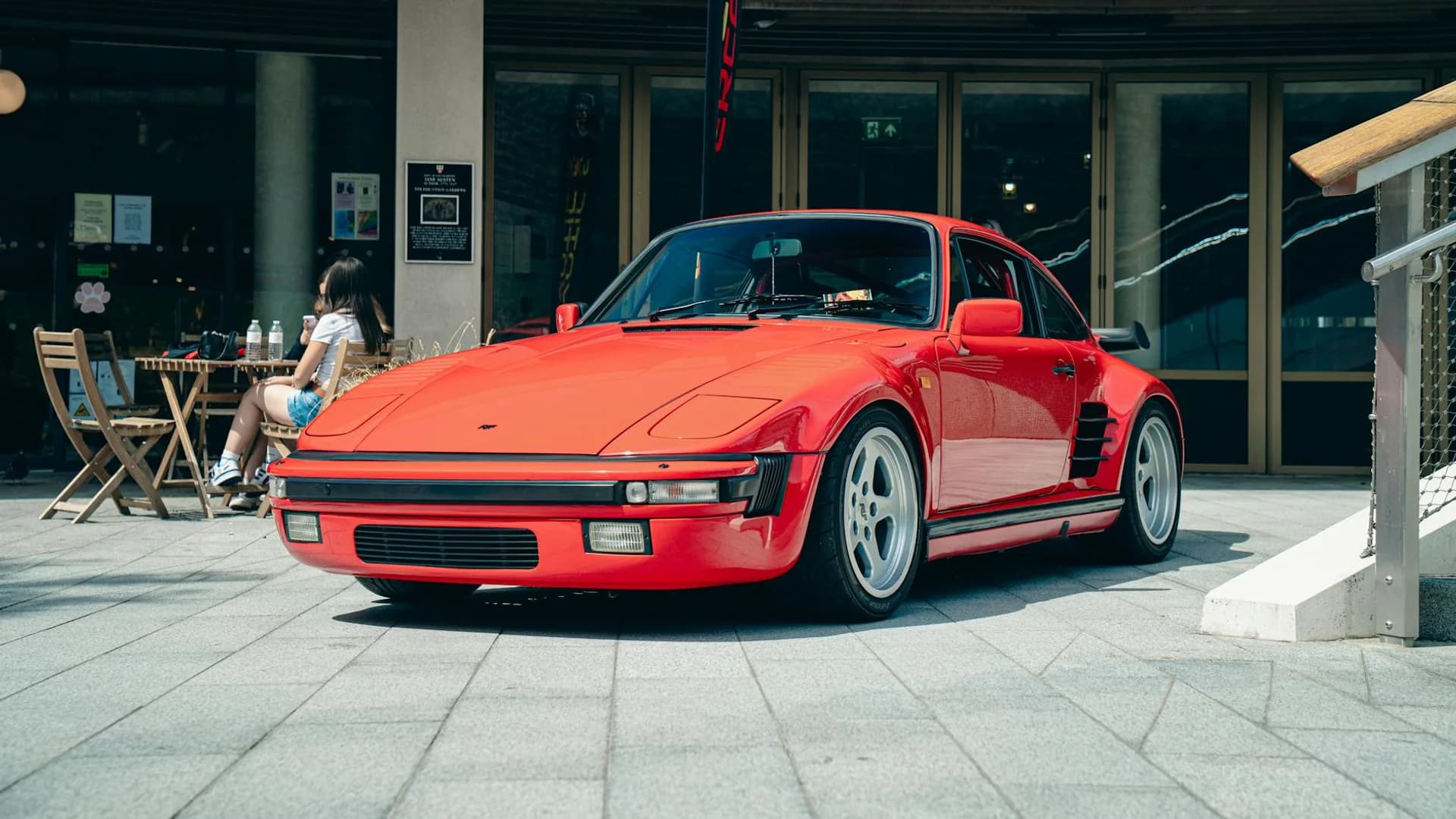
Theon Design's latest 964 commission reads, on a spec sheet, as a deliberate refusal of every direction Porsche's own GT department has taken in the last fifteen years. A 4.0-litre air-cooled flat-six. Six-speed manual to 993 RS specification. 2,535 pounds on the scale. 420 horsepower, naturally aspirated. The way Singer treats the 964 as a sculpture and Gunther Werks treats it as a racing exercise, Theon treats it as a thesis, that lightness, not horsepower, is the variable a driver's car should optimise. The British shop's GBR006, finished in Crayon Grey over Lizard Green, is the latest test of that argument. It is also, depending on how you count, the most expensive way to disagree with the modern GT3 on the market today.
Key takeaways
- Theon's GBR006 weighs 2,535 pounds, 650 pounds less than a 992 GT3 RS with none of the active aero.
- Each commission takes 18 months and 6,000 hours; Theon builds only five or six cars per year from Deddington, Oxfordshire.
- The £430,000 starting price excludes the donor 964, which adds another six-figure cost before a single carbon panel is shaped.
- A 4.0-litre air-cooled flat-six with a 993 RS–spec six-speed manual, no paddle option, no torque vectoring, no launch control.
- The 992 GT3 RS needs 518 horsepower and active aerodynamics to match a 0–60 time Theon reaches through absence of mass.
Why 2,535 Pounds Is the Most Radical Number in This Build
Strip the marketing language off the spec sheet and the curb weight is the only number that matters. At 2,535 pounds, Theon's 964 weighs roughly six hundred and fifty pounds less than a current 992 GT3 RS, a deficit that translates into a power-to-weight ratio of 0.166 hp/lb and a sub-four-second 0–60 time. The GT3 RS gets there with active aerodynamics, a torque-vectoring rear differential, semi-slick tyres, and a power output near 518 horsepower. Theon gets there with absence.
The way Singer solves this, and modern Porsche doesn't, is by treating weight reduction as the chassis programme, not a trim line. Each project starts with a donor 964 that is fully stripped, repaired, and rebuilt, and bodywork can be specified in steel or carbon fiber. Carbon panels replace steel throughout the shell on builds like GBR006, and the saving compounds: lighter body, lighter sub-structures to support it, smaller brakes acceptable for the reduced mass, lighter wheels because the unsprung calculus changes. A modern GT3 cannot retro-fit that decision; it was designed around homologation weight from sentence one.
This is the inversion at the heart of Theon's pitch. Modern performance cars chase lap times by adding capability, bigger tyres, more downforce, more electronically managed grip. Theon's bet is that a driver who actually wants to feel the car would trade all of it for two hundred kilos. The 0.166 hp/lb number is the receipt.
The 4.0-Litre Air-Cooled Flat-Six as a Design Statement
The engine choice is not nostalgia. A lightweight carbon-bodied 964 coupe combining the marque's classic air-cooled character with modern engineering and 421 horsepower is a deliberate counter-argument to the entire forced-induction direction Porsche took in 2016 with the turbocharged 991.2. Air-cooling imposes constraints, packaging, thermal management, peak output, that turbocharging makes vanish. Theon treats those constraints as the point.
The 6-speed manual is specified to 993 RS calibration, not because the 993 was an iconic generation but because the shift quality on that gearbox is the high-water mark for the air-cooled era. No paddle option exists. No dual-clutch alternative is offered. The driver modulates throttle, clutch and brake without intermediation; there is no torque vectoring layer rewriting inputs, no launch control deciding when the rear axle is allowed to slip. Theon Design restores and modernizes Porsche 964s with a focus on mechanical clarity and build quality rather than performance statistics or digital features, and that single sentence is a fair summary of the company's engineering worldview.
Spec-as-philosophy: every choice on the powertrain is downstream of a single editorial decision about what a Porsche driver's car should resolve to. The thinking pattern echoes the broader argument about why shape and engineering intent matter more than badge resemblance in modern performance design. The flat-six is the medium; the manual is the grammar; the absence of assistance is the sentence.
Gear worth having
As an Amazon Associate, ThinkEV earns a small commission from qualifying purchases — at no extra cost to you.

Lectron Level 2 J1772 Charger (40A, WiFi)
Smart WiFi charger with real-time energy monitoring. 40A / 9.6 kW, J1772 with a NEMA 14-50 plug, schedule charging right from your phone.
As an Amazon Associate, ThinkEV earns from qualifying purchases — at no extra cost to you.
6,000 Hours and 18 Months: What Craft Actually Costs
The price tag is a function of the labour model, not a luxury margin. Each Theon commission requires approximately 18 months and 6,000 hours to complete, with the company producing five to six cars per year from its base in Deddington, Oxfordshire, and prices start at £430,000 before the donor car, shipping and local taxes. Divide six thousand hours across an experienced multidisciplinary team and the build economics resolve to something closer to a yacht refit than a car assembly.
That ceiling, five or six commissions annually, is structural. It is what a single workshop staffed by a fixed number of specialists can produce when every car is stripped to bare metal and rebuilt around bespoke parts. Theon Design specializes in restomods based on the 964-generation Porsche 911, and its latest, one of only six that will be built this year, is a brilliant blend of old-school restraint and modern enhancement. No scaling lever exists that does not break the proposition. A Theon built faster is no longer a Theon.
The pricing is the consequence. Prices start at roughly $577,000, excluding the donor car, and the donor itself, a clean 964 in good structural condition, adds another six-figure line before the first carbon panel is shaped. As commissioned, GBR006 cost £420,000 to build, plus the donor car. The buyer is not paying for parts; the buyer is paying for the eighteen months of specialist attention compressed into a single shell.
What Theon Gets Right That Porsche's Own Skunkworks Stopped Doing
Modern Porsche has a weight problem and knows it. The 992 GT3 RS approaches 3,200 pounds with its aerodynamic package, the Taycan Turbo S sits north of 5,100, and even the relatively pure Cayman GT4 RS has crept up generation over generation. Each model adds capability the previous one lacked, and capability has mass. The engineering trade-off has been resolved in one direction for the better part of two decades.
Gear worth having
As an Amazon Associate, ThinkEV earns a small commission from qualifying purchases — at no extra cost to you.

Heavy-Duty Outdoor Timer (Preconditioning)
Schedule your Level 1 charger or block-heater outlet, rated for the outdoors. Warm the battery on grid power before you leave, not on your range.
As an Amazon Associate, ThinkEV earns from qualifying purchases — at no extra cost to you.
Theon's build rejects the weight-power spiral by anchoring to a different objective function entirely. There is no driver assistance suite. There is no digital instrument cluster. There are no electronically adjustable dampers calibrated by software for "Sport Plus." The intentional absence of these systems is the feature, it is what allows the chassis to be honest with the driver in a way that an electronically managed GT3 RS, however brilliant, is no longer asked to be.
This is not nostalgia engineering. In many ways, Theon Design's latest creation is Porsche 911 nirvana – timeless looks, an impeccable level of finish and detail, and an emotive, analogue driving experience paired with lightness and just the right level of potency for modern roads. It is a competing thesis about what a high-performance road car should optimise for once lap times are no longer the only metric. The same engineering tension between weight, capability and driver feedback runs through the broader analysis of how axial-flux motor architecture argues for a different theory of the performance car, different powertrain, identical question.
Gear worth having
As an Amazon Associate, ThinkEV earns a small commission from qualifying purchases — at no extra cost to you.

RGB Car Interior LED Strip Light
A 24-LED strip that tucks under the dash and washes the footwells in any color. Five-minute upgrade, big mood shift.
As an Amazon Associate, ThinkEV earns from qualifying purchases — at no extra cost to you.
Crayon Grey, Lizard Green, and the Aesthetics of Restraint
The visual presentation of GBR006 is its own argument. Crayon Grey is not a heritage shade pulled from the Porsche archive; it is a contemporary muted tone that lets the 964's shoulder line do the work without competing for attention. The Lizard Green interior provides personality where it cannot be seen from the street, a private joke, not a public statement. Both choices reject the restomod-industry tendency toward saturated heritage hues meant to telegraph "valuable old Porsche" to passers-by.
The 17-inch Fuchs-style three-piece wheels are period-correct in profile but engineered for modern tyre sections. Body modifications are subtractive: there is no widebody kit, no exposed carbon-weave theatre, no visible aero appendages beyond what the 964 silhouette already implied. The bodywork looks, at a glance, like a particularly well-preserved 964, which is precisely the design objective. The proportions were correct when the 964 launched in 1989; the job is to make them structurally honest, not to overwrite them.
This is a different aesthetic argument than the Porsche-influenced design language now appearing across Chinese EV programmes that have absorbed the 911 silhouette as a visual grammar. Theon is not borrowing the language; it is editing the original sentence.
The Restomod Market's Uncomfortable Question: Is This Worth It?
At roughly $577,000 USD before the donor car, Theon sits in a price band shared with Singer's reimagined 911s and approaching Gunther Werks territory. The debate over restomod pricing has been running on enthusiast forums for years, and the question, whether restomod buyers are overpaying for what is, structurally, a thirty-year-old car, misframes the calculus. These are not investments. They are commissions. The valuation question is the wrong one to ask.
What Theon is selling is access to a specific engineering argument made physical. Six cars per year means the company will never be a market; it will always be a proof of concept that one workshop, sized correctly, can build the air-cooled 911 the way it should have been built if mass-production economics had never applied. The buyer is funding the proof. The car is the receipt.
That is a defensible answer for the people writing the cheques. It is also worth setting alongside the more practical end of the ownership cost discussion, the ongoing real-world numbers in pieces like the breakdown of what enthusiast car ownership actually costs once the purchase price is settled, which apply to combustion exotics just as cleanly as they do to EVs. Theon's £430,000 is the entry fee, not the running total.
Gear worth having
As an Amazon Associate, ThinkEV earns a small commission from qualifying purchases — at no extra cost to you.

TP-Link Kasa Smart Plug with Energy Monitoring
Track exactly how much electricity your Level 1 charger uses and schedule it for off-peak hours. Know your real cost per kWh.
As an Amazon Associate, ThinkEV earns from qualifying purchases — at no extra cost to you.
The Theon 964 Is A Deliberate Engineering Refusal
The Theon 964 is not the fastest car you can buy for $577,000, and it was never going to be. It is a deliberate engineering refusal, of forced induction, of electronic mediation, of the weight-and-capability arms race that has defined the modern performance car. Whether that refusal is worth the cheque depends entirely on what the buyer believes a driver's car is supposed to feel like in 2026.
I would watch two things from here. First, whether Theon's production ceiling holds: the moment a restomod shop scales past its labour model, the proposition collapses, and the temptation at this price point is significant. Second, whether the next generation of clean-sheet driver's cars, the lightweight electric sports cars that several manufacturers have signalled for the late 2020s, internalises the Theon argument or ignores it. If the industry ends up at 3,500-pound performance EVs with synthetic engine notes piped through the speakers, GBR006 will read, in hindsight, as the last clean statement of a different position.
Six thousand hours, eighteen months, five or six cars a year. The number on the invoice is not the point. The engineering argument is the only thing being sold, and on that count Theon's bet is more interesting than the spec sheet alone makes it look.
Gear worth having
As an Amazon Associate, ThinkEV earns a small commission from qualifying purchases — at no extra cost to you.

P3 Kill A Watt Electricity Usage Monitor
Plug in your charger and see exactly what you spend in kWh, cost, and watts. Settle the is-my-EV-really-cheaper debate with data.
As an Amazon Associate, ThinkEV earns from qualifying purchases — at no extra cost to you.

Founder & Chief Editor
Vlad Pereira is the founder and chief editor of ThinkEV.ca, the Canadian electric-vehicle publication he writes and edits from Courtenay, British Columbia. He covers EV pricing, federal and provincial rebates, charging costs, and the Chinese manufacturers now entering Canada, from the buyer's side rather than the press-fleet side. ThinkEV is a venture of Vlad Pereira Online; his writing on health, income and the long game lives at vladpereira.com.
Frequently asked questions
How many of these Theon 964s actually get built each year?
What does the donor 964 actually add to the final cost?
How much lighter is this than a current GT3 RS?
Why no paddle shifters or dual-clutch option at all?
Where is this car actually made?
More EV & road-trip finds
Affordable upgrades worth a look — tap any to check the price on Amazon.
 ★ 68
★ 68WeatherTech FloorLiner for Tesla Model 3
View on Amazon ★ 8,681
Chemical Guys Complete Car Wash Kit
View on Amazon ★ 537
★ 537USB Star Projector Roof Light
View on Amazon ★ 4,626
HoogaLife Hanging Car Diffuser (2-Pack)
View on Amazon ★ 865
★ 865Collapsible Trunk Organizer
View on Amazon ★ 721
★ 72145W USB-C Fast Car Charger
View on Amazon ★ 87
★ 87Car Window Sun Shades for Kids (4-Pack)
View on Amazon ★ 268
★ 268Anti-Slip Leather Steering Wheel Cover
View on AmazonRead, Plan, Then Stay Current
Explore our expert articles to understand incentives and ownership costs, use the map to pressure-test charging reality, then subscribe so new EV coverage comes straight to you.
Continue Reading
Tesla Q3 2026 Earnings: Flat Revenue, Falling Profits
BYD Denza B8 Suspension Trick Defeats Traffic Boot in Viral Clip

Zenos E10 Returns at £115,000, A Different Car Entirely
Jaecoo J5 EV Uber Discount: $31,500 Fleet Math Changes
VW ID.4 80% Charge Cap Rolls Out This Week, With Opt-Out