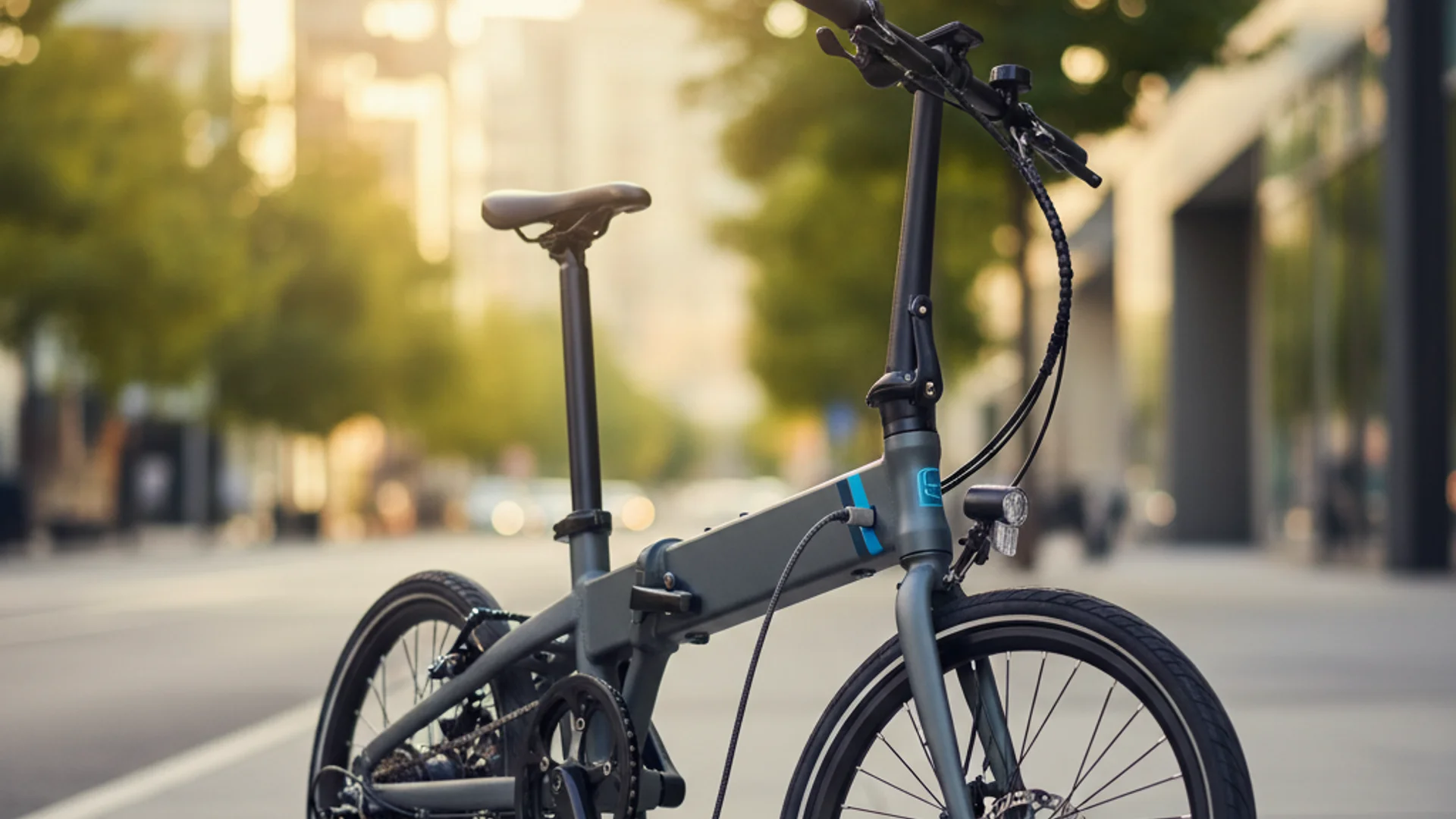
If you lost your e-bike charger, you were often looking at a $100 replacement and a week of shipping. ENGWE’s new Zip ends that problem entirely: it charges via standard USB-C PD 3.1, the same cable as your laptop, and it starts at $500.
Key takeaways
- The ENGWE Zip folding e-bike runs $500–$800, putting USB-C charging on a bike under $1,000 for the first time.
- It charges over USB Power Delivery 3.1, up to 48V and 240W, enough to top a 36V or 48V battery directly, and its 360 Wh LG pack is bidirectional, able to recharge a laptop nearly four times.
- At 16.9 kg without the battery and folding in three seconds, it's lighter than rivals like the 46-lb Lectric XP Lite, and still includes a torque sensor, hydraulic discs, and a 7-speed drivetrain.
- Expect the 120 km rated range to drop to roughly 50–60 km in a Canadian winter, and the LG cells to last 800–1,000 cycles, about 3–5 years of daily commuting.
Gear worth having
As an Amazon Associate, ThinkEV earns a small commission from qualifying purchases — at no extra cost to you.

TP-Link Kasa Smart Plug with Energy Monitoring
Track exactly how much electricity your Level 1 charger uses and schedule it for off-peak hours. Know your real cost per kWh.
As an Amazon Associate, ThinkEV earns from qualifying purchases — at no extra cost to you.
If you’ve ever lugged a five-pound power adapter in your backpack just to ensure you could make it home from work, you know why this matters. By leveraging the latest USB Power Delivery (PD) 3.1 standards, the ENGWE Zip allows you to use the same charger for your laptop, your phone, and now, your primary mode of transportation. It is a fundamental shift in how we think about electric vehicle infrastructure, moving away from closed ecosystems and toward the universal simplicity of the cables we already own.
The USB-C Revolution Hits the Pavement
For years, the e-bike industry has been a bit of a "Wild West" regarding charging standards. Every manufacturer seemed to have their own proprietary connector, round pins, square pins, three-prong, five-prong, forcing riders to carry specific chargers that were expensive to replace and bulky to transport. If you lost your charger, you were often looking at a $100 replacement and a week of waiting for shipping.
The ENGWE Zip changes that script. It follows in the footsteps of premium brands like Ampler, whose Curt model pioneered USB-C integration, but it brings that high-end convenience down to a price point that regular commuters can actually afford.
Why is USB-C such a big deal for a bike? It comes down to three things:
- Weight Reduction: You no longer need to carry a separate e-bike "brick." Most modern laptop chargers (65W to 140W) are now capable of topping up the Zip's battery.
- Availability: In a pinch, you can borrow a charger from a colleague at the office or use a high-powered port at a local coffee shop.
- E-Waste: As the world moves toward universal standards, we stop producing millions of single-use power adapters that end up in landfills when the bike eventually reaches its end of life.
The Sociology of the Universal Charger: Killing Range Anxiety
Range anxiety is the number one reason people hesitate to buy an e-bike. We worry about that moment when the battery bars start flashing red while we're still ten kilometres from home. The proprietary charger exacerbates this fear because it forces you to "plan" your energy consumption. You have to remember the brick. You have to find a specific place to plug it in.
When your mode of transport uses the same cable as your phone, your relationship with the city changes. Suddenly, every library, every modern coffee shop, and every office building becomes a "refuelling station." The ENGWE Zip doesn't just have a 120-kilometre range; it has an "infinite" range in any urban environment where USB-C is present.
This psychological shift is massive. It encourages people to take longer trips, to explore new neighbourhoods, and to rely on their bike as their primary vehicle rather than just a weekend toy. It’s about the democratization of energy. You aren't beholden to a specific manufacturer's ecosystem; you are part of the global USB-C infrastructure.
The Technical Wizardry: How USB-C PD 3.1 Makes This Possible
To understand why we couldn't do this five years ago, we have to look at the math. A standard e-bike battery usually operates at 36V or 48V. Until recently, USB-C was limited to 20V at 5A, providing a maximum of 100W. This wasn't enough voltage to "push" energy into a 36V e-bike battery without complex, heat-generating conversion hardware.
Enter USB Power Delivery (PD) 3.1. This new standard introduced "Extended Power Range" (EPR). It allows USB-C cables to handle up to 48V and 240W of power. This is the "magic bullet" that the e-bike industry has been waiting for. It means the voltage of the charger can finally match the native voltage of the battery.
The ENGWE Zip uses a sophisticated Texas Instruments USB PD EPR controller that manages this handshake. When you plug in a compatible charger, the bike and the charger "negotiate" the optimal voltage. If the charger is only capable of 20V (like an older laptop brick), the bike's internal electronics use a "boost converter" to step that voltage up to the 36V or 42V required by the LG cells. If you use a new PD 3.1 charger, the power flows directly and efficiently.
Meet the ENGWE Zip: Tiny Bike, Big Tech
Don't let the low price tag fool you, the ENGWE Zip isn't a stripped-down toy. It’s a fully featured urban commuter designed for the "last kilometre" problem. Whether you're navigating the downtown core of Toronto or the hilly side streets of Vancouver, the specs on this machine are surprisingly robust for the sub-$1,000 category.
Technical Specifications at a Glance
- Motor: 250W rear hub motor delivering 40 Nm of torque.
- Battery: 360 Wh LG lithium-ion cells (removable and portable).
- Sensor: Precision torque sensor (instead of a cheaper cadence sensor).
- Drivetrain: Shimano 7-speed gearing.
- Brakes: Hydraulic disc brakes (standard, not an upgrade!).
- Weight: 16.9 kg (37 lb) without battery; approximately 19 kg (42 lb) total.
- Folding: 3-second rapid mechanism that shrinks to "20-inch luggage size."
- Range: Up to 120 kilometres on a single charge (under ideal conditions).
- Max Speed: 25 km/h (limited for EU/urban compliance, though often unlockable in North America).
The Power of the Torque Sensor
The inclusion of a torque sensor at this price point is perhaps the most impressive technical feat after the USB-C charging. Most budget e-bikes use a cadence sensor, which acts like an "on/off" switch, once you start pedalling, the motor kicks in at full blast. It can feel jerky and unnatural.
A torque sensor, however, measures how hard you are pedalling and adjusts the motor assistance accordingly. If you’re pushing hard to get up a hill on the Lions Gate Bridge, the bike gives you more power. If you’re just coasting along a flat path in Ottawa, it backs off. This leads to a much more "bionic" feeling, like you have super-legs rather than a motor strapped to your wheel. It also significantly extends battery life, as the motor isn't wasting energy when you're already doing most of the work.
The Evolution of the E-Bike Battery: From Lead to Universal
To appreciate where we are with the Zip, we have to look back at where we started. The early days of e-bikes were dominated by Lead-Acid batteries. These were essentially car batteries strapped to a bike frame. They were heavy (often 30+ lbs just for the battery), had a short lifespan (300 cycles), and were incredibly toxic if not disposed of correctly.
The shift to Lithium-Ion (Li-ion) in the 2010s was the first major revolution. Li-ion batteries were three times lighter and lasted three times longer. However, they brought the "charger problem." Because Li-ion is sensitive to voltage and temperature, every manufacturer built a custom "Battery Management System" (BMS) and a corresponding proprietary charger.
For a decade, we were stuck in the "Brick Era." If you owned a Rad Power bike, you couldn't use a Lectric charger. If you owned a Specialized, you couldn't use a Trek charger. This created a fragmented market that was frustrating for consumers and terrible for the environment.
The ENGWE Zip marks the beginning of the Universal Era. By adopting the same port used by billions of devices worldwide, ENGWE is signalling the end of the proprietary e-bike battery. It turns the battery from a "part of the bike" into a "standardized power module."
The Folding Magic: Portability for the Canadian Commuter
In Canada, our commutes are often multi-modal. You might ride to the GO Train station in the GTA, take the train into Union Station, and then ride the final three kilometres to your office in the Financial District. This is where the ENGWE Zip shines.
The folding mechanism is designed to be intuitive. It doesn't just fold in half; it collapses into a shape that is remarkably easy to wheel around. Because it weighs under 20 kilograms, it’s also one of the few e-bikes that doesn't require a trip to the chiropractor after you lift it into the trunk of your car or onto a bus rack.
The compact footprint is also a massive benefit for apartment dwellers. If you're living in a 500-square-foot condo in Montreal's Plateau, you don't have room for a full-sized mountain bike. The Zip can tuck away in a closet or under a desk, staying out of the way until your next ride.
Multi-Modal Tips for the Zip:
- The "Luggage" Mode: When folded, you can leave the handlebars up to use them as a handle, allowing you to wheel the bike like a piece of carry-on luggage.
- The Pedals: The Zip comes with folding pedals. Don't forget to use them! They save about 4 inches of width, which is the difference between fitting in a narrow hallway or tripping over it.
- The Seatpost: The Zip features a long, telescopic seatpost. Mark your preferred height with a small piece of electrical tape so you can quickly reset it after unfolding.
The Battery: A Giant Power Bank for Your Life
The 360 Wh battery used in the Zip is powered by LG cells, which provides a level of brand-name reliability that is often missing in the budget market. But the real "party trick" is the battery's secondary function.
Because the battery uses USB-C PD (Power Delivery) in both directions (bi-directional), it is essentially a giant portable power bank. You can remove the battery from the bike, bring it into a coffee shop or a meeting, and use it to charge your MacBook Pro, your iPhone, and your tablet, all at once.
Think about the capacity for a second. A typical high-end laptop battery is around 100 Wh (the legal limit for planes). The Zip's battery is 360 Wh. That means you can charge a dead laptop from 0% to 100% nearly four times over. For digital nomads, remote workers, or even students spending long days on campus at UofT or UBC, this is a massive productivity boost.
Charging Your Life on the Go:
- Laptops: Most USB-C laptops require 45W-65W. The Zip battery handles this easily.
- Smartphones: Fast-charging a phone usually takes 18W-25W. You could charge an iPhone 15 Pro Max dozens of times with this battery.
- Emergency Power: If your power goes out at home during a winter storm, the Zip battery can keep your router and your phones running for days.
Sustainability and the Right to Repair
One of the biggest issues with the e-bike boom is the "disposable" nature of cheap bikes. When a proprietary charger breaks or a battery fails after two years, and the company has gone out of business, the entire bike often becomes e-waste.
The Zip’s reliance on USB-C is a major win for the Right to Repair and long-term sustainability. Because the charging interface is standardized, you will always be able to find a way to get power into those LG cells. Even if ENGWE as a company were to disappear tomorrow, the USB-C standard is here for the next decade at least.
Furthermore, by reducing the need for separate charging bricks, we are collectively saving thousands of tonnes of plastic and copper from being manufactured and eventually discarded. It’s a small step, but when you multiply it by the millions of e-bikes expected to hit the road by 2030, the impact is significant.
The EU Influence: Why 2024 Changed Everything
You might be wondering why this is happening now. The answer lies across the Atlantic. The European Union has been aggressive in its push for universal charging standards. Their Common Charger mandate, which went into full effect at the end of 2024, required all mobile phones, tablets, and cameras sold in the EU to be equipped with a USB-C charging port.
While e-bikes weren't specifically named in that initial list of portable electronics, the "USB-C everything" culture has bled into the light electric vehicle (LEV) space. Manufacturers realized that if they wanted to appeal to modern consumers who are increasingly tired of cable clutter, they needed to align with the universal standard.
Furthermore, the EU Battery Regulation (2023/1542) has begun mandating that batteries in light transport must be easily removable and replaceable by the user. By combining a removable battery with a universal charging port, companies like ENGWE are future-proofing their products against tightening global regulations, and Canadian consumers are reaping the benefits of this global shift toward sanity.
Gear worth having
As an Amazon Associate, ThinkEV earns a small commission from qualifying purchases — at no extra cost to you.

P3 Kill A Watt Electricity Usage Monitor
Plug in your charger and see exactly what you spend in kWh, cost, and watts. Settle the is-my-EV-really-cheaper debate with data.
As an Amazon Associate, ThinkEV earns from qualifying purchases — at no extra cost to you.
The Canadian Perspective: Is It Ready for Our Climate?
As someone who has tested e-bikes in everything from a July heatwave in Windsor to a February sleet storm in Halifax, I always look at budget bikes with a healthy dose of skepticism. Our environment is tough on electronics.
Winter Performance and Battery Care
The LG cells in the Zip's battery are reputable, but all lithium-ion batteries lose efficiency in the cold. In a Canadian January, you should expect your range to drop by about 30% to 40%. The "120-kilometre range" advertised is based on a light rider, flat ground, and a warm day. For a realistic Canadian commute, I’d estimate closer to 50-60 kilometres of range if you’re using the higher assist levels and dealing with a bit of wind.
Pro-Tip for Winter: Because the battery is so easy to remove and charges via USB-C, you should never leave it in an unheated garage or on the bike when it's below freezing. Bring it inside. Charging a frozen battery can cause permanent damage to the cells. Let it warm up to room temperature for an hour before plugging it in.
Hill Climbing in Our Cities
With a 250W motor and 40 Nm of torque, the Zip is a capable climber for most urban environments. However, if you're trying to tackle the steepest parts of West Vancouver or the "Mountain" in Hamilton, you might find yourself doing a bit more of the work than you would on a 750W mid-drive motor. The Shimano 7-speed drivetrain is your friend here, downshift early and let the torque sensor help you find your rhythm.
Salt, Slush, and Corrosion
The inclusion of hydraulic disc brakes is a massive win for Canadian riders. Mechanical disc brakes (common on budget bikes) often require frequent adjustment and can get gummed up with road salt and grit. Hydraulic systems are sealed, offering much more consistent stopping power in wet and slushy conditions.
However, salt is the enemy of all things metal. I recommend a "winter spray" of a hydrophobic protectant (like Muc-Off MO-94) on the folding hinges and the chain to prevent the dreaded orange rust that plagues bikes in cities like Winnipeg or Montreal.
Maintenance Masterclass: Keeping Your Zip Zippy
A folding e-bike has more moving parts than a standard bike. To get the most out of your $500-800 investment, you need to be proactive with maintenance.
1. The Hinge Check (Monthly)
The main folding hinge is the heart of the bike. If it gets loose, the bike will feel "flexy" and unsafe.
- Check the tension of the quick-release lever. It should require significant palm pressure to close.
- If it feels loose, there is usually a small adjustment nut. Turn it an eighth of a turn at a time until the latch is firm.
- Apply a drop of dry lubricant to the hinge pin to keep the folding action smooth.
2. Drivetrain Care (Every 200 km)
The Zip uses a standard Shimano 7-speed system.
- Clean the chain: Use a degreaser and a brush to remove old, black gunk.
- Re-lube: Use a Canadian-appropriate lube (Wet lube for the rainy West Coast, Dry lube for the dusty Prairies).
- Derailleur Adjustment: Over time, cables stretch. If the bike is "skipping" gears, use the barrel adjuster on the shifter to fine-tune the tension.
3. Brake Pad Inspection
Hydraulic brakes are powerful, but they use thinner pads than some mechanical systems. Check your pads every few months. If they are less than 1.5mm thick, replace them immediately. Squealing is usually a sign of contamination (oil or salt), clean the rotors with isopropyl alcohol.
Urban Commuting Strategies: How to Ride the Zip
Riding a compact e-bike is a different experience than riding a full-sized commuter. Here’s how to maximize your safety and efficiency in Canadian traffic:
Be Predictable, Not Fast
Because the Zip is small, drivers might mistake you for a "slow" traditional bike. Use your 250W motor to get up to speed quickly at intersections, but don't weave in and out of traffic. Use your hand signals clearly.
The "Last Mile" Advantage
Don't be afraid to fold the bike and hop on the bus if the weather turns or if you're feeling tired. In many Canadian cities (like Calgary or Edmonton), bikes are only allowed on light rail during certain hours. However, a folded bike is often treated as luggage, allowing you to bypass these restrictions.
Route Planning
Avoid the "stroad" (the six-lane suburban road with no bike lane). Even if it’s the most direct route, the Zip's 20-inch wheels aren't meant for 70 km/h traffic. Use apps like Strava or Google Maps (Bike Layer) to find residential streets and dedicated bike paths. A five-minute longer ride on a quiet path is always better than a stressful dash through traffic.
Comparing the Zip to the Competition
How does the ENGWE Zip stack up against the big names in the budget space?
ENGWE Zip vs. Lectric XP Lite
The XP Lite is a North American favourite. It’s rugged and has a 300W motor.
- XP Lite Strengths: Higher motor power (300W), larger support network in the US/Canada.
- Zip Strengths: USB-C charging, torque sensor (much smoother), lighter weight (37 lbs vs 46 lbs).
- Verdict: If you want raw power, go Lectric. If you want a sophisticated, portable commuter, the Zip wins.
ENGWE Zip vs. Rad Power RadExpand
The RadExpand is a "fat tire" folding bike.
- Rad Strengths: Fat tires (4 inches) for better comfort, 750W motor for massive hills.
- Zip Strengths: Portability (the Rad is 60+ lbs), universal charging.
- Verdict: The Rad is a car replacement for people with garages. The Zip is a commute-enhancer for people with stairs.
ENGWE Zip vs. Fiido D11
The Fiido D11 is often called the most stylish budget folding bike.
- Fiido Strengths: Sleek design, battery hidden in the seatpost.
- Zip Strengths: Hydraulic brakes (Fiido uses mechanical), torque sensor, and of course, USB-C.
- Verdict: The Fiido is a fashion statement. The Zip is a piece of engineering.
Buyer's Guide: Choosing the Right USB-C Charger for Your Zip
Not all USB-C chargers are created equal. If you buy a Zip, you need to make sure your "kit" is up to the task.
The Charger (The Brick)
Look for GaN (Gallium Nitride) chargers. These use new semiconductor technology to provide high wattage in a tiny package.
- Recommended Wattage: 100W or 140W.
- Recommended Brands: Anker, Satechi, UGREEN, or the official Apple 140W brick.
- Port Check: Ensure the charger has at least one port that can output the full wattage (some 100W chargers split the power 50/50 if two things are plugged in).
The Cable (The Pipe)
This is where most people make mistakes. A cable that looks like a USB-C cable might only be rated for 60W.
- Rating: You must buy a cable rated for 100W or 240W.
- E-Marker Chip: These cables have a tiny chip inside that tells the bike it’s safe to pull high power.
- Length: A 2-metre cable is usually the sweet spot for charging a bike while it's parked.
The Future: Will Your Next Car Charge by USB-C?
While we're talking about e-bikes today, the implications of the ENGWE Zip go much further. We are seeing the beginning of the "USB-C everything" movement.
- Electric Scooters: Several new high-end scooters are adopting USB-C for charging.
- Portable Power Stations: Units from Jackery and EcoFlow now feature high-wattage USB-C inputs.
- The "Micro-EV" Space: In Japan and Europe, small city cars (like the Citroën Ami) are experimenting with simplified charging systems.
While your Tesla or Ford F-150 Lightning will always need a high-voltage AC/DC charger, the world of "Micromobility" is converging on USB-C. This means your future garage won't be full of tangled cords; it will have a few high-powered USB-C ports that can handle everything from your laptop to your lawnmower to your e-bike.
Safety and Standards: Don't Buy a Fire Hazard
There has been a lot of news lately about e-bike battery fires, usually caused by poor-quality cells or mismatched chargers. This is another area where the USB-C standard provides a safety boost.
Because USB-C Power Delivery involves a "handshake" between the charger and the device, the risk of "over-volting" the battery is significantly reduced. The charger and the bike talk to each other to determine exactly how much power is safe to transfer.
Furthermore, ENGWE's choice to use LG cells is a strong indicator of quality. While it might be tempting to save $200 by buying a "no-name" bike from an overseas marketplace, your home insurance (and your safety) will thank you for sticking to a brand that uses certified, name-brand cells.
Battery Safety Checklist:
- Only use certified cables: Not all USB-C cables are created equal. For the Zip, you need a cable rated for 100W or 240W. Using a cheap $2 gas-station cable can lead to overheating.
- Inspect for damage: If the battery case is cracked or if you notice a "sweet" smell, stop using it immediately.
- Don't charge unattended: Even with the safest batteries, it's good practice to be in the same room (or at least in the house) when charging.
The Verdict: Buy, Wait, or Skip?
The Verdict: BUY
If you are an urban commuter looking for your first e-bike, the ENGWE Zip is a clear winner. At the $500 to $800 price point, you are getting features that were literally impossible to find at this price even twelve months ago.
- Buy it if: You live in a city, have limited storage space, and want the ultimate convenience of universal charging. It is perfect for students, office workers, and anyone who needs a "last kilometre" solution that doesn't feel like a compromise. The torque sensor alone makes it feel like a much more expensive machine.
- Wait if: You are a heavy rider (over 220 lbs) or live in an area with extremely steep, long hills. You might want to save up a bit more for a bike with a 500W or 750W motor to ensure you aren't struggling on the inclines.
- Skip it if: You are looking for an off-road adventurer or a bike to haul your kids in a trailer. This is a personal transport tool, not a heavy-duty cargo vehicle.
The ENGWE Zip isn't just a new bike; it’s a peek into a more convenient, standardized future for electric mobility. By ditching the proprietary charger, ENGWE has removed one of the biggest friction points of e-bike ownership. It’s smart, it’s affordable, and it’s finally here.
See you on the bike path!
Gear worth having
As an Amazon Associate, ThinkEV earns a small commission from qualifying purchases — at no extra cost to you.

WixGear Magnetic Air Vent Phone Mount (2-Pack)
A magnet strong enough that your phone never flinches over potholes or rail crossings. Two in the box, one for each car.
As an Amazon Associate, ThinkEV earns from qualifying purchases — at no extra cost to you.

Founder & Chief Editor
Vlad Pereira is the founder and chief editor of ThinkEV.ca, based in Courtenay on Vancouver Island, British Columbia. He covers the global EV industry with a Canadian editorial lens — independent analysis, honest comparisons, and practical tools for drivers at every stage of the …
Frequently asked questions
Can I really charge the ENGWE Zip with my MacBook charger?
Does the bike come with a standard wall charger too?
Is the ENGWE Zip legal in Canada?
Can I take this bike on a plane?
How long does the battery last before it needs to be replaced?
More EV & road-trip finds
Affordable upgrades worth a look — tap any to check the price on Amazon.
 ★ 692
★ 692USB-A to USB-C CarPlay Adapter (3-Pack)
View on Amazon ★ 61
★ 61Toddler Car Seat Snack and Cup Tray
View on Amazon ★ 17,839
Qifutan Vent Phone Mount (Military-Grade Clip)
View on Amazon ★ 4,050
Touchscreen Mist Screen Cleaner Kit
View on Amazon ★ 314
★ 314Mini USB LED Ambient Lamps (4-Pack)
View on Amazon ★ 4,055
6-Speed Manual Shift Knob Display
View on Amazon ★ 4,424
Sun Visor Card and Document Organizer
View on Amazon ★ 308
★ 308Coiled Lightning Car Cable for iPhone (2-Pack)
View on AmazonRead, Plan, Then Stay Current
Explore our expert articles to understand incentives and ownership costs, use the map to pressure-test charging reality, then subscribe so new EV coverage comes straight to you.
Continue Reading

MG Puts Semi-Solid Batteries in Its 2027 Plug-In Hybrids
VW ID. Polo 37-kWh Lands at €24,995, the Cheap EV Canada Won't Get
Volvo's Ghent Plant Becomes Geely's EU Tariff Back Door
Over Half a Million Subarus Recalled Over a Wrong Sticker (2026)
Tesla Model S Signature Flipped for $260,490, $100K Over MSRP